Key Takeaways
- Recovery is a connected sequence of ASAM levels, not a single stay, and the continuum itself — moving from detox through residential, PHP, IOP, and outpatient — is the treatment.
- Renewal Springs functions as the medically supervised detox entry point inside the Pathways Recovery Centers network, with the next level of care arranged before discharge rather than handed off through a printed referral list.
- The 7 and 14 days after detox are the highest-risk window, which is why SAMHSA measures follow-up inside that stretch and why warm, chart-carrying handoffs outperform passive referrals 11, 5.
- Before agreeing to any detox bed, ask what level of care comes next, who decides, whether your chart travels with you, how fast follow-up is scheduled, and who personally introduces you to the next team.
What Happens After Detox Is Where Recovery Actually Gets Won
If you are reading this at 2 a.m., or reading it for someone you love who is finally willing to talk about detox, take a breath. You are already doing the hardest part.
Here is the truth most rehab websites will not tell you plainly: getting through withdrawal is not the finish line. It is the front door. The days and weeks after your body clears the substance are when the real work of staying well begins, and they are also when most people lose their footing. Continuity of care after medically managed withdrawal is considered so important that SAMHSA tracks whether patients get a follow-up visit within 7 and 14 days of discharge as a formal quality measure.11That window exists because it is where recovery either builds momentum or quietly falls apart.
That is why the shape of what comes next matters as much as the detox bed itself.
This piece walks you through what a continuum of care actually looks like — detox first, then higher levels of care, then aftercare — and how the Pathways Recovery Centers network is built so you do not have to start over at every new step. Renewal Springs, in Oklahoma City, is the medically supervised entry point into that network. When you land here, you are not landing alone, and you are not landing at a dead end. You are landing at the beginning of a plan that keeps going after your bag is packed.
The Continuum of Care, Explained Without the Jargon
Recovery Is a Sequence, Not a Single Stay
If you have tried treatment before and it did not stick, please hear this: it was probably not because you failed. It was probably because the pieces did not connect.
Addiction medicine has known for a long time that recovery is not a single event you check into and check out of. It is a sequence of services with different intensities, designed to match where your body and mind actually are. SAMHSA describes behavioral health as four connected areas — promotion, prevention, treatment, and recovery — not as separate silos you graduate out of.7Within the treatment side of that picture, there is a smaller sequence of its own: outpatient services, intensive outpatient and partial hospitalization, residential and inpatient care, and medically managed intensive inpatient care for the most acute needs.8
Think of it less like a hospital stay and more like a staircase. You come in where the intensity matches what your body needs right now. Then you step down as you stabilize, with the support underneath you changing shape but never disappearing.
The research on this is clear. Substance-dependent patients generally begin with the most intensive level appropriate for their situation and then step down to less intensive care, with each level building on the one before it.4The sequence itself is the treatment. That is the part most people are never told, and it is the part that changes everything about how you should think about your first phone call.
The ASAM Levels: What Each One Actually Looks Like Day-to-Day
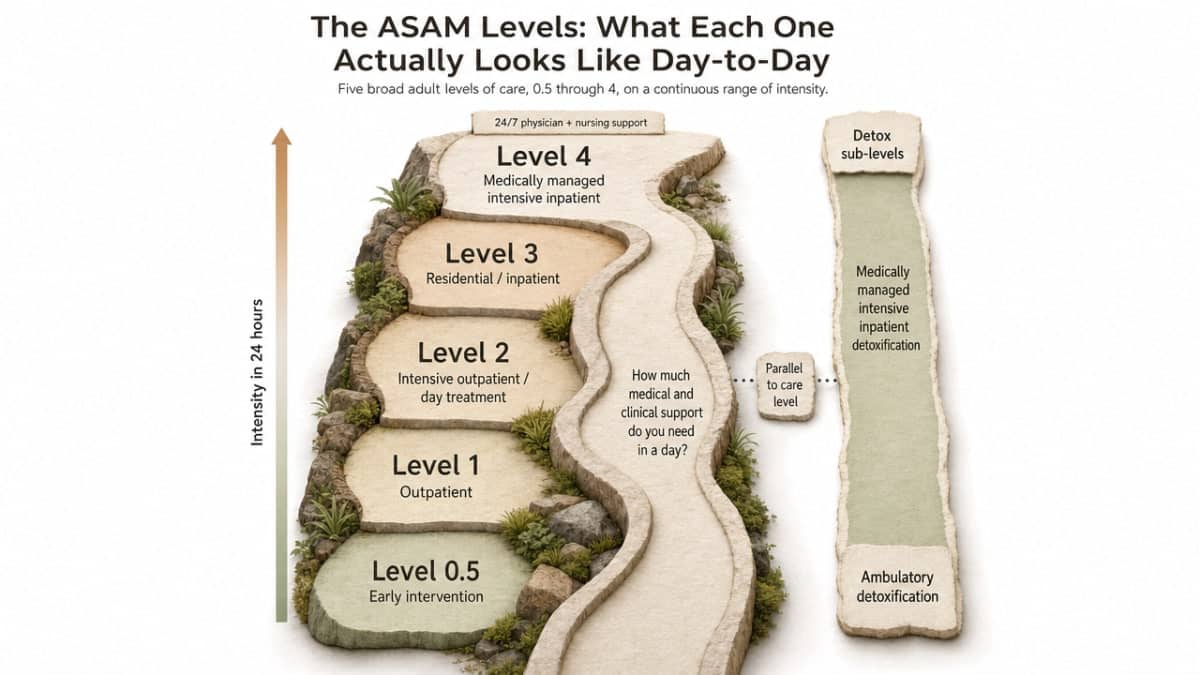
The American Society of Addiction Medicine, or ASAM, publishes the placement criteria that most clinicians in the country use to decide where you belong at any given moment. There are five broad adult levels of care, numbered 0.5 through 4, spanning a continuous range of intensity.9Detox has its own parallel sub-levels layered on top of that, from ambulatory detoxification all the way up to medically managed intensive inpatient detoxification.10It sounds like a lot. In practice, each level answers a simple question: how much medical and clinical support does your body and mind need in a 24-hour period?
Here is what the levels feel like from the inside.
Level 4 — Medically Managed Intensive Inpatient. This is the top of the ladder. Around-the-clock physician availability, nursing, and the ability to manage serious medical complications. For opioid withdrawal complicated by other health issues, or for people coming off multiple substances at once, this is where you start.10
Level 3 — Residential and Inpatient Treatment. You live at the facility. Staff is there day and night, but the medical intensity is a step lower than Level 4. This is the setting most people picture when they hear the word “rehab” — structured days, group work, individual counseling, meals on a schedule.8
Level 2 — Partial Hospitalization (PHP) and Intensive Outpatient (IOP). You sleep at home or in recovery housing and come in for structured programming. PHP is typically five or six hours a day, several days a week. IOP is usually nine to twelve hours across three or four days.3This is where a lot of the real behavior-change work happens, once your body is stable.
Level 1 — Standard Outpatient. Weekly or biweekly counseling, medication management, check-ins. You are running your regular life — work, family, school — with recovery support woven into it.3
Level 0.5 — Early Intervention. Screening, education, brief counseling for people whose use has not yet met the threshold for a formal disorder.9
Detox sits alongside these in its own tiered structure. Ambulatory detoxification means going home each night. Residential detoxification adds a bed and social support. Medically monitored inpatient detoxification adds 24-hour nursing. And medically managed intensive inpatient detoxification — the top rung of the detox ladder — adds physician oversight and the ability to handle severe withdrawal, including opioid withdrawal complicated by fentanyl, benzodiazepines, or medical comorbidities.10
You do not need to memorize any of this. You do not need to walk into a phone call knowing which level you belong in. That is what the intake assessment is for. What matters is understanding that these levels exist, that they are meant to connect to each other, and that the point of the continuum is to move you between them based on what your body and life actually need — not based on what a single facility happens to sell.
Where Renewal Springs Sits on That Ladder
Renewal Springs is the entry point. Specifically, it is the medically supervised detox rung — the place where trained clinicians manage your withdrawal around the clock, using medication-assisted treatment when it is appropriate and monitoring your vital signs, sleep, and stress levels in real time.
For someone in active opioid crisis, that matters. Fentanyl withdrawal is not something to ride out alone in a spare bedroom. It needs medical eyes on it, and it needs someone who can adjust your care hour by hour.
But here is the part that changes the shape of what comes next: Renewal Springs is designed to sit inside the Pathways Recovery Centers network, not off to the side of it. When you land at the detox rung, your clinical team is already thinking about the next rung down — residential, PHP, IOP, or standard outpatient — and preparing the handoff before you ever pack your bag.
You are not walking into a detox that ends at the parking lot. You are walking into the first step of a plan that already knows what step two looks like for you.
Starting Over vs. Being Handed Off
The Fragmented Default: New Intake, New Story, New Providers
Here is how it usually goes, and if this sounds painfully familiar, you are not imagining it.
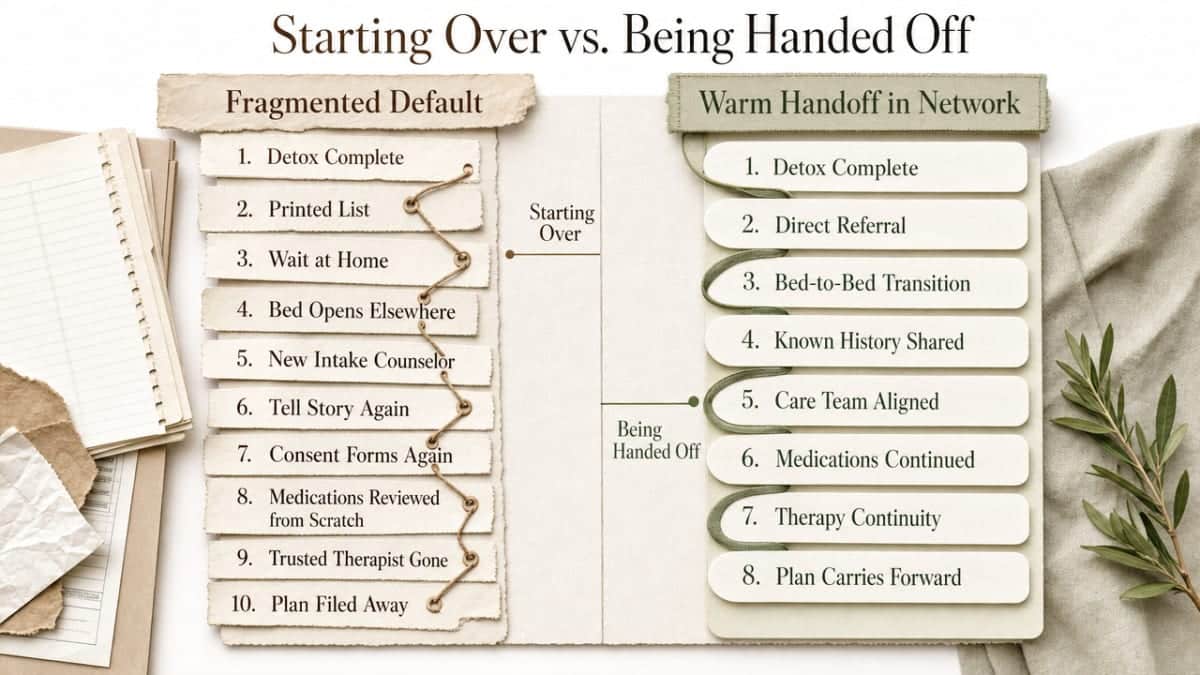
You finish detox at one facility. Someone hands you a printed list of residential programs, maybe makes a phone call on your behalf, and wishes you well. You go home for a night, or three, or a week, while you wait for a bed to open somewhere else. When you finally walk into the next place, you sit down with a new intake counselor who has never met you. You tell your whole story again — the drugs, the doses, the overdoses, the family, the trauma, the last time you tried this. You sign the same stack of consent forms. A new physician reviews your medications from scratch. The group therapist you started to trust at detox is gone. The plan you were building? Filed away in a records system nobody at the new facility can see.
This is the default in American addiction treatment, and it is exhausting. It is also risky. The gap between programs is where cravings creep back in, where old contacts start texting, where the doubt that always whispers “maybe I do not really need this” gets louder. Research on care transitions consistently finds that passive referrals — a phone number and a hope — perform worse than structured, active handoffs backed by case management, patient navigation, and peer support.5Telling your story three times to three strangers is not treatment. It is the friction that ends recovery attempts before they get their footing.
What a Network Handoff Looks Like Inside Pathways
A network handoff is a different experience, and it is worth understanding in specific terms so you can ask for it.
Inside the Pathways Recovery Centers network, the clinical work at Renewal Springs is not a self-contained episode. From the day you are admitted for detox, the team is documenting your history, your medications, your withdrawal course, and your emerging treatment plan in a record that follows you to the next level of care. When it is time to step down — to residential, PHP, IOP, or standard outpatient — you are not being discharged into a directory. You are being introduced to the team taking over your care, ideally before you ever leave the detox unit.
That introduction matters. Expert consensus in addiction medicine has rated interdisciplinary addiction consult teams and bridge-clinic style linkages as the highest-priority models for effective post-discharge transitions, precisely because they replace cold referrals with warm ones.2The 2024 taxonomy of transition strategies names the same short list of what actually works:
- addiction consult services
- bridge clinics
- peer navigation
- care management wrapped around the moment of transfer1
Inside a coordinated network, those elements are not add-ons you have to hunt for. They are how the network is built.
What that looks like on your side of the door: your intake story is told once and carried forward. The medications your physician started at Renewal Springs are continued or thoughtfully adjusted by a clinician who has already read your chart. The counselor who sat with you during your worst withdrawal night can hand you off to a residential therapist by name, in the same conversation. A peer support specialist can walk with you through the transition itself — sometimes literally.
You still have to do the work. Nobody is pretending otherwise. But you are not doing the work of proving yourself, re-explaining yourself, and rebuilding trust with strangers on top of it. That is the difference a network makes. And for someone coming off opioids, where the window between leaving detox and picking up again can be measured in hours, that difference is not a nice-to-have. It is often what decides whether the next chapter of your life starts or stalls.
The First Two Weeks After Detox Are the Riskiest
Why SAMHSA Measures the 7-Day and 14-Day Windows
If you have ever wondered why anyone bothers to measure what happens after someone leaves a detox unit, here is the short answer: because that is where too many people get lost.
SAMHSA takes this seriously enough that continuity of care after medically managed withdrawal, and after inpatient or residential treatment, is formally measured within 7 and 14 days after discharge.11Two windows. Two check-in points. Not because the numbers are magic, but because the days right after you walk out of a detox bed are when your body is still recalibrating, your cravings are still loud, and your old routines are still waiting on the other side of the door.
Think about what that first week actually looks like from where you are sitting. Your sleep is still off. Your appetite is still strange. The feelings you were using to cover — grief, boredom, shame, anger, boredom again — are coming back online without the buffer. If nothing meaningful is scheduled for you inside those first seven days, the space fills up on its own, and it rarely fills up with what helps.
Inside the Pathways Recovery Centers network, those windows are not a report someone files later. They are the reason your next level of care is arranged before you leave Renewal Springs.
What Continuity Actually Buys You
Continuity is one of those clinical words that can sound cold until you feel what it means in your own life.
In practice, it means the person you meet on day nine already has your chart. It means the medications you were started on at Renewal Springs are not paused, restarted, or second-guessed by someone unfamiliar with your case. It means your withdrawal history, your triggers, your family situation, and the plan you were building with your counselor all travel with you.
The systematic evidence on this is consistent. Greater continuity of care is generally associated with improved treatment engagement and reduced substance use.6That is not a marketing claim. It is what happens when handoffs stop dropping people.
Here is what continuity buys you on the days it matters most: fewer strangers to explain yourself to, fewer gaps where cravings get louder than support, and fewer chances to quietly decide that the second phone call is too much to make. You get to keep the momentum you earned in that detox bed instead of spending it on paperwork.
And if you slip — because some people do, and it does not mean you failed — a coordinated network notices sooner and pulls you back faster. That is the quiet, unglamorous work of a continuum that actually connects.
Stepping Down: Residential, PHP, IOP, and Standard Outpatient
How the Step-Down Sequence Works
Once your body is stable and withdrawal is behind you, the question changes. It stops being “how do I get through today?” and starts being “how do I build a life that does not need the substance?” Different levels of care are designed for different answers to that question.
The typical step-down sequence looks like this: from medically managed detox at Renewal Springs, you move into residential or inpatient treatment if you need a structured, live-in environment to break old patterns. From residential, most people step down into intensive outpatient treatment, and from there into standard outpatient care with lower-frequency counseling and check-ins.4It is not a rigid escalator. Some people go directly from detox into PHP because their home environment is stable and they do not need a residential bed. Others need a longer residential stay before their nervous system is ready for the freedom of coming home at night.
What determines the pace is not a policy. It is you — your medical picture, your home life, your work, whether you have safe housing, whether the people around you are supportive or a source of triggers. Inside the Pathways Recovery Centers network, the clinician deciding your next step is doing so with your Renewal Springs chart open in front of them, not guessing from a two-line referral. That is what allows the step-down to actually match your life instead of matching a template. The staircase is real, but the stride length is yours.
Aftercare and Recovery Support as Part of the Same Plan
Aftercare is not the epilogue. It is the longest chapter.
Standard outpatient treatment is often organized into stages — engagement, early recovery, maintenance, and community support — with each stage carrying a different focus and cadence.3Early on, you are meeting weekly with a counselor, sorting out medications, learning to name triggers before they become cravings. Later, the visits stretch out. Peer support, alumni groups, sober housing, and continuing medication management become the scaffolding that holds the rest of your life up.
Extended continuing care is consistently associated with better long-term outcomes than treatment that ends when a program ends.4That is why, inside the Pathways network, aftercare is not something you get handed a pamphlet about on your discharge day. It is written into the plan that started at Renewal Springs and carried through every level below it. The same record. The same team, or a team introduced by name. The same treatment plan, updated as you change — because you will change, and the plan should keep up with you.
What to Ask Before You Say Yes to a Detox Bed
Before you agree to admission anywhere — Renewal Springs included — you deserve to know what happens on day eight. Here are the questions that separate a detox bed from an actual entry point into recovery.
“What level of care comes after detox for someone like me, and who decides?” A good answer names ASAM levels — residential, PHP, IOP, or standard outpatient — and explains that a clinician assesses your medical picture and home situation before recommending the next step.9A vague answer is a warning.
“Will my next program have my chart, or will I be starting over?” Structured referrals with shared records outperform passive handoffs, which are still the industry default.5You want to hear about a coordinated network, not a printed list.
“How fast will my follow-up be scheduled after I leave?” SAMHSA measures follow-up inside 7 and 14 days for a reason.11The answer should be specific, not “we’ll help you figure it out.”
“Who introduces me to the next team?” Warm handoffs — a counselor, case manager, or peer specialist making the introduction — are what the evidence points to as most effective.1
If you call Renewal Springs, ask exactly these questions. Ask how the Pathways Recovery Centers network works for your situation. You are allowed to know the whole plan before you say yes.
Talk Now About Your Next Step Forward
Get real answers about entering the continuum of care today, from someone who truly understands this process.
Frequently Asked Questions
What is a continuum of care in addiction treatment?
A continuum of care is a connected sequence of treatment services at different intensities — from medically supervised detox, to residential or inpatient care, to partial hospitalization and intensive outpatient, to standard outpatient and long-term recovery support. The ASAM Criteria organize these into five broad levels of care spanning that range.9The point is to match the intensity to where you actually are, then step you down as you stabilize.
Where does Renewal Springs fit within the Pathways Recovery Centers network?
Renewal Springs is the medically supervised detox entry point. Trained clinicians manage your withdrawal 24/7, using medication-assisted treatment when appropriate. Because Renewal Springs sits inside the Pathways Recovery Centers network, your team begins arranging your next level of care — residential, PHP, IOP, or standard outpatient — while you are still in the detox bed, so the handoff is planned rather than improvised on your discharge day.
Will I have to start over at each new level of care?
Inside a coordinated network, no. Your chart, medication history, withdrawal course, and treatment plan travel with you, and the counselor or case manager at your next level is introduced by name rather than through a printed referral. Structured, active handoffs consistently outperform passive referrals in the research on care transitions.5You still do the work, but you do not repeat your whole story to a new stranger every week.
Why are the first 7 to 14 days after detox considered the highest-risk window?
Your body is still recalibrating, cravings are still loud, and your old routines are waiting outside the door. SAMHSA formally measures continuity of care within 7 and 14 days after discharge from medically managed withdrawal and residential treatment because that window is where recovery either builds momentum or falls apart.11A follow-up at day 30 is not the same clinical event as one at day 5.
What comes after detox in the step-down sequence?
For most people, the typical path moves from medically managed detox into residential or inpatient treatment, then to intensive outpatient, then to standard outpatient counseling and continuing care.4Some people skip residential and go directly to PHP or IOP if their home life is stable. The pace depends on your medical picture, housing, work, and support system — not on a fixed template. A clinician assesses and adjusts as you change.
What should I ask a detox program before I agree to admission?
Ask what level of care comes after detox and who decides. Ask whether your next program will have your chart or whether you will start over. Ask how quickly your follow-up will be scheduled — days matter, not weeks. Ask who introduces you to the next team. Warm handoffs backed by case management and peer support are what the evidence points to as most effective for staying engaged.1
References
- Post-hospitalization Care Transition Strategies for Patients with Substance Use Disorders: A Narrative Review and Taxonomy. https://pubmed.ncbi.nlm.nih.gov/38413539/
- Expert Panel Consensus on the Effectiveness and Implementation of Models to Support Posthospitalization Care Transitions for People With Substance Use Disorders. https://pubmed.ncbi.nlm.nih.gov/39221815/
- Chapter 3. Intensive Outpatient Treatment and the Continuum of Care. https://www.ncbi.nlm.nih.gov/books/NBK64088/
- The Continuing Care Model of Substance Use Treatment. https://pmc.ncbi.nlm.nih.gov/articles/PMC4007701/
- Strategies to support substance use disorder care transitions: A scoping review. https://pmc.ncbi.nlm.nih.gov/articles/PMC10621088/
- Continuity of care in substance use disorder treatment: A systematic review. https://pmc.ncbi.nlm.nih.gov/articles/PMC11533325/
- The Institute of Medicine’s Continuum of Care. https://www.samhsa.gov/resource/sptac/institute-medicines-continuum-care
- The Institute of Medicine’s Continuum of Care. https://www.samhsa.gov/sites/default/files/resourcefiles/sptac-continuum-of-care.pdf
- Overview of Substance Use Disorder Care Clinical Guidelines …. https://www.medicaid.gov/state-resource-center/innovation-accelerator-program/iap-downloads/reducing-substance-use-disorders/asam-resource-guide.pdf
- 2 Settings, Levels of Care, and Patient Placement. https://www.ncbi.nlm.nih.gov/books/NBK64109/
- Advancing Quality Measurement in Behavioral Health. https://www.samhsa.gov/substance-use/treatment/advancing-quality-measurement-behavioral-health