
Key Takeaways
- Opioid withdrawal from fentanyl, heroin, or prescription opioids is a medical event, and dropping tolerance during home detox raises the risk of fatal overdose if use resumes.
- Medical detox in the OKC metro follows three stages — evaluation, stabilization, and readiness for ongoing treatment — with a licensed physician and RN required on-site under Oklahoma law 8.
- SoonerCare covers detox and medication-assisted therapy with prior authorization handled by the facility, and private plans typically cover detox pending deductible, copay, and in-network specifics 6.
- Before choosing a center, confirm ODMHSAS certification, national accreditation, on-site clinical staffing, transportation options from suburbs like Norman or Edmond, and a written post-detox plan 1.
If You’re Reading This in Withdrawal Right Now
If your skin is crawling, your stomach is turning, and you’re staring at your phone trying to figure out what to do next — you are in the right place. Take a breath. You don’t have to decide the rest of your life in the next hour. You just have to decide the next step.
Opioid withdrawal is brutal. Fentanyl, heroin, oxycodone, hydrocodone — whatever brought you here, your body is telling you something real, and you’re not weak for feeling it. You’re also not alone. Across the OKC metro, from Edmond down to Norman, from Yukon over to Midwest City, people are making this same phone call today.
Here’s what this guide will do. It will walk you through what medical detox actually looks like, why supervision matters when you’re coming off opioids, how SoonerCare and private insurance usually cover it, and how to physically get to a bed tonight — even if you’re miles outside downtown OKC. Renewal Springs sits in central Oklahoma City, which puts it within a reasonable drive of most metro suburbs.
You don’t have to have it all figured out. Keep reading. Then make the call.
What Opioid Withdrawal Actually Feels Like — and Why Home Detox Is Risky
You already know what the first wave feels like. The yawning that won’t stop. Runny nose. Sweat, then chills. Muscles that ache like the flu turned up too loud. Then it gets worse — vomiting, diarrhea, cramping, restless legs, a heart that won’t slow down, and a level of anxiety that makes you feel like you’re going to crawl out of your own skin. If you’ve tried to quit fentanyl, heroin, oxycodone, or hydrocodone before, you know this isn’t a willpower problem. Your body has adjusted to the opioid, and now it’s screaming without it.
People sometimes say opioid withdrawal “won’t kill you.” That’s not the whole truth. Dehydration from vomiting and diarrhea can turn dangerous fast, especially if you have any heart condition. Withdrawal from fentanyl can be longer and more unpredictable than older opioids. And here’s the part that gets people killed: after a day or two of not using, your tolerance drops. If the pain gets unbearable and you go back to your usual amount, that same dose can now stop your breathing.
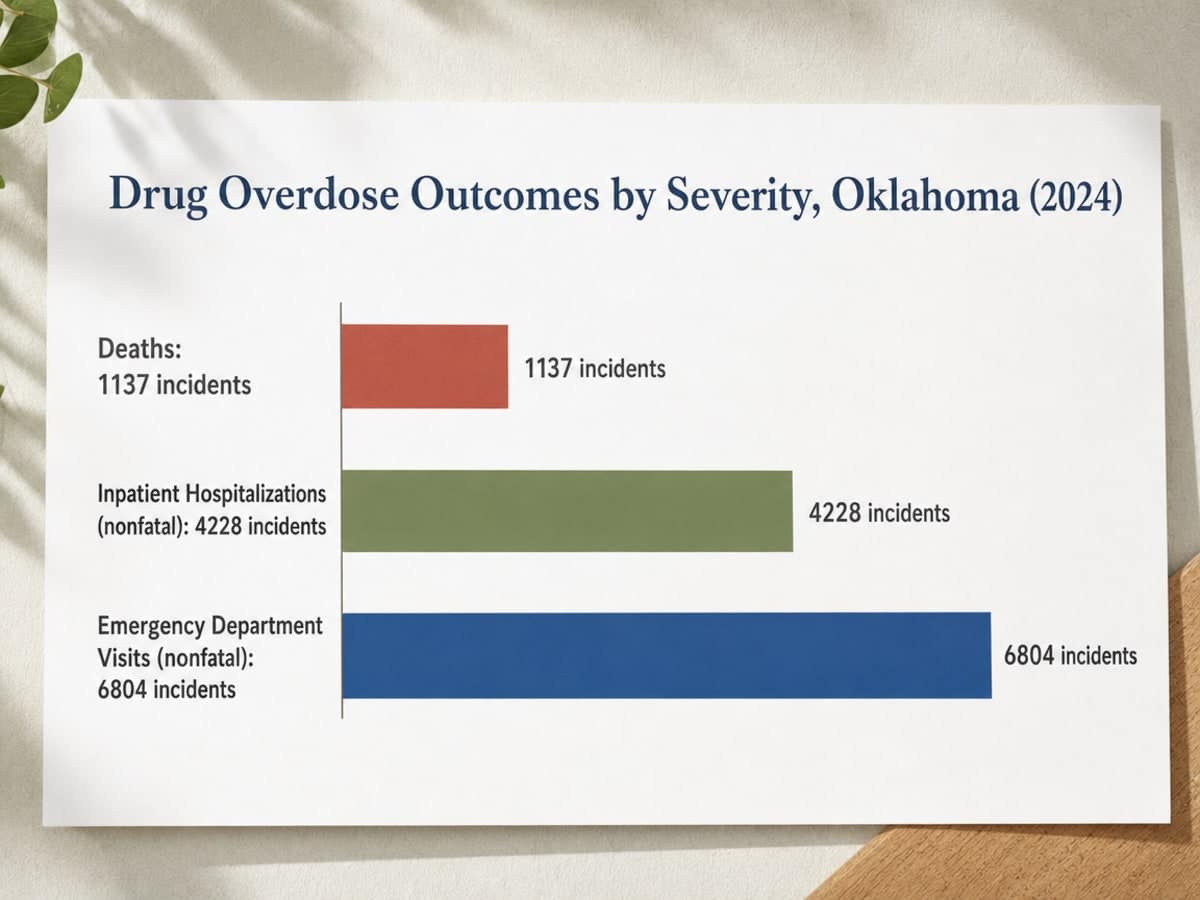
Oklahoma’s numbers make the stakes plain. In 2024, the state recorded 1,137 drug overdose deaths, 4,228 nonfatal inpatient hospitalizations, and 6,804 nonfatal emergency department visits 4. Every one of those ED visits was a moment where someone could have gone to medically supervised detox instead — and every one of those deaths started as someone trying to get through it alone.
Home detox also tends to fail for a reason that has nothing to do with weakness. Without medication to blunt the worst symptoms and without someone monitoring your vitals, the pain wins. That’s not a character flaw. That’s biology. A supervised setting changes the odds because it takes the physical crisis off your shoulders long enough for you to think clearly again.
What Medically Supervised Detox Looks Like in the OKC Metro
The Three Stages: Evaluation, Stabilization, and What Comes Next
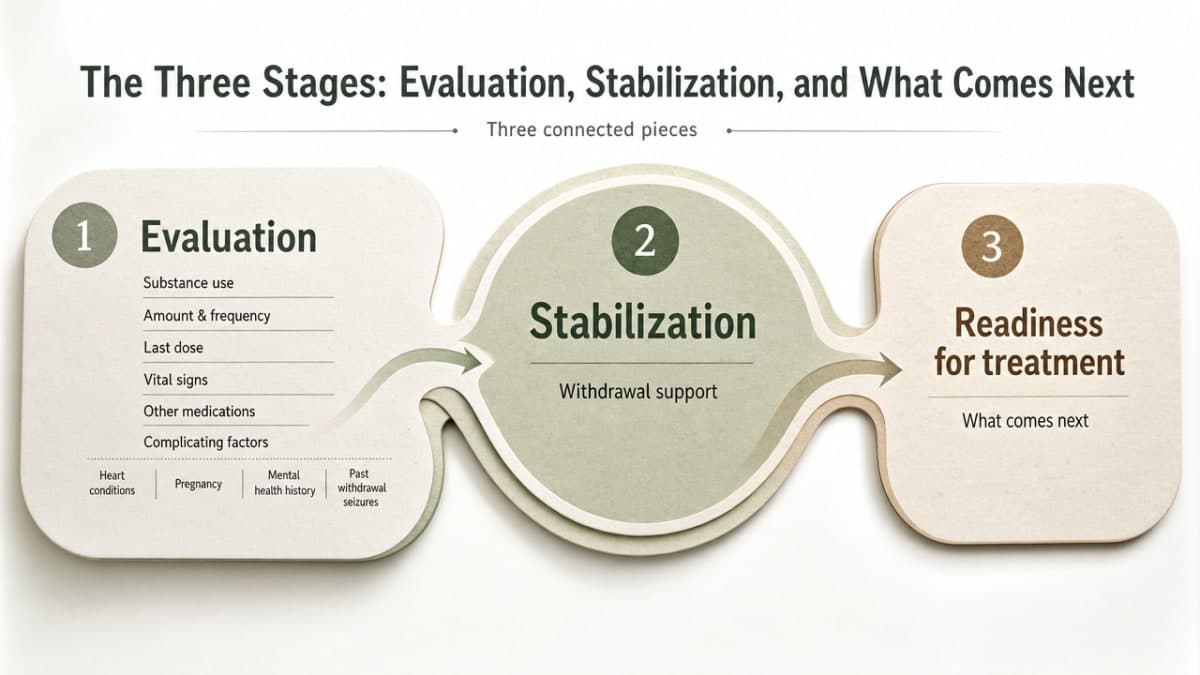
Detox isn’t one thing that happens to you. It’s three connected pieces, and knowing the shape of them can take some of the fear out of walking through the door. SAMHSA’s clinical guide describes detoxification as having three components: evaluation, stabilization, and fostering readiness for treatment 10. That’s the map. Everything a good OKC detox does fits inside those three steps.
Evaluation is the intake. A nurse and physician figure out what you’ve been using, how much, how often, and when your last dose was. They check your vital signs, ask about other medications, look for anything that could complicate withdrawal — heart conditions, pregnancy, mental health history, past withdrawal seizures. This isn’t a quiz you can fail. It’s the team building a plan around your actual body.
Stabilization is the part you probably picture when you hear “detox.” This is where medications, fluids, rest, and 24/7 monitoring take the edge off withdrawal so your body can reset without the crisis. For opioids, this usually means medication to blunt the worst symptoms, hydration, and someone checking on you around the clock. Stabilization can take a few days to a week or so, depending on what you were using.
Fostering readiness for treatment is the piece a lot of people don’t hear about until they’re in it. Detox alone isn’t the whole answer. Your body clears the substance, but your brain, your habits, and your triggers are still there. This stage is about connecting you to what comes next — residential care, outpatient counseling, medication-assisted treatment — so day eight isn’t day one all over again.
Your First 24 Hours: What Actually Happens After You Arrive
Nobody tells you what the first day looks like, and that gap is where a lot of fear lives. Here’s a plain version.
You walk in (or someone walks you in). A staff member greets you — not with a clipboard first, but with a chair, water, and a quiet room if you need one. Paperwork is brief up front because if you’re already in withdrawal, forms can wait a few minutes. A nurse takes your vitals: blood pressure, pulse, temperature, oxygen. They ask what you last used, when, and how much. Honest answers help them help you — there’s no judgment attached to the number.
Within the first hour or two, a physician reviews your intake and orders a medication plan tailored to what your body is going through. If you’re coming off opioids, they’ll watch for objective withdrawal signs before starting certain medications, which is a clinical safety step, not a delay 5. You’ll get fluids if you’re dehydrated. You’ll get something for nausea. You’ll be shown to a bed.
Over the next several hours, staff check on you regularly — vitals, symptoms, comfort. You can rest. You can eat something small when you’re able. You can sleep. That last one might sound impossible right now, but with the right medication support, most people finally sleep sometime in the first day. That sleep is the first sign your body is starting to come down off the emergency it’s been running.
Why Oklahoma Law Requires a Physician and RN On-Site
You might wonder why medical detox is different from just “riding it out” somewhere quiet with a friend. The state has an answer to that. Under Oklahoma’s Chapter 18 rules, medically supervised withdrawal management must be provided under the direction of a licensed physician and a licensed registered nurse 8. That’s not a suggestion. It’s the standard every certified detox facility in the state has to meet.
The reason is simple: withdrawal is a medical event. Your heart rate, blood pressure, hydration, and mental state can all shift fast, especially in the first 48 hours. Having a doctor writing the orders and an RN watching the changes means someone qualified is catching problems before they become emergencies. It also means the medications you get are prescribed and monitored, not guessed at.
When you’re comparing places across the OKC metro, that on-site clinical team is one of the clearest lines between a medical detox and something less. Ask about it. You have every right to.
Medications That Make Opioid Detox Safer
One of the biggest changes in opioid detox over the past two decades is that you don’t have to white-knuckle it anymore. There are real medications, backed by federal clinical guidance, that take the sharpest edges off withdrawal and cut the risk of going back to using during that dangerous first week. SAMHSA’s guidance names three FDA-approved medications for opioid use disorder: buprenorphine, methadone, and naltrexone 5. Each one works differently, and each one has a role.
- Buprenorphine
- A partial opioid agonist. In plain terms, it attaches to the same receptors in your brain that heroin, fentanyl, or oxycodone were hitting, but it activates them only partially. That’s enough to stop withdrawal and reduce cravings without producing the same high. It’s the medication most commonly started during medical detox in a setting like the OKC metro. There’s an important safety step: the clinical team waits for you to show objective signs of withdrawal before giving the first dose, because starting buprenorphine too soon can actually make you feel worse 5. That wait isn’t the staff being slow. It’s them protecting you.
- Methadone
- A full opioid agonist. It fully activates the receptors, which makes it powerful for stabilizing people with long or heavy opioid histories, especially with fentanyl. Methadone for opioid use disorder is dispensed through federally regulated opioid treatment programs rather than every detox facility, so if it’s the right fit for you, your care team will help coordinate that hand-off 5.
- Naltrexone
- An antagonist. It blocks the receptors entirely, so opioids can’t attach and produce a high. It’s typically started after you’re fully through withdrawal — often as a monthly injection — to protect you during the vulnerable weeks after detox 5.
You don’t have to pick one before you walk in the door. A physician will look at what you’ve been using, how much, your health history, and your goals, then talk you through what fits. The point isn’t which medication — the point is that you don’t have to suffer through this alone, and you don’t have to guess your way through it.
Getting There from Edmond, Norman, Moore, Midwest City, Yukon, or Mustang
The Drive Is Shorter Than the Decision
If you’re sitting in Edmond, Norman, Moore, Midwest City, Yukon, or Mustang right now, the drive into central Oklahoma City is not the hard part. The hard part is deciding to go. Once that’s settled, the map takes care of the rest.
Renewal Springs sits in central OKC, which is the geographic middle of the metro for a reason. From Edmond, you’re coming south down Broadway Extension or I-35. From Norman and Moore, you’re heading north on I-35. Midwest City comes in on I-40 west. Yukon and Mustang come in on I-40 east or the Kilpatrick Turnpike. Most of these drives are the kind of trip you’d make for a doctor’s appointment or a dinner in Bricktown — familiar roads, not a road trip.
Here’s something worth saying out loud: you do not have to time this perfectly. There isn’t a rush-hour window that closes the door. Detox intake runs around the clock because withdrawal doesn’t check a clock either. Whether it’s a Tuesday at 2 p.m. or a Sunday at 3 a.m., someone is there. If the thought of driving yourself feels like too much right now, that’s normal — the next subsection is for you.
Rides, EMBARK, and Asking for Help with Transportation
Not everyone has a car keys-in-hand, gas-in-the-tank situation. That’s okay. Ask.
- A family member or friend driving you is the most common way people arrive, and it’s often the safest option if you’re already in withdrawal — you shouldn’t be behind the wheel when your hands are shaking and your focus is gone.
- If nobody in your circle can drive you, EMBARK operates bus service across much of the OKC metro and can get you close to central OKC from many suburbs, though schedules and transfers vary by neighborhood.
- Rideshare works too, and some families split the cost.
The thing people hesitate to do is call the detox center and ask about directions or a ride before they’ve committed. Do it anyway. Ask what neighborhood you’re coming from, what time you’d arrive, whether someone can meet you at the door. Renewal Springs gets that question all the time, and it’s a normal one. Figuring out the logistics is part of what the phone call is for — you don’t have to solve transportation before you dial.
How SoonerCare and Private Insurance Cover Detox
SoonerCare Covers Detox — With Prior Authorization
Money is one of the biggest reasons people put off calling. So let’s put it on the table plainly: if you have SoonerCare, detox is a covered benefit. The Oklahoma Health Care Authority lists detox and residential substance use disorder services as covered under SoonerCare, with prior authorization required 6. That last part isn’t a trap. It’s a paperwork step the detox facility handles with the state, usually starting the moment you call.
Here’s what that looks like in practice. You call. The intake team asks for your SoonerCare information along with basic details about what you’ve been using. They contact OHCA to request authorization for admission. In most crisis situations, this happens quickly because withdrawal doesn’t wait. You’re not sitting in a lobby filling out forms while your symptoms peak — the clinical side and the coverage side run at the same time.
SoonerCare also covers medication-assisted therapy and related behavioral health services beyond detox itself 6, which matters because the medications used during opioid withdrawal and the follow-up care after you leave are part of the same benefit picture. You are not paying out of pocket for buprenorphine or naltrexone if SoonerCare is your coverage. Ask the intake team to walk you through it — that’s a normal conversation.
Private Insurance, Self-Pay, and What to Ask on the Phone
If you have private insurance through work or the marketplace — Blue Cross Blue Shield of Oklahoma, Aetna, Cigna, UnitedHealthcare, or something similar — detox is usually a covered benefit too, but the specifics vary by plan. Deductibles, copays, and in-network status all shape what you’ll actually owe. The good news is you don’t have to decode your policy alone. Renewal Springs runs free benefits verification, which means someone on staff calls your insurer, asks the exact questions, and comes back with a real number.
When you call, have your insurance card nearby if you can find it. If you can’t, don’t let that stop you — they can often look you up with a date of birth and last name. Ask these things:
- Is medical detox covered under my plan?
- What’s my out-of-pocket estimate?
- Is prior authorization needed, and will you handle it?
- If I don’t have insurance, what are self-pay options or payment plans?
Cost matters, but it shouldn’t be the reason you white-knuckle another night. Call, ask, and let the numbers come back before you decide anything.
How to Know a Detox Center Is Actually Certified
Not every place that calls itself a detox is one. In Oklahoma, that word carries a legal weight, and it’s fair to ask any facility to prove it before you trust them with your body.
When you call, you can ask three simple questions: Are you ODMHSAS-certified for medical detox? Do you have national accreditation? Is a licensed physician and RN directing withdrawal management on-site 8? A real facility will answer those quickly and without getting defensive. If the answers feel vague or the person on the phone dodges, that’s information too. You deserve a straight answer before you walk through any door.
After Detox: The Part Nobody Talks About Enough
Here’s the honest truth about detox: finishing it feels like a finish line, but it isn’t one. Your body is clear. Your head is starting to work again. And your tolerance is now much lower than it was a week ago — which means if you go back to the amount you were using before, that dose can be fatal. This is the window where a lot of people get hurt, and it’s the window a good detox team plans for before you ever pack your bag.
That’s why SAMHSA’s clinical guide is clear that detox has three parts, not two — evaluation, stabilization, and fostering readiness for what comes next 10. The third part is where residential treatment, intensive outpatient programs, counseling, and medication-assisted treatment come in. Naltrexone as a monthly injection, buprenorphine maintenance, therapy for the reasons you started using in the first place — these aren’t optional extras. They’re what protects the work you just did.
Before you leave, ask your care team what your next step looks like. A warm handoff to a residential program in the metro, an outpatient clinic closer to Norman or Edmond, a prescriber for ongoing medication — that plan should be written down before discharge, not figured out from your couch on day one.
Making the Call Tonight
You’ve read enough. The next step isn’t more research — it’s the phone. Whatever suburb you’re in right now, whatever your insurance situation, whatever you’ve been using and for how long, the intake team on the other end has heard it before and answered it before. You are not the first person to call from Norman at 2 a.m. or from Edmond in the middle of a workday.
When you call Renewal Springs, tell them where you’re driving from — Moore, Midwest City, Yukon, Mustang, Del City, wherever. Ask about directions, ask about a ride, ask about your insurance, ask what to bring. Those are the normal questions. Nobody expects you to have them sorted before you dial.
Tonight doesn’t have to be the night you fix everything. It just has to be the night you stop trying to do this alone.
Speak Now About OKC Metro Detox Options
Get immediate answers on local detox access, travel, or starting your recovery journey today.
Frequently Asked Questions
How long does opioid detox usually take?
For most people, medically supervised opioid detox runs about 5 to 10 days, depending on what you were using, how much, and how long. Fentanyl tends to take longer than shorter-acting opioids because it lingers in the body. Your care team adjusts the timeline to your actual symptoms and vitals, not a fixed calendar. The stabilization piece isn’t rushed — you leave when your body is steady, not when the clock says so.
Does SoonerCare cover detox in the OKC metro?
Yes. SoonerCare covers detox and residential substance use disorder services, with prior authorization required 6. That authorization is paperwork the detox facility handles with the state — you don’t have to figure it out yourself. Coverage also extends to medication-assisted therapy, so the buprenorphine or naltrexone used during and after detox is part of the same benefit. Call the intake team with your SoonerCare info and they’ll walk you through it.
Can I drive myself to detox from Norman or Edmond, or should someone bring me?
If you’re already in active withdrawal — shaking, nauseated, unable to focus — please don’t drive. Ask a family member, friend, or rideshare to bring you. If nobody is available, EMBARK bus service connects much of the metro to central OKC. When you call, tell the intake team you’re coming from Norman, Edmond, or wherever you are, and ask about transportation options. That’s a routine question, not an inconvenient one.
What should I bring with me when I check in?
Keep it simple. A photo ID, your insurance card if you have one, a list of any medications you take, and comfortable clothes for several days — sweatpants, t-shirts, socks, slip-on shoes. Toiletries are usually provided but you can bring your own. Leave valuables, cash, and anything you were using at home. If you forget something, the staff will help you sort it out. Don’t let a packing list delay the call.
Will I be given medication to help with withdrawal symptoms?
Yes. For opioid withdrawal, buprenorphine is commonly used to blunt symptoms and reduce cravings, with clinicians waiting for objective withdrawal signs before the first dose for safety reasons 5. You may also get fluids, anti-nausea medication, and something to help you sleep. The point of medical detox is that you don’t have to white-knuckle it — a physician writes the plan and an RN monitors how you’re responding, adjusting as needed.
What happens after detox is over?
Detox is the first step, not the finish line. Clinical guidance describes it as three parts: evaluation, stabilization, and preparing you for what comes next 10. Before discharge, your care team should have a written plan — residential treatment, an intensive outpatient program closer to home, ongoing medication like buprenorphine or naltrexone, and counseling. Ask about that plan on day one so it’s ready when you leave. You shouldn’t walk out alone.
References
- Provider Certification – Oklahoma.gov. https://oklahoma.gov/odmhsas/policy/provider-certification.html
- Okla. Admin. Code § 450:27-7-21 – Additional treatment services. https://www.law.cornell.edu/regulations/oklahoma/OAC-450-27-7-21
- Data – Drug Overdose – Oklahoma.gov. https://oklahoma.gov/health/health-education/injury-prevention-service/drug-overdose/data.html
- Drug Overdose Data Graphs and Maps – Oklahoma, 2024. https://oklahoma.gov/content/dam/ok/en/health/health2/aem-documents/prevention-and-preparedness/injury-prevention/drug-overdose/Drug%20Overdose%20Data%20Graphs%20and%20Maps.pdf
- TIP 63: Medications for Opioid Use Disorder (Full Document) – SAMHSA. https://library.samhsa.gov/sites/default/files/pep21-02-01-002.pdf
- Mental Health and Substance Abuse Services – Oklahoma Health Care Authority. https://oklahoma.gov/ohca/individuals/programs/mental-health-and-substance-abuse-services.html
- FY 2026 Budget Performance Review – Oklahoma Department of Mental Health and Substance Abuse Services. https://oksenate.gov/sites/default/files/2025-01/FY%2026%20-%20DMHSAS%20-%20BPR.pdf
- CHAPTER 18 – Standards and Criteria for Substance-Related and Addictive Disorder Treatment Facilities and Organizations (2023 version). https://oklahoma.gov/content/dam/ok/en/odmhsas/documents/policy/provider-certification/administrative-rules/2023/PC–Chapter-18-Final-effective-9-15-23.pdf
- Drug Overdose Data Dashboard – Oklahoma.gov. https://oklahoma.gov/health/health-education/injury-prevention-service/drug-overdose/data/drug-overdose-data-dashboard.html
- Quick Guide For Clinicians Based on TIP 45 Detoxification and Substance Abuse Treatment. https://nida.nih.gov/sites/default/files/samhsa_detoxification_and_substance_abuse_treatment.pdf
- New Programs: Overview of ODMHSAS Certification Process. https://oklahoma.gov/odmhsas/policy/provider-certification/new-programs-overview-of-odmhsas-certification-process.html