Key Takeaways
- Renewal Springs’ Oklahoma City admissions line is staffed 24/7 by a live person, meeting state rules that require on-site staff and a physician available around the clock 10.
- Picking the right door matters tonight: 911 or the ER for medical emergencies, 988 for suicidal thoughts or mental health crises, and medical detox admissions for active withdrawal 2.
- Alcohol and benzodiazepine withdrawal can cause seizures and death, while opioid withdrawal risk comes largely from relapse against a fentanyl-heavy supply that drove 86% of Oklahoma opioid deaths in 2024 8.
- Before calling, weigh insurance and free benefits verification, privacy protections, what to bring, transportation, and whether a plan for care after detox is built in — since detox alone carries high relapse rates 5.
If you’re reading this at 2 a.m. in Oklahoma City
The phone is warm in your hand. The house is quiet, or maybe it isn’t. Maybe someone in the next room is sweating through the sheets, or throwing up again, or asking you what to do. Maybe that person is you.
You searched for this at an hour when most people are asleep. That already tells you something. Part of you is looking for a door.
Here is the honest thing: you don’t have to figure any of this out tonight. You just have to make one call. Renewal Springs’ admissions line is staffed around the clock, right here in Oklahoma City, and someone will pick up when you dial — not a voicemail, not a callback form.
Oklahoma actually requires this. Certified medical detox facilities in the state have to keep staff on site 24 hours a day, seven days a week, with a physician available at any hour 10. A 2 a.m. call is not an imposition. It’s what the building is for.
Take a breath. Read a few more sections if you need to. Then call. That’s the whole next step.
What actually happens in the first 10 minutes when you call
The scariest part of dialing is not knowing what will happen on the other end. So here it is, plainly.
Minute one: a real person picks up. Not a menu. Not a queue that tells you your call is important. Someone at the admissions desk answers, says their name, and asks yours. If you don’t want to give your name yet, that’s fine. You can just say what’s going on.
This isn’t a coincidence of good customer service. Oklahoma’s Chapter 18 rules require certified medical detox facilities to keep staff on site 24 hours a day, seven days a week, with a licensed physician overseeing withdrawal management on site or on call around the clock 10. The people staffing the phone at 3 a.m. are supposed to be there. You are not waking anyone up.
Minutes two through four: a quick safety check. The person on the phone will ask a few short questions. What are you using, and how much? When was your last drink or dose? Are you shaking, sweating, throwing up? Any seizures ever? Any chest pain right now? This isn’t a quiz. They’re listening for anything that means you need an ambulance instead of a car ride, or that you need to be seen tonight instead of tomorrow.
If your answers point to something dangerous happening in your body right now, they’ll tell you. Directly. No guessing.
Minutes four through seven: insurance and cost, without the runaround. They’ll ask for your insurance card if you have one. Most major plans are accepted, and benefits verification is free. If you don’t have a card in front of you, they can often look it up with your date of birth and the carrier’s name. You do not need to have this figured out before you call. That’s what the call is for.
Minutes seven through ten: how you’re getting here. Renewal Springs is in Oklahoma City, so the drive is short from most of the metro. If someone sober can drive you, great. If not, the admissions team will talk through options with you, including what to do if you’re alone and shouldn’t be behind the wheel. They’ll tell you what to bring, what to leave at home, and roughly when to arrive.
Ten minutes. That’s the whole first step. You don’t commit to anything on that call except telling the truth about how you’re feeling. If, after those ten minutes, you decide you’re not ready, you can hang up and call back later. Nobody chases you. Nobody shames you. The line stays open.
988, the ER, and medical detox: picking the right door tonight
Three doors are open right now. They are not the same door, and picking the wrong one can cost you hours you don’t have.
988 is the crisis line. If you’re thinking about ending your life, or you’re watching someone who is, dial 988. Oklahoma’s crisis system runs through that number, connecting you to a counselor and, if needed, to Urgent Recovery Clinics and Crisis Stabilization Units that are staffed around the clock and accept walk-ins 2. 988 is the right door when the emergency is in your head — the thoughts, the panic, the wanting to disappear. It is not primarily a medical detox line. They can point you toward help, but they don’t admit you to a detox bed.
The ER is for a body in immediate danger. Call 911 or go to the nearest emergency room if you’re having a seizure, chest pain, uncontrolled vomiting with blood, trouble breathing, or if someone is unresponsive or turning blue. If you gave someone Narcan and they woke up, they still need the ER. The ER stabilizes you. It usually does not keep you for the full withdrawal, and it rarely hands you a treatment plan on the way out.
Medical detox is the door for withdrawal itself. This is where Renewal Springs’ 24/7 admissions line comes in. If you’re shaking, sweating, throwing up, can’t sleep, feel like you’re crawling out of your skin, or you know that stopping is going to hurt — that’s what a medical detox admission is built to handle. SAMHSA describes detox as a medical intervention with three parts: evaluation, stabilization, and getting you into what comes next 13. It’s not a punishment. It’s a treatment.
If you’re not sure which door you need, call the admissions line. They’ll tell you if tonight is a 911 call, a 988 call, or a drive to us.

Why the Oklahoma City picture makes this hour matter
You don’t need a lecture on the opioid crisis right now. But you probably do need to hear that what you’re feeling tonight is not rare, and it’s not overreacting.
Oklahoma County recorded 655 unintentional drug overdose deaths in the most recent multi-year count, and methamphetamine was involved in nearly two out of three of them — 64% 6. Fentanyl, prescription opioids, alcohol, benzodiazepines, and cocaine round out the list 6. Those are the substances killing people in the same zip codes you’re sitting in.
Read that list again, because it matters for you specifically. If what you’re using tonight is on it, the drug supply around you is not the same drug supply from a few years ago. Meth is often cut. Pills bought outside a pharmacy are often not what the stamp says. A dose that felt normal last week can be the dose that doesn’t wake you up this week.
That’s not a scare tactic. It’s the reason Oklahoma City has been building out crisis and detox capacity at the same time — the city is standing up a restoration center with medically supervised detox, substance abuse counseling, and medication-assisted treatment for opioid addiction, alongside expanded crisis beds 3. The state’s 988 line, Urgent Recovery Clinics, and Crisis Stabilization Units are staffed 24/7/365 for the same reason 2.
You are not the only person awake in Oklahoma City tonight trying to figure out what to do. The system knows that. It was built for this hour.
So the question isn’t whether you’re allowed to reach out at this time. The question is which door. If your body is telling you something is wrong — the shaking, the sweating, the sick feeling that keeps coming back — the medical detox admissions line is the one to dial. You can call now. Someone is there.
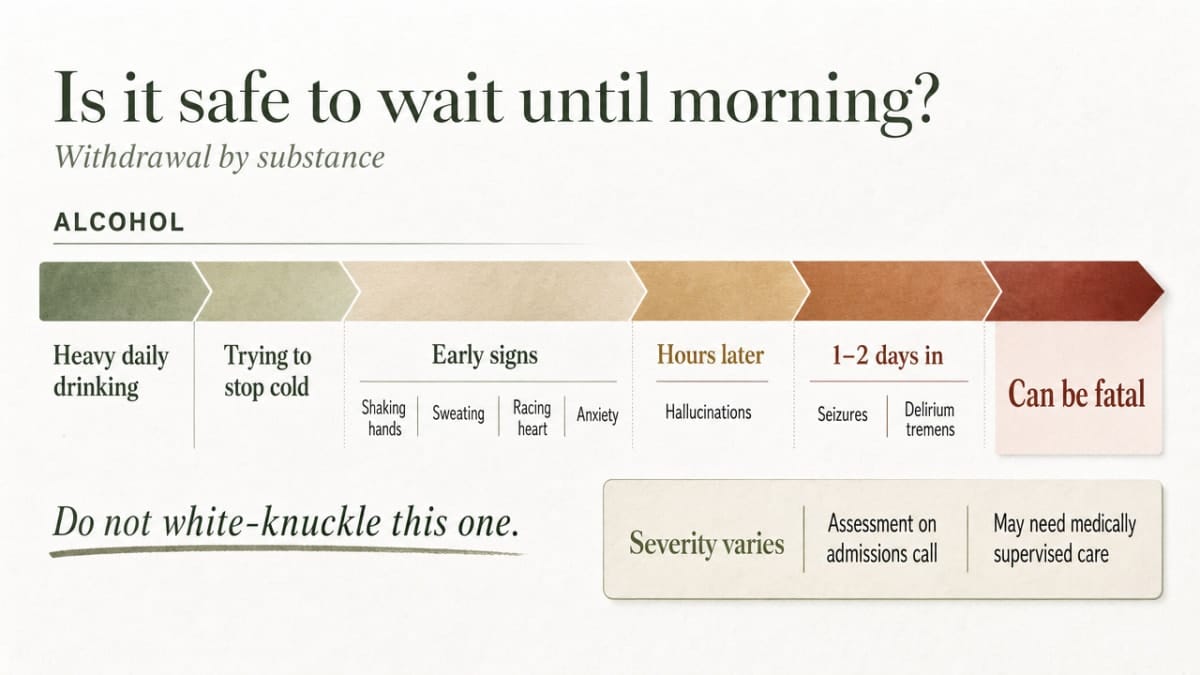
Is it safe to wait until morning? Withdrawal by substance
Alcohol: the withdrawal that can actually kill you
If you’ve been drinking heavily every day for weeks or months, and now you’re trying to stop cold, this is the one you cannot white-knuckle.
You do not have to guess whether yours is the dangerous kind. That’s what the assessment on the admissions call is for. ASAM’s clinical guideline on alcohol withdrawal exists precisely because severity varies, and identifying who needs medically supervised care is a specific clinical decision, not a hunch 12. SAMHSA’s clinician guide names benzodiazepines as the medication of choice for alcohol withdrawal — which is to say, there is an actual treatment for what your body is doing right now, and it lives in a medical detox setting 13.
If you’ve had a withdrawal seizure before, if you’re seeing things, or if your last drink was more than a few hours ago and the shaking is getting worse — do not wait for morning. Call now.
Opioids: miserable, and more dangerous than it used to be
Opioid withdrawal by itself usually won’t kill you. That’s the sentence people cling to when they try to ride it out on a bathroom floor. It’s technically true. It’s also not the whole picture anymore.
The hard truth is this: the opioid supply in Oklahoma is not what it was five years ago. Fentanyl accounted for 86% of opioid-related overdose deaths in Oklahoma in 2024, and fentanyl deaths rose roughly six-fold from 2020 to 2023 8. That reshapes what “just riding it out” actually means.
Here’s why that matters for you tonight. When the withdrawal hits — the bone ache, the diarrhea, the cold sweats, the restless legs, the feeling that your skin doesn’t fit — your tolerance drops fast. If you break down at hour 18 and use again at a dose that felt normal a week ago, the same amount can stop your breathing now. That is the number one way people die during an opioid detox attempt at home. Not from the withdrawal itself. From the relapse it forces.
Medical detox interrupts that loop. You get medication to take the edge off. You get monitored. You don’t have to negotiate with yourself at hour 20 about whether to just make it stop. If what you’re feeling right now is the beginning of that curve, this is the call to make.
Benzos: the taper you should not do alone
Xanax, Ativan, Klonopin, Valium — if you’ve been taking any of these daily for more than a few weeks, especially at higher doses, stopping suddenly is a medical situation, not a willpower situation.
Benzodiazepine withdrawal sits in the same danger category as alcohol. Seizures are possible. So are severe panic, hallucinations, and a rebound anxiety that feels bottomless. This is not the drug you quit by flushing the bottle at 3 a.m. and hoping.
What benzos need is a taper — a stepped, medically supervised reduction that keeps your nervous system from crashing. That’s not something you can safely design in a group text with a friend. It happens under a physician’s oversight, which Oklahoma requires to be available around the clock in certified detox settings 10.
If you’re already skipping doses, feeling the tremor start, or you ran out and the pharmacy doesn’t open until Monday — call the admissions line now. Tell them exactly what you’ve been taking and how long. They can help you decide whether tonight is a drive-in or a 911 call, and neither answer is a wrong thing to have asked.
The quiet questions that keep people from dialing
Cost, insurance, and who finds out
You already know what the sticker on the front of your brain says: this is going to cost money you don’t have, and someone is going to find out.
Let’s take those apart.
On cost: Renewal Springs accepts most major insurance, and benefits verification is free. That means when you call the admissions line, they can check your plan while you’re on the phone and tell you what your coverage actually looks like — not a guess, a real answer. If you don’t have insurance, say that on the call. Don’t hang up because you’re embarrassed. The admissions team can talk through options with you. You are not the first person to ask.
On privacy: substance use treatment records are protected under federal law more strictly than most medical records. Your boss does not get called. Your parents do not get called unless you want them called. Your neighbor at church does not find out because you drove to a building in Oklahoma City.
On who has to know: legally, no one who doesn’t already. Practically, the person you were most afraid to tell — a spouse, a parent, a friend — often turns out to be the person who says, quietly, “I’ve been waiting for you to say something.”
You do not have to solve the money question or the shame question before you dial. You just have to dial. The rest gets figured out on the call, not before it.
‘What if I’m not bad enough’ and ‘what if I’ve tried before’
Two versions of the same doubt.
The first one sounds like: I still go to work. I haven’t lost the house. I’m not the person on the news. Maybe I’m making a big deal out of this.
Here’s the thing. Nobody asks the admissions line if they’re bad enough at 2 a.m. because things are going well. If you’re reading this at this hour, your body or your life is already telling you something. You do not have to earn a bed by hitting a lower bottom. Detox is a medical intervention for withdrawal, not a reward for suffering enough 13.
The second version sounds like: I’ve done this before. I went thirty days once. I went to a meeting for a year. It didn’t stick. Why would this time be different?
That one is harder, and it deserves an honest answer. Detox by itself, without a plan for what comes next, has high relapse rates — that’s not a moral failure, it’s what the research shows 5. If past attempts didn’t hold, it often means the transition after detox wasn’t built. Renewal Springs plans that transition before you leave, not after.
Trying again is not the same as failing before. It’s the part where you learned what the last try was missing. Call now. You can start there.
What to bring, what to leave, and how you’ll get here
This part is easier than you think, and the admissions team will walk you through it on the phone. But if it helps to see it now, here it is.
Bring: a photo ID if you have one, your insurance card if you have one, a list of any medications you take (prescription bottles are fine — just bring them), and a few days of comfortable clothes. Toothbrush, glasses, phone charger. That’s about it.
If you can’t find your ID or your insurance card at 3 a.m., come anyway. Nobody at the door is going to turn you around because your wallet is in someone else’s car.
Leave: any substances, including alcohol, pills that weren’t prescribed to you, and paraphernalia. Leave weapons at home. Leave the pressure to have a perfect bag packed. This isn’t a vacation checklist.
Getting here: Renewal Springs is in Oklahoma City, so the drive is short from most of the metro. If someone sober can drive you, that’s the simplest option. If you’re alone, or you’ve been drinking, or the shaking is bad — do not get behind the wheel. Tell the admissions team on the phone. They’ll help you sort out a ride.
One bag. One drive. One call to start it. You do not have to arrive put-together. You just have to arrive.
After the shaking stops: why the next step is planned before you arrive
Here is something most people don’t know until they’ve been through it: the hardest part of detox isn’t the withdrawal. It’s what happens on day six, when the shaking is gone, the appetite is coming back, and the world outside the door hasn’t changed.
That gap — between feeling human again and having somewhere to go next — is where most attempts fall apart. It’s not a character flaw. It’s the research. Detox on its own, without a real plan for what comes after, is linked to high relapse rates 5. That’s not because detox doesn’t work. It’s because detox was never meant to be the whole treatment. SAMHSA describes it as one of three parts: evaluation, stabilization, and fostering entry into ongoing care 13.
So the transition gets built while you’re still in the bed. Not on discharge day. From the beginning, the team is thinking about what your day seven looks like — whether that’s residential treatment, outpatient care, medication-assisted treatment, a return to work with support, or a safe place to sleep. Insurance gets coordinated for the next level of care while it’s coordinated for this one.
You don’t have to know any of that tonight. You just have to make the call. The plan gets built with you, not handed to you. Someone is on the line right now.
Speak With a Real Person for Immediate Detox Help
Connect now for compassionate guidance and fast answers when you need support the most.
Frequently Asked Questions
Will someone actually answer if I call in the middle of the night?
Yes. Renewal Springs’ admissions line is staffed around the clock, and a real person picks up — not a voicemail. Oklahoma’s certification rules require licensed detox facilities to keep staff on site 24 hours a day, seven days a week, with a physician on site or on call at any hour 10. Calling at 3 a.m. is normal here.
Do I need to call 988, go to the ER, or call a detox admissions line?
It depends on what’s happening in the next hour. Call 911 or go to the ER for seizures, chest pain, unresponsiveness, or an overdose scare. Call 988 if the emergency is suicidal thoughts or a mental health crisis — Oklahoma’s 988 system connects to 24/7 crisis centers 2. For withdrawal itself — shaking, sweating, vomiting, needing to stop safely — call the medical detox admissions line. If you’re unsure, call admissions and they’ll tell you which door.
What if I don’t have insurance or I’m worried about the cost?
Call anyway. Renewal Springs accepts most major insurance and verifies benefits for free while you’re on the phone — you don’t have to figure out coverage before dialing. If you don’t have insurance, say so on the call. The admissions team will talk through options with you. Being embarrassed about money is one of the top reasons people wait too long. Don’t let it be yours tonight.
Am I ‘bad enough’ to need medical detox?
If you’re asking the question at this hour, the answer is probably yes — but you don’t have to decide. That’s what the admissions call is for. Detox is a medical intervention for withdrawal, not a reward for hitting a low enough bottom 13. You do not have to lose a job, a marriage, or a driver’s license to qualify for care. If your body is telling you something is wrong when you try to stop, that’s enough of a reason to call.
Is it dangerous to try to detox at home tonight?
For alcohol and benzodiazepines, yes — those withdrawals can cause seizures and, in the case of alcohol, delirium tremens, which carries real mortality risk. ASAM’s guideline exists because severity varies and identifying who needs supervised care is a clinical decision, not a guess 12. Opioid withdrawal itself is rarely fatal, but relapse during it can be — your tolerance drops fast, and today’s supply is unforgiving. Call before you decide to ride it out.
What should I bring, and how do I get there if I can’t drive?
Bring a photo ID and insurance card if you have them, a list of your medications (or the bottles), and a few days of comfortable clothes. Leave substances, paraphernalia, and weapons at home. If you can’t drive safely — you’ve been drinking, you’re shaking, or you’re alone — tell the admissions team on the phone. They’ll help you sort out a ride. You don’t have to arrive perfectly. You just have to arrive.
References
- CHAPTER 18 – Standards and Criteria for Substance Related and Addictive Disorder Treatment Services (Effective September 1, 2025). https://oklahoma.gov/content/dam/ok/en/odmhsas/documents/policy/provider-certification/administrative-rules/2025/PC–Chapter-18_9-1-25.pdf
- Comprehensive Crisis Response. https://oklahoma.gov/odmhsas/treatment/comprehensive-crisis-response.html
- Mental Health Services – City of Oklahoma City. https://www.okc.gov/Services/Public-Safety/Mental-Health-Services
- CHAPTER 18 – Standards and Criteria for Substance Related and Addictive Disorder Treatment Services (Effective September 15, 2023). https://oklahoma.gov/content/dam/ok/en/odmhsas/documents/policy/provider-certification/administrative-rules/2023/PC–Chapter-18-Final-effective-9-15-23.pdf
- Medically Supervised Withdrawal (Detoxification) and Transition to Substance Use Disorder Treatment. https://www.ncbi.nlm.nih.gov/pmc/articles/PMC4085800/
- Oklahoma County Drug Overdose Fact Sheet. https://digitalprairie.ok.gov/digital/api/collection/stgovpub/id/641307/download
- Drug Overdose Deaths, 2019-2023 – Oklahoma. https://oklahoma.gov/content/dam/ok/en/health/health2/aem-documents/prevention-and-preparedness/injury-prevention/drug-overdose/2025%20State%20Drug%20OD%20-%20IPS%20-%20Fact%20Sheet.pdf
- Drug Overdose Data – Oklahoma. https://oklahoma.gov/health/health-education/injury-prevention-service/drug-overdose/data.html
- Oklahoma Drug Overdose State Summary, 2018-2022. https://oklahoma.gov/content/dam/ok/en/health/health2/aem-documents/prevention-and-preparedness/injury-prevention/drug-overdose/2024_State_DO_Sheet.pdf
- Title 450, Chapter 18: Standards and Criteria for Substance Related and Addictive Disorder Treatment Services. https://oklahoma.gov/content/dam/ok/en/odmhsas/documents/policy/provider-certification/administrative-rules/2020/AdminRules-Chapter18–11-16-20.pdf
- Drug Overdose Data Dashboard – Oklahoma. https://oklahoma.gov/health/health-education/injury-prevention-service/drug-overdose/data/drug-overdose-data-dashboard.html
- The ASAM Clinical Practice Guideline on Alcohol Withdrawal Management. https://pubmed.ncbi.nlm.nih.gov/32511109/
- Quick Guide for Clinicians: Based on TIP 45 – Detoxification and Substance Abuse Treatment. https://nida.nih.gov/sites/default/files/samhsa_detoxification_and_substance_abuse_treatment.pdf