
Key Takeaways
- Same-day admission to medically supervised detox in Oklahoma City is often possible within hours after a 15-minute phone screening and insurance verification, with no referral required.
- Three days works as a stabilization window for uncomplicated alcohol withdrawal, but benzodiazepines and opioid use disorder typically need continued taper or MOUD beyond 72 hours 2.
You Made the Call. Here’s What Happens Next.
If you’re reading this, something already shifted. Maybe it was last night. Maybe it was ten minutes ago. Either way, you opened a browser and typed the words, and that counts more than you know.
Here’s what you probably want to hear first: yes, same-day admission to a medically supervised detox is a real thing, and yes, three days is a real clinical window for many people, not a marketing number. It’s short enough to feel possible when you’re scared, and long enough for a medical team to get you through the worst of the physical withdrawal safely.
But you also deserve honesty. Three days is a stabilization sprint, not a cure. For alcohol and uncomplicated cases, 2–3 days of medically monitored care can carry you through the dangerous part 1. For benzodiazepines or heavy polysubstance use, 72 hours is usually where the work starts, not where it ends 8.
This guide walks you through what happens when you call, what the first 72 hours actually feel like hour by hour, what insurance usually covers, and what comes after day three. Read what you need. Skip what you don’t. You’re already moving.
Can You Actually Get In Today in Oklahoma City?
What Same-Day Admission Really Looks Like
Short answer: often, yes. Longer answer: it depends on a 15-minute phone call and a bed being open.
When you call a medical detox line in Oklahoma City, you’re not filling out a form and waiting for someone to email you back. A nurse or intake counselor picks up, usually in under a few minutes, and starts asking questions that sound personal because they are: what you’ve been using, how much, when your last drink or dose was, whether you’ve had seizures or DTs before, whether you’re pregnant, what other medications you take. This is the evaluation phase that SAMHSA’s TIP 45 describes as the first job of any detox program 5. It’s how they figure out whether you’re safe to come in today, safe to come in tomorrow, or safe only if you go to an emergency room first.
If you’re cleared, most facilities can have you admitted within a few hours. Someone can drive you. In some cases, a facility can arrange transport. You don’t need a referral. You don’t need to have tried outpatient first. You just need to say yes on the phone and show up.
Insurance, Payment, and the Verification Call
Here’s the part that stops a lot of people: the fear that this will bankrupt you.
Most major insurance plans, including commercial plans through your employer and many Medicaid plans, cover medically supervised inpatient detox when it meets criteria like ASAM Level 3.7-WM, which is defined as severe withdrawal needing 24-hour nursing care and physician visits 10. That’s the clinical box a 3-day inpatient stay usually fits into, and it’s the box insurers are used to authorizing.
The verification call is fast. You give the intake team your insurance card information over the phone, or a family member reads it to them. They contact your carrier, confirm your benefits, and tell you what your out-of-pocket exposure looks like before you commit. This usually takes under an hour.
If you don’t have insurance, ask about self-pay rates, sliding scale options, or state-funded beds. Do not assume the answer is no until you’ve asked. The worst outcome of asking is the same as not asking.
Is 3 Days Enough? An Honest Answer by Substance
Alcohol: Why 2 to 3 Days Is a Real Clinical Window
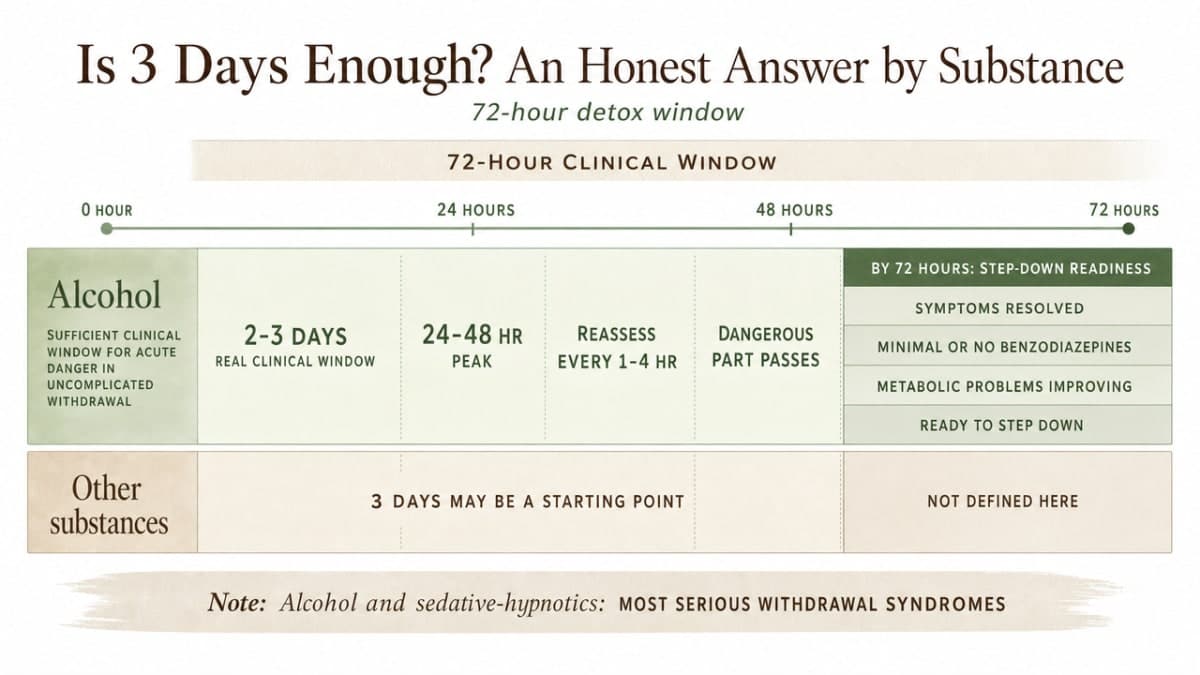
For uncomplicated alcohol withdrawal, 72 hours of medically supervised care is genuinely enough to carry you through the dangerous part. The discharge bar is specific: symptoms of alcohol withdrawal have resolved, you’re on minimal or no benzodiazepines, and any metabolic problems are improving 1. When those things line up, you’re clinically ready to step down to a lower level of care.
The reason 2 to 3 days works for alcohol is the shape of the withdrawal curve. Symptoms typically peak in the first 24 to 48 hours, and a medical team reassesses you every one to four hours during the acute phase to catch trouble early and adjust medication 4. That cadence is what makes a short stay safe.
Here’s the honest scope. Alcohol and sedative-hypnotics carry the most serious withdrawal syndromes, including seizures and, rarely, death 6. If you have a history of DTs, seizures, heavy daily drinking over years, or significant medical problems, your team may recommend a longer stay. Two to three days is the window for the typical case, not a promise for every case. The chart below shows how that window compares to other substances.
Opioids and the SAMHSA 3-Day Rule
Opioid detox is where the phrase “three days” takes on a very specific federal meaning.
Under federal rules, a practitioner who isn’t part of a licensed opioid treatment program can dispense methadone for no more than a three-day supply while arranging your entry into ongoing treatment. This is widely called the 3-Day Rule, and it exists precisely to give you a bridge—a way to start withdrawal management immediately, in a hospital or detox setting, without waiting for a full OTP intake 3. In an emergency, that bridge can be the difference between staying and walking out.
Physical withdrawal from short-acting opioids like heroin or fentanyl usually peaks within the first two to three days, so a 72-hour stay can absolutely get you through the worst of the acute symptoms. But here’s what nobody selling you a “detox package” wants to say plainly: SAMHSA’s federal guidelines are explicit that short-term medically supervised withdrawal alone is not recommended for opioid use disorder because of high return-to-use rates 2. The detox works. What matters is what happens on day four.
That’s why a good opioid detox in Oklahoma City is built around bridging you to medication for opioid use disorder—buprenorphine, methadone, or naltrexone—not just clearing your system.
Benzodiazepines: When 72 Hours Is Just the Start
Benzodiazepine withdrawal deserves its own conversation, because this is the substance where a 3-day promise can be misleading.
Benzos—Xanax, Klonopin, Valium, Ativan and others—sit in the same category as alcohol for withdrawal danger. Sedative-hypnotic withdrawal is one of the few syndromes that can be fatal without medical support 6. Inpatient benzodiazepine protocols emphasize careful, gradual dose reduction rather than fast tapers, particularly for anyone who’s been on daily doses for months or years 8.
What this means for you: 72 hours in a medically supervised bed is often the beginning of a benzo taper, not the end. You’ll be stabilized. Seizure risk will be actively managed. But full symptom resolution can take longer, and your team may recommend continuing a slower taper on the way down through a lower level of care.
That isn’t a bait-and-switch. It’s honest medicine. Coming off benzos too fast is more dangerous than coming off them carefully, and a competent detox will tell you that on the phone.
Stimulants, Kratom, and Polysubstance Realities
Stimulant withdrawal—meth, cocaine, high-dose Adderall—looks nothing like alcohol or opioid withdrawal on the outside. There’s usually no shaking, no seizures, no dangerous vital signs to chase. What you get instead is a heavy crash: exhaustion, deep sleep, low mood that can veer into suicidal thinking, and a raw hunger to use again. Inpatient stimulant protocols focus on sleep, nutrition, mood monitoring, and safety rather than a pharmacological taper 9.
A 3-day stay for stimulants can genuinely reset your sleep and get you past the worst of the crash in a monitored setting where you can’t act on the cravings. It works because the container works, not because a medication is doing the heavy lifting.
Kratom sits in a gray zone with opioid-like withdrawal features and often responds to similar supportive care. Polysubstance use—alcohol plus benzos, opioids plus stimulants—is the norm, not the exception, and it’s why intake asks so many questions. Your team prioritizes the most dangerous withdrawal first 6, then layers in care for everything else across the 72 hours you’re with them.
The First 72 Hours, Hour by Hour
Hour 0 to 4: Intake, Assessment, First Medications
You walk in. Someone actually greets you by name.
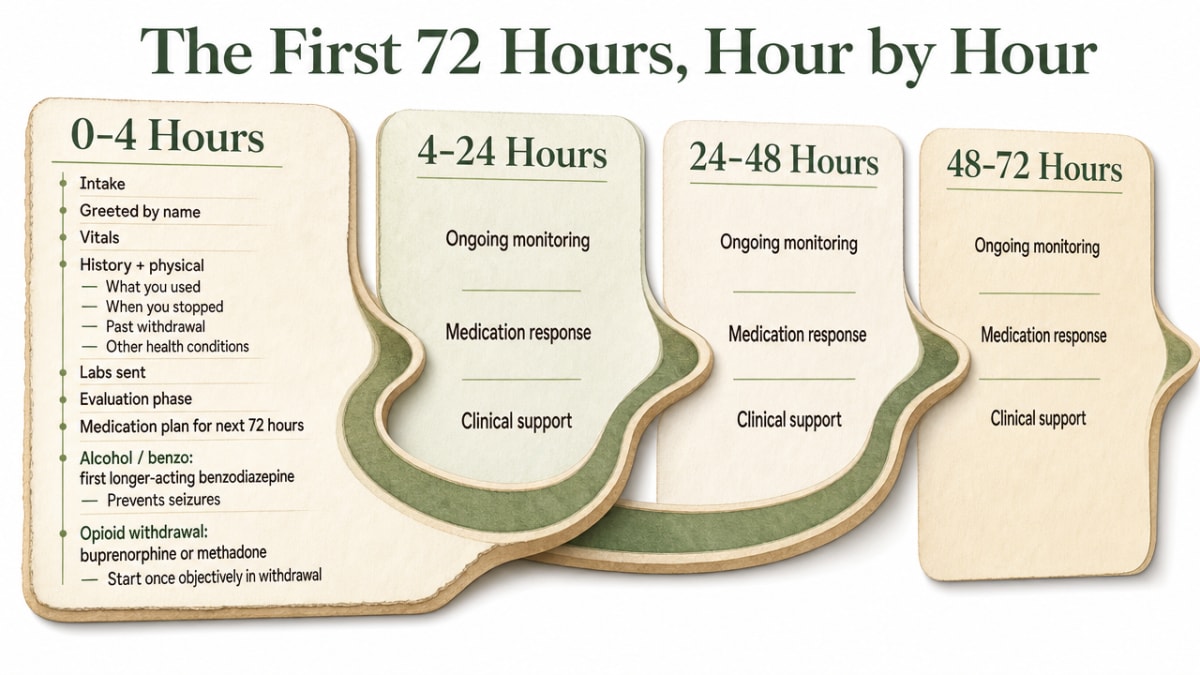
The first four hours are less clinical than you’d expect and more like being carefully seen. A nurse takes your vitals. A physician or advanced practice provider does a full history and physical: what you’ve used, when you stopped, what withdrawal has looked like for you before, what other health conditions you carry. Labs go out. This is the evaluation phase that TIP 45 puts at the front of every detox protocol, and it’s what determines the medication plan for the next 72 hours 5.
If you’re in early alcohol or benzo withdrawal, first doses of a longer-acting benzodiazepine are usually given inside this window to prevent seizures. If you’re opioid-withdrawing, a first dose of buprenorphine or methadone can start once you’re objectively in withdrawal—not before. You get a bed. You get water. You get a change of clothes if you need them. Someone shows you where the bathroom is and tells you what buzzer to press when you need help. That’s it. That’s hour one.
Hour 4 to 24: Stabilization Under 24/7 Supervision
This is where the phrase “medically supervised” stops being marketing and starts being a person walking into your room every couple of hours.
During the acute phase, the ASAM alcohol withdrawal guideline calls for reassessment every one to four hours 4. In practice, that means a nurse checking your blood pressure, pulse, temperature, tremor, sweating, and how oriented you are—then adjusting medication based on what they find. It’s called symptom-triggered dosing, and it’s why short-stay detox can be safe: nothing sits unwatched for long.
You’ll probably sleep in broken pieces. You might feel nauseous, sweaty, jumpy, or unable to hold still. You may feel weirdly fine and wonder if you needed to be there at all—that feeling passes. If you’re on opioids, cravings will show up hard around hour twelve to eighteen. Tell the nurse. That’s what the call button is for. This is the stabilization phase TIP 45 describes as the core of detox work 5, and every uncomfortable hour has someone assigned to it.
Hour 24 to 48: The Peak, and Why It’s Not the Whole Story
Day two is usually the hardest. That’s not a warning. It’s a promise that the shape of this has a curve, and the curve turns.
For alcohol, symptoms typically crest somewhere in the first 24 to 48 hours. For short-acting opioids like heroin or fentanyl, physical withdrawal peaks in this same window. Your team is still reassessing on that one-to-four-hour cadence 4, stepping medication up when you need it and back down when you don’t. The container is doing its job even when your body doesn’t feel like it.
Here’s what nobody tells you about the peak: it’s often when the emotional withdrawal shows up loudest. Shame. Anger. A strong urge to explain why you don’t belong there. That’s the substance leaving, not the truth speaking. Talk to the nurse. Talk to whoever comes by to check on you. You are not the first person to feel that at 3 a.m., and you won’t be the last.
Hour 48 to 72: Symptom Resolution and the Handoff
By hour 48, most people start to feel the edges soften. By hour 72, if things have gone the way they usually do, you’re eating, sleeping in longer stretches, and having conversations that make sense.
The clinical bar for discharge from alcohol withdrawal is specific: symptoms have resolved, you’re on minimal or no benzodiazepines, any metabolic problems are improving, and follow-up is scheduled within two weeks 1. Your team isn’t guessing about when you’re ready. They’re checking against criteria.
The last day is also when the handoff gets built. A counselor or case manager sits with you and maps what comes next—residential treatment, an intensive outpatient program, MOUD continuation through an opioid treatment program, or a slower benzo taper at a lower level of care. This is the third phase TIP 45 names explicitly: fostering readiness for and entry into ongoing treatment 5. Day three isn’t a finish line. It’s a door somebody walks you through, with the next appointment already on the calendar.
What Level of Care Are You Actually Asking For?
When you type “3-day detox near me,” you’re usually asking for one specific level of care without knowing its name.
The technical label is ASAM Level 3.7-WM: medically monitored inpatient withdrawal management, defined as severe withdrawal requiring 24-hour nursing care and physician visits, where the patient is unlikely to complete withdrawal without medical monitoring 10. That’s the level of care that fits a 3-day inpatient stay. It’s also the level insurers recognize and authorize when your intake team calls to verify benefits.
Inside that box, the work follows three phases that SAMHSA’s TIP 45 lays out as the shape of every legitimate detox program: evaluation, stabilization, and fostering readiness for and entry into ongoing treatment 5. Phase one happens in the first hours. Phase two takes up most of the 72. Phase three is the handoff on day three.
TIP 45 is explicit that these protocols are best-practice guidelines meant to sit inside a broader continuum of care 7. That’s the part worth holding onto. Asking for a 3-day detox isn’t asking for a fix. It’s asking for a safe, staffed doorway into the rest of it.
The Fears Nobody Says Out Loud
Judgment, Restraint, and Whether Your Job Will Find Out
Let’s say the quiet parts out loud, because they’re the reason a lot of people don’t call.
You will not be judged in a way that matters. The people who work medical detox floors have seen every substance, every combination, every version of the story you’re rehearsing in your head. Your history is a clinical fact, not a character verdict. It goes into your chart so the team can dose you safely, not into a group text.
You will not be restrained for showing up. Medical detox is voluntary. You can walk in wearing whatever you’re wearing, and you can leave against medical advice if it comes to that. Restraints exist in medicine for narrow safety situations, not as punishment for using.
Your job usually won’t find out unless you tell them. Federal privacy protections around substance use treatment are stricter than general medical privacy. Your employer isn’t called. If you need time off, many people use FMLA or short-term disability for “a medical condition” without naming the diagnosis. Ask the intake team about the paperwork options before you assume the worst.
When to Call 911 Instead of a Detox Line
Day Four and Beyond: Why the Handoff Matters More Than the Detox
Here’s the sentence most detox marketing pages will not print: getting through 72 hours doesn’t treat addiction. It treats withdrawal.
SAMHSA’s federal guidelines on opioid treatment say it plainly. Short-term medically supervised withdrawal alone is not recommended because return-to-use rates are high 2. That isn’t a knock on detox. Detox does exactly what it says. It gets your body through the acute physical piece safely. The next question—what keeps you well on day thirty, day ninety, day three-hundred—needs a different answer.
That answer is usually one of a few shapes. Residential treatment for a few weeks, where the container stays around you while you build a foothold. Intensive outpatient, where you sleep at home but spend real hours each week in group and individual work. For opioids, continuation on buprenorphine, methadone, or naltrexone through an opioid treatment program—the same MOUD your detox team likely bridged you onto in the first 72 hours 3. For benzos, a slower taper at a lower level of care.
The best day-three discharge you can ask for isn’t a handshake and a goodbye. It’s a specific appointment, on a specific calendar, with a specific person, before you walk out the door.
Making the Call in Oklahoma City
You’ve read enough. What’s left is a phone call.
When you dial a local medical detox line, the person answering can usually tell you within fifteen minutes whether a bed is available today, what your insurance covers, and how you’ll get there. That’s the whole first step. Not paperwork. Not a promise to think about it. A conversation.
If you’re in Oklahoma City and you want the call to be short, honest, and rooted in the kind of care that treats you like a person before a patient, Renewal Springs Detox is one place to start. Whoever you call, call someone. The three days start when you say yes.
Ready for Detox? Speak With Us Now
Connect instantly for guidance and rapid admission when every minute counts most.
Frequently Asked Questions
Can I really check in today, or will I be put on a waiting list?
Most days, yes, you can be admitted within a few hours of the first phone call. A nurse or intake counselor screens you by phone, checks bed availability, and starts insurance verification while you’re still on the line. If beds are full at one facility, they’ll usually tell you where to go instead. Waiting lists exist for longer residential programs, not for acute medical detox.
What if I can’t afford it and don’t have insurance?
Ask anyway. Many facilities offer self-pay rates, sliding scale pricing, or access to state-funded beds for uninsured Oklahomans. Some carry charity care allotments. Medicaid enrollment can sometimes happen at intake. The intake team has seen every financial situation and will tell you your real options in one phone call. Not asking is the only guaranteed no.
Will my employer or family find out I went to detox?
Not unless you tell them. Federal privacy rules around substance use treatment (42 CFR Part 2) are stricter than standard medical privacy. Your employer isn’t notified. If you need time off, FMLA or short-term disability paperwork can list “a medical condition” without naming a diagnosis. You choose who gets called, who visits, and what shows up on any form that leaves the building.
Can I just detox at home if I have someone to watch me?
For alcohol or benzodiazepines, please don’t. Sedative-hypnotic withdrawal carries real seizure and mortality risk, and a family member watching you isn’t a substitute for a nurse checking vitals every one to four hours 6. For opioids and stimulants, home withdrawal is rarely dangerous but is often the reason people use again within 24 hours. A supervised bed removes that option.
What should I bring, and what happens to my phone?
Bring an ID, your insurance card, a list of medications you take, and a small bag of comfortable clothes. Skip anything with drawstrings or glass. Most facilities let you keep your phone with limits, common ones being no calls during group hours and no photos of other patients. Rules vary. Ask when you call. Nobody confiscates your life at the door.
What if I change my mind and want to leave after day one?
You can. Medical detox is voluntary, and leaving against medical advice is your right. Your team will tell you honestly what leaving on day one means clinically, especially for alcohol or benzos where the peak hasn’t happened yet. They’ll offer to talk it through. If you still want to go, they’ll help you leave as safely as possible and keep the door open.
References
- Alcohol Withdrawal in Hospitalized Patients. https://www.ncbi.nlm.nih.gov/books/NBK604324/
- Federal Guidelines for Opioid Treatment Programs. https://library.samhsa.gov/sites/default/files/federal-guidelines-opioid-treatment-pep24-02-011.pdf
- Practice Guidance for Hospital and Opioid Treatment Program Coordination of Care. https://www.mass.gov/doc/practice-guidance-for-hospital-otp-coordination-of-care/download
- The ASAM Clinical Practice Guideline on Alcohol Withdrawal Management. https://pubmed.ncbi.nlm.nih.gov/32511109/
- Quick Guide for Clinicians Based on TIP 45—Detoxification and Substance Abuse Treatment. https://nida.nih.gov/sites/default/files/samhsa_detoxification_and_substance_abuse_treatment.pdf
- Detoxification and Substance Abuse Treatment Training Manual (SAMHSA TIP 45). https://www.govinfo.gov/content/pkg/GOVPUB-HE20_400-PURL-LPS125431/pdf/GOVPUB-HE20_400-PURL-LPS125431.pdf
- Detoxification and Substance Abuse Treatment – Preface (TIP 45). https://www.ncbi.nlm.nih.gov/books/NBK65510/
- Inpatient Management of Benzodiazepine Withdrawal: A …. https://pubmed.ncbi.nlm.nih.gov/42294745/
- An Inpatient Protocol for the Treatment of Methamphetamine Withdrawal. https://pubmed.ncbi.nlm.nih.gov/38227855/
- Overview of Substance Use Disorder (SUD) Care Clinical Guidelines and the ASAM Criteria. https://www.medicaid.gov/state-resource-center/innovation-accelerator-program/iap-downloads/reducing-substance-use-disorders/asam-resource-guide.pdf