
Key Takeaways
- A seven-day detox is a clinical window matched to your withdrawal risk through SAMHSA’s five levels of care, not a fixed package you can order online 2.
- Seven days often fits moderate alcohol or opioid stabilization but runs short for benzodiazepine tapers and can be excessive for mild cases handled in ambulatory settings 1.
- Social detox offers supportive supervision, while medical detox in Oklahoma must be provided or supervised by a licensed physician who can manage complications like delirium tremens 10.
- Withdrawal risk varies by substance — alcohol and benzodiazepines can be fatal, opioids drive relapse risk, and stimulants demand co-occurring mental health capability 4.
- Verify an Oklahoma facility in five minutes by confirming ODMHSAS certification, physician supervision, national accreditation, co-occurring capability, and a concrete day-eight plan 5.
- Before calling, gather your insurance details, substance history, and current medications so the intake nurse can quickly assess withdrawal risk using ASAM’s dimensions 3.
- Watch for red flags like vague certification answers, no named medical director, unrealistic taper promises, missing discharge planning, and high-pressure bed-hold sales tactics.
- A strong day-eight handoff to residential treatment, outpatient care, or medication-assisted treatment is what makes detox stick, since detox alone rarely produces lasting change 7.
The Window You’re In Right Now
You’re reading this because something shifted. Maybe it happened at 4 a.m. when the shakes started again. Maybe your kid asked a question you couldn’t answer. Maybe you just typed the phrase into a search bar and now you’re here, phone warm in your hand, wondering if today is really the day.
It is. And you’re already doing the hard part by looking.
Here’s what you need to know before we go further: a “7-day detox” is not a package you order. It’s a clinical window, and the right length for you depends on what you’ve been using, how your body is reacting, and what kind of monitoring keeps you safe. Federal guidance from SAMHSA’s TIP 45 makes this clear — detox happens across five different levels of care, and matching you to the right one is done by trained staff, not by a website 2.
This guide walks you through the next few hours. What to check before you call. What to say when someone answers. How to tell a legitimate Oklahoma detox center from a bad one in under five minutes. What to pack. What insurance actually covers. And what happens on day eight, because that part matters more than most people tell you.
Take a breath. Keep reading. The window is still open.
Why ‘7 Days’ Is a Clinical Range, Not a Product
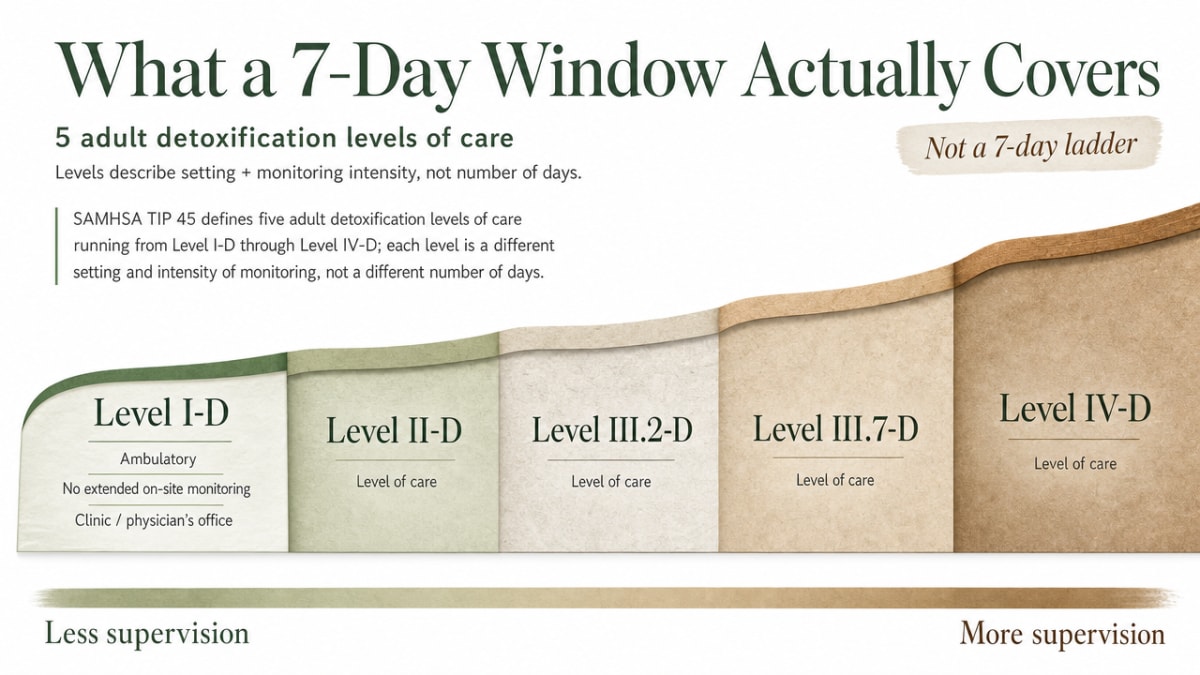
What a 7-Day Window Actually Covers
When you searched “7 day detox centers near me,” a number showed up in your head: seven. It felt manageable. A week off. A reset. Here’s the honest version — seven days is a common length for medical withdrawal management, but the clinical world doesn’t organize itself around a calendar. It organizes itself around what your body is doing and how much supervision keeps you safe.
SAMHSA’s TIP 45, the federal guidance most detox programs are built on, defines five adult detoxification levels of care, running from Level I-D through Level IV-D 2. Each level describes a different setting and a different intensity of monitoring — not a different number of days 3.
Here’s what those five levels look like in plain terms:
- Level I-D — Ambulatory detox without extended on-site monitoring. You come to a clinic or physician’s office, get checked, take medication, and go home. Best for mild withdrawal with a safe home environment 3.
- Level II-D — Ambulatory detox with extended on-site monitoring. You spend hours at the facility during the day, with nurses tracking your vitals, then sleep at home 3.
- Level III.2-D — Clinically managed residential detox. Often called “social detox.” You stay overnight, but medical staff aren’t on-site around the clock 3.
- Level III.7-D — Medically monitored inpatient detox. A residential facility with 24/7 nursing and physician oversight. This is where most people picturing a “7-day detox” actually belong 6.
- Level IV-D — Medically managed intensive inpatient detox. A hospital setting for the sickest patients — seizures, delirium tremens, serious medical complications 6.
Which level fits you gets decided at intake, using ASAM’s six assessment dimensions — things like your withdrawal risk, medical history, and whether home is safe to return to 3. The “7 days” you saw advertised is usually shorthand for Level III.7-D. It’s a common landing spot, not a rule.
When 7 Days Is Right, Too Short, or Too Long
So when is seven days the right window, and when is it the wrong one? The answer depends almost entirely on the substance and how your body is metabolizing withdrawal in real time.
When 7 days tends to fit. A medically supervised inpatient stay of roughly a week is a common range for moderate alcohol withdrawal, opioid stabilization, and stimulant recovery when sleep, appetite, and mood need clinical attention. For alcohol specifically, ASAM’s 2020 guideline supports symptom-triggered benzodiazepine regimens, scored with a tool called CIWA-Ar, which can shorten a stay when you respond well or extend it when symptoms escalate 1. The number on the brochure is a starting estimate. The number your care team writes down is what actually matters.
When 7 days is too short. Benzodiazepine withdrawal — Xanax, Klonopin, Ativan, Valium — often takes longer than a week because a safe taper is slow by design. Severe alcohol withdrawal with a history of seizures or delirium tremens can also need more time and, sometimes, a hospital-level setting 9. If a facility promises to “finish” a benzo detox in seven days, that’s a red flag, not a feature.
When 7 days is too long. Mild alcohol withdrawal in someone with a stable home, no seizure history, and strong support may be managed safely in an ambulatory setting under Oklahoma’s outpatient withdrawal standards, which still require vital sign monitoring and co-occurring disorder capability 4. Seven inpatient days isn’t a badge of seriousness — it’s a match to risk.
You don’t have to figure this out alone before you call. That’s what the assessment is for. But knowing the range exists means you can ask better questions, and you can tell the difference between a clinical answer and a sales pitch.
Medical Detox vs. Social Detox: Know Which One You Need
These two terms get used like they mean the same thing. They don’t, and the difference can be the reason you make it through the first 72 hours.
Oklahoma’s rules spell it out plainly. State regulation defines detoxification as eliminating the toxic effects of drugs and alcohol using supervised methods, and it names two distinct categories: social detoxification and medical monitoring or medical management 5. Same word on the sign out front. Very different clinical reality inside.
Social detox is a residential setting where staff support you through withdrawal, but medical care isn’t the core service. There may be nurses on shift some hours, and there are protocols for when to call an ambulance. It can be a real option for someone withdrawing from a substance with low medical risk, in stable enough shape that hour-by-hour physician oversight isn’t needed 2.
Medical detox — what Oklahoma calls medical withdrawal management — is a different animal. State rules require that these services be provided or supervised by a licensed physician, specifically to manage acute intoxication, delirium tremens, and withdrawal complications 10. That means someone can order medications, adjust doses in real time, and respond if your blood pressure spikes at 2 a.m.
Here’s the honest rule of thumb. If you’ve been drinking heavily every day, taking benzos regularly, or mixing substances, you need medical detox, not social. If a program can’t tell you who the supervising physician is, you’re looking at the wrong door.
Withdrawal Risk by Substance
Not every substance puts you in the same kind of danger. Knowing which one you’re coming off matters, because it tells you what level of monitoring you actually need — and it helps you push back if a facility tries to slot you into the wrong bed.
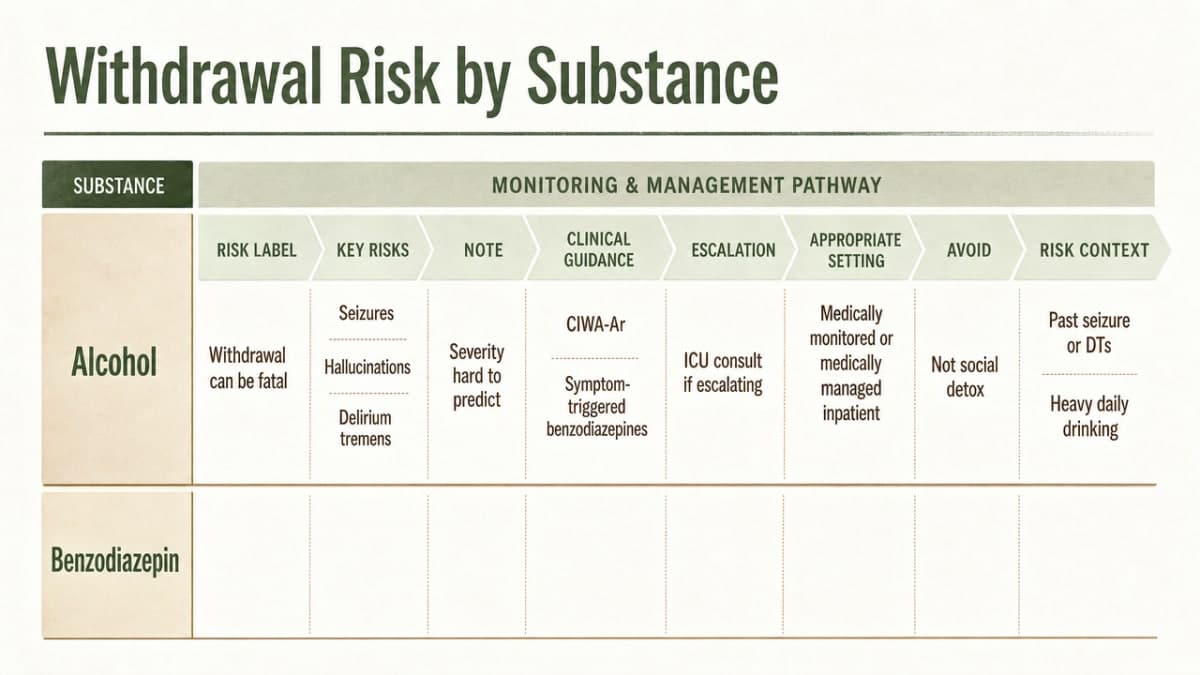
Alcohol. This is one of two substances where withdrawal itself can kill you. Seizures, hallucinations, and delirium tremens are real risks, and severity is hard to predict from how much you drank. ASAM’s 2020 guideline is written specifically for adults hospitalized with alcohol withdrawal of any severity and recommends symptom-triggered benzodiazepine treatment, scored with CIWA-Ar, with ICU consultation when things escalate 1. If you’ve been drinking heavily every day, especially with a past seizure or DTs, you belong in medically monitored or medically managed inpatient care — not social detox.
Benzodiazepines. Xanax, Klonopin, Ativan, Valium. This is the other category where withdrawal can be life-threatening, and it’s the one most often underestimated. A safe taper takes longer than a week, and stopping cold can trigger seizures. Physician-supervised medical withdrawal management is the standard 10.
Opioids. Heroin, fentanyl, prescription painkillers. Withdrawal is miserable — bone pain, vomiting, insomnia, waves of anxiety — but rarely fatal in an otherwise healthy adult. The clinical concern is that untreated symptoms drive people right back to use, sometimes at doses their tolerance no longer supports. Medication-assisted treatment during and after detox changes that math, and TIP 45 supports matching opioid patients to settings with real medical oversight 7.
Stimulants. Meth, cocaine, prescription amphetamines. Withdrawal is more psychological than physical — crushing fatigue, deep depression, sometimes suicidal thinking. Monitoring focuses on mood and safety rather than seizure risk. Co-occurring disorder capability, which Oklahoma requires even at ambulatory levels, matters here 4.
Kratom and polysubstance use. Kratom withdrawal looks like a milder opioid withdrawal for most people, but it’s under-studied and mixes unpredictably with other drugs. If you’ve been using more than one substance — and most people are — placement gets decided by the highest-risk one, not the average 3.
When you call, name every substance and every dose, honestly. The intake nurse isn’t judging. They’re building the plan that keeps you alive.
How to Verify an Oklahoma Detox Center in Five Minutes
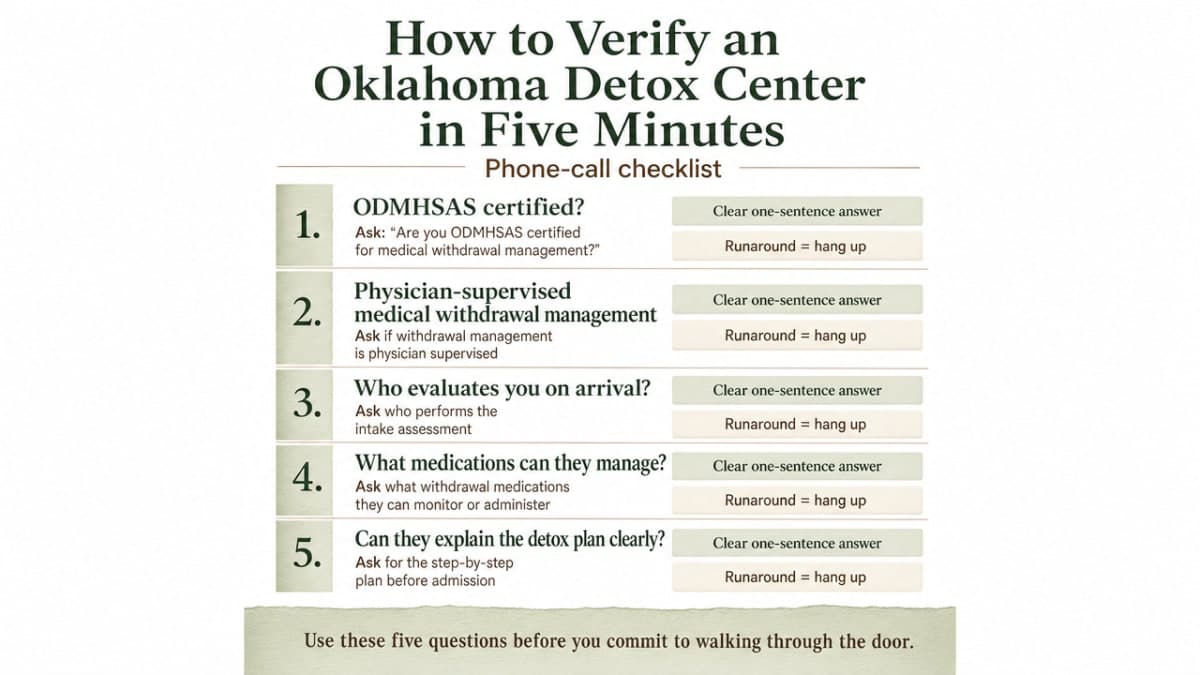
You don’t have hours to research a facility. You have a phone, a Google search bar, and maybe someone else in the room quietly hoping you’ll finish this and dial. So here’s a filter you can actually run before you commit to walking through anyone’s front door.
- State certification through ODMHSAS. In Oklahoma, substance-related treatment facilities must be certified by the Oklahoma Department of Mental Health and Substance Abuse Services. Chapter 18 spells this out — certification is not optional for facilities offering detoxification services 5. Ask directly: “Are you ODMHSAS certified for medical withdrawal management?” A real facility will answer in one sentence. If you get a runaround, hang up.
- Physician-supervised medical withdrawal management. Under Oklahoma’s 2023 rules, medical withdrawal management — the service you need if you’re coming off alcohol, benzos, or heavy opioid use — must be provided or supervised by a licensed physician 10. Ask who the medical director is and whether a physician is available around the clock. “We have a doctor on call” is not the same as physician-supervised care. Press for specifics.
- National accreditation for residential detox. ODMHSAS requires that residential level of care providers, including medical detox, hold national accreditation on top of state certification to be eligible for SoonerCare reimbursement 11. Even if you’re not using SoonerCare, accreditation from a body like The Joint Commission or CARF is a meaningful signal that an outside auditor has looked under the hood. Ask which accrediting body and when the last survey happened.
- Co-occurring disorder capable. Oklahoma’s ambulatory withdrawal management rule requires that services be co-occurring disorder capable — meaning the program can handle depression, anxiety, PTSD, or other mental health conditions alongside the substance withdrawal 4. This is a baseline expectation across levels of care, not a specialty feature. If a facility treats mental health as someone else’s problem, that’s a gap that will follow you into day three.
- A written day-8 plan. Ask what happens when your medical detox ends. A legitimate program will describe residential treatment, outpatient handoffs, or ongoing care coordination — because TIP 45 is explicit that detox without follow-up rarely produces lasting change 7. If the answer is “we’ll figure it out later,” that’s the wrong answer.
Five questions. Five minutes. If a facility clears all five, you’re looking at a real front door. If it fumbles more than one, keep dialing.
What to Do in the Next Two Hours
The Phone Call: What to Say to an Intake Nurse
Picking up the phone is the hardest part. Once someone answers, the conversation is more structured than you’d think — the person on the other end has done this call hundreds of times, and they’re listening for specific things so they can help you fast.
Here’s what to have ready before you dial. Your date of birth. The name of your insurance and the member ID number if you have the card. A short, honest inventory of what you’ve been using — the substance, roughly how much per day, and when you last used. If you’re on any prescription medications, especially anything for blood pressure, seizures, or mental health, have the bottles nearby.
When the intake nurse picks up, keep it simple. Something like: “I think I need medical detox. I’ve been drinking about a fifth of vodka a day for the last six months, and my last drink was around noon.” That one sentence gives them the three things they need most — the substance, the amount, and the timing — so they can start estimating your withdrawal risk against ASAM’s assessment dimensions 3.
They’ll ask more questions. Past seizures. Past detox attempts. Whether you’ve ever had DTs. Whether you’re using anything else, including benzos or opioids or kratom. Whether you have a safe place to be tonight. None of these questions are traps. They’re the tools the nurse uses to figure out whether you need medically monitored inpatient care, a hospital setting, or something less intensive 6.
If you start crying, keep talking. If you go blank, tell them you’re scared and ask them to walk you through what happens next. This is a hard call to make, and you can make it in the next ten minutes.
Insurance, SoonerCare, and Out-of-Pocket Realities
Money fears will try to talk you out of this call. Don’t let them win before you have real numbers.
Most legitimate Oklahoma detox centers verify insurance benefits for free, usually within an hour, sometimes while you’re still on the phone. Have your insurance card in front of you, or a photo of the front and back on your phone. If you don’t have the card, your member ID from a pharmacy receipt or an old EOB works.
If you have SoonerCare, ask directly whether the facility is contracted with SoonerCare for residential medical detox. Under ODMHSAS rules, residential detox providers must hold national accreditation in addition to state certification to be eligible for SoonerCare reimbursement, so this is a real filter, not a formality 11. If you have commercial insurance, ask about in-network status, deductible remaining, and any pre-authorization requirements.
If you’re uninsured or underinsured, say so. Ask about sliding-scale options, state-funded beds, or referral to a facility that accepts your situation. Cost should not be the reason you don’t get help tonight, but you deserve honest numbers before you walk in — not a surprise bill on day nine.
What to Pack and What to Leave Behind
Keep the bag small. Most detox facilities have restrictions on what you can bring, and the intake nurse will tell you the specifics for their program.
Bring: Two or three changes of comfortable clothes. Slip-on shoes. A pair of pajamas. Toiletries in clear containers, no alcohol in the ingredients (yes, they check the mouthwash). Your ID, insurance card, and a list of current medications with dose and frequency. A phone charger. One book if reading helps you settle.
Leave behind: Anything sharp. Anything with alcohol in it. All substances, including anything you’ve been tapering yourself with. Valuables and jewelry — most facilities can’t secure them, and you don’t need the worry. Work laptops. Weapons of any kind.
Handle before you go: Tell one person where you’ll be. Arrange care for kids or pets. Put a short auto-reply on your work email if you can. You don’t owe anyone a full explanation. “I’m handling a medical issue and will be offline for about a week” is enough.
Red Flags in a Detox Center
Most detox centers you’ll find in a search do real, humane work. Some don’t. The tricky part is that the ones that don’t often have the shiniest websites, because marketing budgets and clinical quality aren’t the same thing. Here’s what makes a real intake nurse wince when they hear it from a patient later.
No clear answer on state certification. If you ask whether the facility is certified by ODMHSAS for medical withdrawal management and the person on the phone stumbles, deflects, or says something vague like “we work with all the right agencies,” that’s your answer. Oklahoma requires certification for substance-related treatment facilities 5. It’s a yes-or-no question.
No physician actually supervising the detox. Under Oklahoma’s 2023 rules, medical withdrawal management must be provided or supervised by a licensed physician 10. “A nurse checks on you” isn’t the same thing. Ask for the medical director’s name. Real facilities give it.
Promises that don’t fit the substance. A program that guarantees you’ll be “completely done” with benzodiazepine dependence in seven days is either misinformed or lying. A safe benzo taper takes longer than that, and a facility making that promise is prioritizing bookings over your body.
No day-8 plan. If nobody can describe what happens when detox ends, you’re being sold a room, not a recovery. TIP 45 is direct: detox without follow-up rarely produces lasting change 7.
Pressure tactics. “You have to decide right now or we lose the bed” is a sales script, not clinical urgency. Real intake staff will hold a bed while you verify insurance or talk to a family member. They understand that ambivalence is part of the disease, not a reason to hard-close.
Trust the flinch. If something feels off, keep dialing.
The Day-8 Plan: Why Detox Alone Rarely Holds
Here’s the part most brochures skip. Seven days of medical detox gets the substances out of your body and gets you medically stable. It does not, by itself, change the reasons you were using in the first place. TIP 45 is blunt about this — detoxification is not substance abuse treatment, and without follow-up care, it is unlikely to have any lasting effect 7. TIP 39 says the same thing in different words: detox is an essential precursor to treatment for many people, not a substitute for it 8.
That’s not a scare tactic. It’s the math of your nervous system. Your brain has spent months or years adapting to a substance. A week of medical stabilization gives it a fair starting line — it doesn’t rewire what got you here.
So when you’re evaluating a program, ask what day eight looks like before you ever check in. A real answer sounds specific. Residential treatment at a partner facility. An intensive outpatient program starting the Monday after discharge. A scheduled appointment with a physician for medication-assisted treatment continuation. A therapist name and a first session on the calendar. Family therapy, peer support, sober housing — some combination that means you’re not walking out the door and back into the exact conditions that brought you in.
If your discharge plan is a printed list of phone numbers and a wave goodbye, the program did half its job. The stronger the handoff, the more that hard week actually holds. Ask about it on the first call. Ask again on day three. This is your recovery — the plan should have your name on it.
Ready to Start Detox? Connect Instantly Now
Speak directly with a specialist for immediate answers and rapid admission support when you’re ready to act.
Frequently Asked Questions
Is a 7-day detox long enough for alcohol or benzodiazepine withdrawal?
For moderate alcohol withdrawal, a week of medically monitored care is often enough, especially when symptom-triggered benzodiazepine protocols and CIWA-Ar scoring guide the taper 1. For benzodiazepines, seven days is usually too short — a safe taper is slow by design, and any program promising to finish it in a week should raise your eyebrows. Your care team sets the actual length based on how your body responds, not the brochure.
What’s the difference between medical detox and social detox?
Oklahoma rules name both as forms of detoxification but treat them differently 5. Social detox is a supportive residential setting without hour-by-hour physician oversight. Medical detox — what the state calls medical withdrawal management — must be provided or supervised by a licensed physician who can order medications and respond to complications like delirium tremens in real time 10. If you’re coming off alcohol, benzos, or heavy opioids, you need medical detox.
How do I verify that an Oklahoma detox center is legitimate?
Ask five questions on the first call. Are you ODMHSAS certified for medical withdrawal management 5? Who is the supervising physician 10? What national accrediting body has surveyed you 11? Are you co-occurring disorder capable 4? And what does the discharge plan look like on day eight 7? A real program answers each in a sentence. Fumbling on more than one is your signal to keep dialing.
Will SoonerCare or my private insurance cover a 7-day medical detox?
Often, yes — but details matter. For SoonerCare, the facility must hold national accreditation on top of ODMHSAS state certification to be reimbursement-eligible for residential medical detox 11. For private insurance, coverage depends on in-network status, deductible, and pre-authorization. Most legitimate centers verify benefits free within an hour. If you’re uninsured, say so on the first call and ask about state-funded beds or sliding-scale options.
What should I say when I call a detox center for the first time?
Keep it simple. Name the substance, roughly how much per day, and when you last used. Something like: “I think I need medical detox. I’ve been drinking about a fifth of vodka a day for six months, and my last drink was noon.” That gives the intake nurse what they need to begin an ASAM-based assessment 3. If you go blank, tell them you’re scared and ask what happens next.
What happens after the 7 days are over?
Day eight is where the real work begins. TIP 45 is direct: detoxification is not substance abuse treatment, and without follow-up care it rarely produces lasting change 7. TIP 39 echoes this — detox is a precursor to treatment, not a substitute for it 8. A strong discharge plan names the next setting: residential treatment, intensive outpatient starting Monday, a medication-assisted treatment appointment, a therapist, peer support. Ask about it on the first call.
References
- Executive Summary of the American Society of Addiction Medicine Clinical Practice Guideline on Alcohol Withdrawal Management. https://pubmed.ncbi.nlm.nih.gov/32909985/
- TIP 45: Detoxification and Substance Abuse Treatment. https://www.govinfo.gov/content/pkg/GOVPUB-HE20_400-PURL-gpo124442/pdf/GOVPUB-HE20_400-PURL-gpo124442.pdf
- Settings, Levels of Care, and Patient Placement – Detoxification and Substance Abuse Treatment (TIP 45). https://www.ncbi.nlm.nih.gov/books/NBK64109/
- Okla. Admin. Code § 450:24-3-64 – Ambulatory Withdrawal Management Without Extended On-site Monitoring Environment. https://www.law.cornell.edu/regulations/oklahoma/OAC-450-24-3-64
- Oklahoma ODMHSAS – Chapter 18 Standards and Criteria for Substance‑Related and Addictive Disorder Treatment Facilities (2021). https://oklahoma.gov/content/dam/ok/en/odmhsas/documents/policy/provider-certification/administrative-rules/2021/Chapter%2018%20Final%20effective%209-15-21.pdf
- Quick Guide for Clinicians Based on TIP 45—Detoxification and Substance Abuse Treatment. https://nida.nih.gov/sites/default/files/samhsa_detoxification_and_substance_abuse_treatment.pdf
- Detoxification and Substance Abuse Treatment (TIP 45) – NCBI Bookshelf. https://www.ncbi.nlm.nih.gov/books/NBK64115/
- TIP 39: Substance Abuse Treatment and Family Therapy. https://www.govinfo.gov/content/pkg/GOVPUB-HE20_400-PURL-gpo81969/pdf/GOVPUB-HE20_400-PURL-gpo81969.pdf
- The ASAM Clinical Practice Guideline on Alcohol Withdrawal Management. https://pubmed.ncbi.nlm.nih.gov/32511109/
- Oklahoma ODMHSAS – Chapter 18 Provider Certification Rules (2023). https://oklahoma.gov/content/dam/ok/en/odmhsas/documents/policy/provider-certification/administrative-rules/2023/PC–Chapter-18-Final-effective-9-15-23.pdf
- Oklahoma ODMHSAS – Provider Certification. https://oklahoma.gov/odmhsas/policy/provider-certification.html
- CMS – Hospitals: Conditions of Participation and Coverage. https://www.cms.gov/medicare/health-safety-standards/conditions-coverage-participation/hospitals