
What Does Rehab for Meth Addiction Actually Involve?
Key Takeaways
- Meth rehab centers on behavioral treatment because no FDA-approved medication exists for stimulant use disorder, making contingency management and CBT the clinical core rather than optional add-ons 11.
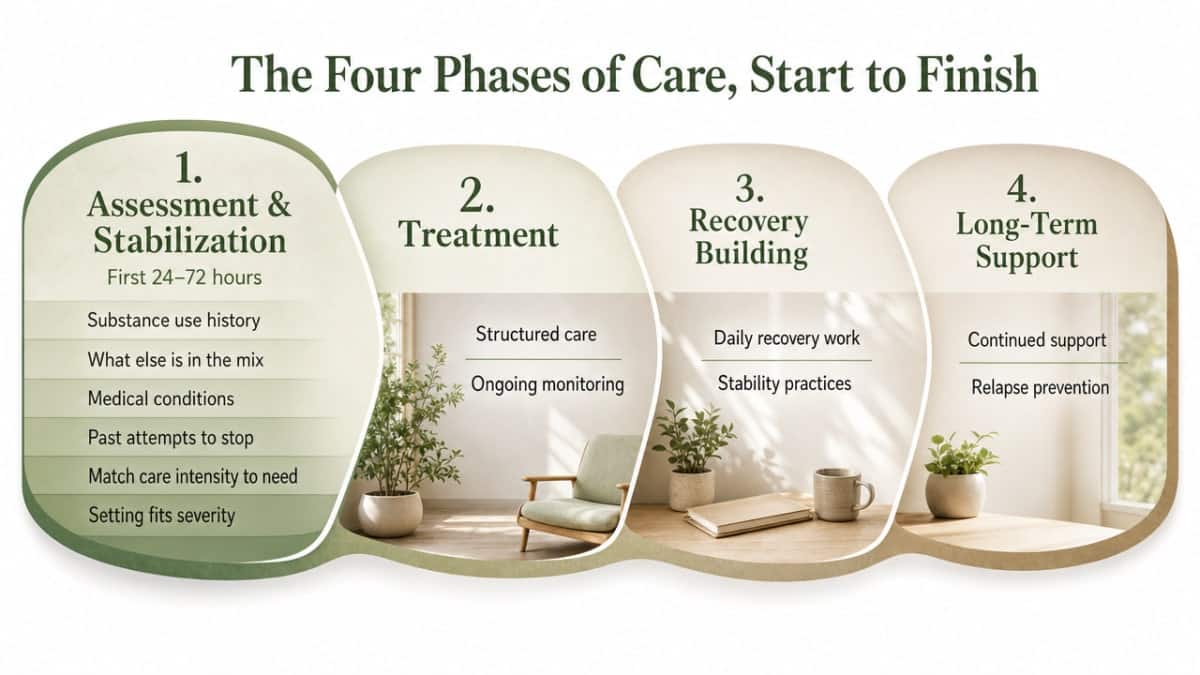
- Care unfolds across four phases: 24–72 hour assessment and stabilization, one to two weeks of withdrawal management, a 16-week Matrix Model intensive outpatient block, and longitudinal aftercare 1, 12.
- When choosing a program, verify it offers meaningful contingency management incentives, a Matrix or CBT-based schedule, integrated care for co-occurring conditions, and a specific aftercare plan 11, 12.
- In Oklahoma, SoonerCare covers detox, residential rehab, outpatient counseling, and MAT services, though residential care and certain medications require prior authorization 9, 13, 14.
Why Meth Recovery Follows a Different Playbook
If you have been reading about rehab, you may have noticed that most articles blur together. Detox, therapy, aftercare — the same three-word summary, whether the drug is heroin, alcohol, or meth. That summary is not wrong, but it hides something important about meth: the tools clinicians reach for are not the same ones you have heard about for opioids or alcohol.
Here is the hinge that changes everything. There is no FDA-approved medication for stimulant use disorder, which includes methamphetamine. SAMHSA’s 2025 advisory puts it plainly: in the absence of any FDA-approved medications for stimulants, contingency management is considered a primary and potentially life-saving intervention 11. That single fact reshapes what rehab for meth addiction looks like for you or your loved one. There is no meth version of methadone or Suboxone. No daily pill that quiets the craving in a reliable, approved way.
What that means in practice: behavioral treatment is not the soft supplement to a medication plan. It is the plan. The structure of your days, the incentives built into your progress, the therapy skills you rehearse each week — those carry the clinical weight.
This is hard news, and it is also honest news. You are not walking into a broken system. You are walking into a different one, built around what actually helps people stop using meth and stay stopped.
The Four Phases of Care, Start to Finish
Assessment and Stabilization: The First 24 to 72 Hours
The first three days are less about treatment and more about getting a clear picture of what your body and mind are doing. When you or your loved one arrives at a program, a clinician will sit down and ask a lot of questions. How much meth, how often, how long. What else is in the mix — alcohol, benzodiazepines, opioids, nicotine. What medical conditions are in play. What has happened during past attempts to stop. This is not paperwork for paperwork’s sake. It shapes every decision that comes next.
Stabilization also means matching the intensity of care to what your body actually needs. The ASAM/AAAP guideline is direct on this point: acute stimulant intoxication and its aftermath require an appropriate level of care, meaning the setting has to fit the severity 1. Someone arriving with a racing heart, dangerously high blood pressure, or signs of stimulant-induced psychosis needs closer medical eyes than someone who used two days ago and is exhausted.
Expect vital signs checked often. Expect a review of any hyperadrenergic symptoms — the elevated heart rate, agitation, and blood pressure spikes that can follow heavy use 1. Expect questions about hallucinations or paranoid thinking, which meth can produce and which sometimes need short-term antipsychotic medication before they resolve 1.
If this sounds intense, it is. It is also the point at which the crisis stops escalating. You are being seen. Someone knows what you took, when, and what to watch for. That is a real milestone, even if it does not feel like one yet.
Withdrawal Management: What Meth Withdrawal Actually Feels Like
Meth withdrawal does not look like the withdrawal scenes you have seen on television. There is no shaking, no vomiting into a hotel toilet, no dramatic bedside vigil. That is a big reason people underestimate it — and a big reason they relapse.
Here is what the first week usually looks like. Days one and two, you crash. Sleep pulls at you in a way that feels almost gravitational. You may sleep 12, 14, 16 hours and still wake up flattened. Appetite comes back, sometimes fiercely. Anxiety and irritability run underneath everything. Some people experience vivid, unsettling dreams.
By day three or four, the physical crash lifts a little. That is where the harder part begins. Meth withdrawal is primarily psychological, and the symptoms that drive early relapse — anhedonia, cravings, and disrupted sleep — often intensify after the acute physical exhaustion fades 1. Anhedonia is the clinical word for what patients describe more simply: nothing feels good. Not food, not music, not sex, not sunlight. Your brain’s reward system, which meth has been hammering, needs time to recalibrate. During that window, using again feels like the only thing that would work.
This is why medically monitored withdrawal management matters even when there is no dramatic physical crisis to treat. Clinicians watch for lingering psychosis, mood collapse, and suicidal thinking, and they treat those with targeted medications when needed 1. Sleep can be supported. Anxiety can be managed. Nutrition and hydration get put back on track. Real-time monitoring of vitals, sleep, and stress — which some programs build in through wearable technology — gives the care team a fuller picture than what you can describe in a morning check-in.
Most of the acute symptoms ease over one to two weeks. Cravings and low mood can linger for months. Knowing that in advance is protective. When week five feels flat and hopeless, that is not a sign the program is failing. That is meth withdrawal doing what meth withdrawal does — and it is exactly when the next phase of care starts to matter most.
Structured Behavioral Treatment: The 16-Week Core
Once your body has stabilized, the real work of rehab begins — and it looks like a schedule. Not a mystical journey. A schedule.
The most studied structure for meth-specific rehab is the Matrix Model, a 16-week intensive outpatient program originally tested in the CSAT Methamphetamine Treatment Program, the largest randomized trial of meth treatment to date 8. Matrix is what SAMHSA’s counselor manual builds around:
- individual counseling
- group cognitive-behavioral therapy
- family education sessions
- relapse prevention groups
- social support groups
- mutual-help involvement
- regular urine testing 12
Sessions run multiple times a week for the first several months, then step down.
A typical week in the early phase might include two or three CBT-based groups, one individual session with your counselor, a family education night your loved ones can attend, and a urine drug screen. The group content is not generic self-help. It teaches specific skills: how to identify triggers, how to interrupt a craving before it becomes a plan, how to structure your day so that boredom and isolation — two of the biggest relapse drivers — do not run unchecked.
Be honest with yourself about the hardest part. Retention. Matrix and other CBT-based programs have real dropout rates, particularly in the first several weeks when withdrawal symptoms still weigh on you and progress feels invisible 12. Showing up for week four is a genuine accomplishment. Showing up for week eight, when your peers have started to drift, is bigger still.
Contingency management often runs alongside Matrix during this phase, adding tangible incentives for verified drug-free samples. Together, these two evidence-based approaches — structured behavioral programming plus reinforcement for staying stopped — form the clinical core of meth rehab in 2025 15, 16.
Ongoing Relapse Prevention and Recovery Support
Completing 16 weeks is not the end of rehab. It is the end of one phase.
Meth changes brain chemistry in ways that take longer to heal than most programs last. The ASAM/AAAP guideline emphasizes longitudinal recovery supports for exactly this reason: cravings, sleep problems, and mood symptoms can persist well past the acute treatment window, and ongoing care is what keeps early gains from unraveling 1.
This phase looks different for everyone. For some, it means stepping down to a weekly aftercare group and continuing individual therapy. For others, it means moving into a sober living environment while going to work again. Many people fold in mutual-help meetings — Crystal Meth Anonymous, SMART Recovery, Narcotics Anonymous — as a source of community that clinical hours cannot fully replace.
If you have a co-occurring condition — depression, PTSD, bipolar disorder, ADHD, chronic pain — this phase is where integrated treatment matters most. The guideline is clear that co-occurring disorders should be treated alongside the substance use disorder, not sequenced after it 1.
What Actually Works: The Evidence Behind Each Tool
Contingency Management: The Behavioral Standard of Care
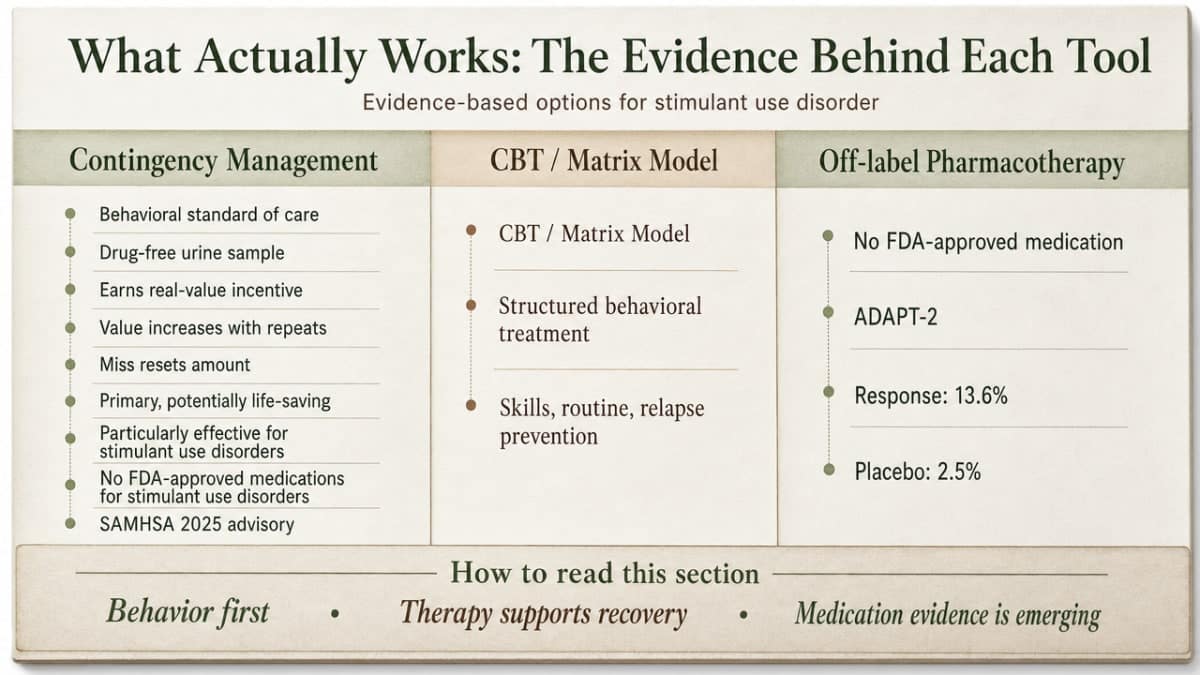
If one thing has changed the meth rehab conversation in the last decade, it is contingency management. The idea sounds almost too simple to be clinical: you provide a drug-free urine sample, you earn something of real value — a gift card, a prize draw, a voucher. Do it again, and the value climbs. Miss, and the amount resets.
What makes CM the standard is not the elegance of the idea. It is the depth of the evidence. SAMHSA’s 2025 advisory is direct on this: in the absence of any FDA-approved medications to treat stimulant use disorders, contingency management is considered a primary and potentially life-saving intervention, and it is particularly effective for people with stimulant use disorders 11. The same advisory raised the incentive cap for SAMHSA-funded programs to up to $750 per patient per year, a meaningful jump from earlier limits that had kept CM’s real-world reach small 11.
That dollar figure matters more than it looks. Patient interviews consistently show that when incentives are too small, motivation flattens; when they reflect real value, engagement rises 7. People who use meth are not asking for a windfall. They are asking for the incentive to be worth the effort of doing something enormously hard.
CM is not a substitute for the rest of care. It is layered on top of counseling, groups, and medical support 11. If a program you are considering does not offer CM at all, that is worth asking about — not as a dealbreaker, but as a signal of how current the program is with what the evidence actually says.
The Matrix Model, CBT, and Motivational Interviewing
If contingency management is the reinforcement layer, cognitive-behavioral therapy is the skills layer. In a CBT group for stimulant use, you learn to spot the sequence of thoughts and situations that lead to a craving, and you rehearse specific responses — calling someone, changing your environment, walking through a written plan you built when you were clear-headed.
The Matrix Model packages CBT into a structured 16-week program with individual counseling, group therapy, family education, urine testing, and mutual-help involvement all running in parallel 12. The systematic review of reviews by Ronsley and colleagues found that contingency management and CBT-based approaches carry the strongest evidence base for stimulant use disorder, with Matrix-type programs also showing benefit 16. SAMHSA’s evidence-based resource guide reaches the same conclusion and adds that community reinforcement approaches and motivational interviewing offer additive value when combined with the core interventions 15.
Motivational interviewing is the quieter piece. It is not a program on its own — it is how skilled counselors talk with you about change when you are ambivalent, which for most people entering meth rehab is nearly always. Rather than arguing you into commitment, a motivational interviewing conversation helps you name your own reasons for wanting something different. That sounds soft. In practice it is one of the more durable tools for keeping people in treatment past the weeks where dropout is highest.
The best programs stack these. CM for reinforcement. CBT for skills. Motivational interviewing woven through every conversation.
Medication Options: Where Pharmacotherapy Actually Stands
Here is where honesty matters most. There is no FDA-approved medication for methamphetamine use disorder. What exists is a growing body of research on off-label combinations that may help some people some of the time.
The most promising candidate right now is a combination of extended-release injectable naltrexone plus oral bupropion, studied in the NIH-funded ADAPT-2 trial. The numbers are worth looking at carefully. At weeks 5 and 6 of treatment, 16.5% of participants who received the naltrexone-bupropion combination were classified as responders, compared with 3.4% on placebo. At weeks 11 and 12, response rates were 11.4% versus 1.8% 2. That is a real, statistically meaningful difference. It is also a reminder that response rates in the double digits — not the majority of patients — represent the current frontier for meth pharmacotherapy.
Read those numbers with two things in mind. First, the combination was tested as an addition to psychosocial care, not a replacement for it 2. Second, ongoing trials are working to identify which patient profiles benefit most, because response is not uniform 4, 5. If a clinician offers naltrexone-bupropion as part of your rehab plan, that is consistent with current evidence — used off-label, with realistic expectations, alongside CM and CBT.
Other medications get discussed too: bupropion alone, mirtazapine, topiramate. Evidence for each is thinner and more mixed 16. None of them is a meth version of methadone. If someone promises you a pill that will make cravings vanish, that is a program to walk away from. The honest offer is this: behavioral care does the heavy lifting, and medication, when it fits your profile, can meaningfully add to what behavioral care is already doing 1.
Levels of Care: Outpatient, Residential, and What’s In Between
Not every person who needs meth rehab needs the same setting. That is not a marketing line — it is a clinical principle. The ASAM/AAAP guideline is direct that the level of care has to match what your body and life actually require, from acute medical monitoring on one end to weekly outpatient sessions on the other 1.
Here is a plain-language map of what is typically available.
Medically supervised detox is the most intensive starting point. It is a short stay — usually a few days to about a week — with round-the-clock monitoring of vital signs, psychiatric symptoms, and any dangerous complications like stimulant-induced psychosis or severe hyperadrenergic states 1. Detox is not treatment for the addiction itself. It is the safe on-ramp.
Residential rehab keeps you on-site for weeks at a time, with structured programming built into every day. In Oklahoma, residential SUD treatment is a defined Medicaid benefit with per diem reimbursement, though prior authorization is required and room and board are billed separately from clinical care 13. Residential makes sense when your home environment is unsafe, when you have relapsed from outpatient before, or when co-occurring conditions need close daily support.
Intensive outpatient (IOP) is where the Matrix Model lives — multiple group and individual sessions per week over 16 weeks, while you sleep at home 12. For many people with meth use disorder, IOP is the workhorse setting: intensive enough to reshape a week, flexible enough to keep a job or custody arrangement intact.
Standard outpatient is the step-down phase: weekly therapy, ongoing urine screens, continued CM if the program offers it.
Be honest about what you need. A residential stay followed by IOP is a common arc for people whose first attempts at outpatient did not hold. Starting at IOP is reasonable if your withdrawal is manageable and your surroundings support recovery. What you want to avoid is under-matching — using the lightest setting because it is the cheapest or most convenient, then losing progress because the structure was not enough.
Paying for Meth Rehab in Oklahoma: SoonerCare and Access
Cost fears keep people out of treatment longer than almost anything else. So let’s put the Oklahoma numbers on the table.
If you or your loved one has SoonerCare, Oklahoma’s Medicaid program, meth rehab is a covered benefit — not a favor, not a maybe. SoonerCare’s behavioral health coverage includes inpatient acute care, crisis stabilization, and medical detoxification, along with outpatient counseling and rehabilitative services for both adults and children 9. SAMHSA directs Oklahomans to the same conclusion: if you are enrolled in SoonerCare, you have access to services for mental health, drug, and alcohol issues 10.
A few specifics worth knowing before you call a program.
Residential rehab in Oklahoma requires prior authorization through Medicaid, and it is reimbursed on per diem rates tied to the level of care 13. Room and board are excluded from that per diem, and medications and physician services can be billed separately 13. In practice, that means the program admitting you will handle the authorization paperwork — but delays happen, and asking about the authorization timeline on your first call is fair game.
Medication-assisted treatment services are covered across SoonerCare populations, including expansion adults, though drugs used for SUD treatment may require prior authorization 14. That matters if a naltrexone-bupropion trial is part of your plan, or if you have a co-occurring opioid or alcohol use disorder that needs its own medication support alongside meth treatment.
If you are uninsured or underinsured, SAMHSA’s Oklahoma page points to helplines and federally supported health centers offering low-cost or free care 10. State-funded meth-specific programs exist too. The point is: cost should factor into which program you pick, not whether you go.
What to Look for in a Program — And What Should Raise a Flag
By the time you are calling programs, you have already done something hard. Now the question is which door to walk through. A short checklist helps.
- Ask whether the program uses contingency management. If yes, ask what the incentives actually are and how they escalate. CM without meaningful reinforcement value is CM in name only 7, 11.
- Ask whether the behavioral core is built on the Matrix Model or another CBT-based structure with a clear weekly schedule, family education, and urine testing 12.
- Ask how they handle co-occurring depression, PTSD, or ADHD — the answer should involve integrated treatment, not a referral for later 1.
- Ask what happens after the intensive phase ends. A program that cannot describe its aftercare in specifics is a program that treats aftercare as an afterthought.
Red flags are simpler. Anyone promising a pill that ends meth cravings is selling something the science does not support. A program that skips assessment, dismisses psychiatric symptoms, or has no plan for stimulant-induced psychosis is missing basics the ASAM/AAAP guideline treats as non-negotiable 1. Vague talk about “holistic healing” without named modalities is a signal to keep dialing.
You are allowed to ask hard questions. A good program welcomes them.
Talk to Someone Who Understands Meth Recovery
Connect right now for answers about meth detox and what support looks like from day one.
Frequently Asked Questions
How long does rehab for meth addiction usually last?
Plan for months, not weeks. The Matrix Model — the most studied structure for meth rehab — runs 16 weeks of intensive outpatient sessions, followed by a step-down phase with lighter ongoing support 12. If you start with residential care or medical detox, add another one to four weeks up front. Recovery itself is measured in months and years, and ongoing relapse prevention is part of what actually works 1.
Is there a medication that treats meth addiction the way Suboxone treats opioid addiction?
No. There is no FDA-approved medication for methamphetamine use disorder, which is why behavioral treatment carries the clinical weight 11. Research on off-label combinations like extended-release naltrexone plus bupropion is promising and may be offered alongside psychosocial care, but response rates are modest and it does not replace counseling, contingency management, or structured outpatient programming 2. If someone promises a pill that ends cravings, keep looking.
What does meth withdrawal actually feel like, and how long does it last?
The first two or three days are mostly a crash — heavy sleep, big appetite swings, low mood, irritability. After that, the psychological piece takes over: anhedonia (nothing feels good), disrupted sleep, and cravings that can actually intensify as the physical exhaustion fades 1. Acute symptoms usually ease within one to two weeks, but low mood and cravings can linger for months. That is normal, and it is treatable.
Does SoonerCare cover meth detox and residential rehab in Oklahoma?
Yes. SoonerCare’s behavioral health benefit covers inpatient acute care, crisis stabilization, medical detoxification, and outpatient counseling and rehabilitative services 9. Residential SUD treatment is covered on per diem rates but requires prior authorization, and room and board sit outside that per diem 13. Medication-assisted treatment services are also covered, subject to prior authorization for specific drugs 14. Programs typically handle the paperwork on your behalf.
What is contingency management, and why do clinicians say it works for meth?
Contingency management (CM) is a structured program that gives you something of real value — a gift card, prize draw, or voucher — each time you provide a drug-free urine sample, with the value climbing as you string together clean tests. SAMHSA’s 2025 advisory calls CM a primary, potentially life-saving intervention for stimulant use disorders and permits up to $750 per patient per year in incentives for grant-funded programs 11.
Do I need inpatient rehab, or can I recover from meth addiction as an outpatient?
It depends on what your body and surroundings actually need. The clinical guideline is that level of care should match severity — acute intoxication, stimulant-induced psychosis, or a chaotic home usually calls for residential or medically supervised detox first 1. Many people then step down into an intensive outpatient program like the Matrix Model, which delivers the core behavioral work while you sleep at home 12. An honest assessment decides.
References
- The ASAM/AAAP Clinical Practice Guideline on the Management of Stimulant Use Disorder. https://pmc.ncbi.nlm.nih.gov/articles/PMC11105801/
- Combination Treatment for Methamphetamine Use Disorder Shows Promise (NIH News Release). https://www.nih.gov/news-events/news-releases/combination-treatment-methamphetamine-use-disorder-shows-promise-nih-study
- Utilizing a Two-Stage Design to Investigate Naltrexone plus Bupropion for Methamphetamine Use Disorder. https://pmc.ncbi.nlm.nih.gov/articles/PMC4969133/
- Baseline Moderators of Response to Naltrexone and Bupropion in Methamphetamine Use Disorder Trials. https://pmc.ncbi.nlm.nih.gov/articles/PMC12798896/
- Naltrexone/Bupropion for the Treatment of Methamphetamine Use Disorder (NCT06233799). https://clinicaltrials.ucsd.edu/trial/NCT06233799
- Implementing an Evidence-Based Prize Contingency Management Program (J Subst Use Addict Treat 2023). https://pubmed.ncbi.nlm.nih.gov/37230390/
- Perspectives and Sentiments on Contingency Management from People Who Use Methamphetamine. https://pubmed.ncbi.nlm.nih.gov/37248676/
- The CSAT Methamphetamine Treatment Program: Research Design Accommodations for ‘Real World’ Application. https://pubmed.ncbi.nlm.nih.gov/10908002/
- Behavioral Health and Substance Abuse Services (SoonerCare Benefits). https://oklahoma.gov/ohca/individuals/mysoonercare/soonercare-benefits/behavioral-health-and-substance-abuse-services.html
- Help for Mental Health, Drugs, Alcohol: OK Medicaid, CHIP (SAMHSA). https://www.samhsa.gov/find-support/health-care-or-support/professional-or-program/medicaid-or-chip/oklahoma
- Using SAMHSA Funds To Implement Evidence‑Based Contingency Management Services (Advisory). https://library.samhsa.gov/sites/default/files/contingency-management-advisory-pep24-06-001.pdf
- Matrix Intensive Outpatient Treatment for People With Stimulant Use Disorders (Counselor’s Treatment Manual). https://library.samhsa.gov/product/matrix-intensive-outpatient-treatment-people-stimulant-use-disorders-counselors-treatment
- 317:30‑5‑95.50. Residential substance use disorder (SUD). https://oklahoma.gov/ohca/policies-and-rules/xpolicy/medical-providers-fee-for-service/individual-providers-and-specialties/inpatient-psychiatric-services/residential-substance-use-disorder-reimbursement1.html
- Mental Health and Substance Abuse Services (Oklahoma Medicaid Program Table). https://oklahoma.gov/ohca/individuals/programs/mental-health-and-substance-abuse-services.html
- Treatment of Stimulant Use Disorders (Evidence‑Based Resource Guide). https://www.samhsa.gov/resource/ebp/treatment-stimulant-use-disorders
- Treatment of stimulant use disorder: A systematic review of reviews. https://www.ncbi.nlm.nih.gov/pmc/articles/PMC7268890/