
Finding Detox Centers in OKC with 24/7 Admissions
Key Takeaways
- Oklahoma City keeps multiple 24/7 entry points open — 988, urgent recovery clinics, community-based structured crisis centers, and private medical detox — so admission is possible overnight, not just during business hours 1, 7.
- The intake nurse’s first questions focus on timing and substances used because alcohol and benzodiazepine withdrawal can be fatal within 6 to 48 hours, while opioid withdrawal creates dangerous post-detox overdose risk.
- Before choosing a door, compare what each tier offers: URCs provide 23-hour observation, CBSCCs extend stabilization several days, and private facilities admit directly through insurance including TRICARE and SoonerCare 7.
- The discharge plan matters as much as the detox itself — a booked residential bed, scheduled outpatient intake, or MAT prescription in hand is what closes the gap where readmissions happen 10.
You Picked Up the Phone at 2 A.M. Here’s What Happens Next
It’s late. Maybe your hands are shaking. Maybe you’ve been up for hours, or days. Maybe someone you love is asleep in the next room and you don’t want them to hear you cry.
You picked up the phone anyway. That counts.
Here’s what you probably don’t know yet: Oklahoma City has a system built to answer at this exact hour. 988 is staffed around the clock by trained professionals who can connect you to crisis and detox resources across the state 1. Urgent recovery clinics and community-based structured crisis centers accept walk-ins and can begin substance-use stabilization the same night 7. Private medical detox facilities keep intake nurses on duty at 2 a.m. for the same reason emergency rooms do — because readiness doesn’t schedule itself.
This guide walks you through what actually happens after that first call. Who picks up. What the nurse asks. How long until you’re in a bed. What withdrawal from alcohol, benzos, or opioids will feel like with medical supervision, and why that supervision matters. What the first 24 hours look like. What comes after.
You don’t have to have it figured out. You just have to stay on the line.
The First Call: Who Actually Answers in Oklahoma City After Midnight
988, 211, and the Front Doors That Never Close
Three digits. That’s the whole barrier.
Dial 988 from any phone in Oklahoma and a trained crisis professional picks up, day or night, holiday or Tuesday 1. They’re not a robot menu. They’re not going to lecture you. Their job is to figure out what you need right now and connect you to the closest resource that can actually help — a mobile crisis team that can come to your door, a crisis center that will take you in, or an urgent recovery clinic that handles substance-use emergencies 1.
211 is the other line worth knowing. It’s the general social-services number, useful when the person calling isn’t in acute crisis but needs help finding a treatment bed, a ride, or a program that fits their insurance. The City of Oklahoma City points residents to both numbers as part of its public mental health infrastructure 8.
If you’re standing over someone who has stopped breathing, that’s 911. Everything else — the shakes, the sweats, the panic at 3 a.m. after a long night — belongs on 988 or a direct call to a medical detox intake line. Both stay staffed while the city sleeps.
What the Intake Nurse Asks First — and Why
The first question usually isn’t what you expect.
It’s not “how long have you been using” or “have you tried to quit before.” It’s closer to: “When was your last drink, or your last dose?” The nurse needs a timestamp, because that number decides how urgent the next hour is. Alcohol withdrawal that starts six hours after the last drink is a different clinical situation than opioid withdrawal peaking on day two.
Then the nurse will ask what you’ve been using, how much, and how often. Any seizures, ever. Any history of DTs. Prescription medications. Recent hospital visits. Whether you’ve eaten today. Whether you’re pregnant. Whether you’re alone right now.
These questions aren’t a test you can fail. There’s no wrong answer that closes the door. Honesty is what lets the nurse triage you correctly — whether that means walking you into a bed tonight, sending mobile crisis to your address, or holding you on the phone until an ambulance arrives.
Tell the truth, even about the parts you’re ashamed of. The person on the other end has heard it before, and they’re already on your side.
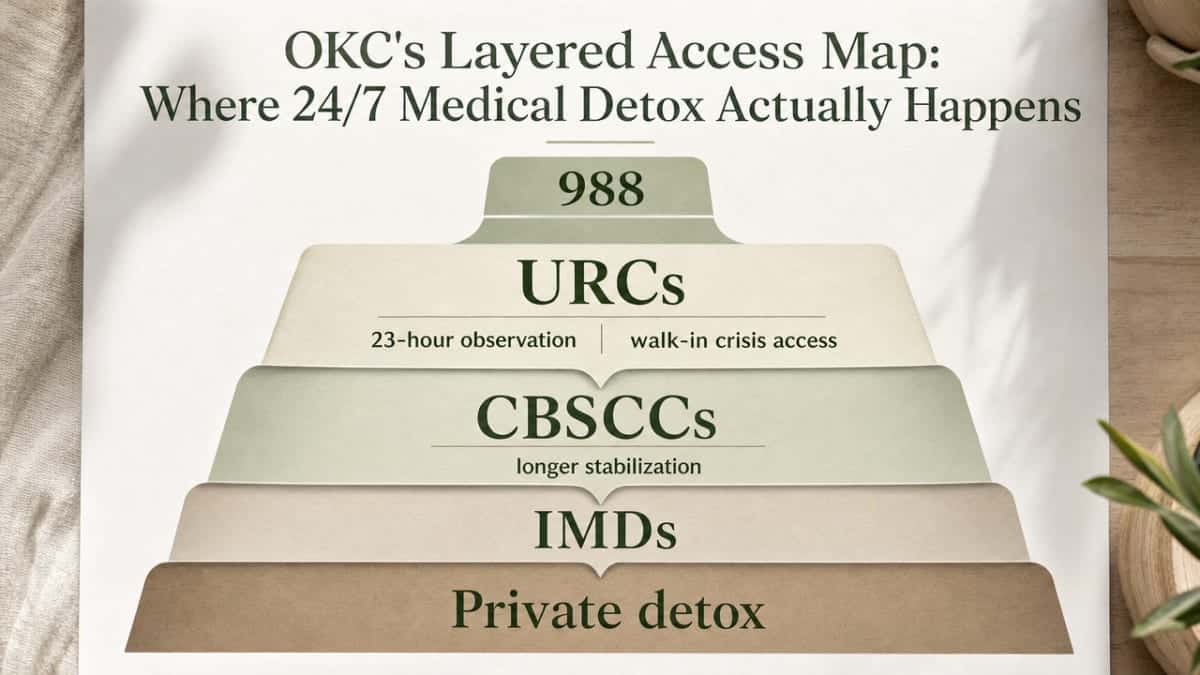
OKC’s Layered Access Map: Where 24/7 Medical Detox Actually Happens
Urgent Recovery Clinics and Community-Based Structured Crisis Centers
Oklahoma’s public crisis system isn’t one building. It’s a tier — designed so that whatever shape your emergency takes, there’s a door that fits.
At the front of that tier sit urgent recovery clinics, or URCs. Think of them as the walk-in urgent care of substance use and mental health. They provide 23-hour respite and observation, and they’re built to address substance abuse emergencies directly — the person shaking from alcohol withdrawal, the person coming down hard, the person who just needs somewhere safe to be while a nurse figures out what’s happening in their body 7.
Behind the URCs are the community-based structured crisis centers, the CBSCCs. ODMHSAS supports 13 of these across Oklahoma, offering longer stabilization than a URC can — usually several days — for people who need more time before stepping down or stepping into longer treatment 7.
Behind those sit the institutions for mental diseases, the IMDs, where average lengths of stay run under 30 days for the people who need the most intensive medical support 7.
You don’t have to know which tier you belong in when you call. That’s the intake nurse’s job. What matters is that whether you walk into a URC at 11 p.m. with the sweats or arrive by mobile crisis at dawn, the system is built to move you to the level of care your body actually needs — not the one that happened to be closest to the door.
The MAPS 4 Restoration Center: OKC’s Coming Public Detox Option
There’s a public detox facility on the way that’s worth knowing about, even if you can’t use it tonight.
As part of the MAPS 4 initiative, Oklahoma City is building a restoration center specifically designed for people in your situation. When it opens, it will provide a public inebriate alternative, medically supervised detox, substance abuse counseling, and medication-assisted treatment for opioid addiction — all under one roof 8. The City Council selected NorthCare as the operator, with the project funded at $24.5 million alongside a separate $12.6 million crisis center operated by ODMHSAS 9.
The restoration center is not open yet. It’s a planned facility, in development. That matters because you might see it referenced online and think you can walk in tonight — you can’t, not yet.
What it does tell you is that OKC is actively building more 24/7 medical detox capacity for people without private insurance, without a fixed address, or without any other place to land. If someone you’re helping tonight ends up in a repeated pattern of ER visits and jail intake instead of medical care, this is the option being built for them. Until it opens, the URCs, CBSCCs, and private medical detox facilities are the doors that are already open.
Private Medical Detox Facilities and Veteran-Specific Pathways
Private medical detox is the fourth door — and often the fastest one at 2 a.m.
These facilities are licensed medical detox centers with their own intake nurses on shift overnight, their own beds, and their own admissions process independent of the 988 pipeline. If you have insurance — most major carriers, TRICARE, or in some cases self-pay — you can call directly, get screened over the phone, and be admitted the same night. No triage through a crisis line first. No waiting to see which public bed opens.
For veterans, this pathway matters. VA benefits, community care referrals, and TRICARE coverage can route you into private medical detox with programming that acknowledges what military service does to a body and a nervous system. Some OKC facilities run veteran-specific tracks, and others offer gender-specific detox for men and women, or private-room care for professionals worried about privacy at work.
None of these options require you to have your life figured out. They just require one phone call to find out which door fits — and whether tonight is the night you walk through it.
Withdrawal Severity by Substance: Why Timing Isn’t the Same for Everyone
Alcohol and Benzodiazepines: When Waiting Can Be Fatal
Here’s the part most people don’t know until it’s too late: alcohol and benzodiazepine withdrawal can kill you. Not “feel awful.” Not “be miserable.” Actually kill you.
Both substances calm the central nervous system. When you stop suddenly, that nervous system rebounds — hard. Blood pressure climbs. Heart rate climbs. Hands shake. Sleep disappears. Somewhere between 6 and 48 hours in, some people start to hallucinate. Some seize. A small but real percentage develop delirium tremens, the DTs, which carries a mortality rate that jumps sharply without medical intervention.
You are not being dramatic by calling. You are being medically correct. The clock on this one starts the moment your last drink or last pill wears off.
Opioids: Different Danger, Same Urgency
Opioid withdrawal usually won’t kill you directly. What it can do is kill you afterward.
The withdrawal itself is brutal — bone pain, vomiting, diarrhea, sweats, restless legs, the kind of anxiety that makes you claw at your own skin. It peaks around 48 to 72 hours for short-acting opioids like heroin, fentanyl, or oxycodone. Methadone takes longer. You feel like you’re dying. You aren’t. But that misery is exactly why so many people relapse mid-detox and use the same amount they used before — after their tolerance has already dropped.
That’s the overdose window. That’s where fentanyl finds people.
Medically supervised detox handles this two ways: comfort medications that make the withdrawal survivable, and medication-assisted treatment — buprenorphine, methadone, or naltrexone — that stabilizes the brain and lowers overdose risk on the other side. MAT is not swapping one addiction for another. It’s the standard of care, and it’s what OKC’s planned MAPS 4 restoration center is being built to deliver 8.
Stimulants and Polysubstance Use: What Medical Supervision Adds
Meth, cocaine, and Adderall don’t usually produce the seizure-and-death withdrawal that alcohol and benzos do. What they produce is a crash — days of exhaustion, hunger, deep depression, and sometimes suicidal thoughts. That last part is why medical supervision still matters, even when the physical danger looks lower.
Most people arriving at detox aren’t using just one thing. Alcohol plus benzos. Fentanyl plus meth. Kratom plus something prescribed. Every combination changes the picture, which is why the intake nurse asks about everything — not to judge, but to plan. A medically supervised setting can watch for the withdrawal that hits hardest, treat the one causing the deepest crash, and keep you safe while your body sorts out which drug leaves first.
One call. Every substance on the table. Honest answers.
The First 24 Hours Inside a Medically Supervised Detox
Once you’re admitted, the shape of the day changes fast.
The first hour is medical. A nurse takes vitals — blood pressure, pulse, temperature, oxygen. Bloodwork. A urine screen. A physical assessment for tremor, sweating, pupil response, and orientation. If you came in for alcohol or benzodiazepines, the nurse is scoring you on a withdrawal scale every few hours to catch escalation before it becomes an emergency. If you came in for opioids, the scoring tool is different but the rhythm is the same: check, medicate, recheck.
Somewhere in that first hour, you get medication. A benzodiazepine taper if the risk is alcohol or sedative withdrawal. Buprenorphine or comfort meds if the risk is opioid withdrawal. Something for nausea. Something for sleep. IV fluids if you’re dehydrated. This is what medically supervised means — the discomfort gets treated, not endured.
The next several hours are quieter than you’d expect. You’re in a bed. A tech checks on you. The lights are lower than a hospital. You sleep in bursts. Someone brings food when you can eat it.
By morning, a clinician sits down with you for a fuller assessment — substances, mental health history, medical conditions, what you’re willing to consider next. This is the model Oklahoma’s crisis system is built around: URCs provide 23-hour respite and observation, community-based structured crisis centers extend that stabilization over several days, and the more intensive IMD-level care runs average lengths of stay under 30 days for people who need it 7.
You don’t have to know how long you’ll stay. You just have to make it through the first 24 hours. The team does the rest.
Why Calling Now Matters: The OKC Urgency Behind 24/7 Access
Oklahoma County carries a real overdose burden. The Oklahoma State Department of Health’s Drug Overdose Data Dashboard tracks fatal and nonfatal overdoses by county, and Oklahoma County consistently posts some of the highest counts in the state — a reflection of population size, fentanyl in the drug supply, and gaps in same-day treatment access 5.
You don’t need to memorize the number. You need to know what it means for the phone call you’re thinking about making.
It means the emergency rooms in OKC see this every night. It means paramedics have narcan in their pockets because they use it. It means the reason 988 stays staffed at 3 a.m., the reason urgent recovery clinics keep beds open, the reason MAPS 4 is funding a restoration center — all of it exists because the demand is already here and the wait between readiness and admission is where people are lost.
Readiness is not a permanent state. It arrives in windows — sometimes after a fight, sometimes after a scare, sometimes after a quiet moment on the bathroom floor. The window closes. Sometimes it opens again in a week. Sometimes it doesn’t.
That’s the honest reason 24/7 access matters in this city. Not because the system is perfect. Because the window you’re in right now is the one that counts, and OKC has built enough doors that at least one of them is open tonight.
Call while you still want to.
Insurance, Payment, and What Not to Let Stop You
Money is the reason a lot of people don’t call. It shouldn’t be, but it is.
Here’s what’s actually true in Oklahoma City. Most major private insurance plans — Blue Cross Blue Shield, Aetna, Cigna, United — cover medically supervised detox as a medical necessity when withdrawal risk is documented. TRICARE covers veterans and dependents. SoonerCare (Oklahoma Medicaid) covers detox and behavioral health services at state-contracted facilities. If you have coverage, most private detox centers will run a free benefits check over the phone before you’re admitted, so you know what you owe before you sign anything.
If you don’t have insurance, that doesn’t close the door. Urgent recovery clinics and community-based structured crisis centers operate as part of Oklahoma’s publicly funded crisis response system and are built to serve people regardless of ability to pay 1, 7. The MAPS 4 restoration center being built by the City of Oklahoma City is specifically designed to expand this safety net for people without private coverage 8.
Call first. Sort the money second. The intake nurse can tell you in ten minutes what you’d otherwise spend a week worrying about — and by then the window may have closed.
Screening for What Else Is Going On
Detox is rarely just about the substance. It’s about everything underneath it.
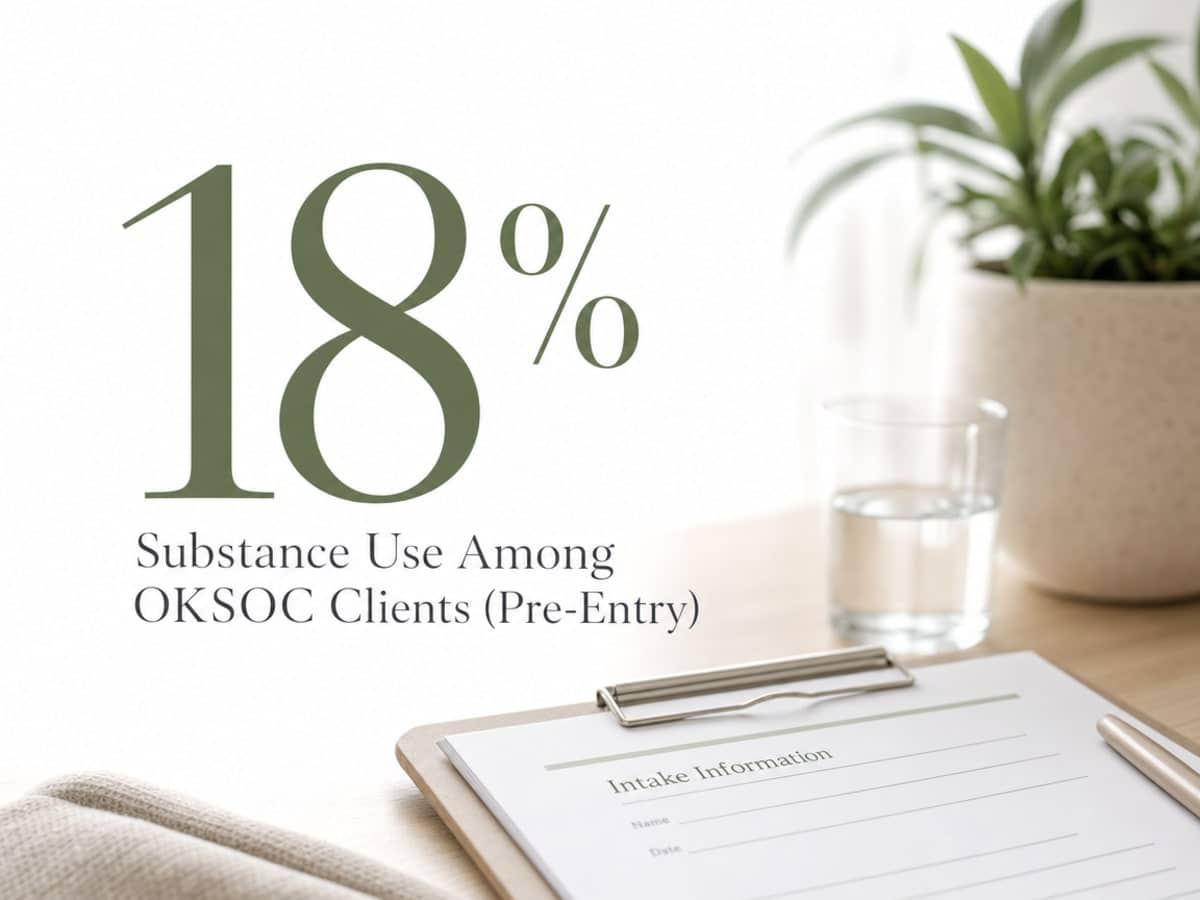
When the intake clinician sits down with you, they’re asking about more than drugs and alcohol. They’re screening for depression, anxiety, PTSD, past suicide attempts, trauma history, chronic pain, and untreated medical conditions. Co-occurring substance use and mental health issues show up together often enough that ODMHSAS tracks it — in one report on clients entering the Oklahoma System of Care, 18% self-reported substance use in the 90 days before intake, a reminder that the two rarely arrive separately 6.
That scope is specific to OKSOC clients, not everyone in OKC. But the pattern holds: if you’re in withdrawal, something else is usually running underneath. The screening isn’t to catch you at anything. It’s to make sure the plan that comes together in the morning treats the whole person who walked in, not just the substance that got you there.
After the First 72 Hours: The Handoff That Decides What Comes Next
The dangerous part of detox isn’t always the withdrawal. It’s the day you walk out.
By day three or four, your vitals have stabilized. The tremor is gone or fading. You’ve slept. You’ve eaten. The medication taper is nearly done. You feel, for the first time in a while, like a person again — and that feeling is exactly what makes the next 72 hours so precarious. Your tolerance has dropped. Your triggers haven’t. The people, places, and habits you left three days ago are still where you left them.
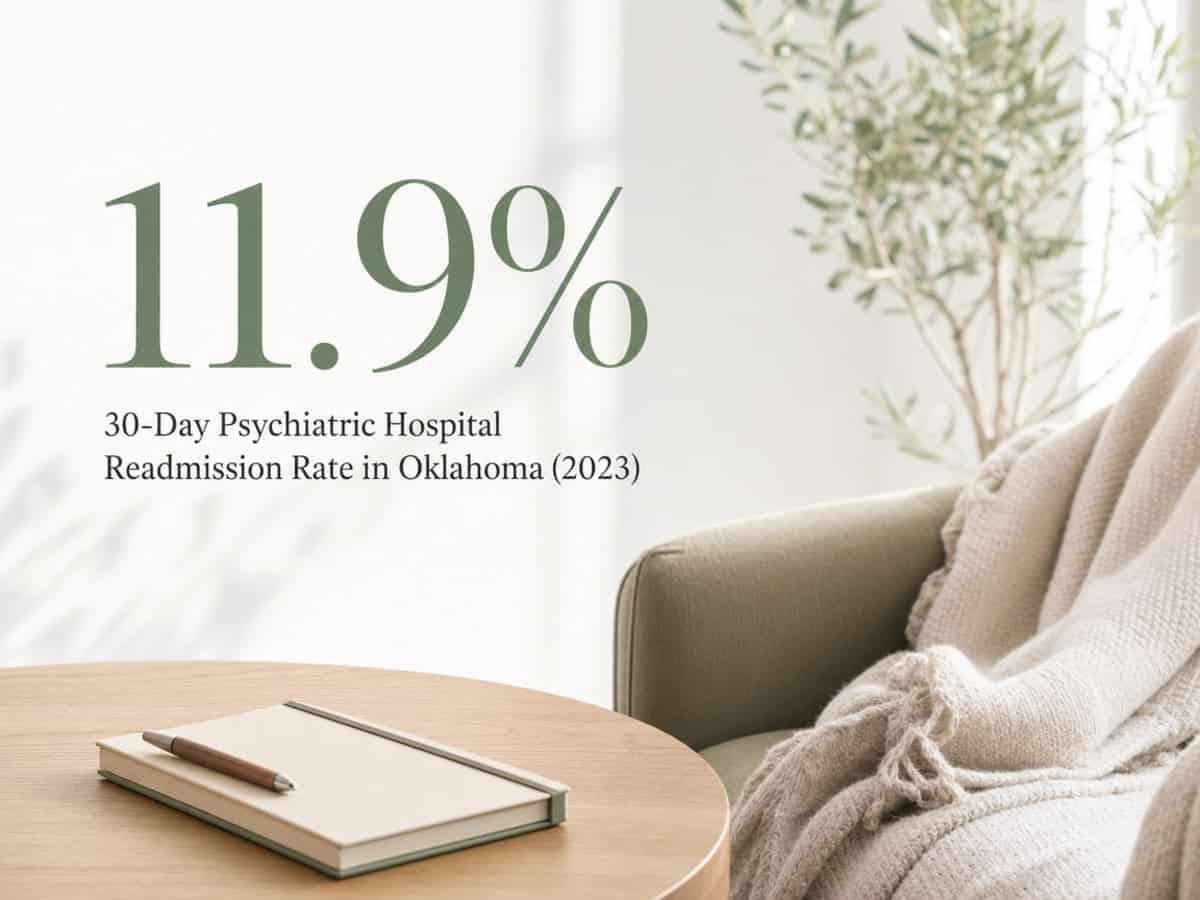
This is where the numbers get honest. SAMHSA’s 2023 Uniform Reporting System data shows a 30-day readmission rate to any psychiatric hospital in Oklahoma of 11.9% 10. That figure covers psychiatric readmissions, not detox specifically, but the pattern it points to is the one every clinician in this field knows by heart: the post-stabilization handoff is where people fall through.
A good discharge plan is not a printed sheet handed to you on the way out. It’s:
- a booked bed at a residential program, or a scheduled intake at an intensive outpatient
- a MAT prescription already called in
- a phone number for a sober-living house and a ride to get there
- someone who calls you tomorrow
Ask before you leave: What’s my appointment, and when. Ask twice if you have to. That question is the one that carries you.
For Family Members Making the Call
If you’re the one dialing on behalf of someone else, a few things will help.
Call from a room they can’t hear. You’ll need to speak honestly about how much they’re using and how bad it’s gotten, and shame in the next room slows that conversation down. Have their date of birth, insurance card if you can find it, and a rough timeline of their last use ready.
The intake nurse can talk to you. They can walk you through what admission would look like, whether the person needs an ambulance right now, and how to bring them in without a fight. What they can’t do is admit someone against their will over the phone.
Your job tonight isn’t to fix them. It’s to keep the door open until they’re ready to walk through it — and to know exactly which number to hand them when they are.
Connect Now for Immediate Detox Admissions Support
Speak directly with a local admissions expert for urgent questions, support, or rapid entry into detox care.
Frequently Asked Questions
Can I actually get admitted to a detox center in OKC in the middle of the night?
Yes. 988 is staffed around the clock by trained crisis professionals who can route you to the right resource in Oklahoma 1. Urgent recovery clinics and community-based structured crisis centers accept walk-ins overnight, and private medical detox facilities keep intake nurses on shift after midnight. One phone call is enough to start.
What happens on the first phone call to a detox center?
The intake nurse asks when you last used, what you used, how much, and how often. They ask about seizures, prescriptions, pregnancy, and whether you’re alone. It’s not a test. Those answers decide whether you come in tonight, need mobile crisis at your door, or need an ambulance. Honesty gets you the right care fastest.
Is it safe to try to detox from alcohol or benzodiazepines at home first?
No. Alcohol and benzodiazepine withdrawal can be fatal. Seizures, dangerous blood pressure spikes, and delirium tremens are real risks within the first 6 to 48 hours after your last drink or pill. Medically supervised detox with monitored tapers, IV fluids, and around-the-clock nursing is the safe option. Please don’t try to white-knuckle this one.
What if I don’t have insurance or can’t afford private detox?
Oklahoma’s publicly funded crisis system is built to serve you regardless of ability to pay. 988, urgent recovery clinics, and community-based structured crisis centers are part of that safety net 1, 7. The MAPS 4 restoration center under development in OKC will expand medically supervised detox access for people without private coverage 8. Call anyway.
How long will I stay in medical detox, and what comes after?
It depends on the substance and your body. Urgent recovery clinics provide 23-hour observation, community-based structured crisis centers extend stabilization several days, and more intensive settings run under 30-day average stays 7. After detox, the plan is usually residential treatment, intensive outpatient, or medication-assisted treatment — booked before you walk out, not after.
I’m a family member — can I call on behalf of my loved one?
Yes, and the intake nurse can walk you through everything — how admission works, whether an ambulance is needed, how to bring them in without a fight. Call from a room they can’t hear. Have their date of birth and insurance card ready. What no one can do over the phone is admit them against their will.
References
- Comprehensive Crisis Response. https://oklahoma.gov/odmhsas/treatment/comprehensive-crisis-response.html
- Statistics and Data. https://oklahoma.gov/odmhsas/research/statistics-and-data.html
- Dashboards. https://oklahoma.gov/odmhsas/research/statistics-and-data/dashboards.html
- NSDUH Behavioral Health Barometer: Oklahoma, Volume 8. https://www.samhsa.gov/data/report/nsduh-behavioral-health-barometer-oklahoma-volume-8
- Drug Overdose Data Dashboard. https://oklahoma.gov/health/health-education/injury-prevention-service/drug-overdose/data/drug-overdose-data-dashboard.html
- Co-Occurring Substance Use. https://oklahoma.gov/content/dam/ok/en/odmhsas/documents/research/reports/Substance-Use-Report.pdf
- Institutions for Mental Diseases Waiver for Serious Mental Illness and Serious Emotional Disturbance and Substance Use Disorder Mid-Point Assessment. https://www.medicaid.gov/medicaid/section-1115-demonstrations/downloads/ok-qutrly-cms-accepted-mid-point-assessment-12132024.pdf
- Mental Health Services – Oklahoma City. https://www.okc.gov/Services/Public-Safety/Mental-Health-Services
- City Council selects operators for MAPS 4 Mental Health and Addiction projects. https://www.okc.gov/News-articles/City-Council-selects-operators-for-two-MAPS-4-Mental-Health-and-Addiction-projects
- Oklahoma 2023 Uniform Reporting System Mental Health Data. https://www.samhsa.gov/data/sites/default/files/reports/rpt53140/Oklahoma.pdf