
Oklahoma City Sober Living: A Guide for Families
Key Takeaways
- Detox stabilizes the body, but the housing decision made in the days after discharge carries more weight for relapse prevention than most families realize.
- Oklahoma City families should ask whether a house holds OKARR certification, and know that state-connected options like Providence Apartments serve parents and families in recovery 1.
- Match the house structure to the substance history — fentanyl histories need naloxone and overdose protocols, methamphetamine needs rigid routine, and alcohol needs environmental awareness 11.
- Before signing anything, compare written house agreements, relapse response protocols, referral relationships, trauma-informed training, and how the house coordinates with outpatient clinical providers 2.
What Happens After the Detox Bed
If you’re reading this at 2 a.m., you’re not the first parent to do that. You’ve probably spent the last stretch of days, maybe weeks, trying to get your adult child into a safe place to withdraw. Maybe they’re in a detox bed right now. Maybe discharge is 48 hours away and no one has said the word housing out loud yet.
Here’s what most families don’t hear until it’s late: detox is the shortest chapter. It stabilizes the body. It does not build the life your child comes home to.
The days after a detox discharge are when relapse risk is highest, and where the next housing decision quietly does more work than any other choice on the table. A returning environment full of old triggers, old contacts, and unstructured time is not neutral ground. It’s the terrain where progress often unravels.
That’s why sober living exists as a category at all. Recovery housing is designed to be the bridge between a medical detox unit and whatever comes next, whether that’s outpatient counseling, an intensive program, or a longer stretch of peer-supported living 3. It is not treatment. It is not a hospital. It is a substance-free place to sleep, eat, and rebuild routines while clinical care continues elsewhere.
This guide is written for you. It walks through what recovery housing actually is in Oklahoma City, how to tell a good house from a bad one, what your role should be, and how to keep from carrying the weight alone. You do not need to become a clinician. You need a framework. Let’s build one.
Sober Living, Defined Without the Jargon
“safe, healthy, family-like substance-free living environments that support individuals in recovery from addiction”3.
Notice what that definition does not say. It does not say clinical program. It does not say treatment. It does not say hospital. A recovery house is a place to live, not a place to be treated. Clinical care happens somewhere else — an outpatient counselor’s office, a therapist’s Zoom window, a medication appointment, a peer support meeting. The house holds the life around that care.
That distinction matters more than it sounds. Federal guidance in 2023 specifically told operators to keep formal substance use disorder treatment out of recovery housing and to coordinate with clinical providers instead 2. Good houses know they are not the therapist. They are the environment where the therapy has a chance to stick.
What does that environment actually produce? National evidence links recovery housing to six documented outcomes:
- decreased substance use
- reduced likelihood of relapse
- lower incarceration rates
- higher income
- increased employment
- better family relationships 5
That last one may be the one you are quietly hoping for the most. You are not wrong to hope for it.
A few plain-language rules of thumb as you read the rest of this guide. Recovery housing is peer-supported, not staff-run like a facility. Residents typically pay rent, follow a house agreement, attend meetings, and take drug tests. Length of stay varies, but a meaningful stay is measured in months, not weeks. And a house is not a substitute for the clinical work — it is the structure that lets your child show up for it.
If someone is selling you a “sober living program” that also promises therapy sessions, medication management, and clinical groups all under one roof, they are describing something else. They may be describing a residential treatment facility, which is a different license, a different price tag, and a different set of questions to ask. Keep the categories straight in your head. It will protect you later.
Why the Post-Detox Window Matters in Oklahoma
The days right after discharge are the ones you probably lose sleep over. That instinct is correct. Post-detox is when the body is stable but the brain is still catching up, cravings still spike, and the environment your child returns to does most of the talking.
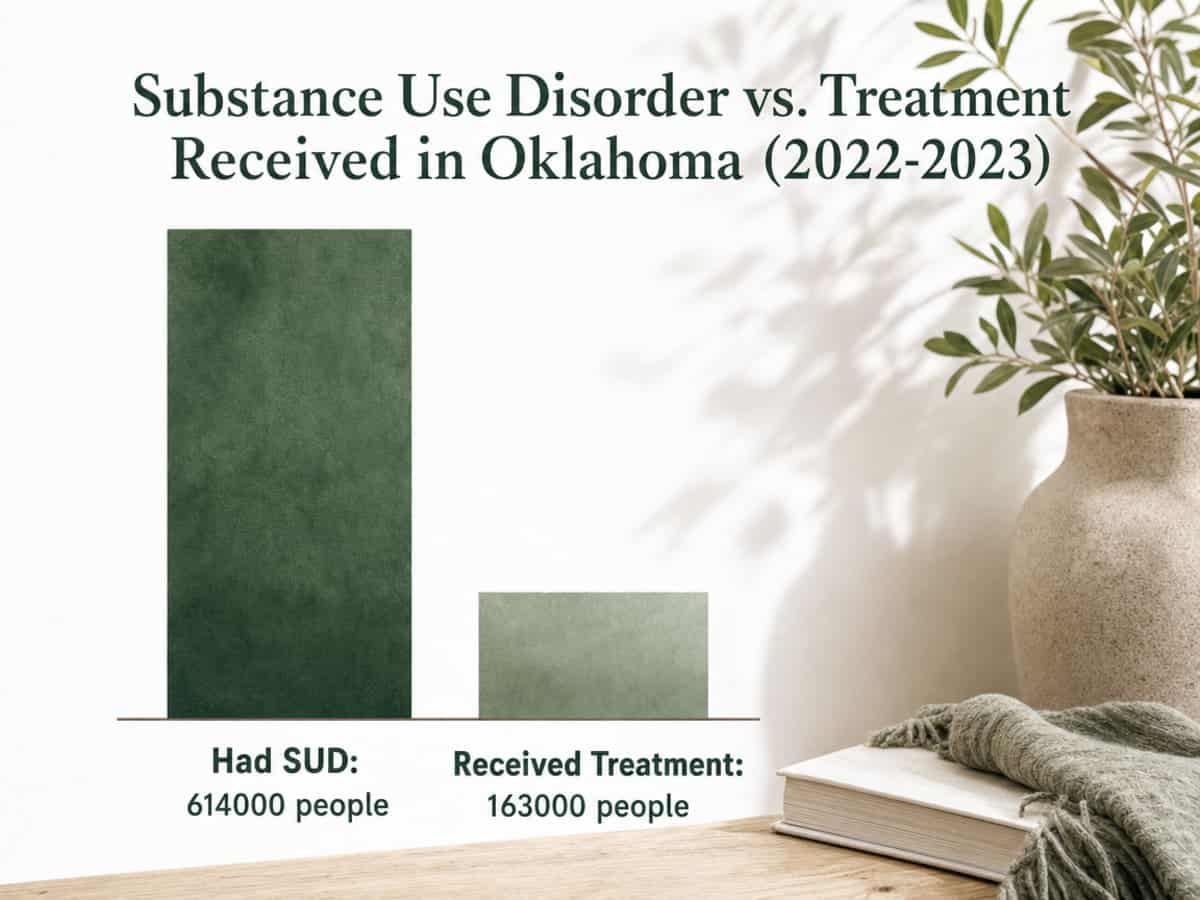
Zoom out for a second. In Oklahoma, an estimated 614,000 people aged 12 and older had a past-year substance use disorder in 2022–2023, and only about 163,000 received any substance use treatment 10. That gap — roughly three out of four Oklahomans with an SUD not getting care in a given year — is the shape of the problem your family is standing inside. It is not a personal failing. It is a system-wide shortfall of connective tissue between one level of care and the next.
Detox is one of the pieces of that connective tissue. Recovery housing is another. What happens between them is where a lot of people quietly drop out.
Oklahoma County sits at the higher end of the state’s overdose burden, and statewide overdose deaths more than doubled between 2019 and 2023 11. That is the risk backdrop your family is discharging into. It is also why the post-detox window is not a scheduling problem — it is a safety window. Every day between the last night in a detox bed and the first night in a structured, substance-free home is a day where the plan either holds or gets tested by circumstances no one designed for recovery.
You cannot single-handedly close a 450,000-person treatment gap. You can shrink it by one, for your person, by making sure the handoff from detox to housing to ongoing clinical care does not happen by accident. That means asking about the next placement before discharge, not after. It means understanding that the calendar week following detox has more leverage than almost any other week in the year ahead.
None of this is meant to frighten you. It is meant to give the fear you already carry somewhere useful to go. The next few sections translate this window into practical decisions — what kind of house fits what kind of substance history, what Oklahoma-specific options exist, and what questions to ask before anyone signs a house agreement.
Matching Housing to the Substance
Not every recovery house is built for every relapse risk. The substance your child was using shapes the kind of structure that will actually protect them in the first weeks after detox.
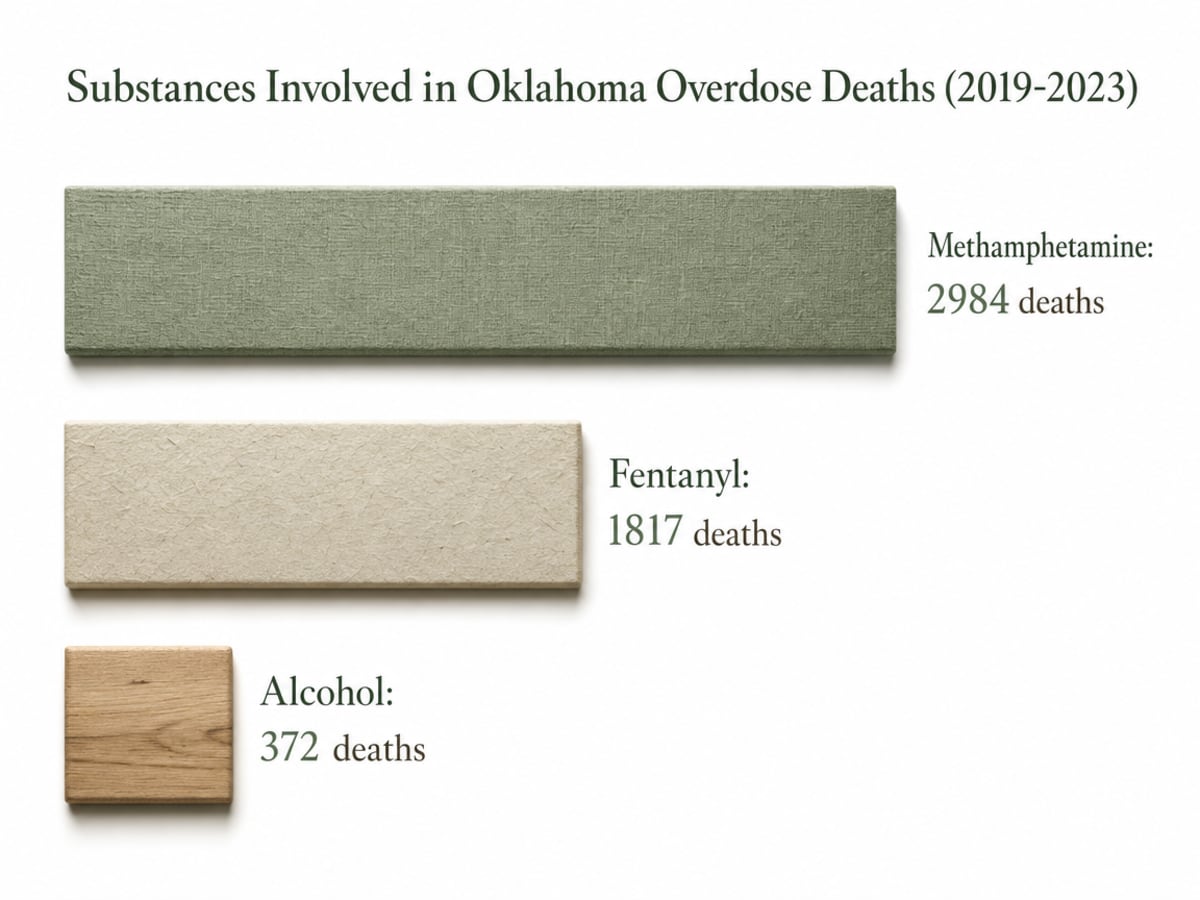
Look at what Oklahoma is actually losing people to. Between 2019 and 2023, methamphetamine was involved in 2,984 overdose deaths in the state, fentanyl in 1,817, and alcohol in 372 11. Those numbers are not evenly distributed across a single “drug problem.” They describe three different environments a recovering person has to survive.
Fentanyl relapse is the one that terrifies most parents, and correctly so. Tolerance drops fast after detox, and a single use of contaminated supply can be fatal. A house serving someone with an opioid history should have naloxone on site, staff or peer leaders trained to use it, clear overdose response protocols in the written house policies, and an ironclad rule about no unsupervised absences in the first weeks. If a house shrugs at any of that, keep looking.
Methamphetamine recovery has a different shape. The physical danger is lower in the moment, but the cognitive fog, sleep disruption, and mood swings stretch out for months. Structure is the medicine here — consistent wake times, mandatory meetings, mandatory chores, mandatory check-ins. A house that runs loose on schedule can look fine on paper and still fail a stimulant-history resident.
Alcohol carries its own trap. It is legal, it is everywhere, and it is culturally invisible in ways fentanyl is not. A house near bars, or one that lets residents work night shifts in restaurants early on, is a harder environment than the address alone suggests.
When you tour a house or interview a manager, name the substance directly. Ask how their structure specifically addresses that relapse pattern. A good operator will have a real answer. A weak one will pivot to general talking points about “community” and “accountability.” That difference tells you almost everything.
The Oklahoma City Housing Landscape
Oklahoma City has more recovery housing than most families realize, and less quality control than most families would like. Both things are true. The trick is knowing where to look and what shorthand to trust.
Start with OKARR, the Oklahoma Alliance of Recovery Residences. OKARR is the state-level affiliate that certifies houses against national recovery-residence standards. Certification is voluntary, which means plenty of houses in the metro operate without it. When a house holds OKARR certification, you have at least a floor to stand on: written policies, a house structure documented on paper, and accountability to an outside body if something goes wrong. When a house does not have it, you are relying entirely on the operator’s word. That is not automatically disqualifying, but it shifts more of the vetting weight onto you.
OKARR uses a tiered system, roughly from peer-run homes with light structure at the lower levels up to service-provider settings with staff and clinical coordination at the higher ones. The right level depends on where your adult child is on the day they leave detox — not where you wish they were.
The most concrete public option in Oklahoma City is state-connected. The Oklahoma Department of Mental Health and Substance Abuse Services runs sober living in partnership with the Oklahoma City Housing Authority at Providence Apartments. It is certified as OKARR level 2 and is built for women with children, men with children, and families with children in recovery. Residents get life skills classes, case management, financial literacy support, on-site staff, and help with family reunification 1. If your situation involves grandchildren, custody questions, or a young parent trying to rebuild, that is a program worth asking about by name.
Outside the state-run option, the private landscape is a mix. Some houses are gender-specific. Some are faith-based. Some are affiliated with an outpatient clinic down the street, which can make the clinical handoff smoother. A few are run by well-intentioned people in over their heads. A small number are frankly predatory. The next section gives you the questions to sort them.
One quiet tip: when you call ODMHSAS or dial 211 14, ask them for a current list of OKARR-certified residences in Oklahoma County. Do not rely on a single referral, even a good one. Two or three tours is not overkill. It is due diligence.
How to Evaluate a House: A Parent’s Checklist
Touring a recovery house feels weird the first time. You walk into someone’s living room, meet a house manager, and try to figure out in forty minutes whether this is where your adult child will sleep for the next six months. Give yourself permission to be a slow buyer. The good houses expect scrutiny. The bad ones flinch under it.
SAMHSA’s 2023 best-practices framework lays out eleven expectations for how recovery housing should operate, including recovery-centered and person-centered approaches, resident safety, written policies, trauma-informed care, and an explicit rejection of patient brokering 2. Translate that framework into questions and you have a checklist that actually protects your kid.
Ask to see the written house agreement before anyone signs anything. A real house has one. It covers rent, curfew, drug testing, guest policy, meeting requirements, and grounds for discharge. If the manager describes rules verbally but cannot hand you a document, that is a policy gap, not a paperwork detail.
Ask how they handle a relapse. The right answer is not “we kick them out on the spot.” The right answer describes a clear response — usually a safety assessment, a brief separation from the house, and a documented path back that involves a higher level of care. Zero-tolerance-with-the-door-locked-behind-them is a red flag, not a strength.
Ask who refers residents in, and who they refer residents out to. Patient brokering — where a house takes kickbacks for sending residents to a specific treatment provider or lab — is the practice SAMHSA singled out to reject 2. If the house has one and only one clinic they send everyone to, and cannot explain why, ask harder questions.
Ask about trauma-informed training. Most people who end up in recovery housing carry trauma histories that predate the substance use. A house that trains its peer leaders to recognize trauma responses, and that does not run its structure on shame, produces different outcomes than one that does not 2.
Ask what “person-centered” looks like on a Tuesday. Does each resident have an individual recovery plan? Are goals reviewed? Can a resident negotiate a work schedule, a family visit, a medication appointment without breaking house rules? A rigid one-size structure is easier to run and worse for actual recovery.
Walk through the physical space. Look at the kitchen. Look at the bathrooms. Look at where your child would sleep. Safe, healthy, and family-like is the SAMHSA standard 3— not luxurious, but clean, functional, and cared for. Overcrowding, broken locks, and a manager who does not know where the fire extinguisher is tell you something.
Ask how they coordinate with clinical providers. Recovery housing is not treatment 2. A good house names the outpatient programs, therapists, and medication providers their residents work with, and can describe how they communicate with those providers when a resident is struggling.
You do not need to ask all nine questions in one visit. You do need to leave with real answers to most of them before you write a check.
Your Role, and Where It Ends
Here is the part that most articles skip because it is uncomfortable: your presence in this process matters more than you have been told, and it also has a boundary you will need to hold.
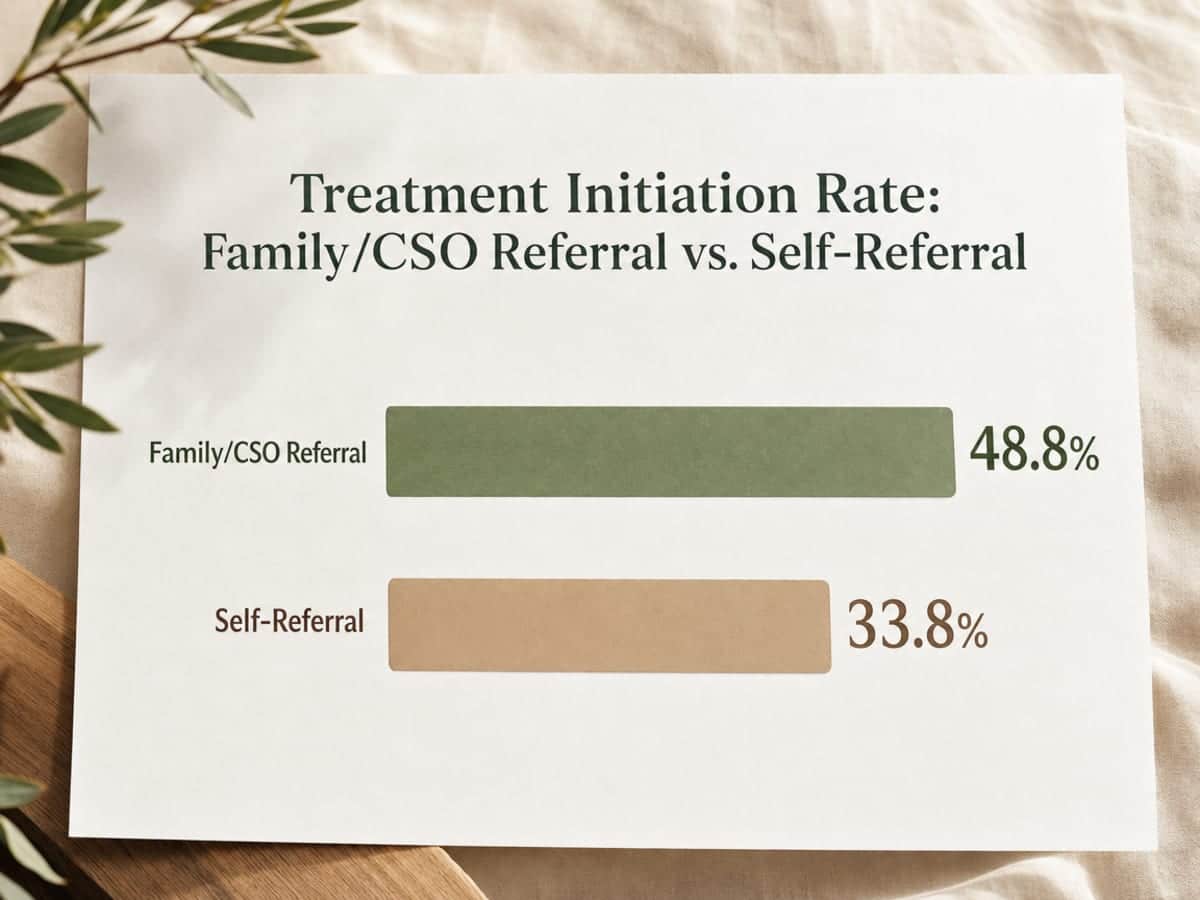
Start with what the evidence actually says. A meta-analysis of substance use disorder treatments involving significant others found that family and concerned-significant-other referrals produced a treatment initiation rate of 48.8%, compared to 33.8% for self-referrals 9. That is a fifteen-point gap, measured across studies of adults where a family member or partner was involved in the front end of care. It is not a promise about your specific situation. It is a signal that engaged families move the needle on whether treatment starts at all.
A 2024 systematic review of 41 studies on family interventions for young adults with substance use problems reached a compatible conclusion: family interventions reduce substance use, improve behavioral outcomes, and strengthen family functioning 7. Your involvement, done well, is not sentimental. It is measurable.
What does “done well” look like when your child is an adult living in a recovery house?
It looks like showing up for the family sessions the outpatient program invites you to, and being coachable when the counselor tells you something about your own communication patterns you did not want to hear 6. It looks like paying the first month of rent if that is what stands between your child and a certified house, without turning it into leverage later. It looks like knowing the house manager’s name and the outpatient provider’s name, without calling either of them daily.
That boundary is protective for both of you. Family-focused care for young adults with SUD explicitly balances involvement with respect for the young adult’s privacy and autonomy 6. Cross that line and you can accidentally make recovery a thing your child does for you, which is a fragile arrangement that tends to collapse the first time you are not in the room.
One more thing worth naming. You are allowed to get your own support. Al-Anon, a family therapist, a trusted friend who has been through this. The research on family involvement is clear that families do better when their own health is addressed, not just the person in recovery 6. You are not selfish for needing that. You are sustainable because of it.
Paying for It: SoonerCare, Self-Pay, and the Gaps Between
Money is the question most families are too polite to lead with on the tour. Ask it early anyway. A house that gets uncomfortable talking about rent, deposits, and what happens if a resident falls behind is a house that will get uncomfortable about a lot of other things later.
Here is the shape of it. Recovery housing is generally not covered by insurance the way a clinical program is. SoonerCare, Oklahoma’s Medicaid program, covers mental health and substance use treatment services on the clinical side — outpatient counseling, medication management, intensive outpatient, and related care 14. Those are the pieces of your child’s plan that happen outside the house. Rent for the bed itself is usually paid another way.
For state-connected options like the sober living at Providence Apartments, eligibility is tied to specific populations — women with children, men with children, and families in recovery — and the program braids housing with case management and life skills support 1. If your family fits that profile, that is a door worth knocking on directly through ODMHSAS.
Private houses typically run on monthly rent paid by the resident, sometimes with a first-month contribution from family. Ask for the number in writing. Ask what it includes. Ask what triggers additional fees.
If you are stuck, dial 211 for local resource routing or 988 for behavioral health crisis support 14. Neither will hand you a bed, but both can point you toward the next honest phone call.
The First 90 Days: What a Good Bridge Looks Like
If you want a picture of what a strong post-detox stretch actually looks like, think in weeks, not milestones.
The first week is about landing. Your child moves into the house, signs the agreement, meets the manager, does the intake drug test, and starts learning the rhythm — wake times, chores, house meetings, curfew. Clinical care starts or resumes in this window too. Outpatient counseling on the calendar. Medication appointments kept. If your child is on medication for opioid use disorder, that prescription does not get missed because they are moving. This is the week to help with logistics without hovering.
Weeks two through four are about routine. Meetings become normal. A sponsor gets picked. Employment or volunteer work starts to enter the conversation, but slowly. A house that pushes a full-time job in week two is rushing. A house that never mentions work by week six is coasting.
The second month is where the house earns its keep. Boredom shows up. Old contacts text. Someone in the house relapses and everyone has to metabolize it. Watch how the house handles that moment. A recovery-centered response — safety, honest conversation, coordination with clinical providers — is the standard SAMHSA points to 2.
By month three, you should see something concrete: a resident who has a schedule, a counselor, a sponsor, a medication plan if applicable, and a growing sense of ownership over the recovery plan itself. That combination — housing plus ongoing clinical care plus peer support — is what the evidence base behind recovery housing is actually describing when it points to reduced relapse and better family relationships 5.
Celebrate the small things. A first week completed. A first house meeting attended without dread. A phone call where your child brings up something other than the crisis. Those are not small. Those are the bridge holding.
Talk With a Local Recovery Support Expert Now
Get personal guidance for safe next steps in Oklahoma City sober living.
Frequently Asked Questions
What is the difference between sober living and a treatment program?
Sober living is a home, not a clinical program. It gives your adult child a substance-free place to live with peers who are also in recovery, along with house rules, drug testing, and meetings. A treatment program provides the actual clinical care — counseling, therapy, medication management. Federal guidance draws that line clearly and asks recovery houses to coordinate with clinical providers rather than deliver treatment themselves 2. Your child usually needs both, running in parallel.
What does OKARR certification mean, and why should I ask about it?
OKARR is the Oklahoma Alliance of Recovery Residences, the state affiliate that certifies houses against national recovery-residence standards. Certification means the house has written policies, a documented structure, and outside accountability. It is voluntary, so plenty of Oklahoma City houses skip it. The state-run sober living at Providence Apartments, for example, is certified at OKARR level 2 1. Asking about certification is a fast way to separate operators who welcome scrutiny from those who avoid it.
Does SoonerCare pay for sober living in Oklahoma City?
Generally, no. SoonerCare covers clinical mental health and substance use services — outpatient counseling, medication management, intensive outpatient care 14. Those are the treatment pieces that happen alongside the housing. Rent for the recovery house itself is usually paid privately, sometimes with family help. State-connected options like the sober living at Providence Apartments braid housing with case management for specific eligible populations, including families in recovery 1. Ask ODMHSAS directly if your family fits that profile.
How long should my adult child stay in a recovery house?
Think in months, not weeks. A meaningful stay usually runs somewhere between six months and a year, though every situation is different. The first 90 days are about landing and building routine — housing, clinical care, meetings, sponsor, employment. What follows is the stretch where the structure quietly does its work. National evidence links longer recovery-housing stays to decreased substance use, reduced relapse likelihood, and better family relationships 5. Short stays rarely produce the outcomes families are hoping for.
How involved should I be without overstepping my adult child’s recovery?
Involved enough to show up. Not so involved that you become the case manager. Attend the family sessions the outpatient program invites you to. Know the house manager’s and counselor’s names without calling them daily. Peer-reviewed guidance on young adults with substance use disorders explicitly balances family engagement with respect for adult privacy and autonomy 6. If recovery becomes something your child does for you rather than themselves, it tends to collapse the first time you step back.
What are warning signs that a sober living house is not reputable?
Watch for a few specific patterns. No written house agreement. Verbal rules that shift depending on who is asking. One clinic they refer every resident to, with no clear explanation why — that is the patient-brokering pattern SAMHSA explicitly told operators to reject 2. Zero-tolerance relapse policies that end at the curb rather than in a coordinated safety plan. Overcrowded rooms, broken locks, a manager who cannot answer basic safety questions. Discomfort talking about rent. Trust what you see.
References
- Recovery-Based Housing. https://oklahoma.gov/odmhsas/recovery/housing/recovery-based-housing.html
- Best Practices for Recovery Housing. https://library.samhsa.gov/product/best-practices-recovery-housing/pep23-10-00-002
- Housing Supports Recovery and Well-Being. https://library.samhsa.gov/sites/default/files/housing-supports-pep24-08-007.pdf
- Housing Supports Recovery and Well-Being: Definitions and Shared Values. https://library.samhsa.gov/product/housing-supports-recovery-and-well-being-definitions-and-shared-values/pep24-08-007
- Recovery Resource Center. https://www.samhsa.gov/substance-use/recovery/recovery-resource-center
- Engaging the Family in the Care of Young Adults With Substance Use Disorders. https://pubmed.ncbi.nlm.nih.gov/33386324/
- Family Intervention Models for Young Adults with Substance Abuse: A Systematic Review. https://pubmed.ncbi.nlm.nih.gov/39564277/
- Family-focused practices in addictions: a scoping review. https://pmc.ncbi.nlm.nih.gov/articles/PMC5781095/
- Engaging Family and Others in Recovery | Research Corner. https://www.iris.ssw.umaryland.edu/rc-family-recovery
- OKLAHOMA – National Survey on Drug Use and Health State Tables, 2023. https://www.samhsa.gov/data/sites/default/files/reports/rpt56188/2023-nsduh-sae-state-tables_0/2023-nsduh-sae-state-tabs-oklahoma.pdf
- Drug Overdose Deaths, 2019–2023 – Oklahoma. https://oklahoma.gov/content/dam/ok/en/health/health2/aem-documents/prevention-and-preparedness/injury-prevention/drug-overdose/2025%20State%20Drug%20OD%20-%20IPS%20-%20Fact%20Sheet.pdf
- Drug Overdose Data Dashboard – Oklahoma.gov. https://oklahoma.gov/health/health-education/injury-prevention-service/drug-overdose/data/drug-overdose-data-dashboard.html
- NSDUH Behavioral Health Barometer: Oklahoma, Volume 8. https://www.samhsa.gov/data/report/nsduh-behavioral-health-barometer-oklahoma-volume-8
- Mental Health and Substance Abuse Services – Oklahoma Health Care Authority. https://oklahoma.gov/ohca/individuals/programs/mental-health-and-substance-abuse-services.html