
Cocaine Detox Programs in Oklahoma City, OK
Key Takeaways
- Cocaine withdrawal in Oklahoma City rarely triggers seizures, but the crash brings severe depression, suicidality, and cardiac strain that call for 24/7 medical monitoring and baseline ECG screening 3.
- Between 2019 and 2023, Oklahoma recorded 412 cocaine-involved overdose deaths, and today’s supply is frequently cut with fentanyl, making supervised detox more relevant locally than most families realize 4.
- SoonerCare covers medical detox with an initial five days authorized and up to three more on medical necessity review, while commercial plans must meet parity standards for SUD care 12, 14.
- Before choosing a program, compare who directs your care and when, whether cardiac and suicidality monitoring are built in, and what the day-nine handoff to outpatient treatment looks like.
If You’re Reading This at 3 A.M.
If you’re reading this at 3 a.m., you’re not the first. Somewhere in Oklahoma City tonight, another person is holding a phone in the dark, trying to figure out what to do about the cocaine in the next room, or the cocaine still in their own system, or the person on the couch who won’t wake up right.
Take a breath. You already did the hardest part, which is looking.
Here’s what you need to know before you scroll further. Cocaine withdrawal is rarely the kind of withdrawal that stops your heart the way alcohol or benzos can. But the crash that follows heavy use can bring a depression so heavy it feels like drowning, cravings that hurt in your chest, and thoughts about ending things that weren’t there a week ago. That is exactly why medical supervision matters, and why guidance for cocaine detox centers on 24/7 monitoring, psychological support, and screening for suicidality rather than a single detox pill.1, 2
You don’t have to white-knuckle this. Keep reading. The next section explains what your body is actually doing.
What Cocaine Withdrawal Actually Does to the Body and Mind
The Crash: Why the First 72 Hours Are the Dangerous Ones
The crash starts within hours of your last hit. Your brain has been running on borrowed dopamine, and the loan is coming due all at once. You’ll feel bone-deep exhaustion and a hunger you can’t explain, then a wall of sleep that feels less like rest and more like being pulled underwater.
That’s the physical part. It’s not what makes the first 72 hours dangerous.
The dangerous part is what happens to your thinking. As the stimulant leaves your system, the same chemistry that gave you energy and confidence flips. Depression can drop hard and fast. Anxiety, irritability, and paranoia often show up too, and cravings can feel physical, like something clawing at your chest.2For some people, this window is when suicidal thoughts appear for the first time, or come back louder than before. Federal clinical guidance is specific on this point: anyone withdrawing from cocaine or other stimulants should be monitored closely for depression and suicidality, along with cardiac issues like prolonged QTc, which is why a baseline ECG is part of the standard workup.3
This is why the first three days aren’t something to ride out on a friend’s couch. Your body will survive. Your mind is the part that needs someone watching. A medically supervised setting means someone checks on you through the night, someone notices if your heart rhythm shifts, and someone is there when the thoughts get loud.
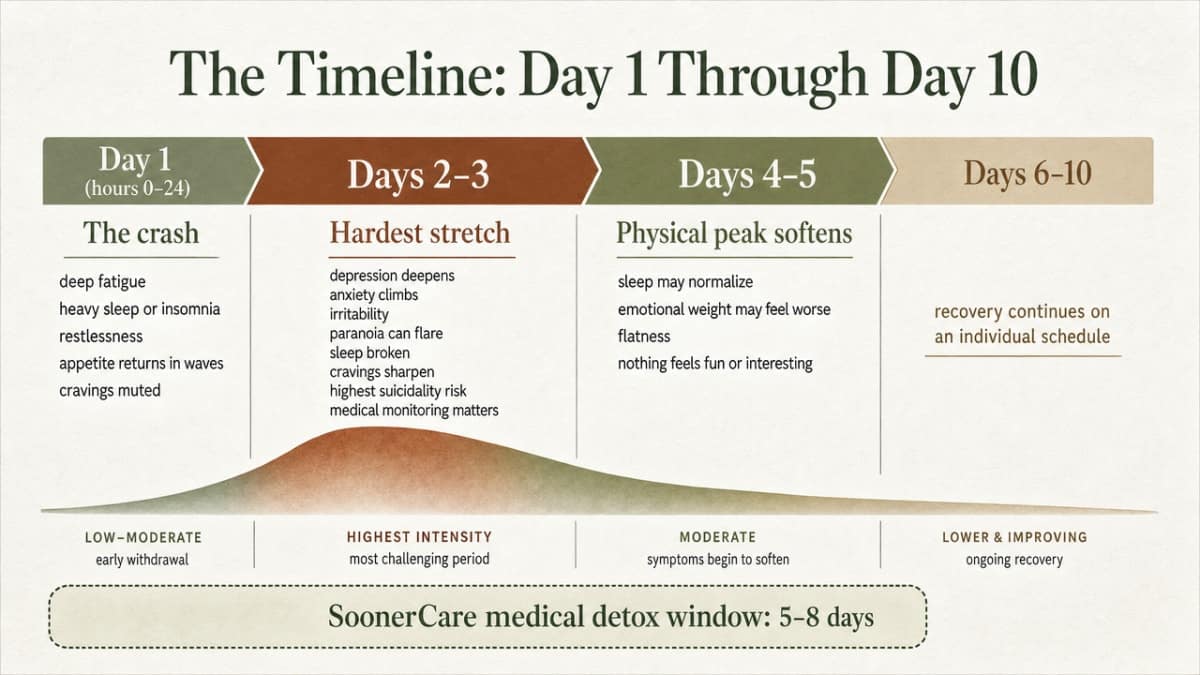
The Timeline: Day 1 Through Day 10
No two people withdraw on the exact same schedule, but the shape of the week is remarkably consistent. Here’s what tends to happen when.
- Day 1 (hours 0–24):
- The crash. Deep fatigue, heavy sleep or the opposite — insomnia laced with restlessness. Appetite may return in waves. Cravings are present but often muted because you’re too tired to chase them.2
- Days 2–3:
- This is the hardest stretch. Depression deepens. Anxiety and irritability climb. Paranoia can flare, especially if sleep has been broken. Cravings sharpen as your body starts to wake up. This is the window where suicidality risk is highest and where medical monitoring earns its keep.2, 3
- Days 4–5:
- The peak begins to soften physically, but the emotional weight can feel worse, not better. You may sleep more normally. You may feel a flatness — nothing is fun, nothing is interesting, everything is gray. This is called anhedonia, and it’s the symptom that most often drives people back to using if they’re not in a supported setting.1
- Days 6–8:
- Sleep starts to stabilize. Appetite returns. Cravings become intermittent rather than constant. The depression begins to lift, though slowly. Most SoonerCare-authorized detox stays fall in this window for a reason — this is when the body is stable enough to hand off to the next level of care.12
- Days 9–10 and beyond:
- Physically, you feel more like yourself. But cravings can still hit hard, triggered by a place, a smell, a text message, a payday. This is why detox alone doesn’t end the story. The clinical guidance is clear that the point of withdrawal management is to establish a period of abstinence — the work of staying off cocaine starts after.2
Knowing the shape of the week matters. When you’re on day 3 and it feels like it will never lift, it helps to know day 6 exists.
Why ‘No Physical Dependence’ Is a Dangerous Myth
You may have read that cocaine isn’t physically addictive, or that there’s no real withdrawal because there’s no FDA-approved medication for it. Both things are technically true and completely misleading.
It’s true that no medication has been developed specifically for stimulant withdrawal, and that care is built around supportive treatment, monitoring, and symptom management rather than a detox drug.2It’s also true that cocaine withdrawal rarely triggers the seizures or cardiovascular collapse that make alcohol and benzo withdrawal medical emergencies on their own terms.
None of that means you can safely detox from cocaine alone in your apartment.
The risks are real, they’re just shaped differently. Suicidal thinking during the crash. Cardiac strain in someone whose heart has been working overtime for days or weeks. Relapse within 48 hours because the craving hit at 2 a.m. and no one was there to interrupt it. Federal guidance recommends ECG monitoring and close observation for depression, suicidality, and QTc changes during cocaine withdrawal for exactly these reasons.3
Why Cocaine Detox Matters in Oklahoma City Right Now
You may have heard that Oklahoma’s overdose crisis is a meth story, or a fentanyl story. Both are true. What gets left out is the cocaine line running quietly underneath them.
Between 2019 and 2023, the Oklahoma State Department of Health recorded 412 cocaine-involved overdose deaths statewide.4That’s not a number that shows up in most headlines, because methamphetamine still drives roughly two out of three drug overdose deaths in Oklahoma.5But cocaine keeps landing on the Chief Medical Examiner’s Top 25 Drugs Detected list year after year, which means it’s showing up in bodies, not just in seizures.7And the deaths tracked as “cocaine” often involve fentanyl too — the powder in Oklahoma City in 2024 is not the powder from 2010.
The people at the counter of that statistic are your neighbors. Someone in Bethany, someone in Del City, someone in a house off NW 23rd. The SAMHSA state survey shows past-year cocaine use is a live pattern among Oklahoma adults, not a coastal problem you’re watching from a distance.8
Here’s why this matters for you, sitting where you are right now. Cocaine deaths in Oklahoma are rarely a first-time-user story. They tend to be the story of someone who used for months or years, tried to stop, couldn’t get through the crash alone, went back, and got a batch cut with something they didn’t expect. Medically supervised detox interrupts that loop at the exact place it usually breaks — the 72 hours when a person is most likely to leave the couch and drive to their dealer.
The local system has more capacity than most families realize. Getting to it starts with understanding what a real program looks like, which is what the next section covers.
What a Legitimate Medical Detox Looks Like in Oklahoma
The Rules a Real Program Must Follow
A legitimate cocaine detox program in Oklahoma isn’t running on good intentions. It’s running on a set of state rules that most families never see, and knowing what those rules require gives you a way to tell a real program from a bed with a coffee pot next to it.
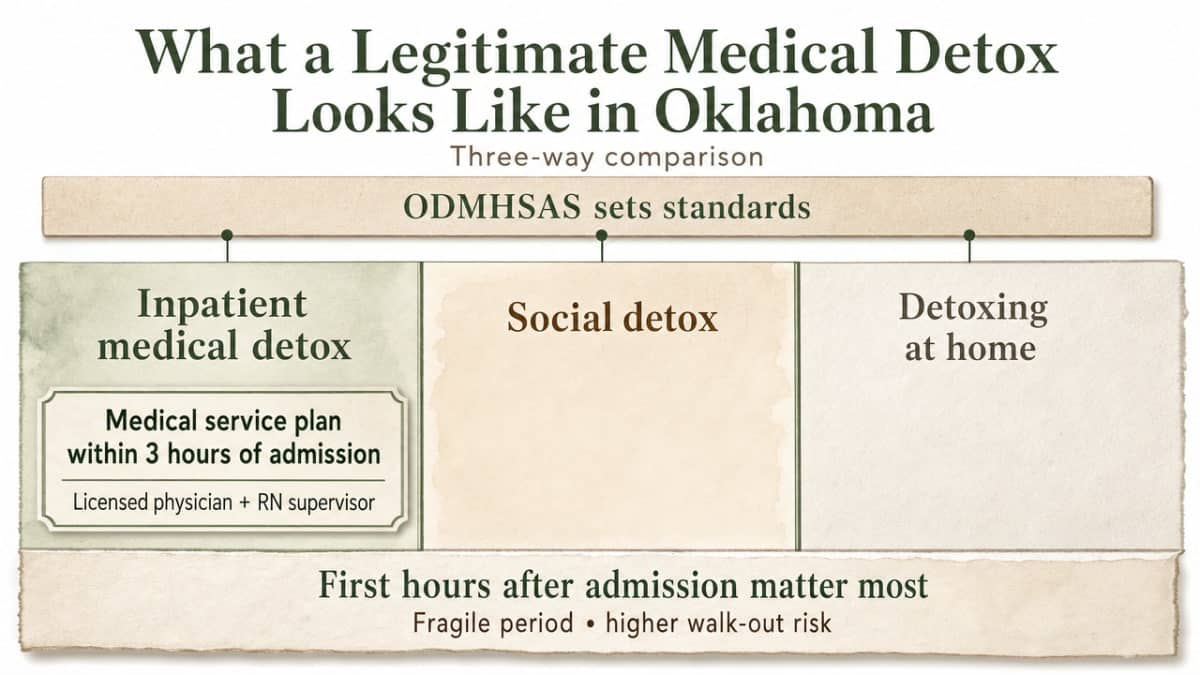
The Oklahoma Department of Mental Health and Substance Abuse Services (ODMHSAS) sets the standards. Any medically supervised withdrawal management facility operating outside a hospital has to complete a medical service plan for you within three hours of admission, and that plan has to be built under the direction of a licensed physician working with a licensed registered nurse supervisor.9That three-hour clock exists because the first hours after admission are when a person is most fragile and most likely to walk out.
Ask a program point-blank: who signs off on my care plan, and when? If the answer isn’t a physician and an RN within a few hours of walking in the door, you’re looking at something the state calls social detox, not medical detox. Both exist. Only one is built for what cocaine withdrawal does to your head.
Inpatient Medical Detox vs. Social Detox vs. ‘Detoxing at Home’
These three options get lumped together in search results, and they are not the same thing.
Inpatient medical detox is 24/7 care in a licensed facility with physicians, nurses, and monitoring equipment. You get a baseline ECG, vitals checks through the night, medications for symptoms like insomnia, anxiety, or nausea, and a clinician trained to spot when depression is tipping into something more dangerous. This is the level of care federal guidance points to for cocaine withdrawal, precisely because the risks are cardiac and psychiatric rather than seizure-related.3
Social detox is a supervised setting without the medical layer. Staff are present, but a physician isn’t directing your care in the same way, and there’s no continuous cardiac or psychiatric monitoring. For a healthy person coming off a short binge, it can work. For someone with a heavy use history, a co-occurring mental health diagnosis, or any polysubstance use, it usually doesn’t.
Detoxing at home means one of two things: white-knuckling it, or using leftover benzos or alcohol to blunt the crash. The second option is how cocaine detox becomes a benzo problem or an alcohol relapse. There’s no monitoring if your heart rhythm shifts, and no one there at hour 60 when the depression turns into a plan.2, 3
If you’re already thinking “I can handle this myself,” that’s the crash talking. It’s a normal thought. It’s also the one that keeps people stuck for another year.
What Cardiac and Psychiatric Monitoring Actually Involves
“Monitoring” sounds vague until you see what it actually means on a shift.
On the cardiac side, you’ll get a baseline ECG on admission and repeat readings if anything looks off. Cocaine is hard on the heart, and prolonged QTc — a delay in how your heart’s electrical system resets — is one of the specific things clinicians watch for during stimulant withdrawal.3Vitals get checked on a schedule: blood pressure, heart rate, temperature, oxygen. A nurse is close enough to notice if something changes overnight.
On the psychiatric side, monitoring means a real person asking real questions, more than once a day. Not a checkbox. Are you sleeping? Are you eating? Are you having thoughts of hurting yourself? Federal guidance is direct that anyone withdrawing from cocaine should be monitored for suicidality throughout the crash and treated for depression when it appears.2, 3
What this looks like from your side of the bed is simpler than it sounds. Someone knocks. Someone asks how you’re doing and actually waits for the answer. That’s the whole point.
Paying for Detox: SoonerCare, Private Insurance, and Parity
The money question is usually the one that keeps families stuck. You want to help. You also can’t put a $30,000 bill on a credit card and pretend you didn’t. Here’s what actually happens when insurance meets cocaine detox in Oklahoma.
If you have SoonerCare, medical detoxification is a covered benefit. The Oklahoma Health Care Authority lists inpatient acute care, crisis stabilization, and medical detoxification directly among mental health treatment benefits.11Coverage extends to children under 21, non-expansion adults, and Medicaid expansion adults, though detox and residential SUD services require prior authorization in every category.13
The number to hold on to is five. SoonerCare’s medical necessity criteria authorize an initial maximum of five days for substance abuse detoxification, with up to three additional days available on a case-by-case medical necessity review.12That’s five days guaranteed if you meet criteria, and up to eight days if your clinical team documents that you still need 24-hour supervision. The criteria also require physiological evidence or expected withdrawal symptoms that need 24-hour medical monitoring — a threshold cocaine crash symptoms can meet when depression, suicidality, or cardiac strain are in play.12
If you have commercial insurance, the Mental Health Parity and Addiction Equity Act is the reason detox has to be treated like any other medical service. Oklahoma’s SoonerSelect parity report confirms that SUD services aligned with DSM-5-TR and ICD-10 criteria must be covered comparably to medical conditions — meaning your plan can’t impose stricter day limits, higher copays, or tougher prior auth hoops on detox than it does on, say, a cardiac admission.14Parity doesn’t mean unlimited. It means your carrier has to justify limits with the same logic they’d apply to a broken leg.
Two practical moves. Call the intake line at a licensed program and ask them to run a benefits check before you commit to anything — most do this at no cost and within a business day. Then ask the specific question that separates real programs from the rest: “What does your average authorization look like for cocaine detox under my plan, and what happens if I need day six?” If they can’t answer, keep dialing.
The Quiet Questions: Job, Custody, Privacy, and Polysubstance Use
Will My Employer Find Out?
This is the question that keeps a lot of people from picking up the phone, so let’s answer it directly.
Federal law protects your substance use treatment records more tightly than almost any other medical record. A detox facility cannot tell your employer you were there, cannot confirm you were a patient, and cannot release records without your written consent. Your insurance claim goes to your insurer, not your HR department.
If you need time off, most people take it as short-term medical leave or FMLA. Your employer learns you have a health condition requiring inpatient care. They do not learn what it is. Talk to the intake nurse on the phone about what documentation you’ll need — they do this every week and know how to word it.
Fear of being found out is not a good reason to skip detox. It’s a reason to ask better questions on the intake call.
Cocaine Plus Alcohol, Fentanyl, or Meth
If you’re only using cocaine, you’re in a shrinking minority. Most of the people walking into detox in Oklahoma City right now are using something else with it, whether they meant to or not.
Cocaine plus alcohol is the most common pairing, and it changes the medical picture. Alcohol withdrawal can kill you — seizures and delirium tremens are real risks — so a facility has to treat the alcohol side with the seriousness it deserves while managing the cocaine crash on top of it. That usually means benzodiazepine tapers, more frequent vitals, and a longer stay.
Cocaine cut with fentanyl is the reason the powder in Oklahoma City is more dangerous than it used to be. If you’ve been using regularly, your body may have physical opioid dependence you didn’t sign up for, which means opioid withdrawal on top of the crash. A medical detox can start buprenorphine or manage the opioid piece directly.
Cocaine plus meth means two stimulants pulling on the same overworked heart. ECG monitoring and cardiac watchfulness matter even more here.3Tell the intake nurse everything. Nothing you say will surprise them.
Veterans, Parents, and People With Custody Concerns
If you’re a veteran, the VA covers substance use treatment and many Oklahoma City programs coordinate directly with VA benefits or accept veterans through community care referrals. Ask on the intake call. Combat trauma, chronic pain, and cocaine use are threaded together often enough that dedicated veteran tracks exist because they’re needed.
If you’re a parent, the fear is usually the same: what happens to my kids while I’m gone, and does going to detox mean losing them. In Oklahoma, voluntarily entering treatment is not itself grounds for a custody action. It’s the opposite of what DHS is looking for. Judges and caseworkers routinely view a documented detox admission as evidence that a parent is protecting their children, not endangering them.
Line up childcare before you go. Bring documentation home. The five to eight days you’re gone are the ones that make the next five years possible.12
After Detox: What Actually Keeps You Off Cocaine
What actually keeps people off cocaine is the work that starts after the crash settles. The federal clinical guidance is blunt about this — the point of withdrawal management is to establish a period of abstinence, and the real treatment for stimulant use disorder is the psychosocial care that follows.2No pill is going to do this for you, because none exists.1What exists is structure.
The structure with the strongest track record for cocaine and other stimulants is the Matrix model, a SAMHSA-developed intensive outpatient program built specifically for stimulant users. Over roughly 16 weeks, you meet several times a week in group and individual sessions to learn how to spot your triggers, how to avoid them when you can, and how to move through cravings when you can’t — through exercise, mutual-help meetings, thought-stopping techniques, and a sober support network you actually call.16It sounds unremarkable on paper. It works because it’s repeated, scheduled, and social.
Before you leave detox, ask the discharge planner one question: what does day nine look like. If they can name the outpatient program, the intake appointment, and the ride, you’re being handed off properly. If they can’t, keep asking until they can.
How to Choose an Oklahoma City Detox Program Without Getting Sold
By the time you start calling programs, you’ll notice the pitches sound similar. Warm voices, comfortable rooms, private chef this, luxury that. Some of it is real. Some of it is a website. Here’s how to tell in ten minutes on the phone.
Ask who runs your care and when. A compliant Oklahoma program must build your medical service plan under a physician’s direction with an RN supervisor, and it has to happen within three hours of you walking in the door.9If the person on the phone can’t name that timeline, that’s your answer.
Ask about cocaine specifically. Do they do a baseline ECG on admission? Who screens you for suicidality, and how often? Federal guidance is explicit that cocaine withdrawal calls for cardiac and psychiatric monitoring, not just a quiet room.3A good intake nurse will answer without pausing.
Ask what happens on day nine. If they can name the outpatient program, the intake date, and the transportation, they’ve done this before. If discharge sounds like a taxi and a phone number, keep dialing. When you call Renewal Springs, these are the same questions to bring.
Talk with a local expert about cocaine detox
Connect now for guidance on safe, supervised cocaine detox in Oklahoma City.
Frequently Asked Questions
How long does cocaine detox take in Oklahoma City?
Most stays run five to eight days. SoonerCare authorizes an initial five days of medical detox based on medical necessity, with up to three additional days available on case-by-case review.12The worst physical and psychological symptoms usually peak between days two and four, then start to soften. You leave stabilized, not cured.
Does SoonerCare or private insurance cover cocaine detox?
Yes. SoonerCare lists medical detoxification directly among covered mental health treatment benefits for children under 21, non-expansion adults, and expansion adults, with prior authorization required.11, 13For commercial plans, the Mental Health Parity and Addiction Equity Act requires SUD detox to be covered comparably to medical services — your carrier can’t impose stricter limits than they would on a cardiac admission.14
Is cocaine withdrawal actually dangerous if there’s no physical dependence?
Yes, just not in the way alcohol or benzo withdrawal is. Cocaine withdrawal rarely causes seizures, but the crash brings deep depression, suicidality, cardiac strain, and paranoia that federal guidance says require close monitoring — including ECG screening for prolonged QTc and repeated suicidality checks.2, 3The mind is the part that needs someone watching, not just the body.
Can I detox from cocaine at home instead of going to a facility?
You can. Most people who try it use again within 48 hours, because no one is there to interrupt the craving at 2 a.m. or notice the depression tipping into a plan. There’s no FDA-approved medication to blunt cocaine withdrawal, so care depends on structure, monitoring, and human presence.1, 2Home isn’t a treatment plan.
What happens if I’m using cocaine along with alcohol, fentanyl, or meth?
Tell the intake nurse everything before you arrive. Alcohol withdrawal can cause seizures and needs its own protocol, usually a benzodiazepine taper. Fentanyl-contaminated cocaine may have created opioid dependence you didn’t know about, which a facility can manage with buprenorphine. Cocaine plus meth compounds cardiac strain and calls for more careful ECG monitoring.3Polysubstance use often means a longer, more layered stay.
Will my employer or family find out if I go to detox?
Not unless you tell them. Federal law protects substance use treatment records tightly — the facility can’t confirm you were a patient without your written consent, and your insurance claim goes to the insurer, not your HR department. Most people use FMLA or short-term medical leave, so their employer knows a health condition required inpatient care, nothing more specific.
References
- Treatment of Stimulant Use Disorders. https://library.samhsa.gov/product/treatment-stimulant-use-disorders/pep20-06-01-001
- Quick Guide for Clinicians Based on TIP 45 — Detoxification and Substance Abuse Treatment. https://nida.nih.gov/sites/default/files/samhsa_detoxification_and_substance_abuse_treatment.pdf
- Medically Supervised Withdrawal for Inmates with Substance Use Disorder. https://www.bop.gov/resources/pdfs/medically_supervised_withdrawal_cg.pdf
- Drug Overdose Deaths, 2019–2023 – Oklahoma. https://oklahoma.gov/content/dam/ok/en/health/health2/aem-documents/prevention-and-preparedness/injury-prevention/drug-overdose/2025%20State%20Drug%20OD%20-%20IPS%20-%20Fact%20Sheet.pdf
- Drug Overdose Data – Oklahoma State Department of Health Injury Prevention Service. https://oklahoma.gov/health/health-education/injury-prevention-service/drug-overdose/data.html
- Drug Overdose Data Dashboard – Oklahoma State Department of Health. https://oklahoma.gov/health/health-education/injury-prevention-service/drug-overdose/data/drug-overdose-data-dashboard.html
- Office of the Chief Medical Examiner Annual Report – Top 25 Drugs Detected. https://digitalprairie.ok.gov/digital/api/collection/stgovpub/id/699360/download
- OKLAHOMA – 2023 National Survey on Drug Use and Health State Tables. https://www.samhsa.gov/data/sites/default/files/reports/rpt56188/2023-nsduh-sae-state-tables_0/2023-nsduh-sae-state-tabs-oklahoma.pdf
- Standards and Criteria for Substance Related and Addictive Disorder Treatment Services – ODMHSAS Administrative Rules, Chapter 18. https://oklahoma.gov/content/dam/ok/en/odmhsas/documents/policy/provider-certification/administrative-rules/2020/AdminRules-Chapter18–11-16-20.pdf
- Okla. Admin. Code tit. 450, ch. 18, subch. 3 – Substance Abuse Treatment Services [REVOKED]. https://www.law.cornell.edu/regulations/oklahoma/title-450/chapter-18/subchapter-3
- Behavioral Health and Substance Abuse Services – Oklahoma Health Care Authority. https://oklahoma.gov/ohca/individuals/mysoonercare/soonercare-benefits/behavioral-health-and-substance-abuse-services.html
- SoonerCare Medical Necessity Criteria for Behavioral Medicine. https://digitalprairie.ok.gov/digital/api/collection/stgovpub/id/81153/download
- Mental Health and Substance Abuse Services – Oklahoma Health Care Authority. https://oklahoma.gov/ohca/individuals/programs/mental-health-and-substance-abuse-services.html
- SoonerSelect Mental Health Parity and Addiction Equity Act (MHPAEA) Report. https://oklahoma.gov/content/dam/ok/en/okhca/docs/research/data-and-reports/studies-and-evaluations/2025/SoonerSelect%20MHPAEA%20Report-final%204.15.2024%20-CLEAN.pdf
- Oklahoma City – North Texas High Intensity Drug Trafficking Area (HIDTA) Drug Market Analysis. https://www.justice.gov/archive/ndic/pubs27/27503/oklacity.htm
- Client’s Handbook: Matrix Intensive Outpatient Treatment for People With Stimulant Use Disorders. https://library.samhsa.gov/sites/default/files/sma15-4154.pdf