
Key Takeaways
- Relapse after unsupported detox reflects a rewired nervous system, not weak character—federal guidance now warns that willpower-only quitting raises the risk of resumed use and overdose death 19.
- Continuing on medication after detox roughly halves opioid-related mortality within a year, making pharmacology the single strongest predictor of who stays alive 3.
- Medication choice should match the person and the goal: methadone tends to hold people in treatment longer, buprenorphine trades some retention for flexibility, and for alcohol, acamprosate favors abstinence while naltrexone reduces heavy drinking 7, 17.
- Recovery works best as a managed chronic condition—medication paired with counseling, medical supervision through withdrawal, and long-term retention rather than a single sprint through detox 5, 24.
The 3 a.m. Relapse Is Data, Not a Verdict on You
You know the moment. The house is quiet. Your heart is doing something it shouldn’t be doing at four in the morning. Your skin feels wrong. You’ve told yourself, told your partner, told the person on the other end of last Tuesday’s phone call that this time was different. And then somewhere between the bathroom floor and the kitchen, the promise you made yourself in daylight stopped mattering.
If that’s where you are, or where you were last weekend, or where you keep ending up every few months, read this carefully: what you’re describing isn’t weakness. It’s the predictable behavior of a body and brain that have been changed by a substance. The relapse at 3 a.m. is a data point. It tells you something specific about what you’re dealing with. It does not tell you who you are.
Most people who try to quit alcohol or opioids on their own don’t succeed on the first attempt. Or the fifth. That isn’t a shameful secret buried in the addiction literature—it’s the reason major medical bodies now say plainly that detox by itself is not enough. The CDC states that detoxification without medication for opioid use disorder is not recommended because it raises the risk of resumed use, overdose, and overdose death 19. Read that again. Federal guidance treats the willpower-only approach not as noble but as dangerous.
This article is going to walk you through what medication-assisted treatment actually does, why the evidence for it is stronger than most people realize, and what the FDA-approved medications for opioid and alcohol dependence do to the withdrawal and cravings that keep pulling you back. You don’t need to believe anything yet. You just need to keep reading.
What Willpower Is Actually Up Against
Dependence Rewires the Brain Faster Than Resolve Can Rewire It
Here’s what the shame narrative gets wrong. When you drink heavily or use opioids for months or years, your brain doesn’t just get used to the substance. It adjusts to it. The receptors that respond to alcohol or opioids change shape, change number, and change how sensitive they are. Your body starts to treat the substance as part of its normal chemistry, and it recalibrates everything else around that assumption.
So when you stop, you’re not just fighting a craving. You’re fighting a nervous system that has been rebuilt around a chemical that is no longer arriving. That’s why the shakes at hour eighteen aren’t in your head. That’s why the 3 a.m. panic feels like something is genuinely, physically wrong—because something genuinely, physically is. Your brain is trying to run a program that requires the substance, and the substance isn’t there.
Willpower operates in the prefrontal cortex, the thinking, planning part of your brain. Cravings and withdrawal come from older, deeper systems that don’t wait for your consent. Asking resolve alone to override that is like asking someone to hold their breath through a fire drill. You can do it for a while. You can’t do it indefinitely. This is why leading medical bodies now describe substance use disorder as a chronic brain condition rather than a discipline problem 1. The framing isn’t sympathy. It’s biology.
Why Detox Alone Is Not Just Ineffective—It’s Dangerous
Here’s the part most people never hear until they’ve already been through several rounds of quitting on their own. When you detox without follow-up medication, your tolerance drops fast. The dose that felt manageable three weeks ago is now a dose your body can no longer handle. If you relapse—and statistically, most people who go through detox without ongoing medication do—the substance that used to keep you functional can now stop your breathing.
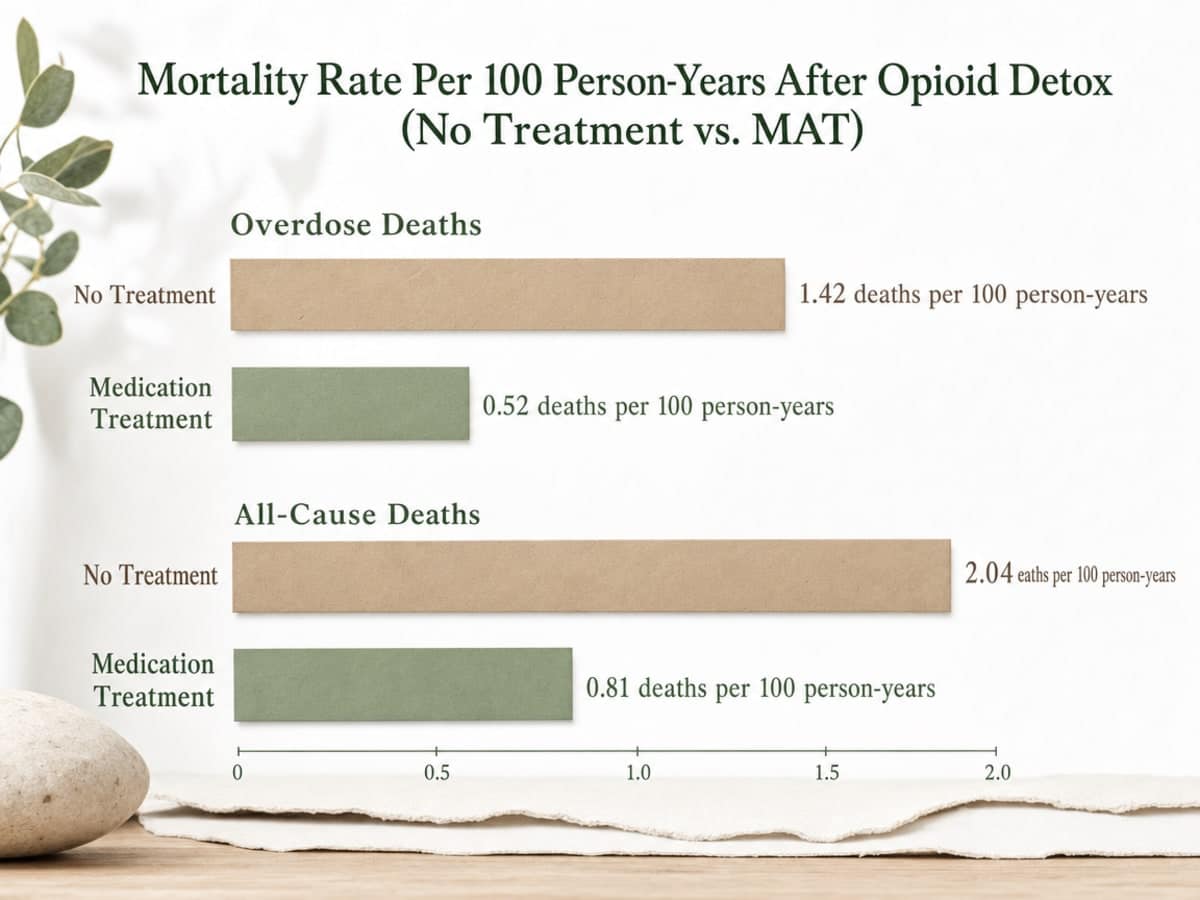
The most rigorous look at this comes from a Massachusetts study that followed more than 30,000 adults after they were discharged from inpatient opioid detox. Researchers tracked what happened to them over the next twelve months based on what care, if any, they received after detox. Among the people who got no further treatment—no medication, no residential program, nothing—the all-cause mortality rate was 2.04 deaths per 100 person-years, and the opioid-overdose death rate was 1.42 per 100 person-years. Among the people who continued on medication treatment, those numbers dropped to 0.81 all-cause and 0.52 overdose deaths per 100 person-years 3. Roughly a two-to-threefold difference in dying, depending on which measure you look at, in one calendar year.
Sit with that for a second. This isn’t a study about who felt better or who reported fewer cravings. It’s a study about who was still alive twelve months later. The single most important variable wasn’t motivation, family support, or how much someone wanted to quit. It was whether they stayed on medication after the withdrawal was over.
If you’ve white-knuckled through detox on your couch before, you already know how the story usually ends. What you may not have known is that the ending isn’t just “I used again.” The ending, for too many people, is an accidental overdose in the exact window when their tolerance has dropped and their brain is still screaming for the substance. That’s not a moral failure. It’s a pharmacology problem with a pharmacology solution.
What Federal Guidelines Actually Say About Quitting Cold
If you’ve absorbed the message that “real” recovery means doing it drug-free, know that message is not coming from the people who study this for a living. It’s coming from an older cultural script that the evidence no longer supports.
The CDC’s clinical guidance on opioid use disorder is unusually direct on this point:“Detoxification on its own, without medications for opioid use disorder, is not recommended for OUD because of increased risks for resuming drug use, overdose, and overdose death” 19.That’s the CDC saying, in plain language, that the willpower-only route is worse than doing nothing about the philosophical purity of it. The American Society of Addiction Medicine reaches the same conclusion in its national practice guideline, stating that detoxification alone is not adequate treatment and that medication combined with psychosocial care is the recommended standard 23.
The CDC’s chronic pain guideline goes further, telling clinicians to offer or arrange medication-assisted treatment when opioid use disorder is identified, not to treat it as a fallback 22. So when you’ve felt like reaching for professional help was somehow giving up, understand what you’re actually giving up: an approach that federal medicine has stopped recommending. Choosing medication isn’t weakness. It’s catching up to the evidence.
What Medication-Assisted Treatment Actually Does
The Medication Takes the Withdrawal Off the Table
Here is the simplest way to understand what MAT does: it turns off the alarm system that keeps dragging you back. The shakes, the racing pulse, the crawling skin, the thought loop that will not stop at 4 a.m.—those are not moral tests. They are signals your nervous system is generating because it is missing a chemical it has come to expect. FDA-approved medications quiet those signals in different ways, so the part of you that wants to be done with this can actually get a word in.
For opioid dependence, that means methadone or buprenorphine occupies the same receptors the substance did, without producing the high, so withdrawal does not arrive and cravings shrink to something you can think around. Naltrexone works from the opposite direction, blocking those receptors after you are fully detoxified so a slip does not turn into a relapse 6. For alcohol dependence, medications like naltrexone, acamprosate, disulfiram, and topiramate change the neurochemistry that keeps drinking rewarding or keeps craving loud 14.
SAMHSA calls this an evidence-based practice, and it pairs medication with counseling and behavioral therapy on purpose—the medication buys you a nervous system that can learn again 5.
The Effectiveness Case in Plain Numbers
You do not have to take the effectiveness of MAT on faith. The comparison has been run, repeatedly, across trials and cohorts, and the direction is consistent.
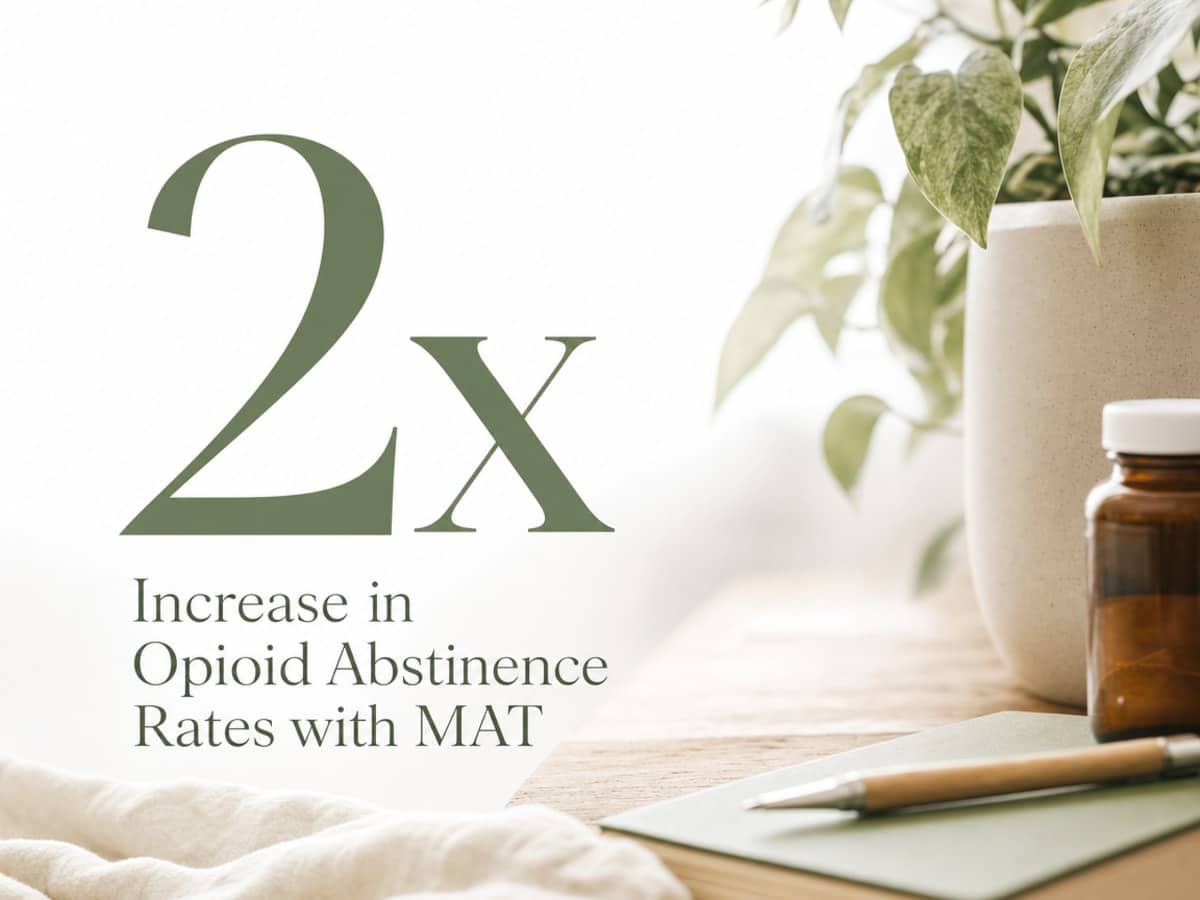
A peer-reviewed synthesis of randomized trials found that adding medication to psychosocial treatment at least doubles opioid abstinence outcomes compared with counseling or placebo alone 2. That is the difference between two versions of the same person: one trying to hold on with therapy and support, the other doing the same work with the withdrawal and cravings turned down. The second version stays abstinent at roughly twice the rate. Not because they wanted it more. Because the biology was addressed.
The CDC’s technical review of opioid treatment reaches the same conclusion in different words, noting that buprenorphine and methadone“stand out consistently as effective treatments”for opioid use disorder and for preventing overdose when compared with counseling, psychotherapy, or behavioral therapy alone 21.
What does that look like in a real program, over a real year? One community-based MAT study followed participants who stayed enrolled for at least 365 days. Among that group, 84% were abstinent from opioids and 62% were abstinent from all illicit substances, with an overall retention rate of 58% 20. Those are not perfect numbers. They are not supposed to be. They are the numbers of a chronic condition being managed well, by people who, like you, had probably already tried something else first.
The Opioid Medications: Methadone, Buprenorphine, Naltrexone
What Each Medication Does, Without the Pharmacology Lecture
Three medications are approved to treat opioid use disorder, and they work in genuinely different ways. Understanding the difference matters, because the right one for you depends on how long you’ve been using, what you’ve been using, and what your life looks like right now.
- Methadone
- A long-acting full agonist. In plain terms, it sits on the same brain receptors that heroin, fentanyl, or oxycodone were hitting, but it does so steadily, without producing a high at a proper dose. Withdrawal disappears. Cravings quiet down. You can eat, sleep, hold a job, and be a parent again. Because it is a full agonist, methadone is dispensed through federally regulated opioid treatment programs, which means daily or near-daily visits at first 4.
- Buprenorphine
- A partial agonist. It occupies the same receptors but only activates them part of the way, with a built-in ceiling that makes it harder to misuse and safer in overdose. It can be prescribed in office-based settings, often as buprenorphine/naloxone (Suboxone), which makes access easier for people who can’t structure their week around a clinic 4.
- Naltrexone
- Works from the other side entirely. It is not an opioid. It blocks the receptors so that if you did use, the substance would have nowhere to land. That’s a real advantage for relapse prevention, but there’s a catch: you have to be fully detoxified before you start, usually seven to ten days opioid-free, or the medication will trigger sudden, severe withdrawal 6.
Retention Data: Why Medication Choice Matters
Here is where the numbers get interesting, and where the choice between medications stops being abstract. Staying in treatment is one of the strongest predictors of not dying. So how long people stay on each medication is not a bureaucratic metric. It’s a survival metric.
The START trial, a large multi-site randomized study conducted across U.S. community treatment programs, tracked how many people were still in care at 24 weeks. Among those assigned to methadone, 74% completed 24 weeks of treatment. Among those on methadone doses of 60 mg per day or higher, that number climbed to 80%. Among those assigned to buprenorphine/naloxone, 46% completed the same 24 weeks 7. A 2023 meta-analysis pooling later studies found the same directional pattern: at six months, retention favored methadone (risk ratio 0.76 in randomized trials) 8. Other reviews of fixed-dose regimens report the gap narrows considerably—retention around 65.5% for methadone versus 57.3% for buprenorphine at four to six months 9.
What that means for you: methadone tends to hold people in treatment longer on average, especially at adequate doses, which likely reflects both its pharmacology and the daily structure of clinic-based care. Buprenorphine trades some retention for flexibility—you can pick it up at a pharmacy and take it at home. Neither medication is a bad choice. A low-dose methadone regimen actually retains fewer people than well-dosed buprenorphine 10. Dosing, structure, and fit matter more than the label on the bottle. The conversation to have with your clinician is not “which is best” but “which is best for me, and at what dose.”
The Alcohol Side: Naltrexone, Acamprosate, and the Others
Why Alcohol Withdrawal Needs Medical Supervision
If your substance is alcohol, the risk profile of quitting on your own looks different from opioids, but it is not smaller. In some ways it’s larger. Opioid withdrawal is brutally uncomfortable but usually not lethal. Alcohol withdrawal, in someone who has been drinking heavily for months or years, can be.
The ASAM clinical practice guideline on alcohol withdrawal is explicit: moderate-to-severe withdrawal can produce seizures and delirium tremens, and it requires medical supervision, not a locked bedroom and good intentions 24. That means monitored vitals, symptom-triggered medication, and clinicians who know what to do when your blood pressure spikes at hour thirty-six.
You may have already tapered on your own and told yourself the shakes and racing pulse were manageable. That may have been true this time. Tolerance and physical dependence rise over years, though, so the withdrawal you survived at forty can be the withdrawal that puts you in an ER at forty-five. Getting through the acute window under medical care is not overkill. It’s the step that makes the medications described next actually possible—because the alcohol MAT medications work best when you start them after you’re already detoxified 16.
Which Alcohol Medication Fits Which Goal
There are four FDA-approved medications for alcohol use disorder, and the honest answer about which one is right for you depends on a question most people haven’t been asked directly: what does success look like to you? Total abstinence? Fewer heavy drinking days? Both are legitimate goals, and the medications sort along that line.
- Acamprosate
- Designed to support abstinence once you’ve stopped drinking. It helps quiet the lingering neurochemical noise that keeps pulling you toward the first drink. It doesn’t do much once you’ve already had one, so it works best if your goal is staying at zero 14.
- Naltrexone
- The same molecule used for opioids—takes the reward out of drinking. It blocks the receptors that make alcohol feel good, so heavy drinking episodes become less compelling. It’s the medication most often chosen when the goal is reducing heavy drinking or preventing a slip from becoming a bender. The COMBINE trial found that patients on naltrexone plus medical management had 80.6% days abstinent during treatment, compared with 75.1% on placebo plus medical management, and a lower risk of any heavy drinking day 15.
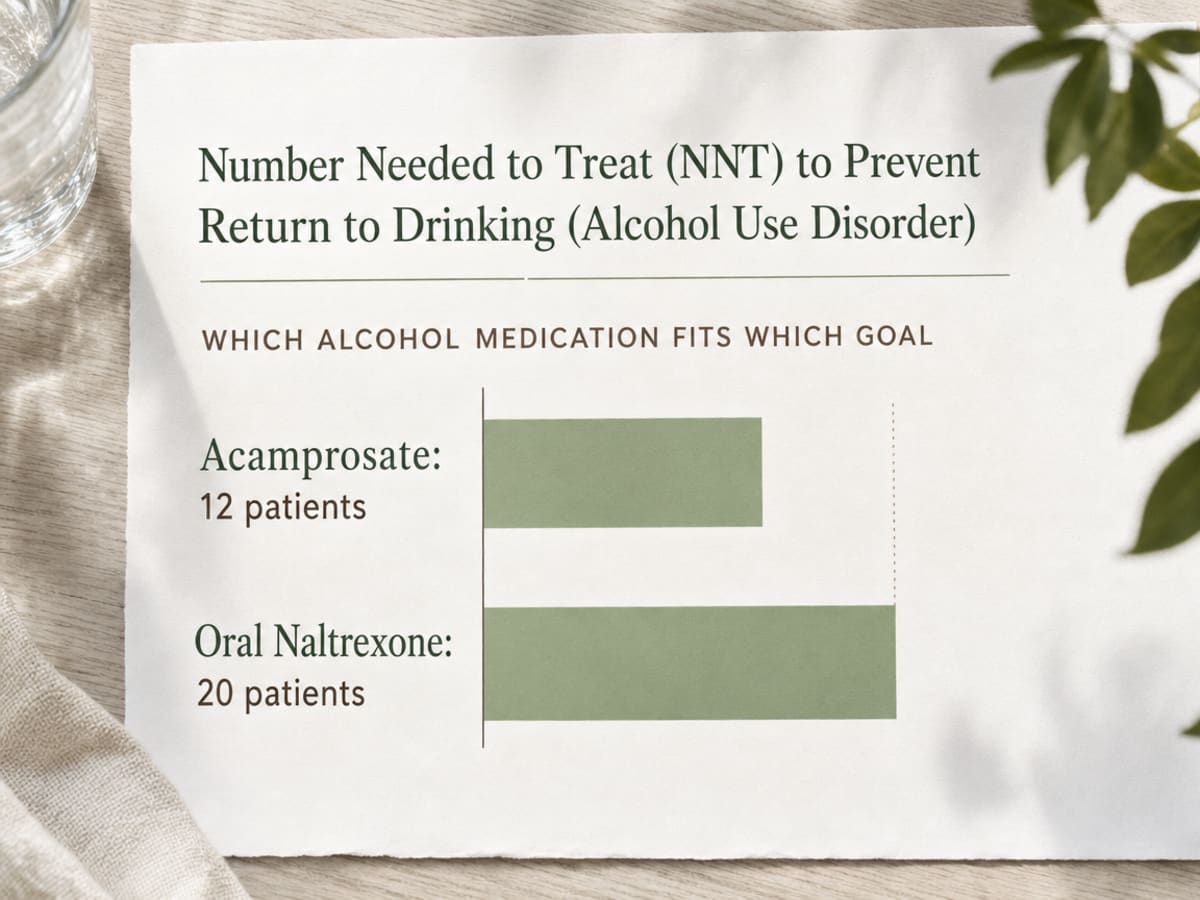
The clearest way to compare them is number needed to treat—how many people have to take the medication for one additional person to benefit. A large systematic review of over 22,000 patients found acamprosate had an NNT of 12 to prevent return to any drinking, oral naltrexone had an NNT of 20 for any drinking, and naltrexone had an NNT of 12 for preventing heavy drinking 17. Translation: if abstinence is the goal, acamprosate has the edge; if reducing heavy drinking is the goal, naltrexone is the stronger fit. Neither is a placebo.
Disulfiram works by making you sick if you drink, which is useful for some people who want a hard external deterrent. Topiramate, though not FDA-approved specifically for alcohol use disorder, is a first-line option in the VA/DoD guideline and reduces heavy drinking for many patients 13. Your clinician’s job is to match the medication to your goal, your medical history, and what you can actually take consistently.
What Recovery Looks Like When Medication Is Part of the Plan
Recovery on medication doesn’t look the way old movies taught you it would. There is no locked room, no shaking under a blanket while someone reads scripture at you. There is a first morning where you wake up and your pulse is normal. There is a second morning where you eat breakfast without thinking about a drink or a pill first. That is not a small thing. That is your nervous system coming back online.
What the evidence actually shows about a good MAT-supported recovery is quieter than the marketing suggests. You stay in care longer. The CDC’s technical review notes that survival, not perfection, is the primary outcome, and that continuing on medication protects you even during periods when abstinence isn’t complete 21. You are not being graded on whether every day is clean. You are being kept alive long enough for the days that are clean to add up.
Structure helps the medication do its job. SAMHSA’s guidance is explicit that MAT works best paired with counseling and behavioral therapy—not because the medication needs a chaperone, but because a nervous system that finally has room to think needs somewhere to put that thinking 5. You’ll talk with someone about the triggers you used to just react to. You’ll learn what your 3 a.m. actually wants. That work becomes possible once the alarm bells stop.
And the timeline is longer than a detox week. Most people who do well stay engaged for months, sometimes years, adjusting doses and eventually tapering under supervision if that’s the goal. Long-term retention is what the outcomes data keeps pointing to 1. Not a sprint you win. A condition you manage—the way someone manages blood pressure, without shame, and with the tools that work.
Getting Care in Oklahoma: Coverage and Access
If you’re reading this from a kitchen in Oklahoma City, Tulsa, Norman, or anywhere in between, the practical question is probably the loudest one right now: can I actually get this, and can I afford it?
The answer is more encouraging than most people expect. Oklahoma explicitly recognizes medication-assisted treatment as an evidence-based practice under Oklahoma Health Care Authority rule 317:30-5-241.7, which defines MAT as FDA-approved medications combined with counseling and behavioral therapy, and lists it among the services SoonerCare will cover when medically necessary 11. If you’re on SoonerCare, the medication side of your care is not a special favor you have to argue for. It’s a covered benefit.
On the delivery side, ODMHSAS Chapter 70 sets the standards for opioid treatment programs across the state, including how methadone and other agonist medications are dispensed and managed 12. That means the clinics offering this care are regulated, credentialed, and operating under a framework designed to keep the medication side of your treatment consistent and safe. Commercial insurance in Oklahoma generally covers medical detox and MAT as well, and most facilities will verify your benefits before you commit to anything.
The step from reading to calling is the hardest one you’ll take. If you’ve made it this far, Renewal Springs Detox and other licensed programs in the area can walk you through what coverage looks like for your specific situation—no paperwork, no pressure, just a phone call.
Talk Now With A Compassionate Detox Professional
Connect directly for real answers and immediate support tailored to your unique detox journey.
Frequently Asked Questions
Is MAT just replacing one drug with another?
No, and this is the question that keeps a lot of people out of treatment longer than they should be. Methadone and buprenorphine act on the same receptors as the opioid you were using, but at steady doses they don’t produce a high—they restore your brain to something closer to normal function. SAMHSA classifies MAT as an evidence-based practice for exactly this reason 5. Naltrexone isn’t even an opioid.
How long will I need to stay on medication?
Longer than a detox week, and often longer than a season. The evidence keeps pointing the same direction: people who stay on medication longer do better, and long-term retention is associated with lower mortality and better functional outcomes 1. Some people take medication for a year, some for several years, some indefinitely. Tapering is a conversation you have with your clinician when your life is stable—not a deadline you have to meet.
Do I still need counseling if the medication is working?
Yes, and the reason is not that the medication needs a chaperone. SAMHSA’s guidance pairs MAT with counseling and behavioral therapy because a nervous system that finally has room to think needs somewhere to put that thinking 5. The medication turns down the alarm. Counseling helps you understand what set the alarm off in the first place and what to do the next time something similar happens. They do different jobs.
Will SoonerCare or insurance cover MAT in Oklahoma?
SoonerCare covers medically necessary MAT services for opioid use disorder under Oklahoma Health Care Authority rule 317:30-5-241.7, which defines MAT as FDA-approved medications combined with counseling and behavioral therapy 11. That coverage is a defined benefit, not a discretionary favor. Commercial insurance in Oklahoma generally covers medical detox and MAT as well. Most licensed facilities will verify your specific benefits before you commit to anything, so you’re not guessing about cost.
Can I start MAT if I’m still drinking or using?
For opioid agonists like methadone and buprenorphine, induction happens during the early phase of withdrawal, so yes—you don’t have to be sober first. Naltrexone is different: you need to be fully detoxified, typically seven to ten days opioid-free, or the medication will trigger sudden severe withdrawal 6. For alcohol, medications like naltrexone and acamprosate work best when started after you’ve completed withdrawal management under medical supervision 16. Your clinician sequences this.
What happens if I’ve already tried MAT and it didn’t stick?
Then you have information most people don’t have yet. Maybe the dose was too low—low-dose methadone retains far fewer people than adequately dosed regimens 10. Maybe the medication didn’t fit your life, or the counseling piece wasn’t in place, or something else came apart. ASAM’s guideline treats switching between medications as a normal clinical decision, not a failure 6. A previous attempt isn’t a verdict. It’s a starting point for a better-designed one.
References
- The Effectiveness of Medication-Based Treatment for Opioid Use Disorder. https://www.ncbi.nlm.nih.gov/books/NBK541393/
- Medication-assisted treatment of opioid use disorder. https://pubmed.ncbi.nlm.nih.gov/25747920/
- Association between mortality rates and medication and residential treatment after medically managed opioid withdrawal. https://pmc.ncbi.nlm.nih.gov/articles/PMC7854020/
- TIP 63: Medications for Opioid Use Disorder. https://library.samhsa.gov/sites/default/files/pep21-02-01-002.pdf
- TIP 63: Medications for Opioid Use Disorder – Full Document (SAMHSA). https://www.samhsa.gov/resource/ebp/tip-63-medications-opioid-use-disorder
- American Society of Addiction Medicine (ASAM) National Practice Guideline for the Use of Medications in the Treatment of Addiction Involving Opioid Use. https://pmc.ncbi.nlm.nih.gov/articles/PMC4605275/
- Treatment Retention among Patients Randomized to Buprenorphine/Naloxone versus Methadone in a Multi-Site Trial. https://pmc.ncbi.nlm.nih.gov/articles/PMC3947022/
- Buprenorphine versus methadone for the treatment of opioid dependence: a systematic review and meta-analysis. https://pubmed.ncbi.nlm.nih.gov/37167985/
- Retention in opioid agonist treatment: a rapid review and meta-analysis. https://pmc.ncbi.nlm.nih.gov/articles/PMC8348786/
- A controlled trial of buprenorphine treatment for opioid dependence. https://pubmed.ncbi.nlm.nih.gov/1578593/
- 317:30-5-241.7. Medication-assisted treatment (MAT) services for eligible individuals with opioid use disorder (OUD). https://oklahoma.gov/ohca/policies-and-rules/xpolicy/medical-providers-fee-for-service/individual-providers-and-specialties/outpatient-behavioral-health-services/medication-assisted-treatment-services-for-eligible-individuals-with-opioid-use-disorder.html
- Chapter 70. Standards and Criteria for Opioid Treatment Programs (Oklahoma ODMHSAS). https://oklahoma.gov/content/dam/ok/en/odmhsas/documents/policy/provider-certification/administrative-rules/2025/PC–Chapter-70_9_15_2025.pdf
- VA/DoD Clinical Practice Guideline for the Management of Substance Use Disorders – Provider Summary. https://www.healthquality.va.gov/guidelines/MH/sud/VADoDSUDCPGProviderSummary.pdf
- Alcohol Use Disorder – VA Pharmacy Benefits Management Academic Detailing Guide. https://www.pbm.va.gov/academicDetailingService/Documents/Academic_Detailing_Educational_Material_Catalog/AUD_Provider_AD_Educational_Guide.pdf
- Combined Pharmacotherapies and Behavioral Interventions for Alcohol Dependence (COMBINE Study): A Randomized Controlled Trial. https://pubmed.ncbi.nlm.nih.gov/16670409/
- Meta-analysis of naltrexone and acamprosate for treating alcohol use disorders: when are these medications most helpful?. https://www.ncbi.nlm.nih.gov/books/NBK132618/
- Pharmacotherapy for adults with alcohol use disorders in outpatient settings: systematic review. https://pubmed.ncbi.nlm.nih.gov/24825644/
- Meta-analysis of naltrexone and acamprosate for treating alcohol use disorders. https://pmc.ncbi.nlm.nih.gov/articles/PMC3970823/
- Opioid Use Disorder: Treating | Overdose Prevention. https://www.cdc.gov/overdose-prevention/hcp/clinical-care/opioid-use-disorder-treating.html
- Trends in Abstinence and Retention Associated with a Community-based Medication-Assisted Treatment Program. https://pmc.ncbi.nlm.nih.gov/articles/PMC7751497/
- Linking People with Opioid Use Disorder to Medication Treatment: An Overview of Best Practices. https://stacks.cdc.gov/view/cdc/119464/cdc_119464_DS1.pdf
- CDC Guideline for Prescribing Opioids for Chronic Pain. https://www.cdc.gov/mmwr/volumes/65/rr/rr6501e1.htm
- Executive Summary of the American Society of Addiction Medicine’s National Practice Guideline for the Treatment of Opioid Use Disorder. https://pubmed.ncbi.nlm.nih.gov/32909985/
- The ASAM Clinical Practice Guideline on Alcohol Withdrawal Management. https://pubmed.ncbi.nlm.nih.gov/32511109/