
Finding Veteran Rehab Near Me: A Step-by-Step Guide
Key Takeaways
- Write down what you’re using, when you last used, and your insurance status, then make one call in the next hour — that’s the whole assignment.
- Detox handles the three-to-ten-day medical withdrawal, while rehab addresses the underlying patterns and trauma afterward; a facility may offer one but not both.
- Identify your coverage lane first — VA enrollment, TRICARE, or community/private — because each has a different fastest door into care.
- Work through five specific calls in order: STAR Clinic, VA Substance Abuse Treatment Program, SAMHSA, insurance verification, and the facility intake line.
- Alcohol and benzo withdrawal can cause seizures, so confirm any detox is medically supervised 24/7 and ask about medications like naltrexone, topiramate, or buprenorphine/naloxone 1, 19.
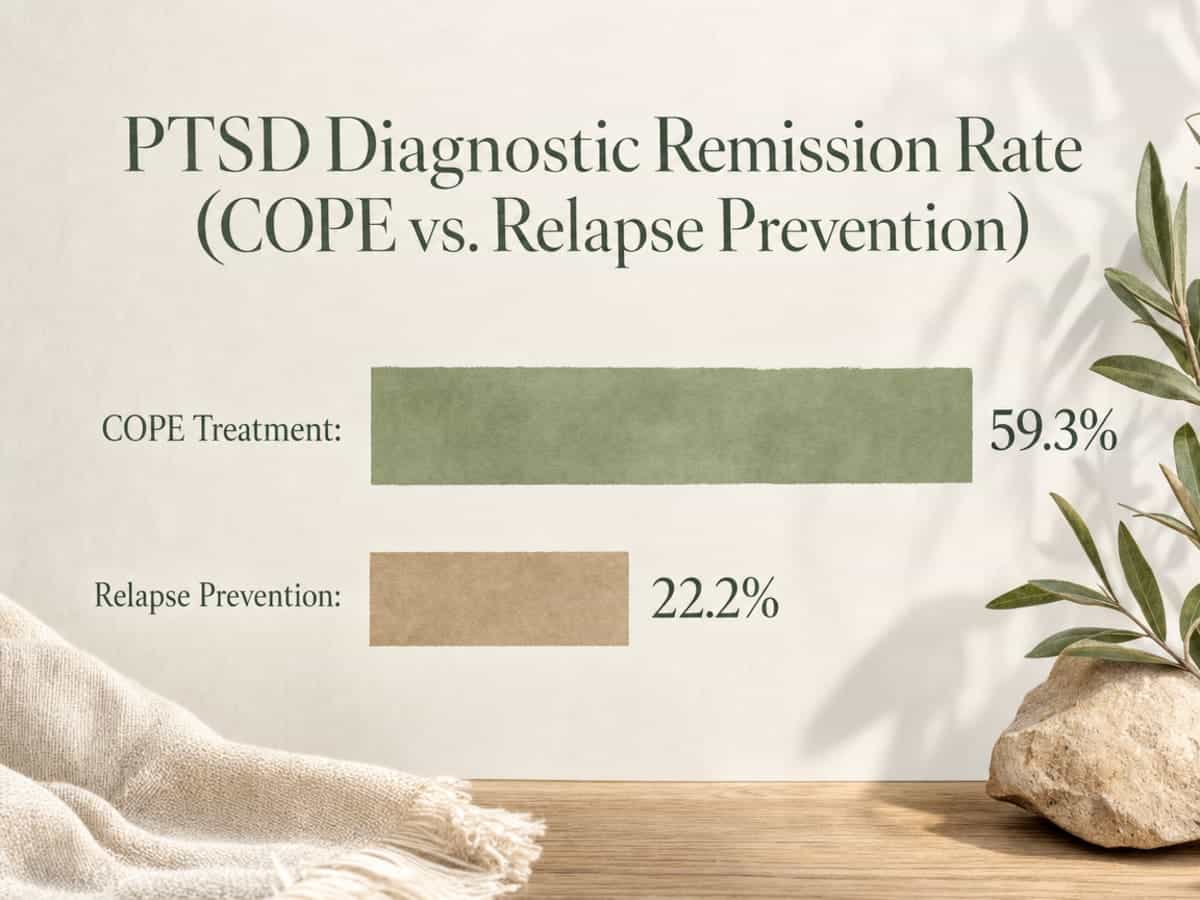
- Ask intake coordinators whether they treat PTSD and substance use concurrently — integrated care produced PTSD remission in 59.3% of veterans versus 22.2% with sequential treatment 3.
- VA policy prohibits denying care to enrolled veterans who are intoxicated, using, or in withdrawal, so showing up unwell is not a disqualifier 2.
- Expect modest, real progress rather than a cure — RAND found drug use dropped from 67.9% to 59.9% after multicomponent treatment 8.
What to do in the next hour
You don’t need a plan for the next six months. You need a plan for the next sixty minutes.
Grab a piece of paper. Write down three things: what you’re using (alcohol, opioids, benzos, stimulants, or a mix), the last time you used, and your insurance situation (VA enrolled, TRICARE, private, or none of the above). That’s the intake information every place is going to ask for anyway. Having it written down means you don’t have to think while someone’s asking questions.
If you’re in Oklahoma City and enrolled in VA care, the fastest door is the Substance Treatment and Recovery (STAR) Clinic at the Oklahoma City VA, which offers same-day help at 405-456-3278 16. If you’re not sure where you stand with the VA, or you want a community option, call SAMHSA’s 24-hour line at 1-800-662-HELP (4357) 11. If you’re having thoughts of hurting yourself, dial 988 and press 1 10. That’s the Veterans Crisis Line. Someone answers.
One call. That’s the whole assignment for the next hour. You made the list. Now make the call.
Detox and rehab are two different things
People use these words like they mean the same thing. They don’t.
Detox is the medical piece. It’s the three to ten days when your body is coming off alcohol, opioids, benzos, or a mix, and a clinical team is watching your vitals, managing withdrawal symptoms, and using medications to keep you safe. For alcohol and benzodiazepines especially, withdrawal can be dangerous without supervision. That’s why medical detox exists as its own level of care.
Rehab is what happens after. It’s the weeks or months of treatment where you actually work on the reasons you started using, the patterns you fell into, and the tools you’ll need going forward. That’s therapy, groups, medication management, and often work on service-related trauma. VA’s own guidance treats these as connected but distinct: detox stabilizes you, then specialty inpatient or outpatient treatment carries the load 5.
Why does this matter for your search? Because a facility that does great detox may not do rehab, and vice versa. When you call, ask which one they provide, and ask what the handoff looks like to the next step. You’re not shopping for one thing. You’re lining up two.
Figure out your coverage lane first
If you’re enrolled in VA care
You’re already in the system. That makes this simpler than you might think.
Start with the Oklahoma City VA. The Substance Treatment and Recovery (STAR) Clinic runs same-day help at 405-456-3278 16. You can also reach the Oklahoma City VA Health Care System’s Substance Abuse Treatment Program directly at 405-456-1000, extension 63218 18. Either line gets you talking to someone who works with veterans every day.
When you call, ask about the level of care you need. Outpatient SUD services, opioid treatment, and referral to residential or inpatient detox all run through the same intake process. VA policy also requires that every VISN offers residential SUD treatment, so if the local outpatient track isn’t enough for what you’re dealing with, they’re required to have a higher-acuity option in the network 2.
If you’re not sure whether you’re enrolled or your enrollment has lapsed, the VA’s general information line at 800-827-1000 can tell you where you stand 13. Ask them to check your eligibility and connect you to SUD services in one call. You don’t have to do this in two steps.
If you have TRICARE or you’re between systems
Maybe you’re still active reserve, recently separated, or a dependent using TRICARE. Maybe you were enrolled in VA care years ago and haven’t touched it since. Either way, you have options — just different ones.
Call SAMHSA’s 24-hour treatment referral line at 1-800-662-HELP (4357) 11. They’ll match you to community programs by ZIP code and can tell you which local facilities accept TRICARE or offer sliding-scale rates. You can also search FindTreatment.gov directly, filtering by state, county, distance, and payment accepted 9.
While you’re between systems, the door to VA care isn’t locked. If you served on active duty and meet basic eligibility, you can apply for VA health care at any time — and once enrolled, SUD treatment is covered 13. Two tracks running at once is fine. Start where you can get seen fastest.
If you’re going through community or private options
You might not want to go through the VA at all. That’s your call, and it’s a legitimate one. Wait times, past experiences, privacy concerns, or just wanting to keep your medical care separate from your service record — all valid reasons.
FindTreatment.gov is your main tool 9. Filter by location and by the services you actually need: medical detox, residential, outpatient, medication-assisted treatment. Local private detox facilities in Oklahoma City accept most major insurance plans, and most will run a free benefits verification before you commit. Ask for that upfront.
Two questions to ask any community facility during the first call: do you have clinicians experienced with military trauma, and can you treat PTSD and substance use together? A yes to both means you’re in the right conversation. A vague answer means keep dialing.
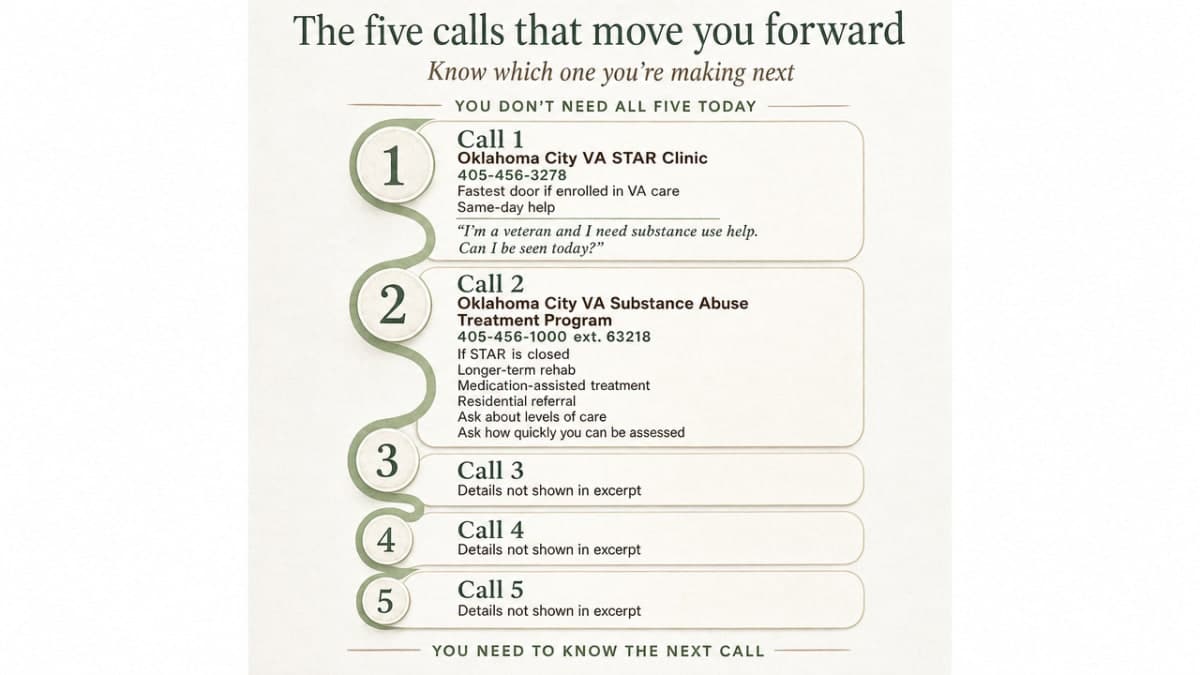
The five calls that move you forward
You don’t need to make all five today. You need to know which one you’re making next.
Here’s the order that actually works for a veteran in the Oklahoma City area. Each call has a purpose, a number, and a script you can borrow.
Call 1: The Oklahoma City VA STAR Clinic at 405-456-3278. This is the fastest door if you’re enrolled in VA care. The Substance Treatment and Recovery Clinic offers same-day help 16. Say: “I’m a veteran and I need substance use help. Can I be seen today?” That’s it. They take it from there.
Call 2: The Oklahoma City VA Substance Abuse Treatment Program at 405-456-1000, extension 63218. Use this line if STAR is closed or you need to talk about longer-term rehab, medication-assisted treatment, or a residential referral 18. Ask what levels of care they offer and how quickly you can be assessed.
Call 3: SAMHSA’s national helpline at 1-800-662-HELP (4357). Twenty-four hours a day, free, confidential. Use it if the VA route isn’t working, you’re not enrolled, or you want community options in Oklahoma City that accept your insurance 11. Say: “I’m a veteran looking for a medical detox that treats PTSD and substance use together. What’s near ZIP code [your ZIP]?”
Call 4: Your insurance company for benefits verification. The number is on the back of your card. Ask three specific questions: Does my plan cover medical detox? Does it cover residential rehab after detox? What’s my out-of-pocket cost? Most detox facilities will also run this verification for you for free — ask when you call them.
Call 5: The intake line at the facility you’ve chosen. By now you know your coverage lane and you have a target. This call is where you confirm they can admit you, when, and what to bring.
Finding a medically supervised detox that can handle your withdrawal
Alcohol, benzodiazepines, and opioids: why medical supervision matters
Not every substance requires a hospital-level detox. Some absolutely do.
- Alcohol withdrawal can escalate into seizures, hallucinations, and delirium tremens, which is a medical emergency.
- Benzodiazepine withdrawal, whether it’s Xanax, Valium, Klonopin, or Ativan, can also produce seizures and dangerous swings in blood pressure and heart rate.
- Opioid withdrawal from heroin, fentanyl, or prescription painkillers isn’t typically life-threatening on its own, but it’s brutal enough that most people can’t stay off use without medical support, and the dehydration and cardiac stress can matter if you have other health conditions.
This is why medical detox exists as a distinct level of care. A clinical team monitors vitals around the clock, uses medications to blunt withdrawal symptoms, and catches complications early. VA policy specifically requires that veterans not be denied care because they are intoxicated, actively using, or in withdrawal 2. You don’t have to clean up before you show up. Showing up in withdrawal is exactly what medical detox is built for.
When you call a facility, ask directly: are you medically supervised twenty-four hours a day, and do you have physicians experienced with alcohol, benzo, and opioid withdrawal? A clear yes is what you’re listening for.
Medications you can ask about by name
You are allowed to walk in knowing what you want to discuss. Naming a medication doesn’t mean you’ll get it prescribed. It means the conversation starts at a higher level.
For alcohol, VA’s own clinician guidance lists naltrexone (oral or extended-release injection) and topiramate as first-line recommended medications, with acamprosate and disulfiram as first-line suggested options 1. These are for after acute withdrawal is managed, to reduce cravings and support the weeks that follow.
For opioids, ask about buprenorphine/naloxone. VA practice recommendations specifically encourage its use when clinically indicated for opioid dependence, and note that opioid dependence tends to be underdiagnosed in veterans 19. Methadone is another option through licensed opioid treatment programs.
For acute alcohol or benzo withdrawal itself, the detox team typically uses benzodiazepines on a tapering schedule to prevent seizures. That’s a clinical decision, not something you request, but it helps to know the standard of care so nothing feels like a black box.
The single most important question to ask an intake coordinator
Here it is: “Will you treat my PTSD and my substance use at the same time, or do I have to get sober before you’ll touch the trauma?”
That question tells you almost everything you need to know about whether a facility is set up for veterans or just marketing to them. The answer you want sounds something like: yes, we treat both concurrently, and we use evidence-based trauma therapies like Prolonged Exposure, Cognitive Processing Therapy, or EMDR alongside substance use treatment. The answer you don’t want sounds like: we handle the substance use first, then we can refer you out for the PTSD piece later.
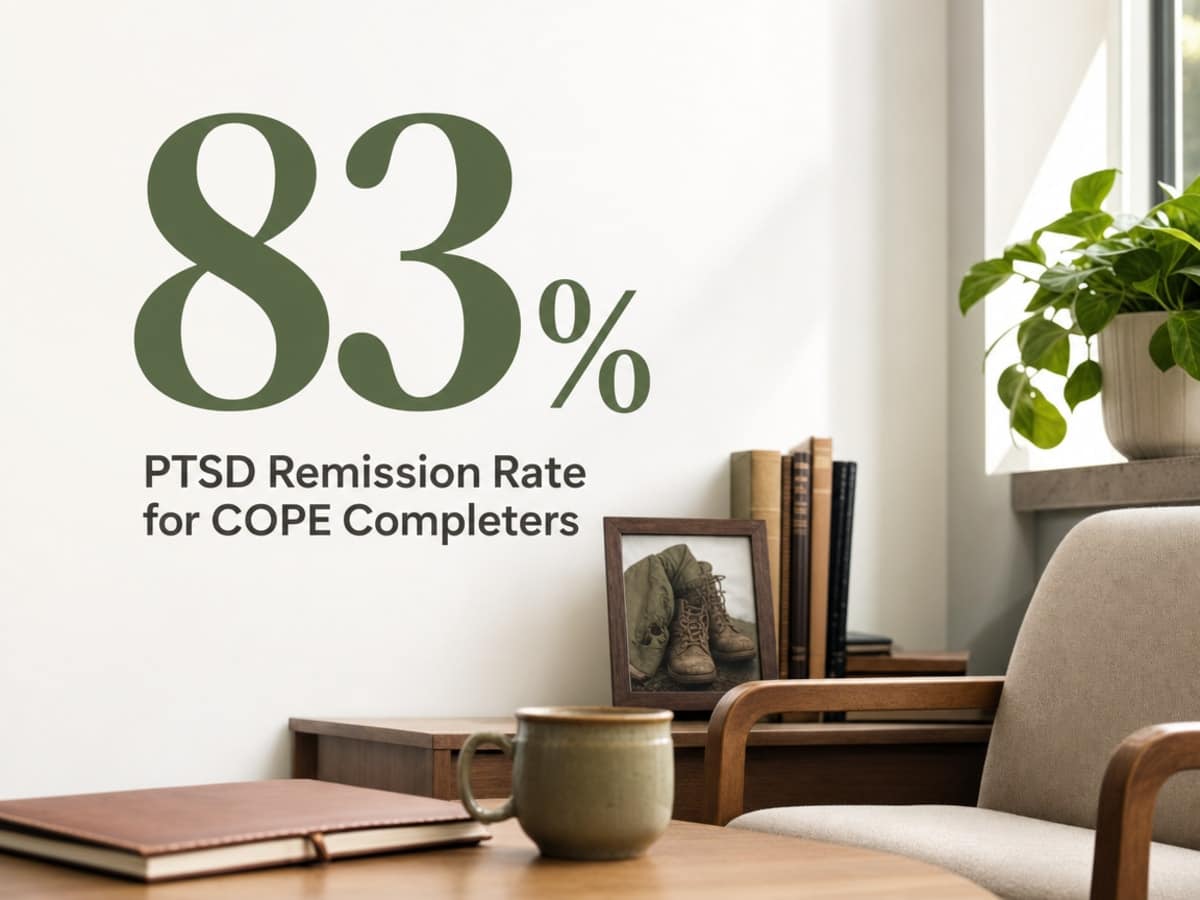
Here’s why this matters, with the actual numbers behind it. In a randomized trial of veterans with co-occurring PTSD and substance use disorder, integrated exposure-based treatment (COPE) produced PTSD diagnostic remission in 59.3% of participants, compared with 22.2% in a relapse-prevention comparison group 3. Among the veterans who completed the full COPE protocol, 83% no longer met criteria for PTSD at the end 3. Substance use outcomes were roughly similar between the two groups — meaning integrated care didn’t cost anything on the substance use side, and it delivered dramatically better trauma outcomes.
RAND’s synthesis of the broader literature reaches the same conclusion: integrated treatments that address both conditions concurrently have a stronger evidence base than approaches that treat one disorder at a time 15. VA’s own PTSD professional guidance is explicit — patients with PTSD and SUD can tolerate and benefit from evidence-based trauma-focused treatment, and having one condition shouldn’t be a barrier to receiving treatment for the other 14.
For decades, the standard was sequential: get clean first, then we’ll deal with what happened over there. A lot of veterans got clean, relapsed when the trauma symptoms roared back, and got told they weren’t ready. That model is not what current evidence supports. If a facility still runs that playbook, you’ve learned something important on the first call.
Ask the question. Listen to the answer. It’s the single best filter you have.
You cannot be turned away for being in withdrawal or actively using
This is the fear that keeps a lot of veterans from picking up the phone: showing up drunk, dope-sick, or shaking, and getting shamed out the door. Read this part carefully.
Withdrawal is the reason medical detox exists. Showing up in it is the correct move, not a disqualifying one.
If a facility, VA or community, treats you like your current state is a moral failure instead of a clinical situation, that’s information about the facility. It is not information about you.
What realistic progress looks like
Set your expectations now, before treatment starts, so the middle of it doesn’t knock you sideways.
Rehab is not a light switch. It’s not a two-week reset that hands you back a new life. The honest picture from the research: in RAND’s synthesis of multicomponent treatment programs for veterans with co-occurring PTSD and substance use disorder, the share of participants using drugs went from 67.9% at intake to 59.9% after treatment 8. That’s a real drop, and it’s a modest one. Progress is a shift, not a cure.
Why does that matter? Because if you walk in expecting to be fixed, the first hard week after discharge can feel like failure when it’s actually just Tuesday. And if you walk in expecting nothing to change, you’ll miss the wins that are happening.
Here’s what tends to move first: sleep, appetite, the ability to sit through a conversation without checking out. Craving intensity often drops before craving frequency does. PTSD symptoms sometimes improve alongside substance use, and in one intensive concurrent treatment program for veterans, lower PTSD symptoms at discharge were linked to less substance use at follow-up 7.
Small wins count. Getting through detox counts. Making it to the next appointment counts. You are not behind schedule. There is no schedule.
Locking down what comes after detox
Detox buys you a stable body. It doesn’t buy you a plan for week two. That’s the piece a lot of veterans leave loose, and it’s the piece where relapse tends to sneak in.
Before you walk into a detox bed, ask what the discharge plan looks like. A good answer names specific things: a referral into residential or intensive outpatient treatment, a scheduled appointment (not a phone number on a piece of paper), a plan for continuing any medications started during detox, and a warm handoff to a clinician who will see you within a week of discharge. VA’s own directive treats continuity of care after discharge as part of the SUD service standard, not an extra 2.
If your detox is medication-assisted, the transition matters even more. Naltrexone or extended-release injectable naltrexone for alcohol, and buprenorphine/naloxone for opioids, are meant to continue past detox — not stop at the door 1, 19. Ask who will prescribe and monitor them after you leave.
Also line up the trauma piece. If PTSD is in the mix, the next-level program should offer Prolonged Exposure, Cognitive Processing Therapy, or EMDR alongside substance use treatment, not after it 14. Get that name and appointment on the calendar before discharge day, not after.
Questions to ask before you say yes
Before you commit to a bed, run through this list on the phone. You can read straight from it. Nobody expects you to sound polished during an intake call.
- Are you medically supervised twenty-four hours a day, and what’s your protocol for alcohol, benzo, and opioid withdrawal? You want a clear clinical answer, not a marketing one.
- Will you treat PTSD and substance use concurrently, or do I have to complete detox and rehab before trauma work starts? Concurrent is what current VA guidance supports 14.
- What medications do you offer during and after detox? Ask about naltrexone or topiramate for alcohol 1, and buprenorphine/naloxone for opioids 19.
- What does the handoff look like on discharge day? You want a scheduled appointment, not a referral list.
- Do you have clinicians who work regularly with veterans? Not “we’ve had veterans before” — do they have staff trained in military trauma.
- What does my insurance cover, and what will I owe? Ask for the number in writing before admission.
- What happens if I need a higher level of care partway through?
Write down what they say. If an answer is vague on any of the first three, that’s your cue to call the next place on your list.
If someone else is making this call for a veteran
Maybe you’re the spouse. The adult daughter. The battle buddy who noticed. You’re the one holding the phone right now, and the person you love is on the couch, or in the garage, or not answering texts.
Here’s what actually helps.
You can call SAMHSA’s helpline at 1-800-662-HELP (4357) yourself and ask questions on their behalf 11. You can call the Oklahoma City VA STAR Clinic at 405-456-3278 to ask what same-day intake looks like before you hand the phone over 16. Facilities talk to family members all the time. You don’t have to pretend to be them.
What you can’t do is force treatment. What you can do is have the door open when they’re ready — a phone number on the counter, an insurance card located, a bag half-packed. Small things that remove friction.
If they’re in crisis, dial 988 and press 1 10. That call is yours to make.
Talk With a Veteran Detox Specialist Now
Get real answers and support from someone who understands your service and your journey to recovery.
Frequently Asked Questions
Can I be turned away from a VA detox if I’m intoxicated or actively using?
No. VA policy is explicit that medical facilities cannot deny care to enrolled veterans because they are under the influence, actively using, or in withdrawal 2. Any veteran requesting SUD care is entitled to an initial screening, and veterans in crisis get same-day access 2. Showing up in withdrawal is what medical detox is built to handle. That is the correct move, not a disqualifying one.
What’s the difference between medical detox and rehab?
Detox is the three-to-ten-day medical piece: a clinical team manages your withdrawal symptoms from alcohol, opioids, benzos, or a mix, and keeps you safe. Rehab is what happens after — the weeks or months of therapy, groups, medication management, and trauma work. VA guidance treats these as connected but distinct levels of care 5. A facility might do one, the other, or both. Ask which when you call.
Do I have to get sober before I can get PTSD treatment?
No. Current VA guidance is clear that veterans with PTSD and substance use disorder can tolerate and benefit from evidence-based trauma-focused treatment, and having one condition should not block treatment for the other 14. RAND’s synthesis of the research reaches the same conclusion: integrated care that treats both concurrently has a stronger evidence base than sequential approaches 15. Ask any facility whether they treat both at the same time.
What if I have TRICARE or no VA enrollment yet?
You still have options. SAMHSA’s 24-hour helpline at 1-800-662-HELP (4357) matches you to community programs by ZIP code and can identify facilities that accept TRICARE or offer sliding-scale rates 11. FindTreatment.gov lets you filter by state, county, distance, and payment accepted 9. You can also apply for VA health care at any time if you served on active duty and meet basic eligibility 13. Two tracks can run in parallel.
Which number should I call first if I’m in Oklahoma City?
If you’re enrolled in VA care, call the Oklahoma City VA Substance Treatment and Recovery (STAR) Clinic at 405-456-3278 — they offer same-day help 16. For longer-term rehab or medication-assisted treatment, the Oklahoma City VA Substance Abuse Treatment Program answers at 405-456-1000, extension 63218 18. If you’re in crisis or thinking about hurting yourself, dial 988 and press 1 for the Veterans Crisis Line first 10. Everything else waits.
What medications can I ask about for alcohol or opioid withdrawal?
For alcohol use disorder, VA clinician guidance lists naltrexone (oral or extended-release injection) and topiramate as first-line recommended medications, with acamprosate and disulfiram as first-line suggested options 1. For opioid dependence, VA practice recommendations encourage buprenorphine/naloxone when clinically indicated, and note that opioid dependence tends to be underdiagnosed in veterans 19. Methadone through a licensed opioid treatment program is another option. Naming these starts the conversation at a higher level.
References
- Alcohol Use Disorder (AUD) – VA PBM Academic Detailing Clinician Guide. https://www.pbm.va.gov/PBM/AcademicDetailingService/Documents/508/10-1530_AUD_ClinicianGuide_508Conformant.pdf
- VHA Directive – Providing Substance Use Disorder Services. https://www.va.gov/vhapublications/ViewPublication.asp?pub_ID=10070
- Integrated exposure-based therapy for co-occurring PTSD and substance use disorders in veterans (COPE trial discussion). https://pmc.ncbi.nlm.nih.gov/articles/PMC6488423/
- A randomized controlled trial evaluating integrated versus phased application of evidence-based psychotherapies for military veterans with comorbid PTSD and substance use disorders. https://pubmed.ncbi.nlm.nih.gov/31675546/
- Clinical Considerations in the Treatment of Substance Use Disorders in Veterans. https://pmc.ncbi.nlm.nih.gov/articles/PMC3885181/
- Is Integrated CBT effective in reducing PTSD symptoms and substance use among veterans?. https://www.ptsd.va.gov/professional/articles/article-pdf/id50582.pdf
- Substance Use after Completion of an Intensive Treatment Program with Concurrent Treatment for PTSD and Substance Use among Veterans: Examining the Role of PTSD Symptoms. https://pubmed.ncbi.nlm.nih.gov/38122816/
- Treatment for Co-Occurring PTSD and Substance Use Disorder Among Veterans (RAND Research Report RR4354). https://www.rand.org/content/dam/rand/pubs/research_reports/RR4300/RR4354/RAND_RR4354.pdf
- FindTreatment.gov (English) – SAMHSA Resource Description. https://www.samhsa.gov/resource/dbhis/findtreatmentgov-english
- Supporting the Behavioral Health Needs of Our Nation’s Veterans. https://www.samhsa.gov/blog/supporting-behavioral-health-needs-our-nations-veterans
- Find a Provider – PTSD: National Center for PTSD. https://www.ptsd.va.gov/gethelp/find_therapist.asp
- Substance Use Disorder (SUD) Program – Locations. https://www.va.gov/directory/guide/sud.asp
- Substance Use Treatment For Veterans. https://www.va.gov/health-care/health-needs-conditions/substance-use-problems/
- Treatment of Co-Occurring PTSD and Substance Use Disorders in VA. https://www.ptsd.va.gov/professional/treat/cooccurring/tx_sud_va.asp
- Veterans with Both Substance Use and Mental Health Disorders Need Integrated Treatment. https://www.rand.org/pubs/research_briefs/RB10132.html
- Make an Appointment | VA Oklahoma City Health Care. https://www.va.gov/oklahoma-city-health-care/make-an-appointment/
- Oklahoma City VA Medical Center. https://www.va.gov/oklahoma-city-health-care/locations/oklahoma-city-va-medical-center/
- Oklahoma – VA Substance Use Disorder Program Locations. https://www.va.gov/directory/guide/state_SUD.cfm?STATE=OK
- Practice Recommendations for Treatment of Veterans with Comorbid Substance Use Disorder and Posttraumatic Stress Disorder. https://www.mentalhealth.va.gov/providers/sud/docs/SUD_PTSD_Practice_Recommendations.pdf
- Substance Use Disorders and PTSD: An Exploratory Study of Treatment Preferences and Readiness for Change. https://pmc.ncbi.nlm.nih.gov/articles/PMC3855915/