
Key Takeaways
- Oklahoma City’s fentanyl-saturated supply has narrowed the margin between a normal dose and a fatal one, making the hours between deciding to get help and reaching a monitored bed the hours that matter most.
- Immediate medical admission means a clinician answers the phone around the clock, insurance is verified on the same call, and a doctor evaluates you on arrival with medication ordered based on your actual use history.
- Alcohol, benzodiazepines, opioids, and sedative-hypnotics are the substances SAMHSA flags as likely to require clinical withdrawal management, with seizures, hallucinations, or high fever signaling the need for immediate medical care.6
- Before choosing a program, compare who answers after hours, how fast benefits are verified, whether a bed is held during transport, and what specifically happens on day four after detox ends.
When the Window to Say Yes Is Narrow
You probably know the moment. It comes after a bad night, or a scare in an emergency room, or a text from someone who has stopped pretending they aren’t worried. You decide you are done. And then the phone sits in your hand for an hour while you think of every reason to wait until Monday.
Picking up the phone is the part most people underestimate. Not the withdrawal, not the paperwork, not the drive to the building. The decision itself is what closes fastest. If you are the mother, the husband, or the adult child making the call for someone else, you already understand this. You have watched the window open and close before.
A rehabilitation center built around immediate medical admission is designed to shorten the distance between that decision and a monitored bed. Not a waitlist. Not a call-back on Tuesday. A nurse on the phone tonight, insurance run in the next hour, and a plan for how you actually get to the door.
This matters because withdrawal from certain substances is not something to power through in a spare bedroom. Alcohol, benzodiazepines like Xanax or Klonopin, and opioids in a fentanyl-saturated supply are not conditions where willpower substitutes for a clinician taking your blood pressure at 3 a.m. The point of medical detox is that a doctor and nurse manage what your body is about to do, using medication when it is indicated, so the first 72 hours become survivable instead of terrifying.6
The pages ahead walk you through what that looks like in Oklahoma City, hour by hour, and what to ask so you know a program can actually take you today.
Why Rapid Admission Matters More in Oklahoma City Right Now
The drug supply that ran through Oklahoma City five years ago is not the drug supply running through it today. That single fact should shape how you think about waiting.
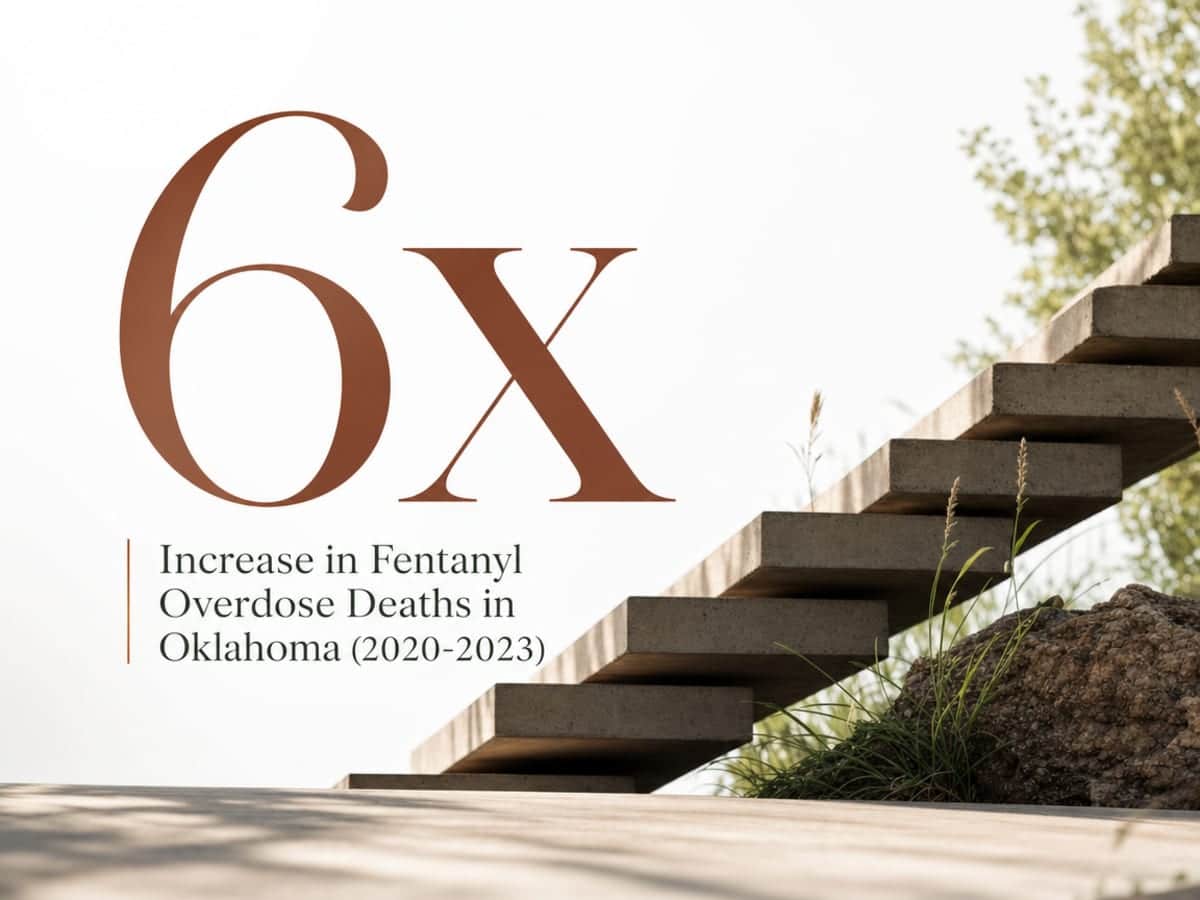
Fentanyl overdose deaths in Oklahoma climbed from 127 in 2020 to 730 in 2023, a nearly six-fold increase in three years. Deaths dropped 34% to 487 in 2024, but fentanyl was still involved in 86% of opioid-related overdose deaths that year. Almost every opioid on the street or in a counterfeit pill in this city now carries fentanyl, whether the person taking it knows or not. The margin for error between a normal dose and a fatal one has narrowed to almost nothing.3
What that means for you or the person you love is simple. If you are using opioids, or you are taking pills you bought outside a pharmacy, the risk of the next dose is not the same risk it was in 2019. And if your plan is to keep using until Monday because it is easier than making the call today, Monday is not guaranteed.
You are not being dramatic if you feel like there isn’t time. The data agrees with you. What you need on the other end of the phone is a program that agrees with you too, and can prove it by getting you evaluated tonight instead of scheduling an intake next week.
What ‘Immediate Medical Admissions’ Actually Means
The phrase gets used loosely, so it helps to define it in operational terms. Immediate medical admission means the clock between your call and a monitored bed is measured in hours, not days. It also means a licensed clinician, not just a call center, is on the other end of the line making decisions about your care.
Here is what that looks like when a program is set up for it.
- The call.
- A nurse or admissions clinician answers, asks what you have been using and how much, when you last used, and whether you have withdrawn before. If you had a seizure the last time you tried to stop drinking, that changes the plan. If you take Xanax daily along with fentanyl, that changes it more.
- Benefits verification.
- While you are still on the phone, someone runs your insurance. SoonerCare, employer plans, individual plans, TRICARE. You should not have to know your policy number by heart; the front desk finds it.
- Transportation.
- If you cannot safely drive yourself or ride with a family member, a program designed for rapid admission has a plan for how to get you there.
- Arrival and intake.
- Paperwork happens beside you, not before you. A nurse takes your blood pressure, temperature, pulse. A doctor evaluates you and orders medication if withdrawal has started or is expected. Oklahoma’s certification standards require 24/7 withdrawal management with fluids, meals, and vital sign monitoring. That is the floor, not the ceiling.1
- The first night.
- Someone checks on you through the night. If your heart rate climbs or your blood pressure spikes, a clinician adjusts your medication. You are not alone with your own body while it detoxes.
That is what the words mean when a program means them.
Medical Detox vs. Toughing It Out: Which Substances Need Clinicians
Not every drug requires a doctor to help you stop. Some do. The difference matters because guessing wrong can kill you, and because the internet is full of stories from people who quit at home without knowing they were lucky.
SAMHSA’s clinician guidance is direct about this. Medical intervention during withdrawal is likely to be required for four substance classes: alcohol, opioids, benzodiazepines, and sedative-hypnotics. That is the line most families do not know exists.6
Alcohol. If you have been drinking heavily every day, stopping cold can cause seizures, dangerously high blood pressure, hallucinations, and delirium tremens. DTs kill people. A nurse checking your vitals and a doctor with the authority to order medication is not a luxury here. It is the standard of care.
Benzodiazepines. Xanax, Klonopin, Ativan, Valium. If you have been taking these daily, quitting without a tapered medical plan can cause seizures the same way alcohol can. Benzo withdrawal is one of the few withdrawals that can be fatal, and the timeline is longer than most people expect.
Opioids. Heroin, fentanyl, prescription painkillers like oxycodone. Opioid withdrawal itself is rarely fatal in a healthy adult, but it is brutal enough that most people relapse to make it stop. In a fentanyl-heavy supply, that relapse is where overdoses happen. Medication-assisted treatment during detox blunts the worst of it and dramatically lowers the odds of walking out the door to use again.
Sedative-hypnotics. Sleep medications in the same family as benzos carry the same seizure risk.
Stimulants like meth and cocaine, marijuana, and kratom generally do not carry the same acute medical risks during withdrawal. That does not mean quitting them is easy, and it does not mean a medical setting is wrong for you. It means the reason to be there is different: structure, safety from relapse, and treatment for the depression, exhaustion, and cravings that come with stopping. If you are using more than one substance at once, which is common, the higher-risk substance sets the plan.
Inside the First 72 Hours: What Monitored Withdrawal Looks Like
The first three days are the part your body cannot negotiate around. Knowing what actually happens in them, hour by hour, tends to lower the fear more than any reassurance does.
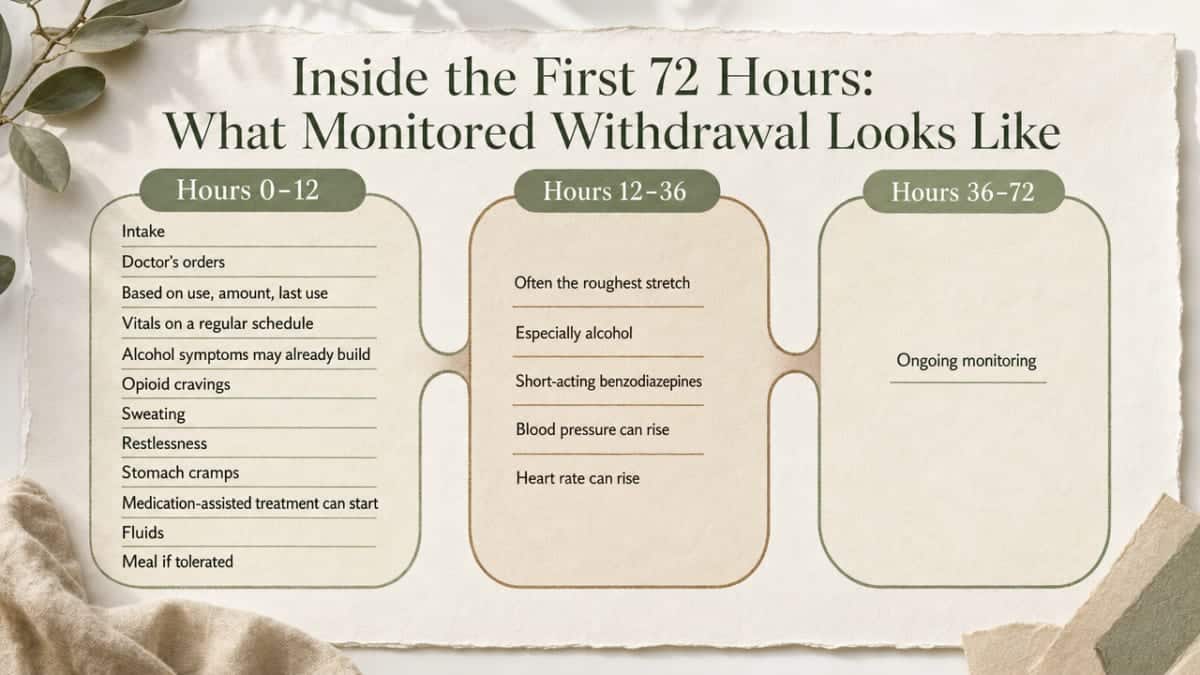
Hours 0 to 12. After intake, a doctor writes orders based on what you have been using, how much, and how recently. If you drink heavily and your last drink was this morning, symptoms may already be building by the time you settle in. A nurse takes your vitals on a regular schedule. If you use opioids, cravings and early withdrawal signs like sweating, restlessness, and stomach cramps show up in this window. Medication-assisted treatment can start here. You get fluids. You get a meal if you can keep it down.1
Hours 12 to 36. This is often the roughest stretch, especially for alcohol and short-acting benzodiazepines. Blood pressure and heart rate can climb. Tremor gets worse before it gets better. Nausea, insomnia, and anxiety spike. The clinical team adjusts medication in response to what your vitals show, not on a fixed schedule someone printed a week ago. Continuous monitoring during this window is why the setting matters: a nurse walking past your room every hour is how a spike gets caught before it becomes a seizure.7
Hours 36 to 72. For most substances, the peak has passed by day three. You are still tired. You are still not sleeping well. But the physical grip loosens enough that you can sit up, eat a real meal, and talk to a counselor without your body drowning out the conversation. This is when SAMHSA’s third phase of detox begins in earnest—fostering your readiness for what comes next. It is not a graduation. It is the point where planning the next 30 days stops feeling impossible.5
Detox is the first phase of treatment, not the whole treatment. What these 72 hours give you is a body that is no longer in crisis, so the harder work of staying stopped has a place to start.5
Paying for It: SoonerCare, Commercial Plans, and Parity Law
The question sitting under every other question is usually money. You can want help, know you need it, and still not call because you assume the answer is a bill you cannot pay. Here is what the law actually says about what your coverage owes you.
SoonerCare. If you are on Oklahoma’s Medicaid program, medical detoxification is a covered behavioral health benefit, along with inpatient acute care and crisis stabilization. That means a member with active SoonerCare should not be turned away from a medically supervised detox bed because of ability to pay. The front desk verifies your eligibility while you are on the phone.9
Commercial insurance. If you have coverage through an employer, the marketplace, or an individual plan, parity law is the sentence that matters. Oklahoma passed SB 1718 in 2020, which requires carriers in the state to offer mental health and substance use disorder coverage on par with medical and surgical coverage. Federal law, through MHPAEA, requires the same at the national level: financial requirements and treatment limitations for behavioral health cannot be more restrictive than those applied to other medical care. In plain terms, if your plan would cover a hospital admission for a cardiac issue, it is required to cover a comparable admission for withdrawal.11,12
What this looks like on the phone. You give the admissions team your insurance card information. They contact your carrier, confirm your behavioral health benefit, and tell you what your deductible and out-of-pocket look like before you commit to anything. If your plan tries to apply a prior authorization requirement that would delay a medically necessary admission, the Oklahoma Insurance Department accepts complaints about parity violations.10
None of this eliminates cost entirely. It does mean the cost of medical detox is not supposed to be higher, harder to access, or more restricted than the cost of any other hospital-level care your body might need. If a program tells you insurance won’t cover detox at all, that is a reason to call a second program, not a reason to hang up and wait.
Co-Occurring Conditions and Specialized Tracks
Substance use rarely arrives alone. Roughly 23% of Oklahomans who died of an overdose had a documented history of mental health problems, and the real number of people living with both is almost certainly higher. If you have been drinking to quiet anxiety, using stimulants to push through depression, or taking opioids after a trauma the health system never treated, you are the norm, not the exception.4
A detox program that treats you as one problem will miss the other. When the alcohol clears, the panic that was underneath it is still there. When the opioids clear, the pain and the nightmares are still there. Good medical detox does not try to fix all of that in 72 hours. It does make sure a psychiatric evaluation happens alongside the medical one, so the plan for what comes after detox is built around both conditions instead of one.
Veterans. If you served, your withdrawal is often tangled with combat exposure, chronic pain, and a VA history that may or may not have gone well. Programs with a veteran track know the difference between civilian anxiety and hypervigilance, and they know how to coordinate with VA benefits.
Gender-specific care. For some people, sharing a hallway with the opposite sex during the worst 48 hours of their life is a nonstarter, especially with a history of assault or domestic violence. Men-only and women-only tracks exist because that safety is clinical, not cosmetic.
Private care. If your job or your public role makes anonymity part of whether you can accept help at all, that is a legitimate clinical variable too. A quieter setting is not a luxury upgrade. It is the difference between calling today and calling never.
How to Tell If a Program Is Actually Set Up for Same-Day Admission
Every treatment center in Oklahoma City will tell you they can help. Not every one is built to admit you tonight. The difference shows up in specific answers to specific questions, and you are allowed to ask them before you commit to a drive across town.
Ask who answers the phone at 11 p.m. If the answer is a call center that will pass your information to a clinician in the morning, that program is not set up for same-day admission. A nurse or admissions clinician should be reachable around the clock and should be asking about your last use, your withdrawal history, and any seizures within the first few minutes of the call.
Ask how insurance is verified. A program with a rapid intake process runs your benefits while you are still on the line and calls you back with numbers, not vague reassurances. If they tell you verification takes 24 to 48 business hours, the door is not open today.
Ask about the medical evaluation. Oklahoma’s certification standards require that certified facilities provide 24/7 withdrawal management with vital sign monitoring, fluids, and meals. A physician or advanced practice provider should evaluate you on arrival and write medication orders based on what you have been using, not on a template. If the intake sounds like a questionnaire and a bed assignment with no doctor involvement in the first few hours, that is a red flag.1
Ask what happens if you arrive already withdrawing. Hallucinations, seizures, or a high temperature require immediate medical attention, not a waiting room. A program prepared for rapid admission has a clear answer for this scenario and will tell you when they would route you to an emergency department first and admit you after stabilization.6
Ask about transportation and the bed hold. If they cannot tell you how you will physically get there, or whether a bed is being held while you drive, they are hoping you make it in. Hoping is not a plan.
After Detox: The Handoff That Determines Whether This Works
Detox is the first phase of treatment, not the whole treatment. SAMHSA is blunt about this: without ongoing care, the odds of a lasting change after a stand-alone medical detox are low. Your body clears in 72 hours. The reasons you were using do not.5,7
The handoff is what most families never think to ask about, and it is often the difference between a detox that holds and one that becomes the third or fourth attempt in a bad pattern. A program set up for real continuity does the planning while you are still in the bed, not the morning you are discharged.
Here is what a real handoff looks like. A counselor sits with you before day three and maps what comes next: residential treatment if the home you would return to is not safe, intensive outpatient if it is, medication-assisted maintenance for opioids if that fits your history. A specific bed or intake slot gets held, with a date. If you have SoonerCare or a commercial plan, that continuation is verified against your benefits before you leave. If you have a co-occurring mental health condition, a psychiatric follow-up is on the calendar, not on a list of suggestions.9
When you call, ask what happens on day four. A program that cannot answer that question specifically is a program that will hand you back your keys and hope.
Making the Call Today
You have read enough. The next thing that changes anything is the phone in your hand.
You do not need a speech ready. You do not need to know your insurance policy number. You do not need to have told your family yet. A nurse on the other end will ask what you have been using, when you last used, and whether you have ever withdrawn before. That is the whole opening conversation.
If tonight is not the night you can go in, ask for the call anyway. Ask what a bed would look like tomorrow. Ask what happens if you show up already shaking. A program built for rapid admission will answer those questions in plain language and hold the door open while you decide.
The decision you are trying to make is not whether you deserve help. You do. The decision is whether the next hour includes a phone call. Renewal Springs is one number to start with.
Speak Now for Immediate Admission and Support
Connect instantly with a compassionate admissions expert ready to guide your next steps without delay.

Frequently Asked Questions
Can I be admitted to a rehabilitation center in OKC today?
Often yes, if the program is built for it. A facility set up for same-day medical admission has a clinician answering the phone around the clock, verifies your insurance while you are still on the line, and can hold a bed while you get there. Call first. If the first program cannot take you today, ask them to refer you to one that can.
Will SoonerCare or my commercial insurance cover medical detox?
SoonerCare covers medical detoxification as a behavioral health benefit alongside inpatient acute care and crisis stabilization. Commercial plans are required by Oklahoma SB 1718 and federal MHPAEA to cover substance use treatment on par with medical and surgical care. The admissions team runs your benefits before you commit, so you know your out-of-pocket costs upfront rather than guessing.9,11,12
Which substances actually require medically supervised detox instead of quitting at home?
SAMHSA guidance is specific: medical intervention during withdrawal is likely required for alcohol, opioids, benzodiazepines, and sedative-hypnotics. Alcohol and benzo withdrawal can cause seizures and can be fatal without clinical management. Opioid withdrawal is rarely fatal but drives relapse into a fentanyl-heavy supply. Stimulants, marijuana, and kratom do not carry the same acute medical risks but often benefit from a supervised setting.6
What happens during the first 24 hours after I call?
A nurse asks what you have been using, when, and whether you have withdrawn before. Your insurance is verified on the same call. Transportation gets arranged if needed. On arrival, a doctor evaluates you, a nurse takes your vitals, and medication is ordered if withdrawal has started. State certification requires 24/7 monitoring with fluids, meals, and regular vital sign checks through your first night.1
What if I have a mental health condition along with the substance use?
You are not unusual. Roughly 23% of Oklahomans who died of an overdose had a documented mental health history, and the living population with both conditions is larger. A program should schedule a psychiatric evaluation alongside the medical one, so the plan after detox addresses depression, anxiety, PTSD, or bipolar disorder instead of leaving those to resurface once the substance clears your system.4
What happens after detox is finished?
Detox is the first phase, not the whole treatment. Without a real handoff, the odds of lasting change drop sharply. Before you leave, a counselor should have mapped what comes next: residential treatment, intensive outpatient, or medication-assisted maintenance for opioids. A specific date and bed or intake slot should be held, and your insurance benefits verified for that continuation of care before discharge.5,7
References
- CHAPTER 18. STANDARDS AND CRITERIA FOR SUBSTANCE‑RELATED AND ADDICTIVE DISORDER TREATMENT SERVICES. https://oklahoma.gov/content/dam/ok/en/odmhsas/documents/policy/provider-certification/administrative-rules/2021/Chapter%2018%20Final%20effective%209-15-21.pdf
- Okla. Admin. Code tit. 450, ch. 18, subch. 3 – Substance Abuse Treatment Services [REVOKED]. https://www.law.cornell.edu/regulations/oklahoma/title-450/chapter-18/subchapter-3
- Drug Overdose Data – Injury Prevention Service. https://oklahoma.gov/health/health-education/injury-prevention-service/drug-overdose/data.html
- Drug Overdose Deaths, 2019–2023 – Oklahoma Fact Sheet. https://oklahoma.gov/content/dam/ok/en/health/health2/aem-documents/prevention-and-preparedness/injury-prevention/drug-overdose/2025%20State%20Drug%20OD%20-%20IPS%20-%20Fact%20Sheet.pdf
- Detoxification and Substance Abuse Treatment (Treatment Improvement Protocol TIP 45). https://www.ncbi.nlm.nih.gov/books/NBK64115/
- Quick Guide for Clinicians Based on TIP 45—Detoxification and Substance Abuse Treatment. https://nida.nih.gov/sites/default/files/samhsa_detoxification_and_substance_abuse_treatment.pdf
- TIP 39: Substance Abuse Treatment and Family Therapy. https://www.govinfo.gov/content/pkg/GOVPUB-HE20_400-PURL-gpo81969/pdf/GOVPUB-HE20_400-PURL-gpo81969.pdf
- SAMHSA TIPs and Publications Based on TIPs. https://www.ncbi.nlm.nih.gov/books/NBK575484/
- Behavioral Health and Substance Abuse Services – SoonerCare Benefits. https://oklahoma.gov/ohca/individuals/mysoonercare/soonercare-benefits/behavioral-health-and-substance-abuse-services.html
- Mental/Behavioral Health and Insurance – Oklahoma Insurance Department. https://www.oid.ok.gov/mental-behavioral-health-and-insurance/
- Understanding Mental Health Parity and Your Insurance Coverage. https://www.oid.ok.gov/getready12_2023/
- Mental Health and Substance Use Disorder Parity – U.S. Department of Labor. https://www.dol.gov/agencies/ebsa/laws-and-regulations/laws/mental-health-and-substance-use-disorder-parity
- Ward Map – City of Oklahoma City. https://www.okc.gov/Government/Administration/Ward-Map