
Key Takeaways
- Pause before you keep reading and recognize that reaching out counts as progress; medically assisted detox means licensed staff monitor vitals and give medication so your body clears substances safely.
- Alcohol and benzodiazepine withdrawal can cause seizures or delirium tremens and requires medical supervision, while opioid withdrawal is rarely fatal but needs careful timing before buprenorphine can safely start 13.
- Same-day admission in Oklahoma runs clinical screening and insurance verification on parallel tracks, with SoonerCare requiring telephonic medical necessity review before inpatient or residential care begins 5.
- Having a photo ID, insurance card, medication list, last-use timeline, an emergency contact, and a transportation plan turns a long intake call into a short one.
- The first 24 to 72 hours focus on evaluation and stabilization, with standardized withdrawal scoring guiding medication timing and staff managing sleep, food, and vitals through the peak.
- Before discharge, decide on continuing medication such as buprenorphine, methadone, naltrexone, or acamprosate while clinicians who know your history can guide the choice 16.
- Post-acute withdrawal symptoms like uneven sleep, mood swings, and cravings can last weeks to months and should be monitored during continuing care, not treated as failure 14.
- No insurance, no ride, and no long-term plan are not dealbreakers; intake teams routinely help with SoonerCare enrollment, transport, and building a plan on-site.
If You’re Reading This Right Now, Start Here
If you’re reading this at 2 a.m., or on a lunch break you almost didn’t take, or from your car in a parking lot, that counts. You are already doing the hardest part. You don’t need the right words. You don’t need a plan that goes past today. You just need to know what happens next, in plain language, so you can make one phone call without your stomach dropping.
Here is what you actually need to know before you keep reading. Medically assisted detox is not the same as “toughing it out” at home or checking into a place that just gives you a bed and a blanket. It means licensed medical staff watch your vital signs, give you medication if you need it, and keep you safe while your body clears the substance. For alcohol and benzodiazepines, that supervision isn’t optional. Severe alcohol withdrawal can turn into seizures or delirium tremens and should be seen at the nearest emergency department 10. For opioids, withdrawal is rarely deadly, but the timing of your first medication dose matters a lot 13.
The rest of this guide walks you through same-day admission in Oklahoma, what to have ready when you call, and what the first three days actually look like inside. Take a breath. Keep going.
When Withdrawal Makes Medical Supervision Non-Negotiable
Alcohol and Benzodiazepines: Why This Is a Medical Emergency Category
If alcohol or a benzodiazepine like Xanax, Valium, Klonopin, or Ativan is what you’ve been using daily, please read this part slowly. You are in the category where stopping cold without medical help can genuinely hurt you. That’s not a scare tactic. It’s the reason detox for these substances exists as a separate clinical process.
When you drink heavily every day, or take benzos on a regular schedule, your brain adapts. Take that substance away suddenly and the nervous system rebounds. Shakes, sweats, and a racing heart come first. Then, for some people, seizures. Then, in the most serious cases, delirium tremens, a condition that includes confusion, fever, and dangerously high blood pressure. The ASAM clinical guidance is direct on this: patients showing signs of severe alcohol withdrawal should be taken to the nearest emergency department, and benzodiazepines are the first-line medication used to keep the withdrawal safe 10.
Opioids: Uncomfortable, Rarely Life-Threatening, but Timing Matters
Opioid withdrawal, whether from heroin, fentanyl, oxycodone, hydrocodone, or another prescription painkiller, feels awful. The worst flu of your life, plus restlessness, plus a kind of full-body ache that makes it hard to sit still. But unlike alcohol or benzos, it usually will not kill you. That doesn’t mean you should white-knuckle it at home. Most people who try that use again within a day or two, because the discomfort is that intense.
The bigger clinical reason to be somewhere supervised is the medication timing. Buprenorphine, one of the main medications used to stop opioid withdrawal, cannot be started too early. If it goes in while there’s still enough of another opioid in your system, it can push you into what’s called precipitated withdrawal, which is sharper and more painful than what you were already feeling. The CDC guidance is clear: you should be in mild to moderate withdrawal before that first dose 13.
A medical team knows how to score where you are, when to dose, and how to keep you comfortable through the peak. If you’re using fentanyl, that timing gets even more nuanced because fentanyl lingers in body tissue longer than short-acting opioids. This is not a call to make on your own kitchen floor.
Stimulants, Kratom, and Polysubstance Use
Stimulant withdrawal, from meth, cocaine, or misused Adderall, looks different. Your body isn’t in danger the same way it is with alcohol. What crashes is your mood. Deep exhaustion, heavy sleep, and a low that can slide into serious depression or thoughts of hurting yourself. That’s a mental health emergency, and medical supervision matters even when the physical risk is lower.
Kratom sits in a gray zone. Because it acts on opioid receptors, withdrawal can feel opioid-like, with anxiety, sweating, muscle aches, and cravings. It’s often underestimated. And if you’ve been using more than one substance, which is common, the safest assumption is to be treated for the highest-risk one on your list.
The comparison below pulls together the safety picture your intake team will be sorting through when you call.
| Substance | Typical onset | Danger level | Medical supervision |
|---|---|---|---|
| Alcohol | 6–24 hours | Can be life-threatening; severe cases go to the ED | Strongly indicated |
| Benzodiazepines | 1–4 days | Seizure risk; requires tapering | Strongly indicated |
| Opioids | 8–36 hours | Rarely fatal; buprenorphine only in mild-to-moderate withdrawal | Strongly indicated for comfort and MAT start |
| Stimulants | Hours to days | Mood crash, suicide risk | Indicated for mental health monitoring |
| Kratom | 12–24 hours | Opioid-like discomfort | Recommended |
How Same-Day Admission Actually Works in Oklahoma
The Call, the Screening, and the Clock
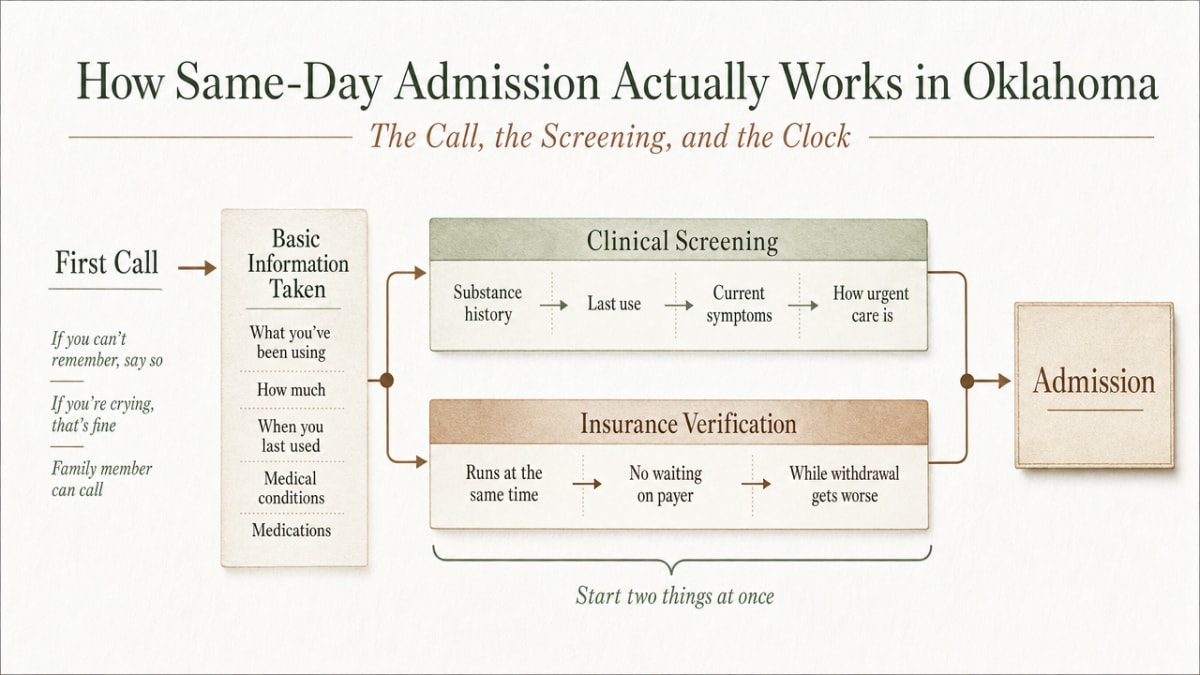
The first call is shorter than you think. You don’t need a speech. Someone on the other end will ask what you’ve been using, how much, when you last used, and whether you have any medical conditions or medications. That’s it. If you can’t remember something, say so. If you’re crying, that’s fine. If a family member is calling for you, that also works.
Here is what happens on the clock from that first call. Intake staff take your basic information and start two things at once. Clinical screening runs on one track: a nurse or counselor works through your substance history, last use, and current symptoms to figure out how urgent your care is. Insurance verification runs on the other track, so nobody is waiting on the payer while your withdrawal gets worse. For SoonerCare members, inpatient and residential services require prior authorization before the service is provided 4, and that authorization involves a telephonic medical necessity review with the intake team 5. In plain English: your insurance and the clinical team talk to each other while you’re still on the phone or shortly after.
From there, a bed gets assigned, transportation gets arranged if you need it, and you arrive for on-site evaluation and stabilization. The federal clinical framework calls this evaluation, stabilization, and fostering readiness for treatment 15. You will hear those words used differently by different staff. They all mean the same thing: figure out where you are, keep you safe, and get you steady enough to think about what’s next.
SoonerCare, Private Insurance, and Prior Authorization in Plain English
Prior authorization is a phrase that sounds like it belongs on a form, so let’s just translate it. It means your insurance company has to say yes before you go in, based on whether the care is medically necessary. For SoonerCare, that yes is required for inpatient hospital and residential services, and it has to be in place before the service is provided 4. For private insurance, most plans work the same way for detox-level care.
You are not the one who has to fight that battle. The intake team at a detox facility does this every day. They call your insurer, walk through your symptoms, medications, and history, and get the authorization moving. On the SoonerCare side, that conversation happens as a telephonic initial review to determine medical necessity, followed by concurrent reviews if your stay continues 5. If you have private insurance, ask the intake team to do a benefits verification. It is usually free, and it tells you what your plan covers before you commit to anything.
Two practical points. First, having your insurance card in hand speeds this up by minutes, sometimes hours. A photo of the front and back on your phone is enough. Second, if authorization takes longer than your withdrawal can safely wait, ask directly whether you meet emergency criteria. Severe alcohol withdrawal is an ED question, not a paperwork question 10.
Certification, Accreditation, and Why Some Doors Open Today
You don’t need to memorize any of this to get admitted. But it helps to understand why some places can take you today and others cannot. In Oklahoma, alcohol and drug treatment programs must be certified by the state mental health and substance-use authority before providing services 1. For residential levels of care, including medical detox, national accreditation is also required in addition to state certification to be eligible for SoonerCare reimbursement 1. That’s why a facility’s phone tree may sound different depending on whether they’re accredited, in temporary permit status, or newly certified.
There is also more capacity now than there was a few years ago. Under a federal Medicaid demonstration, Oklahoma gained authority to receive federal Medicaid payment for medically necessary residential SUD treatment in what are called Institutions for Mental Diseases 6. Benefits under the current waiver include short-term stays in residential and inpatient treatment 7. Translation: more beds, more programs, and a real chance that when you call today, someone answers with a bed available. If the first place you reach is full, ask them to warm-transfer you to another certified provider. That is a normal, expected part of the intake process.
What to Have Ready When You Call
You do not need to prepare a speech. You do need a short list of things within arm’s reach, because they turn a 45-minute intake call into a 15-minute one. If you cannot find something, skip it and keep going. The intake team can work around gaps.
Here is what actually moves the clock:
- A photo ID. Driver’s license, state ID, or passport. A picture on your phone works if the physical card is lost.
- Your insurance card, front and back. A phone photo is fine. If you have SoonerCare, the member number is what the intake team needs to start the telephonic medical necessity review 5.
- A rough list of what you’re taking. Prescription medications, over-the-counter stuff, and the substance or substances you’ve been using. Doses if you know them. Guesses are okay.
- Your last-use timeline. When you last drank, took a pill, used, or dosed. For opioids especially, this shapes when buprenorphine can safely start 13.
- One emergency contact. A name and phone number. Not a whole conversation, just one person the facility can reach.
- A transportation plan. A friend, a family member, or a ride service. If none of those work, tell the intake team. Many facilities can help arrange transport.
One more thing. If you cannot get through to a specific facility, or you’re not sure where to start, the SAMHSA National Helpline is a federal entry point that can point you toward treatment and crisis help in your area 11. It is free and confidential. Making the call is the hardest part, and you don’t have to have the words ready.
The First 24 to 72 Hours: What Actually Happens Inside
Evaluation and Stabilization
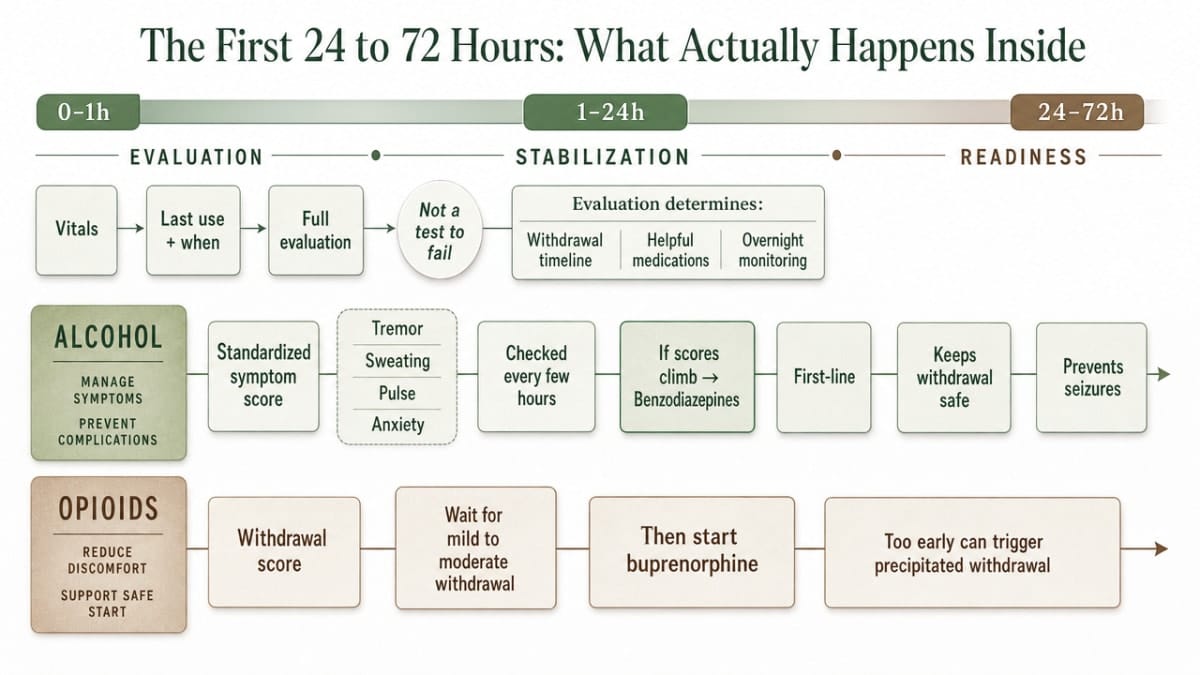
The first hour after you walk in is quieter than you might expect. Someone takes your vital signs, asks you what you last used and when, and starts a full evaluation. That evaluation is not a test you can fail. It is how the medical team figures out where you are on the withdrawal timeline, what medications will help, and what to watch for overnight.
For alcohol, a nurse will usually score your symptoms on a standardized scale, checking things like tremor, sweating, pulse, and anxiety every few hours. If your scores climb, benzodiazepines are the first-line medication used to keep the withdrawal safe and prevent seizures 10. For opioids, the team scores your withdrawal too, and they wait until you’re in mild to moderate withdrawal before starting buprenorphine, because dosing too early can trigger precipitated withdrawal 13. If you’ve been using fentanyl, expect that wait to feel longer than you want it to. That is normal, and it is not the team ignoring you.
Stabilization is the middle phase. Your body starts to settle. Symptoms peak, usually somewhere between hour 24 and hour 72 depending on the substance, and then begin easing. The federal clinical framework describes this stretch as evaluation, stabilization, and fostering readiness for treatment 15. You will feel that shift as it happens.
Sleep, Food, Vitals, and Small Comforts
Sleep will be strange for a few nights. You might sleep hard for twelve hours, then not at all, then in ninety-minute pieces. Staff check on you overnight, which sounds intrusive but usually is not. A quick light, a look at the monitor, and they’re gone. If a facility uses continuous vital-sign monitoring, that check happens without waking you at all.
Food comes back slowly. The first day, broth, crackers, and electrolyte drinks may be all your stomach wants. By day two or three, real meals start sounding like a reasonable idea again. Drink water when it’s offered. Ask for anti-nausea medication if you need it. Ask for a second blanket. Ask for the lights off. None of these requests are too small.
You are allowed to feel awful and still be doing this right. Getting through the peak is the work of these three days. Everything after builds on it.
What Comes After Detox: The Medication Decision You Make Once, Not Twice
Here is something most people don’t hear until day three, when their head is clear enough to take it in. Detox is not the finish line. It is the part where your body stops fighting the substance long enough for you to make one decision that shapes everything after: whether to continue on medication that keeps cravings and relapse risk lower.
You do not have to decide this alone, and you do not have to figure it out after you get home. The federal clinical framework treats detox as evaluation, stabilization, and fostering readiness for treatment 15. That third piece, readiness, is where the medication conversation belongs. While you’re still on-site, still supported, still surrounded by people who can answer questions without judgment.
For opioid use, the two most established options are buprenorphine and methadone, both covered in detail in the federal treatment protocol for medications for opioid use disorder 16. Buprenorphine can often be started during detox itself, once you’re in mild to moderate withdrawal 13. Methadone is dispensed through licensed opioid treatment programs. Naltrexone is a third option, usually started after you’ve been off opioids for a stretch.
For alcohol use, the SAMHSA pocket guide on medication for alcohol use disorder walks through naltrexone, acamprosate, and disulfiram, all intended for people who are dependent on alcohol and abstinent at treatment initiation 12. Detox gets you to that abstinent starting line. The medication decision helps you stay there.
From there, the pathway forks into residential care, an intensive outpatient program, or standard outpatient with medication management. Ask your team which fits your situation before discharge. Making the choice once, with clinicians who already know your history, is easier than making it twice from your couch.
Honest Notes on Post-Acute Symptoms
Nobody tells you this on day one, so hear it now. When you leave detox, you will feel better than when you walked in. You will not feel like your old self yet. That gap is normal, it is called post-acute or protracted withdrawal, and it can last weeks to months depending on the substance and how long you used 14.
What that looks like in daily life: sleep that is still uneven, energy that dips hard in the afternoon, mood that swings without warning, cravings that show up on a Tuesday for no reason you can name. None of this means detox failed. It means your brain chemistry is still rebalancing, and the federal guidance is explicit that clients should be monitored for these symptoms during continuing care 14.
Two things help. Stay connected to the medication decision you made before discharge, whether that is buprenorphine, naltrexone, acamprosate, or another option. And tell your outpatient team when a bad week hits. That is what they are there for.
If You Don’t Have Insurance, Transportation, or a Plan
None of these are dealbreakers. They feel like walls right now, but the intake teams that answer detox lines all day have already worked around every one of them for someone else this week.
No insurance? Call anyway. Ask the facility whether they accept self-pay, sliding-scale, or indigent-care beds, and whether they can help you apply for SoonerCare on the spot. Oklahoma’s Medicaid demonstration expanded coverage for medically necessary residential SUD treatment 6, and short-term stays in residential and inpatient treatment are part of that benefit 7. Enrollment does not always have to happen before you walk in.
No ride? Say that on the phone. Many certified programs coordinate transport, especially when withdrawal is already active. If nobody local can help, the SAMHSA National Helpline is a free, confidential federal line that can point you to nearby treatment and crisis resources 11.
No plan past today? That’s actually fine. The clinical framework treats the first hours as evaluation and stabilization, and readiness for what comes next is something you build with your team on-site, not something you arrive with 15. Show up. The plan gets made there.
Speak to a Detox Admissions Specialist Now
Get immediate answers and support for starting medical detox today.
Frequently Asked Questions
Can I bring my phone with me to detox?
Most facilities let you bring your phone but hold it during the first day or two, or limit calls to set times. That’s less about control and more about giving your nervous system a break while withdrawal peaks. Ask when you call. If keeping one contact reachable matters to you, say so at intake. Staff can usually work it out.
How long will I be in medically assisted detox?
For most substances, medical detox runs three to seven days, though alcohol and benzodiazepine tapers can go longer. Oklahoma’s Medicaid waiver covers short-term stays in residential and inpatient treatment 7. Your length of stay depends on how your symptoms respond, not a fixed calendar. The team reviews your progress daily and works with your insurer through concurrent medical necessity reviews 5.
What if I don’t have insurance or SoonerCare?
Call anyway. Many Oklahoma facilities help with same-day SoonerCare enrollment, and the state’s Medicaid demonstration expanded coverage for medically necessary residential SUD treatment 6. Some programs offer self-pay, sliding-scale, or indigent-care beds. If you’re stuck finding a starting point, the SAMHSA National Helpline is free and confidential and can route you to nearby treatment 11. Not having insurance is not a locked door.
Can I leave detox if I change my mind?
Yes. Medical detox is voluntary in nearly all cases, and you can sign yourself out against medical advice. That said, the urge to leave usually hits hardest around hour 24 to 48, right when your symptoms peak. Tell staff instead of walking out. They can adjust your medication, sit with you, or talk through what’s driving the urge. Wanting to leave does not mean you should.
Should I stop using before I get there, or keep using until admission?
Do not try to stop cold before you arrive, especially with alcohol or benzodiazepines, where sudden cessation can trigger seizures 10. For opioids, timing matters differently: buprenorphine cannot start until you’re in mild to moderate withdrawal, so the intake team will ask when you last used to plan dosing 13. Tell the truth on the phone. Honest answers get you safer care, faster.
Can someone come with me, and can family call to check on me?
A family member or friend can drive you and stay through intake paperwork. Visiting rules vary by facility, and most limit visits during the first 48 to 72 hours while you stabilize. Family can call the main line to confirm you arrived safely, but staff cannot share clinical details unless you sign a release. Signing one at intake for a trusted person makes those later check-in calls much easier.
References
- Provider Certification – Oklahoma.gov. https://oklahoma.gov/odmhsas/policy/provider-certification.html
- New Programs: Overview of ODMHSAS Certification Process. https://oklahoma.gov/odmhsas/policy/provider-certification/new-programs-overview-of-odmhsas-certification-process.html
- Okla. Admin. Code § 450:1-9-6 – Procedures for application for certification. https://www.law.cornell.edu/regulations/oklahoma/OAC-450-1-9-6
- Behavioral Health and Substance Abuse Services – Oklahoma.gov. https://oklahoma.gov/ohca/individuals/mysoonercare/soonercare-benefits/behavioral-health-and-substance-abuse-services.html
- Behavioral Health and Substance Abuse Services. https://oklahoma.gov/ohca/providers/types/behavioral-health-and-substance-abuse-services.html
- CMS Announces Approval of Oklahoma & Maine’s Substance Use Disorder Demonstrations. https://www.cms.gov/newsroom/press-releases/cms-announces-approval-oklahoma-maines-substance-use-disorder-demonstrations-30th-31st-expand-access
- Institutions for Mental Diseases Waiver for Serious Mental Illness and Substance Use Disorder Section 1115(a) Demonstration. https://www.medicaid.gov/medicaid/section-1115-demonstrations/downloads/ok-qutrly-cms-accepted-mid-point-assessment-12132024.pdf
- CHAPTER 18. STANDARDS AND CRITERIA FOR SUBSTANCE …. https://oklahoma.gov/content/dam/ok/en/odmhsas/documents/policy/provider-certification/administrative-rules/2021/Chapter%2018%20Final%20effective%209-15-21.pdf
- Administrative Rules – Chapter 18 Effective 11-16-20. https://www.oklahoma.gov/content/dam/ok/en/odmhsas/documents/policy/provider-certification/administrative-rules/2020/AdminRules-Chapter18–11-16-20.pdf
- The ASAM Clinical Practice Guideline on Alcohol Withdrawal Management Pocket Guide. https://www.samhsa.gov/resource/ebp/asam-clinical-practice-guideline-alcohol-withdrawal-management-pocket-guide
- National Helpline for Mental Health, Drug, Alcohol Issues. https://www.samhsa.gov/find-help/helplines/national-helpline
- Medication for the Treatment of Alcohol Use Disorder. https://library.samhsa.gov/sites/default/files/sma15-4907pocketguid.pdf
- CDC Clinical Practice Guideline for Prescribing Opioids for Pain — United States, 2022. https://www.cdc.gov/mmwr/volumes/71/rr/rr7103a1.htm
- Protracted Withdrawal – SAMHSA Library. https://library.samhsa.gov/sites/default/files/sma10-4554.pdf
- Quick Guide For Clinicians Based on TIP 45—Detoxification and Substance Abuse Treatment. https://nida.nih.gov/sites/default/files/samhsa_detoxification_and_substance_abuse_treatment.pdf
- TIP 63: Medications for Opioid Use Disorder. https://www.samhsa.gov/resource/ebp/tip-63-medications-opioid-use-disorder