
Key Takeaways
- Acute detox usually runs 3 days to 4 weeks, with the exact length driven by which substance you used rather than willpower or motivation.
- Alcohol and short-acting opioids clear in under a week, stimulants and cannabis in one to two weeks, while benzodiazepines require a weeks-long medical taper.1, 9
- Prior withdrawals, other medical conditions, polysubstance use, and medication choices like buprenorphine versus methadone all shift where you land inside those ranges.5,8
- Acute clearance isn’t the same as feeling normal — protracted symptoms like poor sleep, low mood, and anxiety can persist for months after discharge.1,12
The honest answer depends on what you used
You want a number. That’s fair. When you’re standing on the edge of asking for help, “how long does detox take?” is not a small question — it’s the question that decides whether you make the call today or push it to next week.
Here’s the straight answer: for most people, acute detox takes somewhere between 3 days and 4 weeks. Where you land in that range depends almost entirely on what your body has been depending on. Alcohol and short-acting opioids like heroin usually clear the hardest window in under a week. Stimulants and cannabis sit in the 1–2 week range for the acute phase. Benzodiazepines — Xanax, Klonopin, Valium, Ativan — are the outlier, and they need weeks, not days, with a careful medical taper.1,4,9,10,11
That’s the honest version. Anyone telling you “detox takes 7 days” is either simplifying to the point of being wrong or hasn’t asked what you’ve been taking.
A few things worth knowing before we go substance by substance. First, “acute withdrawal” and “feeling like yourself again” are not the same finish line. The physical crisis ends faster than the sleep and mood pieces do. Second, the variables that stretch your stay are usually medical, not personal — your history, your other health conditions, and which medications your team uses to keep you safe. Third, the clock starts when you walk in, not when you finish deciding.1,5
Acute withdrawal timelines by substance
At-a-glance: how many days by drug class
If you only have a minute, here’s the map. Every number below refers to the acute phase — the window when your body is actively adjusting and medical monitoring matters most. It does not describe how long you’ll feel fully like yourself, which is a longer, gentler conversation we’ll get to.
- Alcohol: 5 to 7 days, with the roughest stretch between 36 and 72 hours after your last drink.1,4
- Short-acting opioids (heroin, oxycodone, fentanyl): 4 to 10 days, peaking around days 2 and 3.4,8
- Long-acting opioids (methadone): 10 to 20 days. The onset is slower, and so is the exit.4,8
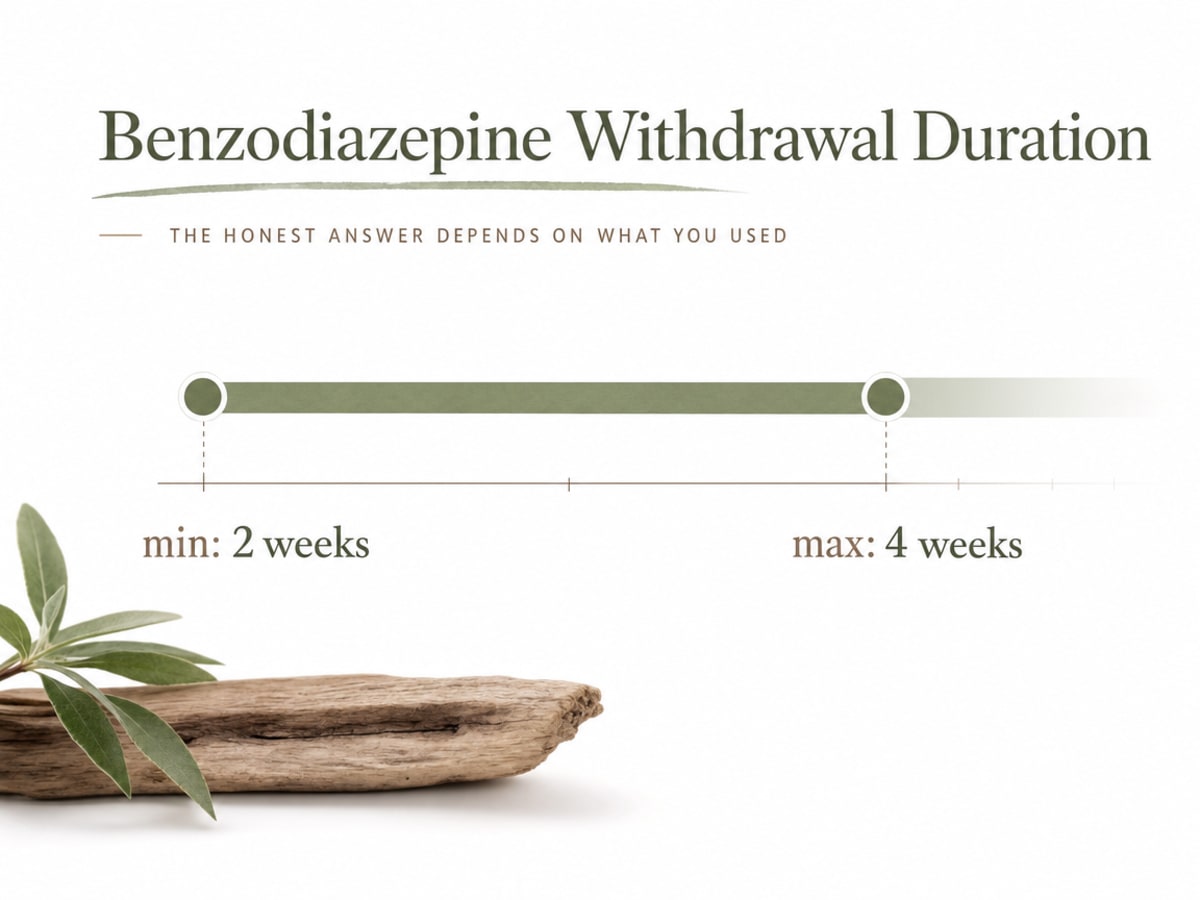
- Benzodiazepines (Xanax, Klonopin, Valium, Ativan): 2 to 4 weeks, and 3 to 5 weeks when tapered on a medically supervised schedule — which is the only safe way to do it.1,9
- Stimulants (cocaine, methamphetamine, Adderall): 1 to 2 weeks. The physical piece is short; the mood and energy piece takes longer.1,10
- Cannabis: 5 to 7 days for the peak, with sleep and appetite disruption trailing into a second week.1,11
Notice how uneven the ranges are. Benzodiazepines are their own category. Methadone is roughly double heroin. Stimulants and cannabis look similar on paper but feel different in practice. That’s why the first question a medical team asks isn’t “how long have you used?” — it’s “what have you been taking, and when did you last take it?” Those two answers set the clock.
One more thing: these are ranges, not promises. Where you personally land inside a range depends on your medical history, how long you’ve been using, and what your team can do with medication to keep you comfortable.5
Alcohol: 5 to 7 days, with the hardest window at 36–72 hours
Alcohol withdrawal has a fairly predictable arc, which is both the good news and the reason it needs supervision. The signs and symptoms start showing up 6 to 24 hours after your last drink. That first day looks like tremor, sweating, a racing heart, anxiety that feels sharper than usual, and the kind of nausea that makes eating feel impossible.2
Days 2 and 3 are the hardest. Symptoms are most severe between 36 and 72 hours after your last drink. This is the window where the medical team earns their keep — monitoring vital signs closely, giving benzodiazepines to calm the nervous system, and watching for the smaller number of people who develop seizures or delirium tremens. If you’ve had prior withdrawals, this risk climbs, which is one reason your history matters more than your willpower here.4
By day 4, most people are noticeably better. By day 5 to 7, the acute phase is winding down. You’re eating. Your hands are steady. Your resting heart rate has come down. Sleep is still a mess and probably will be for a while, but the medical emergency has passed.12
What this looks like from the inside: day one you feel bad but functional. Day two you feel worse and start to wonder if you can do this. Day three is often the day people are most grateful they didn’t try this alone. By day four or five, you have space to think again. That’s usually when the harder conversation about what comes next actually becomes possible.
Opioids: 4 to 10 days for heroin, up to three weeks for methadone
Opioid withdrawal splits into two very different timelines, and which one applies to you depends on the specific drug — not the dose, not the frequency, but the half-life.
Short-acting opioids — heroin, oxycodone, hydrocodone, most fentanyl — start pulling on you 8 to 24 hours after your last dose. Heroin specifically begins withdrawing about 8 to 12 hours out and moves fast. You’ll feel it as restlessness, muscle aches that seem to come from nowhere, a runny nose, watering eyes, stomach cramps, and the bone-deep chills people describe as their skin trying to leave their body. The peak lands at 48 to 72 hours. Then it subsides over roughly 4 to 10 days, with days 5 through 10 feeling more like a bad flu than a crisis.3,4,8
Long-acting opioids move differently. Methadone doesn’t even start withdrawal until 12 to 48 hours after your last dose, and the whole course runs 10 to 20 days. That’s not because methadone withdrawal is more severe day-by-day — often it’s less intense at the peak — but because the drug leaves your system slowly. The trade-off is that you’re uncomfortable for longer.4
Opioid withdrawal, unlike alcohol, is rarely life-threatening on its own. What it is, reliably, is miserable enough that people leave against medical advice and go use again to make it stop. That’s the real risk during days 2 and 3. Modern detox uses buprenorphine or methadone to shorten and soften the peak, which changes both the experience and the odds of finishing.8
If you’re used to fentanyl specifically, expect your team to plan for a slightly harder induction onto buprenorphine — fentanyl’s tissue storage makes the timing tricky. This is a good problem to have someone else solving for you.
Benzodiazepines: weeks, not days — and never cold turkey
If you’ve been taking Xanax, Klonopin, Valium, or Ativan daily — even at prescribed doses — the timeline is fundamentally different from anything else on this list. Benzodiazepine withdrawal is measured in weeks, not days: 2 to 4 weeks for the acute phase, and 3 to 5 weeks when the taper is done on a medically supervised schedule. With long-term high-dose use, symptoms can persist for weeks or months beyond that.1,9
That’s not a scare tactic. It’s the math of how these medications work. They act on the same receptors as alcohol, but with much longer half-lives, so the body’s readjustment period is stretched out. Short-acting benzodiazepines produce withdrawal that continues for 2 to 4 weeks or longer. Long-acting ones like Valium stretch further.4
What a medical taper looks like: your team calculates an equivalent dose in a longer-acting benzodiazepine, then reduces it gradually — usually 10 to 25 percent per step — over weeks. Some days you’ll feel better than others. Anxiety, insomnia, and a strange sensory sensitivity are common along the way. None of this means the taper is failing. It means your nervous system is recalibrating on a schedule your team is managing.
The reason to name all of this bluntly: if you’ve been prescribed a benzodiazepine for years and are thinking about stopping, please do not treat the pill bottle like something you can just decide about on a Tuesday. Call first. The taper is the treatment.9
Stimulants and cannabis: a week to two, mostly mood and sleep
Stimulant and cannabis withdrawals get less attention than alcohol or opioids because they don’t produce the same dramatic physical crisis. That doesn’t mean they’re nothing. It means the hard part is different.
Stimulants — cocaine, methamphetamine, prescription amphetamines like Adderall — start pulling on you within about 24 hours of your last use. The classic picture is a “crash”: deep fatigue, an appetite that swings from nothing to everything, sleep that’s either 14 hours or none, and a low, flat mood that can dip into real depression. Acute symptoms typically last 1 to 2 weeks. Cravings can spike hard during this window, especially at the moments you’d normally use.1,10
Cannabis withdrawal follows a similar shape on a slightly different clock. Symptoms usually begin 24 to 72 hours after your last use and peak in the first week, with the acute phase running about 5 to 7 days and some symptoms lingering into a second week. Irritability, poor sleep, weird vivid dreams when sleep finally comes, and a suppressed appetite are the most common complaints.1,11
Neither of these is life-threatening on its own. Both benefit from medical monitoring because sleep, mood, and hydration can be stabilized with the right supports — and because being alone with a stimulant crash or a week of insomnia is exactly the environment where people go back to using to shut it off.

What actually stretches or shortens your stay
Prior withdrawal history, medical conditions, and polysubstance use
Three things tend to move your timeline more than anything else, and none of them are about how motivated you are.
The first is your withdrawal history. If you’ve been through detox before — especially alcohol or benzodiazepine withdrawal — each subsequent episode can hit harder and last longer. Clinicians take a prior seizure or a prior case of delirium tremens seriously because it raises the odds of the same thing happening again. That’s not a punishment; it’s a reason to plan for a longer, more closely monitored stay.12
The second is your other medical conditions. Liver disease, heart problems, unmanaged diabetes, chronic pain, untreated anxiety or depression — any of these can extend detox because your body has less reserve to spend on the work of withdrawing. Withdrawal duration is highly individual and depends on your particular pharmacokinetics, half-life of what you used, and how long you’ve been using. Your team is essentially solving two problems at once: getting you through withdrawal and keeping your other conditions stable while they do it.5
The third is polysubstance use. If you’ve been drinking and taking a benzodiazepine, or using opioids alongside stimulants, the timeline follows the longer of the two. A person tapering off Klonopin who also drinks daily is looking at the benzodiazepine clock, not the alcohol clock. Tell your team everything you’ve been taking, including anything prescribed. It shortens your stay, not the other way around.1,9
Medication choices: methadone vs. buprenorphine, fast vs. slow taper
The medications your team uses do more than make you comfortable — they set the pace.
For opioid withdrawal, the two main choices are buprenorphine and methadone. Buprenorphine tends to compress the acute phase; many people feel meaningfully better within the first 24 to 48 hours of a proper induction. Methadone smooths the peak but keeps you in the withdrawal window longer because it clears the body slowly. Neither is the “right” answer in the abstract. Fentanyl exposure, prior treatment history, and what your ongoing plan looks like all feed into the decision.8,13
For benzodiazepines, the taper pace is the treatment. A faster taper — say, 25 percent reductions every few days — shortens your total stay but can produce sharper rebound anxiety, insomnia, and sensory sensitivity. A slower taper, closer to 10 percent per step, adds days or weeks but tends to feel more manageable at each step. Neither approach is uniformly better; there’s genuine clinical debate about optimal speed.9
For alcohol, benzodiazepines are the standard treatment inside detox, dosed on a symptom-triggered schedule that gives more medication when your vitals and symptom scores rise, and less when they settle. That’s why two people admitted the same day can leave on different days — the medication is following your body, not a fixed calendar.5
Ultra-rapid detox and why faster isn’t automatically better
You may have heard of ultra-rapid opioid detox — a protocol where a person is placed under sedation or anesthesia and given opioid-blocking medications to compress days of withdrawal into hours. On paper, that sounds like exactly what you want. In practice, it’s not the shortcut it looks like.
Traditional opioid detox runs 5 to 10 days for short-acting opioids. Ultra-rapid protocols push that into a much shorter window, but they do so at the cost of higher intensity and added medical risk during the procedure itself. The withdrawal isn’t erased; it’s telescoped into a period when you’re less able to communicate what your body is doing.13
The other issue is what happens after. A faster acute exit doesn’t shorten the weeks of sleep disruption, mood dips, and craving that follow. It just moves the calendar forward.
Standard medically supervised detox — buprenorphine or methadone, symptom-triggered dosing, a bed and a nurse and time — is slower on the clock and safer over the arc. That trade-off is usually worth it.8,13
Acute detox ends. Protracted symptoms sometimes don’t.
Here’s the part that surprises most people: the day you’re medically cleared from detox is not the day you feel normal. Those are two different mileposts, and confusing them is one of the most common reasons people get discouraged in week three or four and decide something must be wrong with them.
There isn’t. What you’re running into is called protracted withdrawal, and it’s well-documented across substances. SAMHSA describes it plainly: after the acute phase resolves, a set of subtler symptoms — sleep disturbance, anxiety, low mood, difficulty concentrating, blunted pleasure — can persist for months and, in some cases involving alcohol, up to two years. Alcohol reviewers note that insomnia and anxiety often linger well past the 5–7 day acute window Benzodiazepine symptoms can persist for weeks or months in people coming off long-term high-dose use. And withdrawal duration overall is highly individual, tied to the specific drug’s half-life and how long you’ve been using it.1,5,9,12
Why does this matter for a timeline question? Because if you walk out of detox at day 7 expecting to feel like your pre-use self and instead feel flat and can’t sleep at day 20, you might read that as failure. It isn’t. Acute detox got your body out of medical danger. The nervous system’s slower recalibration is a separate process, and it responds to different things — ongoing treatment, sleep hygiene, structure, sometimes medication, and time.
“I can’t take two weeks off work” — what inpatient days actually cover
This is the objection that keeps people using longer than they meant to. It sounds practical, but underneath it is usually fear — of the boss, the paycheck, the kids’ schedule, the sense that stepping out of your life for a week means everything falls apart. Fair. Let’s talk about what inpatient days actually cost you and what they buy.
For most substances, the medically supervised piece is shorter than you think. Alcohol detox is typically 5 to 7 days. Short-acting opioids run 4 to 10 days. Stimulants and cannabis usually resolve in a week to two. Benzodiazepines are the exception; a supervised taper takes weeks, though not all of them require staying in a bed.4,9,10,11,12
What those days cover: 24/7 monitoring during the hours your body is most likely to throw a curveball, medication adjusted to your symptoms rather than a fixed schedule, and — quietly, but this matters — sleep, food, and no access to what you’d otherwise use to make the discomfort stop. You are not “resting.” You are being kept safe through the window when leaving against medical advice is the biggest risk to finishing.
After discharge, you’re not done, but you’re also not stuck in a facility. Detox is one phase inside a longer treatment continuum. The next step — outpatient, intensive outpatient, or residential — is planned around your actual life. FMLA, short-term disability, and employer employee-assistance programs exist for exactly this. A week is not two weeks. And the week you don’t take now tends to become months of the same week, repeated.6
When to walk in the door
There is no clean signal that says now. If you’re waiting for one, it won’t come. What tends to come instead is a Sunday night, or a Wednesday afternoon after something small goes wrong, when you notice you’re tired of the arithmetic — counting pills, counting drinks, counting hours until you can use again without anyone noticing.
The clinical version of “when” is simpler: if you’re using daily and you know what will happen when you stop, that’s enough. You don’t have to hit a bottom. You don’t have to fail an outpatient attempt first. And if what you’ve been using is alcohol or a benzodiazepine, the safest window to walk in is before the last dose wears off, not after, because those are the two withdrawals a physician will never tell you to handle alone.3,7
Admission itself is faster than most people expect. Insurance verification, a medical intake, and a bed — that’s usually the same day when there’s capacity. Bring your medication list, whatever ID you have, and someone who can drive you home in a week. The rest, including the part where you feel worse before you feel better, is what the team is there for. If Renewal Springs is where you land, that’s the shape of the first phone call.
Talk Now About Immediate Detox Admissions Options
Connect directly for fast answers and step-by-step support through urgent detox admission decisions.
Frequently Asked Questions
How long does alcohol detox take?
Can I detox from benzodiazepines at home if I go slowly?
No. Benzodiazepine withdrawal is not recommended without medical supervision, and no benzodiazepine should be stopped abruptly. Cold turkey withdrawal can cause seizures. A supervised taper — usually 2 to 4 weeks, or 3 to 5 weeks with tapering — is the treatment. Please call before you touch the dose.1,3,9
What are the hardest days of opioid withdrawal?
Why do some symptoms last weeks or months after detox ends?
That’s protracted withdrawal. After the acute phase resolves, subtler symptoms — poor sleep, anxiety, low mood, difficulty concentrating — can persist for months. Duration depends on the drug’s half-life and how long you used it. Benzodiazepine symptoms in particular can linger for weeks or months after long-term high-dose use. It’s not failure.1,5,9
Is ultra-rapid detox a safe way to shorten the process?
Ultra-rapid opioid detox compresses days of withdrawal into hours under sedation, but at the cost of added medical risk during the procedure and no reduction in the weeks of sleep and mood recovery that follow. Traditional medically supervised detox runs 5 to 10 days for short-acting opioids and is safer over the full arc.13
How quickly can I be admitted to a detox program?
Often the same day, when there’s capacity. Admission involves insurance verification, a medical intake, and a bed assignment — a matter of hours, not weeks. Bring your ID and a list of everything you’ve been taking, including prescriptions. If alcohol or benzodiazepines are involved, calling before your last dose wears off is the safer window.3,7
References
- Protracted Withdrawal. https://library.samhsa.gov/sites/default/files/sma10-4554.pdf
- Quick Guide For Clinicians Based on TIP 45—Detoxification and Substance Abuse Treatment. https://nida.nih.gov/sites/default/files/samhsa_detoxification_and_substance_abuse_treatment.pdf
- 4 Physical Detoxification Services for Withdrawal From Specific Substances (TIP 45 Chapter). https://www.ncbi.nlm.nih.gov/books/NBK64116/
- Withdrawal Management. https://www.ncbi.nlm.nih.gov/books/NBK310652/
- Withdrawal Syndromes – StatPearls. https://www.ncbi.nlm.nih.gov/books/NBK459239/
- 14-118 C.M.R. ch. 5, § 19 – Substance Abuse Treatment Services (Maine Regulations). https://www.law.cornell.edu/regulations/maine/14-118-C-M-R-ch-5-SS-19
- Alcohol Withdrawal Syndrome – StatPearls. https://www.ncbi.nlm.nih.gov/books/NBK430885/
- Opioid Withdrawal – StatPearls. https://www.ncbi.nlm.nih.gov/books/NBK499891/
- Benzodiazepine Withdrawal – StatPearls. https://www.ncbi.nlm.nih.gov/books/NBK549915/
- Stimulant Withdrawal – StatPearls. https://www.ncbi.nlm.nih.gov/books/NBK556055/
- Cannabis Withdrawal – StatPearls. https://www.ncbi.nlm.nih.gov/books/NBK538131/
- Alcohol Withdrawal in the Setting of Alcohol Use Disorder (Review Article). https://www.ncbi.nlm.nih.gov/pmc/articles/PMC6520157/
- Opioid Detoxification and Naltrexone Induction Strategies: Clinical Considerations. https://www.ncbi.nlm.nih.gov/pmc/articles/PMC4182062/