
Key Takeaways
- Repeated failed quit attempts and dose frequency, not dose size, signal physical dependence that typically needs supervised care rather than another home attempt in Oklahoma City 4.
- Withdrawal from extract shots and semi-synthetic 7-OH products can look opioid-like and rapid-onset, so telling intake staff exactly what you used shapes the medical plan 20.
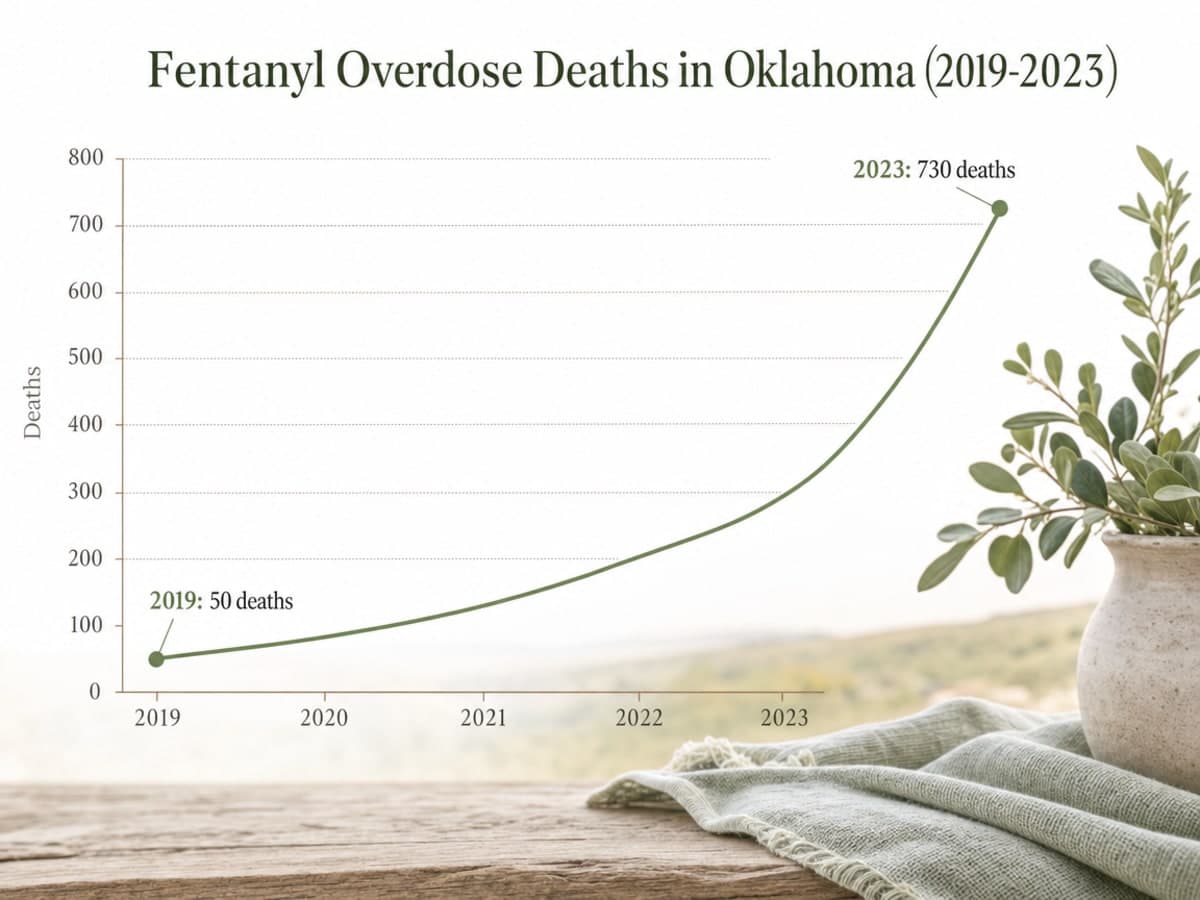
- Oklahoma’s fentanyl-involved overdose deaths rose from 50 in 2019 to 730 in 2023, raising the local stakes of untreated withdrawal and polysubstance risk 14.
- Before calling, compare facilities on medical monitoring during the first 48 hours, medication options like buprenorphine-naloxone, insurance verification, and what continuing care follows discharge 7, 19.
When Quitting on Your Own Keeps Not Working
You’ve tried this before. Maybe twice. Maybe more times than you want to count. You threw out the bag, told yourself Monday was the day, made it thirty-six hours, and then the restlessness, the stomach cramps, the sleeplessness, and the low-grade panic added up to one thought: just enough to feel normal again. And you were back.
If that pattern sounds familiar, here is something worth hearing plainly: you are not weak, and you did not fail at willpower. You are describing something clinicians already have a name for. Regular kratom use can produce dependence, craving, and a recognizable withdrawal syndrome, and repeated unsuccessful quit attempts are one of the DSM-5 signals of a use disorder rather than a character flaw 4.
The research is honest about the fact that withdrawal is not identical for everyone. Some people stop kratom with barely a ripple; others feel like they’ve been run over by a truck for a week 1. Which side of that line you land on has more to do with how often you’ve been dosing, what kind of product you’ve been using, and how long you’ve been at it than with how much grit you can muster on a random Tuesday morning.
This page is written for the person who already knows kratom got a foothold and is trying to figure out the next step in Oklahoma City. Not a lecture on what kratom is. Not a pep talk. A straight look at why home detox keeps not working, what supervised medical detox actually involves, and how to start without making the whole thing harder than it needs to be.
Why Home Detox Fails for Frequent Kratom Users
Here’s the piece most people miss when they try to white-knuckle their way off kratom: the strongest predictor of how hard withdrawal hits is not how many grams you were taking. It’s how often you were dosing. A 2024 analysis using DSM-5 substance use disorder criteria found that greater dose frequency, not dose amount, tracked systematically with more withdrawal symptoms, and the most reported symptoms in that group were needing kratom to avoid withdrawal, tolerance, craving, and repeated unsuccessful attempts to quit 4.
Read that last part again. Repeated unsuccessful attempts to quit is not a moral category. It’s a clinical marker.
If you’ve been dosing every three or four hours through the workday, dosing again to sleep, and dosing first thing before your feet hit the floor, your nervous system has been getting a near-constant signal for months or years. When you cut that signal cold on a Sunday night, your body doesn’t experience it as a decision. It experiences it as a crisis. That’s why the third morning tends to be worse than the first, not better.
In an online survey of U.S. adults who use kratom, the symptoms that showed up most often during withdrawal fell into a recognizable cluster:
- gastrointestinal upset
- restlessness
- anxiety
- irritability
- fatigue and low energy
- craving 2
Look at that list honestly against your last quit attempt. The nausea that made you sure you had the flu. The 3 a.m. wired-but-exhausted feeling. The snapping at people you love. The stomach that wouldn’t settle. The low, gray weight that made getting to work feel impossible. The craving that wasn’t really about wanting kratom so much as wanting the discomfort to stop.
None of that means you’re doing withdrawal wrong. It means your body is doing exactly what a physically dependent nervous system does when you take the substance away without support.
The other honest piece: withdrawal is not identical across all kratom users. Some people taper off with barely any symptoms, and clinical studies have not consistently observed withdrawal in every user 1. If you’re the person who has tried three times and been dragged back three times, you already know which side of that variability you’re on. You don’t need another self-experiment to confirm it. You need a plan that assumes your body is going to protest and has medical staff standing by to make that protest survivable instead of unbearable.
That’s the real difference between a home attempt and supervised detox. It’s not discipline. It’s whether someone is monitoring your vitals and adjusting comfort medications while your body resets, so hour 48 doesn’t become the moment you cave and start the count over again.
Not All Kratom Withdrawal Looks the Same
One of the reasons your last quit attempt may have blindsided you is that kratom isn’t a single, standardized product. The powder your neighbor uses to taper down from morning coffee is not the same molecule doing the driving in a $12 extract shot at the gas station. And the withdrawal profile can shift dramatically depending on which one you were reaching for.
If you’ve been comparing your experience to what a friend went through and wondering why yours was so much worse, the product itself may be a big part of the answer. Two questions matter before a clinician can plan your detox honestly: what were you actually taking, and how did your body respond the last time you stopped.
Traditional Leaf vs. Semi-Synthetic Derivatives
Traditional leaf kratom — the plain green, red, or white powder ground from the plant — tends to produce withdrawal that is milder and slower to arrive. In case-based literature, symptoms often show up a day or more after the last dose, build gradually, and resolve within about a week for most people. The newer generation of products is a different animal. A 2026 case report on mitragynine pseudoindoxyl, one of the semi-synthetic derivatives now showing up in extract shots and concentrates, describes rapid-onset, full-spectrum opioid-like withdrawal — the kind of picture clinicians associate with heroin or oxycodone cessation rather than with plant kratom 20.
Concentrated 7-hydroxymitragynine products belong in that same higher-risk category. If your product came in a small bottle labeled as a shot, extract, or “enhanced” blend — or if the dose you needed kept climbing fast — you may have been using something considerably more potent than leaf, even if the label said the word kratom.
Why this matters for you: the timing, medication needs, and intensity of monitoring during detox all shift based on which product you were physically dependent on. Telling the admitting clinician exactly what you were using, how often, and for how long is not a test you can fail. It’s how they build a plan that matches your body, not a generic one.
The Medical Risks Beyond Withdrawal
Withdrawal is not the only medical concern on the table. Kratom has been linked to clinically apparent acute liver injury in the published literature, and higher-dose or overdose exposures can cause seizures, coma, and death 11. That’s not a scare tactic — it’s the reason a good detox intake includes bloodwork and a look at how your liver and nervous system are actually doing before anyone hands you a taper plan.
If you’ve been feeling unusually fatigued, yellowish in the eyes, or bruising easily, mention it. If you’ve had a seizure, near-fainting episode, or a period of confused breathing during heavy use, mention that too. None of it changes whether you deserve care. It changes what the first 24 hours of that care need to look like so nothing gets missed while your body is already under stress.
What Supervised Kratom Detox Actually Involves
If you’ve never been through medical detox, the word itself can feel bigger than what actually happens. There’s no lockup, no punishment, no lecture about how you should have known better. What supervised detox actually looks like is closer to a quiet clinical room, a nurse checking in, and someone making sure your body has what it needs while it comes off a substance it’s been leaning on.
The point of doing this with medical staff isn’t to prove you needed help. You already know you did — that’s why you’re reading this. The point is that a supervised setting removes the two things that made your last attempts fall apart: the moment when symptoms peak and there’s nobody there to help you ride it out, and the physical suffering that gets bad enough to reach for the exact thing you were trying to stop using. Both of those get handled differently when there are clinicians watching your vitals and titrating comfort medications in real time.
What follows is a plain look at the two pieces of detox that matter most for a kratom-dependent adult: what the acute window feels like when it’s being monitored, and what medications a clinician may actually consider using to make that window tolerable.
The First 48 Hours and Medical Monitoring
The first two days are usually where home attempts collapse. Symptoms cluster fast — the gastrointestinal upset, restlessness, anxiety, irritability, fatigue, and craving that showed up in the U.S. adult survey data 2 don’t tend to space themselves out politely. They pile up in the same afternoon.
In a supervised setting, that same window looks different. You’re admitted, someone takes a full history of what you were using and how often, and baseline vitals get recorded: blood pressure, heart rate, temperature, oxygen. Bloodwork checks liver function and a few other markers so nothing gets missed while your body is under stress. From that point on, you’re not doing this alone in a bathroom at 3 a.m. A nurse is checking on you at regular intervals. If your heart rate spikes, if you can’t hold water down, if your blood pressure climbs, someone notices before it becomes an emergency.
You should expect to feel bad. Nobody is going to promise you a comfortable 48 hours — that would be dishonest. What supervised care promises is that the bad hours are measured, medicated, and survivable. You sleep when your body will let you. You eat when you can. You drink fluids that someone hands you instead of having to walk to the kitchen. And when the craving hits at hour 30 or 42, the door is not between you and a bag of powder. That single fact changes outcomes more than most people expect.
Medication Support and Clinician-Directed Options
You cannot self-prescribe your way through kratom withdrawal, and this is one of the honest reasons a supervised setting matters. The pharmacologic options that show up in the treatment literature are prescription medications that need a clinician’s judgment about your specific history, your vitals, and what you were actually using.
The clearest published summary of proposed treatment approaches for kratom dependence names buprenorphine-naloxone as a reported option, alongside individualized case-based strategies for symptom management 7. Buprenorphine-naloxone is the same medication class used in opioid use disorder — which makes sense given how opioid-like kratom withdrawal can look, especially with the semi-synthetic derivatives that behave like short-acting opioids on the receptor level 20. Whether it’s appropriate for you depends on what you were taking, how your body responded when you stopped before, and what a prescribing clinician sees during your intake.
Beyond that, comfort medications may be used to target specific symptoms — something for nausea, something for sleep, something for the anxiety that keeps you wired at 4 a.m. These aren’t decisions you make from a Reddit thread. They’re decisions a physician makes with your chart in front of them.
Why Detox by Itself Isn’t the Whole Answer
Here’s something worth saying before you take another step: getting through the acute withdrawal window is a real accomplishment, but it isn’t the finish line. It’s the doorway.
CDC’s clinical guidance on opioid use disorder is blunt about this. Detoxification on its own, without medications and continued treatment for the underlying use disorder, is not recommended, because it’s associated with increased risk of resumed use, overdose, and overdose death 19. That guidance was written for classic opioids, but it applies by direct analogy to kratom — especially the semi-synthetic products that behave opioid-like on the receptor level. Your body clears the substance in days. The neural patterns, the sleep disruption, the cue-driven cravings, and the reasons kratom got a foothold in the first place take longer to unwind.
What that means practically: a good detox admission ends with a plan, not a discharge summary and a handshake. That plan might mean stepping down into residential care for a stretch. It might mean an outpatient program you can hold alongside work. It might mean continued medication management, therapy for the anxiety or pain that kratom was quietly medicating, or a peer-support connection you can call at 9 p.m. on a hard Tuesday. The specifics depend on your life. The principle doesn’t: leaving the facility with somewhere to go next is not optional.
If you originally started kratom to get off prescription painkillers or something stronger, this piece matters even more. Trading one dependence for another is a well-worn path, and closing the door on kratom without a plan for the original pain or anxiety often reopens the door to whatever came before it.
None of this is meant to make the detox itself feel smaller. Getting through those first days is genuinely hard, and finishing them is worth naming as a win. It just means the win is a beginning, not an ending — and the staff helping you through admission should already be talking with you about what comes after, before you ever ring the bell to leave.
The Oklahoma City Context You’re Detoxing Into
You’re not making this decision in a vacuum. Where you’re detoxing, what products are on the shelves around you, and how easy it is to physically get to a facility all shape whether the plan holds together in your first week. A few things about Oklahoma City specifically are worth knowing before you pick up the phone.
Local Overdose Stakes
Oklahoma is not a gentle place to gamble on another home attempt. The state fact sheet on drug overdose deaths shows fentanyl-involved deaths climbing from 50 in 2019 to 730 in 2023 — a more than 14-fold increase in five years 14. That’s the environment your body is coming off kratom in, and it matters for two practical reasons.
First, if you’ve been using extract shots or newer semi-synthetic products, the line between kratom dependence and opioid-like risk is thinner than a lot of people realize. The receptors involved overlap. The withdrawal profiles overlap. And a person in the middle of untreated kratom withdrawal is exactly the person who, in a bad hour at 2 a.m., might reach for whatever a friend or a stranger offers to make it stop.
Second, polysubstance patterns are the norm in local overdose data, not the exception. If kratom found its way into your routine because a prescription painkiller or something stronger came first, you’re not the only person in that story. Supervised detox is where that fuller history gets on paper, where a clinician can look at all of it at once, and where the crisis at hour 42 is a nurse call button instead of a decision you have to make alone.
None of that is meant to scare you. It’s meant to say: the stakes of another failed home attempt in this city are not just personal exhaustion. They’re medical.
State Regulation, Product Labels, and Complaints
Oklahoma passed a Kratom Consumer Protection Act framework, and as of the 2025 update under SB 891, kratom products sold in the state are defined to contain no synthesized kratom alkaloids and no more than 1% 7-hydroxymitragynine of total kratom alkaloids by weight 16. That’s a potency cap, not a ban. It exists because concentrated 7-OH products behave very differently from leaf kratom on the receptor level, and the state wanted a legal ceiling.
What this means for you: if you were buying products in the last couple of years that felt dramatically stronger than the powder you started with, there’s a reasonable chance you were using something the current law is specifically trying to restrict. That’s not a legal problem for you as a consumer. It’s information worth telling your intake clinician, because it affects how they read your withdrawal picture.
If you believe a product you bought locally was mislabeled, adulterated, or above the potency cap, the Oklahoma State Department of Health’s Consumer Health Services accepts kratom complaints and is the agency responsible for enforcement 17. Filing a complaint doesn’t have to be part of your recovery. But knowing the pathway exists — and that products are supposed to meet a standard — sometimes helps people stop blaming themselves for how quickly things got out of hand.
How to Access Care Locally Without Making It Harder
The hardest part of getting help is often not the detox itself — it’s the friction between deciding and doing. The phone call you keep meaning to make. The insurance question you’re not sure how to ask. The ride you don’t have. Any one of those can be enough to push admission off another week, and another week is a long time when your body is already tired of the cycle.
None of these logistics are reasons to keep waiting. They’re small problems with normal answers, and most of them get handled during a single conversation at intake. What follows is a practical look at the two pieces most people worry about before they call: how to actually get there and how to pay for it, and what the first conversation sounds like when you finally pick up the phone.
Transit, Timing, and Insurance Coverage
Oklahoma City is easier to reach than a lot of people assume. EMBARK operates a fixed-route bus network and bus rapid transit service across the metro, along with parking operations for anyone driving in 15. If you don’t have a car, or if your license situation is complicated, that matters. Family members can also use the same routes for visits during your stay, which cuts down on the isolation piece that sometimes makes those middle days harder than they need to be.
On timing: you do not have to wait until Monday. Medical detox facilities operate around the clock because withdrawal doesn’t keep business hours. If you’re reading this on a Friday night and thinking you’ll call after the weekend, that’s the version of the plan your withdrawal is going to interrupt on Sunday. Calling now, even just for a benefits check, is a lower-stakes step than it feels.
Insurance is usually less of a wall than people expect. Most major plans cover medical detox as a medical necessity, and reputable facilities will run a free benefits check before you commit to anything. That call tells you what your plan actually covers, what the out-of-pocket piece looks like, and whether you need pre-authorization — without you having to decipher your policy alone.
Starting the Conversation Today
The first call is shorter than you think. You don’t need a speech ready. You don’t need to know how many grams you were taking or the exact name of the product. What the intake team needs to hear is roughly this:
- how long you’ve been using kratom
- how often you’ve been dosing
- what kind of product (leaf, extract, shot, blend)
- what happened the last time you tried to stop
That’s enough to start.
If you’re not ready to call a local facility yet, SAMHSA’s National Helpline is free, confidential, and available 24/7 in English and Spanish at 1-800-662-HELP (4357) 18. It’s a national line, not a sales pipeline, and calling it does not commit you to anything.
When you are ready for the local step, Renewal Springs Detox in Oklahoma City handles admissions, benefits verification, and clinical intake in a single conversation. Bring what you know. Leave what you don’t. The rest is what the staff is there for.
Ready for safe, professional kratom detox support?
Connect directly with a medical detox expert who understands the challenges of kratom withdrawal.
Frequently Asked Questions
How do I know if my kratom withdrawal is serious enough to need medical detox?
If you’ve tried to stop more than once and been pulled back by symptoms you couldn’t outlast, that is already a meaningful signal. Repeated unsuccessful quit attempts are one of the DSM-5 markers of a use disorder, not a willpower issue 4. Add in daily dosing, using to avoid feeling sick, or a history of liver problems or seizures, and the case for supervised care is straightforward — not because you failed, but because your body has been leaning on the substance long enough that clearing it deserves clinical eyes.
Does insurance cover kratom detox in Oklahoma City?
In most cases, yes. Medical detox is generally covered as a medical necessity under major commercial plans, and reputable local facilities run a free benefits check before you commit to admission. That call clarifies what your specific plan pays, what any out-of-pocket portion looks like, and whether pre-authorization is required. You do not need to decode your policy alone. If cost is what’s keeping you from picking up the phone, the benefits verification call itself costs nothing and gives you real numbers instead of guesses.
Why did I fail when I tried to quit kratom on my own?
Probably because your nervous system had adapted to frequent dosing, and stopping cold triggered exactly the withdrawal cluster the research describes: gastrointestinal upset, restlessness, anxiety, irritability, fatigue, and craving 2. The strongest predictor of how hard withdrawal hits is dose frequency, not dose size 4. If you were dosing multiple times a day for months or years, hour 36 was going to be brutal no matter how motivated you were on hour zero. Home attempts fail because nothing changes the physiology — supervised care does, with monitoring and medication support.
Is withdrawal from extract shots or 7-OH products different from leaf kratom?
Yes, and this matters for how detox is planned. Traditional leaf kratom typically produces milder, delayed withdrawal that builds over a day or more. Semi-synthetic derivatives like mitragynine pseudoindoxyl have been documented to produce rapid-onset, full-spectrum opioid-like withdrawal — closer to what you’d expect from a short-acting opioid than from plant kratom 20. Oklahoma’s law now caps 7-hydroxymitragynine at 1% of total kratom alkaloids by weight for products sold in the state 16, but if you were using concentrated shots or extracts before that cap, your withdrawal picture may look more severe. Tell your intake clinician exactly what you were taking.
What medications might a clinician use during kratom detox?
The clearest published summary of proposed treatment approaches names buprenorphine-naloxone as a reported option, alongside individualized comfort medications for specific symptoms like nausea, sleep disruption, and anxiety 7. Buprenorphine-naloxone is used because kratom withdrawal can behave opioid-like at the receptor level, especially with concentrated products. Whether it’s appropriate for you depends on your history, current vitals, and what you were actually using. These are prescription decisions made by a clinician with your chart in front of them — not something to piece together from forums or self-taper attempts.
Do I have to stay in a facility, or can I get help without inpatient care?
Inpatient detox is recommended when withdrawal is likely to be moderate or severe, when you’ve relapsed during prior home attempts, or when medical risks like liver injury or seizure history are in play 11. For lighter dependence, outpatient support may be reasonable. What’s not recommended is stopping and hoping — CDC guidance on opioid use disorder is clear that detox alone, without continued treatment, raises the risk of resumed use 19. That principle applies by analogy to kratom. Whichever level of care you land on, plan for what happens after the acute window, not just through it.
References
- Kratom withdrawal: Discussions and conclusions of a scientific expert forum. https://pmc.ncbi.nlm.nih.gov/articles/PMC10311168/
- Assessment of Kratom Use Disorder and Withdrawal Among an Online Convenience Sample of U.S. Adults. https://pmc.ncbi.nlm.nih.gov/articles/PMC9402806/
- Clinical Implications of Kratom (Mitragyna speciosa) Use. https://pmc.ncbi.nlm.nih.gov/articles/PMC10177737/
- Kratom addiction per DSM-5 SUD criteria, and kratom physical dependence: insights from dosing amount versus frequency. https://pmc.ncbi.nlm.nih.gov/articles/PMC11493341/
- Kratom Withdrawal: A Systematic Review with Case Series. https://pubmed.ncbi.nlm.nih.gov/30614408/
- Case Report: Treatment of Kratom Use Disorder With a Classical Tricyclic Antidepressant. https://pmc.ncbi.nlm.nih.gov/articles/PMC8044355/
- Kratom Dependence and Treatment Options: A Comprehensive Review of the Literature. https://pubmed.ncbi.nlm.nih.gov/32682371/
- FDA and Kratom. https://www.fda.gov/news-events/public-health-focus/fda-and-kratom
- Kratom. https://www.dea.gov/factsheets/kratom
- Kratom. https://www.nccih.nih.gov/health/kratom
- Kratom. https://www.ncbi.nlm.nih.gov/books/NBK548231/
- Kratom safety and toxicology in the public health context. https://pmc.ncbi.nlm.nih.gov/articles/PMC11180979/
- Data – Oklahoma.gov. https://oklahoma.gov/health/health-education/injury-prevention-service/drug-overdose/data.html
- Drug Overdose Deaths, 2019-2023 – Oklahoma. https://oklahoma.gov/content/dam/ok/en/health/health2/aem-documents/prevention-and-preparedness/injury-prevention/drug-overdose/2025%20State%20Drug%20OD%20-%20IPS%20-%20Fact%20Sheet.pdf
- Public Transportation and Parking | City of OKC. https://www.okc.gov/Community-Recreation/Public-Transportation-and-Parking
- ENGR. S. B. NO. 891. https://www.oklegislature.gov/cf_pdf/2025-26%20ENGR/SB/SB891%20ENGR.PDF
- Kratom Consumer Protection Act – Oklahoma.gov. https://oklahoma.gov/health/services/licensing-inspections/consumer-health-service/kratom.html
- National Helpline for Mental Health, Drug, Alcohol Issues. https://www.samhsa.gov/find-help/helplines/national-helpline
- Opioid Use Disorder: Treating | Overdose Prevention. https://www.cdc.gov/overdose-prevention/hcp/clinical-care/opioid-use-disorder-treating.html
- Severe Early-Onset Withdrawal Following Intentional Use of Mitragynine Pseudoindoxyl: A Case Report and Emerging Clinical Considerations. https://pmc.ncbi.nlm.nih.gov/articles/PMC13075513/