
Key Takeaways
- Oklahoma law requires medically supervised detox to run under a licensed physician and RN supervisor, with a medical service plan completed within three hours of admission.4
- Before admitting, ask four questions: who directs care, whether the facility holds ODMHSAS certification and national accreditation, whether insurance can be verified on the call, and how overnight coverage works.5
- Real medical detox is built on three phases — evaluation, stabilization, and handoff to ongoing treatment — because clearing the body is not the same as treating addiction.1
- Medical detox differs from social detox in physician direction, RN coverage, scheduled vitals, medication management, and insurance eligibility, which matters most when withdrawal turns dangerous.4
- For opioid withdrawal, ASAM recommends buprenorphine or methadone over abrupt cessation, and the facility should continue MAT or connect you to a provider who will.3
- Benzodiazepine withdrawal should be managed in inpatient medically managed settings with regular vitals, structured assessment, and seizure-risk evaluation — and flumazenil should be avoided.6
- Good answers are specific about protocols, staffing, and next steps; vague reassurances, pressure to admit, or refusal to verify insurance are reasons to hang up.10
- Discharge planning during your stay — residential care, outpatient, continued MAT, counseling, and follow-up — is where detox actually holds and relapse risk drops.9
What “Medically Supervised” Actually Means in Oklahoma
If you’re reading this at 11 p.m. with a phone in your hand, take a breath. You’re already doing the hardest part — which is looking honestly at what’s happening and trying to find help that won’t make it worse. The good news is that in Oklahoma, the phrase “medically supervised detox” near me isn’t just marketing copy a facility can put on a website. It’s a legal category with specific requirements, and you’re allowed to make anyone answer to them before you show up.
Under Oklahoma’s administrative rules for withdrawal management, a medically supervised detox has to operate under the direction of a licensed physician and a licensed registered nurse supervisor. A medical service plan for you has to be completed within three hours of your admission — not the next morning, not “when the doctor gets in,” but within three hours. That is the floor. Any OKC-area facility calling itself a medical detox has to clear it.4
SAMHSA’s national guidance goes a step further and defines what that supervision is actually for. Detox is a medical intervention that walks you safely through acute withdrawal, and it’s built around three things: evaluating what’s in your system and what your body is doing, stabilizing you with medication and monitoring, and connecting you to what comes next. It is not the same thing as addiction treatment, and any honest program will tell you that on the phone.1
The practical difference between a medically supervised detox and a non-medical one comes down to who is in the building and what they can do if your blood pressure spikes at 3 a.m. In a real medical detox, someone is checking your vitals, someone can order medication, and someone has already thought about whether you’re at risk for a seizure. In a social or non-medical setting, you’re mostly being kept safe from the outside world — not from what your own nervous system is doing.
Everything in the questions ahead builds on that distinction. Knowing the standard is what lets you hear the difference between a facility that meets it and one that hopes you won’t ask.
The First Four Questions Before You Hang Up
Is a Licensed Physician Directing Care, and Is an RN Supervisor On Duty?
This is the first question because everything else depends on the answer. In Oklahoma, a medically supervised withdrawal management program has to run under the direction of a licensed physician and a licensed registered nurse supervisor. That’s not a preference. That’s the rule.4
So on the phone, you can ask it plainly: “Who is the physician directing your program, and is a licensed RN supervisor on the schedule when I’d be there?” A confident facility will name the medical director without hesitation and tell you how nursing coverage works across shifts, including nights and weekends.
Ask one more thing while you have them: “How soon after I arrive will I have a medical service plan?” Oklahoma rules require that plan to be completed within three hours of your admission. Three hours. Not “in the morning.” Not “whenever the on-call gets in.” If a facility hedges on any of these three points — the physician, the RN supervisor, the three-hour window — you’re not talking to a medical detox. You’re talking to something else that has borrowed the language.4
You are allowed to ask twice if the first answer is fuzzy. Anyone who does this work well will not be offended by a careful question.
Are You State-Certified by ODMHSAS and Nationally Accredited?
Certification and accreditation sound like paperwork words. They are actually your safety net. In Oklahoma, a residential medical detox has to be certified by the Oklahoma Department of Mental Health and Substance Abuse Services (ODMHSAS), and for residential providers like medical detox, national accreditation is required on top of state certification to be eligible for SoonerCare reimbursement.5
Two things to ask, in this order:
“Are you currently certified by ODMHSAS for medically supervised withdrawal management?” Then: “Which national accrediting body have you been accredited by?” You’re listening for names like The Joint Commission or CARF. A real medical detox will answer both questions in about ten seconds.
SAMHSA’s own guidance for finding quality treatment tells families to verify licensure and ask whether staff are qualified. That’s not a suggestion for someone else — that’s for you, right now. If the person on the line can’t produce a certification number, can’t name the accrediting body, or tries to redirect you to “we’ve been serving Oklahoma families for years,” that’s a soft answer to a hard question. Move on. There are facilities in the metro that will answer directly.9
Can You Verify My Insurance or SoonerCare Right Now?
Money worry is one of the biggest reasons people hesitate on the call. Get it off the table early. Ask: “Can you verify my insurance benefits right now, on this call, while we’re talking?”
A well-run OKC detox has this workflow ready. They’ll take your insurance card information — or your SoonerCare details — and either confirm coverage before you hang up or call you back within the hour. Not tomorrow. Not “once billing opens.” Now.
Ask what your out-of-pocket cost will look like based on your specific plan, and ask what happens if your benefits don’t cover the full stay. SAMHSA’s guidance on choosing a program lists insurance acceptance as one of the first questions to ask, and for good reason. A facility that can bill SoonerCare has already cleared the state certification and national accreditation bar we talked about a minute ago, which tells you two useful things about them at once.5,10
If you don’t have insurance at all, ask what self-pay looks like and whether they can help you apply for coverage. You deserve a real answer either way.
Can You Admit Me Today, and What Happens at 2 A.M.?
Time matters. Withdrawal doesn’t wait for business hours, and neither should the front desk. Ask: “Can you admit me today?” and then, “What does your overnight coverage look like?”
The overnight question is the one that separates programs. In a real medical detox, if your blood pressure climbs at 2 a.m., there’s a nurse at your door within minutes and a physician reachable by phone with orders in hand. Medication can be given. Vitals get checked on a schedule that doesn’t stop when the sun goes down. That is what “medically supervised” means in practice — not a promise on a website, but a nurse in the hallway when your body is loudest.1
Ask how often vitals will be taken in the first 24 hours. Ask who you’ll see when you first walk in. Ask if there’s someone you can talk to right now, tonight, if you want to keep asking questions before you decide.
You are not being demanding. You are being careful. The right facility will hear the difference.

How Real Medical Detox Works: Evaluation, Stabilization, Handoff
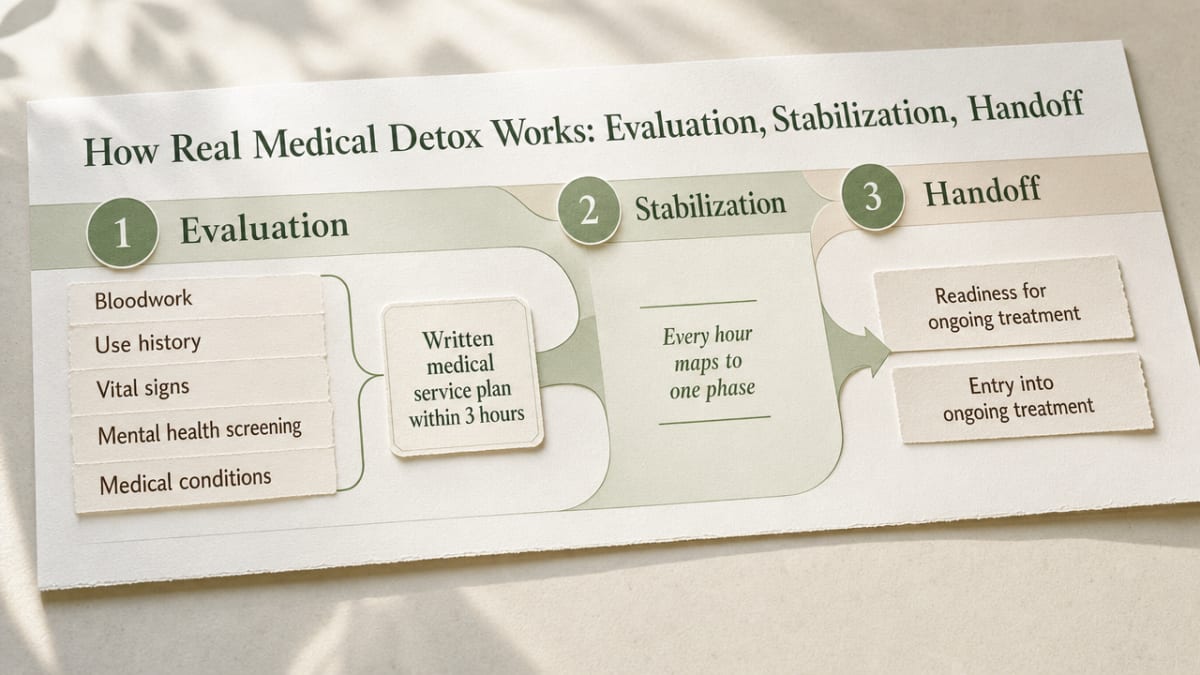
When you picture a medically supervised detox, it helps to know what the days are actually built around. SAMHSA’s clinical guidance is direct about this: detoxification has three essential components — evaluation, stabilization, and fostering your readiness for and entry into ongoing treatment. Every hour you’re there should map to one of those three.1
Evaluation is the first stretch. Bloodwork, a full history of what you’ve been using and how much, vital signs, mental health screening, and a look at any medical conditions that could change the plan. The team is figuring out what your body has been doing and what it’s about to do. In Oklahoma, that written medical service plan has to land within three hours of you walking in. You should feel seen quickly, not parked in a room.4
Stabilization is the middle. This is where medication management, vitals monitoring, and hands-on nursing do the actual work of keeping you safe while your nervous system resets. Blood pressure, pulse, temperature, and withdrawal symptoms get checked on a real schedule. Medications get adjusted as your numbers move. If something spikes, someone responds — not eventually, but soon. This is the piece a non-medical setting simply cannot deliver.
Fostering treatment entry is the part most people don’t hear about on the phone, and it matters as much as the first two. SAMHSA is blunt: detox is not substance abuse treatment. It clears your body. It doesn’t rebuild your life. So a real medical detox spends part of your stay lining up what comes next — residential, outpatient, MAT continuation, counseling — so you don’t walk out the door with nowhere to go.1
When you ask a facility to describe your first 72 hours, you should hear all three phases in the answer. If you only hear about the middle, ask about the other two.
Medical Detox vs. Social Detox: What the Difference Feels Like
On paper, two facilities can both call themselves “detox.” In the hallway at 2 a.m., they are not the same place. The gap between medically supervised withdrawal management and a social or non-medical detox comes down to five practical things — and once you can name them, you’ll hear the difference in any phone call.1,4,5
| What You’re Comparing | Medically Supervised Detox | Social / Non-Medical Detox |
|---|---|---|
| Physician direction | Licensed physician directs care | No physician required |
| Nursing coverage | Licensed RN supervisor on duty | Peer or lay staff; no RN required |
| Vital-sign monitoring | Scheduled checks around the clock | Observation only; no clinical monitoring |
| Medication management | Withdrawal medications ordered and adjusted by clinicians | No prescription medications administered |
| SoonerCare / insurance eligibility | State-certified and nationally accredited residential providers can bill | Typically not reimbursable as medical care |
Here is what that chart feels like in a real room. In a medical detox, a nurse walks in every few hours to take your blood pressure and ask how you’re doing on a scale the team actually tracks. When your numbers move, medication moves with them. If you start shaking, someone has already thought about seizures. If your heart rate climbs, someone is watching the monitor before you notice.
In a social detox, the people around you are kind. They may be in recovery themselves. What they cannot do is order a medication, read a rhythm strip, or decide whether the sweat on your forehead is anxiety or the start of something dangerous. That’s not a knock on them. It’s the design of the setting.
Substance-Specific Questions That Change the Answer
If You Are Detoxing from Opioids: Ask About Buprenorphine and Methadone
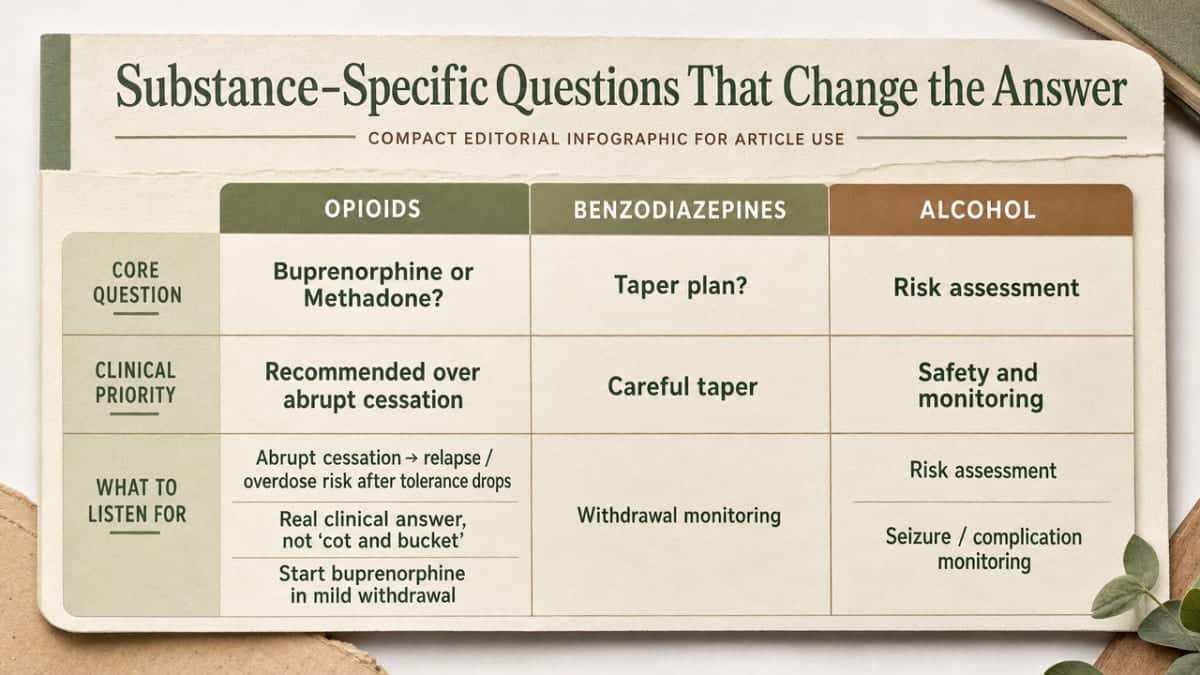
If opioids are what brought you here — heroin, fentanyl, pills, or all of the above — your first substance-specific question is short: “Do you offer buprenorphine or methadone for withdrawal, and how do you decide which one?”
This isn’t a preference question. The American Society of Addiction Medicine is direct in its national guideline: using methadone or buprenorphine for opioid withdrawal management is recommended over abrupt cessation, because abrupt cessation drives relapse and overdose risk after your tolerance drops. A facility that offers you a cot and a bucket and calls that opioid detox is not following current medical practice.3
So listen for a real answer. A strong response sounds like: “We start most patients on buprenorphine once they’re in mild withdrawal, our medical director assesses you within a few hours of admission, and we plan your transition to ongoing MAT before you leave.” A concerning response sounds like: “We taper you off comfort medications only” or “We don’t use those medications here.”
Ask two follow-ups. First: “Will you continue buprenorphine or methadone after detox, or connect me to a provider who will?” ASAM is also blunt that opioid withdrawal management on its own, without ongoing treatment, is not a treatment for opioid use disorder 3. Second: “How do you monitor for sedation and manage cravings during my stay?” You want to hear that someone is watching you, not just handing out pills on a schedule.
If You Are Detoxing from Benzodiazepines: Ask About Seizures and Vitals
Benzodiazepine withdrawal — Xanax, Klonopin, Ativan, Valium — is one of the two withdrawal syndromes that can kill you. Not scare you. Kill you. That’s why the questions here get sharper.
The 2025 joint clinical guideline from ASAM, ACMT, and partnering societies is specific: severe or complicated benzodiazepine withdrawal should be managed in inpatient or residential medically managed settings, with regular vital-sign measurement, structured assessment tools, and seizure-risk evaluation. So ask, in this order:6
- “Are you an inpatient or residential medically managed setting for benzo withdrawal?”
- “How often will my vitals be checked in the first 48 hours?”
- “What structured assessment tool do you use to score my withdrawal?”
- “How do you evaluate my seizure risk on admission, and what’s the protocol if I have one?”
One more question that separates the careful programs from the rest: “Do you ever use flumazenil to reverse benzodiazepines?” The correct answer is no. The 2025 guideline explicitly warns clinicians to avoid rapid reversal agents like flumazenil due to risks of refractory seizure and cardiac dysrhythmias. If a facility is casual about this, or doesn’t know what you’re asking, you’re talking to the wrong place.6
Benzo detox is not something to attempt at home or in a setting without a physician and RN in the building. If your gut is telling you the person on the phone is out of their depth, listen to it.
If You Are Detoxing from Alcohol: Ask About CIWA and Overnight Monitoring
Alcohol is the other withdrawal that can turn dangerous fast. Seizures, delirium tremens, and cardiac events are real risks, and they don’t announce themselves politely. Your questions here are about how closely someone is watching, and how quickly they can act.
Ask: “Do you use the CIWA scale to score my withdrawal, and how often?” CIWA — the Clinical Institute Withdrawal Assessment for Alcohol — is the structured tool most medical detoxes use to track symptoms and drive medication decisions. You want to hear that a nurse scores you on a set schedule, not once a shift as an afterthought.
Then: “What medications do you use for alcohol withdrawal, and who orders them?” A real medical detox will name benzodiazepine protocols for withdrawal management and describe how the physician on call adjusts based on your CIWA scores and vitals.1
Finally: “What happens overnight if my symptoms escalate?” You want a nurse in the building, a physician on call with standing orders, and a clear path to a higher level of care if you need it. Alcohol withdrawal at 3 a.m. is not the moment to find out the staffing is thin.
What a Good Answer Sounds Like — and What Should Make You Hang Up
By now you have a lot of questions in your hand. It helps to know what a real answer feels like, and what a rehearsed one does, before you dial.
A good answer is specific. When you ask who directs the program, a strong voice on the other end names the medical director and describes how nursing coverage works overnight. When you ask about the medical service plan, they know the three-hour window and can walk you through what happens in the first hour after you arrive. When you ask about opioid withdrawal, they mention buprenorphine or methadone by name and describe how the decision gets made. When you ask about benzodiazepines, they know what CIWA-B or a similar structured tool is, and they don’t flinch at the word seizure. Good answers sound like a team that has done this before, calmly, many times.3,4,6
A bad answer sounds vague, defensive, or oversold. Watch for these:1,10
- “We’ve been helping Oklahoma families for years” offered instead of a certification number or accrediting body.
- “We keep everyone comfortable” offered instead of a medication protocol.
- “Don’t worry about that” offered instead of an overnight staffing description.
- “Detox is all you’ll need” — a claim SAMHSA is direct in contradicting.
- Pressure to admit before your questions are answered, or refusal to verify insurance on the call.
Trust your ear. If you feel talked around instead of talked to, that is data. Thank them, hang up, and call the next number on your list.
The Handoff: What Comes After Detox
Here is the part that most facilities glide past on the phone, and it’s the part that decides whether the hard days you’re about to walk through actually stick. Detox clears your body. It does not, on its own, treat addiction. SAMHSA says that plainly, and it’s worth hearing plainly. What happens on discharge day matters as much as what happens on admission day.1
So ask, before you agree to come in: “What does my transition to ongoing treatment look like, and who arranges it?” A strong answer names specific next steps — residential treatment, an intensive outpatient program, continuation of buprenorphine or methadone with a community provider, counseling appointments already on a calendar. You want to hear that a case manager or clinician on staff builds that handoff during your stay, not that you’ll get a printed list at checkout.3
Two more questions worth asking. “Do you offer or coordinate long-term aftercare and family support?” SAMHSA lists ongoing supports and family involvement among the signs of quality care. And: “Will you follow up with me after I leave?” The answer you want is yes, with a name and a timeline.9
A Local Option That Will Answer These Questions on the First Call
You now have the questions. What you need is someone on the other end of the line who answers them without flinching.
Renewal Springs Detox operates 24/7 in Oklahoma City with a licensed physician directing care and RN coverage on the schedule Oklahoma requires. Vitals are monitored around the clock, medication-assisted treatment is available for opioid withdrawal in line with ASAM guidance, and benzodiazepine and alcohol withdrawal are handled in the medically managed setting the clinical guidelines call for. Insurance verification happens on the call, not tomorrow.3,4,6
Whatever you decide, decide by asking. Pick up the phone tonight. Ask the four questions from earlier in this article, then the substance-specific ones. Listen for specific answers. If you like what you hear from Renewal Springs, a bed and a team are ready in the metro. If you keep calling, you’re still doing the right thing. Either way, you took the step. That counts.
Talk to a Local Medical Detox Specialist Now
Connect instantly for answers about safe, supervised detox options in the Oklahoma City area.
Frequently Asked Questions
What does “medically supervised” detox mean under Oklahoma rules?
In Oklahoma, medically supervised withdrawal management has to run under the direction of a licensed physician and a licensed registered nurse supervisor, and your medical service plan has to be completed within three hours of admission. That’s the legal floor. Any OKC facility using the phrase should meet it and be able to explain how.4
How is medical detox different from a social or non-medical detox?
A medical detox has clinicians in the building who can monitor your vitals, order medications, and respond if something turns dangerous. A social detox offers a safe room and peer support, but no physician direction, no RN on duty, and no prescription medication management. For alcohol or benzo withdrawal, that difference can matter more than anything else.1
Can I be admitted to a medically supervised detox in OKC the same day I call?
Often, yes. A 24/7 medical detox in the Oklahoma City metro should be able to screen you by phone, verify insurance on the call, and admit you the same day if a bed is open. Ask directly: “Can you admit me today?” A confident answer includes what time to arrive and what to bring.
Does SoonerCare or private insurance cover medically supervised detox?
For SoonerCare, a residential medical detox must be certified by ODMHSAS and hold national accreditation to be reimbursable. Most private plans cover medical detox too. Ask the facility to verify your benefits on the call and to tell you what your out-of-pocket cost will look like before you commit. That answer should come quickly.5
If I’m detoxing from opioids, should the facility offer buprenorphine or methadone?
Yes. ASAM recommends methadone or buprenorphine for opioid withdrawal management over abrupt cessation, because stopping cold raises relapse and overdose risk once tolerance drops. Ask which medication is used, who prescribes it, and how the plan continues after detox. A program that offers neither is out of step with current practice.3
Is detox alone enough, or do I need treatment after?
Detox clears your body of the substance. It does not treat addiction on its own — SAMHSA is direct that detox is not substance abuse treatment. Plan for what comes after: residential care, an outpatient program, continued MAT, counseling, and family support. The handoff is where the work of detox actually holds.1,9
References
- Detoxification and Substance Abuse Treatment (TIP 45). https://www.ncbi.nlm.nih.gov/books/NBK64115/
- Quick Guide for Clinicians Based on TIP 45—Detoxification and Substance Abuse Treatment. https://nida.nih.gov/sites/default/files/samhsa_detoxification_and_substance_abuse_treatment.pdf
- ASAM National Practice Guideline: 2020 Focused Update (Opioid Use Disorder). https://sites.rutgers.edu/mat-coe/wp-content/uploads/sites/473/2021/11/COPY-ASAM-National-Practice-Guideline-OUD-2020-Focused-Update_Part1.pdf
- Administrative Rules – Chapter 18 (Oklahoma Department of Mental Health and Substance Abuse Services). https://oklahoma.gov/content/dam/ok/en/odmhsas/documents/policy/provider-certification/administrative-rules/2020/AdminRules-Chapter18–11-16-20.pdf
- Provider Certification – Oklahoma Department of Mental Health and Substance Abuse Services. https://oklahoma.gov/odmhsas/policy/provider-certification.html
- Joint Clinical Practice Guideline on Benzodiazepine Tapering. https://pmc.ncbi.nlm.nih.gov/articles/PMC12463801/
- SEEKING DRUG ABUSE TREATMENT: KNOW WHAT TO ASK. https://nida.nih.gov/sites/default/files/treatmentbrochure_web.pdf
- Treatment Options – National Institute on Drug Abuse. https://nida.nih.gov/sites/default/files/pdf/treatment_options_download_nidamed.pdf
- Finding Quality Treatment for Substance Use Disorders. https://library.samhsa.gov/sites/default/files/pep18-treatment-loc.pdf
- A Quick Guide to Finding Effective Alcohol and Drug Addiction Treatment. https://www.michigan.gov/-/media/Project/Websites/mdhhs/Folder2/Folder62/Folder1/Folder162/SAMHSA_Quick_Guide_Find_Treatment.pdf