
Key Takeaways
- Oklahoma law sets the floor for detox in Oklahoma City: physician direction, RN supervision, and a medical service plan completed within three hours of admission 1.
- Veteran ownership adds culture and posture on top of clinical standards — plain communication, trauma awareness, and leaders who treat safety as personal accountability rather than paperwork.
- Veterans often arrive with polysubstance use, alcohol as the most common substance 11, and co-occurring PTSD or chronic pain, so intake honesty about every drug and drink is what keeps withdrawal safe.
- Before saying yes, compare medical director credentials, RN coverage, polysubstance protocols, trauma handling during withdrawal, insurance verification, and the discharge bridge to residential, outpatient, or MAT.
What You’re Actually Looking For When You Search at 2 A.M.
You are not really looking for a website. You are looking for a person who will pick up the phone and not make you feel small.
Maybe it is you shaking on the edge of the bed, counting hours since the last dose. Maybe it is your husband, your daughter, your battle buddy, and you are the one holding the phone because they cannot. Either way, you have already scrolled past a dozen pages that all sound the same. Calming stock photos. The word journey. Promises that feel too smooth to trust.
Here is what you actually want to know, in plain language: Will they keep this person alive through withdrawal? Will they understand what a deployment can do to a nervous system? Will they treat a veteran like a person instead of a demographic on a brochure?
Those are fair questions. They deserve real answers.
This guide is written for the moment you are in right now. It walks through what veteran ownership actually means at a detox center, what Oklahoma law already requires of any licensed facility 1, what medically supervised withdrawal looks like from the first three hours to the last, and how to make the call to admissions without feeling like you are being sold to.
You made it to this page. That counts. Keep reading.
Why Veteran Ownership Changes the Room, Not Just the Brochure
Chain of Command Becomes Duty of Care
In the service, you learn early that a leader who does not know your name still owns your safety. That is chain of command. It is not a slogan. It is the reason someone checks on you at 0300 when you are shivering and you cannot remember why.
When a detox center is veteran-owned, that instinct does not disappear at the front door. It gets rewired into clinical accountability. The person running the facility knows what it feels like to be responsible for a body that is not yours. They have signed for people before. They know the weight of it.
That shows up in small, boring, life-saving ways. Med passes happen on time because someone up top actually cares that they do. Nurses are not left holding a caseload alone. When something goes sideways at 3 a.m., the escalation path is written down and someone answers the phone.
Oklahoma already requires physician direction and RN supervision at any licensed medical withdrawal management facility 9. That is the floor. Veteran ownership does not replace it. What it adds is a leader who treats that floor as the minimum, not the finish line — because they remember what happens when the minimum is all anyone gives you.
No-BS Communication From Intake to Discharge
You have probably already been talked around in circles by someone this week. A pharmacy tech. An insurance rep. Maybe a well-meaning cousin who read something online.
Veterans do not tend to talk that way to each other. The culture is short sentences, real answers, and a willingness to say I don’t know yet, but here is what we’re going to do next. When that culture lives inside a detox facility, intake stops feeling like a sales funnel and starts feeling like a briefing.
You will hear what medication is going in your arm and why. You will hear how long the worst 48 hours usually last. You will hear what happens if your blood pressure spikes at 2 a.m. If the answer is complicated, someone will still try to give it to you straight instead of hiding behind clinical vocabulary.
That matters more than it sounds. Nearly a third of veterans aged 18–49 used illicit drugs in the past year, and 5.3% of adult veterans live with a co-occurring substance use disorder and mental illness 7. People walking in with that much on their plate cannot afford to be managed by euphemism. They need to be told the truth, plainly, by someone who has earned the right to say it.
The Oklahoma Floor: What Every Licensed Detox Must Do
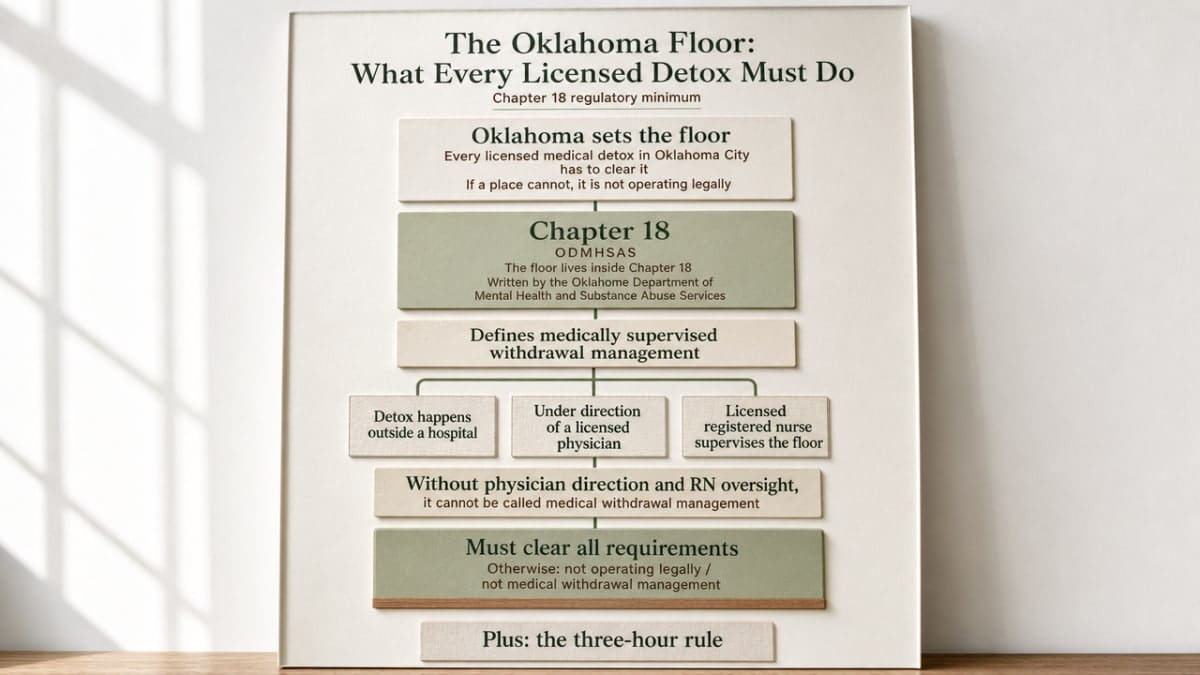
Before you compare any facility, know this: Oklahoma has already set a floor. Every licensed medical detox in Oklahoma City has to clear it. If a place cannot, it is not operating legally.
That floor lives inside a document called Chapter 18, written by the Oklahoma Department of Mental Health and Substance Abuse Services. It defines what medically supervised withdrawal management actually is, and it is more specific than most families realize.
Here is what the rules require, in plain terms. Detox has to happen outside a hospital, but under the direction of a licensed physician and with a licensed registered nurse supervising the floor 1. That is not a suggestion. A facility without physician direction and RN oversight cannot call what it does medical withdrawal management. It is something else.
Then there is the three-hour rule. From the moment you or your loved one walks through the door and is admitted, staff have three hours to complete a medical service plan 1. Not a vibe check. Not a paperwork bundle. An actual plan that documents what substances are in play, what withdrawal is likely to look like, what medications may be needed, and what would trigger a transfer to a hospital if things get worse instead of better.
Chapter 18 also lays out staffing, assessment, and criteria for when someone needs a higher level of care than a residential detox can provide 1. It does not tell facilities how to feel about their patients. It does not require anyone to understand what a deployment does to sleep, or why a veteran might flinch when a stranger walks in behind them at 4 a.m.
That is the gap. The state can mandate the medicine. It cannot mandate the posture. Everything a veteran-owned facility like Renewal Springs adds — the culture, the trauma awareness, the way a nurse phrases a question at intake — sits on top of that legal floor, not instead of it.
When you call a detox in Oklahoma City, you are allowed to ask directly: Who is the medical director? Is there an RN on shift right now? How fast will a medical service plan be done after admission? If the person on the phone cannot answer, keep dialing.
What Veterans Actually Bring Through the Door
Long-Term Opioid Therapy and the Polysubstance Reality
A lot of veterans do not arrive at detox with a clean, single-substance story. They arrive with a pain doctor, a prescription bottle, a case of beer in the truck, and a sedative they started taking because sleep stopped happening around 2011.
That is not a moral failure. That is what chronic pain and a nervous system on high alert do to a person over years.
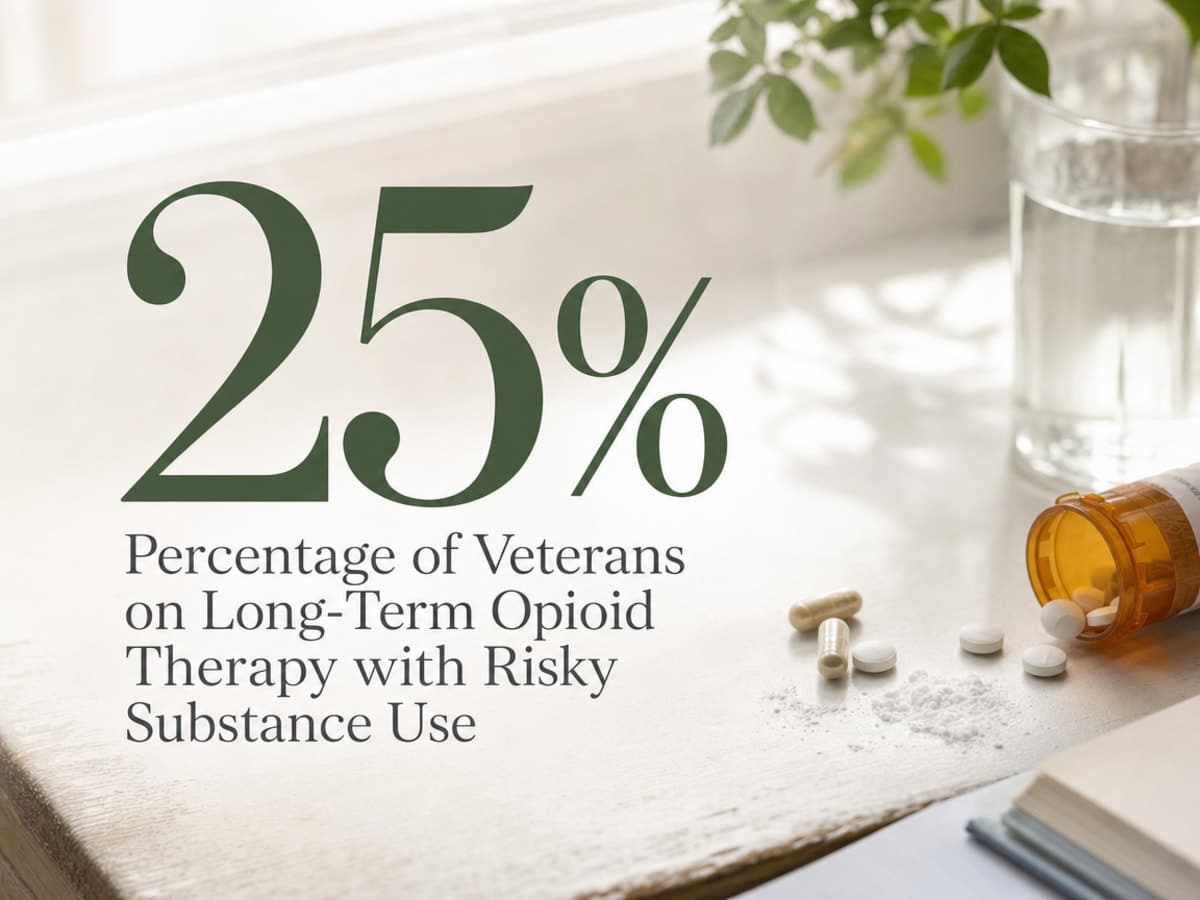
Here is the number that should shape how any facility plans for a veteran on long-term opioid therapy: one in four veterans on LTOT — 25% — either drinks at risky levels, tests positive for another substance, or already carries a diagnosed substance use disorder 2. That figure comes from veterans receiving long-term opioid prescriptions inside VA care, so the scope is specific. But if your loved one has been on hydrocodone or oxycodone for a back injury for the last five years, the odds that something else is in the picture are not small.
The stakes on getting the picture right are real. Sedative co-use — think benzodiazepines like Xanax or Klonopin stacked on top of opioids — doubles the fatal overdose rate for veterans on LTOT 2. Doubles. That is why a detox intake that asks only about the primary drug misses the thing most likely to kill someone.
A veteran-owned facility tends to ask the second and third questions without flinching. What are you taking for sleep. What are you drinking with it. When was the last dose of each. No lecture attached. Just information, because the medication plan for someone coming off opioids and benzos at the same time looks very different from someone coming off opioids alone.
You do not have to disclose everything on the phone. But when you walk in the door, tell the truth. It is the fastest way to be safe.
Alcohol, PTSD, and the Weight of Chronic Pain
If you ask most people to picture a veteran in detox, they picture opioids. The clinical reality tilts the other way.
Sixty-five percent of veterans who enter a treatment program name alcohol as the substance they most frequently misuse 11. Not heroin. Not fentanyl. Beer, whiskey, whatever was cheap and available and quieted the noise for a few hours. Alcohol is the substance most likely to be in the room when a veteran finally decides to stop.
Pooled across national studies, about 11% of U.S. veterans currently meet criteria for a substance use disorder 10. That is roughly one in nine. It is a number that should be spoken plainly, without shame, because it means a veteran walking into a detox in Oklahoma City is not an anomaly. They are part of a large, quiet population that has been carrying this for a long time.
The harder layer sits underneath. SAMHSA’s 2023 data shows 1.0 million veterans — 5.3% of the adult veteran population — living with a co-occurring substance use disorder and a mental illness at the same time 7. PTSD. Depression. Anxiety that comes on at dusk and does not leave until dawn. Chronic pain from a body that has been asked to do too much.
Detox alone does not fix any of that. But detox done well does not pretend the mental health piece is someone else’s problem. A veteran-owned facility trains its clinicians to expect PTSD, to expect chronic pain, to expect a person who has not slept eight hours in a decade. The intake nurse is not surprised when a veteran cannot make eye contact on day two. The medical director already knows that alcohol withdrawal in someone with untreated trauma is a different animal than a textbook case.
Bringing all of that through the door is not a failure of character. It is the shape of the problem. A place that expects it can meet you where you actually are.
Inside a Medically Supervised Withdrawal: What the First Days Feel Like
The Medications: Suboxone, Clonidine, and Why Timing Matters
Nobody comes off opioids clean by willpower. That is not a character flaw. It is biology. Your body has been running on a chemical for months or years, and pulling that chemical without a plan is how people end up in an emergency room or worse.
Here is what the medications actually do.
Buprenorphine — you probably know it as Suboxone — is the workhorse for opioid withdrawal. It attaches to the same receptors heroin, fentanyl, or oxycodone hit, but it does not deliver the same high. What it delivers is enough signal to stop the shaking, the vomiting, the bone-deep ache that makes people go back out and use again just to make it stop. Timing matters. Give it too early, while other opioids are still in the system, and you can trigger something called precipitated withdrawal — which is exactly as bad as it sounds. A physician-directed protocol waits for the right window, usually measured in hours since the last dose and confirmed with a standardized withdrawal score.
Clonidine is quieter. It was originally a blood pressure medication. In detox, it takes the edge off the autonomic storm — the sweating, the racing heart, the anxiety that feels like your skin is trying to leave your body. It does not replace opioids. It calms the system that opioids used to calm for you.
For alcohol and benzodiazepine withdrawal, the medications shift again. Long-acting benzodiazepines on a tapering schedule. Anticonvulsants when seizure risk is on the table. Thiamine, folate, fluids for a body that has been running on empty.
You will not be asked to memorize any of this. You will be told, in plain language, what is going in and why.
Monitoring, Vitals, and the People Watching Over You
The medications only work if someone is watching what your body does with them.
Under Oklahoma’s rules, a licensed RN supervises the floor and a physician directs the care 1. In practice, that means a blood pressure cuff on your arm at regular intervals. A pulse ox on your finger. Temperature checks. A withdrawal score written down every few hours by a nurse who is looking at you, not just at a chart. If your heart rate climbs past a threshold, someone notices before you do. If your blood pressure drops, someone is already moving.
At Renewal Springs, that clinical monitoring is layered with wearable biotech from Huml Health — a small device that tracks vitals, sleep quality, and stress markers in real time. It does not replace the nurse. It gives the nurse more eyes, especially at 3 a.m. when the room is dark and your body is doing its hardest work.
Somebody is awake. That is the point. You do not have to hold yourself together through the night. The people watching over you have done this before, and they are not going anywhere.
Trauma-Informed Care Without the Salute Theater
You can tell the difference within about five minutes.
A place doing salute theater will have a flag in the lobby, a challenge coin display, and a staff member who asks what unit you were with before they ask what you last used. A place doing actual trauma-informed care will notice you chose the chair with your back to the wall and let you keep it.
Trauma-informed does not mean soft. It means the clinical team already knows the nervous system in front of them has been running hot for a long time. They do not slam doors. They tell you before they touch your arm to check a blood pressure. They ask permission for the small things because control has been in short supply.
For veterans, this posture matters clinically, not just emotionally. Substance use disorders in veterans frequently ride alongside PTSD, depression, and chronic pain, and access barriers make that combination harder to treat well 5. A detox that treats withdrawal as a plumbing problem and ignores the mental health layer sets people up to leave against medical advice, or to relapse the week after discharge because nothing underneath got named.
The tell is not the flag on the wall. It is whether the intake nurse asks about sleep before she asks about substances. Whether someone explains what the wearable monitor does before it goes on your wrist. Whether the medical director already knows that pain and trauma and drinking often show up as one problem wearing three different names.
You do not need to be saluted. You need to be seen. Those are different things.
Insurance, Admissions, and the Call You’re About to Make
What Most Major Plans Cover and How to Verify Fast
Money is probably one of the reasons you have not called yet. Say that out loud so it stops running in the background.
Most major insurance plans — commercial group plans through an employer, individual marketplace plans, TRICARE for eligible veterans and dependents, and many Medicaid managed care plans in Oklahoma — cover medically supervised detox when it is medically necessary. That last phrase is the one that matters. A licensed facility documents medical necessity as part of the intake and medical service plan, which is one reason the state requires that plan to be completed quickly after admission 1.
You do not have to figure this out alone at the kitchen table with your insurance card and a calculator. Renewal Springs runs a free benefits verification for you. You give them the name on the card, the member ID, and the group number if there is one. They call the payer directly, get the coverage details in writing, and tell you what your out-of-pocket exposure looks like before you commit to anything.
Ask for the number in writing. Ask what happens if the stay runs longer than the initial authorization. Ask whether the facility will handle the pre-authorization call or whether that falls on you.
Then breathe. This part is the part you can actually solve today.
Five Questions to Ask Before You Say Yes
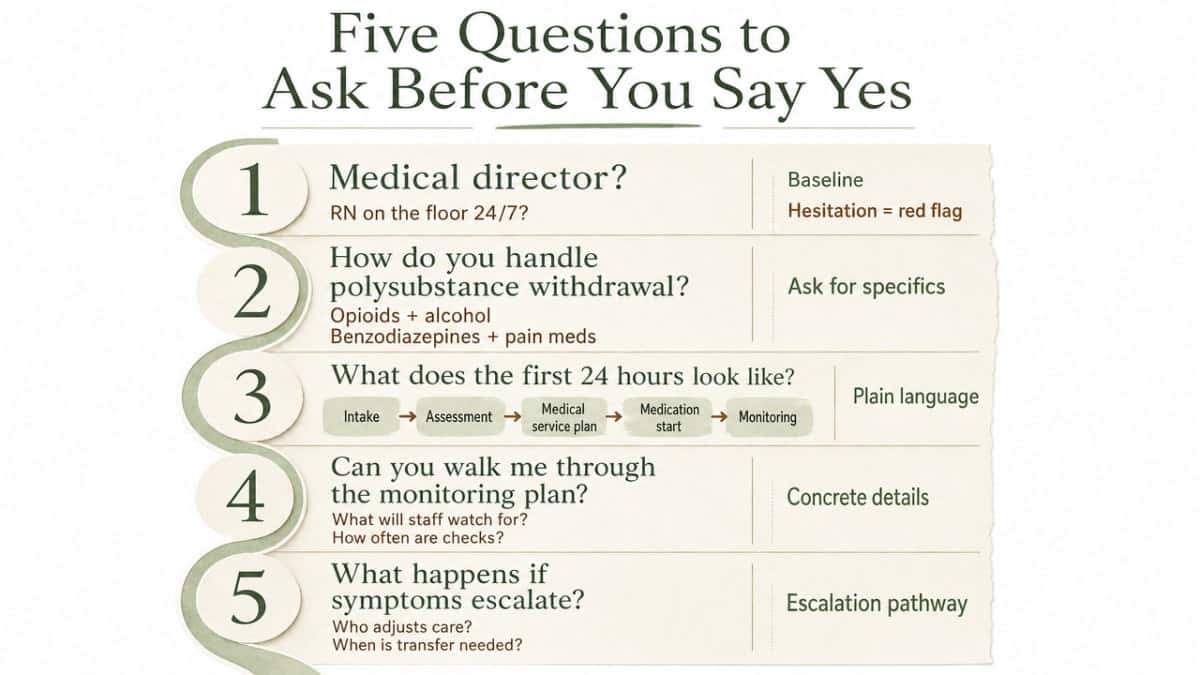
When you dial admissions, you are allowed to interview them. They should welcome it. Here are the five questions worth writing down before you pick up the phone.
Who is your medical director, and is there an RN on the floor around the clock? Oklahoma requires physician direction and RN supervision at any licensed medical withdrawal management facility 9. A confident answer here is the baseline. Hesitation is a red flag.
How do you handle polysubstance withdrawal? If your loved one is on opioids and also drinking, or stacking benzodiazepines on top of pain meds, the medication plan has to account for all of it. You want to hear specifics — not a reassurance.
What does the first 24 hours actually look like? Intake, assessment, medical service plan, medication start, monitoring. If they cannot walk you through it in plain language, keep asking.
How do you handle trauma and PTSD during withdrawal? You are listening for whether they treat mental health as part of detox or as somebody else’s job.
What happens on discharge day? A safe handoff to residential, outpatient, or MAT continuation is the difference between detox that sticks and detox that ends in the parking lot.
Write down the answers. If the person on the phone treats these questions like a burden, that tells you something too.
After Detox: The Bridge That Keeps People From Falling
Detox is not the finish line. It is the first mile of a longer walk, and the day someone gets discharged is the day a lot of people relapse if nobody built the bridge in advance.
A good discharge plan starts on admission day, not day five. That means the clinical team is already asking, before the worst of the withdrawal is over: What comes next? Residential treatment? Intensive outpatient? MAT continuation with a community prescriber? A safe place to sleep that is not the same house where the using happened?
For veterans, the bridge has to hold weight that detox alone cannot carry. The PTSD is still there on day six. The chronic pain is still there. The sleep is still broken. Substance use disorders in veterans commonly ride alongside those conditions, and gaps in follow-up care are where people fall through 5.
At Renewal Springs, discharge planning is a warm handoff, not a phone number scribbled on a discharge form. Ask about that specifically when you call admissions. Ask who makes the next appointment, and when.
Connect With a Veteran-Led Detox Team Now
Speak directly with a care professional who understands the unique needs of veterans facing opioid withdrawal.
Frequently Asked Questions
What does ‘veteran-owned’ actually mean for the care I’ll receive?
It means the person accountable for the building has stood watch over people before. That translates into culture — how nurses are staffed, how communication happens, how trauma is handled — layered on top of the physician direction and RN supervision Oklahoma already requires at any licensed detox 9. The medicine is the same standard. The posture is different.
How long does medically supervised detox in Oklahoma City usually take?
Most stays run five to ten days, depending on the substance and the person’s medical history. Alcohol and short-acting opioids tend toward the shorter end. Benzodiazepine tapers and polysubstance withdrawal can run longer. Your medical service plan, completed shortly after admission 1, will give you a realistic timeline based on what your body actually needs.
Do I have to be a veteran to go to a veteran-owned detox center?
No. Renewal Springs treats civilians and veterans, men and women, in Oklahoma City. Veteran ownership shapes the culture and clinical posture of the facility. It does not gatekeep who walks in the door. If you need medically supervised detox, you are welcome to call whether you served or not.
Will my insurance cover detox, and how do I find out quickly?
Most major commercial plans, TRICARE, and many Oklahoma Medicaid managed care plans cover medically supervised detox when it is medically necessary. The fastest way to know is to let Renewal Springs run a free benefits verification. You give them the member ID; they call the payer and come back with what is covered and what your out-of-pocket looks like.
I’m on long-term opioid therapy for pain and also drink. Is detox safe?
Yes, when it is done under physician direction with proper monitoring. The combination is common — one in four veterans on long-term opioid therapy either drink at risky levels, test positive for other substances, or already carry a diagnosed SUD 2. Tell the intake nurse everything you are taking and drinking. The medication plan for opioids stacked with alcohol is different than for either alone, and honesty is what makes it safe.
What happens after detox ends?
Discharge planning starts the day you walk in, not the day you leave. The clinical team lines up what comes next — residential treatment, intensive outpatient, MAT continuation with a community prescriber, or a combination. For veterans, that bridge matters because PTSD, chronic pain, and broken sleep do not resolve in five days 5. Ask admissions who makes the next appointment, and when.
References
- Chapter 18: Standards and Criteria for Substance Related and Addictive Disorder Treatment Services (Final effective 9-15-23). https://oklahoma.gov/content/dam/ok/en/odmhsas/documents/policy/provider-certification/administrative-rules/2023/PC–Chapter-18-Final-effective-9-15-23.pdf
- Substance use and use disorders among Veterans on long-term opioid therapy: Patterns and mortality risk. https://pmc.ncbi.nlm.nih.gov/articles/PMC12166433/
- Substance Use Disorders Among Veterans in a Nationally Representative Sample. https://pmc.ncbi.nlm.nih.gov/articles/PMC6308169/
- Prescription opioid misuse and its correlates among veterans and military in the United States: A systematic literature review. https://pubmed.ncbi.nlm.nih.gov/33010713/
- Substance use disorders in military veterans: prevalence and treatment challenges. https://pmc.ncbi.nlm.nih.gov/articles/PMC5587184/
- Substance Use and Military Life. https://www.nida.nih.gov/publications/drugfacts/substance-use-military-life
- 2023 National Survey on Drug Use and Health: Among the Veteran Population. https://www.samhsa.gov/data/sites/default/files/reports/rpt53159/2023-nsduh-pop-slides-veterans.pdf
- 2020 National Survey on Drug Use and Health: Veteran Data Slides. https://www.samhsa.gov/data/sites/default/files/reports/slides-2020-nsduh/2020NSDUHVeteransSlides072222.pdf
- Administrative Rules – Chapter 18 Effective 11-16-20. https://oklahoma.gov/content/dam/ok/en/odmhsas/documents/policy/provider-certification/administrative-rules/2020/AdminRules-Chapter18–11-16-20.pdf
- The Epidemiology of Substance Use Disorders in US Veterans: A Systematic Review and Analysis of Assessment Methods. https://pmc.ncbi.nlm.nih.gov/articles/PMC5123305/
- Substance Use and Military Life DrugFacts. https://nida.nih.gov/publications/drugfacts/substance-use-military-life
- Prevalence of substance misuse among US veterans in the general population. https://pubmed.ncbi.nlm.nih.gov/28370701/