
Key Takeaways
- Oklahoma’s SB 1718 requires private carriers to cover substance use detox at parity with medical care, meaning copays, deductibles, and length-of-stay rules cannot be stricter than those for comparable hospital stays 1.
- Two people with identical-looking insurance cards can have different detox coverage depending on whether their plan is fully insured or self-funded through an employer, which verification calls quickly clarify 2.
- Insurance authorizes a specific ASAM level of care rather than ‘detox’ in the abstract, so knowing whether Level III.2-D, III.7-D, or IV-D applies shapes prior authorization and daily rates 10.
- Before choosing a facility, compare in-network status, remaining deductible, coinsurance, out-of-pocket maximum, and how the local team handles prior authorization, appeals, and step-down care within Oklahoma County 4.
The Phone Call You Haven’t Made Yet
You’ve probably looked at your insurance card more times this week than you can count. Turning it over. Wondering if the numbers on the back actually mean anything for what you’re facing. That small act — looking things up, reading this page — is already a step forward, and it counts more than it feels like it does right now.
Here’s what makes the next part hard: you don’t know what you don’t know. You don’t know if your plan covers detox. You don’t know what a facility will ask you. You don’t know if calling means you’ve committed to something you can’t undo. So the phone sits there, and the days pass.
This guide walks you through what private insurance in Oklahoma actually owes you for medically supervised detox, what the words on your policy really mean, and what happens when a facility says “let’s verify your benefits.” No sales pitch. No pressure. Just the map of a process most people have never had explained to them plainly — so when you do pick up the phone, you’ll know exactly what’s on the other end of the line.
What Private Insurance Actually Owes You in Oklahoma
Oklahoma SB 1718 and the Parity Promise
Here’s the part most people don’t realize: Oklahoma has a specific law on the books that changes what your insurance company is allowed to do with substance use treatment. In 2020, the state passed SB 1718, and it requires carriers in Oklahoma to offer mental health and substance use disorder coverage in parity with medical and surgical benefits 1. Parity is the word that matters here. It doesn’t mean free. It means your plan cannot treat detox worse than it treats a hospital stay for pneumonia or a scheduled surgery.
What that looks like in practice: the copay for an inpatient day of detox cannot be higher than the copay for an inpatient day of medical care in the same benefit tier. The deductible you have to meet is the same one you’d meet for any other hospitalization. Day limits, prior authorization rules, and length-of-stay reviews all have to be applied comparably 9. If your plan would cover seven days of inpatient care for a physical illness under a certain rule, it can’t quietly cap detox at three days under a stricter rule.
Fully Insured vs. Self-Funded: Why the Card in Your Wallet Doesn’t Tell the Whole Story
Two people can hold cards from the same insurance company — same logo, same colors, same customer service number — and have completely different rules governing their detox coverage. That’s not a mistake. It’s a quirk of how employer health plans work, and it’s the single most confusing thing about verifying benefits.
Your plan is either fully insured or self-funded. On a fully insured plan, your employer (or you, if you bought it on the individual market) pays premiums to a carrier, and the carrier takes on the financial risk of your claims. In Oklahoma, all fully insured individual, small group, and large group plans must include mental health and substance use disorder benefits at parity — no exceptions 2. If you have one of these plans, detox is covered when medically necessary, and it’s covered on terms comparable to medical care.
A self-funded plan works differently. Your employer pays claims out of its own pocket and usually hires an insurance company just to administer the plan. That’s why the card looks identical. But self-funded large employer plans are not required to cover mental health and substance use disorder services at all. If they do include the coverage — and most large employers do — it must be provided in parity 2. The catch is the “if.”
You probably can’t tell from your card which type you have. The clue is usually in your Summary Plan Description, or you can ask HR directly (“Is our health plan fully insured or self-funded?”). A verification call to the facility will surface this quickly, because the facility contacts the plan administrator and asks the specific question. If it turns out your self-funded plan doesn’t include SUD benefits, that’s hard news — but knowing it in a phone call is better than finding out through a denied claim after you’ve been admitted. And most self-funded plans do include the coverage, because employers understand that untreated substance use is expensive in other ways.
What ‘Detox’ Means to an Insurance Company
Medically Supervised Detox Is a Clinical Category, Not a Vibe
When you say “detox,” you might be picturing a quiet room, some time off work, maybe a nurse checking in. When your insurance company hears “detox,” they’re looking for something much more specific: a clinical category with a definition, a purpose, and criteria for medical necessity.
The federal government’s clinical guide, SAMHSA’s Treatment Improvement Protocol 45, defines medically supervised detoxification as a distinct set of interventions aimed at managing acute intoxication and withdrawal safely — not a lifestyle reset, not a rest, and importantly, not treatment for the underlying substance use disorder itself 7. Detox is the medical stabilization phase. It’s the part where a licensed team manages your body coming off the substance, watches for dangerous complications like seizures or cardiac events, and uses medications when appropriate to keep you comfortable and safe.
This distinction matters for coverage. Your insurance is being asked to pay for medical services delivered by qualified staff for a defined clinical purpose, on evidence that you meet criteria for that level of care. That’s the same framework used for any hospitalization. So when the verification call happens, the facility isn’t asking your carrier to fund a wellness retreat. They’re asking your carrier to authorize a specific medical service — and that framing is what parity law was written to protect 7.
ASAM Levels III.2-D, III.7-D, and IV-D in Plain Language
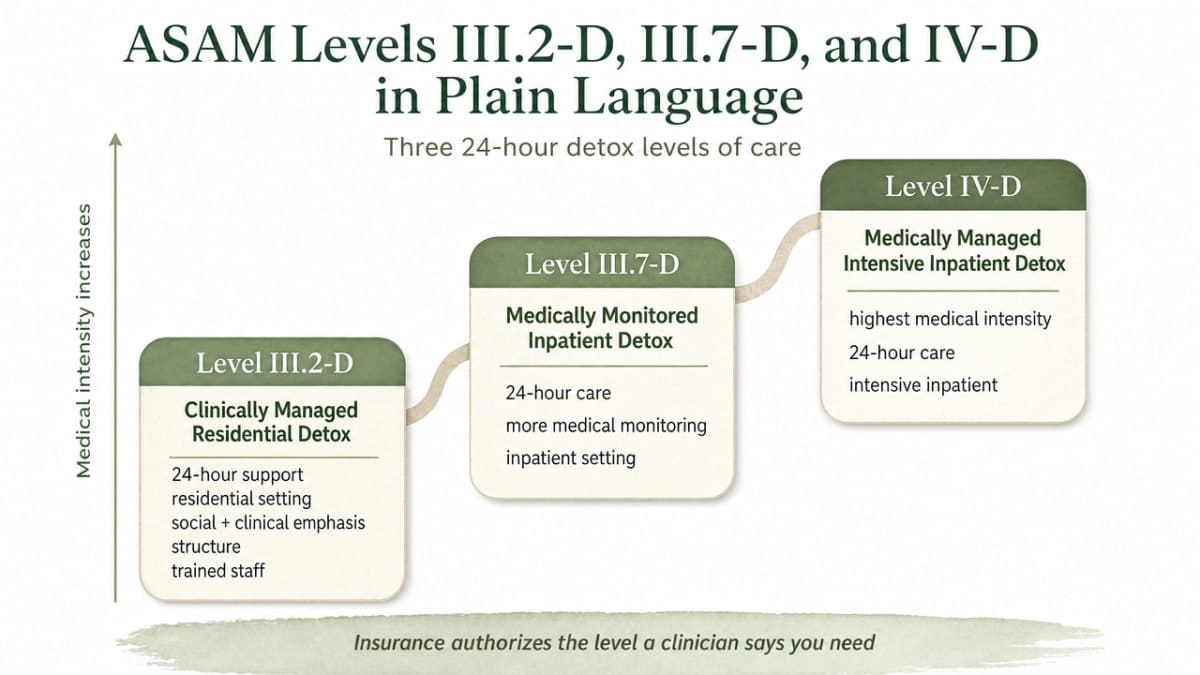
Here’s where verification gets specific in a way that catches most people off guard: “detox” isn’t one service. It’s a family of services, and your insurance authorizes one particular level based on what a clinician says you need. The framework almost every carrier uses comes from the American Society of Addiction Medicine — the ASAM Patient Placement Criteria — which defines five adult detoxification levels of care ranging from ambulatory (outpatient) detox up through medically managed intensive inpatient detox 10.
The three levels you’re most likely to see named in a verification conversation are the 24-hour ones. Level III.2-D is Clinically Managed Residential Detoxification. It’s a residential setting with 24-hour support, but the emphasis is social and clinical rather than heavily medical. Think trained staff, structure, and monitoring — appropriate when withdrawal is expected to be uncomfortable but not medically dangerous 10.
Level III.7-D is Medically Monitored Inpatient Detoxification. This is what a freestanding detox center like Renewal Springs typically provides. It’s 24-hour care in a facility with medical staff on site, medication protocols available, and the ability to manage the more serious withdrawal syndromes — opioids with high tolerance, alcohol with a history of seizures, benzodiazepines that require careful tapering 10.
Level IV-D is Medically Managed Intensive Inpatient Detoxification. This is hospital-based. It’s for people whose withdrawal or co-occurring medical issues need the resources of an acute care hospital — think ICU-adjacent oversight, complex psychiatric complications, or severe medical instability 10.
Why does this level detail matter to you, sitting at a kitchen table with an insurance card? Because when a facility calls to verify your benefits, they’re not asking “does this plan cover detox?” in the abstract. They’re asking “does this plan cover Level III.7-D admission for this patient, given these clinical indicators?” Your carrier will respond about that specific level. The prior authorization, the daily rate, the length-of-stay review — all of it is level-specific.
ASAM criteria are guidelines, not rigid protocols, and clinicians have room to make judgment calls about the right fit 10. But the level named in your authorization is the level your plan is agreeing to pay for. If a clinical review later suggests you’d be better served stepping up or stepping down, that’s a new conversation with the carrier. Knowing this ahead of time makes the verification call feel a lot less like a black box.
Inside the Verification Process, Step by Step
What the Facility Sends to Your Carrier
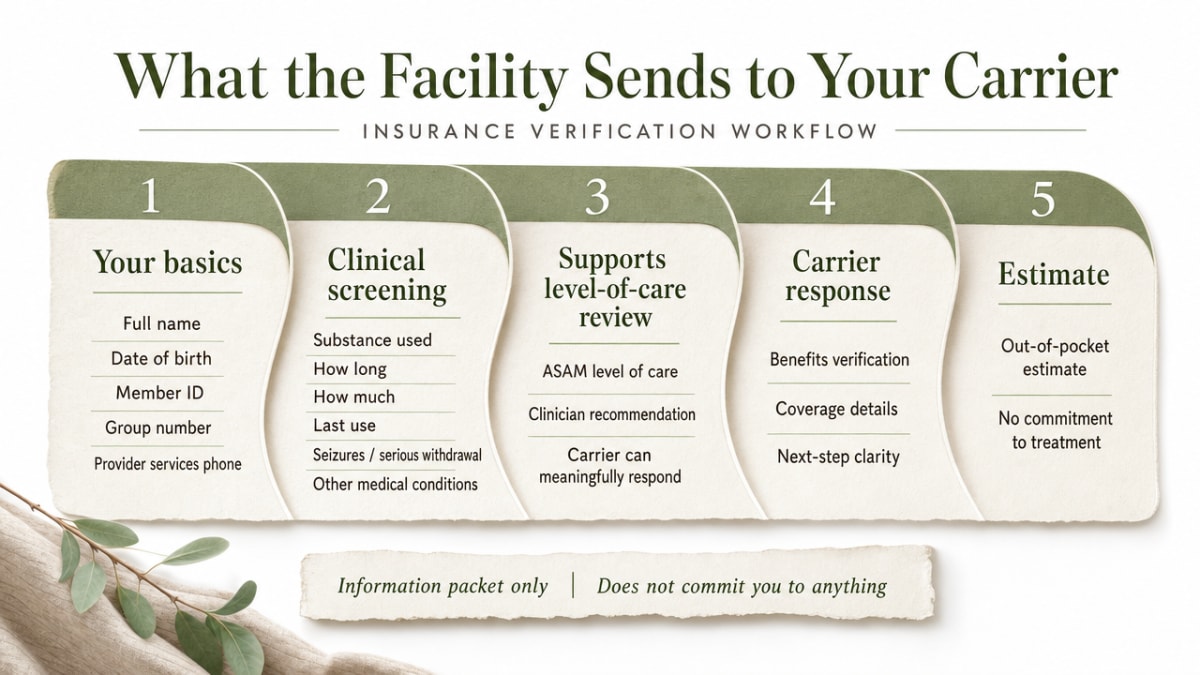
When you agree to let a facility verify your benefits, a specific packet of information moves from their intake team to your insurance carrier. It helps to know what’s in it, because none of it is mysterious — and none of it commits you to anything.
The intake coordinator collects the basics from you first: your full name, date of birth, the member ID and group number on your insurance card, and the phone number on the back of that card for provider services. They’ll also ask a handful of clinical screening questions — what substance, how long, how much, when you last used, any history of seizures or serious withdrawal, any other medical conditions. These are the details that shape which ASAM level of care a clinician is likely to recommend, and the facility needs that information before the carrier can meaningfully respond.
Then the coordinator calls the carrier — or submits electronically — and identifies themselves as an in-network or out-of-network provider requesting a benefits check for a potential admission. They ask specific questions:
- Is this member’s plan active?
- Does it include substance use disorder benefits?
- What’s the deductible, and how much has been met?
- What’s the coinsurance after deductible?
- Is prior authorization required for inpatient detox at Level III.7-D?
- What’s the out-of-pocket maximum?
Under Oklahoma parity rules, those benefit terms have to be comparable to what the plan offers for medical hospitalization 9, and the coordinator is essentially confirming that on paper.
What the Carrier Sends Back: Prior Auth, Medical Necessity, Length of Stay
The carrier’s response usually comes in two waves. The first is quick — often within the same phone call — and covers eligibility and the numbers on your plan. Yes, coverage is active. Yes, SUD benefits are included. Here’s your remaining deductible. Here’s your coinsurance. Here’s your out-of-pocket maximum for the year. That part is essentially arithmetic pulled from your plan documents.
The second wave is where things get more clinical, and it’s the piece most people don’t see coming. Before the plan will authorize an inpatient admission, it wants to know that the care meets medical necessity at the level being requested. This is a non-quantitative treatment limitation — the kind of internal review process that MHPAEA specifically regulates, requiring that plans apply it no more stringently to substance use care than they do to medical or surgical admissions 6. Your carrier will typically ask the facility’s clinical team to submit an assessment: what withdrawal symptoms are present or expected, what vital sign changes have been observed, what medical or psychiatric complications are in play, why outpatient detox isn’t sufficient.
If the clinical picture fits the criteria for Level III.7-D, the carrier issues a prior authorization — a written commitment to pay for a specific number of initial days, often three to five. That number isn’t a maximum on your stay; it’s a checkpoint. Before those days run out, the facility submits a concurrent review — updated clinical notes, current withdrawal status, medication needs — and the carrier decides whether to authorize additional days. This continues until you’re clinically ready to step down.
Under Oklahoma parity rules, day limits and length-of-stay reviews for detox cannot be more restrictive than those applied to comparable medical hospitalizations 9. If a denial happens, it should be based on clinical criteria, not on a shorter arbitrary cap. And denials can be appealed — the facility’s clinical team handles that on your behalf, and you have the right to request the specific criteria used.
What You Actually See: Estimated Out-of-Pocket in Plain Numbers
After the benefits check comes back, someone from the facility sits down with the numbers and translates them into something you can actually hold in your head. This is the part of verification that matters most for your kitchen-table decision.
You’ll typically get an estimate that looks something like this: your remaining deductible for the year, the coinsurance percentage that applies after you meet it, an estimated daily rate for the level of care recommended, and a projected total based on the initial authorized length of stay. If you’re close to your out-of-pocket maximum, that ceiling gets factored in too — because once you hit it, the plan covers 100% of covered services for the rest of the plan year.
It’s an estimate, not a final bill. The actual number depends on how many days you stay, whether any services fall outside the authorization, and how claims process afterward. But it’s a real, specific range grounded in your actual plan — not a scary blank. Many people find that the number is smaller than they feared, especially if they’ve already met part of their deductible earlier in the year. Others learn they’ll want to ask about payment plans for the deductible portion. Either way, you get to make the next decision with real information instead of dread.
The Words Insurers Use, Translated
Insurance vocabulary can feel like a second language dropped on you at the worst possible moment. Here’s a short glossary so the verification call sounds less like a foreign film.
- Deductible
- The amount you pay out of pocket for covered services before your plan starts sharing costs. If your deductible is $2,000 and you’ve paid $500 so far this year, you have $1,500 left to meet.
- Coinsurance
- The percentage of the bill you owe after you’ve met your deductible. A 20% coinsurance means the plan pays 80% and you pay 20% until you hit your out-of-pocket max.
- Copay
- A flat fee for a service — like $250 for an inpatient admission — instead of a percentage. Some plans use copays for detox, some use coinsurance, some use both.
- Out-of-pocket maximum
- The ceiling on what you’ll pay in a plan year for covered, in-network services. Once you hit it, the plan covers 100% of covered care for the rest of the year.
- In-network vs. out-of-network
- In-network providers have a contracted rate with your carrier, which usually means lower costs to you. Out-of-network care is often still covered, but at a less favorable share.
- Prior authorization
- The carrier’s advance approval that a service is medically necessary before they’ll pay. This is one of the non-quantitative treatment limitations parity law regulates, meaning it can’t be applied more strictly to detox than to comparable medical admissions 6.
- Medical necessity
- The clinical justification that the level of care requested matches your condition. It’s the standard your admission will be reviewed against — not a subjective judgment about whether you “deserve” treatment.
Why Local Access Matters in Oklahoma County
There’s a reason the geography of this matters. If you’re reading this in Oklahoma City, you’re not looking for a facility in another state that a family friend once mentioned. You’re looking for a door you can drive to, tonight if it comes to that, in a city where the need is real and documented.
From 2018 to 2022, Oklahoma County recorded 655 unintentional drug overdose deaths, giving the county the 27th highest overdose death rate in the state 4. The substances involved read like the intake list at any detox unit: methamphetamine, fentanyl, alcohol, and other opioids showed up most often 4. These aren’t abstract numbers. They’re the reason a facility like Renewal Springs is here in the first place — and the reason your private insurance carrier is well practiced at authorizing this level of care for people in your zip code.
Local access matters in ways that show up during the verification process itself. An Oklahoma City facility knows your carrier’s Oklahoma network. It knows which plans are common with which employers. It knows how the state’s parity rules interact with the carrier’s internal review process. When you’re admitted close to home, family can visit, the step-down to outpatient or residential care stays in one coordinated system, and the whole handoff feels less like starting over in a strange place. The phone call you’re weighing is a local call — and the door on the other end of it is one you can actually walk through.
What to Do in the Next Hour
You don’t have to solve the whole thing tonight. You just have to take one step that moves you from wondering to knowing. Here’s what that looks like, concretely, in the time it takes to make a cup of coffee.
- Find your insurance card. Front and back. Snap a photo with your phone so you’re not hunting for it again. The member ID, group number, and provider services phone number on the back are the pieces a facility will ask for.
- Fill out the insurance verification form. It’s a short intake — your name, date of birth, the numbers off the card, a phone number where someone can reach you privately. That’s it. You’re not scheduling an admission. You’re not signing anything. You’re asking a facility’s intake team to make the calls you don’t want to make yourself and come back with real numbers grounded in your actual plan.
- Wait for the callback. When it comes, listen for three things: is your plan active for SUD benefits, what will the estimated out-of-pocket look like, and what would the next step be if you decided to move forward. You can end the call there. You can ask questions. You can say you need to think about it.
That’s the hour. One form. One callback. One conversation you don’t have to have alone anymore.
Speak with a detox admissions specialist now
Get straightforward answers on insurance, detox options, and next steps in one confidential call.
Frequently Asked Questions
Does calling a detox facility to verify my insurance commit me to treatment?
No. Verification is just information gathering. You’re asking the facility to contact your carrier and come back with real numbers — what your plan covers, what prior authorization would look like, what your estimated out-of-pocket cost would be. Nothing is scheduled. No admission is booked. You haven’t signed anything or authorized any billing. When the callback comes with the details, you decide what happens next. Saying “I need to think about it” is a complete sentence.
Will my employer or family find out if I use my private insurance for detox?
Your employer sees that a claim was paid, not what it was for — HR doesn’t get diagnosis details from your carrier. Family members on your plan may see summaries mailed to the policyholder unless you request electronic-only or confidential communications, which most carriers allow. The verification call itself is between you and the facility. Ask the intake coordinator directly how they handle privacy, and ask your carrier about confidential communication requests. Both conversations are common.
What if my insurance says detox is ‘not medically necessary’?
A denial isn’t the end of the road. Under parity rules, the criteria used to reach that decision can’t be applied more strictly to substance use care than to medical admissions 6, and you have the right to see the specific criteria and appeal. The facility’s clinical team handles appeals on your behalf, submitting additional documentation about withdrawal risk, medical history, and why a lower level of care isn’t safe. Denials are sometimes overturned quickly with the right clinical detail.
How long does insurance verification actually take?
The eligibility and benefits piece is often done within the same phone call — sometimes 20 to 30 minutes once the intake coordinator has your card details and basic clinical information. Prior authorization for an actual admission can take longer, from a few hours to a business day, because a clinical review has to happen. If you’re calling during a withdrawal that feels urgent, tell the facility that upfront. Timelines shift when medical necessity is time-sensitive.
What happens if my plan is self-funded through my employer?
Self-funded plans — where your employer pays claims directly and uses an insurance company only to administer them — aren’t required by federal law to include substance use disorder benefits. But if they do cover SUD, that coverage must be at parity with medical care 2. Most large employers do include it. The verification call will surface your plan type quickly. If SUD isn’t covered, ask the facility about self-pay options or payment plans before assuming the door is closed.
Can I go to detox before I’ve met my deductible?
Yes. Meeting your deductible isn’t a prerequisite for admission — it’s just the point at which your plan starts sharing costs. You can be admitted with the deductible unmet, and the days you spend in detox typically count toward meeting it. After that, coinsurance kicks in, and once you hit your out-of-pocket maximum, the plan covers 100% of covered services. Many facilities offer payment plans for the deductible portion. Ask about that during the verification callback.
References
- Understanding Mental Health Parity and Your Insurance. https://www.oid.ok.gov/getready12_2023/
- Mental Health Parity and Addiction Equity Act. https://www.oid.ok.gov/regulated-entities/financial/financial-regulation-forms/mentalhealthparity/
- Drug Overdose Deaths, 2019–2023 – Oklahoma. https://oklahoma.gov/content/dam/ok/en/health/health2/aem-documents/prevention-and-preparedness/injury-prevention/drug-overdose/2025%20State%20Drug%20OD%20-%20IPS%20-%20Fact%20Sheet.pdf
- Drug Overdose County Fact Sheet – Oklahoma County. https://oklahoma.gov/content/dam/ok/en/health/health2/aem-documents/prevention-and-preparedness/injury-prevention/drug-overdose/county-fact-sheets/Drug%20Overdose%20County%20Fact%20Sheet%20-%20Oklahoma.pdf
- Drug Overdose Data Dashboard – Oklahoma State Department of Health. https://oklahoma.gov/health/health-education/injury-prevention-service/drug-overdose/data/drug-overdose-data-dashboard.html
- The Mental Health Parity and Addiction Equity Act (MHPAEA) – Fact Sheet. https://www.cms.gov/CCIIO/Programs-and-Initiatives/Other-Insurance-Protections/mhpaea_factsheet
- Detoxification and Substance Abuse Treatment (TIP 45): Chapter 1. https://www.ncbi.nlm.nih.gov/books/NBK64115/
- Fatal Overdose Data – Oklahoma Digital Prairie. https://digitalprairie.ok.gov/digital/api/collection/stgovpub/id/728296/download
- LH Bulletin No. 2020-05. https://www.oid.ok.gov/lh-bulletin-no-2020-05/
- 2 Settings, Levels of Care, and Patient Placement (TIP reference). https://www.ncbi.nlm.nih.gov/books/NBK64109/