
Key Takeaways
- Oklahoma City professionals seeking detox are protected by three overlapping confidentiality layers: federal 42 CFR Part 2, HIPAA, and Oklahoma Admin Code § 450:15-3-20.1, which together keep records from employers, licensing boards, and courts absent written consent.1,6
- Hiding withdrawal at your desk carries real medical risk in Oklahoma, where fentanyl was involved in 86% of opioid-related overdose deaths in 2024, and unsupervised alcohol withdrawal can escalate to seizures or delirium tremens.8
- A confidential admissions call gathers only clinical details, not your workplace or licensing board, and insurance verification runs through the carrier under HIPAA and Part 2 rather than through HR.1
- Before committing, compare how a facility handles Part 2 written notices, EAP confidentiality, EOB and claim naming, and time-away documentation so the paper trail stays under your control.4,5,12
The Math You Keep Running at Your Desk
You already know the equation. If you call, someone finds out. If someone finds out, your license, your job, or your reputation takes the hit. So you keep working. You keep timing doses around meetings, or measuring drinks against how long until you can leave. You tell yourself you’ll deal with it after this case, this shift, this quarter.
Here’s what that math is missing. The federal and Oklahoma laws that govern substance use disorder records were written specifically so that people in your position could get help without their treatment following them into court, into a personnel file, or into a licensing review. Not vaguely. Specifically.1,6
The fear isn’t irrational. The consequences you’re imagining are real in a world where those protections don’t exist. But they do exist, and they’re stricter than most people realize. This article walks through what the law actually says, what a confidential admissions call actually contains, and why medically supervised withdrawal is safer than continuing to hide it at your desk.
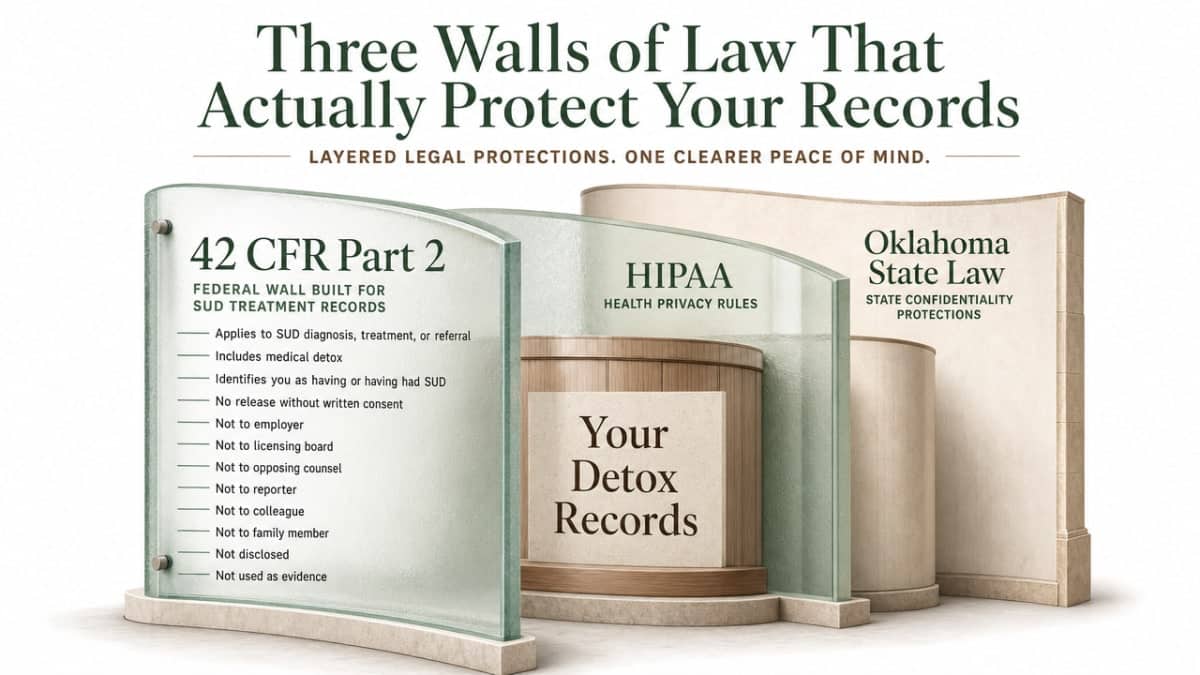
Three Walls of Law That Actually Protect Your Records
42 CFR Part 2: The Federal Wall Built Specifically for You
Part 2 is a federal regulation that exists for one reason: to make sure that people who need substance use treatment can get it without their records being used against them later. It applies to any program that provides SUD diagnosis, treatment, or referral, which includes medical detox. And it applies to any record that would identify you as having, or having had, a substance use disorder.2
Here is what that means in plain language. If Renewal Springs or any Part 2 program treats you, the records that name you cannot be released to your employer, your licensing board, opposing counsel, a reporter, a colleague, or a family member without your written consent. Not disclosed. Not used as evidence. The regulation specifically says those records may not be used in civil, criminal, administrative, or legislative proceedings without a court order that meets narrow, specific findings.2,4
Read that again. A subpoena alone does not open your detox file. A routine background check does not open it. A licensing board asking around does not open it. Part 2 was designed by people who understood that professionals in your position would not seek treatment unless the wall was this high.
HIPAA and the Written Notice You Will Actually Receive
HIPAA is the layer most people already know about. It sets the baseline for how any health provider handles your protected health information, and it prohibits routine disclosure to third parties without your authorization. For detox, HIPAA runs alongside Part 2, and where the two overlap, whichever rule is stricter wins. That is almost always Part 2.1
What this looks like in practice: when you are admitted, you will receive a written summary of your confidentiality rights. That is not a formality. Federal training standards require Part 2 programs to hand you that document and explain that federal law protects your records. You will also be asked to sign, or decline to sign, specific consent forms that name exactly who can receive information and for what purpose.5
If you never sign a release naming your employer, your employer does not get called. If you never sign a release naming your board, your board does not get a letter. The default is silence.
Oklahoma Admin Code § 450:15-3-20.1: The State-Level Backup
Oklahoma adds its own layer on top. Under Okla. Admin. Code § 450:15-3-20.1, all mental health and substance abuse treatment information and communications are treated as privileged and confidential. Your identity as a person in treatment cannot be released without your written consent, and facilities are required to adopt policies that limit staff access to the minimum information they need to do their jobs.6
That last piece matters more than it sounds. It means that inside the facility, the nurse checking your vitals sees what she needs to see. The billing coordinator sees what she needs to see. Nobody gets a broad view of your chart just because they work there. State rule requires the wall to run inside the building too.
There is also a practical Oklahoma-specific concern worth naming: the state health information exchange. Oklahoma’s HIE policy explicitly requires Part 2 consent before substance use treatment data can be shared through the exchange. Your name does not populate the state HIE just because you were admitted.7
The Narrow Exceptions Nobody Wants to Talk About
You deserve the honest version, not a marketing version. There are exceptions. They are narrow, and knowing them helps you make a real decision.
A medical emergency is one. If you arrive unconscious or in acute crisis, clinicians can share what is needed to keep you alive with the treating provider. A court order that meets specific Part 2 findings is another, and courts have to weigh public interest and the need against the injury to the patient before issuing one. Suspected child abuse reporting is a third. Oklahoma’s rule also references limited statutory exceptions tied to certain criminal code provisions.2,6
None of these are back doors your employer or licensing board can walk through on their own. They are specific legal instruments with high bars. What matters for you: routine curiosity, HR inquiries, opposing counsel in an unrelated case, and background check vendors are not on the exceptions list.
Why Hiding It at Your Desk Is the Riskier Choice
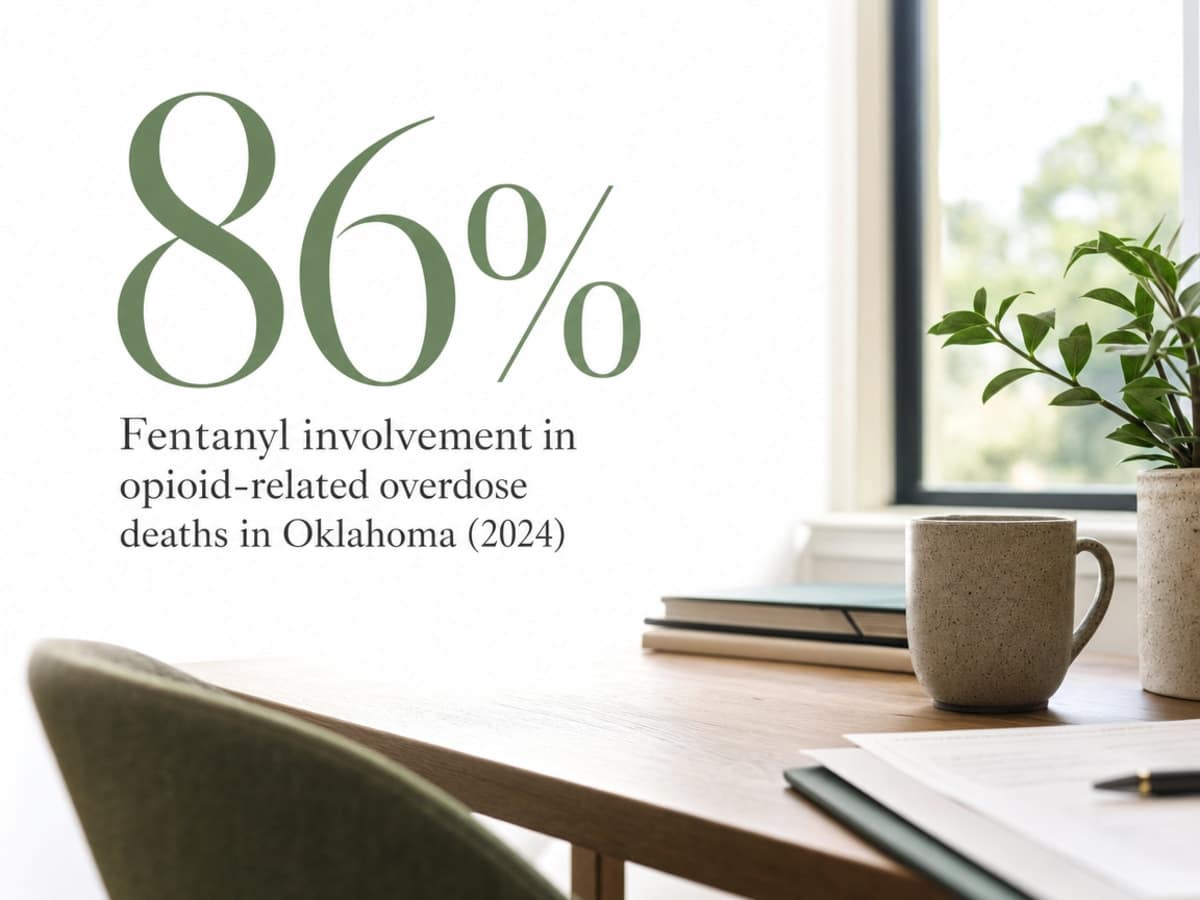
Look at what has changed in Oklahoma since 2020. Fentanyl overdose deaths in the state rose from 127 in 2020 to 730 in 2023, and in 2024, fentanyl was involved in 86% of opioid-related overdose deaths. That is not a background statistic. It is the reality of the supply you or the people around you are using. Prescription pills bought outside a pharmacy are not what they say they are. The dose you tolerated last month is not the dose in your hand this morning.8
The specific risk of hiding withdrawal at your desk is that opioid tolerance drops fast. A weekend of trying to stop, a business trip that interrupts your supply, a stretch where you cut back to prove to yourself you can, and the amount your body was used to becomes an amount your body cannot survive. People die during the exact moment they are trying to quit alone.
Alcohol carries its own version of this. Seizures and delirium tremens are not rare complications for someone drinking heavily every day and then stopping without medical support. They are predictable outcomes for a subset of people, and there is no reliable way to know in advance which subset you are in.
The Fear Pattern the Research Already Documented
The reason you have not called yet is not weakness. It is a pattern researchers have already put a name to. A 2023 peer-reviewed study of healthcare professionals found that clinicians face greater barriers to getting help than the general public, and that stigma directly delays diagnosis and treatment of substance use disorders among them. People who literally treat addiction for a living still wait too long, because they are running the same math you are.10
A 2025 review of stigma across substance-based and behavioral addictions found the same thing across broader populations: experiences of stigma create barriers to seeking help and often discourage people from trying to access care again after a bad first attempt. The fear is not a character flaw. It is a predictable response to a real social cost, and it shows up in physicians, nurses, attorneys, first responders, teachers, and licensed tradespeople alike.11
Here is what changes when you see the pattern from the outside. Your hesitation is not evidence that your situation is uniquely hopeless. It is evidence that you are responding the way almost everyone in your position responds. The people who eventually get well are not the ones who felt less fear. They are the ones who called anyway, into a system built to hold that fear without punishing them for it.
What a Confidential Admissions Call Actually Covers
What You Are Asked
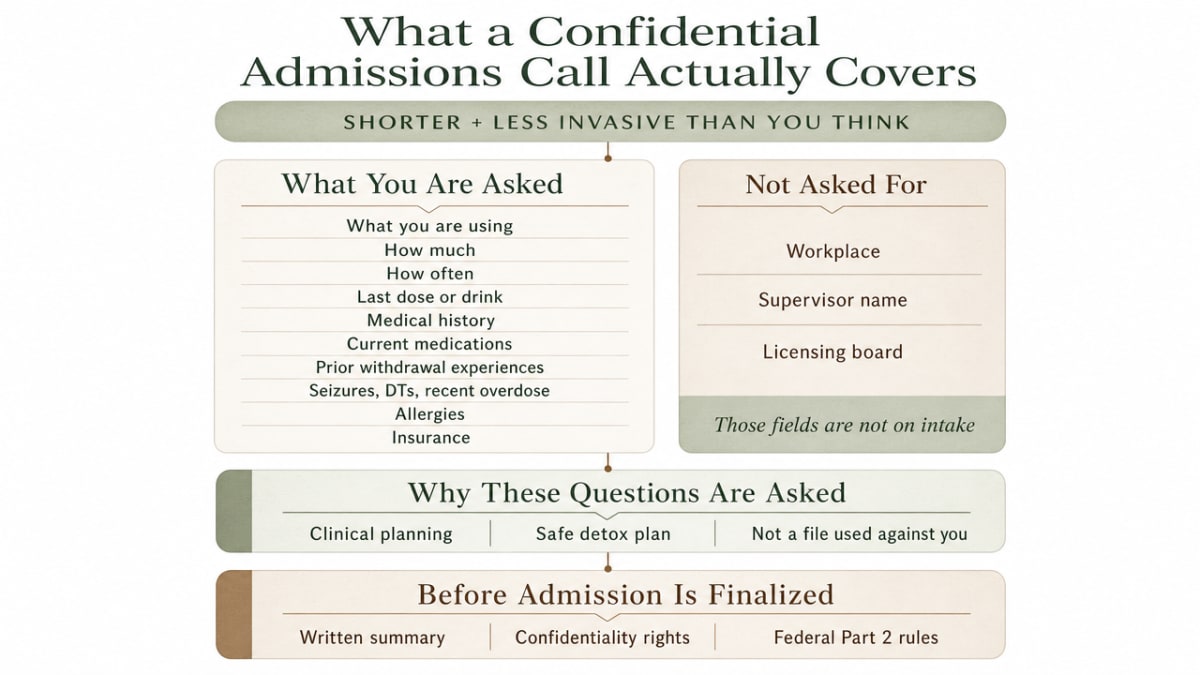
The call is shorter and less invasive than you are probably picturing. An admissions clinician asks what you are using, how much, how often, and when your last dose or drink was. They ask about your medical history, any medications you take, any prior withdrawal experiences, and whether you have had seizures, DTs, or a recent overdose. They ask about allergies. They ask what your insurance is.
You do not have to give your workplace. You do not have to name your supervisor or your licensing board. Those fields do not exist on the intake for a reason. The point of the questions is clinical: to build a detox plan that keeps you safe, not to build a file that can be used against you.
Before your admission is finalized, you will receive a written summary of your confidentiality rights, which federal Part 2 rules require the program to give you. Read it. Ask about anything on it. That document is the receipt for the wall around your care.5
What Is Not Shared, and With Whom
Nothing from that call goes to your employer. Nothing goes to your hospital’s credentialing office, your firm’s managing partner, your school district, your union, your chief, or the state board that issued your license. Not the fact that you called. Not what you said. Not whether you were admitted.4
Family members are not automatically looped in either. If your spouse calls the facility asking whether you are there, the answer is not confirmation and details. Without a signed release naming that person, staff cannot confirm you are a patient at all. The same is true for a friend, a colleague covering your caseload, or a lawyer who is not yours.
The releases you sign are specific. Each one names a person or entity, a purpose, an expiration, and what information can go across. You can decline any of them. You can revoke them later. The default for every conversation you have with admissions is that it stays inside the facility.
How Insurance Verification Stays Off Your Employer’s Radar
This is the question that stops a lot of people from calling. If your health plan comes through work, does using it tell HR? No. Your employer, even when it sponsors the plan, is not the claims processor. The insurance carrier handles claims, and carriers are bound by HIPAA and, for substance use treatment records, by Part 2.1
An Explanation of Benefits goes to the policyholder’s address, not to HR. Renewal Springs verifies your benefits directly with the carrier, confidentially, before you commit to anything. You can ask exactly what the claim will look like, what facility name appears, and whether a diagnosis code shows up on the summary. Get those answers before you decide. That is what the free benefits check is for.
Your EAP Is Not Your Employer’s Spy
A lot of professionals never call their Employee Assistance Program because they assume it is a pipeline back to HR. It is not. Federal guidance on employee wellness programs is direct: you have the right to be supported in a confidential environment, and information about your discussions with EAP staff cannot be disclosed without your permission. Add the substance use layer on top, and Part 2 protections attach to any SUD records generated through that pathway as well.12
SAMHSA’s own EAP toolkit says the same thing from a different angle: EAPs are designed to connect employees to confidential treatment, and employers are required to follow strict confidentiality regulations around any health information that flows through the program. Your manager does not get a memo saying you called. Your file does not get flagged. The EAP counselor’s notes do not appear in your personnel record.13
What your employer typically sees is aggregate data: how many people used the EAP this year, in broad categories, with no names. That is the wall.
There are edges to know. If you tell an EAP counselor something that involves an active workplace safety threat or a criminal matter, narrow exceptions can apply. Calling to ask about detox for yourself is not one of those situations. If you would rather skip the EAP entirely and call admissions directly, you can. Both doors lead to the same protected room.12
What Medically Supervised Detox at Renewal Springs Looks Like
Opioid Withdrawal, Managed the Way It Should Be
- Opioid withdrawal will not kill most people the way alcohol withdrawal can, but it will make you feel like it might. Bone pain, sweating, vomiting, diarrhea, restless legs, an anxiety that feels chemical because it is. That combination is why so many attempts to stop alone end in the same afternoon they started. Your body is not being dramatic. It is negotiating for the dose it expects.
- In a medically supervised setting, that negotiation happens with medication. Medication-assisted treatment protocols use buprenorphine or, when clinically appropriate, other agents to blunt the worst of the symptoms while your system resets. Clonidine calms the autonomic storm. Anti-nausea and sleep support fill in the rest. You are not white-knuckling anything.
- At Renewal Springs, clinicians are on site 24/7 and wearable monitoring from Huml Health tracks vitals, sleep, and stress in real time. That matters most on nights two and three, when your heart rate and blood pressure can swing and you do not want to be the one deciding whether it is normal. Someone else is watching so you can sleep.
Alcohol Withdrawal and Why It Can Kill You Alone
- Alcohol is the substance most professionals underestimate, because it is legal, socially expected, and often the one everyone else at the table is also drinking. If you have been drinking heavily every day, or if you have already had a shaky morning that only stopped when you drank again, your withdrawal is a medical event, not a rough weekend.
- The dangerous window opens roughly 6 to 24 hours after your last drink and can widen into seizures around the 24-to-48-hour mark. Delirium tremens, which carries real mortality, tends to arrive later, between days two and four. There is no reliable home test for who will land in that group. People with years of daily drinking and a normal-looking labs profile still seize.
- Medical detox uses benzodiazepine tapering, fluids, thiamine, and continuous vital sign monitoring to move you through that window safely. The point is not comfort alone. The point is that the specific hours your body is most likely to fail are the hours a clinician is standing next to you.
Discretion, Not Luxury: How the Setting Is Designed
The setting is not a resort. That framing was never the point. What you actually need is a private room, a quiet hallway, and staff who do not react when they recognize your name from a bar association directory or a hospital badge. Renewal Springs is built around that standard.
Gender-specific programs mean you are not in a mixed common room with someone who might work in your building. Private detox accommodations exist so you are not sharing space during the hours you feel worst. The facility sits a short drive from downtown Oklahoma City, close enough to reach on your own, far enough that no one from your office is walking past the entrance.
Staff training on Part 2 confidentiality is not a poster in the break room. It is an operational rule that limits who inside the building sees what part of your chart. Discretion is the design, not an amenity.5,6
Planning the Time Away Without a Paper Trail
The logistics feel harder than the medical part. You are trying to figure out how to be gone for a week without anyone asking a question you can’t answer. Start with the calendar you actually have.
Most people use accrued PTO, personal days, or short-term medical leave. You are not required to state a diagnosis to take medical leave. “A medical issue requiring inpatient care” is a complete sentence. If a physician’s note is needed, it can be written by the treating clinician at Renewal Springs without naming the substance or the facility’s specialty. FMLA paperwork, when it applies, goes to your HR benefits administrator, not your direct supervisor, and the underlying medical detail stays with the provider.
For out-of-office coverage, keep it boring. A medical procedure. A family matter. Auto-replies do not need explanations. Your phone does not need to be reachable during the first several days of withdrawal, and it should not be.
When you call admissions, ask exactly how the facility name appears on any note, invoice, or EOB. Get the specifics before you commit. That is the paper trail you control.4
Speak Privately With a Trusted Medical Professional
Get confidential answers and support about safe, discreet detox whenever you’re ready to talk.
Frequently Asked Questions
Will my employer or licensing board find out if I go to detox?
Not unless you sign a release that specifically names them. Federal 42 CFR Part 2 prohibits Renewal Springs from disclosing records that would identify you as having a substance use disorder without your written consent, and Oklahoma’s confidentiality rule adds a state-level layer on top. Your license, your employer, and your colleagues are not on any automatic notification list.4,6
What exactly does 42 CFR Part 2 protect, and how is it different from HIPAA?
Part 2 covers any record that would identify you as having, or having had, a substance use disorder, and it blocks use of those records in civil, criminal, administrative, or legislative proceedings without specific consent or a qualifying court order. HIPAA is the general baseline for health information. Where the two overlap, Part 2 is stricter, so Part 2 controls.1,2
If I use my insurance, does that create a record my employer can see?
Your employer sponsors the plan but does not process claims. The carrier does, and carriers are bound by HIPAA and Part 2 for substance use records. Explanations of Benefits go to the policyholder’s address, not to HR. Ask admissions exactly what facility name and codes appear on the claim during your free benefits check, then decide.1
Can I really trust my Employee Assistance Program, or will HR be notified?
Federal guidance is direct: information about your EAP discussions cannot be disclosed without your permission, and any SUD records generated through that pathway carry Part 2 protections. SAMHSA’s own toolkit confirms EAPs exist to connect you to confidential care. Employers see aggregate usage numbers, not names. If you would rather skip the EAP entirely, call admissions directly.12,13
Are there any situations where my detox records could be disclosed without my consent?
Yes, and you deserve the honest list. A medical emergency lets treating clinicians share what they need to keep you alive. A court order that meets specific Part 2 findings can compel disclosure, but the bar is high. Suspected child abuse reporting applies. Oklahoma references limited statutory exceptions. Routine HR inquiries, background checks, and licensing curiosity are not on that list.2,6
How do I explain being away from work without revealing I’m in detox?
“A medical issue requiring inpatient care” is a complete sentence. You are not required to name a diagnosis to take PTO, personal days, or medical leave. A physician’s note from the treating clinician can be written without stating the substance or specialty. FMLA paperwork routes through HR benefits, not your supervisor, and Part 2 keeps the underlying detail with the provider.4
References
- Fact Sheet 42 CFR Part 2 Final Rule. https://www.hhs.gov/hipaa/for-professionals/regulatory-initiatives/fact-sheet-42-cfr-part-2-final-rule/index.html
- 42 CFR Part 2 — Confidentiality of Substance Use Disorder Patient Records. https://www.ecfr.gov/current/title-42/chapter-I/subchapter-A/part-2
- 42 CFR Part 2 (2021 edition). https://www.govinfo.gov/content/pkg/CFR-2021-title42-vol1/pdf/CFR-2021-title42-vol1-part2.pdf
- Demystifying 42 CFR Part 2. https://aisp.upenn.edu/wp-content/uploads/2024/12/Final-Demystifying-42-CFR-Part-2.pdf
- 42 CFR Part 2 Confidentiality Training Module. https://www.ihs.gov/sites/privacytraining/themes/responsive2017/display_objects/documents/modules/42%20CFR%20Part%202%20Confidentiality.pdf
- Okla. Admin. Code § 450:15-3-20.1 – Consumer rights regarding confidentiality of mental health and drug or alcohol abuse treatment information. https://www.law.cornell.edu/regulations/oklahoma/OAC-450-15-3-20.1
- Oklahoma State Health Information Network and Exchange – OHCA Policies and Rules. https://oklahoma.gov/ohca/policies-and-rules/xpolicy/medical-providers-fee-for-service/general-provider-policies/general-scope-and-administration/oklahoma-state-health-information-network-and-exchange.html
- Drug Overdose Data – Oklahoma State Department of Health. https://oklahoma.gov/health/health-education/injury-prevention-service/drug-overdose/data.html
- OKLAHOMA – 2023 National Survey on Drug Use and Health State Tables. https://www.samhsa.gov/data/sites/default/files/reports/rpt56188/2023-nsduh-sae-state-tables_0/2023-nsduh-sae-state-tabs-oklahoma.pdf
- Why Health-care Professionals Often Do Not Ask for Help: Understanding the Stigma Associated with Substance Use Disorders. https://pubmed.ncbi.nlm.nih.gov/37105651/
- Stigma in substance-based and behavioural addictions. https://pmc.ncbi.nlm.nih.gov/articles/PMC11974440/
- Legislation – Employee Wellness Programs (U.S. Office of Personnel Management). https://www.opm.gov/policy-data-oversight/worklife/employee-wellness-programs/legislation/
- Employee Assistance Program: Prescription Drug Toolkit and Fact Sheet. https://library.samhsa.gov/sites/default/files/pep20-03-02-001.pdf