Key Takeaways
- Oklahoma Native adults navigating detox face documented barriers including underfunded bed capacity, fragmented care between phases, transportation gaps, and earned mistrust of non-tribal providers 1, 2, 6.
- Coverage pathways stack rather than compete: tribal self-funded plans, Purchased/Referred Care, SoonerSelect, private insurance, and tribal emergency assistance can often be verified same-day when withdrawal is named as urgent.
- A workable non-tribal facility handles the handoff, timing discharge to a residential bed at programs like Hope & Recovery Center, Jack Brown, or George Hawkins Memorial, with records and transportation arranged before admission 4, 8.
- Before dialing a detox facility, call your nation’s behavioral health office or PRC coordinator to identify the fastest coverage pathway, then run both calls in parallel to move faster this week.
What you’re actually deciding this week
If you’re reading this, someone you love, or you yourself, is somewhere on the withdrawal timeline right now. Maybe day two of shaking. Maybe the fentanyl is running out. Maybe the drinking has crossed a line the family can’t ignore anymore. You don’t need a lecture on why detox matters. You need to know what to do this week.
Here’s the honest version. Choosing a medical detox bed as a Native person in Oklahoma involves questions most non-Native readers never have to ask. Will the intake staff know what Purchased/Referred Care is? Will they call your nation’s health program without making you feel like a case file? If the detox happens in Oklahoma City but your family and your follow-on residential program are in Ponca City, Tahlequah, or Clinton, who handles that handoff?
The urgency is real. AI/AN persons have had the highest drug overdose death rates of any racial or ethnic group in recent years, driven largely by synthetic opioids 3. You already know this. Your community has been carrying it.
What this article does is narrower. It walks you through the coverage pathways that actually apply to you, the barriers that are documented and not just felt, and how a non-tribal medical detox facility like Renewal Springs in Oklahoma City fits, or doesn’t fit, into the longer chain of care your nation already provides. No romanticizing. No pretending the hard parts aren’t hard. Just the information you can use before Friday.
The barriers you already know about (and why naming them matters)
You know the list. You’ve watched a cousin get turned away because there were no beds. You’ve seen an auntie ride four hours to Oklahoma City because the closest medical detox couldn’t take her. You’ve heard the story of the intake nurse who didn’t know what a 638 program was, and the family that just went home instead.
Naming these barriers matters because it changes the conversation from “is this in my head?” to “here is what the research also says.” That shift is small, but on a hard week it’s the difference between calling one more number and giving up.
Researchers who interviewed staff at AI/AN substance use programs describe a dominant pattern: policies that underfund detoxification centers, limited bed capacity, and poor coordination of intake and care 1. A separate synthesis of staff perspectives from 18 AI/AN treatment centers found “poor integration between all phases of care from detoxification to community reintegration,” along with transportation gaps and provider shortages 2. And a study looking specifically at American Indian adults seeking treatment named geographic isolation, lack of transportation, and mistrust of mainstream health institutions as significant barriers 6.
Put together, that’s five documented obstacles a Native reader in Oklahoma is likely running into right now:
- Underfunded detox capacity. Beds run out. Waitlists happen. This is not you failing to plan ahead.
- Poor intake coordination. The handoff between your nation’s health program and a medical detox facility can be clunky, especially if the facility hasn’t done it before.
- Transportation. If you live outside the metro, getting to a detox bed on the day it opens is its own problem.
- Fragmented continuum of care. Detox, residential, outpatient, and community reintegration often don’t talk to each other. Families end up doing the coordinating.
- Mistrust of non-tribal providers. This one is earned, not imagined. It’s rational, and it deserves to be treated that way when you make the first call 6.
What naming these barriers does not do is fix them. What it does do is give you a shared vocabulary with any case manager, family navigator, or intake coordinator you’re about to call. When you say “I need to know your intake coordination process with tribal health programs,” you’re not being difficult. You’re asking the question the research says you should ask.
The rest of this article assumes these barriers are real and moves to what you can actually do inside them.
How medical detox fits into a longer chain of tribal care
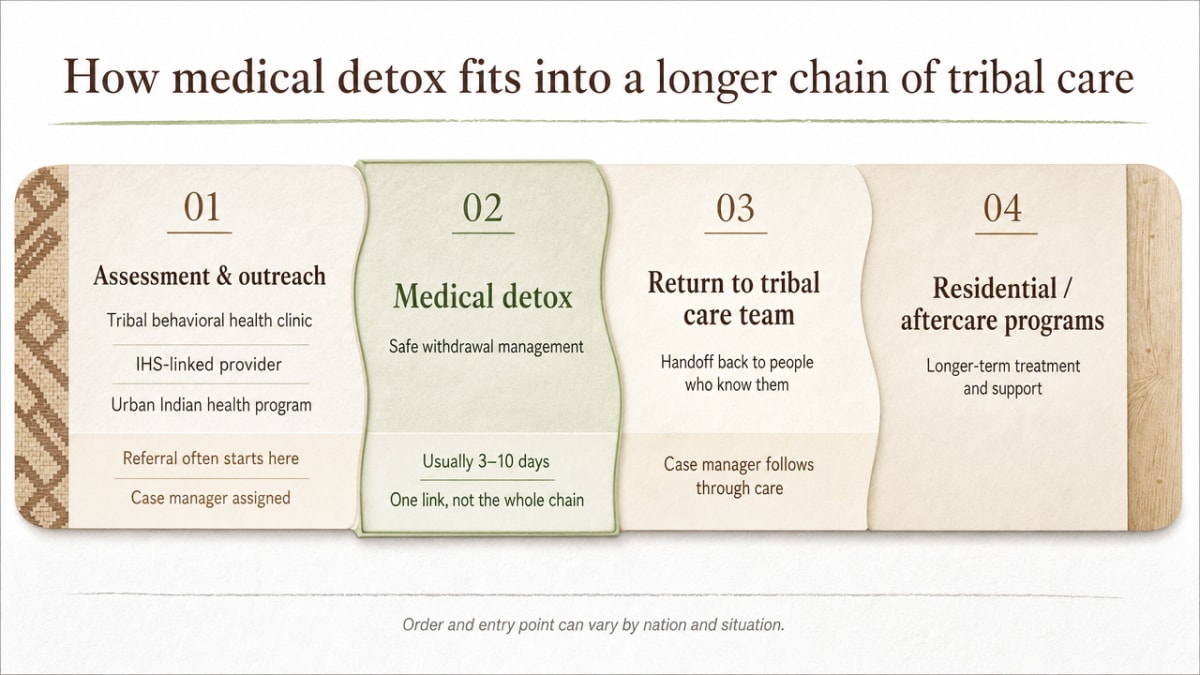
Medical detox is one link. It is not the chain.
That distinction matters because it changes what you’re looking for when you make a call. You are not looking for a place that will fix everything. You are looking for a facility that can safely get someone through withdrawal, then hand them back to the people and programs that actually know them.
Here’s what the chain usually looks like for a Native adult in Oklahoma, though the order and the entry point vary by nation and by situation:
- Assessment and outreach through your nation’s behavioral health clinic, an IHS-linked provider, or an urban Indian health program. This is often where the referral for medical detox originates, and where the case manager who will follow the person through the rest of care gets assigned.
- Medical detox, usually 3 to 10 days depending on the substance, in a licensed facility with 24/7 medical supervision. This is the phase where withdrawal from opioids, alcohol, benzodiazepines, or polysubstance use is managed with medication and monitoring. It is medical stabilization, not treatment for the underlying substance use disorder.
- Residential or intensive outpatient care through a tribal program. In Oklahoma, this includes places like the Ponca Tribe’s Hope & Recovery Center, a 60-day residential program for Native adults that offers group therapy, individual and family counseling, 12-step programming, parenting classes, and traditional and cultural activities 4. For adolescents, the Jack Brown Adolescent Treatment Center in Tahlequah is one of several tribally connected residential options listed in Oklahoma’s tribal behavioral health directory, alongside George Hawkins Memorial Treatment Center in Clinton and others 8.
- Aftercare and community reintegration, which is usually where a person’s home nation, family, and outpatient counseling take the lead. This is the longest phase and the one most likely to determine whether the work of detox holds.
The reason to picture the whole chain before you pick a detox bed is simple. A medical detox facility that cannot, or will not, communicate with your nation’s residential program is a break in the chain. It is a place someone comes out of with no clear next step, no bed waiting, and no case manager updated. That’s how people relapse in the parking lot.
A facility that treats detox as a handoff, not a destination, is different. It knows the name of the residential program you’re going to next. It calls ahead. It sends records. It gets the person there. Renewal Springs’ work with tribal partners has centered on exactly this kind of handoff, because a 5-day medical detox in Oklahoma City only matters if day 6 is already scheduled somewhere your family trusts.
When you make the first call, ask about the chain, not just the bed.
Coverage and funding pathways: who to call first
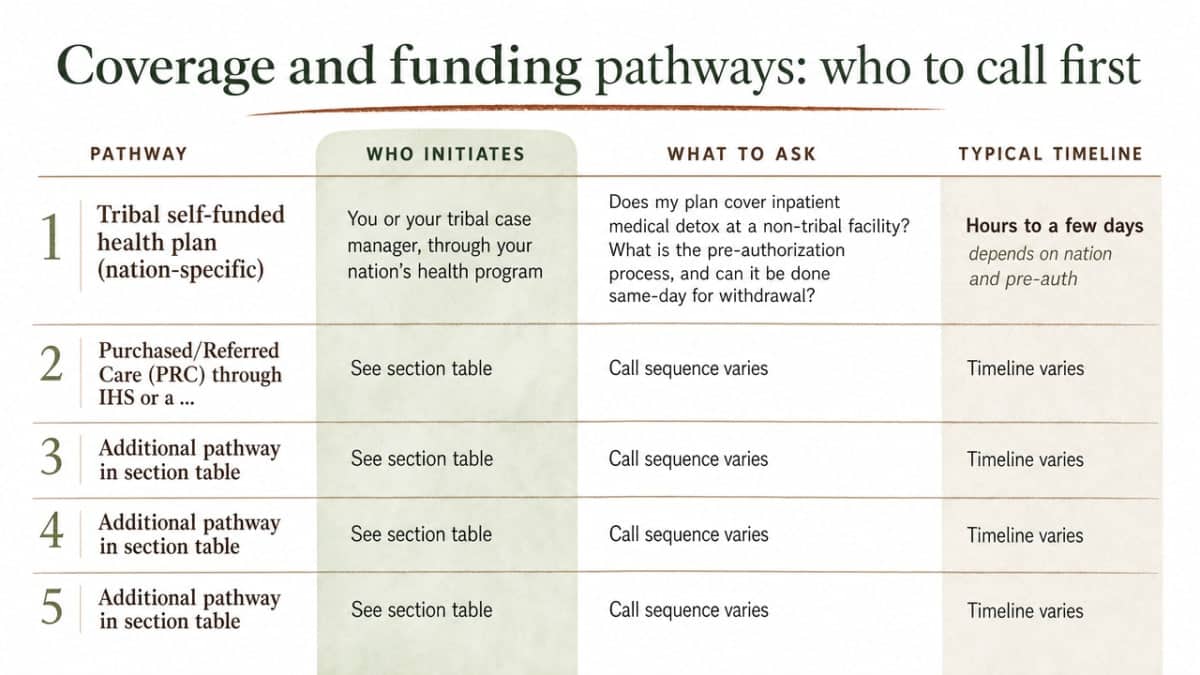
Money is often the thing that stalls the call. Not because you don’t have any options, but because there are five different ones and no one has ever laid them out on the same page. Here they are.
Every Native adult in Oklahoma has at least one, and usually two or three, of these pathways available. The trick is knowing which one is fastest for your situation and who has to pick up the phone first.
| Pathway | Who initiates | What to ask | Typical timeline |
|---|---|---|---|
| Tribal self-funded health plan (nation-specific) | You or your tribal case manager, through your nation’s health program | “Does my plan cover inpatient medical detox at a non-tribal facility? What is the pre-authorization process, and can it be done same-day for withdrawal?” | Hours to a few days, depending on the nation and whether pre-auth is required |
| Purchased/Referred Care (PRC) through IHS or a 638 tribal program | Your nation’s PRC office or IHS-linked clinic | “Is medical detox on the priority list right now? What documentation do you need from the receiving facility, and who is the referring provider?” | Same-day is possible for urgent care; non-urgent referrals take longer and are subject to funding availability |
| SoonerSelect (Oklahoma Medicaid) | You, a family member, or the detox facility’s benefits team | “Is inpatient detox a covered benefit under my plan? Which facilities are in-network, and can benefits be verified today?” | Verification usually same-day; admission can follow within 24–48 hours if a bed is open |
| Private insurance (employer or marketplace) | You or the detox facility’s benefits team | “What is my inpatient behavioral health benefit? What is the deductible status, and is pre-authorization required?” | Same-day verification is standard |
| Self-pay with tribal assistance | You, working with your nation’s behavioral health office | “Does my nation have emergency assistance funds for detox, and can the facility bill the nation directly or accept a promissory letter?” | Varies by nation; some have same-week emergency processes |
A few things worth saying plainly.
PRC is not a guarantee. It is a funding pool with priority rules, and non-emergency detox referrals can be denied or delayed if the pool is thin that quarter. If the situation is urgent, say so on the first call. The word “withdrawal” changes the conversation.
Your nation’s self-funded plan is the pathway most people underestimate. Several Oklahoma nations run their own health plans that behave more like private insurance than IHS, and they may cover a non-tribal medical detox stay in full or nearly in full. Your tribal case manager or the nation’s benefits office is the one to ask. Not the internet.
SoonerSelect covers medical detox as a behavioral health benefit for eligible members. If you already have a SoonerSelect card, the detox facility’s benefits team can usually verify same-day. Renewal Springs runs free benefits verification for exactly this reason, so you’re not guessing whether coverage will hold.
The state framework behind a lot of this coordination is Oklahoma’s Tribal State Relations office at ODMHSAS, which maintains a designated Tribal Liaison whose job includes ensuring tribal nations have access to state behavioral health services, data, and programs 11. Your case manager may already work with them. If not, they are a legitimate resource to ask about when coverage gets tangled between systems.
If you don’t have a case manager yet, call the detox facility first and ask their benefits team to help you map it out. That is a conversation Renewal Springs’ intake staff has had many times with Native families in Oklahoma, and it is the reason to pick up the phone even if you don’t have all the answers yet.
Walking into a non-tribal facility: what to ask on the first call
Making this call is hard. Not logistically, though it can be that too. Hard because you are handing a piece of your family, or yourself, to a place that isn’t yours. Your hesitation is not a flaw. It’s the accumulated weight of what Native adults have reported in the research: geographic isolation, transportation gaps, and real mistrust of mainstream health institutions 6. That mistrust was earned. It doesn’t disappear because a facility has a nice website.
What can shift, though, is what happens in the first ten minutes of the call. A facility that knows what it’s doing with Native patients will not make you explain the basics. A facility that doesn’t will tell you fast, and then you can call someone else.
Here are the questions worth asking, in roughly this order.
On coordination with your nation:
- “Have you worked with patients referred from tribal health programs before? Which nations?”
- “Will you communicate directly with my tribal case manager or PRC office during the stay, including sending discharge records to my nation’s follow-on program?”
- “If my nation’s health plan or PRC is the payer, is your billing team set up to work with that?”
On the medical piece:
- “Is there 24/7 medical supervision, or nursing coverage only on certain shifts?”
- “What medications do you use for opioid or alcohol withdrawal, and does the medical team decide protocol based on the patient’s history?”
- “How do you handle polysubstance withdrawal, especially if there’s benzodiazepine use alongside opioids or alcohol?”
On dignity and daily life:
- “Can family visit or call during the stay?”
- “If a spiritual advisor or elder from my nation wants to visit or call, how does that work?”
- “What does a day look like, and what happens if someone wants to leave against medical advice on day two?”
On the handoff, before admission:
- “When my nation’s residential program has a bed date, can discharge be timed to match it, or will there be a gap?”
- “Who on your team owns the transportation piece from your facility to the next program?”
You are allowed to ask all of these. You are also allowed to hang up if the answers are vague. The staff you speak with should be able to tell you specifically what they’ve done with tribal partners before, not just that they’re open to it. Renewal Springs’ intake team has been asked these questions by Native families in Oklahoma more than once, and the right response is a plain one: names of programs they’ve coordinated with, how billing worked, and who to loop in on the tribal side. If a facility can’t give you that, keep looking.
One more thing. You do not have to have your answers together before you dial. You are allowed to call and say, “My husband is in withdrawal, I don’t know if our insurance covers this, and I’m not sure what to ask next.” That is a complete sentence. The rest is their job.
What medical detox at Renewal Springs actually looks like
You’ve heard about the facility. Here’s what actually happens inside it, in plain terms, so you can decide whether it fits.
Renewal Springs is a licensed medical detox facility in Oklahoma City. That means the whole operation is built around one thing: getting someone safely through the physical withdrawal from alcohol, opioids (including fentanyl and heroin), benzodiazepines, stimulants, kratom, or a combination. Nursing coverage runs 24/7. A physician oversees the medication protocol, adjusted to the person in the bed, not a template. For opioid withdrawal, that typically means medication-assisted treatment to take the edge off the worst of it. For alcohol and benzo withdrawal, which can be medically dangerous, it means close monitoring for seizures and other complications.
One thing that’s different from a lot of detox settings: the medical team uses wearable biotech from Huml Health to track vital signs, sleep, and stress levels in real time. In practice, that means a nurse doesn’t have to wake someone at 3 a.m. to check a pulse. The data is already there. For a person coming off opioids who hasn’t slept in four days, that quiet matters.
The facility offers gender-specific programming for men and women, a track for veterans, and private room options. None of that replaces cultural connection to your nation, and Renewal Springs does not claim to. What it does mean is that a Native veteran, for example, is not sharing a unit with fifteen strangers on their worst week.
Length of stay is usually 5 to 10 days, depending on the substance and the person. The goal on day one is stabilization. The goal on the last day is a warm handoff to whatever comes next, whether that’s a residential program on your nation’s land, an outpatient counselor at your tribal clinic, or a bed at a program like Hope & Recovery Center 4. That handoff piece is the one to press on when you call. It’s what turns a medical detox stay into something more than a pause.
The handoff: coordinating with your nation’s follow-on care
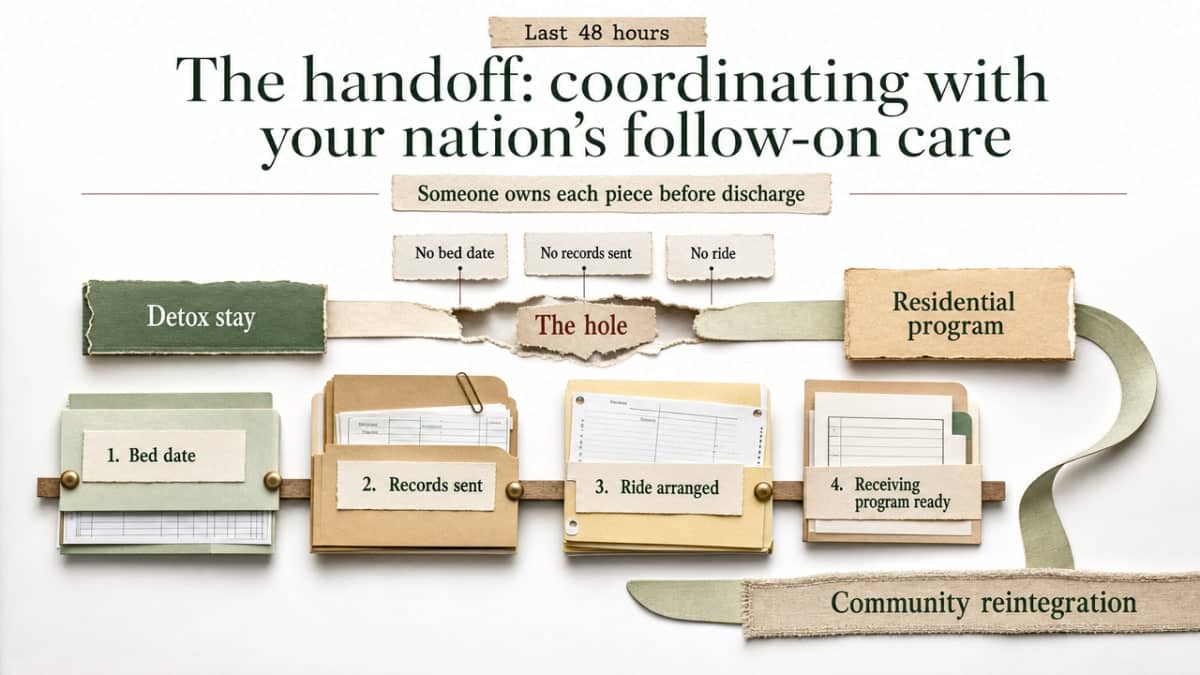
The last 48 hours of a detox stay are the most important 48 hours of the whole thing. That’s when the handoff either happens or doesn’t.
The research on this is blunt. Staff at AI/AN treatment centers describe “poor integration between all phases of care from detoxification to community reintegration,” with transportation and provider shortages making the gaps worse 2. In plain terms: someone finishes medical detox, and then there is a hole. No bed date. No records sent. No ride. The person goes home, and the reason they went to detox in the first place is still waiting for them there.
A good handoff has four moving pieces, and someone has to own each one before discharge day.
- The bed date. Your nation’s residential program, whether that’s Hope & Recovery Center, Jack Brown, George Hawkins Memorial, or another program in the tribal behavioral health directory 8, needs to know when detox ends. Ideally, the residential intake is scheduled before detox even begins.
- The records. The medical team’s discharge summary, medication list, and any labs need to travel to the next program. This is a release-of-information form and one phone call. It should not require the family to hand-carry paperwork.
- The ride. If the residential program is in Ponca City, Tahlequah, or Clinton and detox was in Oklahoma City, someone is driving. Ask before admission who arranges it.
- The case manager loop. Your tribal case manager should get the discharge update the same day it happens, not a week later.
Ask the detox facility, on the first call, who on their staff owns each of those four pieces. If the answer is a name, that’s a good sign. If the answer is vague, that’s the gap the research is describing.
For tribal case managers and family navigators
This section is for you specifically. The case manager at the tribal behavioral health office. The family navigator. The auntie who has become the de facto coordinator because no one else picked it up. You are running a different play than the family in crisis, and you need different information.
Here is what makes a non-tribal detox facility workable as a referral partner, from a coordination standpoint:
- Same-day benefits verification across tribal self-funded plans, PRC, SoonerSelect, and private insurance, without requiring you to route everything through your own billing office first.
- A named intake contact who will take your call directly, not a general 1-800 line that resets the conversation each time.
- Willingness to hold a bed for a short window while PRC authorization or a self-funded pre-auth completes.
- Discharge planning that starts on day one, with records routed to your nation’s residential or outpatient program before the patient leaves.
- Comfort with the ODMHSAS Tribal Liaison framework when a coverage question needs escalation across systems 11.
When you call Renewal Springs, ask for the intake coordinator by name and say you’re calling from a tribal program. That shortens the conversation to the part that matters: is there a bed, will the coverage work, and how fast can we move.
Talk with Someone Who Understands Tribal Detox Needs
Get clear answers about safe, respectful detox options for Oklahoma tribal community members and their families.
Frequently Asked Questions
Will a non-tribal detox facility respect my tribal identity and connection to my nation’s health program?
A good one will, and you’re allowed to test for it on the first call. Ask whether the intake team has worked with patients referred from tribal health programs, whether they’ll communicate directly with your case manager, and how they handle visits or calls from an elder or spiritual advisor from your nation. Renewal Springs does not offer traditional or ceremonial care itself, and does not claim to. What it does is coordinate with your nation’s programs so cultural connection stays with your nation, where it belongs.
Can Purchased/Referred Care (PRC) or my tribal self-funded health plan cover detox at a non-tribal facility like Renewal Springs?
Often, yes, though the answer depends on your nation and your specific situation. PRC can cover urgent medical detox when withdrawal makes it a priority-level referral, but it’s a funding pool with rules, not a guarantee. Tribal self-funded plans, which several Oklahoma nations run, frequently cover non-tribal medical detox similarly to private insurance. Call your nation’s PRC office or benefits office first, then call Renewal Springs’ benefits team. They can verify most coverage same-day and tell you what pre-authorization the receiving facility needs.
What happens after medical detox, and how does the handoff to a tribal residential program like Ponca’s Hope & Recovery Center or Jack Brown work?
Medical detox is 5 to 10 days of stabilization. The residential program is where longer treatment actually happens. Ideally, the bed at Hope & Recovery Center 4, Jack Brown, or another program in the tribal directory 8is scheduled before detox begins, so discharge day and admission day line up. The detox facility sends records ahead, your tribal case manager gets updated, and someone has already worked out transportation. Ask the intake coordinator who owns each of those four pieces before you admit.
How fast can someone get a detox bed if they’re in active withdrawal this week?
Often within 24 to 48 hours, sometimes same-day, if a bed is open and coverage clears. Withdrawal from opioids, alcohol, or benzodiazepines is treated as urgent. Call the facility and say the word “withdrawal” plainly. That moves you into a different queue than a routine admission. Benefits verification for SoonerSelect, private insurance, or a tribal self-funded plan can usually happen while you’re still on the phone. If PRC authorization is the pathway, your nation’s office can start that paperwork in parallel.
What should a tribal case manager or family member ask on the first call to coordinate care?
Ask five things. One, is there a bed available in the next 24 to 72 hours. Two, can you verify coverage today across PRC, tribal self-funded plans, SoonerSelect, or private insurance. Three, will you communicate directly with the tribal case manager during the stay and send discharge records to the follow-on program. Four, who on your staff owns transportation to the residential program. Five, have you worked with patients from tribal nations before, and which ones. Direct answers are the signal you’re looking for.
What if my nation is outside Oklahoma City and transportation to detox is a real barrier?
Transportation is one of the documented barriers Native adults in Oklahoma face when seeking substance use treatment 6, and it does not disappear because someone is willing to help. Ask the detox facility directly whether they can arrange or assist with transport from your community to Oklahoma City, and ask your nation’s behavioral health office whether they have emergency transportation funds or a case manager who can drive. Between the two, most situations can be worked out. Don’t let a ride problem be the reason the call doesn’t happen.
References
- American Indian and Alaska Native substance use treatment: Barriers and facilitators. https://pubmed.ncbi.nlm.nih.gov/37277023/
- Challenges to providing quality substance abuse treatment services for American Indian and Alaska Native communities: Perspectives of staff from 18 treatment centers. https://pmc.ncbi.nlm.nih.gov/articles/PMC4080609/
- Drug Overdose Deaths Among American Indian and Alaska Native Persons. https://www.cdc.gov/mmwr/volumes/72/wr/mm7240a5.htm
- Hope & Recovery Center – Ponca Tribe of Indians of Oklahoma. http://www.ponca-nsn.gov/hope–recovery-center.html
- Drug Overdose Deaths Among American Indians and Alaska Natives. https://www.cdc.gov/drugoverdose/data/ai-an.html
- Barriers to Substance Use Treatment Among American Indian Adults. https://pubmed.ncbi.nlm.nih.gov/35238643/
- 2022 National Survey on Drug Use and Health (NSDUH) – Oklahoma State Tables. https://www.samhsa.gov/data/sites/default/files/reports/rpt44486/2022-nsduh-sae-state-tables/NSDUHsaeOklahoma2022.pdf
- Tribal Behavioral Health Resource Directory (Revised 1/2018). https://oklahoma.gov/content/dam/ok/en/oja/documents/2018%20Tribal%20Behavioral%20Health%20Directory%202.pdf
- Substance use among American Indian adults in Oklahoma: Prevalence and correlates. https://pubmed.ncbi.nlm.nih.gov/30642548/
- Drug Overdose Deaths Among American Indians and Alaska Natives: A National Analysis. https://www.cdc.gov/mmwr/volumes/69/wr/mm6940a3.htm
- Tribal State Relations – Oklahoma Department of Mental Health and Substance Abuse Services. https://oklahoma.gov/odmhsas/policy/tribal-state-relations.html