Key Takeaways
- Calling a detox line is not a commitment — intake coordinators answer questions about cost, insurance, and timing, and honesty on that first call shapes a safer care plan.
- Medical detox is the supervised process of clearing substances from the body, legally requiring a physician, medical staff, history and physical, labs when warranted, and continuous supervision 4.
- The clinical assessment on arrival builds a full picture — vitals, medical history, labs, and often an EKG — so the team knows exactly what to watch for during withdrawal.
- Inpatient care is the safer setting for heavy daily drinking, long-term benzodiazepine use, prior withdrawal seizures, pregnancy, or an unsupportive home, while milder cases may fit ambulatory programs 14, 11.
- Symptom-triggered medications and continuous monitoring do the heavy lifting during withdrawal — benzodiazepines for alcohol, methadone or buprenorphine for opioids, and a controlled taper for benzodiazepines 7, 8, 11.
- Days progress from a busy first 24 hours through a peak middle stretch to a clearer later phase, with discharge tied to symptom resolution rather than a fixed date 7.
- Transition planning is critical because detox handles the body, not the addiction — for opioid use disorder, the CDC warns detox alone raises relapse and overdose risk 1.
- When choosing a facility, ask about state certification, national accreditation, overnight medical staffing, substance-specific medication protocols, and how discharge appointments get arranged before you leave 2, 4.
The phone call is the hardest part
You have probably rehearsed the call in your head a dozen times. Maybe you have picked up your phone, stared at it, and put it back down. That is normal. The hardest part of medical detox is not the withdrawal, the intake paperwork, or the first night in a strange bed. It is deciding to dial the number.
So let’s take some pressure off. A first call to a detox facility is not a commitment. You are not signing anything. You are not being admitted. You are asking questions — the same way you would call a doctor’s office about a procedure you are unsure about. How long does this take? What does it cost? Will my insurance work? Can my partner visit? What if I have a job I cannot lose?
Reading this article counts as a step forward. So does saving a phone number. So does telling one person you are thinking about it. Nothing here has to happen today.
What this guide walks you through is what to expect at a medical detox once you do call — the intake conversation, the clinical assessment when you arrive, the medications and monitoring during withdrawal, and the plan that gets built for what comes after. Medical detox is a defined, supervised process, not a mystery 13. At Renewal Springs Detox in Oklahoma City, that process runs 24/7 with licensed medical staff on-site, and the phone line does too. You can call just to ask.
What medical detox actually is (and what it is not)
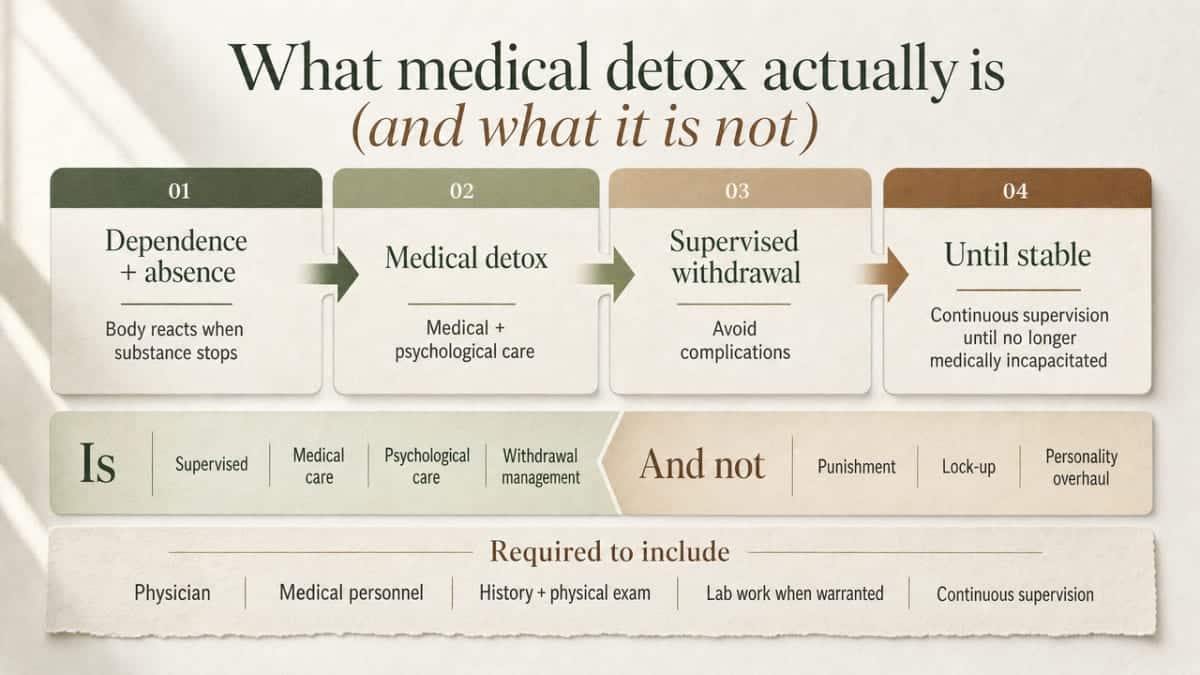
Medical detox is the medical and psychological care of someone whose body has become dependent on a substance and is now reacting to the absence of it 13. That is the plain definition. It is not a punishment, a lock-up, or a personality overhaul. Oklahoma’s own administrative rules put it even more simply: detoxification is the process of eliminating the toxic effects of drugs and alcohol from the body, done in a supervised way so withdrawal complications can be avoided 3.
Here is what a licensed medical detox is actually required to include, according to Oklahoma code:
- a physician
- medical personnel on hand
- a medical history and physical exam
- lab work when it is warranted
- continuous supervision until you are no longer medically incapacitated 4
That is the legal floor. It is not marketing. If a facility calls itself a medical detox, that is what has to be happening under the roof.
The four phases you can expect look like this:
- the intake call
- the clinical assessment on arrival
- medication-supported monitoring while your body clears the substance
- transition planning for what comes next 12, 13, 4
The rest of this article walks through each one so nothing about the process stays hidden.
What happens when you call: intake and screening
When you call a medical detox line, the first voice you hear is usually not a doctor. It is an intake coordinator — someone whose entire job is to ask questions gently and figure out whether this is the right place for you. At Renewal Springs, that line is staffed around the clock, which matters, because the moment you decide to ask is not always business hours.
Expect the conversation to cover a few things:
- What are you using, how much, and how recently?
- Have you tried to stop before, and what happened?
- Do you have other health conditions — seizures, heart trouble, diabetes, pregnancy?
- Are you taking prescribed medications?
- Any history of withdrawal seizures or DTs?
- Do you feel safe right now?
None of these questions are trick questions. They exist because the answers change what happens next. Someone with a heavy daily alcohol history and a past withdrawal seizure needs a very different plan than someone tapering off kratom 11.
You will also be asked about insurance, and this is where a lot of people freeze. You do not need to have the answers memorized. Read the card, or say you do not have one. A benefits check is free and does not obligate you to admit. If cost is the thing keeping you on the fence, say so out loud — the coordinator can only help with what they know.
Honesty on the intake call is not about confession. It is about safety. Detox teams build the initial care plan off what you tell them, and a doctor will confirm and adjust everything once you arrive 4. Underreporting how much you drink or use is one of the few things that can genuinely make withdrawal more dangerous, because the medication plan gets calibrated to what the team believes your body is used to.
You will not be judged. Intake staff have heard every version of this call. They are not scoring you. They are trying to get you in the door safely.
By the end of the call, you should know three things:
- whether the facility can admit you
- roughly when a bed is available
- what to bring
At Renewal Springs, the coordinator will also tell you what the arrival looks like — where to pull up, who meets you, and what happens in the first hour. If you want to hang up and think about it, that is allowed too. The call itself is not the commitment.
The clinical assessment on arrival
You walk in. Someone greets you by name. Your bags get checked — not to shame you, but because certain items (mouthwash with alcohol, personal medications, sharps) need to be logged and stored. You will get them back. This part usually takes less time than a DMV visit.
Then the real work starts: a full clinical assessment. In Oklahoma, medical withdrawal management is legally required to include a physician, medical personnel, a documented medical history and physical exam, lab work when it is warranted, and continuous supervision until you are stable 4. That is not a facility choosing to be thorough. That is the code.
Here is what that actually looks like in the first few hours. A nurse takes your vital signs — blood pressure, heart rate, temperature, oxygen. A physician or advanced practice provider sits down with you and goes through a longer version of the intake conversation: what you have been using, how much, when you last used, what withdrawal has felt like in the past. They ask about mental health, past overdoses, seizures, chronic pain, prescriptions, allergies. If you are pregnant or think you might be, say so — it changes the medication plan immediately.
Blood may be drawn. A urine screen is standard. An EKG is common, especially if you have been drinking heavily or using stimulants, because the heart takes a beating from both. None of this is a test you can fail. It is the team building a map of your body so they know what to watch for.
At Renewal Springs, this is also where wearable monitoring gets fitted. Huml Health biotech tracks your vital signs, sleep quality, and stress markers continuously — so the night nurse is not just checking on you every few hours, the data is coming in the whole time. That matters most when withdrawal peaks in the middle of the night, which is when it usually does.
By the end of the assessment, the team has a working plan: your risk level, the medications you will likely be offered, how often vitals will be checked, what your room looks like, and roughly how long you will be there. You will be told all of it. If something is unclear, ask. This is your care, and the team wants you to understand it.
Is inpatient medical detox the right setting for you?
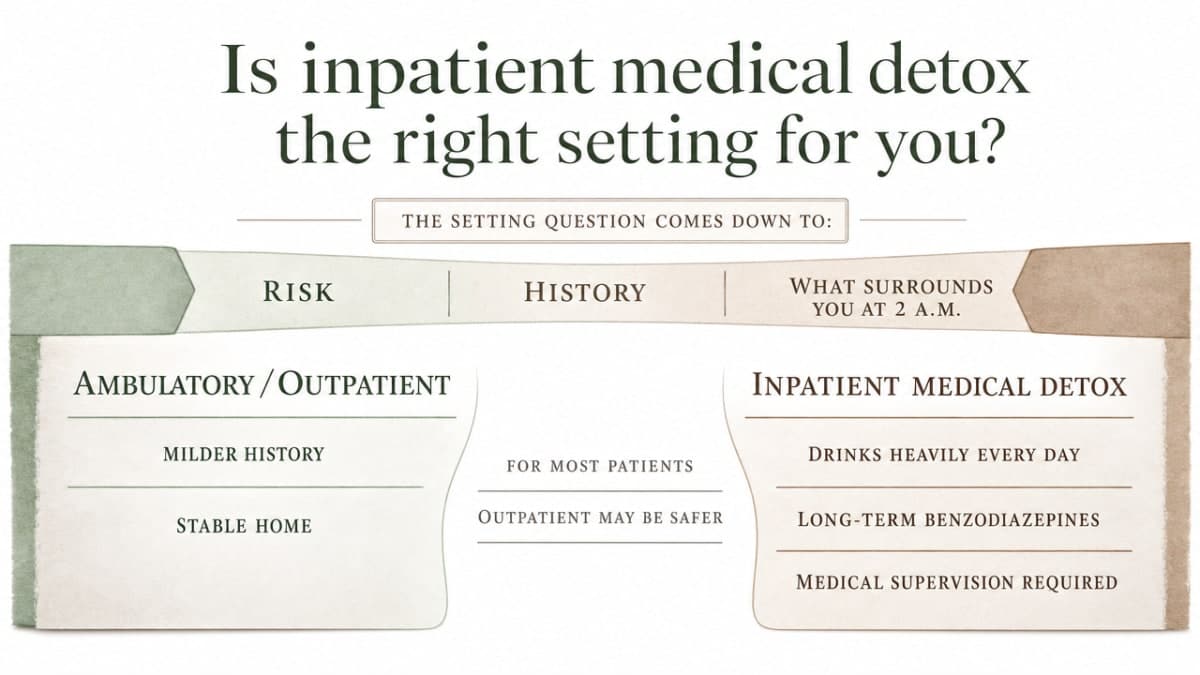
Here is a truth most detox marketing skips: not everyone needs to check in for inpatient care. Evidence reviewed for the 2024 Canadian guidelines on alcohol use disorder found that for most patients, withdrawal management can be provided more safely in an outpatient rather than an inpatient setting 14. That is worth saying plainly. If your history is milder and your home is stable, an ambulatory option may be a real choice.
But “most patients” is not “you.” The setting question comes down to risk, history, and what surrounds you when the shakes start at 2 a.m.
Inpatient medical detox is usually the safer call if any of these describe you:
- You drink heavily every day, or you have been on benzodiazepines for a long stretch — benzodiazepine withdrawal should not be attempted without medical supervision, full stop 11.
- You have had a withdrawal seizure or delirium tremens before.
- You are pregnant.
- You have a serious heart, liver, or seizure condition.
- You are using opioids alongside other substances.
- You do not have someone sober at home who can watch you and drive you to an ER.
- You have tried to stop on your own and it did not hold.
Ambulatory withdrawal management, by contrast, is a legitimate lower-acuity option for people with milder dependence and a supportive home. In Oklahoma, an ambulatory program is required to monitor and document vital signs, food and liquids, and to keep written emergency medical procedures approved by a licensed physician 5. That is real care — but you go home between visits.
Inpatient medical detox sits at a different clinical floor. Oklahoma code requires a physician, medical personnel, a documented history and physical exam, labs when warranted, and continuous supervision until you are no longer medically incapacitated 4. You are watched around the clock. Medications can be adjusted in real time. If something goes sideways at 3 a.m., a nurse is already in the hallway.
At Renewal Springs, everyone who walks through the door gets that inpatient floor of care — 24/7 licensed medical staff, continuous vitals through Huml Health wearables, and a private space to sleep through the worst of it. If you are not sure which setting fits your history, call and ask. The intake coordinator will walk through your situation honestly, and if inpatient is not what you need, they will tell you that too.
Medication support and 24/7 monitoring: what the team is doing while you rest
Once you are settled in your room, it can feel like nothing is happening. You are lying down. The lights are low. Somebody brings you water. But underneath the quiet, a lot of care is running in the background — and understanding that shift, from “surviving withdrawal alone” to “being watched over,” is one of the biggest reasons medical detox exists.
The core idea is symptom-triggered treatment. Rather than dosing everyone on a fixed schedule, the team watches your vitals and your symptoms and treats what actually shows up. For alcohol withdrawal, hospital guidelines specifically recommend this approach: screen for risk, treat by symptoms, and hold off on discharge until withdrawal has actually resolved 7. That is why you may not know exactly when you are leaving on day one. The team is watching your body, not a stopwatch.
Medication looks different depending on what you were using:
- Alcohol. Benzodiazepines are the mainstay of alcohol withdrawal management, given in a quiet room with low lighting and minimal stimulation to reduce the risk of seizures and severe symptoms 8. You will also likely be offered thiamine, fluids, and nutrition support — heavy drinking depletes the body, and replacing what’s missing is part of the plan.
- Opioids. For opioid withdrawal, medication management is most commonly achieved with methadone plus adjunctive medications for symptoms like nausea, muscle aches, and sleep 11. Buprenorphine is also used in many programs. The goal is to blunt the worst of the symptoms so you can actually rest.
- Benzodiazepines. This one has a hard rule attached: benzodiazepine withdrawal is not recommended without medical supervision 11. Quitting long-term benzo use cold turkey at home can trigger seizures. In a monitored setting, the team uses a controlled taper so your nervous system can adjust without crashing.
Monitoring is the other half of the equation. In Oklahoma, medical withdrawal management legally requires attendant medical personnel and continuous supervision until you are no longer medically incapacitated 4. In practice, that means vitals get checked on a schedule — blood pressure, heart rate, temperature, oxygen — and a nurse is available every hour of the day and night.
At Renewal Springs, that supervision layer runs on both people and technology. Licensed medical staff are on-site 24/7, and Huml Health wearables track your vital signs, sleep quality, and stress markers continuously. So when the nurse walks in at 3 a.m., they already know your heart rate has been climbing for the last twenty minutes. The care catches up to what’s happening before you have to press a call button.
That is the shift worth holding onto. You are not white-knuckling withdrawal. You are resting while trained people watch the numbers and adjust the plan. Your only job is to say what you feel and let the team do theirs.
What the days actually feel like
You want to know what the hours are like. That is fair. Most people picture detox as either a movie scene or a hospital ward, and it is neither.
The first 12 to 24 hours are usually the busiest. You are getting settled, meeting the nurses on your shift, going through the assessment, and starting whatever medication plan the doctor has ordered. You may feel anxious, sweaty, nauseous, restless — early withdrawal symptoms are real, and they show up before you have had time to get bored. This is when the team is most attentive. Vitals are checked often. If your symptoms climb, the medication plan adjusts to meet them, which is the whole point of a symptom-triggered approach 7.
The middle stretch — usually the second and third days — is often when things peak, and also when they start to turn. Alcohol withdrawal tends to hit hardest here, which is why guidelines keep you in a quiet room with low lighting until symptoms resolve 8. Opioid withdrawal has its own rhythm: aches, chills, a stomach that will not settle, sleep that comes in pieces. Medications blunt the sharp edges so you can rest 11. You may not feel good. You will feel watched over.
By the later days, most people describe it as tired but clearer. Appetite comes back. You sleep longer stretches. You have real conversations with staff instead of just answering symptom questions. At Renewal Springs, this is often when the counseling team and the discharge planner start spending more time with you, because your brain is finally online enough to think about what comes next.
Discharge does not happen on a fixed day. It happens when your withdrawal has actually resolved 7. That timeline is yours, not a schedule.
Transition planning: why detox is Phase 1, not the finish line
Somewhere around day three or four, when your head is clearer and your body has stopped fighting itself, a different conversation starts. It is quieter than the medical one. A counselor or discharge planner sits down and asks what comes next.
This part matters more than most people expect. Detox handles the physical piece — clearing the substance, calming the nervous system, getting you medically stable 12. It does not, on its own, treat addiction. The CDC is unusually blunt about this for opioid use disorder: detoxification alone, without ongoing medications for opioid use disorder, is not recommended, because the risk of returning to use and overdosing climbs sharply once your tolerance has dropped 1. Leaving detox with no plan is the dangerous part. Not the detox itself.
So a good transition plan is not paperwork. It is a warm handoff. Depending on what you need, that might mean:
- residential treatment for a few weeks
- an intensive outpatient program you attend during the day
- ongoing medication for opioid use disorder with a prescriber who already has your chart
- a therapist appointment on the calendar before you leave
- a sober living placement if home is not safe yet
For alcohol withdrawal, guidelines specifically hold off on discharge until symptoms have actually resolved and a follow-up plan is in place 7.
At Renewal Springs, the discharge planner starts working on this early — not on the morning you leave. They coordinate with residential and outpatient partners, help sort insurance for the next level of care, and make sure you walk out with appointments, not just a folder. Family gets looped in when you want them to be.
You are not being handed off because the team is done with you. You are being handed off because the next chapter needs different tools than the ones detox provides. Phase 1 got your body back. Phase 2 is where the life around it gets rebuilt.
Choosing a detox in Oklahoma: what to ask before you commit
If you are calling around, a few direct questions will tell you more than any brochure. You do not need to feel expert about this. You just need to hear how the person on the other end answers.
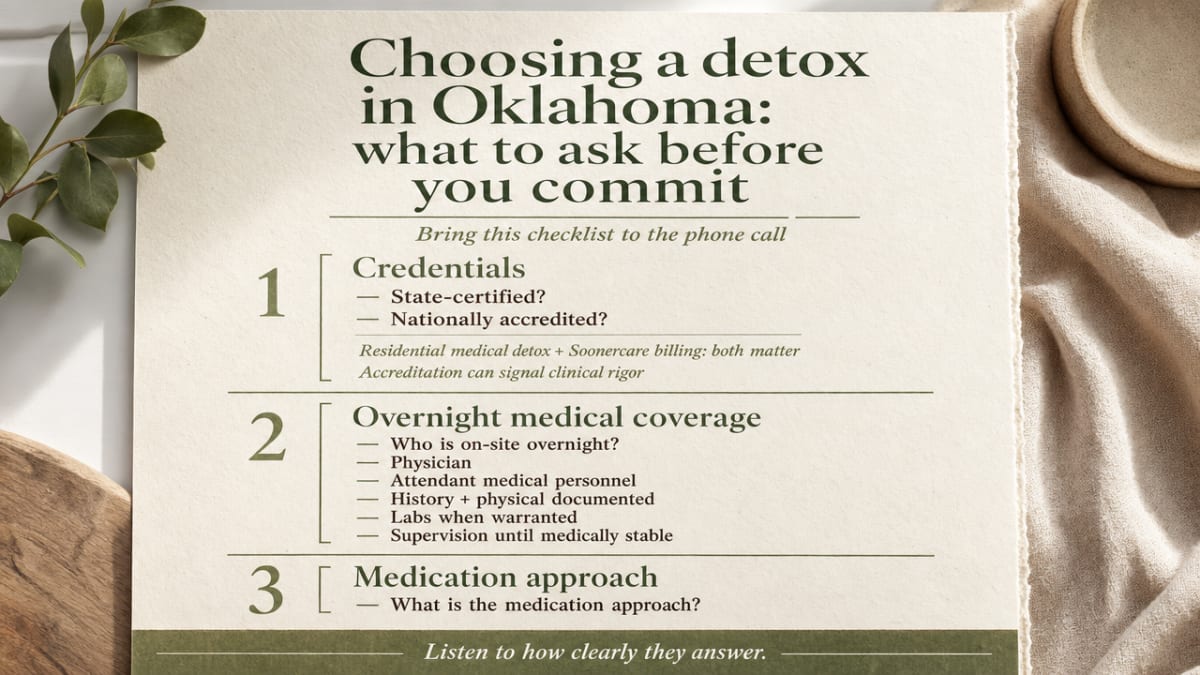
Ask whether the facility is state-certified and, for residential medical detox, nationally accredited. In Oklahoma, residential medical detox providers need national accreditation on top of state certification to bill Soonercare, and that same accreditation is a reasonable signal of clinical rigor for anyone else too 2. Ask who is on-site overnight. Medical withdrawal management in Oklahoma requires a physician, attendant medical personnel, a documented history and physical, labs when warranted, and supervision until you are medically stable — every one of those is a fair thing to confirm out loud 4.
Ask what the medication approach looks like for your specific substance. A good answer sounds specific: symptom-triggered protocols for alcohol, methadone or buprenorphine with adjunctive medications for opioids, a supervised taper for benzodiazepines 7, 11. A vague answer is worth noting.
Ask how discharge gets planned. Who sets up your next appointment? Do they coordinate with residential or outpatient programs? For opioid dependence especially, ask whether they arrange ongoing medication for opioid use disorder before you leave — detox alone is not the recommendation 1.
At Renewal Springs, the intake line is answered 24/7, and asking questions does not put you on a list. Call. Ask everything above. If the answers feel steady and specific, that is your signal.
Speak with a real person, right now
Get answers about the detox process and feel supported before you make any decisions.
Frequently Asked Questions
How long does medical detox usually last?
There is no fixed number of days. Detox lasts until your withdrawal has actually resolved, which is what clinical guidelines specifically recommend as the discharge marker rather than a set schedule 7. For most people, that lands in a short window of several days, longer for benzodiazepines because a supervised taper takes time 11. Ask your intake coordinator for a realistic estimate based on your history — they will give you a range, not a promise.
Will I be judged when I call to ask about detox?
No. Intake coordinators do this every day and have heard every version of the story. They are not scoring you or reporting you. The call is confidential, and it does not commit you to admitting. You can ask about insurance, timing, what to bring, whether your job situation works — anything. At Renewal Springs, the phone line runs 24/7 for exactly this reason: the moment you decide to ask is not always daytime.
Do I have to go inpatient, or can I detox at home with medical support?
It depends on your history. Evidence reviewed for the 2024 Canadian alcohol use disorder guidelines found that for most patients, withdrawal management can be provided safely in an outpatient setting 14. But if you have had a withdrawal seizure or DTs, use benzodiazepines long-term, are pregnant, or lack a sober person at home, inpatient is the safer call 11. Call and describe your situation honestly. The intake team will tell you which setting fits.
What medications might be used during detox?
It depends on the substance. For alcohol withdrawal, benzodiazepines are the mainstay, usually given on a symptom-triggered protocol alongside thiamine and fluids 8. For opioid withdrawal, medication management is most often achieved with methadone plus adjunctive medications for nausea, aches, and sleep, with buprenorphine also commonly used 11. For benzodiazepines, the team uses a controlled taper — quitting cold turkey is not safe 11. The doctor confirms your specific plan after the assessment.
Is it dangerous to detox from alcohol or benzodiazepines on my own?
Yes, and this one is worth taking seriously. Benzodiazepine withdrawal is explicitly not recommended without medical supervision because it can trigger seizures 11. Heavy daily alcohol use carries similar risks — seizures, delirium tremens, and complications that need trained eyes and medication ready. Hospital guidelines call for screening every adult inpatient for alcohol withdrawal risk and treating symptoms as they climb 7. If you have been drinking heavily every day or taking benzos long-term, call before you stop.
What happens after detox is over?
Detox is Phase 1 — evaluation, stabilization, and readiness for the next level of care 12. What comes after depends on you: residential treatment, intensive outpatient, therapy, sober living, or ongoing medication for opioid use disorder. For opioid dependence, the CDC is clear that detox alone is not recommended, because relapse and overdose risk climbs once tolerance drops 1. At Renewal Springs, the discharge planner sets up your next appointments before you leave, not on the way out.
References
- Opioid Use Disorder: Treating | Overdose Prevention. https://www.cdc.gov/overdose-prevention/hcp/clinical-care/opioid-use-disorder-treating.html
- Provider Certification – Oklahoma.gov. https://oklahoma.gov/odmhsas/policy/provider-certification.html
- Administrative Rules – Chapter 18 Effective 11-16-20. https://oklahoma.gov/content/dam/ok/en/odmhsas/documents/policy/provider-certification/administrative-rules/2020/AdminRules-Chapter18–11-16-20.pdf
- Okla. Admin. Code § 450:18-1-2 – Definitions. https://www.law.cornell.edu/regulations/oklahoma/OAC-450-18-1-2
- Okla. Admin. Code § 450:24-3-64 – Ambulatory withdrawal management without extended on-site monitoring environment. https://www.law.cornell.edu/regulations/oklahoma/OAC-450-24-3-64
- Okla. Admin. Code § 450:24-3-61 – Withdrawal management services. https://www.law.cornell.edu/regulations/oklahoma/OAC-450-24-3-61
- Alcohol Withdrawal in Hospitalized Patients – NCBI Bookshelf – NIH. https://www.ncbi.nlm.nih.gov/books/NBK604324/
- Clinical management of alcohol withdrawal: A systematic review. https://pmc.ncbi.nlm.nih.gov/articles/PMC4085800/
- Executive Summary of the American Society of Addiction Medicine Clinical Practice Guideline on Alcohol Withdrawal Management. https://pubmed.ncbi.nlm.nih.gov/32909985/
- Clinical guideline highlights for the hospitalist: 2020 American Society of Addiction Medicine clinical practice guideline on alcohol withdrawal management. https://pubmed.ncbi.nlm.nih.gov/34910619/
- 4 Physical Detoxification Services for Withdrawal From Specific Substances – NCBI. https://www.ncbi.nlm.nih.gov/books/NBK64116/
- 1 Overview, Essential Concepts, and Definitions in Detoxification. https://www.ncbi.nlm.nih.gov/books/NBK64119/
- Withdrawal Management – NCBI – NIH. https://www.ncbi.nlm.nih.gov/books/NBK310652/
- Summary of Evidence – Inpatient and Outpatient Treatment of Alcohol Use Disorder: A Review of the Research for the 2024 Canadian Guidelines on Alcohol Use Disorder. https://www.ncbi.nlm.nih.gov/books/NBK507689/
- Management of Acute Withdrawal and Detoxification for Adults who Present to an Emergency Department. https://www.ncbi.nlm.nih.gov/books/NBK545066/