Key Takeaways
- Returning to detox in Oklahoma City is treated as a medical event, not a moral failing — clinical intake focuses on what you used and when, so dosing stays safe 12.
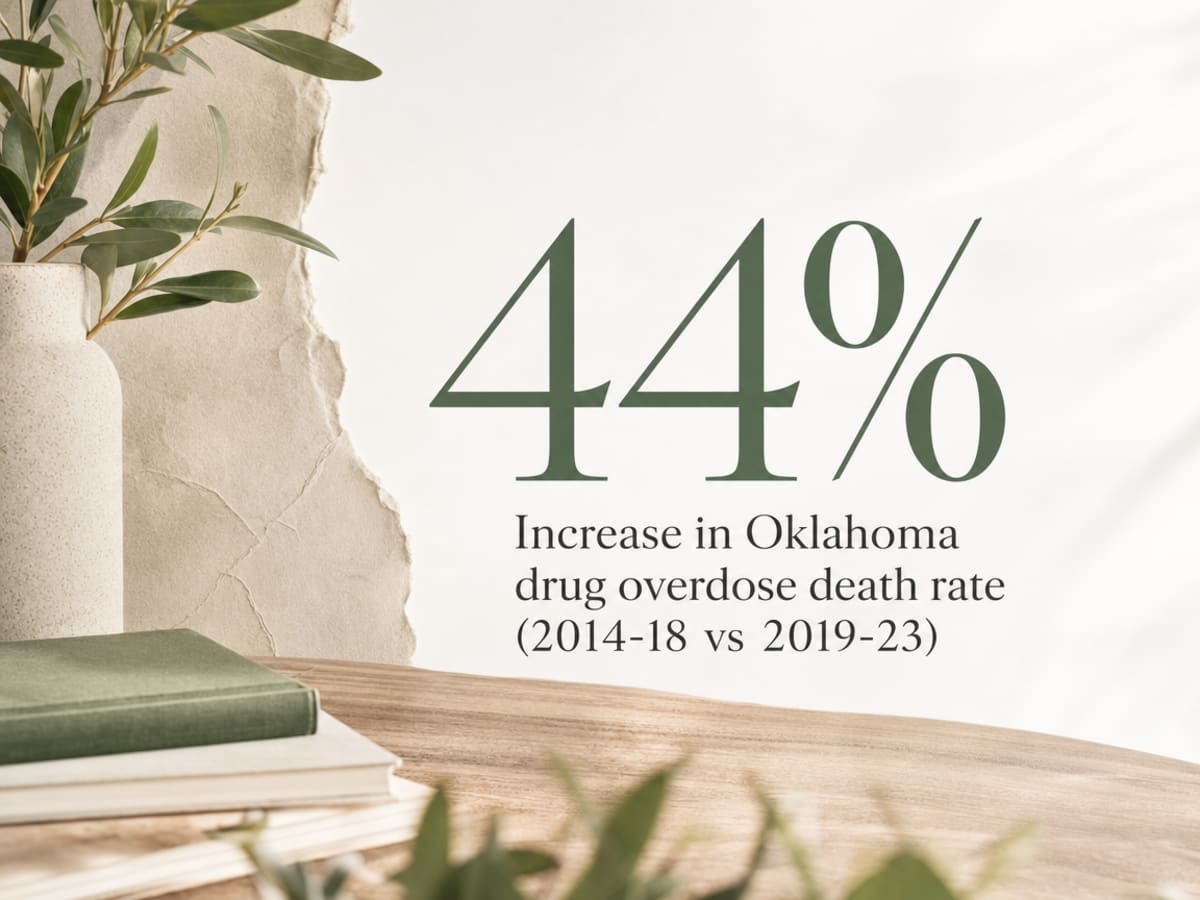
- Local risk has shifted underneath returning patients: fentanyl overdose deaths in Oklahoma jumped 14-fold from 2019 to 2023, and dropped tolerance makes waiting until Monday genuinely dangerous 2, 6.
- Medical detox with MAT, wearable monitoring, and private or veteran-specific rooms addresses withdrawal more safely than an ER visit or toughing it out at home, where alcohol and benzo withdrawal can trigger seizures 13.
- Before choosing where to go, compare whether the facility offers guideline-based withdrawal medications, continuing-care handoff, insurance verification, and language that treats a setback as clinical information rather than a verdict 12, 10.
The 2 a.m. Phone Call You’ve Made Before
It’s late. The house is quiet. Your phone is in your hand and the number is already in your contacts, because you called it once before — maybe six months ago, maybe two years ago, maybe last spring when the dogwoods were blooming on Classen. You know exactly what to say. You just can’t make your thumb move.
You used again.
And now you’re sitting there running the same math everyone runs at this hour: What will they think of me? Do I have to explain the whole story? Will someone recognize my voice? Is it worse to call, or worse to wait until morning and pretend this didn’t happen?
Here is what you need to hear first, before any of the clinical detail that comes later in this piece. Coming back is not starting over. It’s not a reset. It’s not a failure of will. Relapse rates for substance use disorders sit in the same range as relapse rates for other chronic medical conditions like hypertension and diabetes, and a return to use does not mean treatment failed 6. It means the condition is doing what chronic conditions do, and you noticed early enough to pick up the phone.
You’re not starting over. You’re starting again. And you don’t have to do it alone.
The rest of this page is for the part of you that needs to know what happens next — medically, physically, and practically — when you walk back through the door.
Relapse Is a Medical Event, Not a Verdict
Here is the part your brain keeps skipping past at 2 a.m.: what happened to you has a clinical name, a research literature, and a treatment pathway. It is not a referendum on who you are as a partner, a parent, a coworker, or a veteran. Substance use disorder is a chronic, treatable medical condition, and the return of symptoms — including a return to use — is a feature of chronic conditions, not proof that you were fake-recovering the whole time 10.
If you had diabetes and your blood sugar spiked after a hard month, you would not sit on the kitchen floor deciding whether you deserve insulin. You would call. This is the same call.
The National Institute on Drug Abuse puts it plainly: relapse rates for substance use disorders sit in the same range as relapse rates for hypertension and asthma, and a return to use does not mean treatment failed. It means the treatment plan needs to be adjusted, resumed, or intensified 6. Some clinicians and researchers have started arguing that the word “relapse” itself carries too much moral weight, and suggest neutral language like “setback” or “recurrence” — not to soften the seriousness, but to keep shame from doing more damage than the drug did 7.
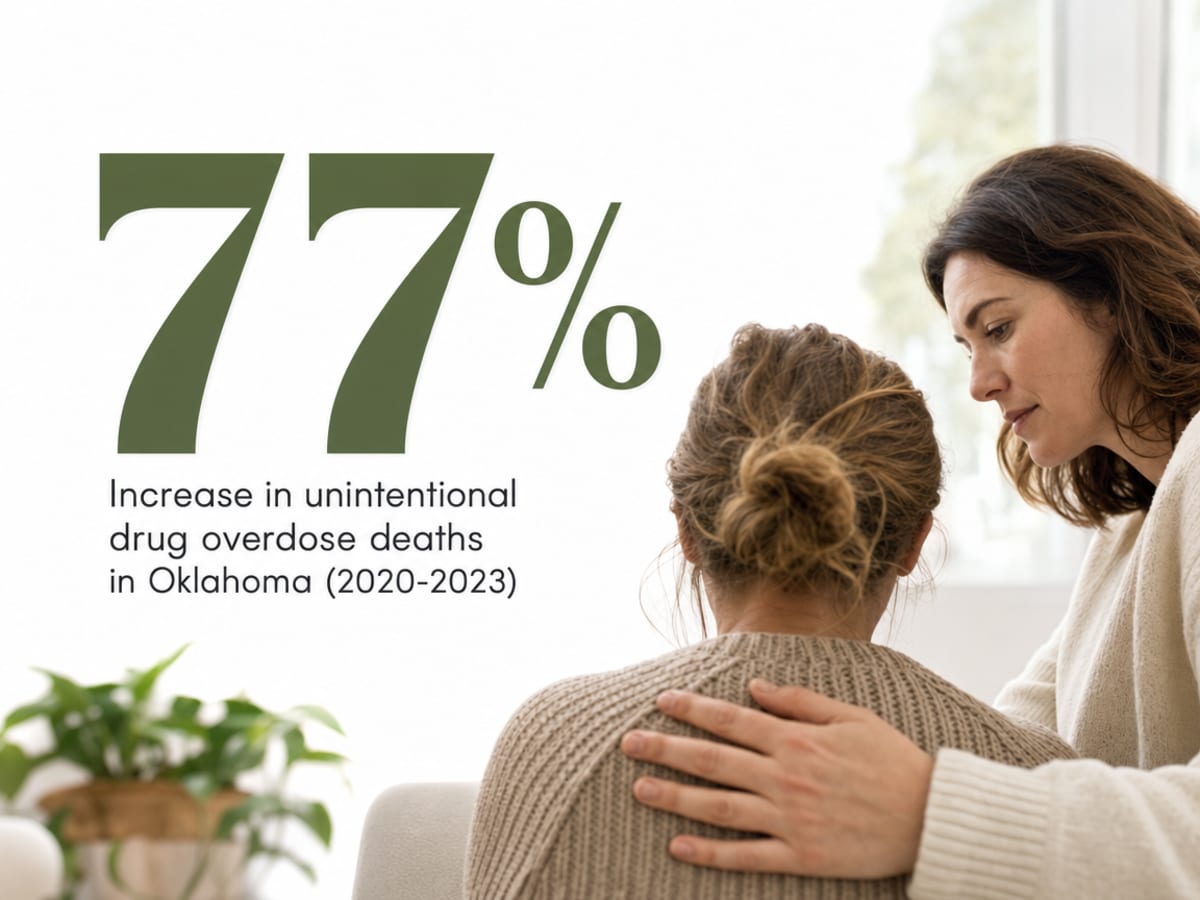
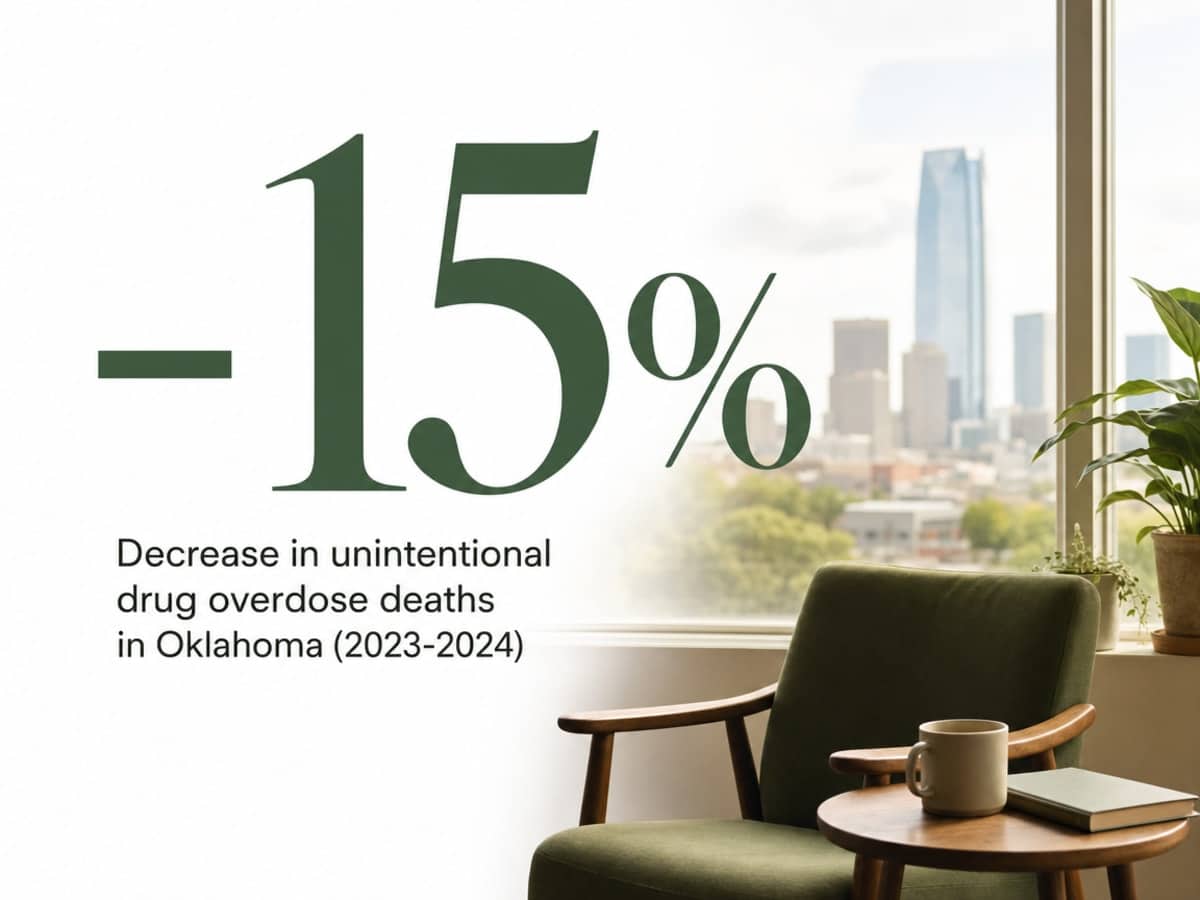
The local picture matters here too, because your risk environment is not theoretical. Oklahoma’s unintentional drug overdose death rate climbed 77% between 2020 and 2023 before dropping 15% from 2023 to 2024 1. That decline is real and it is fragile. It reflects more naloxone in more hands, more people getting to detox, more MAT prescriptions written — and it depends on people like you making the call instead of waiting until Monday.
You are not a statistic on either end of that curve. You are a person whose condition flared. That is a medical event. What comes next is medicine, not penance.
Why Shame Is a Clinical Risk Factor, Not a Character Flaw
Shame is not just an unpleasant feeling that comes with relapse. It is a variable clinicians can measure, and it changes outcomes.
In one study of people with alcohol use disorder, nonverbal shame behaviors — the slumped shoulders, the averted eyes, the physical wanting-to-disappear that you might be doing right now on your couch — predicted both the likelihood of relapse and how severe that relapse would be 9. Researchers were watching bodies, not asking people to rate their guilt on a scale, and the bodies told the story before the mouths did. Shame was not a consequence of relapse. It was a leading indicator of the next one.
NIDA describes the mechanism directly: people with substance use disorders often carry self-stigma, and those feelings of shame and isolation reinforce drug-seeking behavior 10. Read that again. The feeling you are having right now — the one telling you that you are the problem, that you are beyond help, that everyone is going to be disappointed — is chemically and behaviorally pushing you toward the exact thing you are trying to stop.
Review after review has landed on the same point: stigma is a major barrier to treatment, and the internalized version is often the loudest voice in the room 17. One analysis put it bluntly — addiction is commonly accompanied by shame, and people sometimes keep using specifically to escape the shame of using 8. It’s a loop, and shame is what keeps it spinning.
This is why the language matters. Some clinicians have started replacing “relapse” with words like “setback” or “recurrence,” not to soften the medical seriousness but to stop stacking moral weight on a chronic condition 7. When you say to yourself, “I had a setback” instead of “I relapsed,” you are not making excuses. You are lowering the physiological volume of shame so the part of your brain that knows how to call for help can hear itself think.
The Oklahoma City Overdose Reality Nobody Told You About
Nobody sat you down when you left detox last time and said the drug supply that almost killed you before is not the same drug supply waiting for you now. But it isn’t. And this is the part where being honest with you matters more than being gentle.
Fentanyl overdose deaths in Oklahoma went from 50 in 2019 to 730 in 2023 — a 14-fold increase over four years 2. That is not a slow drift. That is the entire risk landscape underneath your feet shifting while you were doing the hard work of staying in recovery. The pill you took last night, the powder someone handed you at a party off Western, the baggie that looked like what you used to buy — none of it is what it looks like anymore. Even meth and cocaine in the OKC supply have been showing up cut with fentanyl, which means people who never intended to touch an opioid are ending up in emergency rooms.
Here is what that means for you specifically, tonight. NIDA warns that using the same amount you used to use, after any period of not using, can cause overdose because your body is no longer adapted to it 6. Your tolerance dropped. The supply got more potent. Those two facts are pointed at each other, and you are standing between them.
This is not a scare tactic. This is the reason the phone call cannot wait until Monday. The 15% decrease in Oklahoma overdose deaths from 2023 to 2024 that you may have seen in the news is real progress 1, but it is built on people getting to detox this week, not next week. It is built on calls exactly like the one you are trying to make.
You did not do anything wrong by having a lower tolerance. You did something right. The problem is that the market changed in the meantime, and the version of the drug you knew is not the version that exists now. That is not a moral situation. That is a pharmacology situation, and it has a medical answer.
The answer is a monitored bed, a clinician who can dose you appropriately, and someone watching your vitals while your body works through this. Not a friend’s couch. Not the parking lot behind an urgent care. A bed, tonight or tomorrow, with people who have done this a thousand times and are not going to make you feel small for needing it.
What Walking Back Into Detox Actually Looks Like
The First Hour: Intake Without the Lecture
You will not be asked to explain yourself in the driveway. You will not be handed a clipboard and told to justify what happened. The first hour at Renewal Springs is designed to be the opposite of what your brain is bracing for.
Someone opens the door. You give your name. If you have been a patient before, your chart is already there — the meds that worked last time, the ones that didn’t, your allergies, the notes from the nurse who liked you. You do not have to reintroduce yourself as a stranger to your own history.
A licensed medical professional will sit down with you and ask what you used, how much, and when. That is not a moral inventory. That is a clinical intake, and every answer changes the next decision — which withdrawal medication is safe to give you, how soon, and at what dose. SAMHSA’s TIP 45 is explicit that medically supervised withdrawal management for alcohol, opioids, and benzodiazepines requires exactly this kind of specific, honest information at the front door 12. Vague answers get vague care. Truthful answers get you dosed correctly.
Nobody will call what happened a relapse if you don’t want them to. Some of the intake staff will say “setback” or “return to use” because the clinical literature has been moving that direction for a reason 7. You get to pick the word you can stand to hear.
Hours 6 to 72: MAT, Monitoring, and the Wearable on Your Wrist
The first three days are where the medicine does most of its work, and where medical detox stops looking anything like what people imagine from movies.
If you came in on opioids — fentanyl, heroin, pills — a physician will talk with you about medication-assisted treatment. Buprenorphine, methadone, or naltrexone-based protocols each have a role, and the choice depends on what you used, when you last used, and what your history with MAT has been. Pharmacologic detox from opioids is standard of care, and it exists specifically so you do not have to white-knuckle withdrawal on a bathroom floor 13. If alcohol brought you in, benzodiazepines like chlordiazepoxide are the guideline-supported way to reduce withdrawal severity and prevent seizures or delirium tremens 13. Benzo withdrawal itself gets a careful, slow taper — never a cold stop — because that’s what the evidence supports.
While the medication is doing its job, something is happening in the background you may not have experienced before. A Huml Health wearable sits on your wrist and streams your vitals, sleep quality, and stress signals to the nursing station in real time. It is how the team catches a heart rate climbing before you feel your chest tighten, or notices you haven’t reached deep sleep in 20 hours. You are not being watched. You are being monitored — the distinction matters.
Somewhere around hour 24 you will probably eat a real meal for the first time in longer than you want to admit. Somewhere around hour 48 you will sleep. By hour 72 the acute physical part is usually behind you, and the conversation shifts to what comes next. SAMHSA is clear that detox is the first step, not the whole treatment 12, and the team will start planning your handoff to residential, outpatient, or MAT-based continuing care while you are still comfortable enough to think clearly about it.
Private Rooms, Veteran Tracks, and Gender-Specific Care
The room you sleep in matters more than the brochures suggest. If you have been in shared-bay detox before — bright lights, someone crying two beds over, no door — you already know why.
Renewal Springs offers private rooms, and for many people that alone changes whether they stay through the hardest 48 hours or leave against medical advice. Private care is not a luxury flourish. It is a way to lower the sensory load while your nervous system is renegotiating with itself.
If you are a veteran, the veteran track exists because a detox that ignores what your service asked of you is a detox that misses half the picture. Co-occurring PTSD, chronic pain from injury, and moral injury are not side issues — TIP 42 stresses that recovery from substance use is a long-term process that requires continuity of care across both the substance use and the mental health side 18. Your intake will reflect that.
Men’s and women’s tracks give you a room and a peer group where you do not have to perform, protect, or shrink. For survivors of trauma, that separation is not preference. It is clinical.
Why Medical Detox Beats the ER or Toughing It Out at Home
Here is the practical version of a decision you may already be making: is this a call to a detox facility, a drive to the ER, or a bad idea involving Gatorade and a locked bathroom door?
The ER is built to keep you alive through an acute crisis. It is not built to walk you through 72 hours of opioid or alcohol withdrawal with the right medication at the right dose at the right time. And the scale of what ER-driven care looks like in this state is not small. From 2021 to 2023, 12,969 Oklahomans were hospitalized for nonfatal drug overdose, with total inpatient costs of $553 million and an average stay of 4.7 days 3. Those are your neighbors — people whose withdrawal or overdose escalated to the point that a hospital bed became the only option left.
Toughing it out at home is the other version of the same math, and it fails for reasons that are chemical, not motivational. Alcohol withdrawal without medical support can cause seizures and delirium tremens; the guideline-supported answer is a benzodiazepine taper like chlordiazepoxide, delivered under supervision 13. Benzo withdrawal on your own is dangerous for the same reasons — cold stops can trigger seizures. Opioid withdrawal is rarely fatal on its own, but the vomiting, dehydration, and sheer physical misery drive most people back to using within hours, often at a dose their body can no longer handle safely 6.
Medical detox is the setting where the medicine, the monitoring, and the handoff to continuing care all happen in the same building. SAMHSA’s TIP 45 is direct on this point: detoxification is the first step in treatment, and its value depends on being linked to what comes after, not standing alone in an ER discharge summary 12. A bed at Renewal Springs is not a nicer version of an ER. It is a different kind of care, aimed at a different outcome.
How to Talk About What Happened Without Burning Down Your Life
You are going to have to tell someone. Maybe your partner, maybe your sponsor, maybe the boss who needs to know why you’re taking a week. The version of the story you tell in the next 48 hours will shape how the next 48 days go, so it is worth thinking about the words before you use them.
Try this: “I had a setback. I’m going back to detox.” That’s it. That’s the sentence. You do not owe anyone a forensic breakdown of what you used, how much, or the exact chain of decisions that got you here. The clinical literature has been moving toward language like “setback” and “recurrence” specifically because the older vocabulary loads a chronic medical event with moral weight it cannot carry 7. Person-first phrasing — “I’m a person with a substance use disorder who had a setback” rather than “I’m an addict who relapsed” — is what NIDA and SAMHSA recommend, and not as a semantic favor to you 10, 16. It changes how the person hearing you responds, which changes what you can ask them for next.
Some people in your life will react well. Some will not. The ones who spiral — who cry, who get angry, who need you to manage their feelings about your medical event — are not the ones to call first. Call the person who can drive you, or watch the kids, or feed the dog. Save the harder conversations for after intake, when you have a treatment plan to hand them instead of just a crisis.
You do not have to burn your life down to be honest. You just have to be honest enough to get to the bed.
Planning the Days After Detox in the Neighborhoods You Actually Live In
Detox works because it’s a controlled environment. The days after work because you plan for the environment you actually live in — not a hypothetical one where every trigger has been erased from Oklahoma City.
SAMHSA’s discharge guidance is direct about this: before you leave, you register for the next level of care, and you map the specific people and places that could pull you back 15. That means naming them out loud with your case manager. The bar on NW 23rd where you used to close out Fridays. The friend in the Paseo who always has something. The stretch of I-40 you drive home on that takes you past two dealers. These are not moral failures to admit; they are coordinates on a map, and the map is the plan.
Then you build the replacement routes. A different way home from work that skips the Asian District exit. A coffee shop in Uptown 23rd instead of the patio in Bricktown. A gym, a church, a NA meeting in Nichols Hills, a standing Tuesday call with your sponsor — something that fills the hour you used to fill with using.
The clinical literature calls this identifying high-risk situations and building coping strategies around them, often paired with continuing MAT 14. TIP 42 adds that if you’re also managing depression, PTSD, or anxiety, the mental health side gets a plan too — not later, now 18. Your discharge paperwork should name your outpatient provider, your MAT prescriber, and your first appointment date before you walk out the door 12.
A Script for Making the Call Again
You do not need a speech. You need one sentence, and then you need to breathe while somebody on the other end takes it from there.
Try this: “Hi. I’m a former patient. I had a setback and I need to come back in.”
That’s the whole call. You do not have to name the drug in the first sentence. You do not have to say how much, or when, or why. The intake nurse will ask, because they need clinical information to keep you safe 12, and you can answer plainly when they do. “Fentanyl. Last night. I don’t know how much.” That is enough. SAMHSA’s own guidance on responding to a return to use is built around exactly this kind of direct, low-shame contact — call, name what happened, get to care 11.
If your voice cracks, that’s fine. If you cry, that’s fine. If you have to hang up and call back in ten minutes, that’s fine too. They’ve heard all of it.
You are starting again. You are not starting over alone.
Ready to reach out after a relapse?
Connect with someone who understands and can help you start again, without judgment, whenever you’re ready.
Frequently Asked Questions
Will the staff judge me for coming back to detox after a relapse?
No. Coming back is common enough that the intake team treats it as clinical information, not a character report. Substance use disorder is a chronic, treatable condition, and a return to use signals the treatment plan needs adjusting — not that you failed 6. NIDA and SAMHSA guidance actively push staff toward person-first, nonjudgmental language for exactly this reason 10, 16.
Is it medically safe to detox again so soon after using?
Yes, and it is safer than the alternatives. Medically supervised withdrawal management exists specifically for repeated episodes of use, especially with alcohol, opioids, and benzodiazepines where unsupervised withdrawal can cause seizures or dangerous rebound 12. Your prior chart actually helps — the clinicians dosing you know what worked before. Waiting is riskier than returning, particularly because tolerance drops during any period of not using 6.
What withdrawal medications are available during medical detox?
For opioid withdrawal, buprenorphine, methadone, and naltrexone-based protocols are all standard options, chosen based on your history and last use 13. Alcohol withdrawal is typically managed with a benzodiazepine taper like chlordiazepoxide to prevent seizures and delirium tremens 13. Benzodiazepine dependence itself requires a careful, slow taper — never a cold stop. Stimulant and kratom detox use symptom-targeted medications rather than a single primary agent.
How long will I stay in detox this time?
Most medical detox stays run three to seven days, with the acute physical withdrawal usually peaking and easing within the first 72 hours. Your length depends on the substance, how much you used, your health history, and how withdrawal actually unfolds under monitoring. SAMHSA is clear that detox is only the first step — the more useful question is what continuing care you’ll be linked to before discharge 12.
What should I say when I call if I’ve been a patient before?
One sentence is enough: “I’m a former patient. I had a setback and I need to come back in.” The intake nurse will take it from there and ask the clinical questions they need to keep you safe 12. You do not have to explain the full story on the phone. SAMHSA guidance for returns to use is built around exactly this kind of direct, low-shame contact 11.
Does my insurance cover detox after a relapse?
Most major insurance plans cover medically supervised detox, and a prior admission does not disqualify you from coverage for a return visit. Renewal Springs offers free benefits verification, which means someone on staff runs your plan and tells you what’s covered before you commit to anything. Ask for a benefits check when you call — it takes minutes and removes the financial unknown from a decision you’re already carrying enough weight on.
References
- Data – Oklahoma.gov (Drug Overdose). https://oklahoma.gov/health/health-education/injury-prevention-service/drug-overdose/data.html
- Drug Overdose Deaths, 2019–2023 – Oklahoma.gov Fact Sheet. https://oklahoma.gov/content/dam/ok/en/health/health2/aem-documents/prevention-and-preparedness/injury-prevention/drug-overdose/2025%20State%20Drug%20OD%20-%20IPS%20-%20Fact%20Sheet.pdf
- Oklahoma Drug Overdose Deaths, 2019–2023 – Nonfatal Hospitalizations. https://digitalprairie.ok.gov/digital/collection/stgovpub/id/729608/
- Drug Overdose Data Dashboard – Oklahoma.gov. https://oklahoma.gov/health/health-education/injury-prevention-service/drug-overdose/data/drug-overdose-data-dashboard.html
- Changes in Drug Overdose Mortality and Selected Characteristics, 2022–2023. https://www.cdc.gov/nchs/data/hestat/drug-overdose/drug-overdose-2022-2023.htm
- Treatment and Recovery | National Institute on Drug Abuse. https://nida.nih.gov/publications/drugs-brains-behavior-science-addiction/treatment-recovery
- Relapse on the Road to Recovery: Learning the Lessons of Failure on the Pathway to Change. https://pmc.ncbi.nlm.nih.gov/articles/PMC9014843/
- Stigma and Self-Stigma in Addiction. https://pmc.ncbi.nlm.nih.gov/articles/PMC5527047/
- The Association Between Perceived Stigma and Substance Use Disorder Treatment Outcomes. https://pmc.ncbi.nlm.nih.gov/articles/PMC6311321/
- Stigma and Discrimination | NIDA. https://nida.nih.gov/research-topics/stigma-discrimination
- SAMHSA TIP 35: Enhancing Motivation for Change in Substance Use Disorder Treatment. https://library.samhsa.gov/sites/default/files/tip-35-pep19-02-01-003.pdf
- Detoxification and Substance Abuse Treatment (TIP 45). https://www.ncbi.nlm.nih.gov/books/NBK64115/
- Pharmacological Strategies for Detoxification. https://pmc.ncbi.nlm.nih.gov/articles/PMC4014033/
- Addiction Relapse Prevention – StatPearls. https://www.ncbi.nlm.nih.gov/books/NBK551500/
- The Next Step Toward a Better Life (Detox Discharge Planning Pamphlet). https://library.samhsa.gov/sites/default/files/sma14-4813viet.pdf
- Countering Discrimination and Improving Recovery Supports Across the Criminal Legal System. https://library.samhsa.gov/sites/default/files/countering-discrimination-pep24-08-008.pdf
- Stigma and Substance Use Disorders: A Clinical, Research, and Advocacy Agenda. https://pmc.ncbi.nlm.nih.gov/articles/PMC8168446/
- Substance Abuse Treatment for Persons With Co-Occurring Disorders (TIP 42). https://www.ncbi.nlm.nih.gov/books/NBK207276/