
Key Takeaways
- In Oklahoma City, self-pay detox is often a deliberate choice for privacy, speed, or high-deductible math, not a fallback for people without insurance coverage.
- Federal rules give self-pay patients a written Good Faith Estimate before admission, delivered within 3 business days, with dispute rights if the final bill exceeds it by $400 or more within 120 days 7.
- Oklahoma’s public treatment network spans 70 facilities across all 77 counties 10, while the state’s Hospital Discount Act caps hospital charges for qualifying self-pay patients but does not govern freestanding programs 5.
- Before committing, compare what the estimate includes, accepted payment methods, admission timing, whether the program is hospital-affiliated, and available payment plans, HSA/FSA use, or family contribution options.
Why People in Oklahoma City Choose to Pay for Detox Directly
If you’re reading this at 2 a.m. with a phone in your hand, you’re not alone in wondering whether to use your insurance or pay for detox yourself. That question stops a lot of people from making the call at all. It shouldn’t.
Self-pay is not what most people assume. It isn’t a fallback for someone whose insurance card got declined. In Oklahoma City, plenty of people who could bill a plan choose not to — and their reasons are practical, not desperate.
Some are on a high-deductible plan where the first several thousand dollars come out of pocket anyway, so billing insurance mostly means paperwork without savings. Others have out-of-network plans that would technically cover detox but at reimbursement rates that make self-pay the cleaner path. A veteran worried about how a claim might interact with a security clearance review, a nurse thinking about license reporting, a parent in the middle of a custody matter — each has a real reason to keep the admission off an insurance record. Privacy is a legitimate clinical concern, not a suspicious one.
There’s also a speed factor. Insurance verification, prior authorization, and utilization review can add hours or days to an admission. When you’re deciding whether to detox from opioids this afternoon or wait until Monday, those hours matter.
Federal law backs you up on cost transparency here. If you’re uninsured or choosing not to bill insurance, you have the right to a written Good Faith Estimate before you say yes to care 1. That right exists specifically so the money conversation doesn’t feel like a leap of faith.
Choosing self-pay is a decision, not a compromise. The rest of this guide walks through what that decision actually looks like when you pick up the phone.
What Self-Pay Actually Means (and What It Doesn’t)
The Definition Admissions Staff Use
When admissions staff say “self-pay,” they mean something specific, and it’s worth knowing before you call.
Federal guidance defines a self-pay individual as someone who either has no insurance or has coverage but is choosing not to bill it for this particular service 8. That second half matters. You can have a Blue Cross card in your wallet and still be a self-pay patient at admission if you tell the facility you’d rather not use it. The choice is yours to make, and admissions staff are trained to treat both categories the same way.
That designation is not just a billing label. It triggers a specific set of federal obligations from the provider — most importantly, the right to a written Good Faith Estimate of your expected charges before care begins 6. So when you say “I’d like to be self-pay,” you’re not opting out of protections. You’re opting into a different set of them.
Admissions won’t ask you to justify the choice. They’ll note it, confirm it, and move on to the clinical questions.
Reasons People Deliberately Keep Detox Off Their Insurance
The reasons people choose self-pay for detox are usually more practical than dramatic.
Privacy sits at the top of the list for a lot of callers. A veteran going through a security clearance review, a nurse thinking about state board reporting requirements, a commercial pilot weighing FAA disclosure rules, a parent in the middle of a custody hearing — each has real professional or legal reasons to keep a substance use diagnosis out of their insurance record. The claim itself creates a paper trail that lives outside the facility’s walls. Self-pay keeps the clinical record where it belongs: with your provider.
Then there’s the deductible math. If you’re on a high-deductible plan and haven’t touched it this year, billing insurance mostly means paying the same money through a longer channel. Some out-of-network plans reimburse so little that the paperwork isn’t worth the return.
Speed is the third driver. Insurance verification, prior authorization, and utilization review can add hours or days between your call and your admission. When you’re deciding whether to detox from fentanyl tonight or try to hang on until Friday, that gap is not abstract.
The federal framework treats self-pay as a legitimate path, not a workaround. You are entitled to the same written cost disclosure and dispute rights whether you’re uninsured or simply choosing not to bill a plan you have 1. The admissions conversation reflects that: different documents requested, different timeline, different privacy handling — same clinical care on the other side of the door.
What Self-Pay Is Not
A few myths tend to travel with the phrase, and they keep people from calling.
Self-pay is not cash-only. Facilities accept credit cards, debit cards, HSA and FSA accounts, personal checks, and in many cases a card on file with a payment plan. The word “pay” in self-pay just means you — not an insurer — are the party responsible for the charges.
Self-pay is not a signal of lower-quality care. The clinical protocol, the medical staffing, the withdrawal monitoring, the medications used to manage symptoms — none of that changes based on how the bill gets settled. Admissions staff are not sorting patients into faster or slower lanes by payment type.
Self-pay is not permanent. Some patients choose self-pay at admission for privacy or speed and later submit their itemized bill to insurance for possible out-of-network reimbursement. That’s a separate conversation with your carrier, not a decision that has to be made at the front door.
And self-pay is not a judgment on your finances. Plenty of people who choose it have insurance sitting right there in their wallet.
The Federal Rights That Govern Your Cost Conversation
The Good Faith Estimate: Your Written Number Before You Say Yes
Talking about money when you’re already scared is hard. The federal Good Faith Estimate, or GFE, is designed to make that part shorter and clearer.
Here’s what it is in plain terms: a written document that lists the expected charges for the care you’re about to receive, given to you before you agree to anything. It applies specifically to people who are uninsured or who are choosing not to bill their insurance for a given service 6. Detox admissions fall squarely inside that category.
The estimate has to include the diagnosis codes, service codes, and expected charges for each item or service you’re likely to receive during your stay 3. That means you’re not looking at a single mystery number. You’re looking at a line-item picture of what you’re being asked to pay for.
One important thing to know: the GFE is not a contract 7. It’s the facility’s best written prediction, not a locked-in bill. Your care can shift if your clinical picture changes — a longer taper, an added medication, a medical complication. But the estimate gives you a written baseline you can hold onto, ask questions about, and dispute later if the final bill lands far above it.
You don’t have to earn this document by being polite or pushing hard. It’s yours by right, and admissions staff at any compliant facility already know that.
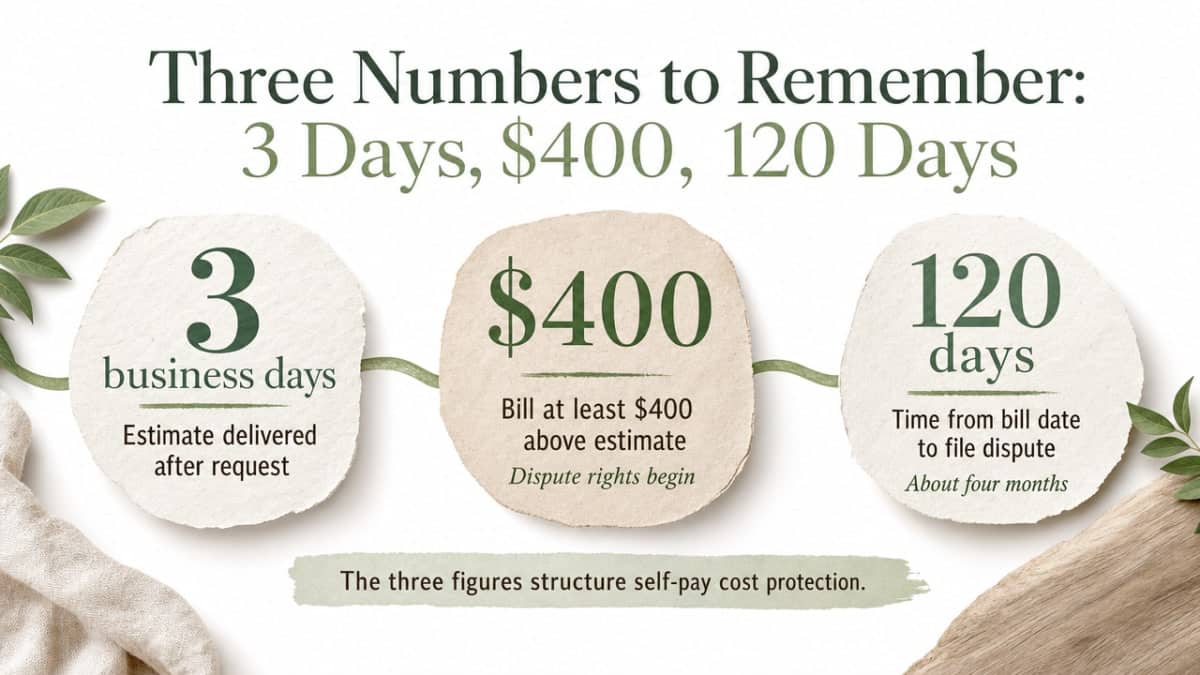
Three Numbers to Remember: 3 Days, $400, 120 Days
If you remember nothing else from this article, remember these three figures. They’re the whole architecture of your cost protection as a self-pay patient.
3 business days. When you request a Good Faith Estimate, the facility has to deliver it within three business days 7. That’s the outside window. For a scheduled admission, you should have the written number in hand well before you show up at the door.
$400. This is the threshold that unlocks your dispute rights. If your final bill comes in at least $400 higher than the estimate you were given, you can formally challenge it through a federal patient-provider dispute resolution process 7. Not negotiate quietly. Dispute, on paper, with federal backing.
120 days. You have 120 days from the date on your bill to file that dispute 7. That’s roughly four months — enough time to finish detox, transition to the next level of care, and still exercise your rights without racing a clock.
These aren’t provider courtesies. They’re federal rules that exist because Congress decided cost surprises after medical care were doing real harm to real people. Screenshot the numbers if it helps. Write them on the same notepad you’re using for the call.
When Detox Is Urgent: How GFE Timing Actually Works
Here’s the honest wrinkle. Most people don’t call a detox facility three business days ahead of when they want to be admitted. They call because today is the day, or tonight is the night, or a family member just walked in on something that can’t wait until Monday.
Federal guidance recognizes that. The three-business-day GFE window applies to services scheduled at least three business days in advance 8. When care is truly urgent and unscheduled — the kind of admission that happens within hours of the phone call — the standard GFE timing doesn’t fit the same way, and CMS acknowledges that emergency and unscheduled care can fall outside normal timing rules 8.
What that means for you in practice: asking for the cost information doesn’t have to slow down the medical care. A good admissions team will still walk you through expected charges verbally at intake, follow up with the written estimate as soon as it’s practical, and answer your questions in real time. You’re not choosing between speed and transparency. You can have both, and you should ask for both.
What Happens When You Call: The Admissions Conversation, Step by Step
Before You Dial: Five Things to Have Within Reach
You don’t need paperwork to make the call. You do need a few things nearby so the conversation moves at your pace instead of stalling on details you have to hunt for.
- A photo ID or the information from one. Driver’s license, state ID, passport — whatever you have. Admissions will ask for basic identifiers.
- A rough list of what you’ve been using. Substance names, how much, how often, and when you last used. Approximate is fine. Nobody expects a spreadsheet.
- Any current medications and known allergies. Prescriptions, over-the-counter, supplements. This shapes the medical plan more than the money conversation.
- An emergency contact. One name and one phone number for someone who can be reached if needed. It does not have to be family.
- A notepad and pen. Write down the intake person’s name, any numbers they quote you, and the questions that come up while you’re talking.
That’s it. Pick up the phone even if you’re missing two of the five.
The First Ten Minutes of the Call
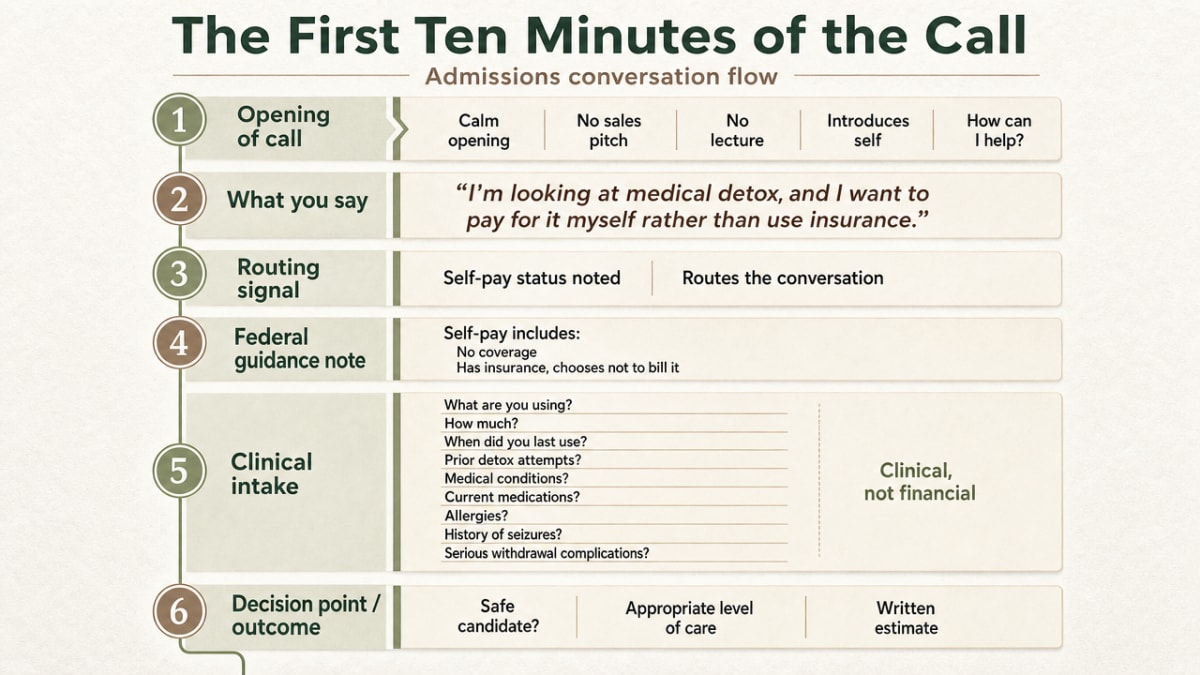
The opening of the call is calmer than most people expect. No sales pitch. No lecture. Someone answers, introduces themselves, and asks how they can help.
You can say it plainly: “I’m looking at medical detox, and I want to pay for it myself rather than use insurance.” That single sentence tells admissions everything they need to route the conversation. They’ll note your self-pay status, which under federal guidance covers both people without coverage and people who have insurance but are choosing not to bill it 8.
From there, the questions are clinical, not financial. What are you using. How much. When did you last use. Any prior detox attempts. Any medical conditions, current medications, or allergies. Any history of seizures or serious withdrawal complications. This is the part that determines whether you’re a safe candidate for their level of care and what your medication plan might look like.
Then comes the money portion. Because you’ve asked to be self-pay, admissions is now obligated to prepare a written Good Faith Estimate of your expected charges 6. They’ll walk you through what the estimate will include, when you’ll receive it, and how payment is typically handled. If you have questions about that document, this is where you ask.
You are not being auditioned. You called. That was the hard part.
Questions You Are Allowed to Ask Back
Admissions calls are two-way. Nobody’s going to hand you a script, so here’s one worth keeping next to the notepad.
- “Can you send me the Good Faith Estimate in writing before I commit?” Yes, they can. The written estimate is your right, not a favor 6.
- “What does the estimate include and what might not be in it?” A compliant estimate lists diagnosis codes, service codes, and expected charges for each item you’re likely to receive 3. Ask specifically about medications, lab work, and any specialty consults.
- “What forms of payment do you accept?” Credit, debit, HSA, FSA, personal check, payment plan — the answer varies by facility, and it’s a fair thing to ask upfront.
- “If my clinical picture changes and the final bill goes higher, what are my options?” A compliant answer will mention that the estimate is not a contract 7and that you retain federal dispute rights if the final bill significantly exceeds the estimate.
- “How quickly can I be admitted?” For urgent situations, this matters more than any other question. Ask directly.
If any answer feels vague or rushed, that’s information too.
Oklahoma-Specific Context That Affects Your Options
The State’s Treatment Landscape and Where Private Detox Fits
It helps to know what surrounds you before you pick a door.
Oklahoma’s public substance use treatment system is not small. Through the Oklahoma Department of Mental Health and Substance Abuse Services, funded treatment and recovery services are delivered at 70 facilities that cover all 77 counties in the state 10. That network handles a wide range of needs, from outpatient counseling to residential care, and it exists so that no county is left without a reachable option.
Private, self-pay detox is a different lane inside that same landscape. It isn’t a replacement for the public system, and it isn’t in competition with it. It’s a separate path chosen by people who want the specific things private admission tends to offer: faster entry, more control over privacy, a smaller census, and no insurance file to open. Some callers try the public system first and find the wait doesn’t match their situation. Others start with private self-pay because they already know that’s the fit.
Knowing both lanes exist matters. If self-pay isn’t right for your circumstances after the cost conversation, the state network is still there. Nobody in Oklahoma is choosing between one facility and no care.
Oklahoma’s Hospital Discount Law for Qualified Self-Pay Patients
Oklahoma has one state-level tool worth knowing about, even though it applies narrowly.
The Hospital Discount for Qualified Self-Pay Patients Act sets a specific rule for hospital-based care in the state: a qualifying family of four at or below 400% of the federal poverty level cannot be charged more than the insured population for their hospital care 5. The idea behind the law is straightforward. Self-pay patients had been getting billed at chargemaster rates that far exceeded what insurers actually paid for the same services. The Act closed that gap for people under the income threshold.
What to do with this information: ask directly. When you call, you can say, “Is this program hospital-affiliated, and if so, does the Oklahoma self-pay discount apply to my situation?” A facility that knows its own structure will answer without a pause. And if the answer is no, that isn’t a red flag — it just tells you which set of rights and disclosures shapes your cost conversation. The federal GFE protections still apply either way.
If Cost Feels Like a Wall: Options Inside the Self-Pay Path
Sometimes the estimate lands and your first thought is, I can’t do this. Sit with that for a second, and then keep reading. There is usually more room in a self-pay conversation than the number on the page suggests.
Payment plans are the most common tool. Many facilities will split the total across scheduled installments, secured by a card on file, so you’re not writing one large check on admission day. Ask directly: “What payment plan options do you offer, and what’s the smallest deposit that gets me admitted?” The answer is almost never zero, but it’s often smaller than you’d guess.
HSA and FSA accounts count. If you have one through a current or former employer, medical detox is a qualified medical expense. That money is already yours, already set aside for exactly this kind of care.
Family contributions are worth naming out loud. A parent, sibling, or partner who wants to help can pay directly to the facility, sometimes as a third-party guarantor on the account. You don’t have to move the money through your own bank first.
And your Good Faith Estimate is a starting point for conversation, not a verdict 6. If the expected charges are truly out of reach, tell admissions. A compliant facility can walk you through what’s flexible, whether that’s the length of stay being reassessed clinically, or a discussed adjustment reflected in a revised estimate. Ask. The worst answer you get is no, and you’re still exactly where you started.
Making the Call to Renewal Springs
If you’ve read this far, you’ve already done more preparation than most people do before picking up the phone. You know what self-pay means. You know a Good Faith Estimate is your right, not a favor 6. You know the admissions conversation starts with clinical questions, not a credit check.
Renewal Springs is a medical detox facility in Oklahoma City. When you call, you can say plainly, “I want to talk about self-pay options.” That single sentence routes the conversation. From there, the intake team will ask about what you’ve been using and your medical history, and they’ll walk you through what a written estimate for your care would include.
You don’t have to have every answer ready. You don’t have to explain why you’d rather not use insurance. You just have to make the call. That part — the dialing — is the step nobody else can take for you, and it’s a real one.
Talk With a Real Person About Self-Pay Options
Get clear answers about self-pay detox and start planning your next step right now.
Frequently Asked Questions
Will paying for detox myself show up on my medical record or insurance history?
Your clinical record stays with the facility that treats you, the same as any other medical care. What changes with self-pay is that no claim gets filed with your insurance company, so nothing about the admission enters your insurance history. That’s the whole point for a lot of people who choose this path. Sharing records with anyone else still requires your written permission.
Can I submit a self-pay detox bill to my insurance for reimbursement later?
Sometimes, yes. If you have out-of-network benefits, some carriers will reimburse a portion of a self-pay bill after you submit an itemized receipt and any required documentation. Rules vary by plan, and reimbursement is never guaranteed. Call your insurer directly to ask about out-of-network claim submission before you count on it. Choosing self-pay at admission doesn’t close that door — it just delays the conversation.
What if I can’t pay the full Good Faith Estimate upfront?
Say so directly when admissions walks you through the estimate. Most facilities offer payment plans that split the total into scheduled installments with a card on file, and many accept HSA or FSA funds, family contributions paid directly to the facility, or a smaller admission deposit with the balance on terms. The estimate is a starting point for that conversation 6, not a locked door.
Does self-pay mean I have to pay in cash?
No. Self-pay just means you — not an insurer — are responsible for the bill. Facilities typically accept credit and debit cards, HSA and FSA accounts, personal checks, and payment plans secured by a card on file. Some also accept third-party payments from a family member or guarantor. Ask admissions what forms of payment they take. The answer is almost always broader than cash.
What happens if my final bill is higher than the estimate I was given?
If the final bill comes in at least $400 above your Good Faith Estimate, you have the right to file a federal patient-provider dispute 7. You have 120 days from the date on the bill to submit it 7. Start by asking the facility’s billing team about the difference — sometimes it’s a coding fix. If not, the federal dispute process is available to you.
Can a family member call and start the self-pay admissions process for me?
Yes, and it happens all the time. A spouse, parent, sibling, or close friend can make the initial call, ask questions about self-pay, and get the process started. The patient will still need to speak with clinical staff at some point to answer medical questions and consent to care, but the first phone call doesn’t have to come from the person being admitted. Making that call counts.
References
- No Surprises: Understand your rights against surprise medical bills. https://www.cms.gov/newsroom/fact-sheets/no-surprises-understand-your-rights-against-surprise-medical-bills
- Providers: payment resolution with patients. https://www.cms.gov/nosurprises/providers-payment-resolution-with-patients
- No Surprises Act Good Faith Estimates and Patient Provider Dispute Resolution Requirements. https://www.cms.gov/files/document/gfe-and-ppdr-requirements-slides.pdf
- Good Faith Estimates (GFEs) for Uninsured (or Self-Pay) Individuals – Part 3. https://www.cms.gov/files/document/good-faith-estimate-uninsured-self-pay-part-3.pdf
- Hospital Discount for Qualified Self-Pay Patients Act passes Senate with bi-partisan support. https://oksenate.gov/press-releases/hospital-discount-qualified-self-pay-patients-act-passes-senate-bi-partisan-support
- GOOD FAITH ESTIMATES (GFEs) FOR UNINSURED (OR SELF-PAY) INDIVIDUALS – PART 1. https://www.cms.gov/cciio/resources/regulations-and-guidance/downloads/guidance-good-faith-estimates-faq.pdf
- Good Faith Estimate for Health Care Items and Services. https://www.cms.gov/files/document/good-faith-estimate-example.pdf
- Decision Tree: Requirements for Good Faith Estimates for Uninsured (or Self-Pay) Individuals. https://www.cms.gov/files/document/nsa-gfe-decision-tree.pdf
- Poverty in States and Metropolitan Areas: 2022. https://www.census.gov/content/dam/Census/library/publications/2023/acs/acsbr-016.pdf
- 2023 Oklahoma State Report: Underage Drinking Prevention and …. https://library.samhsa.gov/sites/default/files/oklahoma-iccpud-state-report-2023.pdf