Key Takeaways
- In Oklahoma City, where fentanyl was involved in 86% of opioid overdose deaths in 2024 20, CBT is layered into medically supervised detox in short clinician-led moments rather than full sessions.
- Detox stabilizes the body, but NIDA notes it does little to change long-term use on its own 23, so pairing CBT with MAT during withdrawal keeps care connected instead of fragmented.
- Evidence shows CBT produces small-to-moderate gains that peak in the first one to six months 3, making the handoff to outpatient care, medication management, and continuing sessions the deciding factor.
- Before admitting, compare what therapy looks like on day one, day three, and day seven, who delivers it, and how SoonerCare prior authorization 18or private coverage will be handled.
What CBT actually feels like at hour 36 of withdrawal
You are not going to sit through a therapy session at hour 36. Your legs ache. Your stomach is a mess. Sleep comes in twenty-minute pieces, if it comes at all. The thought loop is loud: one more time and this stops. That’s the moment people picture when they hear “CBT-based detox” and reasonably think, no way I can do that right now.
Here is what it actually looks like. A nurse checks your vitals, adjusts your medication, and sits down for maybe four minutes. She asks what the craving felt like when it hit hardest. Not to analyze it. Just to name it. She might say, “That thought—one more time—is your brain doing exactly what it’s supposed to do right now. Let’s put a word on it and keep moving.” That’s cognitive behavioral therapy in early withdrawal. Small. Quiet. Done in minutes, not hours.
The clinical shorthand is that CBT helps you “recognize, avoid, and cope with the situations” that trigger use 24. During acute withdrawal, the clinician carries most of the load. You are not journaling. You are not doing homework. You are noticing one thing at a time, with someone right next to you, while your body stabilizes.
If you have been picturing a therapist asking you about your childhood while you’re shivering under a blanket, let that image go. The point at hour 36 is safety, comfort, and one small foothold for your mind. That’s it. The deeper work waits until you can actually hear it.
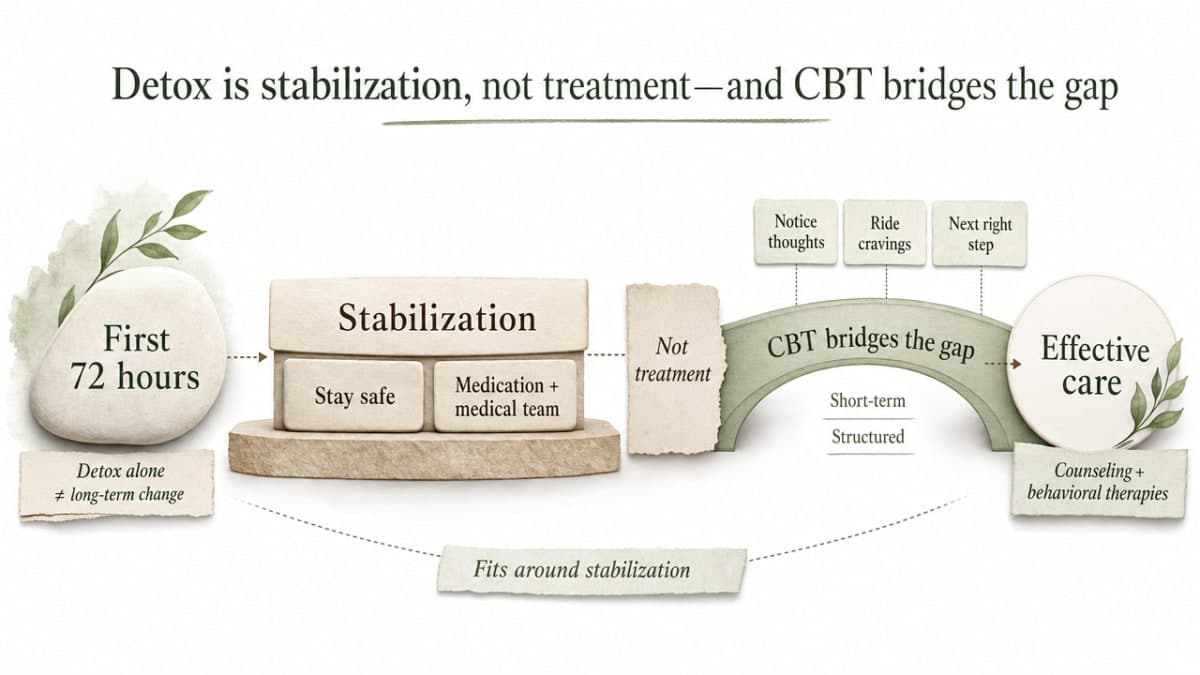
Detox is stabilization, not treatment—and CBT bridges the gap
Here’s the sentence that changes how you should think about the next few days: detox is stabilization, not treatment. That framing comes straight out of the clinical literature, which describes withdrawal management as “best considered stabilization” rather than a cure 2. NIDA puts it more bluntly—detox on its own “does little to change long-term drug use,” which is why counseling and behavioral therapies are considered critical parts of effective care 23.
That’s not a warning. It’s a relief. You don’t have to solve your addiction while your body is coming off opioids. Your job right now is to stay safe and let the medication and the medical team do their work. The therapy piece is designed to fit around that, not on top of it.
So what is CBT, in plain terms? It’s a short-term, structured approach that helps you notice the thoughts and situations that push you toward using, and practice small responses that don’t involve using 24. In a full outpatient program, that usually looks like 12 to 24 sessions of about an hour each 2. In detox, it looks nothing like that. It’s compressed into moments.
Picture the first 72 hours as three quiet skills, introduced one at a time by your clinician:
- Noticing the thought. “I need to use” isn’t a command—it’s a signal your brain sends during withdrawal. A nurse or counselor helps you catch it as a thought, not an order.
- Naming the trigger. Was it the smell of the hallway? A text you saw? The 3 a.m. hour itself? Putting a word on the trigger takes some of its power away.
- Using one small coping response. A cold washcloth. A breathing pattern. Asking for the PRN medication that’s already in your plan. One small action, done once.
That’s the bridge. It’s not therapy in the movie sense. It’s a handful of tools your clinician hands you, one at a time, so that when your body finally stabilizes around day four or five, your mind isn’t starting from zero.
The Oklahoma City backdrop: fentanyl, MAPS 4, and why timing matters
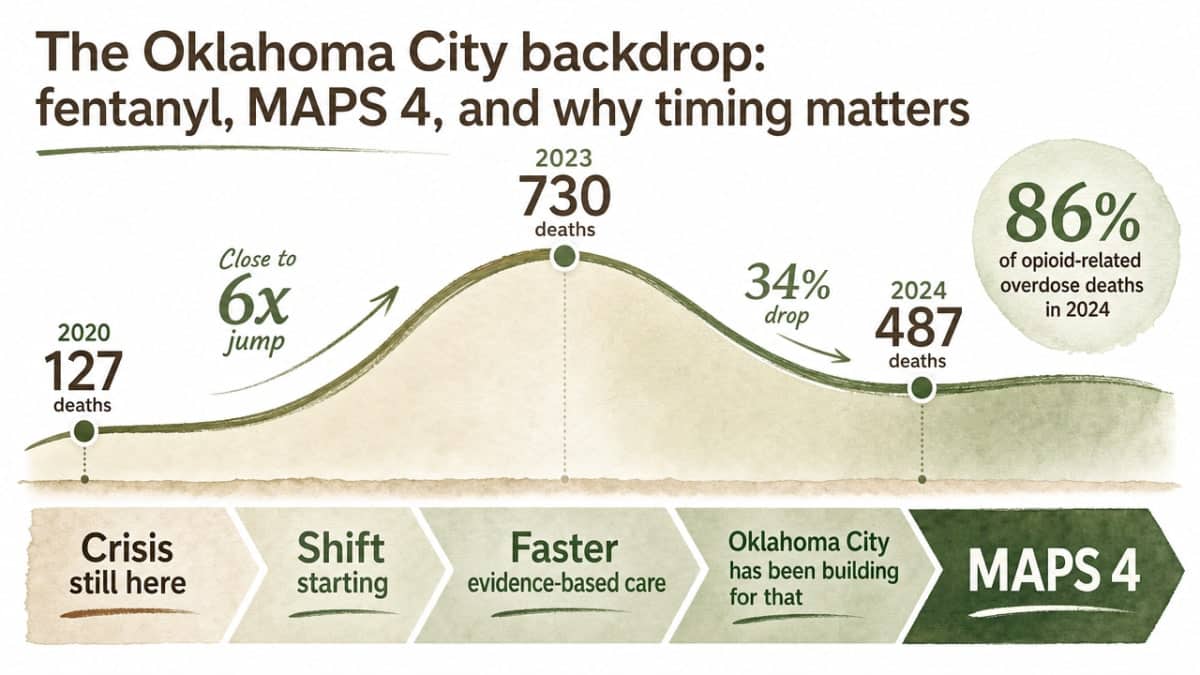
You are not going through this alone, and you are not going through it in a vacuum. Oklahoma has been living inside a fentanyl surge for four years, and the numbers help explain why the wait for a bed, the phone tree at the insurance company, and the fear in your chest all feel so heavy right now.
From 2020 to 2023, fentanyl overdose deaths in Oklahoma climbed from 127 to 730—close to a six-fold jump in three years. In 2024, that figure came down to 487, a 34% drop, though fentanyl was still involved in 86% of opioid-related overdose deaths in the state that year 20. The trajectory matters. It says the crisis is still here. It also says something is starting to shift, and that shift depends on people getting into evidence-based care faster.
Oklahoma City has been building for that. Under MAPS 4, the city is putting real capital into a restoration center that will offer “medically supervised detox, substance abuse counseling, and medication-assisted treatment for opioid addiction” 16. A new mental health crisis center near the medical district will add up to 16 beds in each stabilization wing, along with a group therapy room 17. The overall MAPS 4 plan folds assessment, detoxification, crisis de-escalation, counseling, and respite into one connected model 15.
That is the standard OKC is moving toward: detox, medication, and behavioral therapy sitting in the same building, on the same day, for the same patient. It’s the model the research has pointed to for years. Here is why the timing piece matters for you, right now. Waiting for the perfect moment to start—when work slows down, when the holidays are over, when you feel a little stronger—is the exact pattern fentanyl exploits. The margin for error with this drug is thin. If you or someone you love is in the window where a call is possible, that call is the window. A program that starts CBT during medical stabilization, rather than handing you a referral on discharge day, keeps the door open when your body finally has a minute to breathe.
How CBT is layered into a medically supervised detox day
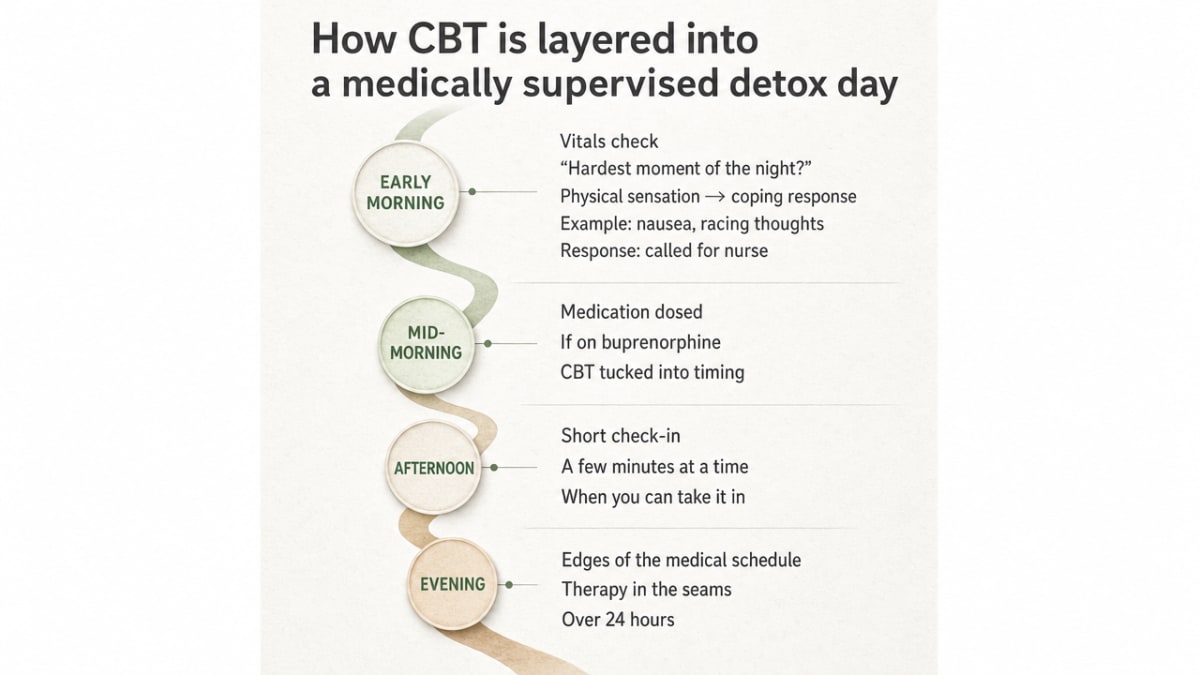
A day in medical detox doesn’t look like a therapy schedule. It looks like a medical schedule with therapy tucked into the seams. That’s on purpose. When your body is doing the hardest work, the clinical team fits CBT into moments when you can actually take something in—usually a few minutes at a time, sometimes at the edge of a vitals check, sometimes when you first wake up from a stretch of sleep.
Here’s roughly how it plays out over 24 hours:
- Early morning. A nurse takes vitals and asks a single, specific question—what was the hardest moment of the night? That question is CBT. She’s helping you connect a physical sensation (the 3 a.m. wave of nausea, the racing thoughts) with a coping response that already worked, even if that response was just calling for the nurse.
- Mid-morning. Medication is dosed. If you’re on buprenorphine or another MAT protocol, this is when the physical noise quiets enough for a short check-in with a counselor. Ten minutes. Not a session. She might introduce one idea: cravings peak and pass, usually inside 20 to 30 minutes. That’s it. You don’t have to believe it yet. You just have to hear it once.
- Afternoon. Rest, hydration, sometimes a longer conversation if you’re up for it. This is where a clinician might do a small piece of what the literature calls functional analysis—walking backward through the last time you used, not to make you feel bad, but to spot the trigger that came 10 minutes before the decision 4.
- Evening. Sleep is the priority. Before lights out, a counselor might name one skill for the night: if a craving thought shows up, notice it, breathe through 60 seconds, and ring the call button if it’s still loud. That’s a CBT coping plan sized for someone who is exhausted.
None of this is optional homework. The clinician is doing the structuring; you’re doing the noticing. That’s the ratio that makes CBT work during stabilization, and it’s the same ratio NIDA points to when it says counseling and behavioral therapies are critical components layered alongside medication, not saved for after discharge 23. By day three or four, when the acute symptoms start to lift, those small skills stop feeling like something the counselor is doing to you and start feeling like something you can reach for on your own. That shift—from clinician-led to patient-held—is what a good detox day is quietly building toward.
The honest evidence: what CBT does well, and where it plateaus
You deserve a straight answer about whether this actually works, so here it is. CBT for substance use has moderate-quality evidence behind it, and the effects on substance use outcomes are small to moderate compared with inactive treatments 3. Not miraculous. Not a cure. Real, measurable, and better than doing nothing—but honest people in this field don’t pretend it’s more than that.
The most important detail is when those effects show up. The 2023 systematic review that pooled the CBT trials found the biggest gains in the first one to six months after treatment starts, with the signal fading by around eight months out 3. That timing is not a footnote. It’s the whole reason a good program starts CBT during medical stabilization instead of saving it for the next facility. The window where CBT gives you the biggest lift is the same window you’re stepping into right now.
A separate meta-analysis pinned the average effect at roughly a moderate size (d ≈ 0.45) across 34 randomized trials of CBT for drug use 4. Another pooled analysis put outcomes about 15 to 26 percent better than control conditions 5. Numbers on a page, but they matter because they set an honest expectation: CBT is a real tool, not a magic one.
Here is the part treatment marketing usually skips. When CBT is compared head-to-head with other evidence-based therapies—contingency management, motivational enhancement, structured counseling—no single form of CBT consistently comes out on top 6. That’s not a knock on CBT. It’s a reminder that the goal isn’t to pick the winning therapy; it’s to get you into an evidence-based approach quickly and keep you connected while the early gains are still forming.
MAT, CBT, and the co-occurring picture (PTSD, sleep, veterans)
Most people who walk into detox are not just working on one thing. There’s the opioid dependence. There’s usually a sleep problem that predates the drug use. There’s often a trauma history the person has never really named out loud. And for a lot of Oklahomans—especially veterans—those layers stack in ways that make a medication-only detox feel incomplete by day three.
Here’s how CBT fits with medication-assisted treatment (MAT) in that reality. Buprenorphine, methadone, or naltrexone quiets the physical pull. CBT gives you a way to handle what surfaces once the pull quiets down. NIDA’s guidance is straightforward on this: counseling and behavioral therapies are critical components of effective care, meant to work alongside medication, not instead of it 23. When the medication is doing its job, you can actually hear the counselor. When the counselor is doing hers, the medication is not carrying the whole weight of preventing return to use.
Sleep is where you’ll feel this first. Opioid withdrawal wrecks sleep architecture. You’ll wake at 2 a.m. with your heart pounding and a thought that says this is never going to end. That’s not a therapy moment in the traditional sense. It’s a CBT moment sized for the middle of the night: notice the thought, name it as a withdrawal signal rather than a fact, and use the coping response your counselor walked you through earlier—usually breath work, a cold compress, or the call button.
Trauma is the layer that changes the plan. If you’ve carried PTSD alongside your substance use—combat exposure, assault, a childhood you don’t talk about—standard addiction counseling on its own tends to leave the trauma piece untouched. A randomized trial of integrated CBT versus individual addiction counseling for co-occurring PTSD and SUD found the integrated CBT protocol reduced PTSD re-experiencing symptoms and PTSD diagnosis more effectively, while producing comparable substance use outcomes 13. Translation: when trauma is part of the picture, a program that can address both from the start tends to move the trauma symptoms further without giving up ground on the substance use.
For veterans in Oklahoma City, that pairing matters. A detox that flags trauma on day one—and hands you off to a clinician who can do integrated CBT rather than choosing between the two—is not a luxury. It’s the difference between stabilizing your body and stabilizing your whole system.
What to ask before you admit: day one, day three, day seven
When you call a detox program, you are usually running on very little sleep and a lot of fear. It helps to have a small script. Not a list of gotcha questions—just three time-anchored ones that separate programs that have thought this through from programs that will hand you a pamphlet on discharge day.
Ask what therapy looks like on day one. A good answer sounds like: a counselor meets you within the first 24 hours, checks in for a few minutes, and introduces one coping skill—not a full session. If the program tells you therapy starts on day four or five, that is a signal they are treating detox and CBT as separate stages rather than layered care. NIDA is clear that counseling and behavioral therapies are meant to work alongside medical stabilization, not follow it 23.
Ask what therapy looks like on day three. This is usually when acute symptoms start to lift and you can actually take something in for longer than ten minutes. The answer should include a specific technique—functional analysis, trigger mapping, a coping plan for the first week after discharge—not just “we do group.” You want to hear that a clinician is walking backward through recent use with you to spot the cue that came before the craving 4.
Ask what therapy looks like on day seven—or whatever your discharge day turns out to be. The honest research says CBT’s biggest gains show up in the first one to six months after treatment starts, then taper 3. So the question is: what happens on day eight? Is there a warm handoff to an outpatient clinician, a scheduled follow-up already on the calendar, a medication plan that doesn’t lapse? “We’ll give you a list of referrals” is not a plan. A confirmed appointment is.
One more question worth asking, quietly: who does the CBT? A licensed counselor, a nurse with behavioral health training, a peer specialist? All can play a role. You just want to know the answer isn’t nobody in particular.
How coverage and admission usually work in Oklahoma
The money question is usually the one keeping you up. You are already exhausted, and now you have to figure out whether a phone call today turns into a bed tonight or a two-week wait. Here is roughly how it works in Oklahoma, so you can make the call with your eyes open.
If you have private insurance, most detox programs run a free benefits check in under an hour. You give them the member ID over the phone, they call the payer, and they come back with what’s covered, what your out-of-pocket looks like, and whether prior authorization is needed before admission. Same-day admissions are common when the plan clears quickly and a bed is available.
If you have SoonerCare (Oklahoma Medicaid), detox and residential SUD services are covered—but prior authorization is required 18. That’s not a barrier; it’s a step. Oklahoma’s Medicaid framework specifically supports 24/7 monitored withdrawal management and care management in residential SUD settings, so the coverage is there 19. What varies is timing. A good admissions team knows how to move a prior auth through same-day when the clinical picture supports it.
A few things worth having ready when you call:
- Insurance card or SoonerCare member ID
- A rough list of what you’ve been using, how much, and how recently—no judgment, just clinical information
- Any medications you’re currently taking, including psychiatric prescriptions
- Emergency contact for a family member or friend
If you can’t produce all of that, call anyway. Admissions teams are used to filling in the gaps. What you don’t want to do is wait until Monday because you couldn’t find a pill bottle on Saturday night.
Renewal Springs in Oklahoma City: how CBT fits the detox model here
Here is how CBT works inside the detox model at Renewal Springs. A licensed clinician meets you inside the first 24 hours—not for a full session, but for a short, focused check-in that names one thought and one coping response you can reach for that night. That pattern continues in short doses as your body stabilizes under 24/7 medical supervision and, when appropriate, medication-assisted treatment.
The physical side and the cognitive side are meant to reinforce each other. As MAT protocols quiet the acute pull, wearable monitoring from Huml Health tracks vitals, sleep, and stress in real time, so the clinical team can see when you are actually ready to take something in—not guess. That’s when a counselor slides in a short piece of functional analysis or a coping plan, at a moment your nervous system can hold it.
For veterans and anyone carrying trauma alongside substance use, the plan flexes. Research on integrated CBT for co-occurring PTSD and SUD supports addressing both from the start rather than sequentially 13, and specialized tracks—veteran, gender-specific, private—shape who sits with you and what the room feels like.
Before you admit anywhere, ask the clinical team a direct question: what does therapy look like on day one, day three, and day seven, and who delivers it? A program that has thought about CBT as a core modality will have a straight answer.
Talk to a clinician about safe CBT detox
Connect immediately for answers about CBT-guided, medically supervised opioid withdrawal support.
Frequently Asked Questions
Will I really be expected to do therapy while I’m in withdrawal?
No, not in the way you’re picturing. During acute withdrawal, a counselor might sit with you for a few minutes to name one thought or one coping response—not run a full session. The clinician does most of the work early on. You are noticing, not performing. Longer conversations happen later, once your body has stabilized and you can actually take something in.
How is CBT during detox different from CBT in ongoing treatment?
In ongoing treatment, CBT is typically a structured 12- to 24-session protocol focused on dysfunctional thinking, self-monitoring, and coping skills 2. In detox, that same framework is compressed into short check-ins—minutes at a time—layered around vitals, medication, and sleep. The goal during stabilization is a small foothold, not deep psychological work. The longer, structured version comes after discharge.
Does CBT actually work for opioid and fentanyl use?
The honest answer is yes, with limits. Systematic reviews find moderate-quality evidence that CBT produces small-to-moderate effects on substance use compared with inactive treatments, with the strongest signal in the first one to six months 3. It is not consistently better than other evidence-based therapies 6. That’s why CBT is usually paired with medication and continuing care rather than used as a stand-alone fix for opioid dependence.
Can CBT be combined with medication-assisted treatment (MAT)?
Yes, and that combination is the standard. NIDA states directly that counseling and behavioral therapies are critical components of effective treatment, meant to work alongside medications like buprenorphine or methadone 23. MAT quiets the physical pull of opioid withdrawal so the medication is doing its job on the body while CBT gives you tools for the thoughts, cravings, and sleep disruption that surface once the acute symptoms ease.
Does Oklahoma Medicaid (SoonerCare) cover CBT-based detox?
Yes. Detox and residential substance use services are covered for eligible SoonerCare members, though prior authorization is required before admission 18. Oklahoma’s Medicaid framework specifically supports 24/7 monitored withdrawal management and care management in residential SUD settings 19. A good admissions team can often move the prior auth through same-day when the clinical picture supports it, so call before assuming a wait.
What if I also have PTSD or trauma alongside substance use?
Tell the admissions team on the first call. A randomized trial of integrated CBT versus individual addiction counseling for co-occurring PTSD and substance use disorder found the integrated protocol reduced PTSD re-experiencing symptoms and PTSD diagnosis more effectively, while producing comparable substance use outcomes 13. That matters for veterans and anyone carrying trauma. A program that flags both from day one tends to move both further.
References
- Treatment | National Institute on Drug Abuse (NIDA) – NIH. https://nida.nih.gov/research-topics/treatment
- EARLY INTERVENTION, TREATMENT, AND MANAGEMENT OF SUBSTANCE USE DISORDERS. https://www.ncbi.nlm.nih.gov/books/NBK424859/
- An Evaluation of Cognitive Behavioral Therapy for Substance Use Disorder. https://pmc.ncbi.nlm.nih.gov/articles/PMC10572095/
- Cognitive-Behavioral Therapy for Substance Use Disorders. https://pmc.ncbi.nlm.nih.gov/articles/PMC2897895/
- A Meta-Analysis of Cognitive-Behavioral Therapy for Alcohol or Other Drug Use Disorders. https://pmc.ncbi.nlm.nih.gov/articles/PMC6856400/
- Efficacy of Cognitive Behavioral Therapy for Alcohol and Other Drug Use Disorders: A Meta-Analysis. https://pmc.ncbi.nlm.nih.gov/articles/PMC9948631/
- Randomized clinical trial of computerized cognitive behavioral therapy and clinician-delivered CBT in comparison with standard outpatient treatment for substance use disorders: Primary within-treatment and follow-up outcomes. https://pmc.ncbi.nlm.nih.gov/articles/PMC6120780/
- Computerized Cognitive Behavioral Therapy for Substance Use Disorders. https://pmc.ncbi.nlm.nih.gov/articles/PMC6768920/
- A Digital Cognitive Behavioral Therapy Program for Adults With Alcohol Use Disorder. https://pmc.ncbi.nlm.nih.gov/articles/PMC11428014/
- Digital cognitive-behavioral therapy for substance use: systematic review and meta-analysis of randomized controlled trials. https://pubmed.ncbi.nlm.nih.gov/39436326/
- A review of research-supported group treatments for drug use disorders. https://pmc.ncbi.nlm.nih.gov/articles/PMC8215831/
- Computer-assisted Behavioral Therapy and Contingency Management for Cannabis Use Disorders. https://pmc.ncbi.nlm.nih.gov/articles/PMC4586287/
- A Randomized Controlled Trial Comparing Integrated Cognitive Behavioral Therapy and Individual Addiction Counseling for Comorbid PTSD and Substance Use Disorders. https://pmc.ncbi.nlm.nih.gov/articles/PMC3289146/
- Mental Health Services | City of OKC. https://www.okc.gov/Services/Public-Safety/Mental-Health-Services
- Mental Health and Addiction | City of OKC. https://www.okc.gov/Infrastructure-Development/Current-Infrastructure-Projects/MAPS-4/Projects/Mental-Health-and-Addiction
- Council selects operators for MAPS 4 Mental Health, Addiction project. https://www.okc.gov/News-articles/City-Council-selects-operators-for-two-MAPS-4-Mental-Health-and-Addiction-projects
- MAPS 4 Mental Health Crisis Center final plans approved. https://www.okc.gov/News-articles/MAPS-4-Mental-Health-Crisis-Center-final-plans-approved
- Mental Health and Substance Abuse Services – Oklahoma.gov. https://oklahoma.gov/ohca/individuals/programs/mental-health-and-substance-abuse-services.html
- Oklahoma State Plan Amendment (SPA) 25-0014 – Medicaid. https://www.medicaid.gov/medicaid/spa/downloads/OK-25-0014.pdf
- Data – Oklahoma.gov (Drug Overdose Data). https://oklahoma.gov/health/health-education/injury-prevention-service/drug-overdose/data.html
- Drug Overdose Data Dashboard – Oklahoma.gov. https://oklahoma.gov/health/health-education/injury-prevention-service/drug-overdose/data/drug-overdose-data-dashboard.html
- Randomized Clinical Trial of Computerized and Clinician-Delivered CBT in Comparison With Standard Outpatient Treatment for Substance Use Disorders. https://pubmed.ncbi.nlm.nih.gov/29792052/
- Principles of Effective Treatment – NIDA (Principles of Drug Addiction Treatment). https://nida.nih.gov/publications/principles-drug-addiction-treatment-research-based-guide-third-edition/principles-effective-treatment
- Treatment Approaches for Drug Addiction – NIDA DrugFacts. https://nida.nih.gov/publications/drugfacts/treatment-approaches-drug-addiction
- Drug Overdose Deaths – CDC. https://www.cdc.gov/drugoverdose/deaths/index.html