
Key Takeaways
- MAT combines an FDA-approved medication—buprenorphine, methadone, or naltrexone—with counseling and clinical monitoring, forming the whole-patient standard of care for opioid use disorder 4.
- Detoxification without ongoing medication is not recommended, since relapse rates can exceed 90% and lowered tolerance sharply raises overdose risk 10, 2.
- Medication selection hinges on physiology, logistics, and adherence: methadone shows modestly higher six-month retention, while buprenorphine offers office-based flexibility and naltrexone requires 7–10 opioid-free days 11, 12, 5.
- The first week follows a predictable arc—intake, induction after objective withdrawal signs, then stabilization by day three—transitioning into long-term maintenance rather than ending at discharge 14, 1.
The First Phone Call and Its Impact
You know a change is necessary. The dose increases, the time between uses shrinks, and stopping feels impossible. Withdrawal from opioids is a medical event, not a willpower issue.
This is why the first call is crucial. You don’t need to articulate your situation perfectly or sound completely ready. The person on the other end has heard countless versions of this story. What changes after that call is that you are no longer facing this challenge alone.
Medication-assisted treatment (MAT) involves medically supervised detox to ensure safety during withdrawal and improve the chances of long-term opioid abstinence. It integrates an FDA-approved medication—such as buprenorphine, methadone, or naltrexone—with counseling and clinical monitoring, which federal guidelines define as a “whole-patient” approach 4. The CDC advises against detox without medication due to the heightened risk of relapse and fatal overdose 2.
Therefore, the call is not as daunting as it may seem; it marks the beginning of a structured plan.
Understanding Medication-Assisted Treatment
Medication and Counseling: A Combined Approach
MAT is not merely taking a pill. Federal treatment guidelines describe it as a “whole-patient” approach that combines FDA-approved medication with counseling and behavioral therapies 4. Both components are vital. The medication addresses the physical aspects—withdrawal symptoms, cravings, and the constant physiological demand for opioids. Counseling supports the rebuilding of one’s life.
The FDA-approved buprenorphine label explicitly states that the medication “should be used as part of a complete treatment plan that includes counseling and psychosocial support” 13.
This is a fundamental aspect of its design.
Practically, your initial days will involve medical staff monitoring your vitals and adjusting your dosage, alongside conversations about your journey, your fears, and future steps. You are not expected to be an expert in these discussions; simply engaging in them is sufficient.
Addressing Concerns: Is MAT Just Trading One Drug for Another?
A common concern, often voiced by loved ones or internal thoughts, is whether buprenorphine or methadone simply substitutes one addiction for another, implying that true recovery means being entirely substance-free.
The reality is that it is not the same. Buprenorphine acts as a partial opioid agonist, binding to the same receptors as heroin or fentanyl but only partially activating them. This mechanism reduces cravings and withdrawal without producing the euphoric high that drives compulsive use 9. CDC educational materials clarify that these medications “reduce the cravings for and the euphoria (extreme pleasure) experienced with opioids” 8. The medication is taken in a stable, prescribed dose, eliminating the compulsive pursuit associated with illicit opioid use.
Opioid use disorder is a medical condition, similar to diabetes requiring insulin or high blood pressure needing long-term medication. MAT is the established standard of care. The CDC explicitly states that detoxification without medication for opioid use disorder “is not recommended” due to the increased risk of relapse, overdose, and overdose death 2. Continuing medication enhances safety.
FDA-Approved Medications for Opioid Use Disorder
Three medications are FDA-approved for treating opioid use disorder: buprenorphine, methadone, and naltrexone. They are distinct in their mechanisms, administration settings, and initiation requirements. Understanding these differences can help you engage more effectively with your care team.
Buprenorphine is a partial opioid agonist. It binds to opioid receptors, partially activating them to alleviate cravings and withdrawal symptoms without inducing the euphoric effects associated with illicit opioids 8. It can be prescribed by office-based providers or through opioid treatment programs, often administered as a sublingual tablet or film. A critical requirement is that it can only be started once objective signs of withdrawal are present 14. Initiating it too early can trigger precipitated withdrawal, a more severe form of withdrawal. Your medical team will monitor for these signs before administering the first dose.
Methadone is a full opioid agonist. It effectively reduces cravings and blocks withdrawal symptoms and has extensive evidence supporting its use. However, its administration is restricted; methadone for opioid use disorder is dispensed exclusively through federally certified opioid treatment programs, typically requiring daily clinic visits initially before take-home doses are permitted 5, 8.
Naltrexone operates differently as a full opioid antagonist. It blocks opioid receptors, preventing opioids from attaching and thus eliminating their effects. This means it has no potential for misuse. It is often given as a monthly injection or a daily pill in outpatient settings. A strict prerequisite for naltrexone is that it can only be started after at least 7 to 10 days of complete opioid abstinence 5. Starting it prematurely will induce severe, abrupt withdrawal. For many individuals recovering from fentanyl or heroin dependence, a supervised detox facilitates achieving this opioid-free window.
The choice of medication is not about superiority but about finding the best fit for your individual physiology, history, and lifestyle.
The First Week of MAT: A Detailed Timeline
Hours 0-12: Intake, Assessment, and Waiting for Withdrawal
The initial phase is often calmer than anticipated. You’ll provide your name, details of your last opioid use (substance, amount, time), and undergo vital sign checks (blood pressure, pulse, temperature). Any belongings will be checked in. You’ll be offered water and a place to sit.
During these early hours, the medical team focuses on two key aspects: gathering a comprehensive health profile, including other substances used, existing conditions, and current medications, and observing for withdrawal. Buprenorphine cannot be started immediately upon arrival. Clinical guidelines mandate waiting until objective signs of withdrawal are present 14 to prevent precipitated withdrawal, a sudden and intense form of withdrawal.
Therefore, the first several hours are dedicated to assessment and patience. If your last use was recent, you might still feel relatively normal. If it was longer ago, symptoms like yawning, watery eyes, and restless legs may begin to emerge. Staff use a standardized scale to track these signs, ensuring the first dose is administered at the optimal time. This period of observation is crucial for effective medication timing.
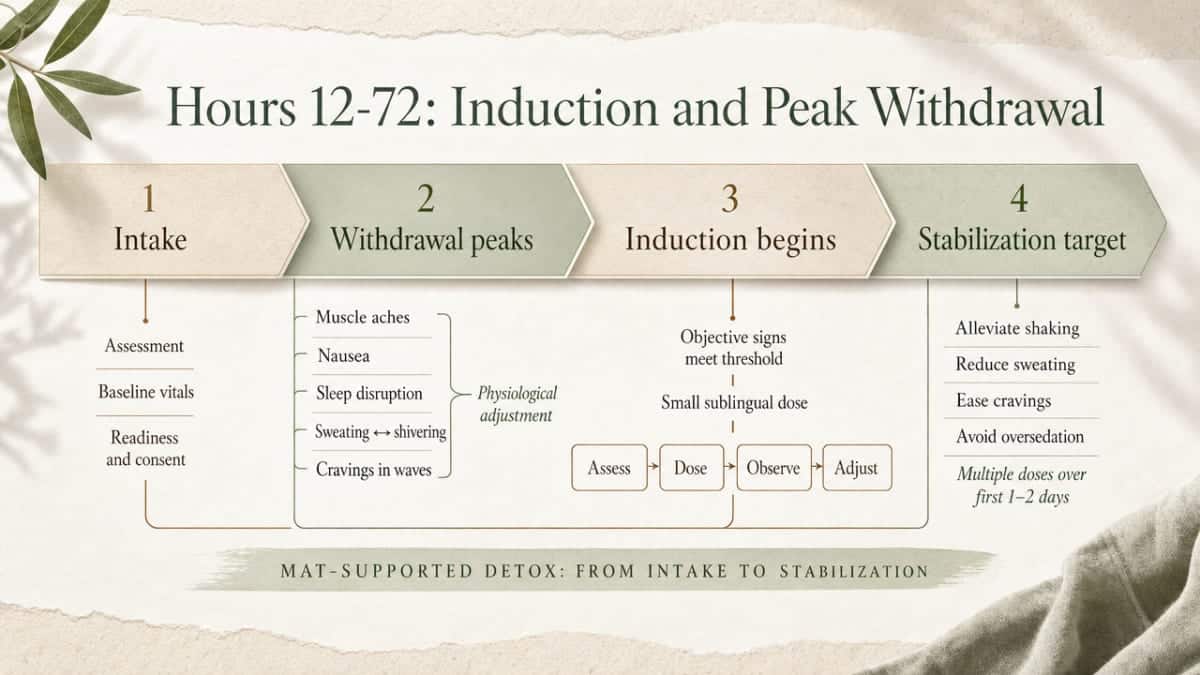
Hours 12-72: Induction and Peak Withdrawal
This period is often the most feared, and rightly so. Withdrawal typically peaks within this window. Muscle aches intensify, nausea may occur, and sleep patterns are disrupted. You might experience alternating sweating and shivering. Cravings can come in waves. These symptoms indicate your body’s necessary physiological adjustment.
Once objective withdrawal signs meet clinical thresholds, induction begins. The initial buprenorphine dose is small, administered sublingually, and the team monitors your response before making adjustments. The primary goal is to reach a dose that alleviates shaking, sweating, and cravings without causing oversedation 14. For most individuals, this requires multiple doses over the first one to two days. SAMHSA’s protocol outlines this as a stepwise process: assess, dose, observe, adjust 1.
Concurrently with medication, staff address specific symptoms. Anti-nausea medication for nausea, non-opioid pain relief for muscle aches, and treatments for diarrhea and insomnia are provided. You are not expected to endure these symptoms without support.
The most honest assessment of hours 12 to 72 is that it is the most challenging phase, but it is temporary. This is a defined period you navigate with professional support to ensure your safety.
Days 3-7: Stabilization and Return of Normal Function
Around day three, a noticeable shift occurs. The intensity of symptoms diminishes. With the medication reaching a steady dose, acute symptoms begin to recede. While you may still feel fatigued, sweating lessens, and muscle aches fade. You start to experience longer periods of restorative sleep.
Appetite gradually returns. Food becomes appealing again, and you notice basic physiological needs like thirst. A sense of boredom may emerge, which is a positive sign, indicating your body is no longer in crisis.
This phase also marks a more prominent role for the counseling component of MAT. Conversations extend to discharge planning, continued medication, and the next level of care. SAMHSA’s guidelines describe this stabilization phase as the bridge to maintenance treatment—ongoing medication and counseling beyond the acute detox period 1.
Successfully navigating the most difficult part is a significant achievement and the core purpose of the treatment plan.
Choosing the Right Medication: Buprenorphine, Methadone, or Naltrexone
There is no single “best” medication; the ideal choice depends on your personal history, physiology, and desired level of daily structure. Your care team will guide you through this decision, but understanding the factors involved is beneficial.
Treatment retention is a key consideration. Longer engagement in treatment is strongly linked to sustained opioid abstinence. A rapid review and meta-analysis of opioid agonist treatment found mean weighted 4–6 month retention rates of 57.3% for buprenorphine and 65.5% for methadone 11. While methadone showed a modest advantage, a 2025 meta-analysis of seven randomized trials further clarified that methadone had significantly higher retention at six months compared to buprenorphine-naloxone, though buprenorphine-naloxone had a more favorable safety profile 12. Neither medication is universally superior.
Logistical factors are also important. Methadone for opioid use disorder is dispensed exclusively through federally certified opioid treatment programs, often requiring daily clinic visits initially 6. Buprenorphine can be prescribed in an office setting and filled at a pharmacy, offering greater flexibility for work or family commitments 5.
Naltrexone is distinct as a non-agonist. It does not provide daily craving management in the same way but blocks the effects of opioids. This makes it suitable for individuals who have completed withdrawal and prefer a non-opioid option, provided they have been opioid-free for 7 to 10 days 5. A supervised detox often helps achieve this necessary opioid-free period.
Ultimately, the most important factor is consistent adherence to the chosen medication. Discuss potential side effects, drug interactions, and continuing care options with your team. The “right” answer is the treatment you will consistently follow.

The Limitations of Detoxification Alone
A critical truth, which underpins the design of MAT, is that completing withdrawal does not equate to sustained opioid abstinence. If previous detox attempts resulted in relapse, it reflects a predictable outcome, not a personal failure.
During detox, opioid tolerance decreases significantly. This physiological change means that if an individual uses opioids again at their previous dosage, their body can no longer tolerate it, leading to a high risk of fatal overdose. Continuing MAT after acute detox maintains quieted cravings, occupied receptors, and a reduced overdose risk while other aspects of life stabilize. The medication serves as a bridge, with detox being just the initial step.
Life on MAT: Routine, Side Effects, and Duration
Once a stable dosage is achieved, MAT transitions from a medical event to a routine. Medication is typically taken at a consistent time each day. For buprenorphine, this usually involves a sublingual tablet or film administered at home 13. Methadone requires visits to a certified opioid treatment program, often daily initially, with take-home doses earned over time 6. Naltrexone may involve a monthly injection, simplifying daily management.
Side effects are a real consideration. Common side effects with buprenorphine include sedation, constipation, headache, and sweating 9. Most of these tend to diminish after the first few weeks or can be managed with minor dose adjustments. It is important to communicate any side effects to your prescriber, as dosages are tailored to individual needs.
The duration of MAT varies. Many individuals remain on MAT for one year, several years, or indefinitely, as continued medication helps manage cravings and reduces overdose risk 10. When the time is appropriate, discontinuing MAT involves a slow, planned taper in consultation with your prescriber, rather than an abrupt, unilateral decision. The primary objective is a functional and stable life, not merely being off medication.
MAT Coverage in Oklahoma: Medicaid Benefits
Financial concerns often delay treatment. In Oklahoma, if you have SoonerCare or are eligible, MAT services are a mandatory Medicaid benefit through September 30, 2025, for adults and children meeting medical necessity criteria 7. This coverage includes the medication, provider services, and behavioral health components—counseling and therapy—reimbursed on a fee-for-service basis 7. Essentially, the medication, doctor visits, and counseling, which federal guidelines mandate as part of MAT 4, are all covered.
Coverage periods can be extended or updated, so verify your current status when you call. For those with private insurance, most major plans also cover MAT; a benefits check before admission can clarify out-of-pocket expenses.
Specialized Paths: Veterans, Gender-Specific Care, and Private Options
Detox experiences are not uniform, nor should they be. The elements that foster a sense of safety and facilitate the treatment process are highly individual.
For veterans, MAT is not experimental. The VA/DoD clinical practice guideline recommends buprenorphine/naloxone in any setting, or methadone or buprenorphine/naloxone through an accredited opioid treatment program, as first-line care for opioid use disorder 15. This means the same medications are supported by your care history. If combat exposure, chronic pain from service, or PTSD is part of your background, inform your intake team immediately, as this influences how withdrawal symptoms are interpreted and how counseling is structured.
Gender-specific treatment tracks exist for substantive reasons. Men and women often have distinct trauma histories, different motivations for opioid use, and varying anxieties about being in withdrawal. A detox unit that offers separate programming can help individuals feel more comfortable and open, allowing the medication and therapeutic conversations to be more effective.
Private or luxury settings offer enhanced privacy and quieter environments, but the medical protocols for buprenorphine, methadone, or naltrexone remain consistent 1. The value lies in the surrounding environment—single-occupancy rooms, fewer interactions, and the ability to focus on recovery without external distractions. Choose a setting where you feel you can commit to staying.
Post-Detox: Transitioning to Ongoing Recovery
Discharge day can evoke mixed emotions. You may feel clearer than in months, yet the secure environment you’re leaving contrasts with an unchanged external world. This is precisely the phase MAT is designed to support.
You leave with a comprehensive plan, not just your belongings. This plan typically includes a continued prescription or dosing arrangement for your medication, a scheduled first outpatient appointment, and an associated counseling schedule. Federal guidance views this stabilization-to-maintenance transition as the true beginning of treatment, not its conclusion 1. Medication and counseling continue, and overdose risk remains lower due to occupied opioid receptors.
Expect the first two weeks post-discharge to be challenging. Sleep patterns may still be irregular. Cravings might resurface in specific contexts—a particular location, a phone number, or a certain time of day. Communicate these experiences to your prescriber, as dose adjustments are normal. Attending your next appointment is a significant step forward.
Talk Now About Starting Your MAT Journey
Connect directly with a caring team member ready to guide you through your next steps in MAT treatment.
Frequently Asked Questions
Can I start MAT if I’m still using opioids right now?
Yes, it is expected that you may still be using opioids when you seek treatment. For buprenorphine, the medical team will wait until objective signs of withdrawal are present before administering the first dose to prevent precipitated withdrawal 14. Methadone can be initiated in an opioid treatment program during withdrawal 6. Naltrexone is an exception, requiring 7–10 opioid-free days prior to initiation 5.
How long will I need to stay on MAT medication?
There is no fixed duration for MAT. Many individuals remain on MAT for a year, several years, or longer. This sustained use helps manage cravings and reduces the risk of overdose 10. When you and your prescriber determine the time is right, discontinuing medication involves a slow, planned taper, which should never be attempted independently.
Will I be able to work, drive, or care for my kids while on buprenorphine or methadone?
Once you are stabilized on a consistent dose, generally, yes. Sedation can occur early in treatment, particularly with buprenorphine, but typically subsides or improves with dose adjustments 9. It is important to inform your prescriber if you experience impaired alertness while driving. Buprenorphine is prescribed and taken at home 13, while methadone requires initial clinic visits, with take-home doses earned over time 6.
What if I’ve tried detox before and relapsed—will MAT be different?
Previous relapse is a primary reason for the development of MAT in its current form. Detoxification without continued medication can result in relapse rates exceeding 90% in some studies 10, and the CDC does not recommend detox alone for opioid use disorder 2. MAT differs because the medication continues to work after the acute detox phase, keeping opioid receptors occupied while you rebuild your life.
Do I have to attend counseling, or can I just take the medication?
Counseling is an integral part of how MAT is designed to function. The FDA-approved buprenorphine label specifies its use as part of a complete treatment plan that includes counseling and psychosocial support 13. Federal guidelines define MAT as medication combined with counseling and behavioral therapies, emphasizing a “whole-patient” approach 4. Active participation in counseling is expected.
What should I bring, and who should I tell, before I go in?
Bring a photo ID, your insurance card, a comprehensive list of all medications and substances you’ve used recently (including approximate amounts and times), and comfortable clothing. Inform one trusted individual about your whereabouts and expected duration. If you are a veteran, mention this during intake, as it will influence your care plan under VA/DoD first-line MAT recommendations 15. You do not need to prepare specific explanations.
References
- TIP 63: Medications for Opioid Use Disorder. https://library.samhsa.gov/product/tip-63-medications-opioid-use-disorder/pep21-02-01-002
- Opioid Use Disorder: Treating | Overdose Prevention. https://www.cdc.gov/overdose-prevention/hcp/clinical-care/opioid-use-disorder-treating.html
- CDC Clinical Practice Guideline for Prescribing Opioids for Pain — United States, 2022. https://www.cdc.gov/mmwr/volumes/71/rr/rr7103a1.htm
- Medication-Assisted Treatment (MAT) in the Criminal Justice System: Brief Guidance to States. https://library.samhsa.gov/sites/default/files/pep19-matbriefcjs_0.pdf
- Treatment of Opioid Use Disorder | Overdose Prevention. https://www.cdc.gov/overdose-prevention/treatment/opioid-use-disorder.html
- Federal Guidelines for Opioid Treatment Programs (2024). https://library.samhsa.gov/product/federal-guidelines-opioid-treatment-programs-2024/pep24-02-011
- Oklahoma State Plan Amendment (SPA) 20-0036. https://www.medicaid.gov/Medicaid/spa/downloads/OK-20-0036.pdf
- Medication-Assisted Treatment for Opioid Use Disorder. https://stacks.cdc.gov/view/cdc/78827/cdc_78827_DS1.pdf
- Buprenorphine – StatPearls. https://www.ncbi.nlm.nih.gov/books/NBK459126/
- Buprenorphine Treatment for Opioid Use Disorder: An Overview. https://pmc.ncbi.nlm.nih.gov/articles/PMC6585403/
- Retention in opioid agonist treatment: a rapid review and meta-analysis. https://pmc.ncbi.nlm.nih.gov/articles/PMC8348786/
- Buprenorphine-naloxone vs methadone for opioid use disorder: A systematic review and meta-analysis. https://pubmed.ncbi.nlm.nih.gov/40536198/
- Label: BUPRENORPHINE tablet – DailyMed. https://dailymed.nlm.nih.gov/dailymed/drugInfo.cfm?setid=da90618a-5621-4b15-bc48-9dcc631418de
- Chapter 3D: Buprenorphine – Medications for Opioid Use Disorder. https://www.ncbi.nlm.nih.gov/books/NBK574909/
- VA/DoD Clinical Practice Guideline for the Management of Substance Use Disorders – Provider Summary. https://www.healthquality.va.gov/guidelines/MH/sud/VADoDSUDCPGProviderSummary.pdf