Key Takeaways
- Opioid use disorder develops when the brain and body adapt to opioids, producing loss of control, cravings, rising tolerance, and continued use despite mounting damage to work, health, and relationships 13.
- Misuse and full opioid use disorder sit on a spectrum, and roughly 3.3 million Americans misuse opioids without meeting diagnostic criteria — waiting for every box to check delays help unnecessarily 21.
- Medically supervised detox paired with FDA-approved medications like methadone, buprenorphine, or naltrexone and a warm handoff into ongoing MAT and counseling is the standard of care 10, 11.
- Quitting alone is the highest-risk move: tolerance drops within days, and returning to a previous dose frequently causes fatal overdose, which is why VA guidance forbids solo withdrawal management 6, 15.
If You’re Reading This at 2 A.M., You Already Know Something Is Off
Here’s the truth about the search you just made: people don’t type “opiate addiction symptoms” into a phone at 2 a.m. because they’re curious. They type it because something in their gut has been whispering for weeks, maybe months, and tonight they needed to hear it out loud from somewhere that isn’t a mirror.
So before anything else — you’re not overreacting. And you’re not too late. Whether you’re the one taking the pills, or you’re the parent who noticed the bottle count is off, or the spouse who keeps finding reasons that don’t add up, the fact that you’re here means part of you already knows what you’re looking at.
That’s not a small thing. Recognition is the first real step in every clinical framework for opioid use disorder 13. You just took it.
What follows is not a lecture and not a checklist wall. It’s a plain-language map: what the symptoms actually are, what withdrawal will feel like if opioids stop, why doing this alone at home is the most dangerous move on the table 15, and what safer, medically supervised options exist right now in Oklahoma City. Read at your own pace. You have time for this paragraph.
Three Different Things People Mean When They Google ‘Symptoms’
Misuse, Use Disorder, and Overdose Are Not the Same Question
When you typed those words into your phone, you might have been asking one of three very different questions — and the answer changes depending on which one.
The first is misuse: taking opioids in a way they weren’t prescribed. Higher doses than the bottle says. Someone else’s pills. Using them to sleep, to numb, to get through a shift. Misuse is a behavior, not a diagnosis.
The second is opioid use disorder, or OUD. That’s the clinical name for what most people mean when they say “addiction.” It’s diagnosed when a pattern of use starts causing real problems — you keep using despite consequences, you can’t cut down when you try, cravings pull at you, your tolerance climbs 13. It’s a spectrum, from mild to severe, based on how many of those signs are showing up in your life 13.
The third is overdose — a medical emergency where breathing slows or stops, requiring naloxone and 911, right now 1. That’s not a symptom question. That’s an ambulance question.
Knowing which one you’re actually asking about is the first sorting move.
The Gap Between Misuse and Diagnosis Is Wider Than Most People Think
If you’re sitting somewhere between “I take more than I should” and “I’m not sure if this counts as addiction,” you are not alone in that in-between space. You’re actually standing in the most populated part of the map.
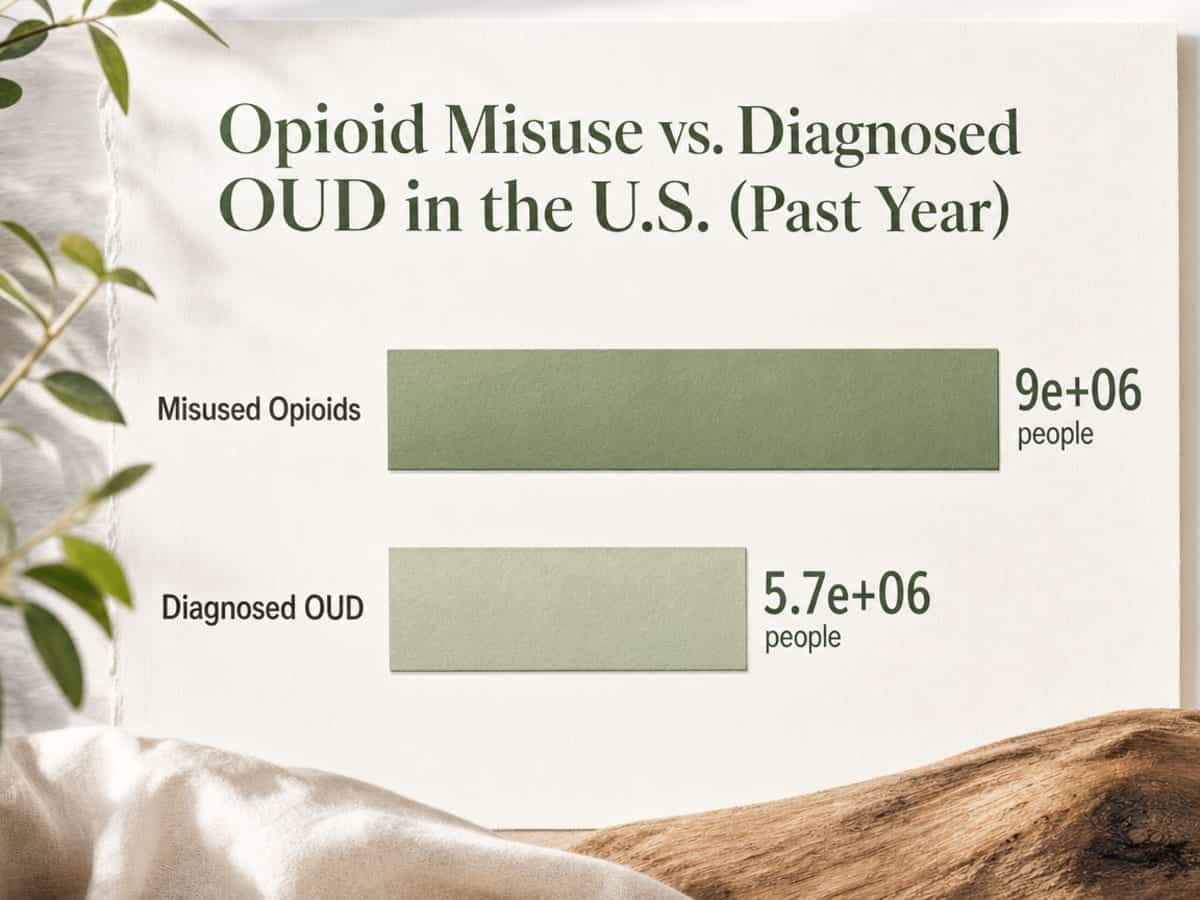
NIDA’s most recent strategic plan estimates that nearly 9 million Americans aged 12 and older misused opioids in the past year, while roughly 5.7 million meet the clinical criteria for opioid use disorder 21. That’s a gap of about 3.3 million people — folks who are using opioids in ways they weren’t prescribed, but who haven’t crossed into a formal OUD diagnosis. Or haven’t yet.
Why does that matter to you tonight? Because it means “do I qualify?” is the wrong question to be stuck on. Misuse without a diagnosis is still worth addressing. Waiting until every DSM-5 box is checked isn’t a milestone — it’s a slower version of the same story. If something feels off enough that you’re reading this, that itself is data worth taking seriously.
The Symptom Clusters That Actually Matter
Losing Control Over How Much and How Often
This one is quiet, and it usually starts as a story you tell yourself. “Just one more to get through today.” “I’ll skip tomorrow.” “I only take extra when the pain is really bad.” And then tomorrow the same thing happens, and the bottle empties four days early, and you find yourself counting pills in a way that would have embarrassed you a year ago.
The clinical language for this is taking opioids in larger amounts or over a longer period than intended, and making unsuccessful efforts to cut down or control use 1314. In plain English: you’ve tried to stop or slow down, and it didn’t stick. That’s not weakness. That’s one of the most reliable early signals that a substance has moved from something you’re using to something that’s using you back.
If you’ve had that conversation with yourself more than once, count it. It matters.
Cravings and the Tolerance Creep
Cravings don’t always feel like the movie version. Sometimes they show up as a low hum of restlessness, a specific time of day when your attention narrows, a phone in your hand before you’ve decided to pick it up. DSM-5 lists craving — a strong desire or urge to use opioids — as its own criterion 13.
Tolerance is the other half of this cluster. The dose that worked six months ago doesn’t reach the same place anymore. You need more to feel normal, more to feel relief, more to feel anything 1314. That climb is your nervous system adapting, not a character flaw. But it’s also the mechanism that quietly raises your overdose risk every time the numbers go up.
When Use Starts Costing You Something Real
Look at the last three months honestly. Missed shifts. A project you used to be proud of that you’re now phoning in. A birthday you forgot. A friend who stopped calling. A partner who has learned not to ask certain questions.
The DSM-5 groups these together:
- Failure to fulfill major obligations at work, school, or home
- Giving up important social, work, or recreational activities
- Continued use despite social or interpersonal problems
- Continuing to use even when you know it’s making a physical or psychological condition worse 1314
CDC’s plain-language list echoes the same pattern — unsuccessful efforts to cut down, failure to meet obligations, and continued use despite consequences 1.
You don’t have to hit every item on that list. Two within a twelve-month window is enough to meet the clinical threshold 13. If you’re mentally checking boxes right now, that’s the checklist doing its job.
The Body Already Depends On It
Here’s the one that scares people, and the one that gets misread most often. If you go a few hours past your usual dose and your nose starts running, your skin prickles, your stomach twists, your legs ache — that’s physical withdrawal. Your body has adapted to the presence of the opioid and now protests when it’s not there 12.
Important distinction: withdrawal by itself, if you’re taking opioids exactly as a doctor prescribed for a legitimate medical reason, is not enough on its own to diagnose opioid use disorder 14. Physical dependence and addiction are related, but they aren’t the same thing. What matters is whether withdrawal is showing up alongside the other clusters — the control loss, the cravings, the life costs.
If it is, that’s not a moral verdict. It’s a medical picture. And it’s the picture that changes what your next safe step looks like — because a body that’s already dependent needs supervision, not willpower, to come off.
What Withdrawal Actually Feels Like, Hour by Hour
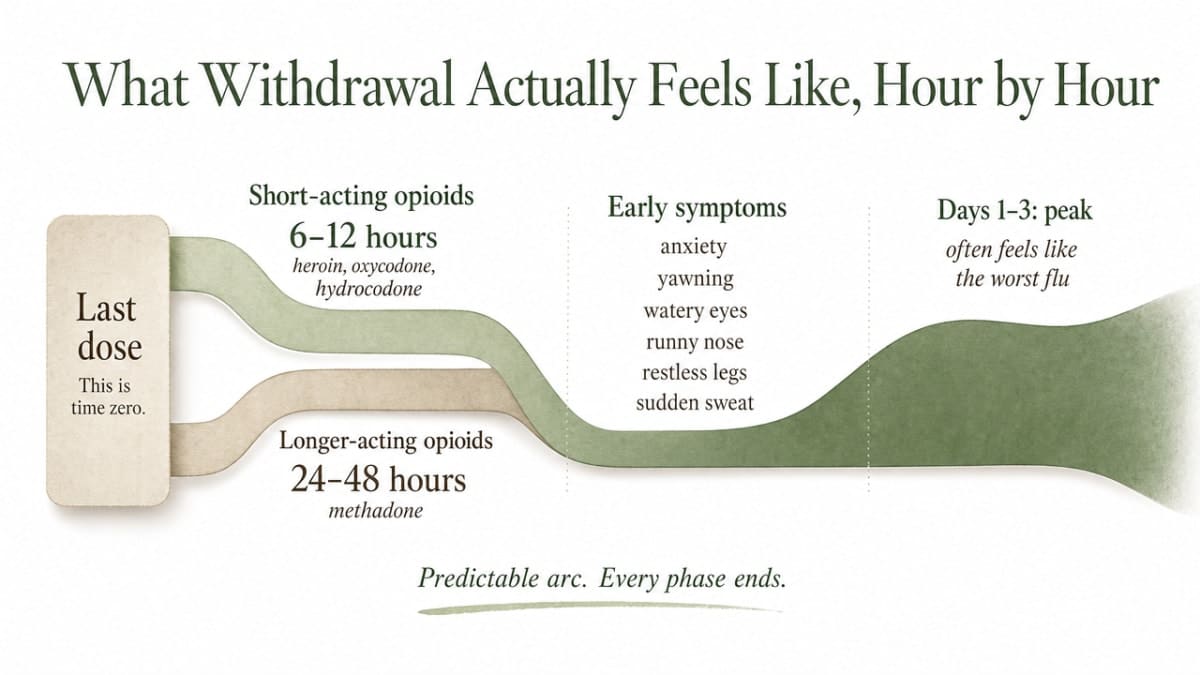
One of the reasons people put off getting help is that they don’t know what they’re walking into. Withdrawal is scary in the imagination, and knowing the shape of it actually makes it less so. It has a predictable arc, and every phase ends.
For short-acting opioids like heroin, oxycodone, or hydrocodone, the first symptoms usually show up around 6 to 12 hours after your last dose. For longer-acting opioids like methadone, it can be 24 to 48 hours before you feel much at all 12. The early hours are the anxious ones — yawning that won’t stop, watery eyes (the clinical word is lacrimation, but it just means your eyes leak), a runny nose, a restless twitch in your legs, and sweat that comes out of nowhere 12.
Days one through three are the peak. This is the part people describe as the worst flu of their life and mean it literally. Muscle aches deep in the bones. Goosebumps that won’t go away — piloerection, which is where the phrase “going cold turkey” comes from. Nausea, vomiting, diarrhea, and abdominal cramping all at once. Dilated pupils. A racing heart, high blood pressure, and a body that feels wired and exhausted at the same time — that’s the autonomic hyperactivity the clinicians talk about 12.
Days four through seven, the physical storm starts to lift. The GI symptoms ease. Sleep, which has been shredded, slowly starts to piece itself back together. You’re not comfortable yet, but you’re recognizable to yourself.
Then there’s the part most articles skip: post-acute withdrawal. For weeks after the acute phase, low energy, disrupted sleep, and waves of craving can linger. This is not you failing. This is your brain chemistry recalibrating, and it’s exactly why the next section matters so much.
Why Quitting Alone Is the Most Dangerous Move Right Now
If you’ve made it this far, you’re probably already thinking, “Maybe I just stop.” That instinct makes sense. It’s brave, even. But it’s also the move that most reliably ends in one of two outcomes: you go back to using within days, or you go back at a dose your body can no longer handle and overdose. This is the part of the story almost no one tells you plainly, so here it is.
A clinical trial published through the NIH looked at what happens to people after short-term inpatient detox for opioid use disorder. The finding was blunt: short-term inpatient treatment is associated with a high rate of relapse when it isn’t followed by medication-assisted treatment, and the researchers explicitly recommended that medically supervised withdrawal be paired with ongoing MAT 15. Detox alone isn’t a finish line. It’s a cliff.
So when the voice in your head says “willpower,” translate it. What you actually need is supervision, medication, and a warm handoff into what comes next 10. That’s not weakness. That’s the standard of care.
What Medically Supervised Detox and MAT Actually Look Like
The Medications That Do the Heavy Lifting
If the phrase “medication-assisted treatment” makes you think of trading one drug for another, you’re not alone — a lot of people arrive with that worry. Here’s what the research actually says: for opioid use disorder, medication should be the first line of treatment, usually paired with counseling or behavioral therapy 10. That’s not a fringe opinion. It’s the standard of care across NIDA, SAMHSA, and the VA 976.
Three FDA-approved medications do most of the work:
- Methadone is a long-acting opioid that steadies the brain’s opioid receptors so cravings quiet down and withdrawal doesn’t drag you back 78.
- Buprenorphine — often prescribed as Suboxone — attaches to those same receptors more gently, easing withdrawal and cravings while making it much harder to overdose 811.
- Extended-release naltrexone is different: it blocks opioids from working at all, so if you use, you don’t feel the reward 89.
For the acute withdrawal window itself, a non-opioid medication called lofexidine is FDA-approved to soften symptoms like sweating, cramping, and anxiety 9. Alongside those, a supervised detox will typically add medications for nausea, sleep, and body aches so the days-one-through-three peak becomes something you can actually get through.
Detox Is a Doorway, Not a Destination
Here’s the shift most people don’t hear until they’re already inside a program: the goal of medical detox isn’t to “get the drugs out” and send you home. The goal is to get you stable enough to start the medication and therapy plan that actually keeps you well 11. The clinical language is a warm handoff — from a monitored bed into ongoing care, whether that’s a residential program, an outpatient MAT clinic, or a primary care doctor who prescribes buprenorphine 11.
That handoff is the whole point. Detox by itself has been shown, again and again, to end in relapse when nothing follows it 15. Continuing medication is what protects your dropping tolerance from becoming an overdose statistic. And pairing that medication with counseling — cognitive behavioral therapy, family therapy, contingency management — is what helps the rest of your life catch up to the change in your body 10.
So when you picture calling a detox program, picture the first door of a longer hallway, not a single locked room. That reframe alone can make the call easier.
Overdose: Signs to Memorize Before You Need Them
You may never need this section. Read it anyway, because the difference between a scare and a funeral is often thirty seconds of recognition.
An opioid overdose usually looks quieter than people expect. Not thrashing. Not dramatic. Someone becomes very hard to wake — you shake them, you shout their name, they don’t respond, or they respond and drift right back out. Their breathing slows down, gets shallow, or stops. You may hear a gurgling snore, sometimes called the death rattle. Their lips or fingertips can turn blue or gray. Pupils shrink to pinpoints. Their body goes limp 116.
If any of that is happening, or if you’re not sure whether it’s a deep sleep or something worse, treat it as an overdose. The CDC is direct on this: when you can’t tell, act like it’s an overdose — you could save a life 3.
Three moves, in this order:
- Call 911.
- Give naloxone if you have it, and give a second dose after two to three minutes if there’s no response 2.
- Stay with the person, keep them breathing, and roll them onto their side until help arrives 2.
Fentanyl has made tolerance a smaller safety margin than it used to be. If you or someone in your home is using opioids — even prescribed ones — keeping naloxone within arm’s reach is the single most important thing you can do tonight 16.
Local Help in Oklahoma: Naloxone and Where to Get It
If you live in Oklahoma City, the tools to keep someone alive long enough to get real treatment are closer — and freer — than you probably realize. You don’t need a prescription, you don’t need to explain yourself, and you don’t need to be the one using opioids to qualify.
The Oklahoma State Department of Health runs a free naloxone-by-mail program, and there are vending machines stocked with naloxone and fentanyl test strips scattered around the state 23. Since 2021, the Oklahoma Department of Mental Health and Substance Abuse Services has distributed 427,056 doses of naloxone and 213,528 fentanyl test kits to Oklahomans, and installed twenty-one naloxone and test-strip vending machines across the state 24. That’s not a symbolic program. That’s a supply chain built to put the medication in your hand.
Locally, the Central Oklahoma Community Mental Health Center serves as a naloxone hub, handing out free overdose-reversal kits to anyone who walks in, along with brief instructions on how to use them on yourself or someone else 25. No insurance card required. No lecture attached.
Put a kit in the nightstand tonight. Put one in the glove box. It’s the cheapest insurance policy you’ll ever carry.
If You’re a Veteran, the Door Is Already Open
If you served, the path in is shorter than you’ve been told. The VA treats opioid use disorder as a medical condition, not a discipline problem, and offers medically managed detoxification alongside evidence-based medications — methadone, buprenorphine, and naltrexone — combined with counseling and mental health care 45. That’s the same standard of care the rest of this article has been pointing toward, delivered through a system that already has your records.
You don’t have to be sober to walk in, and you don’t have to explain how it started. The VA also makes naloxone available to veterans and their families, which matters if pain management, PTSD, or a long deployment history has left opioids in the picture 4. If you’re not enrolled or the VA isn’t the right fit tonight, a local medically supervised detox program in Oklahoma City can start you safely and coordinate the handoff. Either door works. The important thing is that one of them opens today.
If You Found This Page Looking for Someone You Love
Everything above has been written for the person using opioids. This part is for you — the parent, the partner, the sibling, the adult child who has been watching and worrying and trying not to make it worse.
First: you can’t force someone into recovery, and you already know that. But you can do two things that actually change outcomes. Keep naloxone in the house and learn how to use it, even if they’ve told you they don’t need it — the Surgeon General specifically urges family members of people at risk to carry it 16. And when they’re ready to talk, know enough about medically supervised detox and MAT to answer the fear behind their questions, because “I’ve heard withdrawal is horrible” and “I don’t want to trade one drug for another” are the two walls that keep people from calling 10.
The Next 24 Hours: A Plainly Written Plan
You’ve read a lot tonight. Here’s what to actually do with it, in the order that keeps you safest.
- Right now, before you close this tab: put naloxone on tomorrow’s list if you don’t already have it in the house. If you’re in Oklahoma City, you can order it free by mail or pick up a kit at a local naloxone hub without explaining yourself to anyone 2325.
- Tomorrow morning, when the light is different and the fear feels smaller: call a medically supervised detox program. Not to commit to anything — just to ask questions. What does the first day look like? What medications will be offered? What happens after? A good program will answer plainly and will talk to you about the handoff into ongoing MAT and counseling, because that’s what actually holds 1115. If you’re a veteran, the VA is a parallel door that’s already open to you 4.
- Do not taper alone. Do not “just stop” tonight and see how it goes. Your dropping tolerance is the exact window where overdose risk climbs 615.
If you’re in Oklahoma City, Renewal Springs Detox is one local option built around this model — medical supervision, MAT, and a warm handoff into what comes next. Whichever door you pick, pick one. You already did the hardest part by reading this far.
Talk to Someone Who Understands Opiate Withdrawal Now
Get real answers and reassurance about safe, supervised detox when you’re unsure about your next step.
Frequently Asked Questions
How do I know if what I’m seeing is opioid addiction or just physical dependence?
Physical dependence means your body has adapted to opioids and reacts with withdrawal when the dose drops — that alone, in someone taking a legitimate prescription as directed, isn’t enough to diagnose opioid use disorder 14. Addiction shows up when dependence is joined by loss of control, cravings, or continued use despite real damage to work, relationships, or health 13.
Is it really dangerous to quit opioids cold turkey at home?
Yes. Withdrawal itself is brutal but rarely fatal — the danger is what comes after. Your tolerance drops fast, and if you use again at your old dose, you can stop breathing. VA guidance says plainly: do not do withdrawal management alone, because of high relapse and overdose risk 6. Detox without follow-up medication reliably ends in relapse 15.
How long does opioid withdrawal last?
For short-acting opioids like heroin or oxycodone, symptoms usually start 6 to 12 hours after the last dose, peak on days one through three, and start easing by days four through seven 12. Longer-acting opioids like methadone take 24 to 48 hours to kick in and last longer. Low energy, poor sleep, and cravings can linger for weeks after.
What medications are used in medication-assisted treatment (MAT) for opioid use disorder?
Three FDA-approved medications are considered the standard of care: methadone, buprenorphine (often as Suboxone), and extended-release naltrexone 78. Methadone and buprenorphine quiet cravings and withdrawal at the receptor level, while naltrexone blocks opioids from working 9. For the acute withdrawal window, a non-opioid medication called lofexidine is FDA-approved to soften symptoms like sweating and cramping 9.
How can I get free naloxone in Oklahoma?
You have several options. The Oklahoma State Department of Health runs a free naloxone-by-mail program and maintains vending machines stocked with kits and fentanyl test strips 23. The Central Oklahoma Community Mental Health Center serves as a naloxone hub, giving out free overdose-reversal kits to anyone with brief instructions 25. No prescription, insurance, or explanation is required.
What should I do if I think a loved one is overdosing right now?
Call 911 immediately. Give naloxone if you have it, and repeat with a second dose after two to three minutes if there’s no response 2. Stay with them, keep them breathing, and roll them onto their side until help arrives 2. If you’re unsure whether it’s an overdose or deep sleep, treat it as an overdose — you could save a life 3.
References
- Signs of Opioid Misuse, Opioid Use Disorder, and Overdose. https://www.cdc.gov/overdose-resources/pdf/Signs-of-Opioid-Misuse-Opioid-Use-Order-and-Overdose_508.pdf
- Risks and How to Reduce Them | Overdose Prevention. https://www.cdc.gov/overdose-prevention/manage-treat-pain/reduce-risks.html
- Preventing Opioid Overdose. https://www.cdc.gov/overdose-prevention/prevention/index.html
- Opioid Use Disorder – How Veterans Can Get Help. https://www.mentalhealth.va.gov/substance-use/opioid-use-disorder.asp
- Substance Use Treatment For Veterans. https://www.va.gov/health-care/health-needs-conditions/substance-use-problems/
- Identifying and Managing Opioid Use Disorder (OUD). https://www.pbm.va.gov/PBM/AcademicDetailingService/Documents/Academic_Detailing_Educational_Material_Catalog/OUD_Provider_ProviderGuide_IB10933.pdf
- Federal Guidelines for Opioid Treatment Programs (2024). https://library.samhsa.gov/product/federal-guidelines-opioid-treatment-programs-2024/pep24-02-011
- TIP 63: Medications for Opioid Use Disorder. https://library.samhsa.gov/product/tip-63-medications-opioid-use-disorder/pep21-02-01-002
- Treatment | National Institute on Drug Abuse (NIDA). https://nida.nih.gov/research-topics/treatment
- Treatment and Recovery | National Institute on Drug Abuse. https://nida.nih.gov/publications/drugs-brains-behavior-science-addiction/treatment-recovery
- Opioid Use Disorder Treatment. https://nida.nih.gov/nidamed-medical-health-professionals/treatment/opioid-use-disorder-treatment
- Opioid Withdrawal – StatPearls – NCBI Bookshelf. https://www.ncbi.nlm.nih.gov/books/NBK526012/
- [Table] Who to Treat – DSM-5 Criteria for Opioid Use Disorder. https://www.ncbi.nlm.nih.gov/books/NBK558319/table/box1/?report=objectonly
- TIP 1: Understanding Opioid Use Disorder. https://www.mass.gov/doc/tip-1-understanding-opioid-use-disorder-0/download
- Relapse to opioid use disorder after inpatient treatment. https://pmc.ncbi.nlm.nih.gov/articles/PMC5755382/
- U.S. Surgeon General’s Advisory on Naloxone and Opioid Overdose. https://www.hhs.gov/surgeongeneral/reports-and-publications/addiction-and-substance-misuse/advisory-on-naloxone/index.html
- Opioid Overdose Prevention. https://www.hhs.gov/surgeongeneral/reports-and-publications/addiction-and-substance-misuse/opioid-overdose-prevention-resources/index.html
- Understanding the Opioid Overdose Epidemic. https://www.cdc.gov/overdose-prevention/about/understanding-the-opioid-overdose-epidemic.html
- U.S. Overdose Deaths Decrease Almost 27% in 2024. https://www.cdc.gov/nchs/pressroom/releases/20250514.html
- Focus on Opioids. https://www.fcc.gov/reports-research/maps/connect2health/focus-on-opioids.html
- NIDA HEAL Opioid Use Disorder and Overdose Strategic Plan FY 2025. https://nida.nih.gov/publications/2022-2026-nida-strategic-plan/heal-opioid-use-disorder-overdose-strategic-plan/nida-heal-opioid-use-disorder-overdose-strategic-plan-fy-2025
- Clinical Trial Design Challenges and Opportunities in Opioid Use Disorder Treatment. https://pubmed.ncbi.nlm.nih.gov/36449315/
- Naloxone – Oklahoma.gov. https://www.oklahoma.gov/health/health-education/injury-prevention-service/drug-overdose/opioid-overdose/naloxone.html
- ODMHSAS’ Opioid Response Continues Saving Lives Across the State. https://oklahoma.gov/odmhsas/about/public-information/press-releases-and-other-news/2023/odmhsas–opioid-response-continues-saving-lives-across-the-state.html
- Southwest Prevention Center – OU Outreach. https://outreach.ou.edu/Community-Services/Health-and-Human-Services/Southwest-Prevention-Center