
Key Takeaways
- Every verification call comes down to four questions: is coverage active, is detox covered, is prior authorization required, and what will you owe out of pocket.
- Gather your insurance card, policyholder details, and basic clinical information like primary substance and last use before calling so the process takes fifteen minutes instead of forty-five.
- SoonerCare names inpatient medical detox as a covered benefit with prior authorization, initially approving up to five days based on medical necessity, with Renewal Springs submitting the PA form 8, 10, 12.
- Commercial and Marketplace plans in Oklahoma must cover substance use treatment on par with medical care, and federal rules push insurers toward expedited authorization decisions within 72 hours for urgent detox admissions 5, 13.
- A side-by-side comparison shows both SoonerCare and commercial paths land on the same four verification answers, with a Renewal Springs coordinator handling the carrier call either way.
- Parity law requires insurers to apply the same financial, treatment, and administrative rules to detox as to medical care, and 2025 federal rules make prior authorization harder to slow-walk 4, 6.
- After you submit, a coordinator confirms benefits with your carrier, files any prior authorization, then calls back with plain-English numbers before you commit to admission.
- If coverage is denied or limited, a peer-to-peer review can extend approval on medical necessity, and parity complaints can go to the Oklahoma Insurance Department for fully insured plans 14, 15.
The Four-Question Mental Model Behind Every Verification Call
If you are reading this while your hands are shaking or your loved one is asleep in the next room and you don’t know what happens tomorrow — take a breath. You are already doing the hard part. The insurance call ahead of you is not a test. It is four questions with four answers, and at Renewal Springs, a coordinator does most of the asking for you.
Here is the whole thing on one page:
- 1. Is your coverage active right now? Your insurer confirms the policy is in force today, that premiums are paid, and that you are the person on the card. This is a yes-or-no check.
- 2. Is medical detox a covered benefit under your plan? Detox has to be listed as something the plan pays for. Federal law requires plans that offer substance use disorder benefits to cover them at the same level as medical or surgical care 2. For SoonerCare members in Oklahoma, inpatient medical detoxification is specifically named as a covered benefit 8.
- 3. Does your plan require prior authorization? Prior authorization is your insurance company saying “yes” before treatment starts. For most Oklahoma detox admissions — especially SoonerCare — the answer is yes, and the facility submits that request 9. Federal rules now require insurers to make those authorization requirements electronically identifiable and to support expedited decisions within 72 hours in urgent cases 5.
- 4. What will you actually owe? This is the number that keeps people up at night. Verification produces an estimate — your deductible status, copay, or coinsurance for the stay — before you commit to admission.
Hold those four questions in your head. Every scary insurance conversation collapses back down to them.

What “Verifying Insurance” Actually Means at a Detox Facility
The phrase “verify your insurance” sounds like paperwork. It isn’t. It’s a short conversation between the admissions team at Renewal Springs and your insurance company, and it produces four specific answers that decide how the next 24 hours look for you.
Here is what actually happens on the other end of the phone. A coordinator pulls up the number on the back of your card, calls the carrier’s provider line, and asks the insurer to look at your plan while they’re on the line together. The carrier reads back what your policy says about substance use disorder treatment. Renewal Springs writes it down and translates it into plain English for you.
The four things they are confirming — and these are the same four whether you’re on SoonerCare, a Blue Cross plan through your job, or a Marketplace policy you bought yourself — are (1) that your coverage is active today, (2) that medical detox is a benefit your plan pays for, (3) whether your insurer requires prior authorization before admission, and (4) what your share of the cost will be after insurance pays its part. Those four checks aren’t invented by the facility. They map directly to the parity protections federal law already guarantees you: financial limits, treatment limits, and care management rules like authorization before treatment 3.
What verification is not: it is not a credit check. It is not a report to your employer. It is not a promise of payment — no one, at any facility, can guarantee that until services are billed. It is a clear read of what your plan says right now, before you commit to walking in.
What to Have in Front of You Before the Call
Before you dial, gather a small stack of information in one spot — your kitchen table, your lap, wherever you can see it. Having these things nearby means the call takes fifteen minutes instead of forty-five, and you don’t have to hang up and start over when a question catches you off guard.
Grab the insurance card first. It’s usually in a wallet, a phone case, or a drawer with old EOB letters. From that card, you’ll need the member ID number, the group number if one is printed, and the 1-800 number on the back — that’s the line insurers use to verify benefits. If the person going to detox isn’t the policyholder (say, a spouse or an adult child on a parent’s plan), write down the policyholder’s full name and date of birth too. Insurers won’t discuss benefits without matching that record.
Next, write down the basics about the person entering care: full legal name, date of birth, current address, and a phone number where a coordinator can call back. Add one emergency contact — someone who can be reached if the call drops or admission moves quickly.
Then the clinical side. Have the primary substance ready (alcohol, opioids, benzos, stimulants, more than one), roughly the date and time of last use, and any prescription medications currently being taken. If there are other diagnoses — anxiety, depression, chronic pain, seizure history — mention them.
If any piece is missing, call anyway. The Renewal Springs admissions team can start with what you have and fill in the rest as you go.
How Verification Works if You Have SoonerCare
If your insurance card says SoonerCare, take a small breath of relief here. Oklahoma Medicaid explicitly names inpatient medical detoxification as a covered benefit, alongside inpatient acute care and crisis stabilization 8. Detox is not a maybe, and it is not something you have to argue your way into. It is written into the benefit.
There is one extra step: prior authorization. On the state’s benefit table, detox and residential substance use services are marked as covered with prior authorization required 9. That word — authorization — scares people, but here is what it actually means for you: Renewal Springs, not you, submits the request. The admissions team fills out the Adult Ages 18-64 Inpatient Medical Detox PA Request Form, a real document that lives on the Oklahoma Health Care Authority’s provider page 12, and sends it in on your behalf.
What the state approves at first is a defined window. The Oklahoma Medicaid manual lays this out plainly: the initial maximum for chemical dependency detoxification and withdrawal management is five days, based on medical necessity, and requests are processed during business hours 10. If your withdrawal is more complex — say, you’re detoxing from opioids and benzos at the same time, or you have a seizure history — the medical team can request more days by documenting the clinical picture.
Two more things worth knowing. First, MHPAEA parity protections apply to Medicaid-managed behavioral health, so your SoonerCare detox coverage cannot be made more restrictive than medical care 7. Second, Renewal Springs holds the certification and national accreditation that Oklahoma requires of any residential medical detox provider billing SoonerCare 11— meaning the reimbursement pathway is already open on the facility’s end before you ever call.
How Verification Works if You Have a Commercial or Marketplace Plan
If your card says Blue Cross Blue Shield of Oklahoma, Aetna, Cigna, UnitedHealthcare, Humana, or a plan you bought yourself on Healthcare.gov, the verification call looks a little different — but it lands in the same four answers.
Here’s the first thing worth knowing: every fully insured health plan sold in Oklahoma has to include substance use disorder benefits at the same level as physical illness benefits 13. Detox is not an extra you have to talk your carrier into. It’s already a benefit the state requires them to cover on par with medical or surgical care. Federal parity law backs the same rule for Marketplace plans 3. So when the Renewal Springs coordinator calls your carrier, they aren’t asking permission for a favor — they’re confirming a benefit you’re already paying premiums for.
What the coordinator asks the insurer, in order: Is the policy active? Is inpatient medical detox a covered benefit? Is Renewal Springs in-network, and if not, what are the out-of-network terms? Does the plan require prior authorization before admission? And what is the deductible, copay, or coinsurance the patient will owe?
Commercial prior authorization works a bit differently than SoonerCare. Each carrier has its own form and its own criteria, and the Renewal Springs medical team submits the clinical documentation directly. Federal rules now require insurers to make those authorization requirements electronically identifiable and to support expedited decisions within 72 hours for urgent care 5— which detox almost always is.
One wrinkle to name plainly: if your coverage is a self-funded employer plan (common with large employers), Oklahoma’s state parity law doesn’t govern it directly, though federal MHPAEA still applies 13. The coordinator will spot this on the call and explain what it means for your specific policy. You don’t have to know it going in.
SoonerCare vs. Commercial: What Gets Checked, Side by Side
You’ve read through both paths. Here is the quick visual your brain probably wants — the two coverage types laid next to each other so you can spot your own square on the grid without flipping back.
| What gets checked | SoonerCare (Oklahoma Medicaid) | Commercial or Marketplace plan |
|---|---|---|
| Is medical detox a covered benefit? | Yes — inpatient medical detoxification is a named covered benefit 8. | Yes — fully insured Oklahoma plans must cover SUD benefits at the same level as physical illness 13. |
| Is prior authorization required? | Yes, on nearly all detox admissions 9. | Varies by carrier and plan; most require it for inpatient detox. |
| Initial approved window | Up to five days, based on medical necessity, with more days available on clinical review 10. | Set by carrier’s medical necessity criteria; extensions handled by the clinical team. |
| Who submits the PA? | Renewal Springs, using the Adult Ages 18-64 Inpatient Medical Detox PA Request Form 12. | Renewal Springs, using each carrier’s own form and clinical criteria. |
| Decision timing | Processed during business hours 10. | Federal rules require insurers to support expedited decisions within 72 hours for urgent care 5. |
| Patient out-of-pocket | Generally minimal for covered members. | Depends on deductible, copay, coinsurance, and in-network status. |
| Parity protection | MHPAEA applies to Medicaid managed behavioral health 7. | Federal MHPAEA plus Oklahoma state parity for fully insured plans 13. |
One line to carry with you: whichever column is yours, the person filling in the boxes is a Renewal Springs coordinator on the phone with your carrier — not you, alone, on hold.
What Parity Law Means for Your Detox Coverage (and Why It Matters in 2025)
You may have heard the word “parity” from a case manager or a nurse and wondered if it was something you needed to understand. Short version: parity is the reason your detox coverage exists in a form worth verifying. Longer version — worth two minutes of your attention — is below.
Parity is a federal rule with a plain-English translation: if your health plan covers substance use disorder treatment, it has to cover it at the same level as medical or surgical care 2. Not a lower tier. Not with harder-to-clear hoops. The same level. That applies to the dollars (copays, deductibles, coinsurance), the limits (days covered, visits allowed), and — this is the part that matters most for detox — the administrative rules like prior authorization 6.
For SoonerCare members, parity applies to Medicaid-managed behavioral health, so your detox benefit cannot be made more restrictive than your medical benefit 7. For a fully insured commercial plan sold in Oklahoma, both federal law and state law require the carrier to cover mental and behavioral health conditions the same way they cover other medical conditions 14.
Here is what changed for 2025 and why it matters if you’re calling this week. In 2024, federal regulators finalized new rules that treat prior authorization, step therapy, and provider-network standards as nonquantitative treatment limitations — meaning your insurer has to prove those rules aren’t stricter for detox than for medical care 4. Most provisions took effect for plan years starting on or after January 1, 2025, with more coming in 2026 4. Translation for you: a carrier that used to slow-walk a detox authorization now has a harder time doing it legally.
Oklahoma’s Insurance Department has its own enforcement layer for fully insured carriers, and state law says treatment limitations for SUD benefits must be no more restrictive than those for medical benefits 15. If something on your call sounds off — a flat denial, a five-day cap that seems clinically wrong, a copay that looks higher than a hospital stay — that is a parity flag, and it is something a coordinator can name and push back on, not something you have to accept quietly.
You don’t need to memorize any of this to make the call. You just need to know that the law is already on your side before you dial.
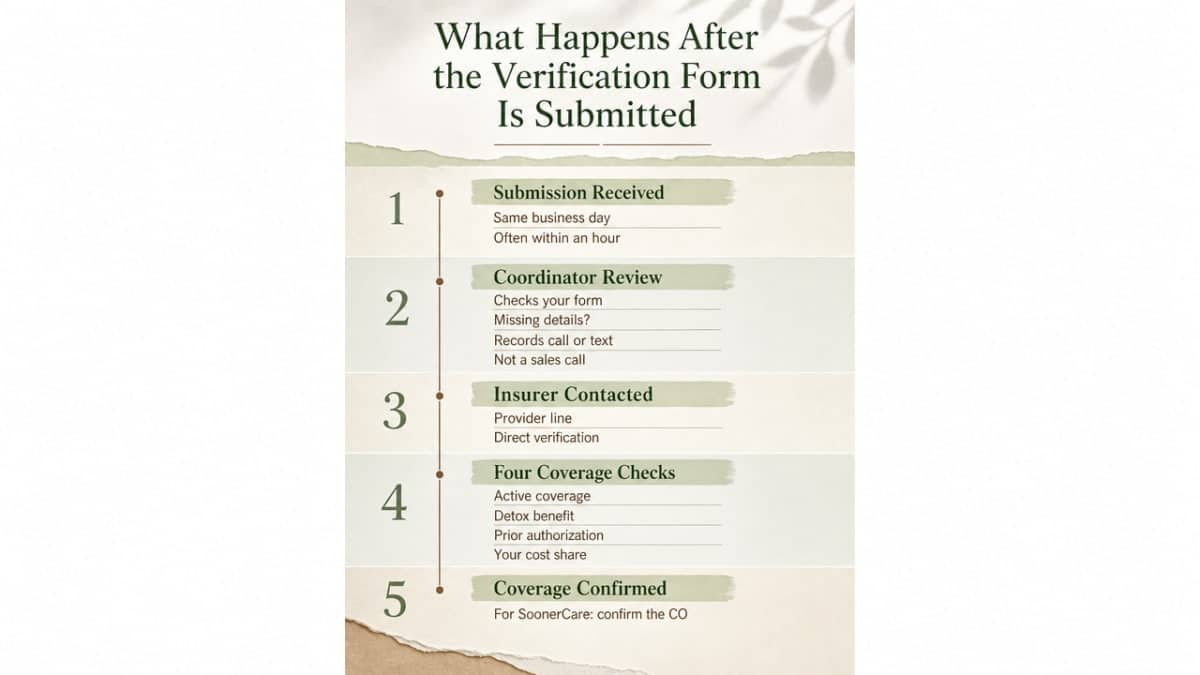
What Happens After the Verification Form Is Submitted
You hit submit on the Renewal Springs verification form, or you hang up after the first call. What now? The waiting is the part that eats at people, so here is the sequence, step by step, so you know what’s happening on the other end.
- Step one: a coordinator picks up your submission — usually within the same business day, often within an hour during regular hours. They read what you sent, and if anything critical is missing (a group number, a date of birth), they call or text you back to fill the gap. This is not a sales call. It’s a records call.
- Step two: they call your insurer directly. Using the provider line on the back of your card, the coordinator walks through the four checks — active coverage, detox as a covered benefit, prior authorization rules, and your cost share. For a SoonerCare member, this is where they confirm the covered benefit and identify that a PA is coming 8, 9. For a commercial plan, they pin down in-network status and the carrier’s specific authorization criteria.
- Step three: if prior authorization is required, the clinical team submits it. For SoonerCare, that’s the Adult Ages 18-64 Inpatient Medical Detox PA Request Form 12, processed by the state during business hours 10. For commercial plans, federal rules now push insurers toward expedited decisions within 72 hours for urgent care 5— and detox typically qualifies.
- Step four: a coordinator calls you back with plain-English numbers — what’s covered, whether PA is approved or pending, and your estimated out-of-pocket. Nothing is committed yet. You get the picture before you decide.
- Step five: if you say yes, admission is scheduled. Often the same day. Sometimes within hours. You come with the card and a bag. The paperwork is already done.
Common Fears About the Call — Answered Plainly
You are not the first person to hesitate before dialing. Here are the fears that keep phones face-down on kitchen tables, and what is actually true about each one.
“They’ll ask me something I can’t answer.” They won’t. If you don’t know your group number, the coordinator can find it. If you don’t remember the exact date of last use, “sometime last night” is enough to start. Missing pieces get filled in as you go — nobody gets rejected from a verification call for not having the right paperwork.
“Calling will trigger a bill.” A benefits check is not a billable service. Renewal Springs does not charge you to verify, and your insurer does not deduct anything from your plan for the phone call. Nothing hits your deductible until treatment is actually delivered.
“My employer will find out.” Your insurer cannot share your health information with your employer for a self-funded plan any differently than they would for a medical procedure — HIPAA covers substance use treatment the same way it covers a surgery. What your employer sees is what they see for any claim: a summary, not a diagnosis.
“They’ll say no, and then it’s on my record.” Verification produces answers, not denials. If prior authorization ends up required, that request comes later, and federal parity rules mean your insurer can’t apply stricter criteria to detox than to medical care 6. A tough call is not a failed one.
If Coverage Is Denied or Limited: Your Next Move in Oklahoma
A denial is not the end of the road. It is a paperwork step with a next move, and in Oklahoma you have more leverage than the first “no” makes it feel.
If your insurer comes back with a denial, a partial approval, or a day count that doesn’t match what your body actually needs, the first thing to know is that the Renewal Springs clinical team can file a peer-to-peer review — a doctor-to-doctor conversation where the medical necessity for continued detox is walked through directly with the insurer’s reviewer. This is standard, not confrontational. It is often where an initial five-day SoonerCare approval 10gets extended for a more complex withdrawal.
If the denial looks like a parity issue — a stricter rule for detox than the plan applies to medical care — you have a second lane. Federal parity law now treats prior authorization and step therapy as nonquantitative treatment limitations your insurer has to justify 4. For fully insured plans sold in Oklahoma, the Oklahoma Insurance Department enforces that same standard at the state level and takes consumer complaints directly 14, 15.
You don’t file these appeals alone. The coordinator names what’s happening, tells you which lane fits, and keeps you moving toward admission while the paperwork moves in parallel.
Talk Now to Confirm Your Insurance Coverage
Get clarity on your insurance and next steps in minutes with a real, supportive team member.
Frequently Asked Questions
Does it cost anything to have my insurance verified for detox at Renewal Springs?
No. Verifying your benefits is free and confidential. Renewal Springs does not charge you to make the call, and a benefits check is not a billable service on your plan — nothing hits your deductible. You are asking questions, not committing to treatment. If you decide not to come in, the call simply ends.
How long does insurance verification take before I can start detox?
Often the same day, sometimes within an hour during business hours. The benefits check itself is a short conversation with your carrier. If prior authorization is required, that adds a step — federal rules now push insurers toward expedited decisions within 72 hours for urgent care, which detox typically qualifies as 5. Admission is often scheduled the same day approval comes through.
Does SoonerCare cover medical detox in Oklahoma City?
Yes. Oklahoma Medicaid names inpatient medical detoxification as a covered benefit, right alongside inpatient acute care and crisis stabilization 8. Detox and residential substance use services are marked as covered with prior authorization required 9, and the initial approved window is up to five days based on medical necessity, with more available on clinical review 10. Renewal Springs submits the paperwork for you.
What information do I need to have ready when I call?
Your insurance card is the main thing — the member ID, group number, and the 1-800 number on the back. Add the policyholder’s full name and date of birth if it’s not you, plus a callback number and one emergency contact. On the clinical side, the primary substance, rough date of last use, and any current prescriptions. If pieces are missing, call anyway.
Will my employer find out if I use my insurance for detox?
No. HIPAA protects substance use treatment records the same way it protects records for a surgery or any other medical procedure. Your employer doesn’t see your diagnosis or where you sought care. What they see, at most, is what they see for any medical claim — a summary of costs paid, not the reason. Verification itself generates no claim and no employer notification.
What happens if my insurance denies coverage for detox?
A denial is a step, not the end. The Renewal Springs clinical team can file a peer-to-peer review — a doctor-to-doctor call — to walk through medical necessity with your insurer’s reviewer, and this is often where an initial SoonerCare five-day approval gets extended 10. If the denial looks like a parity issue, federal rules now treat prior authorization as a nonquantitative treatment limitation your insurer has to justify 4, and the Oklahoma Insurance Department takes consumer complaints on fully insured plans 14.
References
- The Mental Health Parity and Addiction Equity Act (MHPAEA). https://www.cms.gov/marketplace/private-health-insurance/mental-health-parity-addiction-equity
- Mental Health and Substance Use Insurance Help. https://www.hhs.gov/programs/health-insurance/mental-health-substance-use-insurance-help/index.html
- Mental health & substance abuse coverage. https://www.healthcare.gov/coverage/mental-health-substance-abuse-coverage/
- Departments of Labor, Health and Human Services, Treasury Issue Final Rules Strengthening Access to Mental Health and Substance Use Disorder Benefits. https://www.cms.gov/newsroom/press-releases/departments-labor-health-and-human-services-treasury-issue-final-rules-strengthening-access-mental
- CMS Interoperability and Prior Authorization Final Rule (presentation). https://www.cms.gov/files/document/cms-interoperability-and-prior-authorization-final-rule-presentation-3-26-24.pdf
- New Mental Health and Substance Use Disorder Parity Rules. https://www.dol.gov/agencies/ebsa/laws-and-regulations/laws/mental-health-parity/new-mhpaea-rules-what-they-mean-for-providers
- Parity – Medicaid. https://www.medicaid.gov/medicaid/benefits/behavioral-health-services/parity
- Behavioral Health and Substance Abuse Services. https://oklahoma.gov/ohca/individuals/mysoonercare/soonercare-benefits/behavioral-health-and-substance-abuse-services.html
- Mental Health and Substance Abuse Services – Oklahoma.gov. https://oklahoma.gov/ohca/individuals/programs/mental-health-and-substance-abuse-services.html
- Behavioral Health Prior Authorization Procedures. https://oklahoma.gov/content/dam/ok/en/okhca/docs/providers/types/behavioral-health/OHCA%20BH%20Manual.pdf
- Provider Certification. https://oklahoma.gov/odmhsas/policy/provider-certification.html
- Behavioral Health and Substance Abuse Services. https://oklahoma.gov/ohca/providers/types/behavioral-health-and-substance-abuse-services.html
- Mental Health Parity and Addiction Equity Act – Oklahoma Insurance Department. https://www.oid.ok.gov/regulated-entities/financial/financial-regulation-forms/mentalhealthparity/
- Mental/Behavioral Health and Insurance. https://www.oid.ok.gov/mental-behavioral-health-and-insurance/
- LH BULLETIN NO. 2020-05. https://www.oid.ok.gov/lh-bulletin-no-2020-05/