
Key Takeaways
- Leaving detox in Oklahoma City should include a written continuing-care folder with a scheduled outpatient appointment, relapse-prevention plan, medication list, housing plan, and peer contact before discharge 1, 10.
- The first outpatient follow-up should fall inside 24 to 72 hours after discharge, and no later than 7 days, with structured caring contacts continuing for 12 months or more 3.
- Choosing residential, IOP, or sober living depends on home safety, co-occurring conditions, and housing stability — fix a shaky address first through ODMHSAS recovery housing if that’s the real gap 2, 14.
- Save 988 and SAMHSA’s 1-800-662-HELP in your phone before leaving, and use the ODMHSAS directory for local peer support, transportation, and food resources in Oklahoma City 9, 15, 17.
The day you leave detox shouldn’t feel like a blank page
Here is the truth almost nobody says out loud: for a lot of people, the day you walk out of detox feels scarier than the day you walked in. Coming in, you at least knew the next step was a bed, a nurse, and someone watching the withdrawal for you. Going home can feel like the floor drops away. If you’re feeling that right now, or you’re a spouse or parent reading this with a knot in your stomach, that fear is not a failure. It’s a normal reaction to a real gap that too many people fall into.
You got through detox. That is a genuine win, and it counts. Now the goal is simple to say and specific to build: you should not leave the building without a written continuing-care plan already in motion. National guidance is clear that discharge planning has to include the next appointment, the relapse-prevention plan on paper, and a link to community supports before you go 1, 2. Not a shrug. Not a stack of pamphlets.
In Oklahoma City, that plan can be real. This guide walks you through exactly what it should look like.
What a real continuing-care handoff looks like
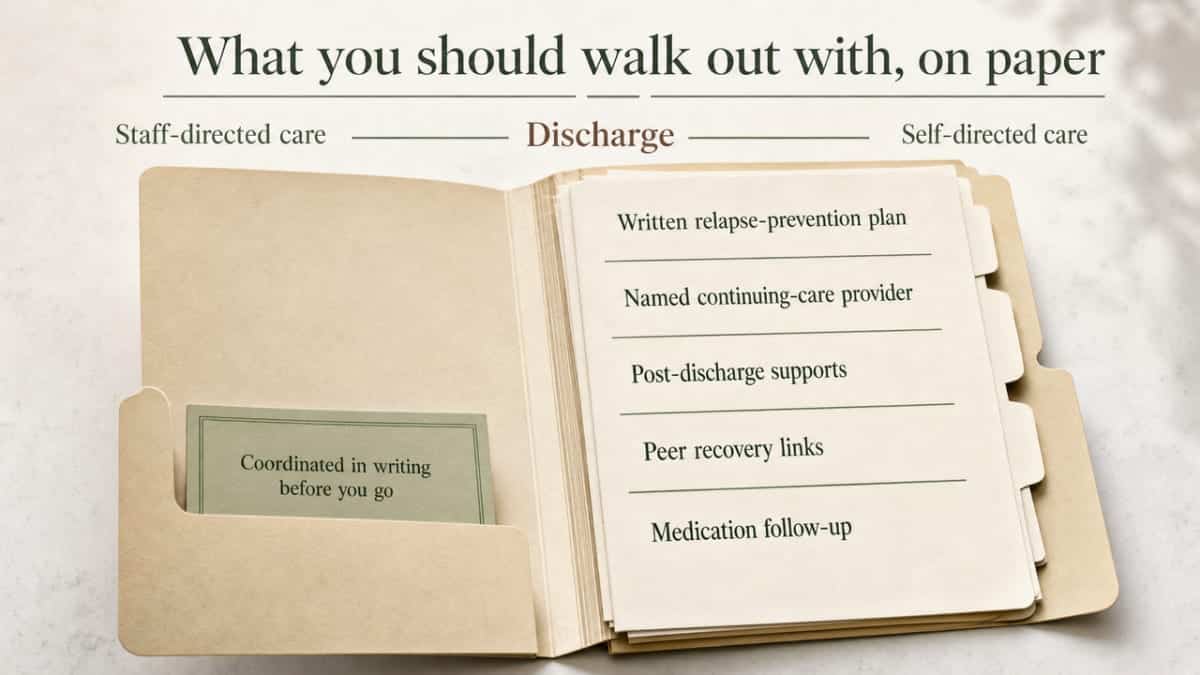
What you should walk out with, on paper
Think of your discharge folder as the difference between hope and a plan. Hope is fragile at 8 a.m. on the day you leave. A folder in your hand is not. SAMHSA’s case-management guidance is direct: the discharge stage is when a person shifts from staff-directed care to self-directed care, and that shift only works when the aftercare pieces are already coordinated in writing before you go 1. The transition-plan checklist used across SAMHSA clinical guidance names the essentials plainly: a relapse-prevention plan and a named continuing-care provider 10. For co-occurring anxiety, depression, or trauma, that same guidance says post-discharge supports, peer recovery links, and medication follow-up should be discussed with you, not handed to you 2.
Here is what your folder should physically contain before you walk out:
- A written relapse-prevention plan in your own words — your triggers, your early warning signs, and who you call first 10.
- The name, address, and appointment date for your next outpatient provider 1.
- Your medication list, including any MAT prescription, the next refill date, and the pharmacy 2.
- A housing plan — where you sleep tonight, tomorrow, and next week.
- One peer support contact (a sponsor, a peer recovery specialist, or a meeting time) 2.
- 988 and the SAMHSA National Helpline (1-800-662-HELP) saved in your phone 9.
If any of these are blank when the paperwork comes out, that is your cue to ask. You are allowed to slow the discharge down until they are filled in.
The clock on your first follow-up appointment
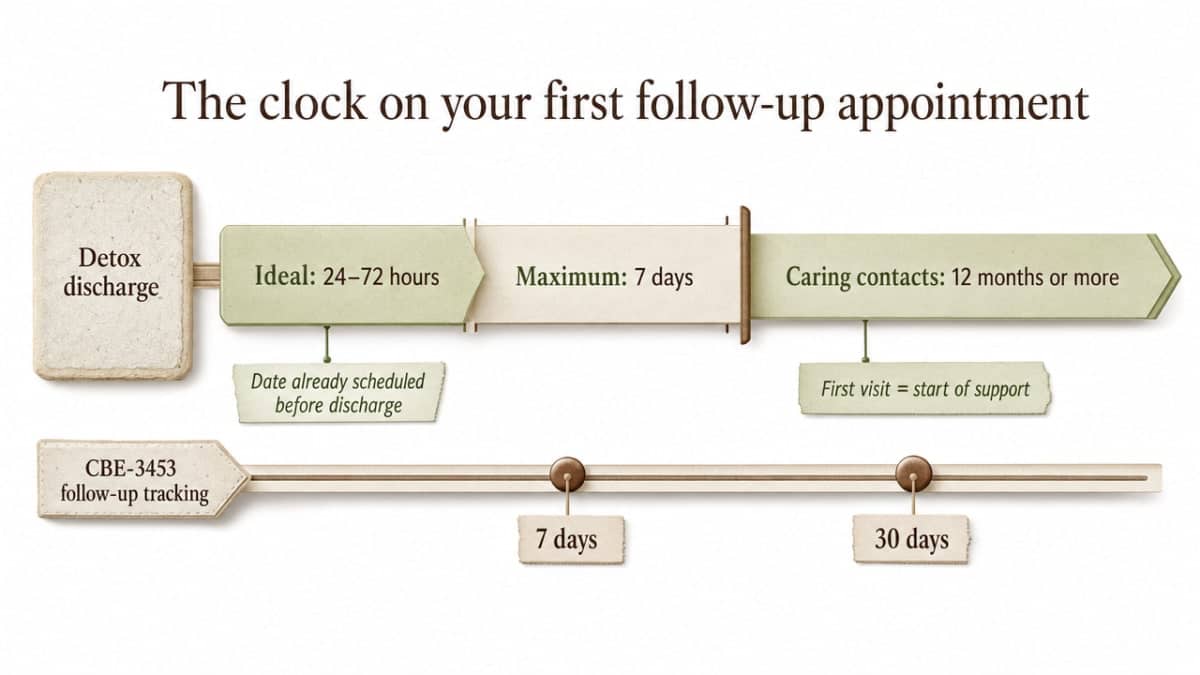
The single most important date in your folder is the date of your first outpatient appointment. Not the phone number to call later. Not the referral to figure out on Monday. The actual date, already scheduled, before you sign your discharge papers.
Why does this timing matter so much for you personally? The first 72 hours after detox are when withdrawal echoes, sleep is broken, and old cues show up in familiar places. An appointment already on the calendar gives that week a shape. It tells your brain there is somewhere to be and someone expecting you.
Ask three specific questions before you leave:
- What is the date and time of my first outpatient appointment?
- Who is the provider, and where is their office?
- What is the backup plan if that appointment cancels?
If the answer to the first question is “we’ll help you set that up after you leave,” that is not a schedule. That is a wish. A real handoff has a real date, inside the 24-to-72-hour window when possible and no later than 7 days out 3, 7.
Why ‘discharged with nothing’ is the fear to name out loud
Let’s say the thing you’ve been afraid to say: what if they just open the door and you walk out with a paper bag and a shrug? That fear is not paranoia. It’s a reasonable response to a real pattern that clinicians themselves have flagged. The NCBI review of continuing care is blunt about it — programs that discharge before threats to recovery are addressed leave people exposed, and continuing-care planning has to be a central task, not an afterthought 6.
Naming the fear helps you push back on it. You are allowed to ask, out loud: “What does my week look like after I leave here?” You are allowed to ask your family member to ask the same question on the day of intake, not the day of discharge. And you are allowed to feel every bit of the anxiety that comes with that question. Feeling scared about the next step is not a sign you can’t do this. It’s a sign you’re taking the next step seriously.
A good handoff replaces the blank page with a page that has your name on it, a date on it, and a phone number that answers. That is the standard. If it’s missing, ask for it. If it’s there, take a breath — you already did the hard part by getting this far.
Your first 72 hours after discharge
Hour 0 to 24: the ride home and the first night
The car ride home is quieter than you expect. The city looks the same. You feel different. Some people cry in the parking lot before they even close the door. That is okay. You just did something hard, and your nervous system is still catching up.
Here is the plan for the first day, kept small on purpose. Eat something. Drink water. Take your medications on the schedule your discharge paperwork lists, including any MAT dose and the next refill date 2. Put 988 and 1-800-662-HELP into your phone as favorites before you unpack anything else 9, 15. Text one person from your support list — a sponsor, a peer specialist, a sibling — and tell them you’re home.
Then rest. Sleep will be uneven. Cravings can show up around familiar cues: a certain chair, a certain hour, a certain song. That is your brain remembering, not you failing. If a wave hits hard, call 988 before you talk yourself out of it 15. The first night is a night, not a test. Getting through it counts.
Day 2 to 3: the first appointment, the first meeting, the first refill
Day two is where the plan starts doing the work for you. Look at your folder. Your first outpatient appointment should already be on the calendar, ideally inside this 24-to-72-hour window that SAMHSA names as the target for a warm handoff 3. Set two alarms — one an hour before, one thirty minutes before. If someone is driving you, confirm the ride the night before. If you’re taking the bus, screenshot the route.
Show up even if you feel raw. Especially if you feel raw. That first visit is where your outpatient team meets the version of you that just came through detox, and where they start the caring contacts that best-practice guidance says should continue for 12 months or more 3. Bring your discharge summary. Bring your medication list. Ask them to confirm your next appointment before you leave the office.
Day three, add the other two anchors. Go to your first peer support meeting — in person if you can, virtual if you can’t. Post-discharge peer recovery links are part of what SAMHSA calls collaborative continuing care, not extra credit 2. Then handle the first refill. Know the pharmacy, know the pickup time, and know who to call if there’s a hold. Three appointments, three anchors, three days. That’s the shape of the week.
Choosing the next level of care without the jargon
When residential makes sense
Residential means you keep sleeping in a treatment bed for a stretch — usually a few weeks — while you keep working on the reasons the substance had a grip on you. It’s the right next step when the honest answer to “can I stay safe at home this week?” is no. That can look like a home where the substance is still in the house, a partner who is still using, or nowhere stable to sleep. It can also look like heavy co-occurring depression, anxiety, or trauma that needs daily eyes on it, which SAMHSA specifically flags as a reason to plan for more intensive post-discharge support, not less 2. Clinical guidance is direct: don’t step down until the threats to recovery are actually addressed 6. If yours aren’t, residential is not failure. It’s the plan working.
When IOP is enough
IOP stands for intensive outpatient — a few group sessions a week that you go home from. Most people do three sessions, three hours each, plus individual counseling and medication follow-up. It’s the right fit when you have a safe place to sleep, someone who knows you’re in treatment, and a schedule that can hold appointments without falling apart. IOP is also where continuing-care planning does its real work — the NCBI continuum-of-care guidance calls that planning a central task, not a formality 6. If your team uses a Matrix-style track, expect a weekly social support group that runs for 36 weeks of continuing care alongside the group sessions, plus at least one community recovery meeting each week 5. That is a long enough runway to let the new routine feel like your routine, not a program you’re visiting.
When sober living matters more than the clinical step
Sometimes the clinical piece is fine and the housing piece is the emergency. If you’re going back to a couch you can’t count on, a household where people still use, or an apartment tied to old cues, sober living is the move — even if your clinical level is “just” IOP or standard outpatient. A stable bed changes what you can hear in group and what you can carry home. ODMHSAS recovery housing pairs immediate independent housing with intensive recovery support and links to community mental health treatment, with the stated goal of helping people obtain and sustain permanent supportive housing 14. Ask your discharge planner to name the housing option out loud, with an address, before you sign out. If the clinical plan is solid and the address is a question mark, fix the address first.
The Oklahoma City support network you can actually use
ODMHSAS housing, peer support, and transportation
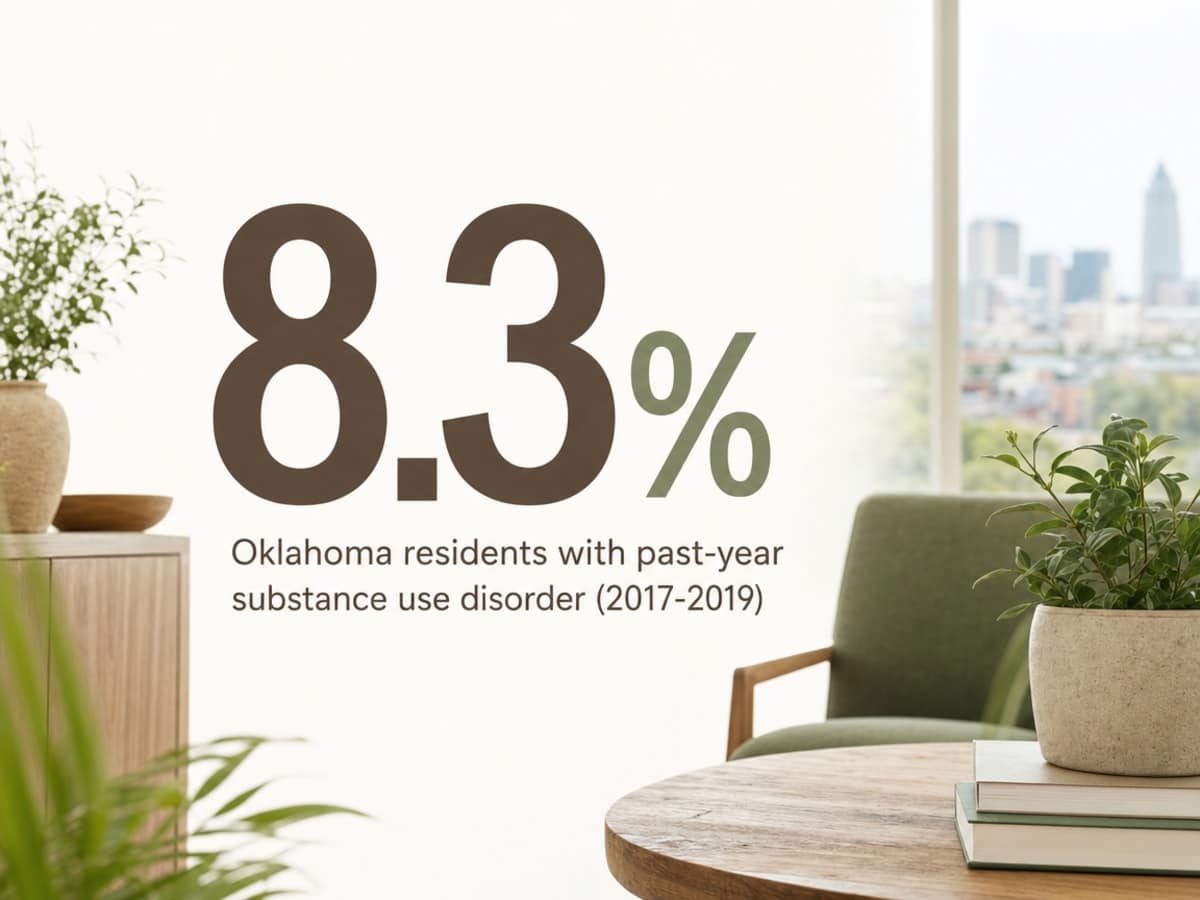
If you feel like you’re the only person in Oklahoma City trying to build a life after detox, please hear this: you are not. During 2017–2019, about 8.3% of Oklahomans age 12 and older — roughly 267,000 people — had a past-year substance use disorder 11. That number is not there to scare you. It’s there to tell you the local network was built at real scale, because the need is at real scale. You are walking into a system that has been getting bigger, not smaller.
The Oklahoma Department of Mental Health and Substance Abuse Services (ODMHSAS) is the backbone of that network. Their recovery housing program can place you in immediate independent housing paired with intensive recovery support and a link to community mental health treatment, with the goal of helping you obtain and sustain a permanent place to live 14. The ODMHSAS Community Recovery Support Services Directory lists Oklahoma City agencies that offer peer counseling, transportation help like agency bus passes, emergency food, and socialization opportunities 17. Those pieces — a bed, a bus pass, a peer who has been where you are, a meal you didn’t have to figure out — are exactly what turns a discharge plan into a livable week.
Oklahoma City is also building out more capacity through the MAPS 4 mental health and addiction projects, with ODMHSAS operating treatment provider organizations across the state’s safety-net system 16. Ask your discharge planner to name at least one ODMHSAS-linked resource by service and address before you leave. “Peer support at this agency, Tuesday at 6 p.m.” beats “here’s a directory” every time.
Crisis numbers to save in your phone before you leave
Do this before you pack your bag. Open your phone, add these contacts, and mark them as favorites so they show up first when your hands are shaking.
- 988 — the Suicide & Crisis Lifeline. The City of Oklahoma City points residents in crisis to 988 as a 24-hour helpline for mental health resources; you can call, text, or chat 15.
- 1-800-662-HELP (4357) — SAMHSA’s National Helpline. Free, confidential, 24/7, 365 days a year, for treatment referrals and information for you or a family member 9.
- Your outpatient provider’s direct line — from your discharge folder.
- One person from your support list — the human you’ll actually call before you call anyone else.
National crisis guidance treats follow-up as a core part of the crisis continuum, not an add-on, and connecting people to community-based supports is part of that follow-through 4. In plain terms: these numbers are supposed to answer, and the people on the other end are supposed to help you get somewhere safe. Save them tonight. You may never need them. If you do, you won’t have to think.
For the person helping build the calendar
A quick note to the spouse, parent, sibling, or adult child reading this over someone’s shoulder: you are not being paranoid, and you are not being pushy. You are being useful. When a person leaves detox, their bandwidth for phone trees and paperwork is low. Yours is higher. That gap is where you help.
Ask to be part of the discharge planning meeting, not just the pickup. SAMHSA’s guidance for co-occurring disorders is explicit that long-term follow-up should be discussed collaboratively so the client is fully aware of the supports and services in place — and that conversation goes better when a family member is in the room to write things down 2. Bring a notebook. Ask for the first outpatient appointment date, the provider’s address, the medication refill date, and the crisis line before you leave the building 1.
Once you’re home, your job is the calendar, not the coaching. Put the first appointment on a shared calendar. Set the pharmacy pickup as a reminder. Save 988 and 1-800-662-HELP in your own phone too 9, 15. If a peer support meeting is on the plan, offer the ride without making it a negotiation.
One more thing: take care of yourself in this. Your steadiness is part of the plan working.
The 30-day checklist and the 36-week horizon
Zoom out for a minute. The first month is about building rhythm; the months after are about letting that rhythm hold.
Here is what the first 30 days can look like, kept simple:
- Week 1: Attend your first outpatient appointment inside the 24-to-72-hour window your discharge team scheduled 3. Go to one peer support meeting. Pick up your first medication refill on time 2.
- Week 2: Settle into your IOP or outpatient schedule. Confirm your housing plan is holding — if it isn’t, call your discharge planner or ODMHSAS recovery housing before it becomes a crisis 14.
- Week 3: Add a second peer contact. Two people who know your week is better than one.
- Week 4: Sit down with your outpatient provider and update the relapse-prevention plan. What you wrote on day one is not what you know by day 28.
Then keep going. The Matrix continuing-care model asks people to attend a weekly social support group for 36 weeks alongside at least one community recovery meeting each week 5. That is not a punishment sentence. It is a runway — long enough for the new routine to stop feeling like a program and start feeling like your life. Small wins, week after week, are how this actually works.
How Renewal Springs builds the handoff with you
Here is where Renewal Springs fits in the picture you’ve been building. The team’s job doesn’t end when the withdrawal ends. It ends when you walk out with a real next step — a scheduled outpatient appointment, a written relapse-prevention plan, a housing answer, a peer contact, and the crisis numbers already in your phone 1, 2. That handoff is built with you, not handed to you at the door.
If you’re the person calling admissions — for yourself or for someone you love — this is the question worth asking out loud: How do you support the transition after detox? Ask about the timing of that first outpatient appointment. Ask about the housing conversation. Ask who helps coordinate the folder. You did the hard part by picking up the phone. A team that answers those questions plainly is the team that will help you leave with a plan, not a shrug.
Talk Through Your Next Steps After Detox
Get real answers about planning your transition and support after medical detox.
Frequently Asked Questions
How soon after detox should I have my first outpatient appointment in Oklahoma City?
The target window is 24 to 72 hours after discharge, and no later than 7 days out 3. That date should already be on the calendar before you sign your discharge paperwork, not something you call to arrange from home. If the answer you’re getting is “we’ll help you set that up after,” ask again — a real handoff has a real date, a provider name, and an address.
What documents and contacts should I actually leave detox with?
At minimum: a written relapse-prevention plan in your own words, your first outpatient appointment date and provider address, your medication list with the next refill date, a housing plan for tonight and next week, one peer support contact, and 988 plus 1-800-662-HELP saved in your phone 1, 10, 9. If any line is blank when the folder comes out, slow the discharge down until it’s filled in.
Do I need residential treatment, IOP, or sober living after detox?
It depends on what’s shaky. If home isn’t safe or co-occurring depression, anxiety, or trauma needs daily eyes, residential is the honest next step 2. If you have a safe bed and a schedule that holds, IOP — a few group sessions a week you go home from — is often enough 6. If the clinical piece is fine but housing isn’t, fix the address first with sober living 14.
What if I don’t have a safe place to live after discharge?
Tell your discharge planner before you leave. ODMHSAS runs recovery housing that pairs immediate independent housing with intensive recovery support and links to community mental health treatment, with the goal of helping you sustain permanent supportive housing 14. The ODMHSAS Community Recovery Support Services Directory also lists Oklahoma City agencies offering peer counseling, transportation help, and emergency food 17. A shaky address is a solvable problem — but only if you name it out loud.
Who do I call if a crisis hits in the first days at home?
Call, text, or chat 988 — the City of Oklahoma City points residents in crisis to it as a 24-hour helpline 15. For treatment referrals or if you’re helping a loved one, call SAMHSA’s National Helpline at 1-800-662-HELP, free and confidential 24/7, 365 days a year 9. National crisis guidance treats follow-up as a core part of the continuum, not an extra 4. Save both numbers tonight so you don’t have to think later.
How can I help a family member plan their life after detox?
Ask to be in the discharge planning meeting, not just the pickup. SAMHSA guidance says long-term follow-up should be discussed collaboratively so everyone knows the supports in place 2. Bring a notebook. Write down the first appointment date, provider address, refill date, and crisis numbers 1. At home, own the calendar — the appointment, the pharmacy pickup, the peer meeting ride. Save 988 in your phone too 15. Steadiness is part of the plan working.
References
- TIP 27: Comprehensive Case Management for Substance Abuse Treatment. https://library.samhsa.gov/sites/default/files/sma15-4215.pdf
- Treatment of Co-Occurring Disorders: Guidance for Inpatient and Residential Settings (PEP20-02-01-004). https://library.samhsa.gov/sites/default/files/SAMHSA_Digital_Download/PEP20-02-01_004.pdf
- Best Practices in Care Transitions for Individuals with Suicide Risk: Inpatient Care to Outpatient Care. https://www.samhsa.gov/sites/default/files/suicide-risk-practices-in-care-transitions-11192019.pdf
- 2025 National Guidelines for a Behavioral Health Coordinated Crisis System. https://library.samhsa.gov/sites/default/files/national-guidelines-crisis-care-pep24-01-037.pdf
- Counselor’s Treatment Manual: Matrix Intensive Outpatient Treatment for People With Stimulant Use Disorders. https://library.samhsa.gov/sites/default/files/sma13-4152.pdf
- Chapter 3. Intensive Outpatient Treatment and the Continuum of Care (Substance Abuse Treatment: Group Therapy). https://www.ncbi.nlm.nih.gov/books/NBK64088/
- Continuity of Care After Inpatient or Residential Treatment for Substance Use Disorder (CBE-3453 Technical Specifications Manual). https://www.samhsa.gov/sites/default/files/cbe-3453-technical-specifications-manual.pdf
- The Institute of Medicine’s Continuum of Care. https://www.samhsa.gov/resource/sptac/institute-medicines-continuum-care
- National Helpline for Mental Health, Drug, Alcohol Issues. https://www.samhsa.gov/find-help/helplines/national-helpline
- Quick Guide for Clinicians Based on TIP 30: Continuity of Offender Treatment for Substance Use Disorders. https://library.samhsa.gov/sites/default/files/sma15-3594.pdf
- Behavioral Health Barometer: Oklahoma, Volume 6. https://www.samhsa.gov/data/sites/default/files/reports/rpt32853/Oklahoma-BH-Barometer_Volume6.pdf
- NSDUH Behavioral Health Barometer: Oklahoma, Volume 8. https://www.samhsa.gov/data/report/nsduh-behavioral-health-barometer-oklahoma-volume-8
- OKLAHOMA – 2023 NSDUH State Tables (Substance Use and Mental Health Measures). https://www.samhsa.gov/data/sites/default/files/reports/rpt56188/2023-nsduh-sae-state-tables_0/2023-nsduh-sae-state-tabs-oklahoma.pdf
- Housing – ODMHSAS Recovery Support Housing Programs. https://oklahoma.gov/odmhsas/recovery/housing.html
- Mental Health Services – City of Oklahoma City. https://www.okc.gov/Services/Public-Safety/Mental-Health-Services
- City Council selects operators for MAPS 4 Mental Health and Addiction projects. https://www.okc.gov/News-articles/City-Council-selects-operators-for-two-MAPS-4-Mental-Health-and-Addiction-projects
- Oklahoma Department of Mental Health and Substance Abuse Services – Community Recovery Support Services Directory. https://digitalprairie.ok.gov/digital/api/collection/stgovpub/id/8690/download