
Key Takeaways
- Cigna plans almost always cover medically supervised detox when a licensed clinician documents medical necessity, though the setting, length of stay, and prior authorization rules depend on your specific policy.
- Federal parity law and ACA essential health benefits protect substance-use coverage, but the floor still comes from your plan document, which is why fully insured, self-funded, and Marketplace plans behave differently 1, 12, 5.
- Most detox denials trace to four causes: weak medical-necessity documentation, out-of-network facilities, missed prior authorization, or self-funded plan design, and many are reversible through appeal or peer-to-peer review 10, 11.
- Verifying benefits should cover the full arc of care, including medication-assisted treatment after discharge, since CDC guidance warns that detox alone without ongoing OUD medication raises the risk of resumed use and overdose 13.
The Short Answer, Before You Make Another Call
Yes. In almost every case, Cigna plans cover medically supervised detox when a licensed clinician documents that you need it. The harder question is how your specific plan pays for it, which setting it will approve, and whether prior authorization is required before you walk through the door.
Here is what you can hold onto right now, before you dial anyone. Federal parity law prevents Cigna from making substance-use-disorder benefits harder to use than comparable medical benefits 1. If your coverage came through the Health Insurance Marketplace, substance-use treatment is a required essential health benefit 12. If it came through an employer, the answer depends on how that plan is funded, which you will want to confirm before admission 5.
You are not behind for not knowing this yet. Insurance language is designed to be opaque, and you are reading it during one of the most stressful weeks of your life. The next few sections walk you through what Cigna typically approves, what gets pushed back on, and exactly what to ask so you leave the call with real answers instead of more questions.
What Cigna Will Usually Say Yes To (and What They Push Back On)
Detox Settings Cigna Plans Typically Cover
When a licensed clinician documents that withdrawal poses a real medical risk, Cigna generally pays for detox across a range of settings. The specific setting your plan approves depends on what your clinical presentation calls for, not on what you request.
Here is what tends to land inside the yes column:
- Inpatient medical detox. A 24/7 supervised stay for alcohol, opioid, or benzodiazepine withdrawal, where seizures, delirium tremens, cardiac stress, or protracted opioid symptoms require around-the-clock nursing and physician oversight.
- Residential detox with medical monitoring. A step down from acute hospitalization, with vital-sign checks, medication protocols, and licensed clinical staff on-site.
- Outpatient or ambulatory detox. Scheduled clinic visits with medication management for people whose withdrawal risk is lower and whose home environment is safe.
- Medication-assisted treatment during and after detox. Buprenorphine, methadone, and naltrexone for opioid use disorder are FDA-approved and clinically recommended, and your plan is expected to treat them as covered medical care rather than optional add-ons 13.
For Cigna policies sold through the Health Insurance Marketplace, substance-use-disorder treatment, including inpatient behavioral-health care, falls inside the essential health benefits every Marketplace plan must cover 12. Employer-sponsored Cigna plans usually cover these same settings, though the exact level of care, length of stay, and in-network facility list vary by plan. The pattern across all of them: if a clinician can show the care is medically necessary, Cigna is designed to pay.
The Four Things That Can Still Get a Detox Stay Denied
Approval is the default when detox is medically necessary, but denials still happen. Almost every one you will see traces back to one of four things. Knowing which bucket you are in changes what you do next.
- Medical necessity wasn’t documented clearly enough. Cigna uses clinical criteria to decide whether inpatient detox is justified versus outpatient. If the admitting notes don’t spell out withdrawal severity, co-occurring conditions, prior failed attempts, or safety concerns at home, the stay can be downgraded or denied. You have the right to request the medical-necessity criteria the plan used and the specific reason for the denial 11.
- The facility is out of network. Even a covered benefit can hit a wall if the detox provider doesn’t have a Cigna contract. In-network stays almost always cost less and clear authorization faster.
- Prior authorization wasn’t obtained. Most Cigna plans require the facility to call for approval before admission, or within a short window after an emergency admit. Skipping that step is a common, and often reversible, reason for denial.
- The plan funding type limits the benefit. A self-funded employer plan may design its SUD benefits differently than a fully insured plan, which affects what gets approved and under what rules.
Federal Law vs. Your Actual Plan Document
What Parity and the ACA Guarantee
There are two separate things working in your favor here, and it helps to see them as two different tools instead of one big promise.
The first is the Mental Health Parity and Addiction Equity Act. Parity doesn’t force every plan to cover substance-use treatment, but when a plan does include those benefits, it can’t make them harder to use than comparable medical and surgical benefits. That applies to copays, deductibles, visit limits, and the less obvious stuff like prior authorization and medical management 1. The 2024 MHPAEA final rules sharpened that standard. Plans now have to study their own data and show that restrictions on substance-use care aren’t more burdensome than restrictions on comparable medical care, and they have to fix what the analysis exposes 2.
The second tool is the Affordable Care Act. Marketplace plans must cover substance-use-disorder treatment and inpatient behavioral-health services as essential health benefits 12. So if you bought your Cigna coverage through Healthcare.gov, SUD treatment isn’t a bonus feature. It’s required.
Here is what parity does not do. It doesn’t guarantee that every detox facility is in your network, that every length of stay gets approved, or that your preferred setting is the one your plan will pay for. It sets the ceiling on how restrictive the plan can be. The floor still comes from your own policy document.
Why Your Cigna Plan Type Changes Everything
Two neighbors can both hand over a Cigna card at the same detox facility and get wildly different answers. That isn’t a mistake. It’s the plan type doing the talking.
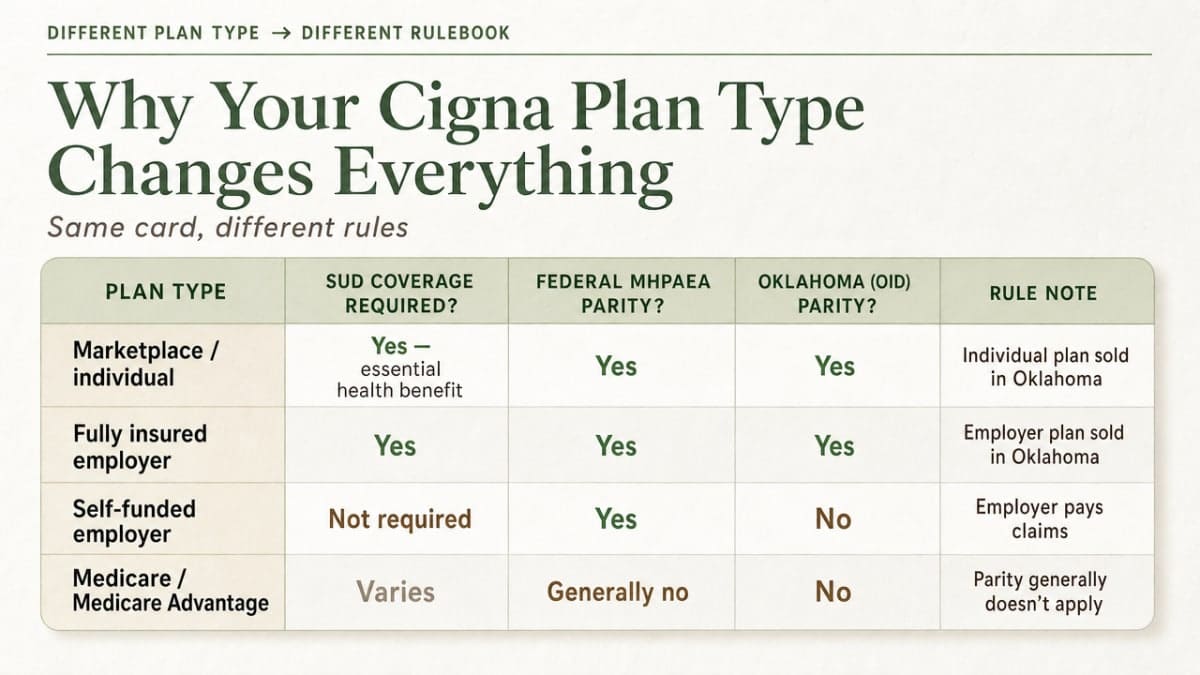
Cigna sells and administers coverage under four main arrangements, and each one answers to a different set of rules. The Oklahoma Insurance Department spells out the distinction that trips up most families: fully insured individual and employer plans sold in Oklahoma must include mental-health and substance-use-disorder benefits, while self-funded employer plans aren’t required to include those benefits at all, and parity generally doesn’t apply to Medicare fee-for-service or Medicare Advantage 5.
| Cigna plan type | SUD coverage required? | Federal MHPAEA parity applies? | State (OID) parity applies? |
|---|---|---|---|
| Marketplace / individual | Yes, as an essential health benefit 12 | Yes 1 | Yes, for Oklahoma-regulated plans 5 |
| Fully insured employer | Yes, under Oklahoma rules 5 | Yes 1 | Yes 5 |
| Self-funded employer (ASO) | Not required, but if offered, parity applies 5 | Yes, if SUD benefits are offered 1 | No, regulated federally |
| Medicare Advantage | Follows Medicare rules | Generally no 5 | No 5 |
Here is why this matters in practice. If your coverage runs through a large employer, there is a real chance it’s self-funded, meaning the employer pays claims directly and uses Cigna only to administer the plan. Those plans can still be generous with detox benefits, and many are. But the rules that force them to be generous are different, and the appeals process can land in a different jurisdiction if something gets denied.
You don’t have to memorize any of this. You just need to know one thing before you make the verification call: ask whether your plan is fully insured or self-funded. That single answer tells the facility’s benefits team which playbook to run, and it tells you whose rules protect you if things get complicated.
The Oklahoma City Lens: What Local Readers Should Know
If you’re reading this from Edmond, Norman, Midwest City, or anywhere else inside the OKC metro, there are a few state-level details worth tucking into your back pocket before you call Cigna.
Oklahoma’s Insurance Department has been direct about one thing: when a plan requires prior authorization for behavioral-health treatment but doesn’t require it for comparable medical treatment, that pattern can raise a parity concern worth reporting 4. That matters for you because it means a frustrating approval delay for detox isn’t automatically something you have to accept. OID has also issued regulatory guidance saying plans may not impose more restrictive quantitative or nonquantitative limitations on substance-use benefits than on medical and surgical benefits 6. If your Cigna plan is Oklahoma-regulated and something feels off, the state has a channel for that.
One local point of confusion worth clearing up: you may have heard that detox in Oklahoma is capped at five days. That cap exists in the SoonerCare behavioral-health manual as an initial authorization maximum for chemical-dependency detoxification under Medicaid rules 9. It is not a Cigna limit. SoonerCare and private Cigna coverage run on separate playbooks, and your Cigna plan’s length-of-stay decisions come from its own medical-necessity criteria, not from state Medicaid policy.
The useful takeaway for OKC families: your location gives you both federal parity protections and a state insurance department that has already named this kind of friction as a red flag worth flagging.
A Verification Script That Actually Works
What to Have in Front of You Before You Dial
Set yourself up before you pick up the phone. The call goes faster, you sound calmer, and the Cigna rep can actually look things up instead of asking you to call back.
Gather these in one spot:
- Your Cigna insurance card, front and back. The member ID, group number, and the behavioral-health phone number on the back are what the rep will ask for first.
- The full legal name and date of birth of the person who needs detox, exactly as they appear on the policy.
- The substance or substances involved and roughly how long dependence has been active. You don’t need clinical language. Plain description is fine.
- A notepad, a pen, and a quiet half hour. These calls run 15 to 40 minutes.
- If you have it, the name and phone number of the detox facility you’re considering, so Cigna can confirm network status in the same call.
One small thing that helps more than it should: write down the time you called and the rep’s first name before you ask a single question.
The Exact Questions to Ask Cigna
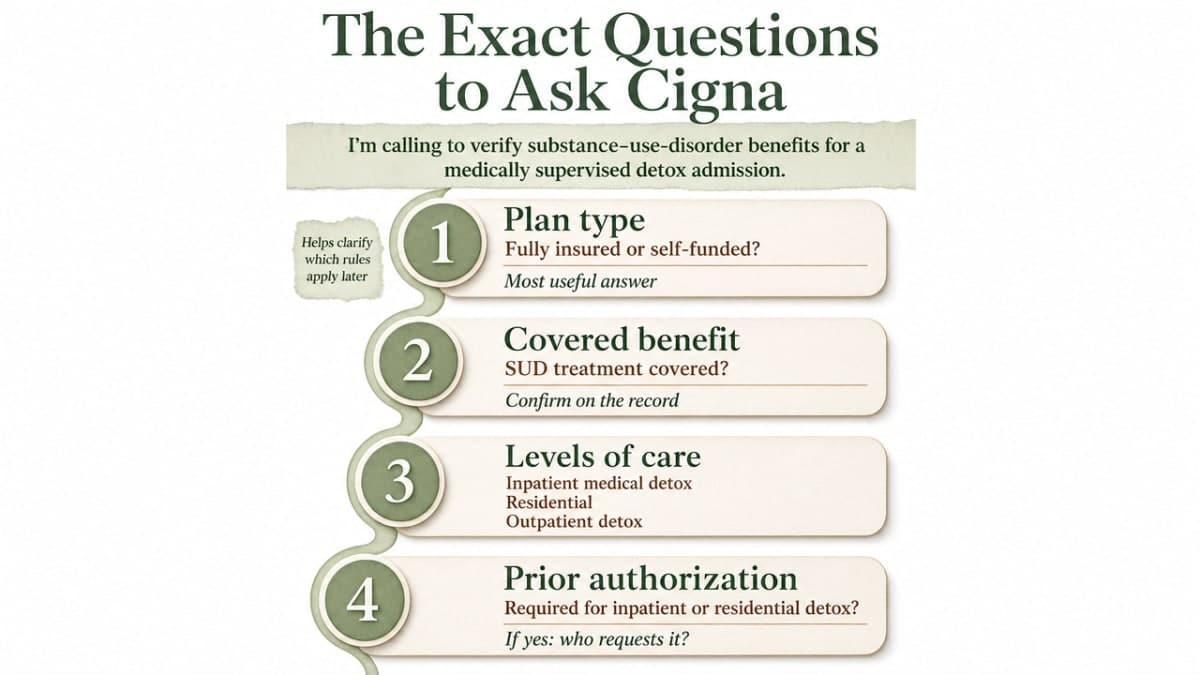
Open with: “I’m calling to verify substance-use-disorder benefits for a medically supervised detox admission.” That one sentence routes you to the right department and signals you know what you’re asking about.
Then work through this list in order. Don’t let the rep skip ahead.
- Is my plan fully insured or self-funded? This is the single most useful answer you’ll get, because it tells you which rules protect you if something is denied later 5.
- Is substance-use-disorder treatment a covered benefit under this plan? For Marketplace coverage the answer is yes by federal rule 12, but confirming it on the record matters.
- What levels of care are covered — inpatient medical detox, residential, and outpatient detox? Ask about each one specifically.
- Is prior authorization required for inpatient or residential detox? If yes, who requests it, and what is the turnaround time?
- What medical-necessity criteria does the plan use to approve inpatient detox? You have the right to request those criteria in writing 11.
- What is my deductible, what have I met so far this year, and what is my out-of-pocket maximum?
- What is my coinsurance or copay for in-network inpatient detox? For out-of-network?
- Is [facility name] in-network for behavioral health? Network lists for behavioral health sometimes differ from medical, so confirm this directly.
- Does the plan cover medication-assisted treatment during and after detox, including buprenorphine, methadone, and naltrexone? CDC guidance treats these as the clinical standard for opioid use disorder 13, and you want to know now whether coverage continues after discharge.
- If the stay is denied, what are my appeal rights, and what are the deadlines?
If the rep hedges or says “it depends on medical necessity,” that is a real answer, not a brush-off. Ask them to note on the call that you requested the written medical-necessity criteria for inpatient detox under your plan.
What to Write Down and Why It Matters Later
Every answer you get on this call becomes evidence if coverage gets questioned later. Capture it in the moment, because reps change shifts and notes don’t always transfer cleanly between calls.
Keep a simple log with these fields:
- Date and time of the call
- Rep’s first name and employee or reference ID
- A direct call-back number for that department
- Your plan funding type (fully insured or self-funded)
- Prior-authorization requirements, who submits them, and expected turnaround
- Deductible, met-to-date, out-of-pocket maximum, and coinsurance for each level of care
- Confirmed in-network status for the specific facility, by name
- MAT coverage details, including which medications are on the formulary
- Appeal deadlines quoted on the call
Ask the rep to send a written benefits summary to your member portal or email. If something gets denied later, this log is what you’ll hand your facility’s benefits team or attach to an internal appeal 10. You just built your own paper trail. That is a real step forward.
If Cigna Denies the Detox Stay
A denial is scary, but it is not the end of the conversation. It is the start of a different one, with clearer deadlines and real rights attached to it. Thousands of SUD denials get reversed on appeal every year, and the paperwork you already gathered during verification is most of what you need.
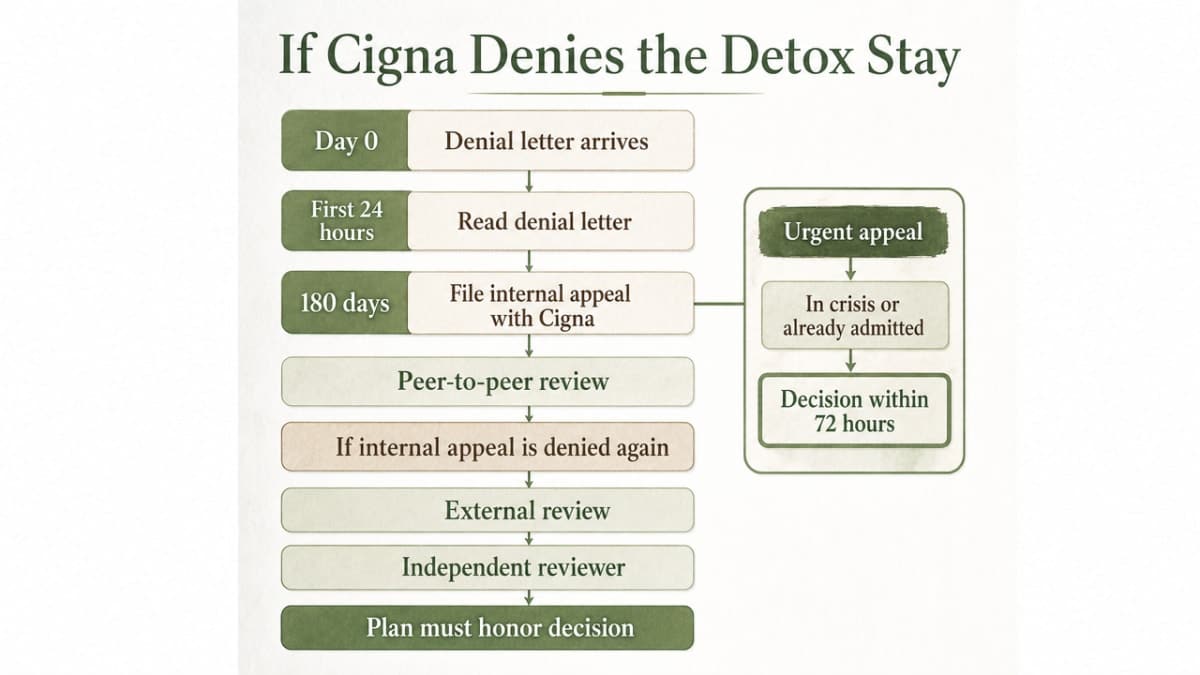
Here is the timeline to anchor yourself to. The day the denial letter arrives is Day 0. From there, you generally have 180 days to file an internal appeal with Cigna 10. If the person needing detox is actively in crisis or already admitted, the appeal qualifies as urgent, and the plan is required to decide within 72 hours 10. If the internal appeal is denied again, you can request an external review by an independent reviewer whose decision the plan has to honor 10.
Three things to do in the first 24 hours after a denial:
- Read the denial letter closely and name the reason. Was it medical necessity, out-of-network, missing prior authorization, or a benefit exclusion? The reason determines the strongest counter.
- Request the plan’s medical-necessity criteria and the specific clinical reasoning for the denial, in writing. Cigna is required to make these available on request 11. This document often reveals whether the plan applied the criteria correctly, and whether a parity concern exists under the 2024 MHPAEA final rules 3.
- Ask the detox facility’s clinical team to submit a peer-to-peer review. The admitting physician speaks directly with Cigna’s medical reviewer, which is often faster than a written appeal and resolves many denials on the spot.
If something still feels wrong after the internal appeal, Oklahoma-regulated plan members can also raise a parity concern with the Oklahoma Insurance Department, which has publicly identified behavioral-health prior-authorization patterns as a red flag worth reviewing 4. A denial is a decision, not a verdict. You have the deadlines, the documentation rights, and the appeal path to push back, and using them is itself a form of advocacy for the person you love.
Detox Is the Start, Not the Finish — What Else to Verify
Clearing your system is a real accomplishment. It is also the shortest chapter of recovery. CDC clinical guidance is blunt about this: detoxification alone, without ongoing medication for opioid use disorder, is not recommended because of the increased risk of resumed use, overdose, and overdose death 13. If opioids are part of your story, what happens the week after discharge matters as much as what happens inside the facility.
That means your verification call shouldn’t stop at the detox bed. While you have the Cigna rep on the line, ask about the whole arc of care so you aren’t scrambling to understand coverage during the handoff.
- Medication-assisted treatment after discharge. Confirm that buprenorphine, methadone, and naltrexone are on your plan’s formulary, what the copay looks like, and whether a prescribing provider needs to be in-network 13.
- Residential or partial hospitalization step-down. Ask whether these levels of care are covered, what prior authorization looks like, and how many days are typically approved on an initial request.
- Intensive outpatient and standard outpatient counseling. Confirm the per-visit cost and whether a referral is required.
- Co-occurring mental-health care. If depression, anxiety, PTSD, or trauma is part of the picture, verify that therapy and psychiatric visits are covered under the same behavioral-health benefit.
You are not getting ahead of yourself by asking. You are protecting the work.
One Call That Does the Work for You
You have done the hard reading. The next step doesn’t have to be another hour on hold with a benefits line.
Renewal Springs Detox in Oklahoma City runs free Cigna benefits verification on your behalf. Our admissions team places the call, asks the plan-type question first, confirms your deductible and coinsurance, pins down whether inpatient medical detox requires prior authorization, and checks whether medication-assisted treatment is covered during and after your stay 13. You get a plain-English summary of what Cigna will pay, what you would owe, and what we can start today.
If your plan is fully insured, self-funded, or Marketplace coverage, we read the rules that apply to it 5, 12. If something looks like a parity concern, we flag it before admission, not after 1. One call. Real numbers. A safer first step than facing withdrawal alone.
Speak with a Specialist About Cigna Detox Coverage
Get answers on Cigna insurance coverage for detox and support planning your next steps.
Frequently Asked Questions
Does Cigna cover medical detox for alcohol, opioids, or benzodiazepines?
In almost every case, yes. When a licensed clinician documents that withdrawal poses a real medical risk, Cigna plans generally cover medically supervised detox. Marketplace Cigna policies must cover substance-use-disorder treatment as an essential health benefit 12, and parity law prevents plans that offer SUD benefits from making them harder to access than comparable medical care 1. The setting and length of stay depend on medical necessity and your plan documents.
Will Cigna require prior authorization before I can start detox?
Most Cigna plans require prior authorization for inpatient or residential detox, and the facility usually handles the request on your behalf. Under the 2024 MHPAEA final rules, Cigna cannot apply authorization or medical-management rules more strictly to substance-use care than to comparable medical care 2, 3. If approval feels unreasonably delayed or inconsistent with how your plan handles medical admissions, that pattern may itself be a parity concern worth flagging 4.
What’s the difference between a fully insured and self-funded Cigna plan for detox coverage?
In a fully insured plan, Cigna pays the claims and the policy follows state and federal rules; in Oklahoma, those plans must include MH/SUD benefits 5. In a self-funded plan, your employer pays claims and only uses Cigna to administer them, so SUD coverage isn’t automatically required, though parity still applies if the plan offers those benefits 5. Ask Cigna directly which arrangement your plan uses before admission.
What should I do if Cigna denies my detox stay?
Read the denial letter and identify the exact reason, then request Cigna’s medical-necessity criteria and the written clinical rationale, which the plan must provide on request 11. You generally have 180 days to file an internal appeal, and if the person needs detox urgently, the plan must decide within 72 hours 10. Ask the facility to submit a peer-to-peer review. If the internal appeal fails, you can request external review by an independent reviewer 10.
Does Cigna cover medication-assisted treatment (MAT) after detox?
Most Cigna plans cover FDA-approved medications for opioid use disorder, including buprenorphine, methadone, and naltrexone, though formulary tier, copay, and in-network prescriber rules vary by policy. CDC clinical guidance is clear that detox alone, without ongoing medication for OUD, is not recommended because of the heightened risk of resumed use and overdose 13. Confirm MAT coverage during the same call that verifies your detox benefits, not afterward.
How can I verify my Cigna detox benefits without calling the insurance company myself?
Renewal Springs Detox in Oklahoma City runs free Cigna benefits verification on your behalf. The admissions team calls Cigna, confirms your plan funding type 5, checks deductible and coinsurance, pins down prior-authorization requirements, and verifies whether medication-assisted treatment is covered during and after your stay 13. You receive a plain-English summary of what Cigna will pay and what admission could look like, usually within the same day.
References
- The Mental Health Parity and Addiction Equity Act (MHPAEA). https://www.cms.gov/marketplace/private-health-insurance/mental-health-parity-addiction-equity
- New Mental Health and Substance Use Disorder Parity Rules. https://www.dol.gov/agencies/ebsa/laws-and-regulations/laws/mental-health-parity/new-mhpaea-rules-what-they-mean-for-participants-and-beneficiaries
- Fact Sheet: Final Rules under the Mental Health Parity and Addiction Equity Act. https://www.dol.gov/agencies/ebsa/about-ebsa/our-activities/resource-center/fact-sheets/final-rules-under-the-mental-health-parity-and-addiction-equity-act-mhpaea
- Mental/Behavioral Health and Insurance. https://www.oid.ok.gov/mental-behavioral-health-and-insurance/
- Understanding Mental Health Parity and Your Insurance Coverage. https://www.oid.ok.gov/getready12_2023/
- LH BULLETIN NO. 2021-03 – Oklahoma Insurance Department. https://www.oid.ok.gov/lh-bulletin-no-2021-03/
- Mental Health and Substance Abuse Services – Oklahoma.gov. https://oklahoma.gov/ohca/individuals/programs/mental-health-and-substance-abuse-services.html
- SECTION 95.50. Residential substance use disorder (SUD). https://oklahoma.gov/ohca/policies-and-rules/xpolicy/medical-providers-fee-for-service/individual-providers-and-specialties/inpatient-psychiatric-services/residential-substance-use-disorder-reimbursement1.html
- Behavioral Health Prior Authorization Procedures – Oklahoma.gov. https://oklahoma.gov/content/dam/ok/en/okhca/docs/providers/types/behavioral-health/OHCA%20BH%20Manual.pdf
- Internal Claims and Appeals and the External Review Process: An Overview. https://www.cms.gov/files/document/internal-claims-appeals-external-review-process-overview.pdf
- Affordable Care Act Implementation FAQs – Set 17. https://www.cms.gov/cciio/resources/fact-sheets-and-faqs/aca_implementation_faqs17
- Mental health & substance abuse coverage. https://www.healthcare.gov/coverage/mental-health-substance-abuse-coverage/
- Opioid Use Disorder: Treating | Overdose Prevention. https://www.cdc.gov/overdose-prevention/hcp/clinical-care/opioid-use-disorder-treating.html