
Key Takeaways
- Benzo withdrawal is one of the few withdrawals that can be medically dangerous on its own, with the FDA warning that abrupt stopping can trigger life-threatening seizures 2.
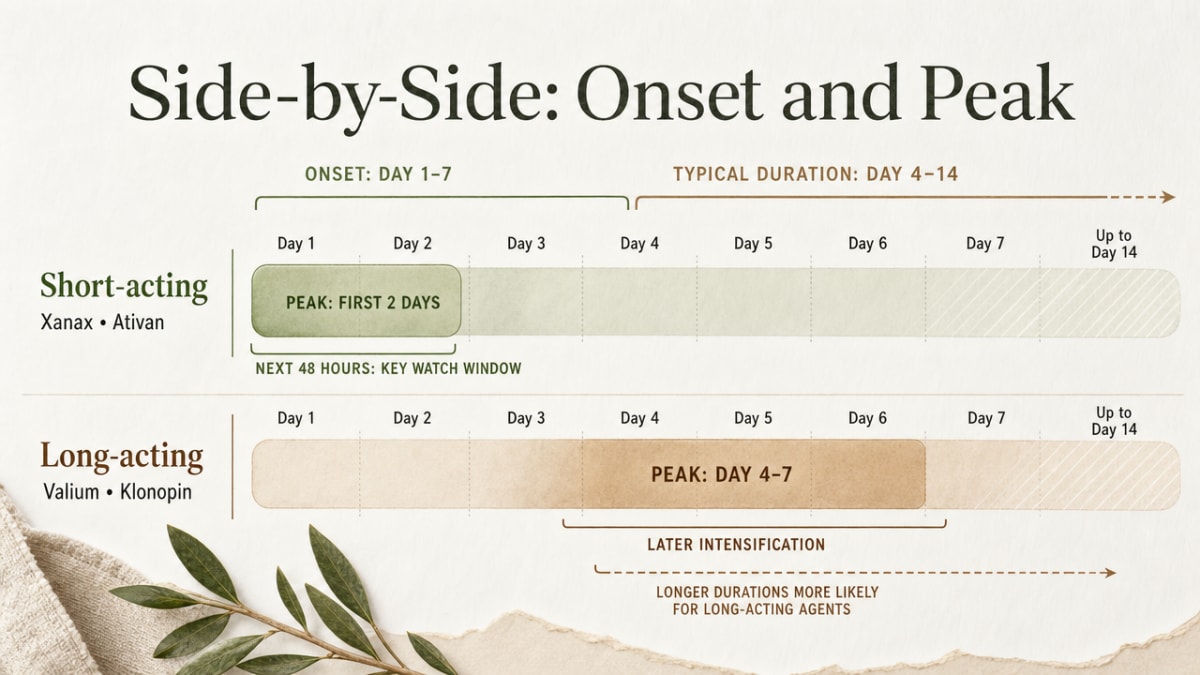
- Half-life drives the timeline: short-acting Xanax and Ativan tend to peak within the first two days, while long-acting Valium and Klonopin often peak between days four and seven 10.
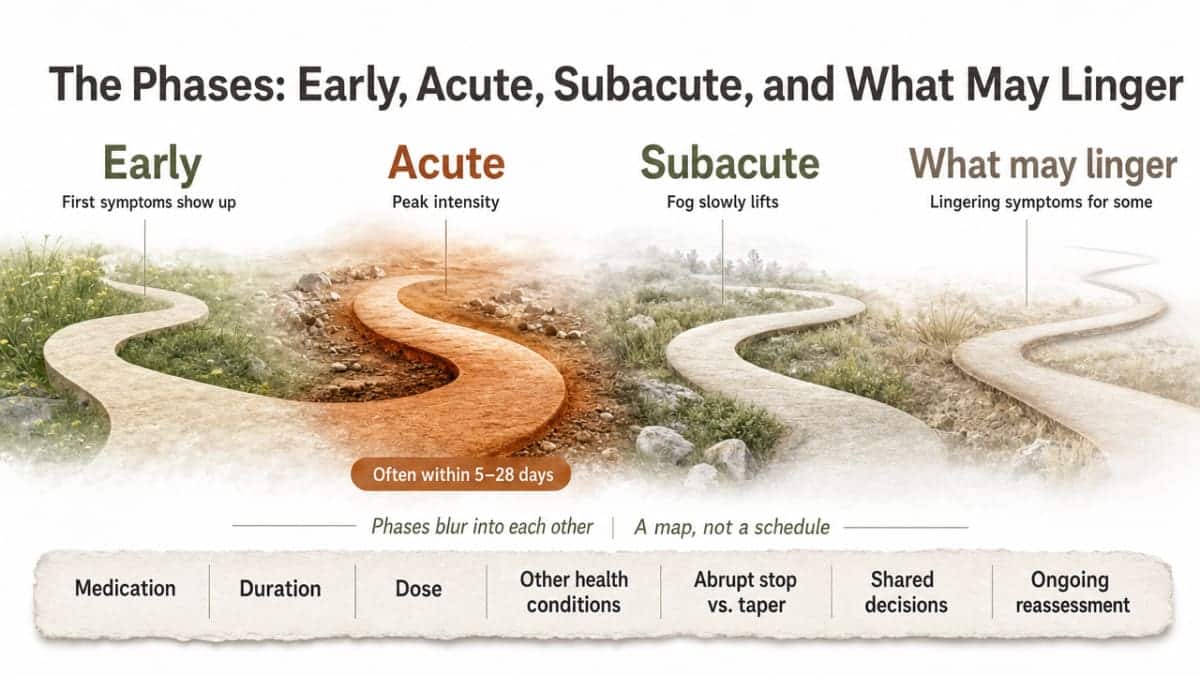
- Withdrawal moves through early, acute, and subacute phases roughly spanning 5 to 28 days, and a smaller group experiences protracted symptoms that can linger for months 13.
- Because seizure and delirium risk is real across all half-lives, current guidelines call for individualized, clinician-supervised tapering rather than any fixed at-home schedule 1.
If You’re Reading This Before You Stop, Good
If it’s 2 a.m. and you’re searching this because you skipped a dose, or because the bottle is almost empty and your refill is a week away, take a breath. You did the right thing by looking first. That one choice, to read before you stop, is already protecting you from the worst outcomes of benzodiazepine withdrawal.
Here’s what you need to know up front: benzo withdrawal is one of the few withdrawals that can be medically dangerous on its own. The FDA warns that physical dependence can develop after just a few days to weeks of steady use, even when you take the medication exactly as prescribed, and that stopping suddenly or cutting back too fast can cause life-threatening reactions including seizures 2. This isn’t about blame. Many of you were handed a prescription for anxiety, panic, insomnia, or PTSD and did everything right. Dependence can still happen.
This article walks you through what the timeline usually looks like, why Xanax feels different from Valium, and what makes supervised care safer than the kitchen table. Before you change anything about your dose, call a medical professional.
Why Benzo Withdrawal Is Different From Other Withdrawals
You’ve probably heard that quitting alcohol can be dangerous. The same category of risk applies to benzodiazepines, and for the same underlying reason. Both calm your central nervous system by boosting a chemical called GABA. When you take them steadily, your brain quietly adjusts, ramping up its own excitatory signals to balance the sedation. Pull the medication away suddenly, and that excitatory wiring is left running without a brake pedal. That’s what a withdrawal seizure actually is.
Here’s what makes benzos stand apart from, say, opioid withdrawal. Opioid withdrawal is miserable, but it rarely kills an otherwise healthy adult. Benzo withdrawal can. The FDA’s boxed warning for the entire benzodiazepine class states plainly that physical dependence can develop after steady use for just several days to weeks, even when you take the medication exactly as prescribed, and that abruptly stopping or reducing the dose too quickly can trigger life-threatening withdrawal reactions, including seizures 2. That warning covers Xanax, Klonopin, Ativan, Valium, and the rest of the class.
The National Institute on Drug Abuse puts it in plainer language: stopping a central nervous system depressant can produce a rebound effect that includes seizures and other harmful consequences, which is why they tell people to speak with a physician before changing anything 14. And every current clinical guideline reviewed in a 2026 deprescribing analysis says the same thing. Not one recommends stopping on your own 7.
So if you’ve been thinking, “I’ll just push through a rough week,” please know the medical community is in rare agreement here. This is not a willpower problem. It’s a brain-chemistry problem, and it deserves a brain-chemistry solution with someone watching over you.
How Half-Life Changes Everything About Your Timeline
Half-life is just the time your body needs to clear half a dose of a drug. That number sounds like pharmacy trivia until you’re trying to figure out when withdrawal will hit. For benzodiazepines, half-life is the single biggest reason two people can quit the same type of medication on the same day and have completely different experiences on day three.
Think of it this way. A short-acting benzo is like a candle that burns bright and fast. When the wax runs out, the room goes dark quickly, and your nervous system notices right away. A long-acting benzo is more like a slow-release ember. Even after you stop, the drug lingers in your system for days, which delays the moment your brain realizes the sedative is gone. Delayed does not mean gentler. In many cases, it just means the storm arrives later and sometimes lasts longer.
The VA’s clinical guidance frames this clearly: withdrawal symptoms generally begin within one to seven days of stopping or significantly cutting a dose, and the full window can run four to 14 days, with longer durations more common for the long-half-life agents 5. Those are averages, not promises. Your dose, how long you’ve been taking the medication, your other health conditions, and whether you stop abruptly or step down all shift the picture.
The next three subsections break this down the way most readers actually search for it: by drug name. If you take Xanax or Ativan, start with the short-acting section. If you take Valium or Klonopin, the long-acting section is yours. Then the side-by-side will tie them together.
Short-Acting: Xanax and Ativan
If Xanax (alprazolam) or Ativan (lorazepam) is the pill in your bottle, you’re dealing with the fastest-moving timeline. These medications are cleared from your body relatively quickly, which is partly why they feel so effective for a panic attack and partly why the comedown is so sharp.
After your last dose, early withdrawal symptoms can start within hours, often by the end of the first day. The VA’s clinical reference points to a one-to-seven-day window for onset across the class, with short-acting agents sitting on the earlier end of that range 5. You might notice a jittery edge first, like your morning coffee hit twice as hard. Then sleep gets rough. Then the anxiety that your medication was holding down comes back louder than before, which clinicians call rebound anxiety.
Here’s the part that matters most. A qualitative study of people who stopped benzodiazepines abruptly found that peak severity for short-acting agents landed in the first two days 10. That is a very narrow, very dangerous window. If a withdrawal seizure is going to happen, this is often when the risk is highest. Please do not spend those 48 hours alone or hoping it passes.
Long-Acting: Valium and Klonopin
Valium (diazepam) and Klonopin (clonazepam) move through your body on a slower clock. Diazepam in particular has active metabolites that can linger for days, which is why some clinicians use it to help smooth withdrawal from other benzos. If this is your medication, your timeline will probably look very different from a Xanax reader’s.
Early symptoms may not show up for two, three, even five days after your last dose. That delay can be deceiving. You might feel fine on day two and assume you’ve dodged the worst of it, only to feel the floor drop out on day five. The qualitative research on abrupt discontinuation found that peak withdrawal severity for long-acting agents clustered around days four through seven 10. The VA’s clinical guidance also notes that withdrawal duration tends to run longer for long-half-life medications, often stretching the 4-to-14-day window toward its upper end 5.
The diazepam prescribing label is blunt about what’s at stake: abrupt discontinuation or rapid dose reduction can precipitate acute withdrawal reactions, including seizures, and patients are directed to seek emergency care for serious symptoms 3. A slower clearance does not mean a safer stop.
Side-by-Side: Onset and Peak
Lining the two groups up next to each other makes the pattern easier to hold in your head. The VA’s PTSD clinician guide gives us the overall envelope: withdrawal symptoms typically begin within one to seven days of stopping, with a full duration of roughly four to 14 days, and longer durations more likely for long-half-life agents 5. Inside that envelope, the peak-severity data from a qualitative study of abrupt discontinuation sharpens the picture: short-acting benzos like Xanax and Ativan tend to peak in the first two days, while long-acting benzos like Valium and Klonopin tend to peak between days four and seven 10.
So if you take a short-acting benzo and today is day one off your last dose, the next 48 hours are the window that most deserves medical eyes on you. If you take a long-acting benzo and today is day one, you may feel reasonably okay through the weekend, and the hard part may hit mid-next-week.
Neither timeline is safer. They are just differently timed. Both carry the same core risks the FDA has flagged for the entire class, and both are reasons to have a clinician aware of what you’re doing before you change your dose. If you’re trying to time this around work, childcare, or a family event, that planning instinct is good. Let a medical team help you plan it so the window is monitored instead of guessed at.
The Phases: Early, Acute, Subacute, and What May Linger
Clinicians usually describe benzo withdrawal in four rough phases:
- an early window when the first symptoms show up,
- an acute peak when things feel worst,
- a subacute stretch of weeks when the fog slowly lifts, and
- a smaller group of people who deal with lingering symptoms long after that.
These phases blur into each other. They are not clean calendar boxes.
Think of what follows as a map, not a schedule. Your own path depends on which medication you took, how long you took it, your dose, your other health conditions, and whether you stop abruptly or step down with a clinician. Two people on the same drug can have very different weeks. The 2025 Joint Clinical Practice Guideline on Benzodiazepine Tapering is firm about this: tapering has to be individualized, with shared decision-making and ongoing reassessment, because there is no one-size timeline 1.
The Early Window: Hours to the First Few Days
The early window is when your nervous system first notices that the sedative isn’t coming. If you took a short-acting benzo like Xanax or Ativan, this can start within hours of a missed dose. If you took a longer-acting one like Valium or Klonopin, it may take two to five days before anything shifts. The VA’s clinical reference puts the broad onset window at one to seven days after stopping or cutting back significantly 5.
What does it actually feel like? For many people, the first signals are small and easy to blame on something else. Sleep goes shallow. Your heart feels a little faster at rest. Light and sound seem sharper. Then rebound anxiety arrives, which is the condition your medication was treating coming back louder than before. The National Institute on Drug Abuse describes this exact pattern as a rebound effect when a central nervous system depressant is removed, and it’s the moment they say to call a physician rather than tough it out 14.
If you’re in this window right now, treat it as the signal to make a phone call, not to wait and see.
The Acute Peak: Days 2 Through 14
The acute peak is the hardest stretch, and it’s also where the seizure risk sits. If you take a short-acting benzo, the qualitative research on abrupt discontinuation puts peak severity in roughly the first two days 10. If you take a long-acting benzo, the same research clusters peak severity between days four and seven 10. The VA’s clinical guide gives an overall acute duration of about four to 14 days, with longer stretches more common for long-half-life agents 5.
During the peak, the earlier symptoms get louder and new ones often join. Insomnia can become near-total. Tremor, sweating, nausea, racing heart, and a kind of raw sensitivity to light, sound, and touch are common. Panic can arrive in waves that feel bigger than any you had before the medication. Some people describe a sense of unreality, as if the world has gone slightly flat or far away.
The Subacute Weeks: Reaching 5 to 28 Days
Past the peak, most people enter a subacute stretch that an older peer-reviewed review describes as an acute withdrawal phase of roughly five to 28 days overall 13. The intensity usually eases, but it rarely ends cleanly. Sleep slowly stitches itself back together. The physical symptoms (sweating, tremor, racing heart) tend to fade first. The psychological ones (anxiety, low mood, a short fuse, trouble concentrating) often take longer.
This is the phase where people start to feel human again in flashes. You might have a decent afternoon, then a hard evening. Progress at this stage is almost never a straight line, and that’s normal. It is not a sign you’ve failed or that something has gone wrong.
The same review notes that for a smaller group, some symptoms can persist well beyond this four-week window, sometimes for 12 months or longer 13. That possibility is the bridge to the next section. For most people in week three or four, the direction is still toward recovery, even on the days it doesn’t feel that way.
Protracted Symptoms: What We Know and What We Don’t
Protracted withdrawal is the name clinicians give to symptoms that stick around past the point most people have recovered. The 2025 Joint Clinical Practice Guideline on Benzodiazepine Tapering defines these as symptoms that persist beyond the expected elimination period, sometimes for months or years, and acknowledges real uncertainty about why they happen and how long they last 8. Common reports include:
- waves of anxiety,
- insomnia that won’t fully resolve,
- sensitivity to light and sound,
- cognitive fog, and
- a kind of emotional flatness that fades and returns.
Here is the honest part. A 2023 study of people describing enduring symptoms after benzodiazepine use found that many respondents reported symptoms lasting months to years, but the authors were careful to say these symptoms are not necessarily confirmed as true withdrawal or as evidence of neurological injury 9. That caveat matters. It doesn’t mean the suffering isn’t real. It means the mechanism is still being studied, and anyone promising you a certain cause or a certain timeline is overstating what the science currently supports.
If you develop protracted symptoms, you are not broken and you are not alone. You also are not stuck. Supervised care, trauma-informed therapy, sleep support, and patient medical follow-up all help. The reason to taper under supervision in the first place is partly to reduce the odds of this long tail, and partly to have a team already in place if you end up in it.
The Seizure Window Is the Reason to Call Someone
Of all the symptoms you might read about, one is the reason this article exists: the withdrawal seizure. It is the single clearest argument for not doing this alone.
A seizure during benzo withdrawal is not a warning sign that something bad might happen. It is the bad thing happening. It can arrive without the dramatic buildup people expect. Some people have no tremor, no sweating, no obvious crisis before it hits. A review of 48 case reports of suspected benzodiazepine withdrawal seizures found they involved medications with short, medium, and long half-lives, and that seizures were not consistently limited to long-term users or high-dose patients 12. A broader clinical review on withdrawal seizure management reached the same conclusion: reported seizures have crossed all three half-life categories, and outcomes have ranged from a single seizure to coma and death 11.
Those case reports cannot tell you your personal odds. They can tell you the risk is real enough that every current clinical guideline reviewed in a 2026 deprescribing analysis recommends against abrupt stopping or overly rapid reduction, specifically because withdrawal reactions can include life-threatening seizures 7. The diazepam label uses the same word, life-threatening, and tells patients to seek emergency care if serious symptoms appear 3.
Why This Article Will Not Give You a Taper Schedule
You came here looking for a timeline, and you deserve an honest one. What you will not find on this page is a day-by-day taper schedule, a milligram-reduction chart, or a “how to come off Xanax at home” plan. That choice is deliberate, and it is for you.
Every current clinical guideline reviewed in a 2026 deprescribing analysis warns against abrupt stopping or overly rapid reduction, specifically because withdrawal reactions can include life-threatening seizures 7. The 2025 Joint Clinical Practice Guideline on Benzodiazepine Tapering goes further and says tapering has to be built around you: your dose, your medication, how long you’ve taken it, your other health conditions, your seizure history, and your support at home 1. A number on a webpage cannot see any of that.
Writing a generic schedule for a stranger would be the opposite of safe care. What this article can do is help you walk into a real conversation already informed. The schedule itself belongs to you and a clinician, together.
What Supervised Detox Actually Looks Like
If you’ve never been inside a medical detox, the word probably sounds scarier than the reality. You are not being locked away. You are being watched over by people who know exactly what benzo withdrawal can do and have the medications and monitoring to keep you ahead of it.
In a supervised setting, a clinician assesses your medication, your dose, how long you’ve been taking it, your seizure history, and any other health conditions before anything changes. That intake is what the 2025 Joint Clinical Practice Guideline on Benzodiazepine Tapering means by shared decision-making and individualized tapering 1. From there, you’re on a gradual dose reduction, adjusted in real time to how your body is responding, which is the approach the VA/DoD guideline recommends for benzodiazepine discontinuation 6.
Vital signs get checked around the clock. If seizure or delirium risk rises, the team is already there, not twenty minutes away. The 2025 guideline specifically tells clinicians to prioritize seizure-risk assessment and monitoring during the acute window, which is hard to do from your own couch 8. You also get sleep support, hydration, and a quiet room, three things that are nearly impossible to maintain at home mid-withdrawal.
For Oklahoma Veterans and the People Who Love Them
If you’re a veteran, this part is for you, and for the spouse or adult child who sometimes refills the prescription without saying much about it. Benzodiazepines often enter veterans’ lives through PTSD care, sleep problems, or anxiety that followed you home. You took them the way they were prescribed. That is not a character flaw, and leaving them is not a test of toughness.
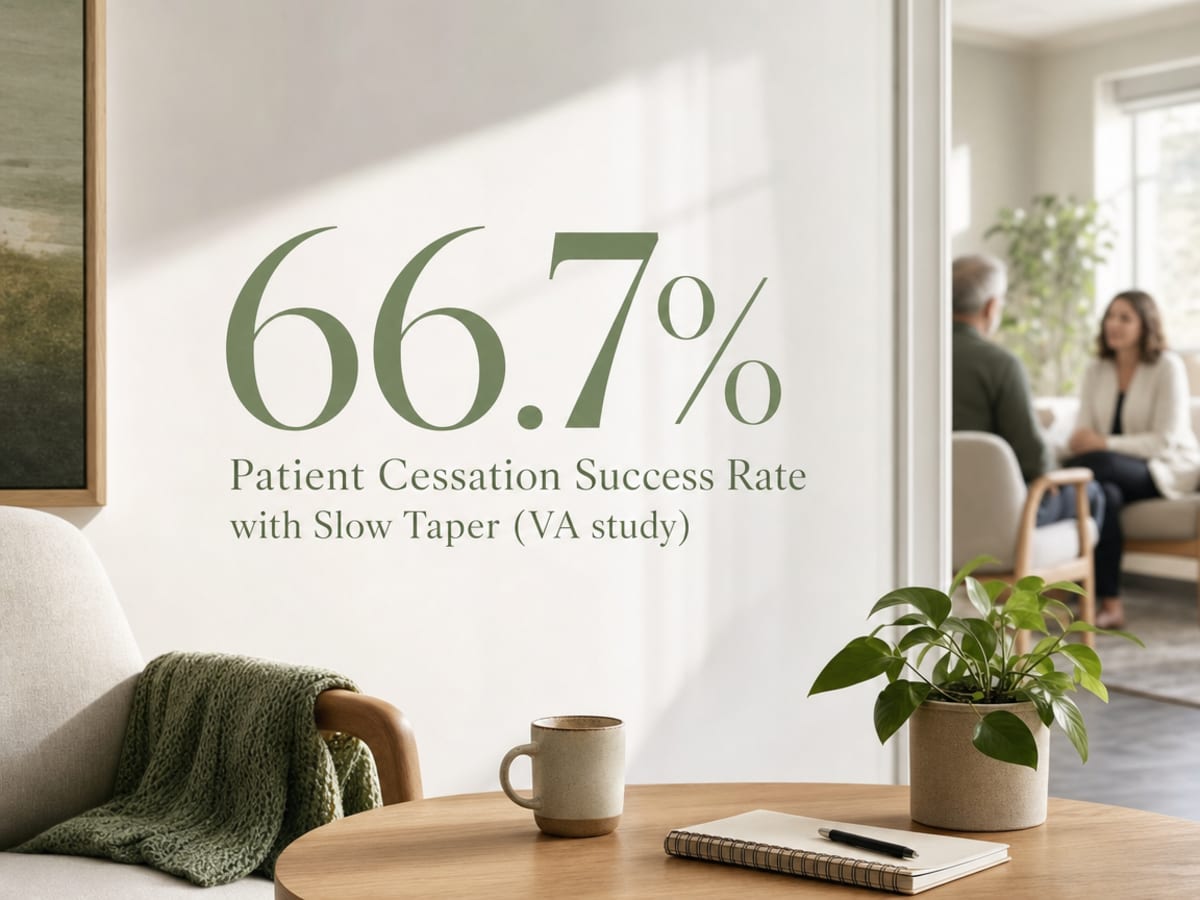
The VA has been rethinking this class of medication for years. A VA provider guide reports that a slow taper over three to six months is preferred in many cases, and that approximately two-thirds of patients achieve cessation with that approach when it’s done with medical support 4. The VA/DoD Clinical Practice Guideline for the Management of Substance Use Disorders backs this up, recommending gradual dose tapering built around your symptoms and tolerability rather than a fixed calendar 6.
For families: your veteran does not need a lecture. They need someone to sit with them while they make the call. In Oklahoma City, that call can be to a medical team that has worked with veterans before.
Renewal Springs in Oklahoma City: Call Before You Stop
Renewal Springs Detox sits in Oklahoma City, which means if you’re reading this from Edmond, Norman, Moore, Yukon, or anywhere else in the metro, help is a short drive away. The team provides 24/7 medically supervised detox with licensed clinicians who have walked people through benzodiazepine withdrawal before. That matters because the acute window, where seizure and delirium risk is highest, is exactly when the 2025 Joint Clinical Practice Guideline on Benzodiazepine Tapering tells clinicians to prioritize monitoring 8.
You do not have to have a plan figured out before you pick up the phone. You do not have to know your exact dose, your exact start date, or what insurance covers. The intake conversation is where those things get sorted. Most major insurance is accepted, and benefits verification is free.
Call before you change your dose. Not after. Before.
Speak to a Medical Detox Specialist Now
Get answers and immediate support for safe benzo withdrawal today.
Frequently Asked Questions
When will benzo withdrawal symptoms start after my last dose?
It depends on your medication. Short-acting benzos like Xanax and Ativan can trigger early symptoms within hours. Long-acting ones like Valium and Klonopin may stay quiet for two to five days before anything shifts. The VA’s clinical reference puts the broad onset window at one to seven days after stopping or significantly cutting a dose 5. Call a clinician before you time this yourself.
Can you really die from stopping benzos cold turkey?
Yes, and that is not an exaggeration. The FDA’s boxed warning for the entire benzodiazepine class states that abruptly stopping or reducing a dose too quickly can cause life-threatening withdrawal reactions, including seizures 2. The diazepam label uses the same word, life-threatening, and tells patients to seek emergency care for serious symptoms 3. Please do not stop cold turkey without medical help in place.
How long does Xanax withdrawal last compared to Klonopin or Valium?
Xanax tends to hit sooner and peak faster, often within the first two days after an abrupt stop. Klonopin and Valium move more slowly, with peak severity clustering around days four through seven 10. The overall acute window usually runs four to 14 days, and the longer-half-life medications more often push toward the upper end of that range 5. Neither pattern is safer.
What is protracted benzo withdrawal, and will I get it?
Protracted withdrawal describes symptoms that linger past the expected elimination window, sometimes for months 8. Common reports include waves of anxiety, insomnia, and sensitivity to light or sound. A 2023 study found many people describe long-lasting symptoms, but the authors note these are not confirmed as proven neurological injury 9. Most people do not get it, and supervised care lowers the odds.
Is it safe to taper benzos at home if I go slowly?
Going slowly helps, but “slowly” is not the same as “safely alone.” Every current clinical guideline reviewed in a 2026 deprescribing analysis warns against abrupt stopping or overly rapid reduction because withdrawal reactions can include life-threatening seizures 7. The 2025 Joint Clinical Practice Guideline insists on individualized tapering with shared decision-making 1. A clinician should design the schedule and monitor your response.
What should I do right now if I already stopped and feel withdrawal starting?
Call a medical team today. If you experience a seizure, severe confusion, hallucinations, high fever, or chest pain, call 911 or go to an emergency room immediately 3. NIDA advises people to speak with a physician before changing a CNS depressant dose or to seek immediate care if withdrawal is already underway 14. In Oklahoma City, Renewal Springs provides 24/7 medically supervised detox.
References
- Joint Clinical Practice Guideline on Benzodiazepine Tapering. https://pubmed.ncbi.nlm.nih.gov/40526204/
- FDA requiring Boxed Warning updated to improve safe use of benzodiazepine drug class. https://www.fda.gov/drugs/drug-safety-and-availability/fda-requiring-boxed-warning-updated-improve-safe-use-benzodiazepine-drug-class
- VALIUM (diazepam) tablets, for oral use, C-IV Initial U.S. Approval. https://www.accessdata.fda.gov/drugsatfda_docs/label/2026/013263s095lbl.pdf
- Re-evaluating the use of benzodiazepines. https://www.pbm.va.gov/pbm/academicdetailingservice/documents/benzodiazepine_provider_ad_educational_guide.pdf
- PTSD: A VA Clinician’s Guide to Optimal Treatment of PTSD. https://www.pbm.va.gov/PBM/AcademicDetailingService/Documents/PTSD_QRG.pdf
- VA/DoD Clinical Practice Guideline for the Management of Substance Use Disorders. https://healthquality.va.gov/HEALTHQUALITY/guidelines/MH/sud/VA-DoD-SUD-CPG_Final_for-508_v3.pdf
- Pharmacological principles for safe benzodiazepine and Z-drug deprescribing. https://pmc.ncbi.nlm.nih.gov/articles/PMC13280687/
- Joint Clinical Practice Guideline on Benzodiazepine Tapering. https://pmc.ncbi.nlm.nih.gov/articles/PMC12463801/
- Enduring neurological sequelae of benzodiazepine use. https://pmc.ncbi.nlm.nih.gov/articles/PMC9905027/
- Experiences with benzodiazepine use, tapering, and discontinuation: a qualitative study. https://pmc.ncbi.nlm.nih.gov/articles/PMC9047812/
- Benzodiazepine withdrawal seizures and management. https://pubmed.ncbi.nlm.nih.gov/21815323/
- Benzodiazepine withdrawal seizures: analysis of 48 case reports. https://pubmed.ncbi.nlm.nih.gov/3427560/
- Benzodiazepine dependence and its treatment with low dose flumazenil. https://pmc.ncbi.nlm.nih.gov/articles/PMC4014019/
- Misuse of Prescription Drugs. https://nida.nih.gov/sites/default/files/2609-misuse-of-prescription-drugs.pdf