
Key Takeaways
- Aetna plans generally cover medically supervised detox, residential rehab, PHP, IOP, and medication-assisted treatment for opioid dependence, with specific costs tied to your individual plan details.
- In-network status determines whether your out-of-pocket share is calculated against contracted rates or exposes you to balance billing, which is why asking about your specific plan matters more than asking if a facility accepts insurance.
- The 2024 federal parity rule prevents Aetna from applying stricter prior authorization, visit limits, financial requirements, or medical-necessity standards to addiction care than it uses for comparable medical treatment 8.
- Most delays in seeking treatment come from shame, cost fear, and not knowing where to start rather than actual denials, and benefits verification takes about two minutes without calling Aetna yourself 3.
The short answer, before anything else
Yes. Aetna covers medically supervised detox and rehab for opioid use, and Renewal Springs Detox in Oklahoma City is in-network. That is the answer you came here for, and you deserved to see it in the first breath.
If you are reading this at 2 a.m. with a loved one in the next room, or sitting in your car trying to decide what to do next, take one slow breath. The hardest part right now is not the insurance. It is being here at all, and you already are.
Here is what matters in the next few minutes. Aetna plans generally pay for medically supervised detox, residential rehab, partial hospitalization, intensive outpatient care, and medication-assisted treatment for opioid dependence, subject to your specific plan details 1. Because Renewal Springs is in-network, your out-of-pocket costs are typically lower than at an out-of-network facility, and admission does not require you to figure out the paperwork alone.
The rest of this article walks you through what Aetna actually covers, what the 2024 federal parity rules mean for you, what the first 24 hours of detox look like, and how to verify your benefits in about two minutes. You can stop at any point and still have what you need.
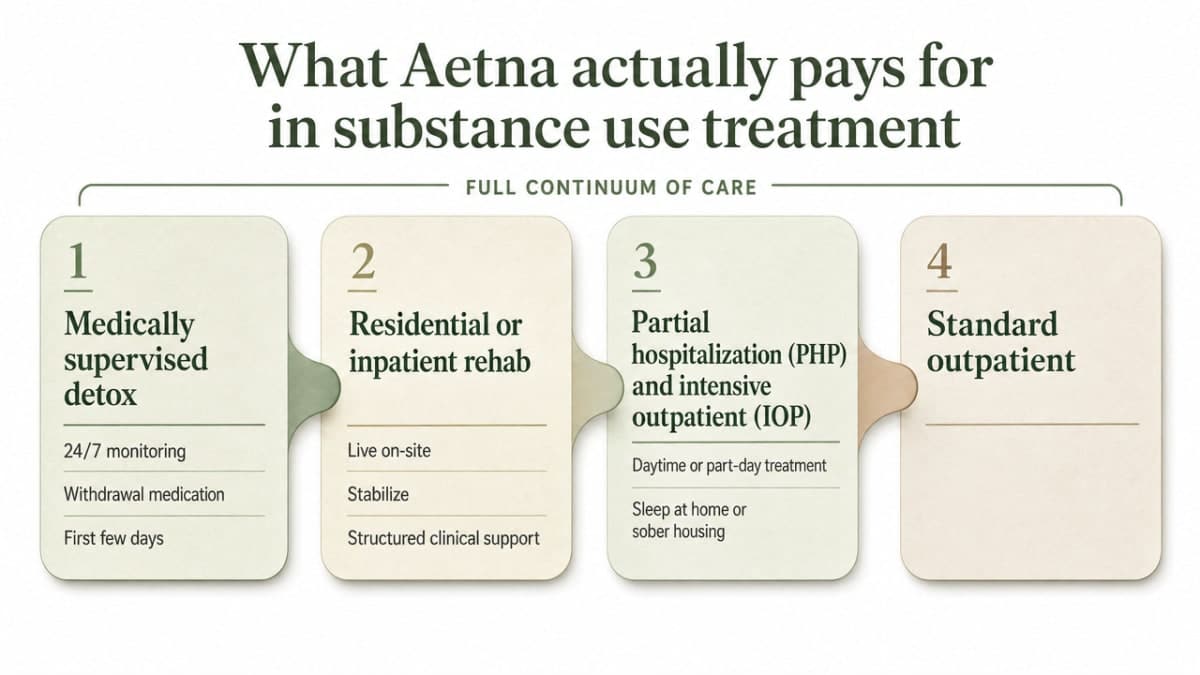
What Aetna actually pays for in substance use treatment
Here is the honest version of what your plan is built to cover. Aetna plans generally pay for the full continuum of substance use care, which means you are not choosing between “insurance will help” and “insurance will not help.” You are usually choosing between levels of care that are already inside your benefits.
For opioid dependence, that continuum typically includes:
- Medically supervised detox. Around-the-clock monitoring and medication to manage withdrawal safely. This is the piece that matters most in the first few days off heroin, fentanyl, or prescription painkillers.
- Residential or inpatient rehab. Living on-site after detox while you stabilize, with structured clinical support.
- Partial hospitalization (PHP) and intensive outpatient (IOP). Daytime or part-day treatment while you sleep at home or in sober housing.
- Standard outpatient care. Counseling, group therapy, psychiatric follow-up, and relapse-prevention work.
- Medication-assisted treatment (MAT). Buprenorphine, methadone, or naltrexone, prescribed and monitored by licensed clinicians.
If you have an Aetna plan through the Health Insurance Marketplace, substance use treatment is categorized as an essential health benefit, which means it is not an optional add-on your plan can decline to cover 1. Employer-sponsored Aetna plans typically include the same categories of care, though specific details, like your deductible, your coinsurance after the deductible, and whether a given level of care requires prior authorization, live in your individual plan documents.
What Aetna does not promise is a blank check. Your plan still defines a deductible, a copay or coinsurance share, an out-of-pocket maximum, and medical-necessity criteria for each level of care. Those are the real numbers that determine what the first week of treatment costs you, and they are the exact numbers a benefits-verification call is designed to pull up in minutes.
So the practical answer looks like this. The services you need for an opioid crisis, detox, MAT, and step-down rehab, are the services Aetna is set up to pay for. The remaining question is not whether coverage exists. It is what your specific plan will apply toward it, and that is a question someone else can answer for you.
Why in-network status matters more than you think
When a facility says “we take insurance,” that is not the same thing as being in-network with your specific Aetna plan. The difference is the gap between a bill you can plan for and a bill that arrives three weeks later with a number you did not expect.
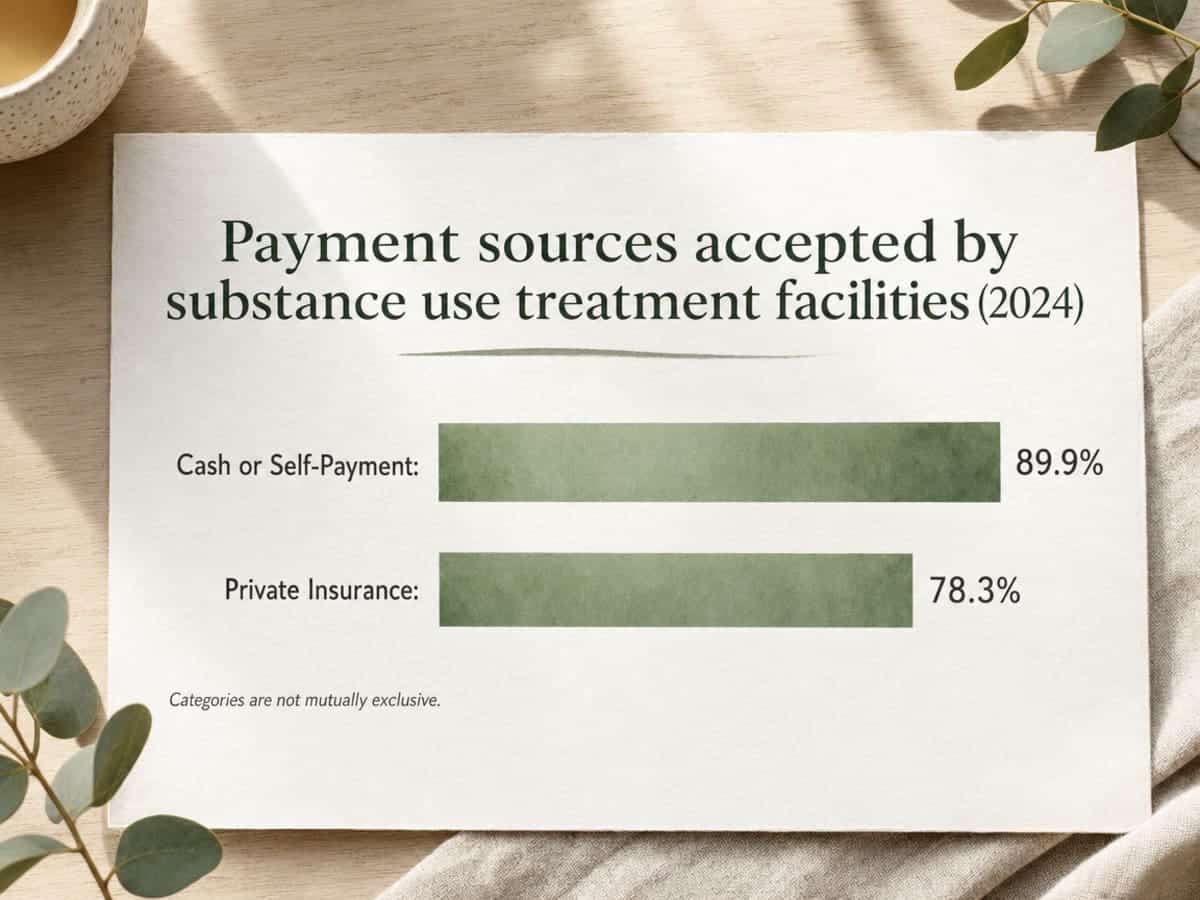
Here is the landscape in plain terms. In 2024, 89.9% of U.S. substance use treatment facilities accepted cash or self-payment, while 78.3% accepted private insurance 2. Those categories overlap, and “accepts private insurance” is a wide net. It can mean a facility will bill your insurer, submit for out-of-network reimbursement, or let you pay upfront and chase a partial refund yourself. None of that is the same as being contracted directly with Aetna.
In-network means something more specific. The facility has a signed agreement with Aetna that fixes the rates for covered services. Your plan pays its share based on those agreed rates, and your out-of-pocket share, your deductible, copay, or coinsurance, is calculated against those rates too. You are not exposed to the difference between what a facility charges and what Aetna considers reasonable.
Out-of-network is where surprise bills live. Even when a plan offers out-of-network benefits, your coinsurance share is usually higher, your deductible may be separate, and the facility can bill you for the balance between its full charge and what Aetna pays. For a week of medically supervised detox, that gap is not a rounding error.
Renewal Springs Detox in Oklahoma City is in-network with Aetna. That one fact changes the math on the first phone call. It means the question is no longer “can we afford this?” and becomes “what does my specific plan apply to in-network detox?” That second question has a short, verifiable answer, and it is the one the benefits-verification process is built to pull up for you.
Your rights under Aetna: the 2024 parity rule in plain language
There is a federal rule written specifically to stop insurance companies from treating addiction like a lesser medical problem. You should know it exists, because it is probably the reason your coverage looks the way it does right now.
It is called the Mental Health Parity and Addiction Equity Act, and in September 2024 federal regulators issued a final rule that strengthened it. The rule became effective November 22, 2024, and applies to most employer-sponsored plan years that began on or after January 1, 2025 8. If you have an individual Aetna plan bought through the Marketplace, certain parts of the rule start applying to policy years beginning January 1, 2026 9. Translation: these protections are current, and they likely apply to the plan sitting in your wallet.
Here is what the rule actually does for you, in three plain-English pieces.
- No stricter prior authorization than medical care. Aetna cannot make you jump through more hoops to get detox approved than it would require for, say, a cardiac admission or a surgical hospitalization 8. If getting a hospital bed for a physical emergency is a phone call from a doctor, getting a detox bed cannot be a week-long paperwork maze.
- No stricter visit limits or financial requirements. Your copay, your coinsurance, your deductible, and any day or visit caps for substance use treatment have to be comparable to what the plan uses for medical and surgical care in the same category 7. Addiction cannot be singled out for a worse deal.
- No stricter medical-necessity standards. The criteria Aetna uses to decide whether you “really need” residential rehab or MAT have to be built on the same kind of clinical evidence it uses for medical decisions 4. The bar is clinical, not punitive.
None of this means Aetna writes a blank check or that every plan covers every service. Parity is about how limitations are applied, not whether limits exist at all 7. Your plan still has a deductible and a network. What parity does mean is that the game is not rigged against you for asking about detox instead of asking about pneumonia.
Why does this matter at 2 a.m. when you are reading an article about Aetna? Because the fear underneath most of these searches is that insurance will find a reason to say no. That fear is reasonable, and it is also outdated. The 2024 rule is specifically designed to close the loopholes that used to make substance use benefits harder to use than medical benefits 8.
You do not have to memorize any of this. You just have to know it is in your corner when you make the next call.
What opioid detox with Aetna typically looks like
Opioid detox under an Aetna plan is not one thing. It is a sequence of clinical decisions that match the drug, the person, and the severity of withdrawal in front of the care team. Knowing roughly what to expect takes some of the fear out of the first phone call.
For heroin, fentanyl, or prescription painkillers, medically supervised detox is usually the first level of care Aetna authorizes. That means a licensed medical team, 24-hour monitoring, and medication to blunt withdrawal rather than a cold-turkey wait-out. Fentanyl changes the picture in particular. It sits in body tissue longer than older opioids, so withdrawal can start later, peak harder, and last longer than people expect. Clinicians plan for that. A plan built around older heroin timelines is not the plan you want for a fentanyl case.
Medication-assisted treatment is the clinical center of most opioid detox stays. Buprenorphine is the most common induction medication in a detox setting because it eases withdrawal and lowers craving without the full high. Methadone is used in licensed opioid treatment programs. Naltrexone comes later, after the body is clear. Aetna generally covers these medications when they are prescribed and monitored by qualified clinicians, and federal parity guidance tells plans they cannot wall off substance-use medications behind stricter rules than they use for comparable medical prescriptions 12.
A typical opioid detox stay runs several days. That window is not a hard rule. It is a clinical judgment built on your vitals, your symptoms, your medication response, and your medical history. Aetna’s medical-necessity review is designed to track that same clinical picture, which is why your care team documents it carefully from the first assessment forward.
Detox is not the whole treatment. It is the stabilization step that makes the rest of treatment possible. Most people step down from detox into residential rehab, partial hospitalization, intensive outpatient, or ongoing MAT with counseling, and Aetna plans are built to cover that continuum, not just the first few days. Thinking of detox as the finish line is the single biggest reason people relapse in week two. Thinking of it as the floor you build the next months on is what the clinical team is already planning for.
What this looks like day to day at Renewal Springs in Oklahoma City is simple. You arrive. A medical team evaluates you. Appropriate MAT is started when it is clinically indicated. Vital signs are monitored around the clock, including with wearable biotech that tracks heart rate, sleep, and stress between nurse checks. When you are stable, the team helps you line up what comes next, whether that is residential care, outpatient treatment, or an MAT maintenance plan.
You do not have to understand all of this before you call. The care team walks you through it. Your job in this moment is smaller than it feels. It is to be willing to let someone else carry the clinical plan for the next 72 hours.
The first 24 hours at an in-network detox in Oklahoma City
The first day is the one most people are quietly dreading. Here is what it actually looks like when the facility is in-network with your plan and the admission is not something you have to engineer alone.
The intake call. You or someone calling for you reaches the admissions team. The conversation is clinical and calm, not a sales pitch. They ask what you have been using, how much, how recently, your medical history, and whether you are safe right now. If you are in acute withdrawal or in danger, the triage changes accordingly.
Benefits verification runs in the background. While you are still on the phone, or while you are filling out the online verification form, the admissions team pulls your Aetna benefits directly. They confirm your deductible status, your in-network coinsurance share for detox and residential care, and whether your specific plan requires prior authorization for the level of care being recommended. You do not have to call Aetna yourself. That is the single most exhausting thing to do in early withdrawal, and it is the one thing you do not have to do.
Admission. You arrive at the Oklahoma City facility. Intake paperwork is kept short. A nurse takes vitals. You meet the people who will be with you overnight.
Medical assessment. A licensed clinician does a full history and physical, screens for co-occurring conditions, and builds your initial detox plan. For opioids, this is where the MAT decision gets made. Federal parity guidance to providers is clear that plans cannot wall off medication-assisted treatment behind stricter rules than they use for comparable medical prescriptions 12, which is one reason in-network detox admissions tend to move faster than people expect.
MAT initiation when clinically indicated. If buprenorphine is appropriate, induction typically happens once you are in mild to moderate withdrawal, not before. Methadone is used in licensed opioid treatment program settings. The timing is clinical, not administrative.
Monitoring through peak withdrawal. Nurses check in on a schedule, and wearable biotech tracks heart rate, sleep, and stress between those checks. If something changes at 3 a.m., someone knows.
By the end of day one, the hardest decisions have already been made for you. That is the point.

The real reason people wait, and why you don’t have to
Here is the quiet truth most insurance articles skip. The reason people with Aetna coverage wait weeks to call about detox is almost never the policy itself. It is shame, cost fear, and not knowing where to start.
The federal survey data backs this up. When people who needed substance use treatment were asked why they did not get it, the top reasons were believing treatment would cost too much, worrying their insurance would not pay enough, lacking coverage for alcohol or drug treatment, and not knowing where to go for care 3. Notice what is on that list and what is not. The barriers are mostly about fear and uncertainty, not about actual denials.
If you have read this far, you already know something that most people in your position do not. You have Aetna coverage. You have a federal parity rule in your corner. You have an in-network detox facility in Oklahoma City. The three things people wait weeks to figure out are already answered.
The shame part is harder, and it deserves to be named. Needing help for opioid dependence does not make you weak, broken, or a bad parent, partner, or employee. It makes you a person whose brain and body are responding exactly the way opioids are designed to make them respond. The medical team at an in-network detox has seen every version of what you are feeling right now, including the part where you almost did not call.
You do not have to feel ready. You just have to let the next step happen. Reading this was a step. The next one is smaller than it looks.
How to verify your Aetna benefits in the next two minutes
You have read enough. Here is the smallest next step, broken down so it stops feeling like a wall.
There are two ways to find out exactly what your Aetna plan will apply toward in-network detox at Renewal Springs, and both are faster than most people expect.
Option one: submit the insurance verification form. It takes about two minutes. You enter your name, your date of birth, your Aetna member ID from the front of your card, and a phone number where you can be reached. The admissions team pulls your benefits directly, confirms your in-network coinsurance for detox and residential care, checks your deductible status, and flags any prior authorization your specific plan requires. You get a call back with real numbers, not estimates.
Option two: call admissions directly. If filling out a form feels like too much right now, call. A person answers. They will walk you through the same information conversationally, and they will run the verification on their end while you stay on the line.
Either way, you do not call Aetna yourself. That is the step most people get stuck on, and it is the one Renewal Springs is set up to handle for you.
A few things to have within arm’s reach if you can, though none of them are required to start:
- Your Aetna member ID card, or a photo of the front and back.
- A rough list of what has been used recently and how often. The medical team needs this for clinical planning, not judgment.
- A phone that will be on for the next hour.
If you do not have the card, the admissions team can still look up your plan with your name and date of birth. If you are the family member making the call, you can start the verification on behalf of your loved one and loop them in when they are ready.
Here is the part worth sitting with for one more second. Two minutes of a form is not a commitment to admission. It is information. It gives you a real number instead of a feared one, and it puts the next decision on solid ground. Most people describe the moment after verification the same way: the knot in their chest loosens a little, because the unknown just got smaller.
That is the step for today. Not the whole recovery. Just the two minutes.
Speak with a detox admissions specialist now
Get immediate answers about Aetna coverage and next steps for medically supervised detox.
Frequently Asked Questions
Does Aetna cover medically supervised detox for opioids?
Yes. Aetna plans generally cover medically supervised detox for opioid dependence, including heroin, fentanyl, and prescription painkillers, when it is clinically indicated. Coverage includes 24-hour monitoring, medication to manage withdrawal, and the step-down levels of care that come after. Your specific deductible, coinsurance, and any authorization requirements live in your individual plan details, which the admissions team at an in-network facility can pull up for you in minutes.
Is Renewal Springs Detox in-network with Aetna?
Yes. Renewal Springs Detox in Oklahoma City is in-network with Aetna. That means the facility has a contracted rate agreement with Aetna, so your out-of-pocket share is calculated against those agreed rates instead of full retail charges. You are not exposed to balance billing for covered services, and the admissions team handles the benefits verification directly with Aetna on your behalf.
Will Aetna cover medication-assisted treatment like buprenorphine or methadone?
Yes, in most cases. Aetna generally covers medication-assisted treatment, including buprenorphine, methadone through licensed opioid treatment programs, and naltrexone, when prescribed and monitored by qualified clinicians. Federal parity guidance tells plans they cannot wall off substance-use medications behind stricter rules than they use for comparable medical prescriptions 12. The clinical team at your in-network detox decides which medication fits your situation, and the admissions team confirms your specific plan’s coverage during verification.
Do I need prior authorization from Aetna before going to detox?
It depends on your specific plan. Some Aetna plans require prior authorization for inpatient detox or residential care, and some do not. Under the 2024 federal parity rule, Aetna cannot make prior authorization for substance use treatment harder to get through than it would for comparable medical care 8. You do not have to figure this out yourself. When you submit the verification form or call admissions, the team checks your plan’s requirements and handles the authorization process for you.
What will I pay out of pocket with my Aetna plan?
Honest answer: it depends on where you are in your plan year. Your out-of-pocket cost is shaped by your deductible, your in-network coinsurance for detox and residential care, and your annual out-of-pocket maximum. If you have already met your deductible this year, your cost drops. The only way to get a real number instead of a feared one is to run your benefits. The verification form pulls those numbers from your specific Aetna plan in about two minutes.
How fast can I verify my Aetna benefits and get admitted?
Benefits verification typically takes a few minutes once you submit the form or call admissions. For a true opioid crisis, admission can often happen the same day. The admissions team at Renewal Springs runs your Aetna benefits, confirms the level of care, handles any authorization your plan requires, and coordinates your arrival in Oklahoma City. You do not have to call Aetna yourself, and you do not have to have the plan details memorized to start.
References
- Mental Health and Substance Abuse Coverage. https://www.healthcare.gov/coverage/mental-health-substance-abuse-coverage/
- Data on Substance Use and Mental Health Treatment Facilities: 2024 National Substance Use and Mental Health Services Survey. https://www.samhsa.gov/data/sites/default/files/reports/rpt56696/2024-nsumhss-annual-report.pdf
- Appendix A – Results from the 2024 National Survey on Drug Use and Health: Detailed Tables. https://www.samhsa.gov/data/sites/default/files/reports/rpt56484/NSDUHDetailedTabs2024/NSDUHDetailedTabs2024/2024-nsduh-detailed-tables-appa.htm
- New Mental Health and Substance Use Disorder Parity Rules. https://www.dol.gov/agencies/ebsa/laws-and-regulations/laws/mental-health-parity/new-mhpaea-rules-what-they-mean-for-participants-and-beneficiaries
- New Mental Health and Substance Use Disorder Parity Rules. https://www.dol.gov/agencies/ebsa/laws-and-regulations/laws/mental-health-parity/new-mhpaea-rules-what-they-mean-for-plans-and-issuers
- Fact Sheet: Final Rules under the Mental Health Parity and Addiction Equity Act (MHPAEA). https://www.dol.gov/agencies/ebsa/about-ebsa/our-activities/resource-center/fact-sheets/final-rules-under-the-mental-health-parity-and-addiction-equity-act-mhpaea
- Mental Health and Substance Use Disorder Parity. https://www.dol.gov/agencies/ebsa/laws-and-regulations/laws/mental-health-and-substance-use-disorder-parity
- Departments of Labor, Health and Human Services, and the Treasury Issue Final Rule to Strengthen Protections for Mental Health and Substance Use Disorder Benefits. https://www.dol.gov/newsroom/releases/ebsa/ebsa20240909
- Statement of U.S. Departments of Labor, Health and Human Services, and the Treasury Regarding Enforcement of the Final Rule on Requirements Related to MHPAEA. https://www.dol.gov/agencies/ebsa/laws-and-regulations/laws/mental-health-parity/statement-regarding-enforcement-of-the-final-rule-on-requirements-related-to-mhpaea
- 2024 MHPAEA Report to Congress. https://www.dol.gov/sites/dolgov/files/ebsa/laws-and-regulations/laws/mental-health-parity/report-to-congress-2024.pdf
- About the law and regulations. https://www.dol.gov/agencies/ebsa/laws-and-regulations/laws/mental-health-and-substance-use-disorder-parity/law-and-regulations
- New Mental Health and Substance Use Disorder Parity Rules. https://www.dol.gov/agencies/ebsa/laws-and-regulations/laws/mental-health-parity/new-mhpaea-rules-what-they-mean-for-providers