
Key Takeaways
- Self-pay at a licensed Oklahoma detox meets the same ODMHSAS clinical standards as insured care, including 24/7 medical supervision and a documented service plan within three hours of admission 10.
- Under the No Surprises Act, uninsured and self-pay patients can request a written Good Faith Estimate with itemized line items before admission, and dispute final bills that exceed it by $400 or more.
- Before writing a check, weigh SoonerCare eligibility for adults 19–64, VA care for veterans through the OKC VA, and CCBHCs for continuing care against private self-pay’s speed and transparency 1, 2, 8, 4.
- Call a certified Oklahoma facility, ask for the daily rate, line-item estimate, deposit and payment-plan terms in writing, and confirm a continuing-care handoff since detox alone is not treatment 7, 14.
The Phone Call You’re About to Make
You already know the hard part. Someone you love — or you yourself — needs medical detox, and insurance isn’t going to be the way in. Maybe there’s no plan. Maybe the deductible is impossible. Maybe you don’t want this showing up on an employer’s benefits portal. Whatever brought you here, you’ve landed on self-pay, and now you need a facility that will actually talk to you about it.
That’s a fair thing to ask for. It shouldn’t be rare, and in Oklahoma, it isn’t.
What this guide gives you is the shape of the conversation before you dial. You’ll learn what self-pay actually covers at a licensed Oklahoma detox, what a written Good Faith Estimate should include, which questions reveal whether a facility is being straight with you, and how private self-pay sits next to SoonerCare, VA care, and community clinic options so you can choose with your eyes open.
If you’ve already been on hold three times today, that’s not your failure. It’s the system’s. Keep reading. The next call can go differently.
What ‘Self-Pay’ Actually Means at an Oklahoma Detox
Self-pay means you — or someone paying on your behalf — covers the cost of care directly, without routing the bill through a commercial insurer, SoonerCare, or the VA. That’s it. It isn’t a code word for cash-under-the-table, and it isn’t a sign you’re getting lesser care. Licensed Oklahoma detox facilities admit self-pay patients every week, and the clinical standards don’t change based on how the bill gets paid. The same state rules that require 24/7 qualified medical supervision, a licensed physician or APRN directing withdrawal management, and a medical service plan within three hours of admission apply whether you hand over a credit card or a Medicaid number 10.
What does change is the conversation. Instead of a benefits verification, you’re asking about a daily rate, what’s bundled into it, what gets billed separately, and whether a payment plan is on the table. A straightforward facility will answer those questions in plain numbers, in writing, before you drive anywhere.
There’s also a reason to say the word out loud without flinching: self-pay often means faster admission. There’s no prior authorization queue, no appeal, no network argument. For someone in acute withdrawal, that speed can matter more than the price tag — which is why asking the right questions upfront is how you protect both the person needing care and the money paying for it.
The Good Faith Estimate: Your Written Price Before Admission
What the No Surprises Act Entitles You To Ask For
If you’re paying out of pocket, federal law gives you something you can hold in your hand before you ever sign an admission form: a Good Faith Estimate. Under the No Surprises Act, uninsured and self-pay patients are generally entitled to a written estimate of expected charges when they request one or when care is scheduled at least three business days in advance. You don’t have to apologize for asking. You don’t have to be sophisticated about it. The phrase you need is simply, “I’d like a Good Faith Estimate in writing before I decide.”
A facility that treats self-pay as routine will send that document by email or secure portal within a day or two, sometimes faster for urgent admissions. It should name the provider, list the services expected during your stay, give an itemized dollar figure for each, and state a total. If the person on the phone can’t explain what a Good Faith Estimate is, that’s useful information too — about them, not about you.
Line Items That Belong on the Estimate
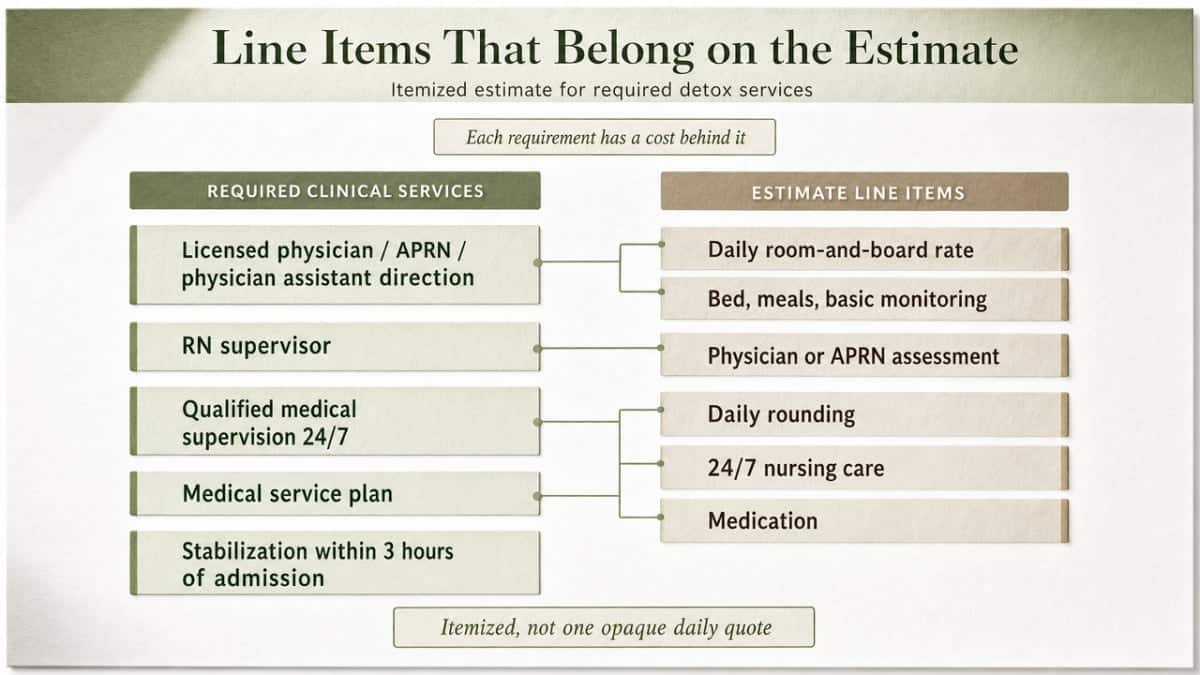
A single opaque number — “detox costs X per day” — isn’t an estimate. It’s a quote on a billboard. What you want is an itemized breakdown that mirrors the actual clinical services Oklahoma rules require a certified detox facility to deliver. Under ODMHSAS Chapter 18, medically supervised withdrawal management must operate under the direction of a licensed physician, APRN, or physician assistant with an RN supervisor, with qualified medical supervision available 24/7 and a medical service plan addressing stabilization within three hours of admission 10. Each of those requirements has a cost behind it, and each should show up as a line.
Here is what you should see itemized when the estimate lands in your inbox:
- Daily room-and-board rate (the bed, meals, basic monitoring)
- Physician or APRN assessment and daily rounding
- 24/7 nursing care
- Medications for withdrawal management, including MAT such as buprenorphine, methadone, or medications for alcohol withdrawal
- Laboratory work (admission panel, urine drug screen, follow-up labs as needed)
- Discharge planning and continuing care referral
Ask whether anything commonly used — a psychiatric consult, EKG, specialty medications, a longer stay if symptoms don’t resolve on the expected timeline — is bundled into the daily rate or billed separately. Both answers can be legitimate. The red flag is vagueness. If the facility quotes you a flat number and waves off the pieces, you don’t yet have an estimate; you have a sales pitch. A straight answer sounds like, “The daily rate includes nursing, physician rounding, and standard medications. Specialty medications and labs beyond the admission panel are billed at cost, and we’ll show you those line items on the invoice.” That’s the shape of a conversation you can trust.
If the Final Bill Exceeds the Estimate by $400 or More
Keep the estimate. Save the email, screenshot the attachment, print a copy — whatever you’ll actually be able to find in two weeks when the real invoice arrives. Under the No Surprises Act, if your final bill from a provider listed on the Good Faith Estimate exceeds the estimated charge by at least $400, you may be eligible to dispute the charge through the federal patient-provider dispute resolution process.
You don’t have to pay a bill that doesn’t match what you were promised, at least not without raising the question. Call the billing office first and ask them to reconcile the invoice against the estimate line by line. Most legitimate discrepancies get resolved there. If they don’t, the dispute pathway exists for a reason — and knowing that it does changes how the first conversation goes.
Scripts: What to Say When You Call
You don’t need to sound polished. You need to get three or four answers in writing. Here’s language you can use verbatim, whether you’re calling for yourself or for someone else.
If you’re calling for yourself:
“Hi. I’m looking at medical detox and I’ll be paying out of pocket. Can you tell me what your daily rate is, what it includes, and send me a Good Faith Estimate in writing before I decide?”
If you’re calling for a family member:
“Hi. My [son/husband/sister] needs medical detox and we’re paying out of pocket. Can you walk me through your self-pay rate, what’s bundled in, what gets billed separately, and whether you offer a payment plan?”
If you’re in a hurry because withdrawal is already starting:
“Hi. We need to admit today. I’m self-pay. What’s the fastest way to get a written estimate and start admission?”
After the opener, keep a short list in front of you. These are the questions that tend to get skipped:
- What substances do you treat, and do you have a physician or APRN directing withdrawal management on-site?
- Is nursing on-site around the clock?
- Are MAT medications like buprenorphine included in the daily rate, or billed separately?
- What happens if I need to stay an extra day or two?
- Do you help arrange what comes after detox, and is that referral included?
- What deposit do you require, and do you offer a payment plan?
Verifying the Facility Before You Commit a Dollar
Before you wire a deposit or hand over a card, spend ten minutes confirming the facility is who they say they are. In Oklahoma, that’s not a trust exercise — it’s a records check. ODMHSAS certifies alcohol and drug treatment programs, and residential-level providers seeking SoonerCare reimbursement also carry national accreditation and, for newer providers, a Certificate of Need 11. Even if you’re paying privately, that certification tells you the state is holding the facility to a real standard.
Here’s what to verify, in writing or by phone, before you commit:
- ODMHSAS certification as an alcohol and drug treatment program — ask for the certification number and the service category.
- Medical direction by a licensed physician, APRN, or physician assistant, with an RN supervisor over the nursing team 10.
- Qualified medical supervision available 24 hours a day, not just during business hours 10.
- A medical service plan documented within three hours of your admission — the clinical baseline that drives your withdrawal management 10.
- National accreditation (such as Joint Commission or CARF) if the facility also serves SoonerCare patients at residential level 11.
If the person on the phone can rattle these off without defensiveness, that’s a good sign. If they hedge, ask for a supervisor. You’re not being difficult — you’re protecting a person in a vulnerable moment with money you’ve worked hard for.
Four Oklahoma Payment Pathways, Compared Honestly
SoonerCare: Check This Before You Write a Check
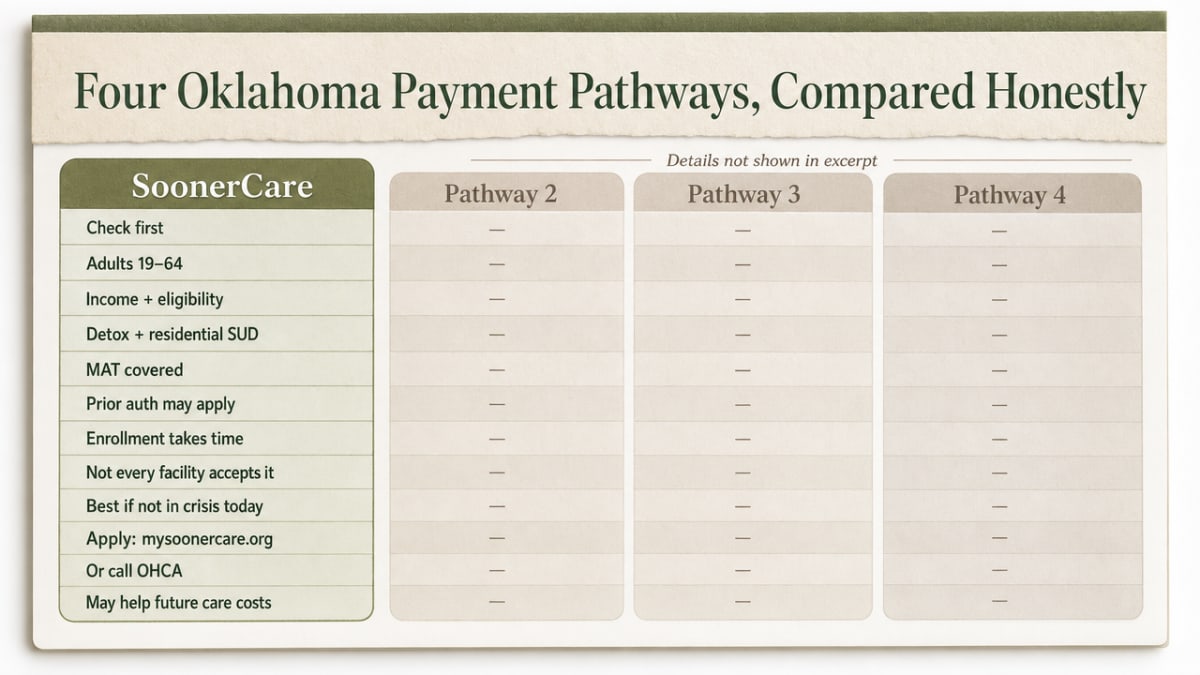
Before you commit a dollar to private self-pay, spend fifteen minutes finding out whether you qualify for SoonerCare. Oklahoma’s Medicaid expansion covers adults ages 19 through 64 who meet income and other eligibility requirements 2. If you qualify, detoxification and residential substance-use-disorder services, along with medication-assisted treatment, are listed as covered benefits — though prior authorization may be required for specific services 1.
The catch is time. Prior authorization and enrollment don’t move at the speed of acute withdrawal, and not every facility accepts SoonerCare. Still, if you’re not already in crisis today, this is the first phone call to make. Apply at mysoonercare.org or call OHCA directly. Even if you end up self-paying for this detox episode, confirming eligibility now sets up continuing care — therapy, MAT maintenance, follow-up appointments — that you’d otherwise have to pay for out of pocket for months afterward.
The VA Pathway for Veterans in Oklahoma City and Statewide
If you served, this call comes before any private facility. The Oklahoma City VA Medical Center offers same-day drug and alcohol evaluation through its Substance Treatment and Recovery Clinic, with a local phone line you can reach directly 8. For eligible veterans, VA health care covers medically managed detoxification, medications like methadone and buprenorphine for opioid use disorder, counseling, residential care, and relapse-prevention services 9.
Eligibility depends on your enrollment status and discharge characterization, and local capacity varies. Call the OKC VA first and ask whether medically supervised detox is available on-site or whether they’ll refer you to a community provider through VA community care. Either way, you may be looking at little or no out-of-pocket cost for care that would otherwise land on a credit card.
CCBHCs for Continuing Care After Detox
Certified Community Behavioral Health Clinics aren’t typically where you’ll get 24/7 medically supervised withdrawal management — but they are where a lot of good things happen next. Oklahoma’s CCBHC network provides a comprehensive range of mental-health and substance-use-disorder services, including 24-hour crisis care, medication services, case management, and care coordination 4. ODMHSAS also operates a statewide network of certified community behavioral-health clinics covering most regions of the state 3.
If private self-pay is going to drain the account on detox itself, a CCBHC is often the answer for what comes after: outpatient counseling, MAT maintenance, peer support, and connection to housing or employment help. Service scope differs by location, so call the clinic nearest you and ask specifically what they offer, whether there’s a sliding-scale fee, and how soon you can be seen.
Private Self-Pay as an Informed Choice
After checking the three pathways above, private self-pay may still be the right call — and that’s a legitimate choice, not a fallback. You might not qualify for SoonerCare. You might not be a veteran, or the VA timeline might not match your situation. You might need admission tonight, want privacy from an employer plan, or prefer a specific facility with specific programming. Private self-pay gives you immediate admission without prior authorization queues, a written Good Faith Estimate before you sign, and the option to negotiate a payment plan.
Here’s how the four pathways compare at a glance:
- SoonerCare covers detox and MAT for eligible expansion adults ages 19–64 but requires prior authorization and takes time to arrange 1, 2.
- The VA offers same-day access and often no out-of-pocket cost for eligible veterans in Oklahoma City 8, 9.
- CCBHCs handle crisis care and continuing care across the state, with scope varying by site 3, 4.
- Private self-pay is fastest at admission and most transparent on price when you ask the right questions.
Payment Plans, Deposits, and What a Fair Arrangement Sounds Like
Here’s the part nobody wants to talk about on the phone: the money has to move before admission. Most self-pay detox facilities ask for a deposit upfront, often the first few days of care, with the balance due on a schedule the two of you agree to before you walk through the door. That’s not predatory. That’s how a bed gets held for you instead of someone else.
What is fair varies, but the shape of a good conversation is consistent. The facility should tell you the deposit amount in plain numbers, explain what happens to it if your stay is shorter or longer than expected, and offer a written payment plan for any balance you can’t cover at admission. A fair plan has a defined length, no vague “we’ll figure it out later,” and clear language about what happens if a payment is late — ideally a grace period and a conversation, not immediate collections.
You can ask these questions directly: How much is the deposit? Is it refundable if I’m discharged early? Can I split the balance over three or six months? Do you charge interest or financing fees? Will you put the plan in writing before I’m admitted?
A facility that treats you with dignity will answer each one without flinching. One that pressures you to “just get here and we’ll work it out” is asking you to sign a blank check in a crisis. You deserve better, and in Oklahoma, better is available.
Why Timing Matters in Oklahoma Right Now
There’s a reason the person on the other end of your call keeps mentioning the word today. Fentanyl is in nearly everything, and it doesn’t care about your pay stub. In 2024, fentanyl was involved in 86% of all opioid-related overdose deaths in Oklahoma 12. That isn’t a scare statistic — it’s the clinical reality shaping how fast a licensed facility wants to get someone into a monitored bed when opioids are part of the picture.
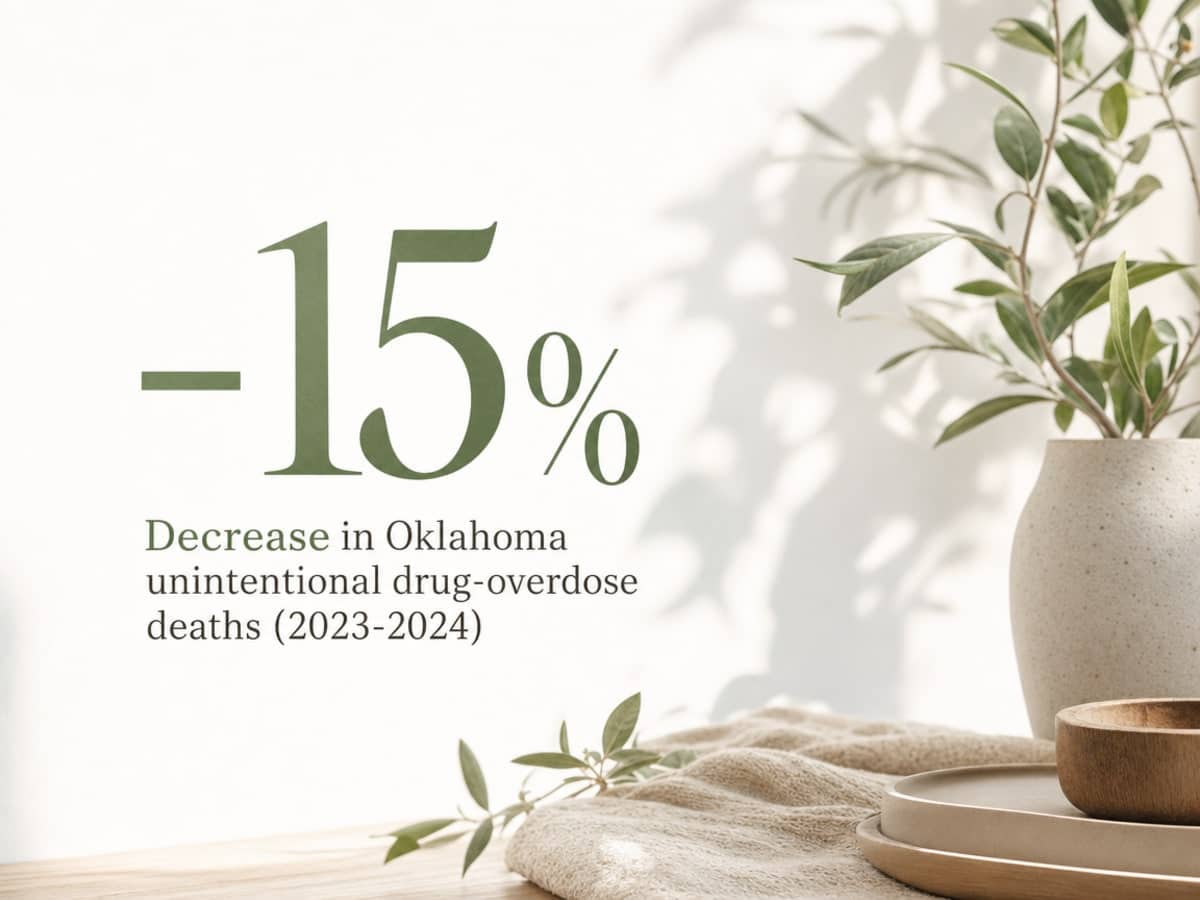
There is some good news in the same data: the state’s unintentional drug-overdose death rate dropped 15% from 2023 to 2024, the kind of movement that happens when more people reach medically supervised care in time 12. You being here, reading this, is part of that shift.
Self-pay doesn’t have to mean waiting. It often means skipping the authorization queue entirely. If withdrawal has already started, or if the person you’re calling for is using alone, the next 24 hours matter more than the perfect spreadsheet. Make the call. Get the written estimate. Decide from there.
Detox Is the First Step, Not the Treatment
Here’s something a good facility will tell you before you ask: paying for detox is not the same as paying for recovery. Medical detox gets your body through withdrawal safely. It doesn’t rewire the patterns that got you here. Federal clinical guidance is explicit on this point — detoxification alone is not sufficient treatment for substance dependence, and withdrawal management without follow-up care typically leads to resumed use 7. NIDA says the same thing in plainer language: detox is not treatment, and for opioid use disorder, medications combined with behavioral therapy should be the first line of ongoing care 14.
Why this matters for your self-pay conversation: when a facility quotes you a daily rate, ask what happens on day six. Is there a warm handoff to continuing care — a therapist, a MAT prescriber, a residential program, a CCBHC in your area? Is that referral included in the price, or billed separately? Does someone help you schedule the first appointment before discharge, or do you leave with a photocopied list?
The right answer sounds like a plan, not a goodbye. That’s the detox worth paying for.
When You Call Renewal Springs
If Oklahoma City is where you are, Renewal Springs is one of the facilities built to have this exact conversation with you. Call and say the quiet part first: I’m paying out of pocket, and I’d like a Good Faith Estimate in writing. You won’t be redirected to a benefits portal, and you won’t be made to feel like you’ve shown up at the wrong door.
Here’s what you can ask, and what you should expect in return: a daily rate explained in plain numbers, a line-item breakdown of what’s included and what’s billed separately, deposit and payment-plan options spelled out before admission, and a clear answer about continuing care — because detox is the first step, not the finish line 7, 14.
You’ve done the hard reading. The next move is a phone call that treats you like an adult making a decision under pressure. That’s the conversation waiting on the other end.
Talk Self-Pay Detox Options With Us Now
Get honest answers about self-pay detox costs and your next steps, right from a supportive team member.
Frequently Asked Questions
What does self-pay detox in Oklahoma actually include?
At a certified Oklahoma facility, self-pay typically covers your bed, 24/7 nursing, physician or APRN oversight, withdrawal medications, standard labs, and discharge planning 10. Specialty medications, extra lab work, or an extended stay may be billed separately. Ask for an itemized Good Faith Estimate so you can see each piece in writing before admission.
Can I get a written price before I agree to admission?
Yes. Under the No Surprises Act, if you’re uninsured or self-pay, you can request a Good Faith Estimate of expected charges before you commit. Say it plainly on the phone: I’d like a Good Faith Estimate in writing. A facility that treats self-pay as routine will send one by email or portal, usually within a day or two.
Should I check SoonerCare eligibility before paying out of pocket?
If time allows, yes. Oklahoma’s Medicaid expansion covers adults ages 19–64 who meet income rules, and detox, residential SUD services, and MAT are listed as covered benefits 1, 2. Even if you self-pay for this admission, confirming eligibility now sets up continuing care — therapy, MAT maintenance, follow-up — without months of out-of-pocket bills afterward.
Do Oklahoma detox facilities offer payment plans?
Many do. A fair arrangement includes a clearly stated deposit, a written payment schedule for the balance, defined length, and plain language about late payments — a grace period and a conversation, not immediate collections. Ask whether interest or financing fees apply, and insist the plan be put in writing before admission, not after.
What happens after detox if I can’t afford more private care?
Detox is not treatment — withdrawal management without follow-up usually leads to resumed use 7, 14. If private continuing care isn’t affordable, Oklahoma’s CCBHC network offers outpatient counseling, MAT, case management, and crisis care, often on a sliding-scale fee 3, 4. Ask the detox facility to help schedule your first appointment before you’re discharged.
How do I verify a facility is properly licensed in Oklahoma?
Ask for the facility’s ODMHSAS certification number and service category — alcohol and drug treatment programs require state certification 11. Confirm medical direction by a licensed physician, APRN, or PA with an RN supervisor, 24/7 qualified medical supervision, and a medical service plan documented within three hours of admission 10. A legitimate facility answers without hesitation.
References
- Mental Health and Substance Abuse Services – Oklahoma.gov. https://oklahoma.gov/ohca/individuals/programs/mental-health-and-substance-abuse-services.html
- SoonerCare Choice Expansion Benefits Guide. https://oklahoma.gov/ohca/individuals/mysoonercare/benefits-guides/soonercare-choice-expansion.html
- ODMHSAS Facilities. https://oklahoma.gov/odmhsas/about/odmhsas-facilities.html
- Certified Community Behavioral Health Clinics (CCBHC). https://oklahoma.gov/odmhsas/treatment/ccbhc.html
- Provisional Drug Overdose Death Counts. https://www.cdc.gov/nchs/nvss/vsrr/drug-overdose-data.htm
- STATE FACTS. https://oklahoma.gov/content/dam/ok/en/health/health2/aem-documents/prevention-and-preparedness/injury-prevention/drug-overdose/up-methamphetamine-overdose-fact-sheet.pdf
- Appendix C—Excerpts From Quick Guide for Clinicians Based on TIP 45, Detoxification and Substance Abuse Treatment. https://www.ncbi.nlm.nih.gov/sites/books/NBK64044/
- Make An Appointment | VA Oklahoma City Health Care. https://www.va.gov/oklahoma-city-health-care/make-an-appointment/
- Substance Use Treatment For Veterans. https://www.va.gov/health-care/health-needs-conditions/substance-use-problems/
- CHAPTER 18. STANDARDS AND CRITERIA FOR CERTIFIED ALCOHOL AND DRUG TREATMENT PROGRAMS. https://oklahoma.gov/content/dam/ok/en/odmhsas/documents/policy/provider-certification/administrative-rules/2025/PC–Chapter-18_9-1-25.pdf
- Provider Certification. https://oklahoma.gov/odmhsas/policy/provider-certification.html
- Data. https://oklahoma.gov/health/health-education/injury-prevention-service/drug-overdose/data.html
- Opioid Abatement Board approves plans to award $29 million in grants. https://oklahoma.gov/oag/news/newsroom/2025/march/opioid-abatement-board-approves-plans-to-award-29-million-in-grants.html
- Treatment and Recovery. https://nida.nih.gov/publications/drugs-brains-behavior-science-addiction/treatment-recovery