
Key Takeaways
- Meth withdrawal unfolds in two distinct phases: a 1–3 day crash of heavy sleep and emptiness, followed by a longer stretch of depressed mood, anxiety, and cravings as brain chemistry resets 8.
- Acute symptoms typically peak 2–3 days after last use and ease over 5 to 14 days, but sleep problems and cravings can persist for weeks, with cravings lasting at least five weeks in one study 3, 5, 6.
- Week three is a high-risk relapse window because mood improves while cravings remain loud and dopamine levels stay low, making the quieter post-acute phase as important to protect as the first days 2.
- No FDA-approved medication treats meth withdrawal, so supervised detox focuses on monitoring for suicidal thoughts, paranoia, and severe agitation while providing food, sleep, and symptom-targeted care 2, 3, 9.
The First Hard Nights: What a Meth Crash Actually Feels Like
If you’re reading this at 3 a.m. because the sweats won’t stop and your chest feels hollow, you are not weak. Your brain and body are doing something predictable, something that has a shape and an end. Knowing that shape makes it easier to get through.
The first thing most people describe is a flattening. The energy that kept you up for a day, or two, or four, drops out from under you. You feel bone-deep tired but not restful. You might sleep for twelve hours and wake up still exhausted. You might lie awake wired and empty at the same time. Both are normal. Clinical reviews describe this early phase as a mix of hypersomnia, dysphoria, inactivity, irritability, and vivid dreams that can wake you up sweating 10.
Then comes the hunger. Not polite hunger — the kind that feels almost angry, like your body is trying to collect on a debt. Eat anyway. Even small things. Your body burned through reserves it needs back.
And then the feelings arrive. A heavy, gray sadness. A sense that nothing will ever feel good again. That feeling is a chemical event, not the truth about your life. Guidelines note that sleepiness and irritability can begin within 12 to 24 hours of stopping 2, and the emptiness most people call “the crash” tends to settle in during that same window 8.
Making it to morning is not nothing. That is already your body doing the work.
Crash vs. Withdrawal: Two Different Things Happening in Your Body
People use “crash” and “withdrawal” like they mean the same thing. They don’t, and the difference matters when you’re trying to figure out what’s happening to you.
The crash is the first wave. It’s your body collapsing after days of being pushed past its limits. NIDA describes it as roughly one to three days of heavy sleepiness, emptiness, and lethargy — the lights-out stage where you might sleep almost around the clock and still feel wrung out 8. Think of it as the bill coming due for the energy you borrowed.
Withdrawal is what starts underneath the crash and keeps going after the sleep comes back. This is where the depressed mood, the anxiety, the cravings, and sometimes dark thoughts settle in 8. It’s less about exhaustion and more about your brain chemistry trying to find a new baseline without the drug telling it what to do.
Why does this split matter for you? Because the crash feels like something you can sleep off, and a lot of people assume that once they wake up rested, they’re through the hard part. The harder part is often what comes next — quieter, longer, and the window where cravings get loud. Knowing a second wave is coming lets you plan for it instead of being blindsided by it.
The Timeline: Hour by Hour, Day by Day
Hours 0–24: The Shutdown Starts
The first day is quieter than you might expect. There’s no dramatic alarm going off. Instead, your body starts closing shop one system at a time.
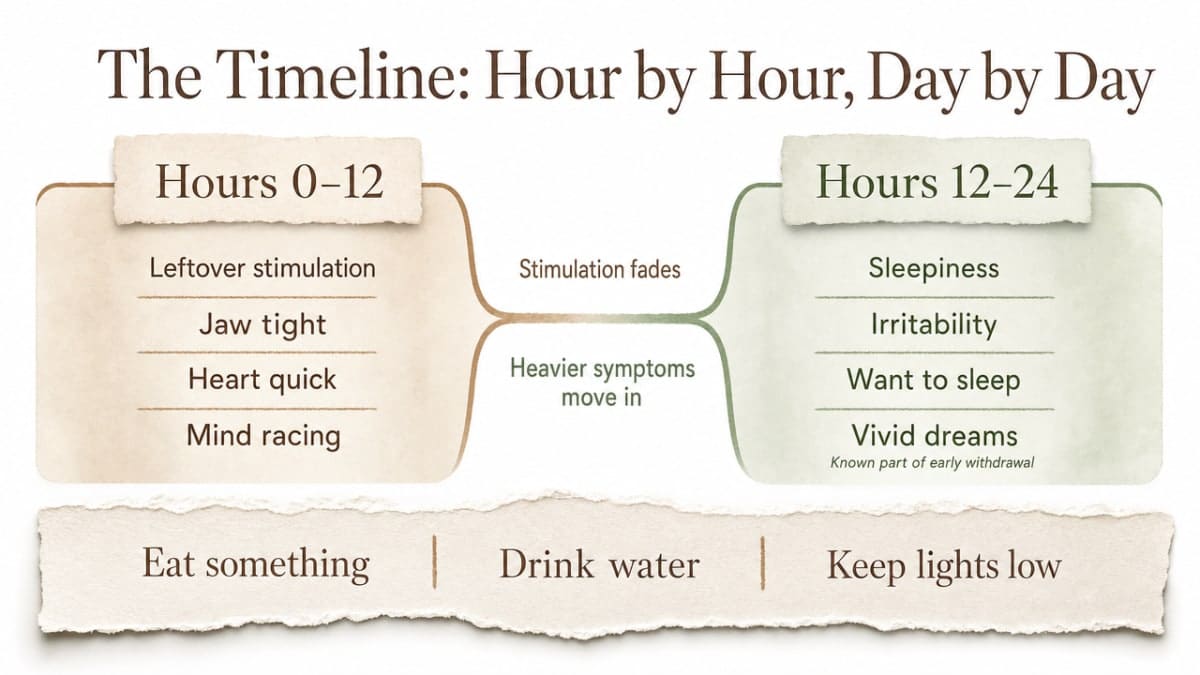
In the first several hours after your last use, you might still feel keyed up — jaw tight, heart quick, mind racing. That’s leftover stimulation burning off. Somewhere between hour 12 and hour 24, that fades and something heavier moves in. Clinical guidelines describe this as a predictable 12-to-24-hour window where sleepiness and irritability take over 2.
You’ll probably want to sleep, hard. If you can, let yourself. If you can’t sleep, don’t fight the bed — eat something, drink water, keep the lights low. The vivid dreams some people get in this window can feel disturbing, and that’s a known part of early withdrawal, not a warning sign on its own 1.
You might feel irritable with people who are trying to help. That’s chemistry, not character. Tell someone close to you what day you’re on so they understand why you’re short. Getting to the end of day one with food in your stomach and a safe place to lie down is a real win.
Days 2–3: The Peak
This is the part that scares people, and it’s also the part that passes. Across clinical reviews, acute methamphetamine withdrawal tends to be most severe during the first 72 hours 1, 10, and NIDA notes that symptoms commonly peak two to three days after last use 3. If you’re in it right now, you are at the hardest point of a curve that bends down from here.
Expect the fatigue to deepen before it lifts. Hypersomnia — sleeping ten, twelve, fourteen hours — is common, as is waking up still feeling flattened. Appetite comes back with force. Mood drops. A dull, gray dysphoria sits on your chest. Your body may feel heavy and slow, or restless and agitated, sometimes both in the same day 10.
Cravings get loud here. Your brain, used to being flooded with dopamine, is asking for the thing it knows will fix the feeling fast. That craving is a symptom, not an instruction.
If you can get through hour 72 without using, you have crossed the steepest part of the slope. Keep someone nearby. Keep the room quiet. Keep eating. If dark thoughts show up at this peak, that is the moment to call for help, not tough it out alone.
Days 4–14: The Slow Climb Back
After the peak, things start to shift — unevenly. Some symptoms lift quickly. Others take their time. One of the most important things to understand about meth withdrawal is that different symptoms recover on different clocks, and expecting them all to clear at once sets you up to feel like you’re failing when you’re not.
In a prospective study of people entering residential treatment, mood and anxiety symptoms improved most in the first week and generally resolved within two weeks — but sleep stayed disrupted across the full four-week observation window 6. A separate inpatient study of 56 people found that depressive and psychotic symptoms largely resolved within one week, while cravings persisted for at least five weeks 5. In other words: you may start to feel emotionally lighter by day 7 to 14, still not be sleeping right, and still get hit by waves of wanting to use. All of that is on the normal map.
Days 4 through 7 usually bring the first real relief. The heavy sadness thins. You can hold a conversation again. Food tastes like something. By days 7 to 14, acute withdrawal is winding down for most people, which clinical reviews put at a 5-to-14-day acute phase 1.
The trap in this stretch is thinking “I’m fine now.” You are better. You are not done. The next few weeks are where protection matters most.
What Your Body Is Doing vs. What Your Mind Is Doing
One of the most disorienting things about meth withdrawal is that it comes at you from two directions at once. Your body is doing one set of things. Your mind is doing another. When you try to describe it to someone, it can sound like a dozen unrelated problems. It is not. It is one syndrome with two tracks, and both tracks are expected.
On the body side, the most common experiences are heavy sleepiness or long stretches of sleep (hypersomnia), appetite that comes roaring back, vivid dreams that can wake you up, body aches and heaviness, and movements that feel either slowed down or jittery and restless 1, 10. Your heart rate and blood pressure, which were running high during use, start settling. You may feel cold, sweaty, or both. You may notice headaches, a sore jaw from clenching, or an upset stomach when you start eating again. None of this means something is wrong with you — it means your body is coming back online.
On the mind side, the dominant experiences are depressed mood, anxiety, irritability that can flash into anger over small things, trouble concentrating or holding a thought, and cravings that come in waves 1, 3. The depression is often the hardest piece. It can feel bottomless. It is not a verdict on your life; it is a predictable chemical dip that lifts as your brain’s reward system recalibrates.
The two tracks feed each other. When you have not slept well, anxiety sharpens. When your mood is low, body aches feel heavier. When cravings hit, your heart races and you start pacing, and the pacing makes the agitation worse. Knowing the loop exists helps you interrupt it: eat something, drink water, step into a different room, call someone, lie down with the lights low.
Here is the practical reason this split matters. If you only know to expect the physical side, the mental side can convince you that something has gone catastrophically wrong — that you are broken, that this feeling will never end, that using is the only way out. If you only know to expect the mental side, the physical fatigue can scare you into thinking you have gotten sick. Seeing both tracks on the same map lets you locate what you are feeling, name it, and remember that it has a timeline. The acute phase of all of this is usually most intense in the first 72 hours and winds down over roughly 5 to 14 days 1. You are not inventing symptoms. You are not overreacting. Your body and brain are doing exactly what they do when the drug leaves — and that work, uncomfortable as it is, is how you get your baseline back.
Post-Acute Symptoms: Why Week Three Is Where People Relapse
Here is the part almost no one warns you about. You get through the crash. You get through the peak. By day ten or so, you are eating, you are showering, you are starting to recognize yourself in the mirror. And then week three hits and the floor drops out again — not as hard as the first time, but harder than you expected because you thought you were done.
This is post-acute withdrawal, and it is real. The ASAM/AAAP clinical guideline notes that depression, anxiety, insomnia, and paranoia can continue for weeks to months after the acute phase ends 2. Hospital-based clinicians describe a similar protracted stretch of cognitive dysfunction, dysphoria, anxiety, and cravings that outlasts the first week 10. The inpatient study that followed people for five weeks found something even more specific: depressive and psychotic symptoms largely cleared within a week, but cravings stayed loud for at least five weeks straight 5.
Treat week three like week one. Keep someone close. Keep your phone on. The fact that it still hurts does not mean you are not healing.
How Common and How Painful This Really Is
If you have felt alone in this, you are not. Withdrawal from meth is a widely shared experience, and for a lot of people, it is genuinely rough — not something you are exaggerating or inventing.
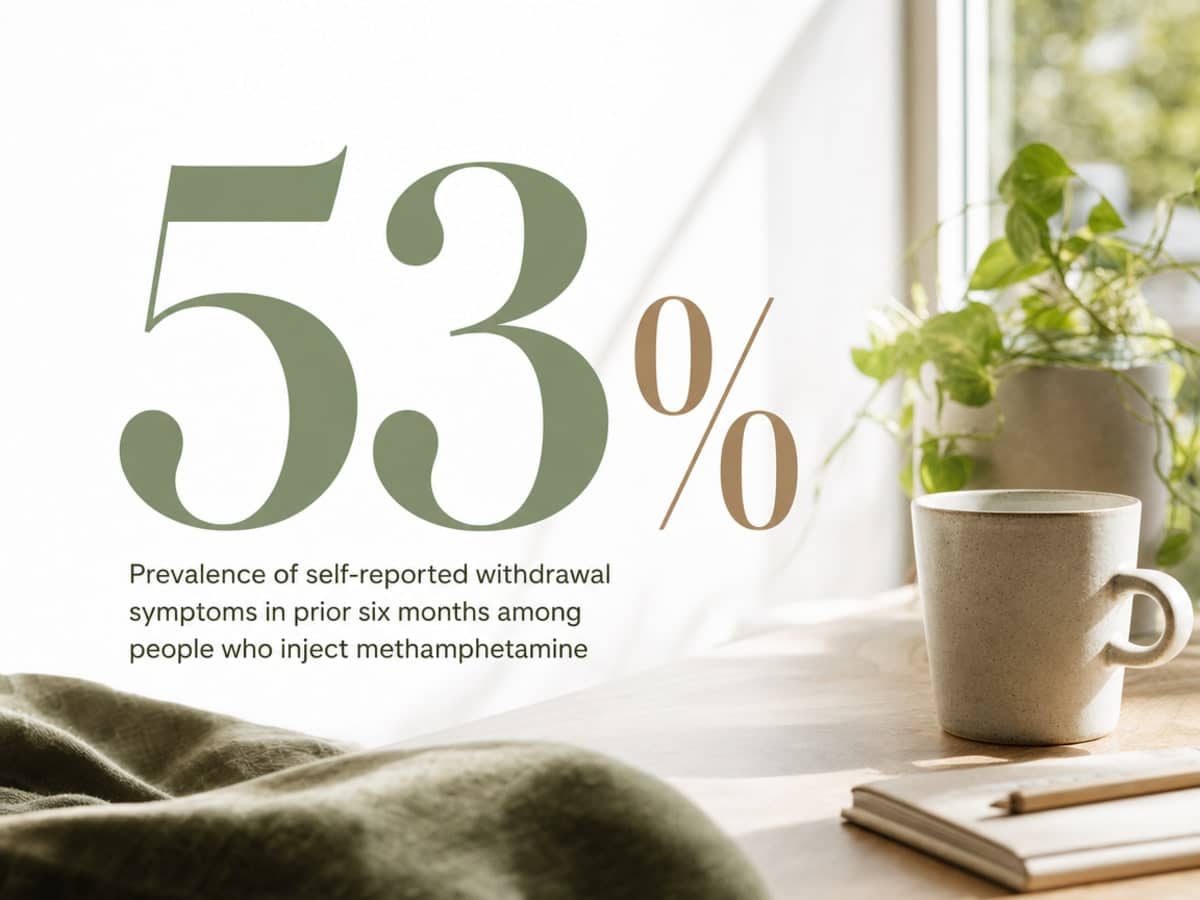
A study of people who inject drugs put some numbers on it. In the prior six months, 53% reported withdrawal symptoms. One in four — 25% — had them weekly. And 20% described their symptoms as very or extremely painful 7. That last number is the one worth sitting with. One in five people in that study were not describing a bad mood or a long nap. They were describing pain.
A caveat matters here: this study looked specifically at people who inject drugs, so the exact percentages do not map onto everyone who uses meth. But the shape of the finding travels. Withdrawal is common, it can hit hard, and if yours feels like the painful end of that spectrum, you are inside a known pattern — not failing at something other people breeze through.
Red Flags: When to Stop Reading and Call Someone
Most meth withdrawal is miserable but not medically dangerous in the way alcohol or benzodiazepine withdrawal can be. There are, however, specific symptoms that mean this stops being something you ride out and starts being something you get help for — now, not tomorrow.
Call 988 or a trusted person immediately if you notice any of these:
- Thoughts of killing yourself, or a plan to do it. NIDA explicitly lists suicidal thoughts as part of the withdrawal period after a meth crash 8. That is a known chemistry, not a true read on your worth, but it needs another human on the line with you until it passes.
- Seeing, hearing, or believing things other people cannot verify. Paranoia and psychotic symptoms can show up during acute withdrawal and can continue into the post-acute window 2. This needs clinical eyes.
- Severe agitation you cannot settle — pacing for hours, unable to sit, unable to be reached. Clinical guidance treats this as a reason for supervised care, not solo endurance 1.
- You cannot keep down water, cannot stay oriented, or cannot care for yourself safely.
None of these mean you failed. They mean the version of this you are having needs more than a quiet room. Call 988. Call someone in your house. Call a detox line. You do not have to decide anything else first.
Is There a Medication That Fixes This? An Honest Answer
Short answer: no, not in the way methadone or buprenorphine fixes opioid withdrawal. If you were hoping to read that there is a pill you can take that turns this off, you deserve the truth instead.
A systematic review of medications studied for amphetamine and methamphetamine withdrawal found no pharmacotherapy with convincing evidence for reducing withdrawal symptoms or reliably treating methamphetamine dependence 4. NIDA puts it plainly on their current overview: no FDA-approved medication treats methamphetamine use disorder or any other stimulant use disorder 3. That is not a gap someone forgot to fill. Researchers have been looking hard for years. The brain chemistry involved is stubborn.
There is some newer movement worth knowing about. A phase 3 trial of mirtazapine, an antidepressant that also helps with sleep, found that people with moderate-to-severe methamphetamine use disorder who took it had about two fewer use days per month than people on placebo over 12 weeks 11. That is a real finding, and it may matter later in recovery. It is not an approved withdrawal medication, and it does not shut off the crash.
What clinicians actually do during withdrawal is treat the symptoms in front of them — something for sleep, something for anxiety, something for agitation, careful watching for depression and suicidal thoughts 9. That is useful. It is not a cure. Knowing that going in protects you from feeling like the system failed you when no one hands you a prescription that ends it.
What Supervised Detox Actually Offers for Stimulant Withdrawal
If you’ve read this far hoping for a reason supervised detox makes sense for meth — not opioids, not alcohol, but meth — here is the honest version. A detox facility for stimulant withdrawal is not handing you a medication that turns off the crash. There isn’t one 4. What it offers is the stuff that is almost impossible to arrange for yourself when you feel this bad.
The first piece is safety during the psychiatric symptoms. Suicidal thoughts, paranoia, and severe agitation are known parts of this window 2, 8, and they are not symptoms you want to ride out in a bedroom alone. A licensed medical team watching for them, 24 hours a day, is the thing an app or a sober friend cannot replicate.
The second piece is the environment itself. Clinical guidance for stimulant withdrawal is specific about what helps: food on hand, uninterrupted sleep, quiet surroundings, and symptom-targeted medications for anxiety, insomnia, or agitation when they show up 1, 9. That sounds simple until you try to build it in a house with a job, a phone that keeps ringing, and a corner store two blocks away.
The third piece is close monitoring during the first 72 hours, when symptoms are typically most severe 1, 10. At Renewal Springs in Oklahoma City, that means around-the-clock licensed medical staff and attentive bedside care through the window where things are hardest and decisions are shakiest. No pill ends meth withdrawal. Having people whose only job is to watch over you while it passes is a different kind of medicine.
Getting Through It at Home: Food, Sleep, People, and a Plan
If you’ve decided to ride this out at home — and the red flags from earlier aren’t in the picture — a few concrete things make the difference between a brutal week and a survivable one.
Food. Keep easy stuff within reach before day one: bananas, peanut butter, crackers, soup, electrolyte drinks. Your appetite will come back hard, and clinical guidance specifically names food access as part of supportive care for this withdrawal 9. Eat even when it feels like too much effort.
Sleep. Let yourself sleep when sleep comes, even if it’s noon. Keep the room dark and the phone face-down. Expect sleep to stay wonky for weeks after the mood lifts — that’s the normal shape of recovery, not a sign it isn’t working 6.
People. Tell one person what day you’re on. Not for a lecture — just so someone knows to check in and knows to call for help if you mention dark thoughts 8.
A plan for the craving waves. Decide ahead of time what you’ll do when a craving hits: a shower, a walk around the block, a text to your person, a glass of water, lying down. The craving will crest and pass. Your job is to outlast it, not argue with it.
A Next Step in Oklahoma City
If you’ve gotten this far, you already know more about what’s happening to you than most people do when they try to stop. That matters. Knowing the shape of the next 72 hours, the next two weeks, and the quieter stretch after is how people make it through.
If you’re in or near Oklahoma City and want to ask what medically supervised meth detox actually looks like — the monitoring, the sleep and nutrition support, the staff on hand when the hard hours hit — Renewal Springs will answer the phone and talk you through it. No pressure to decide anything on the call. Just ask the questions you have. Making the call is a next step, not a commitment.
Talk to Someone Who Understands Meth Withdrawal
Get real answers and support for managing meth withdrawal symptoms, right when you need them.

Frequently Asked Questions
How long do meth withdrawal symptoms last?
Acute symptoms usually begin within hours of your last use, peak around 2–3 days in, and ease over roughly 5 to 14 days 1, 3. Lower-grade symptoms — depression, anxiety, insomnia, cravings — can linger for weeks or months after the acute phase, which is normal and does not mean something is wrong 2.
Can you die from meth withdrawal?
Meth withdrawal itself is generally not directly life-threatening the way alcohol or benzodiazepine withdrawal can be. The real danger is psychiatric: suicidal thoughts, severe depression, paranoia, and psychosis are known parts of this window 2, 8. If any of those show up, call 988 or get to a medical setting right away.
Is there a medication that treats meth withdrawal?
No FDA-approved medication treats methamphetamine withdrawal or methamphetamine use disorder 3, 4. Clinicians treat symptoms as they appear — something for sleep, anxiety, or agitation — and watch closely for depression and suicidal thoughts 9. A recent mirtazapine trial showed modest benefit for reducing use days in use disorder, not as an approved withdrawal medication 11.
What is the difference between the meth crash and withdrawal?
The crash is the first 1–3 days: heavy sleep, emptiness, lethargy — your body collapsing after being pushed past its limits 8. Withdrawal is what unfolds underneath and after that: depressed mood, anxiety, cravings, and sometimes dark thoughts as your brain chemistry resets 8. The crash feels like exhaustion. Withdrawal is quieter, longer, and where cravings get loudest.
Do I need a detox facility, or can I withdraw from meth at home?
Many people get through meth withdrawal at home with food, rest, and someone checking on them. Supervised detox matters when the psychiatric side gets heavy — suicidal thoughts, paranoia, severe agitation — or when you can’t arrange food, sleep, and a quiet space on your own 1, 9. In Oklahoma City, Renewal Springs can talk you through which fits your situation.
Why do cravings and sleep problems last so much longer than other symptoms?
Mood and anxiety tend to lift within a week or two as acute chemistry rebalances, but cravings and sleep run on a different clock. One inpatient study found depressive and psychotic symptoms largely cleared within a week while cravings persisted at least five weeks 5. A separate study showed sleep disruption continuing past the four-week mark 6. Your reward system and sleep architecture take longer to reset — not a failure, just the shape of recovery.
References
- Methamphetamine Toxicities and Clinical Management. https://pmc.ncbi.nlm.nih.gov/articles/PMC11458184/
- The ASAM/AAAP Clinical Practice Guideline on the Management of Stimulant Use Disorder. https://pmc.ncbi.nlm.nih.gov/articles/PMC11105801/
- Methamphetamine. https://nida.nih.gov/research-topics/methamphetamine
- Pharmacological Treatment of Methamphetamine Use Disorder: A Systematic Review. https://pmc.ncbi.nlm.nih.gov/articles/PMC7125061/
- Withdrawal symptoms in abstinent methamphetamine-dependent subjects. https://pubmed.ncbi.nlm.nih.gov/20840201/
- Characterizing methamphetamine withdrawal in recently abstinent methamphetamine users: a pilot field study. https://pubmed.ncbi.nlm.nih.gov/21219261/
- Factors associated with methamphetamine withdrawal symptoms among people who inject drugs. https://pubmed.ncbi.nlm.nih.gov/33894459/
- Methamphetamine. https://nida.nih.gov/sites/default/files/e-methamphetamine-slides.pdf
- Methamphetamine Toxicities and Clinical Management. https://stacks.cdc.gov/view/cdc/164676/cdc_164676_DS1.pdf
- Management of the hospitalized patient who uses methamphetamine. https://pmc.ncbi.nlm.nih.gov/articles/PMC11963739/
- Mirtazapine for Methamphetamine Use Disorder. https://pmc.ncbi.nlm.nih.gov/articles/PMC13044789/