
Key Takeaways
- PHP sits between residential care and standard outpatient treatment, delivering twenty or more clinical hours per week while your adult child sleeps at home or in sober living 5, 20.
- The right candidate has a real diagnosis, mild to moderate withdrawal, psychiatric stability, and a safe place to sleep; unsafe home environments or acute crisis point toward residential instead 6, 23.
- Outcomes data shows measurable symptom improvement during PHP and meaningful early abstinence rates afterward, though long-term durability depends on the step that follows, whether IOP, sober living, or ongoing medication management 13, 12, 11.
- Before enrollment, press the admissions team on medical necessity reasoning, weekly hours, on-site prescribing for co-occurring conditions, family involvement, and how continued-stay reviews and step-downs are handled 4, 19, 20, 23.
The Week After Detox: Why This Next Step Matters
You got your son or daughter into detox. That was hard. Maybe it took years of asking, one bad night, or a phone call you’d been dreading. Whatever it took, they are safe right now, and that is real progress worth naming.
And then, usually around day five or six, a nurse or case manager says something like, “We should talk about what’s next.” That sentence lands differently when you’re the parent. Detox handles the physical crisis, the withdrawal, the vitals, the medication. It does not treat the addiction itself. Federal data from the NIDA Clinical Trials Network on opioid outcomes after detox and short-term residential care shows how quickly things can slip when people leave stabilization without a structured next step in place 25.
A Partial Hospitalization Program, or PHP, is often that next step. It is not inpatient rehab. It is not a weekly therapy appointment. It sits between them, on purpose. Your adult child spends most of the day in a clinical setting, five days a week, then sleeps at home or in a sober living residence. The idea is to keep the structure that made detox work while giving your child room to practice a life without the substance 6.
This article is written for you, the parent standing in that hallway conversation. It explains what PHP actually is, what a day inside one looks like, who fits and who doesn’t, what the outcomes really show, and how it gets paid for in Oklahoma. No jargon dressed up as reassurance. Just the information you need to ask the right questions before your child walks out of detox.
What a Partial Hospitalization Program Actually Is
The Clinical Definition, in Plain Language
A Partial Hospitalization Program is a structured day treatment program. Your adult child comes in the morning, spends most of the day in therapy and clinical care, and goes home in the evening. That’s the shape of it. The federal regulation that governs PHP for Medicare purposes describes it as a distinct, organized, intensive treatment program furnished under a physician’s plan of care, expected to improve or maintain the person’s condition 2, 3.
The clinical logic is straightforward. Some people need more than a weekly therapist visit but don’t need to sleep in a hospital or residential facility to stay safe. PHP is built for that middle space. CMS describes these programs as “structured to provide intensive psychiatric care through active treatment” for people who would otherwise need inpatient care 1. Substance use disorder is squarely inside that definition, and CMS specifically notes PHP staffing includes clinicians trained to work with patients who have substance use disorders 4.
Two words in the name matter. “Partial” means part of the day, not part of the treatment. Your child gets the full intensity of a treatment program during the hours they are there. “Hospitalization” describes the level of care, not the setting. Most PHPs run out of outpatient clinics or community mental health centers, not hospitals.
How Oklahoma Defines Adult PHP
If your adult child is in Oklahoma, the rules are more specific than the federal definition. The state’s adult PHP regulation, 317:30-5-241.10, defines partial hospitalization as “intensive nonresidential, structured therapeutic treatment” for adults with substance use disorder, mental health diagnoses, or co-occurring conditions 8, 19. That single sentence is doing a lot of work, so it’s worth breaking apart.
Intensive means the program has to deliver a real dose of treatment. Oklahoma sets the floor at a minimum of three hours per day, five days per week 19. In practice, many programs run longer than the minimum, which is how they hit the roughly 20 hours per week that federal guidance associates with this level of care 20. Nonresidential means your child sleeps somewhere else, usually at home or in sober living. And structured means there is a written treatment plan, scheduled groups, individual therapy, medication management when needed, and documentation of progress.
Oklahoma also frames PHP two ways in the same rule. It can be an alternative to inpatient or residential care when someone doesn’t need 24-hour supervision, or a step-down from those higher levels once the crisis piece is handled 8. For a young adult coming out of detox, the step-down framing is usually the one that matters. The program has to be delivered by an accredited provider (TJC, CARF, ACHC, or COA), and prior authorization is generally required through SoonerCare or the private insurer before your child starts 19.
Where PHP Sits on the Care Continuum
PHP vs. IOP vs. Residential: The Real Dividing Lines
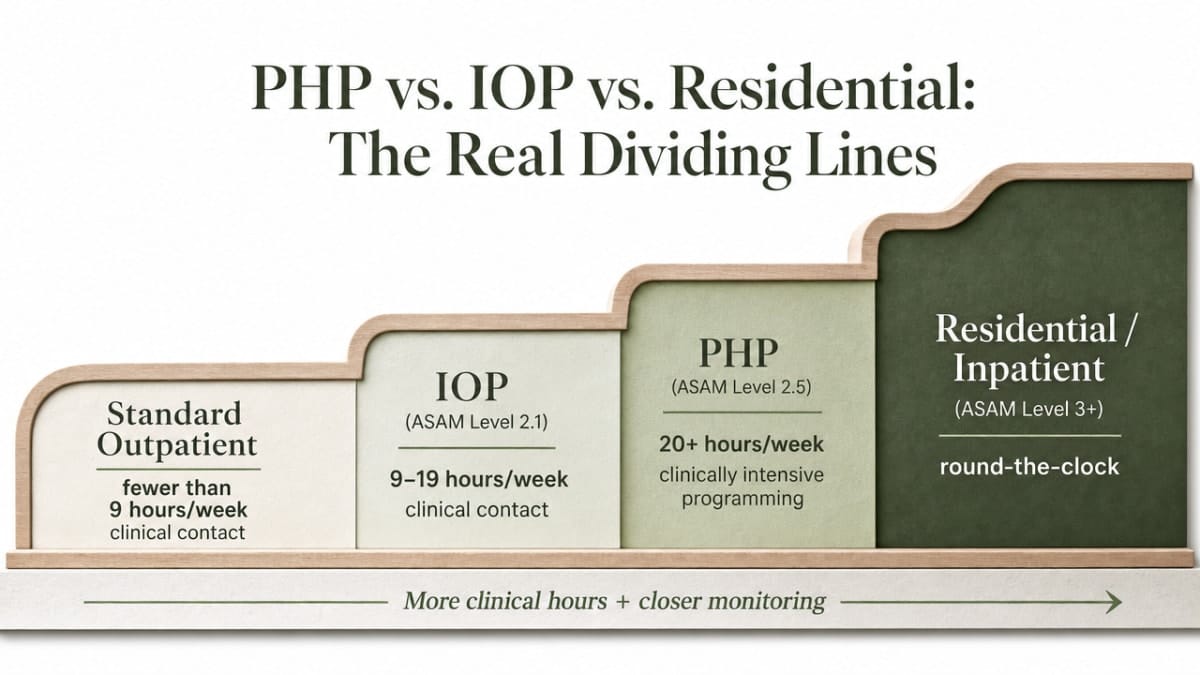
When you sit in that discharge planning meeting, someone is going to draw a ladder for you. Detox at the top, then residential, then PHP, then IOP, then standard outpatient at the bottom. It looks tidy on paper. What the ladder is really measuring is one thing: how many hours per week of clinical care your adult child gets, and how closely they are watched between those hours.
Here is the line that actually matters:
- Standard outpatient treatment is usually fewer than nine hours a week of clinical contact.
- Intensive outpatient, or IOP, which lives at ASAM Level 2.1, runs somewhere between nine and nineteen hours a week 24.
- PHP, ASAM Level 2.5, is where federal guidance draws the threshold at twenty or more hours a week of clinically intensive programming 5, 20.
- Residential and inpatient care, ASAM Level 3 and above, is round-the-clock supervision in a bed the program provides.
That twenty-hour line is the one your admissions coordinator is thinking about when they say “IOP might not be enough.” It is not a marketing distinction. It is the dividing line for medical necessity, for prior authorization, and for what a treatment team can realistically do in a week.
The other real difference is who is in the building. PHP has direct access to psychiatric, medical, and lab services during program hours 20. If your child needs a medication adjustment on a Wednesday, a prescriber is there. IOP is not built that way. Residential adds the overnight piece, which matters when a person is not yet safe to be alone with their own decisions after dinner.
Why Detox Alone Rarely Holds
You know this in your gut already, but it helps to have someone say it plainly. Medical detox is a stabilization event, not a treatment for the underlying disorder. It clears the substance out of your child’s body safely. It does not teach them how to handle a Sunday afternoon three months from now when they are bored and their old friend texts.
The NIH treatment placement chapter makes the same point in different language. Moving someone from detox or inpatient care into PHP is called a “step-down,” and it exists for a reason: mild to moderate cravings and early recovery instability do not need a hospital bed, but they do need more than a phone number for a therapist 6. PHP keeps the days full while your child sleeps at home.
What a Day in PHP Looks Like
Abstract descriptions of “intensive outpatient treatment” don’t help much when you’re trying to picture where your adult child will actually be on Tuesday at 11 a.m. So here is the concrete version, built from Oklahoma’s minimum standard of three hours per day, five days per week 8, 19and SAMHSA’s description of what fills those hours 7. Programs vary, but the shape is remarkably consistent.
Morning starts around 9 a.m. Your child checks in, meets briefly with a nurse or counselor, and often does a short mood and craving check. If they are on medication for addiction (naltrexone, buprenorphine, disulfiram) or for a co-occurring condition, that dose is confirmed. This is also when a prescriber can pull them aside if something is off. CMS points out that PHP staffing specifically includes clinicians trained to work with substance use disorder 4, so the person doing the check-in usually understands what post-detox cravings look like.
Then group therapy. This is the core of the day, and most PHPs run two or three group sessions of about 60 to 90 minutes each. One might be process group, where people talk about what actually happened since yesterday. Another might be a skills group focused on relapse prevention, distress tolerance, or handling a trigger without using. SAMHSA describes this mix of one-on-one, group, and skills sessions as the defining feature of the level 7.
Sometime in the middle of the day, your child sits down with their individual therapist. This is not group work. It is a private, scheduled hour, usually once or twice a week, where the treatment plan gets updated based on what is actually happening. If they are struggling with a specific memory, a family conflict, or a job worry, this is where it goes.
Family involvement usually shows up once a week, sometimes twice. That might be a family therapy session, a psychoeducation group for parents and partners, or a phone check-in with the case manager. Oklahoma’s rule expects a coordinated plan of care 19, and family contact is often part of that plan when the adult child consents.
The day typically ends between 2 and 3 p.m. Your child leaves, drives home, goes to a support meeting or a job in the evening, and comes back the next morning. That’s it. Five days a week, usually for two to four weeks, sometimes longer depending on progress and prior authorization.
Who PHP Fits (and Who It Doesn’t)
Admission Criteria Parents Should Recognize
You are not going to be the one signing off on medical necessity. But you can recognize the shape of it when the admissions team walks you through the assessment, and that helps you know whether the placement is honest.
A few markers show up again and again in the criteria that govern PHP admission:
- Your adult child needs a real diagnosis, either a substance use disorder, a mental health condition, or both, that is severe enough to require more than standard outpatient care 8, 19.
- They need to be medically and psychiatrically stable enough that they do not require 24-hour supervision.
- Any withdrawal should be mild to moderate, the kind that does not need a hospital bed 6.
- There has to be a safe place for them to sleep, whether that is your home, a sober living residence, or their own apartment with enough support around it 23.
The Oklahoma behavioral health provider manual puts it plainly: the condition must be severe enough to require a higher intensity of services than other outpatient levels, but there also needs to be evidence of a stable and safe living environment 23. Both halves of that sentence matter. SoonerCare’s medical necessity language echoes it, describing PHP as an intermediary, stabilizing step expected to improve functioning and prevent relapse or rehospitalization 22. If the assessment ties your child’s specific situation to those criteria in concrete terms, you’re looking at a real placement decision, not a marketing pitch.
When Residential or IOP Is the Better Call
PHP is not the right answer for every adult child coming out of detox. Two directions can be more honest.
Residential is usually the better call when the home environment is not safe or stable. If your child would be walking back into a house where they used, or living with people who are actively using, PHP’s evenings become the weak point. The same is true if they are still in acute crisis, expressing recent suicidal intent, or showing withdrawal severity that needs overnight medical eyes on them 6, 15. PHP is built for people who can be trusted with their own nighttime, and that trust has to be real.
IOP, the step below PHP, is usually the better call when your child is further along than the day-after-detox moment. Someone who has already completed PHP, held a job or classes through it, and needs continued structure without giving up 20-plus hours a week is often a cleaner IOP fit 24. IOP can also be right when someone’s substance use is real but their functioning at work, school, and home has not collapsed, and a shorter weekly commitment will hold.
The clinical team’s job is to match the level of care to the person in front of them. Your job is to push back if the match doesn’t feel right and ask what specifically drove the recommendation.
What the Outcomes Data Actually Shows
You want to know if this works. Not “works” in the marketing sense, but works in the way that matters: will your adult child be better off six months from now than they are on the day they walk into a PHP? The honest answer is that the evidence points in a hopeful direction, and it also has real limits. Both things are true.
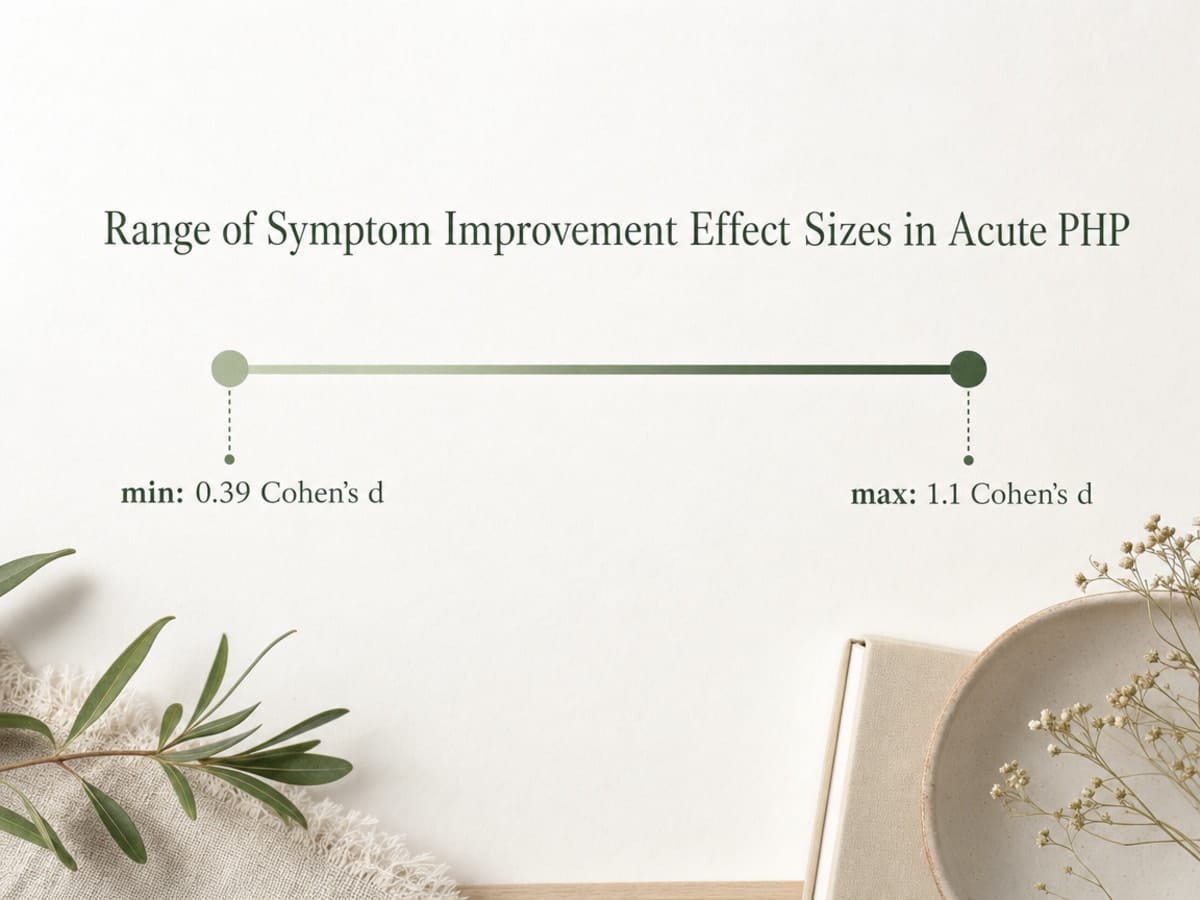
The clearest signals come from acute symptom improvement. A large-sample study of adults in acute partial hospital treatment found significant improvement across four measures of symptom severity and cognitive functioning during the stay, with Cohen’s d effect sizes ranging from 0.39 to 1.1 13. In plain terms, that spans a moderate to large effect. People do not just feel a little better on the way out. Measurable psychiatric symptoms move.
Substance-specific follow-up data is smaller in scale but worth taking seriously. In one alcohol PHP cohort, 69.7% of patients who completed the follow-up assessment were abstinent during that follow-up period 12. In a separate opiate cohort drawn from inpatient and partial hospitalization treatment, about 40% of the sample reported complete abstinence one month post-discharge, and better quality-of-life scores tracked with lower relapse risk 11. Those two numbers are not comparable head-to-head. They come from different substances, different follow-up windows, and different patient mixes. What they share is a signal that a meaningful share of adults leaving PHP hold ground in the weeks after, especially when their quality of life improves alongside the treatment.
Now the limits. A 2024 systematic review of adolescent PHP outcomes found only 15 studies of 10 programs, and while every one of them showed improvement from admission to discharge, controlled follow-up evidence was sparse 14. Adults are studied more than adolescents, but the same pattern holds across the field: we know PHP helps people get better while they are in it, and we know less than we should about how durable that improvement is a year later. For a specific population you may care about, one VA study of veterans with substance use disorders in a PHP reported gains on vocational rehabilitation outcomes, which matters because holding a job is one of the strongest anchors in early recovery 18.
What this means for your family is not a promise. It is a reasonable expectation. Symptoms will likely move during the program. A real portion of people stay abstinent in the first weeks after. The step that follows PHP, whether that is IOP, sober living, ongoing therapy, or medication management, is where the durability question actually gets answered.

How PHP Is Paid For in Oklahoma
Money is the second question every parent asks, right after “is this the right level of care.” You are not wrong to ask it. PHP is a real financial commitment, and understanding how it gets paid for helps you push back on surprises.
For SoonerCare members, PHP is a defined Medicaid benefit under Oklahoma Administrative Code Title 317, delivered by accredited providers with prior authorization based on medical necessity 19, 21. Oklahoma pays for it on a per diem basis, meaning one all-inclusive daily rate covers the encounter up to 23 hours and 59 minutes. As of July 1, 2025, that rate is $180.00 per encounter, up from the earlier $160.50 9, 10. You will not see that number on your child’s paperwork, but it tells you PHP is a funded, established benefit rather than an experimental service.
If your adult child has private insurance, most commercial plans cover PHP as an in-network behavioral health benefit, again with prior authorization tied to medical necessity criteria similar to the federal framework 2, 20. Ask the admissions team three concrete questions before enrollment:
- What your out-of-pocket cost per day will be.
- Whether authorization is confirmed in writing.
- How the program handles a continued-stay review if your child needs more than the initial approved window.
Questions to Ask an Admissions Team Before Your Adult Child Enrolls
By the time you get on the phone with an admissions coordinator, you have already done the hard part. You know your child. You know what worked and what didn’t. What you need now is a short list of questions that separate a real clinical plan from a warm brochure.
Start with medical necessity. Ask what specific criteria they use to place someone at PHP versus IOP or residential, and what in your child’s assessment pointed to this level 8, 23. A confident team will tie the answer to concrete details from the intake, not adjectives.
Ask about hours and dose. How many hours per day, how many days per week, and how does that compare to the twenty-hour weekly threshold federal guidance associates with PHP 20? If a program says PHP but runs closer to IOP hours, you deserve to know that before enrollment.
Ask about co-occurring care. Who prescribes and manages psychiatric medication during the program? Is there an on-site prescriber during program hours 4? If your child is on buprenorphine, naltrexone, or a mental health medication, ask specifically how those are handled.
Ask about family involvement. How often is there a family session or check-in, and what does the program expect from you? Oklahoma’s provider standards explicitly value active family involvement in the plan of care 23.
Ask what happens if the plan changes. How is a continued-stay review handled if your child needs more time, and how do they move someone to IOP or sober living when it’s time to step down 19?
A Note on Renewal Springs and Next Steps
If your adult child is finishing detox in Oklahoma City right now, the next 48 hours matter more than any brochure suggests. Ask the discharge team specifically about PHP-level step-down, not just “aftercare.” Get the name of the receiving program, the start date, and the person who will call if your child no-shows. That handoff is the thing that closes the gap the NIDA data warns about 25.
Renewal Springs Detox works to make that handoff a real one, connecting patients from medical detox to PHP, IOP, or residential care based on what the assessment actually shows. Recovery is hard. You already knew that. The next step doesn’t have to be the one you make alone.
Speak With a Compassionate Recovery Professional Today
Get immediate answers and guidance for the next steps in your loved one’s recovery journey.
Frequently Asked Questions
How long does a typical PHP stay last?
Most adult PHP stays run two to four weeks, though some go longer based on progress and prior authorization. Oklahoma’s initial authorization windows for this level of care typically cover one to three months, with continued-stay reviews built in 23. Your child’s team should be adjusting the plan every week based on how they are doing, not running out a fixed calendar.
Can my adult child go home at night during PHP?
Yes. That is the defining feature. PHP is nonresidential by design, which means your child sleeps at home or in a sober living residence and comes in during the day 8, 19. This only works if the home environment is stable and safe. If evenings are the risky part, the treatment team may recommend sober living alongside PHP, or move up to residential care instead.
What’s the difference between PHP and IOP?
Hours per week is the honest answer. IOP, ASAM Level 2.1, runs roughly nine to nineteen clinical hours a week. PHP, ASAM Level 2.5, delivers twenty or more hours per week of clinically intensive programming and includes direct access to psychiatric and medical services during program hours 5, 20, 24. PHP is the higher dose; IOP is often the step down from it.
Does SoonerCare or private insurance cover PHP in Oklahoma?
SoonerCare covers adult PHP as a defined Medicaid benefit through accredited providers, with prior authorization based on medical necessity 19, 21. Most commercial insurers cover PHP as an in-network behavioral health service under similar necessity criteria 2, 20. Before enrollment, ask the admissions team for written confirmation of authorization, your daily out-of-pocket cost, and how continued-stay reviews are handled if more time is needed.
Is PHP the right step if my child just finished detox?
For many adults leaving detox, yes. NIH placement guidance specifically describes PHP as the common step-down from inpatient or detox care when withdrawal is mild to moderate and 24-hour supervision is no longer needed 6. The NIDA Clinical Trials Network data on post-detox opioid outcomes shows why the step matters: relapse risk climbs quickly without a structured next level of care in place 25.
What happens if my adult child relapses while in PHP?
Relapse during treatment is treated as clinical information, not failure. The team reassesses the plan, adjusts medication or therapy focus, and sometimes recommends moving up to residential care if safety is at risk. Oklahoma’s continued-stay framework expects the treatment plan to respond to what is actually happening, and family involvement in that adjustment is part of the standard 19, 23. Ask exactly how the program handles a slip.
References
- Medicare Benefit Policy Manual Chapter 6. https://www.cms.gov/regulations-and-guidance/guidance/manuals/downloads/bp102c06.pdf
- 42 CFR 410.43 — Partial hospitalization services. https://www.ecfr.gov/current/title-42/chapter-IV/subchapter-B/part-410/subpart-B/section-410.43
- Medicare Benefit Policy Manual – Chapter 6. https://www.cms.gov/files/document/r12425bp.pdf
- QSO-24-06-CMHC DATE: March 1, 2024. https://www.cms.gov/files/document/qso-24-06-cmhc.pdf
- Overview of Substance Use Disorder (SUD) Care Clinical …. https://www.medicaid.gov/state-resource-center/innovation-accelerator-program/iap-downloads/reducing-substance-use-disorders/asam-resource-guide.pdf
- 2 Settings, Levels of Care, and Patient Placement – NCBI – NIH. https://www.ncbi.nlm.nih.gov/books/NBK64109/
- Treatment Types for Mental Health, Drugs and Alcohol. https://www.samhsa.gov/find-support/learn-about-treatment/types-of-treatment
- 317:30-5-241.10. Partial hospitalization program (PHP) – Adults. https://www.oklahoma.gov/ohca/policies-and-rules/xpolicy/medical-providers-fee-for-service/individual-providers-and-specialties/outpatient-behavioral-health-services/partial-hospitalization-program-adults.html
- REVISED PUBLIC NOTICE. https://oklahoma.gov/content/dam/ok/en/okhca/documents/a0401/23263.pdf
- State/Territory Name:Oklahoma State Plan Amendment (SPA) OK …. https://www.medicaid.gov/medicaid/spa/downloads/OK-25-0013.pdf
- Quality of Life and Well-being following Inpatient and Partial …. https://pmc.ncbi.nlm.nih.gov/articles/PMC5968820/
- Alcohol treatment outcomes following discharge from a partial …. https://pmc.ncbi.nlm.nih.gov/articles/PMC6419972/
- Outcomes of Acute Partial Hospital Treatment. https://pubmed.ncbi.nlm.nih.gov/29303947/
- Patient Outcomes in Transdiagnostic Adolescent Partial …. https://pubmed.ncbi.nlm.nih.gov/37271333/
- Providing Crisis-oriented and Recovery-based Treatment in …. https://pmc.ncbi.nlm.nih.gov/articles/PMC2848466/
- Effectiveness and application of partial hospitalization – PubMed. https://pubmed.ncbi.nlm.nih.gov/3811995/
- Effectiveness of partial hospitalization in the treatment of borderline …. https://pubmed.ncbi.nlm.nih.gov/10518167/
- Vocational rehabilitation outcomes of veterans with substance use disorders in a partial hospitalization program. https://pubmed.ncbi.nlm.nih.gov/11097656/
- 317:30-5-241.10. Partial hospitalization program (PHP) – Adults. https://oklahoma.gov/ohca/policies-and-rules/xpolicy/medical-providers-fee-for-service/individual-providers-and-specialties/outpatient-behavioral-health-services/partial-hospitalization-program-adults.html
- Joint CMCS and SAMHSA Informational Bulletin. https://www.medicaid.gov/federal-policy-guidance/downloads/cib-01-26-2015.pdf
- PART 21. OUTPATIENT BEHAVIORAL HEALTH SERVICES. https://oklahoma.gov/ohca/policies-and-rules/xpolicy/medical-providers-fee-for-service/individual-providers-and-specialties/outpatient-behavioral-health-services.html
- SoonerCare Medical Necessity Criteria for Behavioral Medicine. https://digitalprairie.ok.gov/digital/api/collection/stgovpub/id/81153/download
- Behavioral Health Provider Manual AUGUST 2010 (OAC 317:30-5-240–249). https://digitalprairie.ok.gov/digital/api/collection/stgovpub/id/17842/download
- Chapter 3. Intensive Outpatient Treatment and the Continuum of Care for Substance Abuse Treatment. https://www.ncbi.nlm.nih.gov/books/NBK64088/
- Treatment-as-Usual Opioid Use Outcomes Following Discharge from Detoxification and Short-Term Residential Programs (CTN-0051A2). https://datashare.nida.nih.gov/divisions/ctn