
Key Takeaways
- Renewal Springs answers detox admissions calls 24/7 in Oklahoma City, and many callers move through screening, clinical assessment, insurance verification, and arrival within a single day 1, 2.
- The clinical assessment digs into last use, dose, frequency, medical history, and mental health because those specifics shape withdrawal medication protocols like CIWA-guided alcohol detox 5, 10.
- Oklahoma parity law requires fully insured plans to cover substance use disorder care equally to physical health care, and SoonerCare admissions are handled with prior authorization managed on your behalf 7, 13.
- Before calling, compare what each facility asks about co-occurring mental health conditions, how it handles release-of-information consent, contraband checks, and rides — all standard admission steps worth understanding upfront 3, 11.
The Call You’re Afraid to Make
You’ve probably had the number pulled up for days. Maybe weeks. You close the app. You open it again. You tell yourself you’ll call after one more drink, one more pill, one more morning where you promise yourself this is the last one.
Picking up the phone is the hardest part. Not the detox. Not the paperwork. The call.
Here’s what you deserve to know before you dial Renewal Springs in Oklahoma City: the person who answers is not going to shame you. They’re not going to grill you. They’re not going to report you to your job or your family. They’re going to ask a handful of questions, listen, and start figuring out whether you can be seen today.
This article walks you through the whole path — first call, clinical assessment, insurance check, arrival — so you can picture it before it happens. When you can picture it, dialing gets easier.
From First Ring to Admission: The Path in Plain View
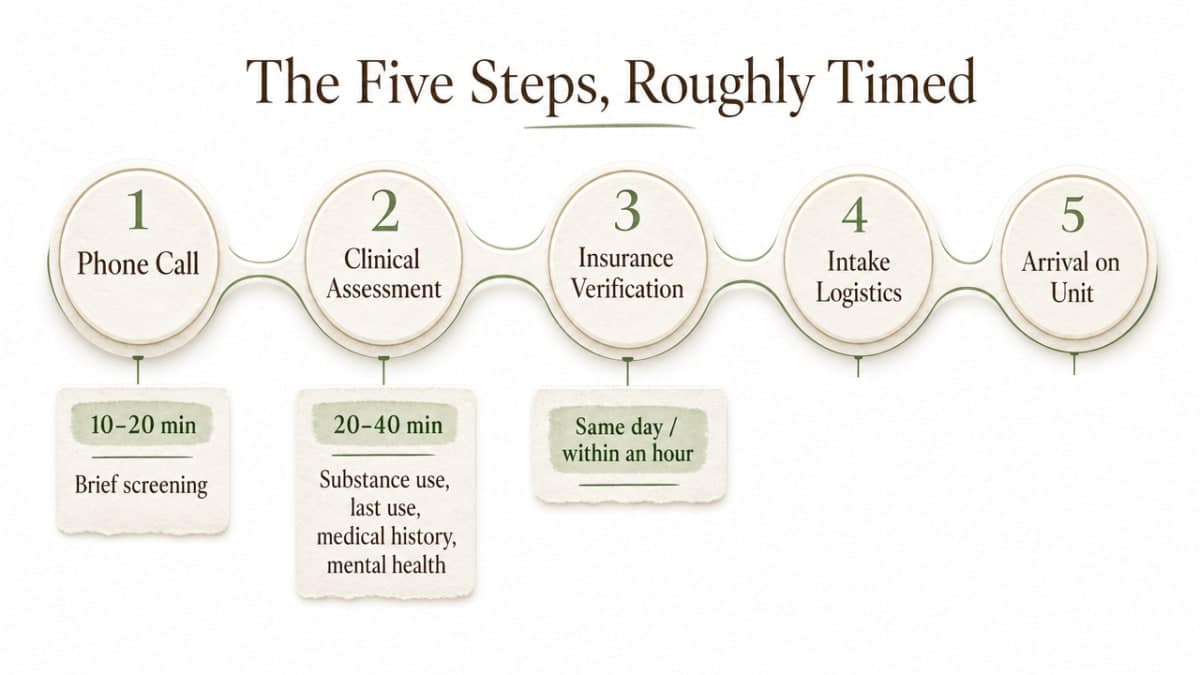
The Five Steps, Roughly Timed
Before you dial, it helps to see the whole path. Detox admissions at a facility like Renewal Springs follow the same general shape that hospital detox units and clinical guidelines describe: a phone contact, a clinical assessment, an insurance check, intake logistics, and then arrival on the unit 1, 2.
Here is roughly what each step looks like when things move smoothly:
- The phone call (about 10 to 20 minutes). A brief conversation with intake staff to hear your story, ask a handful of screening questions, and figure out whether medical detox is the right level of care 2.
- The clinical assessment (20 to 40 minutes). A more detailed conversation with a licensed healthcare worker covering your substance use, last use, medical history, and mental health 1, 10.
- Insurance verification (often same day, sometimes within an hour). Renewal Springs runs your benefits for free while you stay on the line or wait for a callback, and confirms whether a pre-certification is needed 1, 2.
- Intake logistics (a short window that day). Scheduling your admit date and time, coordinating a ride, and telling you what to bring 1.
- Arrival on the unit (the day you’re admitted). Registration, signing forms, a nursing assessment, and getting settled into your room 3.
Many callers move through all five steps in a single day. Some need a day or two because of pre-authorization or coordinating a ride. Either way, you’ll know where you stand before you hang up the first call.
Who Answers the Phone, and What They Actually Do
The Renewal Springs line is answered 24/7. Middle of the night, Sunday morning, holiday afternoon — someone is there. That matters, because the moment you’re ready to talk is rarely the moment that’s convenient.
The person on the other end is trained intake staff, not a receptionist reading from a script and not a salesperson. Their job is to listen first, then walk you through a short screening to see if medical detox fits what you’re dealing with 2. If it does, a licensed healthcare worker completes the fuller intake assessment before you’re admitted 2. If detox isn’t the right level of care, they’ll tell you that too, and point you somewhere that is.
What they will not do: judge you, quiz you about how you got here, or make you justify your decision. They’ve heard every version of this call. Someone crying. Someone whispering so their kids don’t hear. Someone calling from a parking lot on their lunch break. A parent calling for a son who doesn’t know they’re calling yet.
You don’t need a speech ready. “I think I need help detoxing” is enough to start.
The First Phone Call: What Gets Asked and Why
The Mini-Assessment in the First Ten Minutes
The first ten minutes are mostly listening. You’ll be asked what’s going on, what you’ve been using, and how long it’s been that way. That’s the shape of it.
The specific questions come from a mini-assessment that intake staff use to figure out whether medical detox is the right level of care 2. Expect a handful of straightforward ones: What substances are you using? When was your last drink or dose? Roughly how much, and how often? Have you ever had a seizure, DTs, or a bad withdrawal before? Are you dealing with any medical conditions or mental health symptoms right now?
None of this is a test. There’s no right answer that gets you in and wrong answer that gets you turned away. Honest answers just help the person on the phone match you to the right care. A licensed healthcare worker completes the fuller intake assessment before you’re admitted, so this first call is the beginning of that conversation, not the whole thing 2.
What to Have Ready Before You Dial
You don’t need anything to make the call. You can pick up the phone with nothing but the phone. But if you have a few minutes to gather these before you dial Renewal Springs, the conversation moves quicker and the insurance check can start sooner.
A short list worth pulling together:
- Your insurance card (front and back), or a photo of it. If you’re on SoonerCare, your member ID works.
- A rough list of what you’ve been using — substances, roughly how much per day, how often, and when you last used. TIP 45, the national clinical guide detox nurses work from, specifically covers last use, dose, and frequency at intake, so having a ballpark ready saves you from guessing on the spot 10.
- Current medications, including anything a doctor prescribed and anything you buy over the counter.
- A photo ID if you have one handy.
- An emergency contact — a name and phone number for someone you trust.
Missing something on this list? Call anyway. Intake staff work with what you have.
If You’re Calling for Someone You Love
You’re calling for someone you love — a husband, a daughter, a parent, a best friend. They may not know you’re on the phone. They may have asked you to call. Either way, the process bends to include you.
Detox admission workflows explicitly account for calls from family and non-professional contacts, not just from the person who will be admitted 2. Intake staff can walk you through the mini-assessment based on what you know, tell you what a same-day admission would look like, and coach you on how to talk to your loved one about coming in.
What they can’t do is share protected details back to you without your loved one’s permission once they’re a patient. That’s a boundary that protects them, and eventually protects the trust between you.
Before you hang up, ask two things: what to bring, and how to help them get through the door.
The Clinical Assessment: Why the Questions Get More Specific
Substance History, Last Use, and Withdrawal Risk
Once the phone screen tells intake staff that medical detox is likely the right level of care, the questions get more specific. Not more invasive — more specific. A licensed healthcare worker walks through your substance history in real detail: which substances, how much, how often, when you last used, and what previous withdrawals have felt like. SAMHSA’s TIP 45, the national clinical guide detox nurses work from, is explicit about why: last use, dose, and frequency shape the medical plan, and toxicology screening helps confirm what’s actually in your system 10.
The reason for the granularity is safety. Alcohol and benzodiazepine withdrawal can cause seizures. Opioid withdrawal is rarely deadly on its own but is brutal enough that people leave against advice if it isn’t medicated well. Stimulant withdrawal looks different again. The assessment is trying to sort you into the right protocol before you ever walk in.
Oklahoma admissions data helps explain why the triage bends the way it does. In 2023, TEDS-A reported that 69.5% of Oklahoma SUD treatment admissions were White, 12.6% were Black or African American, and 6.8% identified as Hispanic or Latino, with primary substances spanning alcohol, opioids, meth, and marijuana across those groups 12. That mix is why the Renewal Springs assessment doesn’t assume anything about your drug of choice — it asks.
Mental Health, Medical History, and Co-Occurring Conditions
After the substance questions, the assessment moves to the rest of you. Medical history — heart, liver, kidneys, seizures, pregnancy, past surgeries, current prescriptions. Mental health history — depression, anxiety, PTSD, past suicidal thoughts, any psychiatric medications you’ve been on. TIP 45 lists all of this as core intake territory alongside vital signs and a physical assessment 10.
The mental health questions can feel like the hardest ones. Say the true answer anyway. SAMHSA’s guidance on co-occurring disorders is clear that screening for psychiatric conditions at intake is how detox care gets coordinated with the mental health care you’ll likely need next — not a reason to deny you admission 11. If you’ve been drinking to quiet panic, or using opioids to blunt trauma, that’s information the nurse needs to keep you safe during withdrawal, not evidence against you.
Veterans, in particular, often carry medical and psychiatric history that shapes the plan. Renewal Springs asks about service history for that reason — so a veteran walks into a protocol built for what they’re actually carrying, not a generic one.
How the Assessment Becomes Your Detox Plan
Every answer you give goes somewhere. The last-drink time sets when withdrawal is likely to peak. The dose and frequency inform medication choices. The medical history rules certain medications in or out. The mental health picture decides whether a psychiatric consult is scheduled early in your stay.
For alcohol detox, this translates directly into a monitored pathway with repeated CIWA scoring — a nurse-administered scale that tracks withdrawal symptoms — and vital sign checks that guide dosing hour by hour 5. Opioid and benzo protocols work similarly, with their own scoring tools and taper plans. At Renewal Springs, Huml Health wearables add continuous vital-sign, sleep, and stress data on top of nurse checks, so the plan built during your assessment keeps adjusting to what your body is actually doing.
The paperwork you answered honestly on the phone is what makes that plan possible. That’s the payoff for the harder questions.
Insurance, SoonerCare, and What Coverage Actually Looks Like
Why the Benefits Check Happens Before You Pack a Bag
The benefits check isn’t a hurdle. It’s how the door opens on time.
While you’re still on the phone, Renewal Springs runs your insurance for free and confirms whether your plan requires a pre-certification before admission. That step is baked into how detox units are supposed to work: intake staff verify insurance and check for pre-cert requirements as part of scheduling the admit date and time 1, 2. Doing it first means you don’t drive over, get settled, and then find out something needs a phone call to your insurer.
For SoonerCare members, the same conversation includes checking medical necessity documentation and any prior authorization or concurrent review your plan requires for inpatient or residential SUD care 13. Renewal Springs handles that paperwork on your behalf — the licensed clinician’s assessment notes are what actually satisfy those requirements.
If a pre-cert is needed, expect a short wait, sometimes an hour, sometimes longer. If it isn’t, admission can often be scheduled the same day.
Parity Rules That Work in Your Favor
You’ve probably been told, somewhere along the way, that insurance won’t really cover this. That’s worth pushing back on.
Oklahoma law requires health insurance companies to cover mental health and substance use disorder benefits equal to benefits for other physical diseases and disorders 6. Every fully insured plan sold to individuals, small employers, and large employers in Oklahoma must include benefits for mental health and substance use disorder services 7. In plain terms: your plan can’t make detox harder to get than a hospital stay for a physical condition would be 8.
That protection extends to the fine print — prior authorization, medical necessity criteria, concurrent review. These are called nonquantitative treatment limits, and carriers have to demonstrate they aren’t applied more stringently to SUD care than to medical-surgical care 6. For SoonerCare members, a 2025 Oklahoma law (HB 2049) now requires Medicaid managed care contracts to include regular parity compliance analyses of those same limits 9.
None of that changes what you do on the call. It changes what you can expect back.
If You Don’t Have Insurance Information Handy
Not having your card in front of you isn’t a reason to hang up.
Renewal Springs can often locate your plan with your name, date of birth, and the insurer’s name — even a photo of an old card texted over works. If you’re on SoonerCare, your member ID is enough. If you have no idea what coverage you have through your employer, the HR line at your job or a quick check of your last pay stub can usually surface it later.
If you’re uninsured, say so on the call. Intake staff will walk you through what options exist and what the next step looks like. What you don’t want to do is stall the call trying to gather perfect paperwork. Dial first. Sort the card second.
Arrival Day: Paperwork, Belongings, and the First Hours on the Unit
Getting There: Rides, Timing, and Who Can Come With You
The admit time you agreed to on the phone is the anchor for arrival day. Come a little early if you can. Traffic in the OKC metro can be forgiving or it can eat twenty minutes; give yourself the buffer.
You should not drive yourself. If you’ve been drinking or using to hold off withdrawal, driving is unsafe for you and for everyone else on the road. A spouse, parent, adult child, or trusted friend is the right ride. If nobody in your life can take you, tell intake staff on the phone — they’ll help you problem-solve a rideshare or another option.
The person driving you is welcome to walk you in. They can sit with you through registration and stay until you’re taken back to the unit. After that, visitor access follows the unit’s rules, which your intake nurse will explain. Say goodbye at the door and know that showing up is already a win.
Forms, Rights, and the Contraband Check
The first hour on the unit is paperwork and process. It’s less dramatic than it sounds. You’ll sign three main things before or at the time of admission:
- the admission forms themselves,
- release-of-information forms that let Renewal Springs coordinate with the people you name, and
- a patient-rights document that spells out what you can expect and what you can refuse 3.
Read them. Ask questions if a line doesn’t make sense.
Then comes the contraband search and belongings inventory. A staff member goes through what you brought, lists it, and secures anything that can’t stay with you on the unit 3. This includes obvious things like alcohol, drugs not prescribed to you, and sharps, and less obvious things like mouthwash or hand sanitizer that contain alcohol. Prescription medications are usually held and dispensed by nursing so your detox plan stays coordinated.
The search is not personal. Every patient goes through it. It exists so that the person detoxing in the room next to you — and you — stay safe 3.
Your First Nursing Assessment and the Handoff to Care
Once paperwork is done, a registered nurse completes a full admission assessment 3. Vital signs. A physical check. A review of what you already told intake on the phone, plus anything new — how you’re feeling right now, when your last drink or dose was, what symptoms have shown up on the drive over. TIP 45 lays this out as standard practice: vital signs, physical assessment, and confirmation of substance use patterns at the moment of admission 10.
For alcohol detox, this is where the CIWA scoring starts — a short scale the nurse uses to track withdrawal symptoms so medication can be dosed to what your body is actually doing, not a guess 5. Opioid and benzo protocols have their own tools. Renewal Springs adds Huml Health wearable monitoring on top, so vitals, sleep, and stress are tracked continuously between nurse checks.
Then you’re shown to your room. You made the call. You walked in. The team takes it from here.
The Honest Questions People Are Too Embarrassed to Ask
There are questions you probably won’t ask on the phone. Ask them here instead.
- “What if I used this morning to get through the call?”
- Tell intake staff. It doesn’t disqualify you — it changes the timing of your medication plan. Knowing exactly when you last used is one of the specific details a licensed clinician needs to build a safe protocol 10.
- “Will my boss find out?”
- Not from Renewal Springs. You control who is on your release-of-information forms 3. If you want your employer looped in for FMLA paperwork, you sign for that. If you don’t, you don’t.
- “Am I going to be searched like a criminal?”
- Your bag gets inventoried and checked for anything that could be dangerous on the unit — every patient, every time 3. It’s a safety step, not a judgment.
- “What if I change my mind at the door?”
- Admission is voluntary. Walk in anyway. Sit with a nurse for ten minutes before you decide.
Speak Directly With a Compassionate Admissions Specialist
Get immediate answers and support to start your detox admission without delay.
Frequently Asked Questions
How long does the first admissions call actually take?
Most first calls run about 10 to 20 minutes. That covers the mini-assessment intake staff use to screen whether medical detox fits, plus a starting point for insurance verification 2. If you’re in active withdrawal, say so early — it changes the pace, not the welcome.
Can I be admitted the same day I call?
What if I used drugs or alcohol this morning before calling?
Tell intake staff exactly what you used and when. It doesn’t disqualify you — it shapes the medication timing your nurse will use. Last use, dose, and frequency are specific pieces of information a licensed clinician needs to build a safe withdrawal plan 10. Honest answers keep you safer, not out.
Will my employer, family, or anyone else be told I’m in detox?
Not unless you say so. You decide who is listed on your release-of-information forms during admission 3. If you want your employer contacted for FMLA paperwork or a spouse kept in the loop, you sign for that. If you don’t, that information stays with the clinical team.
What if I don’t have my insurance card or don’t have insurance at all?
Call anyway. Renewal Springs can often locate coverage using your name, date of birth, and insurer, and SoonerCare members just need a member ID. Oklahoma law requires fully insured plans to cover substance use disorder benefits equal to physical health benefits 7. If you’re uninsured, intake staff will walk you through options.
Can a family member drive me, and what should I bring?
Yes — please have someone drive you. They can sit with you through registration. Bring a photo ID, your insurance card, a list of current medications, and comfortable clothes. Leave alcohol, non-prescribed medications, and anything with alcohol content at home; belongings are inventoried on arrival for everyone’s safety 3.
References
- Guideline Detox Unit – Admission Criteria. https://www.utoledo.edu/policies/utmc/nursing/guidelines/6cd/docs/Guideline%20Detox%20Unit%20-%20Admission%20Criteria.pdf
- Nursing Service Guidelines 6CD Inpatient Detox Unit. https://www.utoledo.edu/policies/utmc/nursing/guidelines/6cd/docs/admission-criteria.pdf
- Nursing Services Guideline 6CD Inpatient Detox Unit – Admission Procedures. https://www.utoledo.edu/policies/utmc/nursing/guidelines/6cd/docs/Guideline%20Detox%20Unit%20-%20Admission%20procedures%20UTHealth%202025.pdf
- Oklahoma Administrative Code 450: Chapter 18 – Standards and Criteria for Substance Abuse Services. https://oklahoma.gov/content/dam/ok/en/odmhsas/documents/policy/provider-certification/administrative-rules/2021/Chapter%2018%20Final%20effective%209-15-21.pdf
- Alcohol Detox Clinical Pathway (Inpatient). https://www.utoledo.edu/policies/utmc/nursing/guidelines/6cd/docs/Alcohol_Detox_Clinical_Pathway.pdf
- LH BULLETIN NO. 2020-05 – Oklahoma Insurance Department. https://www.oid.ok.gov/lh-bulletin-no-2020-05/
- Understanding Mental Health Parity and Your Insurance. https://www.oid.ok.gov/getready12_2023/
- Mental/Behavioral Health and Insurance. https://www.oid.ok.gov/mental-behavioral-health-and-insurance/
- HB 2049 – Oklahoma Legislature (Enrolled). https://www.oklegislature.gov/cf_pdf/2025-26%20ENR/hB/HB2049%20ENR.PDF
- Quick Guide for Clinicians Based on TIP 45: Detoxification and Substance Abuse Treatment. https://nida.nih.gov/sites/default/files/samhsa_detoxification_and_substance_abuse_treatment.pdf
- Quick Guide: For Mental Health Professionals—Based on TIP 42: Substance Abuse Treatment for Persons With Co-Occurring Disorders. https://library.samhsa.gov/sites/default/files/sma10-4531.pdf
- 2023 TEDS-A Oklahoma | CBHSQ Data – SAMHSA. https://www.samhsa.gov/data/node/51076
- Oklahoma Health Care Authority Policy Manual – Behavioral Health and Substance Use. https://oklahoma.gov/ohca/policies-and-rules/xpolicy.html