
Key Takeaways
- Aetna generally covers medically necessary detox in Oklahoma City, and Renewal Springs is in-network, which reduces cost-share and simplifies the prior authorization process.
- Oklahoma and federal parity rules require substance use benefits to be no more restrictive than medical/surgical coverage, giving you standing to challenge tighter detox limits 11, 9.
- Whether your Aetna plan is fully insured or self-funded shapes what is required, so confirm plan type through HR or your Summary Plan Description before assuming coverage 1.
- Before calling, compare in-network status, prior authorization rules, ASAM level of care, deductible and out-of-pocket costs, and what happens after detox ends 7, 8.
Reading the Aetna card in your hand right now
You’re holding a small plastic card and trying to figure out if it will actually help someone you love get through withdrawal safely. Maybe that someone is you. Either way, the fact that you’re reading this instead of scrolling past it means you’re already doing the hard thing.
Here’s the short version: Aetna generally covers medically necessary detox as part of substance use disorder benefits, and both Oklahoma and federal parity rules require that coverage to be no more restrictive than what your plan gives for a medical or surgical stay 11, 9. Renewal Springs Detox in Oklahoma City is in-network with Aetna. That combination is genuinely good news.
What this article will not do is promise you a specific dollar amount, a coverage percentage, or a guaranteed approval. Those numbers depend on your plan, and anyone who pretends otherwise is selling something.
What it will do is walk you through what to look at on that card, what kind of Aetna plan you likely have, what Aetna is required to cover for detox in Oklahoma, and how to turn all of that into a real answer today, without spending your last clear-headed hours on hold. One small step at a time. You don’t have to figure it all out in one sitting.
What Aetna actually covers for detox
Most Aetna plans treat medically supervised detox as a covered substance use disorder (SUD) benefit when it’s medically necessary. That last phrase does a lot of work. It means a licensed clinician has to document that withdrawal from alcohol, opioids, benzodiazepines, or another substance meets clinical criteria for a specific level of care, usually using ASAM withdrawal-management guidelines 8. Severe withdrawal, especially from alcohol or benzos, typically points toward medically monitored inpatient detox, which is the setting Aetna is most often asked to authorize 8.
What’s usually covered when the plan says yes:
- The initial evaluation and assessment when you arrive
- 24/7 medical monitoring during acute withdrawal
- Medication-assisted treatment (MAT) to manage symptoms and cravings
- Stabilization and discharge planning into the next level of care
Those four pieces line up with what federal clinical guidance calls the core stages of detox: evaluation, stabilization, and fostering readiness for ongoing treatment 7. That last stage matters because Aetna, like most payers, sees detox as one step in a continuum, not the whole treatment 7. Coverage for detox does not automatically mean coverage for the residential or outpatient program that comes after. Those get authorized separately.
Here’s what tends to shape the actual answer for your plan:
- Network status. In-network facilities almost always cost you less. Renewal Springs is in-network with Aetna in Oklahoma City, which removes one of the biggest variables right up front.
- Prior authorization. Many Aetna plans require it for inpatient detox, sometimes within a specific window after admission.
- Medical necessity documentation. The admitting clinician’s notes on withdrawal severity, vitals, and risk history are what Aetna reviews.
- Your plan’s cost-sharing structure. Deductible, coinsurance, and out-of-pocket maximum all shape what you owe, and they’re specific to your policy.
So when someone asks whether Aetna covers detox, the honest answer is: usually, yes, when it’s medically necessary and properly authorized, but the number you’ll actually pay lives inside your specific plan documents. That’s why verification exists.
Why parity law matters more than fine print in Oklahoma
Insurance language can feel like it’s designed to wear you down. Parity law exists partly to push back on that. It says, in plain terms, that a plan can’t treat addiction care like a lesser problem than a broken leg.
The federal rule, the Mental Health Parity and Addiction Equity Act, requires that financial requirements and treatment limitations for mental health and substance use disorder benefits be no more restrictive than those applied to medical and surgical benefits 9. That covers deductibles, copays, visit limits, prior authorization rules, and how often a plan reviews whether you still need care.
Oklahoma layers its own standard on top. The Oklahoma Insurance Department’s parity bulletin states that treatment limitations for MH/SUD benefits “shall be no more restrictive” than those for medical and surgical benefits 11. Different words, same spine. If your Aetna plan would cover a five-day inpatient stay for a cardiac issue without a fight, it shouldn’t create tougher barriers for a five-day medically supervised detox stay for withdrawal.
Why does this matter when you’re staring at a card and a phone?
Because it gives you standing. If Aetna tells you detox needs prior authorization but a comparable medical admission doesn’t, that’s a parity question. If your plan caps SUD inpatient days more tightly than medical inpatient days, that’s a parity question. If concurrent review keeps interrupting detox care in ways it wouldn’t interrupt a hospital stay, that’s a parity question too 6.
You do not need to memorize the statute. You just need to know that the rule exists, and that Oklahoma regulators expect fully insured plans to follow it 12. When you or the Renewal Springs admissions team is on the phone with Aetna, that awareness changes the posture of the conversation. You’re not asking for a favor. You’re asking a regulated plan to apply its own required standard to your situation.
One caution before you lean too hard on parity: the rule mostly shapes how a plan applies its coverage, not whether a specific plan covers SUD services at all. That’s why the next question, the one about fully insured versus self-funded plans, matters so much. Parity is your lever. The plan type tells you how much leverage that lever actually has.
Fully insured or self-funded: the one question that changes everything
Before you spend another minute reading plan documents, find the answer to one question: is your Aetna plan fully insured, or is it a self-funded plan that your employer just pays Aetna to administer? That single distinction shapes what Aetna is actually required to cover for detox in Oklahoma.
Here’s the difference in plain terms. A fully insured plan is one where an insurer, in this case Aetna, takes on the financial risk and sells the policy. That includes plans you buy on the individual marketplace and plans your employer buys from Aetna. A self-funded plan is different: your employer pays the medical claims out of its own pocket and hires Aetna to handle the paperwork. The Aetna logo on your card looks the same either way. The rules behind it are not.
Fully insured plans sold to individuals, small employer groups, and large employer groups in Oklahoma must include mental health and substance use disorder benefits, and those benefits must be provided at parity with medical and surgical coverage 1. Detox falls under that umbrella. Self-funded employer plans are governed by federal law rather than state insurance rules, and they are not required to cover MH/SUD services at all. If they do choose to cover them, they must still apply parity 1.
What that means for you at the kitchen table:
- If your plan is fully insured in Oklahoma, medically necessary detox should be a covered benefit, and the Oklahoma Insurance Department can help if something feels off 2.
- If your plan is self-funded and includes SUD coverage, detox is likely covered and must be at parity, but state regulators have less direct authority over how it’s administered 1.
- If your plan is self-funded and excludes SUD coverage, detox may not be covered at all, and you’ll need to talk with the admissions team at Renewal Springs about other options.
How do you tell which one you have? Two quick checks. First, look at your Summary Plan Description or benefits booklet, usually available through your employer’s HR portal or your Aetna member account. Fully insured plans typically name the insurer as the underwriter. Self-funded plans often say the employer is the plan sponsor and Aetna is the claims administrator. Second, just ask HR. “Is our medical plan fully insured or self-funded?” is a normal question, and the benefits contact will know.
You don’t need to sort this out alone. When the Renewal Springs team runs your verification, they’ll identify the plan type as part of confirming your benefits. Knowing the answer ahead of time just means fewer surprises, and a clearer sense of which levers, parity complaints to the state or an internal appeal through the employer plan, are available if you hit resistance later.
Why verification speed matters here
If you’re reading this at 11 p.m. because the person next to you is starting to shake, speed is not a customer-service question. It’s a clinical one.
What that means for verification: the window between “we’ve decided to get help” and “we’re actually admitted” is the most dangerous stretch. Fear, withdrawal symptoms, and one bad hour can undo a week of resolve. Every day you spend waiting on a callback is a day the decision has to be made again.
The good news is that verification does not have to take days. When Renewal Springs is in-network with your Aetna plan, admissions can usually confirm your benefits, plan type, and prior authorization requirements the same day you submit the form, often within a few hours during business hours. That’s not a promise of instant approval. It’s a promise that you won’t be the one sitting on hold with the customer-service line while someone you love white-knuckles the couch.
You don’t need to move perfectly. You just need to move once, today. Submitting the verification form or making one call is the small win that gets the next one in reach. The rest of this article walks you through exactly what to have ready so that first step actually goes somewhere.
Before you call Aetna: what to have in front of you
You will do better in this conversation if you spend five minutes gathering a few things first. Not because Aetna is trying to trip you up, but because the person on the other end of the line has a script, and the script asks for specific information. When you have it ready, the call is shorter, calmer, and more likely to end with a real answer.
Pull these together before you dial or open the verification form:
- Your Aetna member ID card, front and back. The member ID is usually on the front. The group number, plan name, and the customer-service phone number for behavioral health or substance use benefits are often on the back. Some cards list a separate behavioral health line; that is the one you want.
- The full legal name and date of birth of the person who needs detox, exactly as they appear on the policy. If you’re the spouse or parent calling on someone else’s behalf, have your own information ready too.
- Your Summary Plan Description or benefits booklet, if you can find it. Your Aetna member portal or your employer’s HR site usually has a PDF. Look for the sections on substance use disorder, behavioral health, and inpatient hospital benefits 2.
- A pen and a notebook. Write down the representative’s name, the reference number for the call, and the exact words they use about coverage, prior authorization, and in-network status. If something needs to be appealed later, that written record matters.
- The facility name and address for Renewal Springs Detox in Oklahoma City, so you can ask directly whether it’s in-network on your specific plan.
- The substance and rough timeline. How long has the dependence been going on, when was the last use, and are there prior withdrawal complications like seizures or DTs? Aetna’s clinical reviewer will ask, because that shapes which ASAM level of care is medically appropriate 8.
One more thing that helps: pick a quiet spot and expect to be on the phone for twenty to forty minutes. If you can, put someone else in charge of the person going through withdrawal during that stretch so you’re not splitting your attention. If that’s not possible, submit the Renewal Springs verification form instead and let the admissions team make the call for you. That single step, done in the next ten minutes, counts. You are already moving.
The words that move a detox request forward
Insurance conversations run on specific language. Not because the person on the other end is being difficult, but because their system is built around certain terms, and those terms unlock certain answers. When you use them, the call stops feeling like a maze.
A few phrases carry real weight when you’re asking about detox coverage:
- “Medically necessary withdrawal management.” This is the clinical term for detox. Asking whether your plan covers “medically necessary withdrawal management for [alcohol/opioid/benzodiazepine] dependence” gets you further than asking about “rehab” or “treatment,” which mean different things to different reviewers.
- “ASAM level of care.” Aetna’s clinical reviewers use ASAM criteria to decide which setting is appropriate. Severe withdrawal often points to medically monitored inpatient detox, sometimes written as ASAM Level 3.7-WM 8. You don’t need to diagnose anything. Just knowing the framework exists signals that you understand how the decision gets made.
- “In-network benefits for inpatient substance use disorder treatment.” Ask specifically about in-network, because that’s where Renewal Springs sits on your Aetna plan, and it’s where your cost-share will be lowest.
- “Prior authorization requirements.” Ask whether one is needed, who submits it, and how long a decision takes. Also ask about concurrent review, which is when Aetna checks in during the stay to see if continued care is still authorized.
- “Parity.” If a limitation on detox sounds tighter than what your plan applies to a medical inpatient stay, say the word. Oklahoma requires MH/SUD treatment limitations to be no more restrictive than medical/surgical ones 11.
Write down the answers as you hear them, including the reference number for the call. If a representative says something is not covered, ask them to point you to the exact plan language that says so. That’s a fair question, and a well-trained rep will answer it.
You are not being pushy by using precise words. You’re being clear. Clarity is what gets someone admitted faster.
How Renewal Springs verifies your Aetna benefits
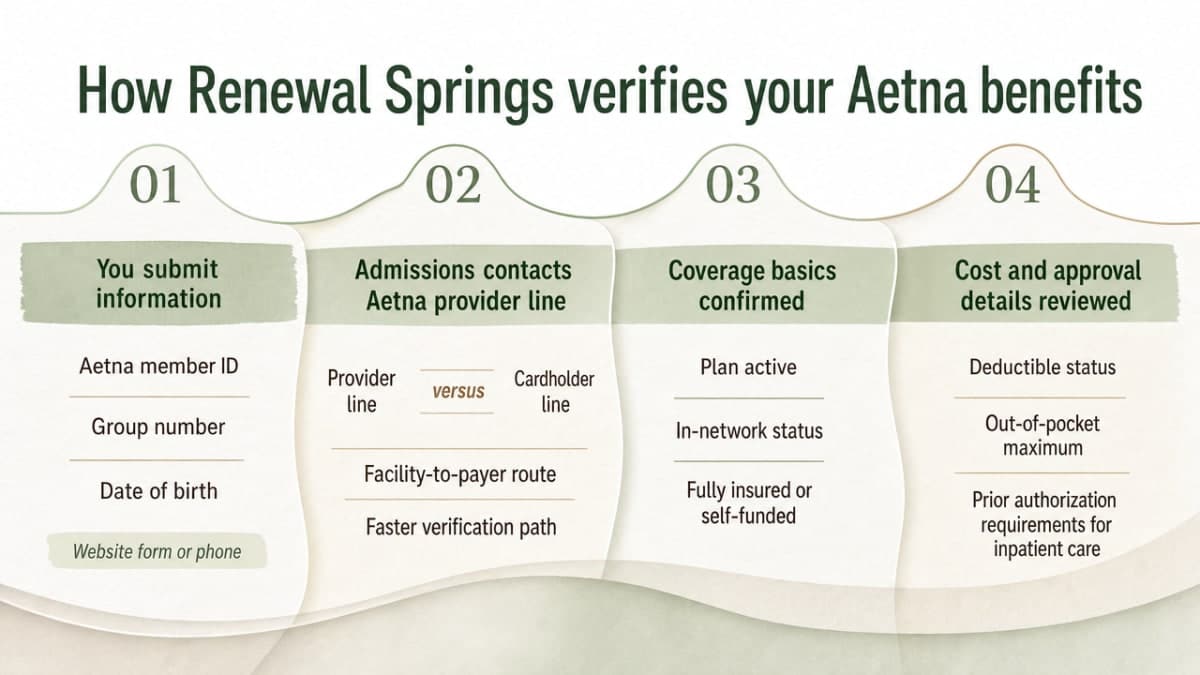
Here is what actually happens when you submit the insurance verification form on the Renewal Springs website or hand your card to the admissions team on the phone. It is not mysterious, and it does not require anything from you beyond a few pieces of information.
The admissions team takes your Aetna member ID, group number, and date of birth, and contacts Aetna’s provider line directly. That is a different line than the one printed on the back of your card, and it moves faster because it is built for facility-to-payer conversations. On that call, they confirm three things: whether the plan is active, whether Renewal Springs is in-network for your specific policy, and whether the plan is fully insured or self-funded 1. They also ask about your deductible status, out-of-pocket maximum, and any prior authorization requirements for inpatient substance use disorder care.
From there, a clinical intake call, usually a short conversation with you or the person seeking care, gathers the medical detail Aetna’s reviewer will need to authorize the appropriate ASAM level of withdrawal management 8. That means questions about substance, last use, prior withdrawal history, and any co-occurring medical or mental health conditions. Renewal Springs’ clinicians document medical necessity and submit the prior authorization request on your behalf.
You then get a written summary of what your plan covers, what your estimated cost-share looks like based on your current deductible, and whether authorization has been approved before you arrive. No surprise bills at admission. No hold music. One form, one call back, one clear answer.
What detox coverage does and does not include
It helps to know what your Aetna approval is actually paying for, so you’re not blindsided a week from now when the next set of decisions shows up.
When Aetna authorizes medically supervised detox, coverage usually applies to the acute withdrawal stay itself: the room and board at an in-network facility like Renewal Springs, 24/7 medical monitoring, the medications used to manage withdrawal symptoms and cravings, the clinical assessments, and discharge planning into the next level of care 7. That’s the piece that gets someone through the dangerous days safely.
Here is what a detox authorization typically does not include:
- The residential or outpatient program that comes after. Federal clinical guidance is clear that detox alone is not sufficient treatment; it’s the evaluation and stabilization stage, followed by a separate continuum of care 7. Aetna authorizes that next stage separately, with its own medical necessity review.
- Long-term medication management. MAT started during detox may continue, but ongoing prescriptions and follow-up visits run through your outpatient benefits.
- Transportation, lost wages, or family lodging. These are not covered benefits under any standard plan.
Knowing this in advance changes what you ask about on the verification call. Getting through detox is the first win. Planning the handoff to what comes next is the second, and it’s worth asking Renewal Springs to walk you through both before admission.
If Aetna says no, or the number feels wrong
A first no is not the last word. Denials happen, sometimes because paperwork was incomplete, sometimes because the clinical documentation did not clearly match ASAM criteria for the level of care requested 8. Either way, you have options, and you do not have to run them yourself.
Ask Aetna, in writing, for the specific reason for the denial and the plan language it is based on. Then ask Renewal Springs to file a peer-to-peer review, where the admitting clinician talks directly with Aetna’s medical reviewer about withdrawal severity and medical necessity. Many detox denials are overturned at this stage without a formal appeal.
If the number you’re quoted for cost-share feels wrong, or a limit on detox looks tighter than what your plan applies to a comparable medical inpatient stay, that is a parity question worth raising. Oklahoma’s parity standard says treatment limitations for SUD benefits shall be no more restrictive than medical/surgical ones 11. If your plan is fully insured, the Oklahoma Insurance Department can review parity concerns directly 2.
You are allowed to push back. A hard first answer does not close the door. Take one more step today.
Speak With a Detox Coverage Expert Now
Get fast, clear answers about your Aetna detox coverage and next steps for safe medical care.
Frequently Asked Questions
Does Aetna cover medical detox in Oklahoma City?
In most cases, yes. Aetna generally covers medically necessary detox as part of substance use disorder benefits, and Oklahoma parity rules require those benefits to be no more restrictive than medical/surgical coverage on a fully insured plan 11. Your specific out-of-pocket cost depends on your plan type, deductible, and whether the facility is in-network. That is what verification is for.
How do I find out what my specific Aetna plan will pay for detox?
Two paths, and either one counts as progress today. You can call the behavioral health number on the back of your Aetna card and ask about medically necessary withdrawal management, in-network benefits, and prior authorization. Or you can submit the Renewal Springs insurance verification form and let the admissions team make that call for you 2. The second option is faster when withdrawal is already underway.
Is Renewal Springs in-network with Aetna?
Yes, Renewal Springs Detox is in-network with Aetna in Oklahoma City. That matters because in-network care almost always means lower cost-share for you and a smoother prior authorization process. Network status still gets confirmed against your specific policy during verification, since some Aetna plans have narrower networks than others. The admissions team checks that directly when you submit the form.
Do I need prior authorization before starting detox?
Many Aetna plans require prior authorization for inpatient detox, and some allow admission first with authorization completed shortly after. The rules vary by plan. Renewal Springs’ clinicians handle the prior authorization submission on your behalf, documenting withdrawal severity and the appropriate ASAM level of care so Aetna’s reviewer has what they need 8. You do not have to file the paperwork yourself.
What if my Aetna plan is through a self-funded employer?
Self-funded employer plans are governed by federal rules, not Oklahoma insurance law. They are not required to cover substance use disorder services, but if they do, coverage must be at parity with medical/surgical benefits 1. Most large employer plans include SUD coverage. Verification will identify your plan type and confirm what your specific policy covers for detox, so you know before admission rather than after.
What can I do if Aetna denies detox coverage?
A denial is not the end of the road. Ask Aetna, in writing, for the specific reason and the plan language behind it. Renewal Springs can request a peer-to-peer review, where the admitting clinician speaks directly with Aetna’s medical reviewer. If a limit on detox looks tighter than what your plan applies to medical inpatient care, the Oklahoma Insurance Department reviews parity concerns on fully insured plans 2.
References
- Mental Health Parity and Addiction Equity Act – Oklahoma Insurance Department. https://www.oid.ok.gov/regulated-entities/financial/financial-regulation-forms/mentalhealthparity/
- Understanding Mental Health Parity and Your Insurance Coverage. https://www.oid.ok.gov/getready12_2023/
- Drug Overdose Data – Oklahoma.gov. https://oklahoma.gov/health/health-education/injury-prevention-service/drug-overdose/data.html
- Drug Overdose Deaths, 2019-2023 – Oklahoma.gov. https://oklahoma.gov/content/dam/ok/en/health/health2/aem-documents/prevention-and-preparedness/injury-prevention/drug-overdose/2025%20State%20Drug%20OD%20-%20IPS%20-%20Fact%20Sheet.pdf
- Oklahoma Opioid Summary – NIDA. https://nida.nih.gov/sites/default/files/21981-oklahoma-opioid-summary_0.pdf
- The Mental Health Parity and Addiction Equity Act (MHPAEA) Fact Sheet. https://www.cms.gov/cciio/programs-and-initiatives/other-insurance-protections/mhpaea_factsheet
- Quick Guide For Clinicians Based on TIP 45 Detoxification and Substance Abuse Treatment. https://nida.nih.gov/sites/default/files/samhsa_detoxification_and_substance_abuse_treatment.pdf
- Overview of Substance Use Disorder Care Clinical Guidelines and Levels of Care. https://www.medicaid.gov/state-resource-center/innovation-accelerator-program/iap-downloads/reducing-substance-use-disorders/asam-resource-guide.pdf
- The Mental Health Parity and Addiction Equity Act of 2008 (MHPAEA). https://www.cms.gov/newsroom/fact-sheets/mental-health-parity-and-addiction-equity-act-2008-mhpaea
- Mental Health Parity and Addiction Equity Act (MHPAEA). https://www.cms.gov/marketplace/about/oversight/other-insurance-protections/mental-health-parity-and-addiction-equity-act-mhpaea
- LH BULLETIN NO. 2020-05. https://www.oid.ok.gov/lh-bulletin-no-2020-05/
- Mental/Behavioral Health and Insurance. https://www.oid.ok.gov/mental-behavioral-health-and-insurance/
- Drug Overdose Data Dashboard – Oklahoma.gov. https://www.oklahoma.gov/health/health-education/injury-prevention-service/drug-overdose/data/drug-overdose-data-dashboard.html