
Key Takeaways
- Ambetter marketplace plans in Oklahoma must cover medically necessary detox under ACA essential health benefits and federal parity law, with the state naming medical detoxification a covered behavioral health service 3, 4.
- Oklahoma’s clinical floor for medically supervised detox requires a licensed physician directing care and 24/7 RN oversight, plus ODMHSAS certification that Ambetter uses to build its in-network provider list 5, 11.
- Cost exposure hinges on your deductible, coinsurance, and out-of-pocket maximum, while room and board and non-treatment amenities typically fall outside covered benefits and land on your bill 1.
- Call an in-network Oklahoma facility like Renewal Springs to run free benefits verification, handle prior authorization for you, and schedule the MAT or outpatient handoff before discharge 9.
What Your Ambetter Card Actually Means at 11 p.m.
It’s late. You’re scrolling with one hand, holding your Ambetter card in the other, and trying to figure out if it will actually pay for detox. Maybe you’re the person who needs help. Maybe you’re the sister, the spouse, the parent who typed the search. Either way, you’re doing something hard right now, and that already counts.
Here’s the short answer: yes, your Ambetter marketplace plan in Oklahoma is required to cover medically necessary substance use disorder care, including medical detox. Under the Affordable Care Act, mental health and substance use services are essential health benefits, and federal parity law says your plan can’t treat them worse than a broken leg. Oklahoma’s own health authority names medical detoxification as a covered behavioral health service, which sets the benchmark commercial plans in this state are measured against.3, 4
What that means for you at 11 p.m. is this. You don’t have to solve every coverage question tonight to get help tomorrow. Your card is a starting point, not a final answer. The specifics — your deductible, your coinsurance, whether prior authorization gets handled by the facility, whether Renewal Springs is in your Ambetter network — are all knowable, and most can be confirmed in a single phone call.
The rest of this guide walks you through what your plan actually covers, what medically supervised detox in Oklahoma should look like, what to expect from prior authorization, and how a bronze plan or high deductible fits into the picture. One step at a time.
Why Detox Is a Covered Benefit on Every Ambetter Marketplace Plan
Two federal rules do most of the heavy lifting here, and they work in your favor. The Affordable Care Act names mental health and substance use disorder services as one of the ten essential health benefits every marketplace plan sold in Oklahoma has to include. The Mental Health Parity and Addiction Equity Act then says your plan can’t put tighter limits on that care than it puts on medical or surgical care. Put together, that means an Ambetter bronze, silver, or gold plan can’t quietly leave detox off the list.
Oklahoma’s own rulebook makes the standard easier to picture. The Oklahoma Health Care Authority lists detox and residential substance use disorder services as covered benefits across every eligibility group, subject to prior authorization.4 The state’s consumer benefits page names medical detoxification directly as part of behavioral health care, not as an optional add-on.3 And when the state defines what a detox setting has to look like, it points to a licensed physician and a registered nurse on site or on call 24 hours a day, seven days a week, with vital-sign monitoring throughout withdrawal.5 That’s the clinical floor Oklahoma wrote down. Ambetter’s in-network detox facilities are expected to meet it.
Medication is part of the same picture. Oklahoma’s Medicaid State Plan Amendment 20-0036 defines medication-assisted treatment as a mandatory benefit for adults and children who meet medical necessity, and it specifically includes medications used for detoxification, maintenance, overdose reversal, and relapse prevention.2 So when you read “MAT is covered,” that phrase already includes the buprenorphine, methadone, or naltrexone protocol a physician might use to keep opioid withdrawal safe. Commercial plans in Oklahoma, Ambetter included, are built on top of these same clinical standards.
Here’s the practical translation. Your plan has to cover medically necessary detox. The state has already defined what medically necessary detox looks like — 24/7 physician and RN oversight, MAT access when it’s the right tool, prior authorization from an eligible provider.5, 2, 4 The question isn’t whether the benefit exists. The question is what your specific plan pays toward it, and how quickly you can get the prior authorization moving. Those are the mechanics the next few sections walk through, so you can stop guessing and start acting.
What Medically Supervised Detox Should Look Like in Oklahoma
When you’re weighing where to go, it helps to know what “medically supervised” is actually supposed to mean here. Oklahoma has written the answer down, and it’s more specific than most people expect.
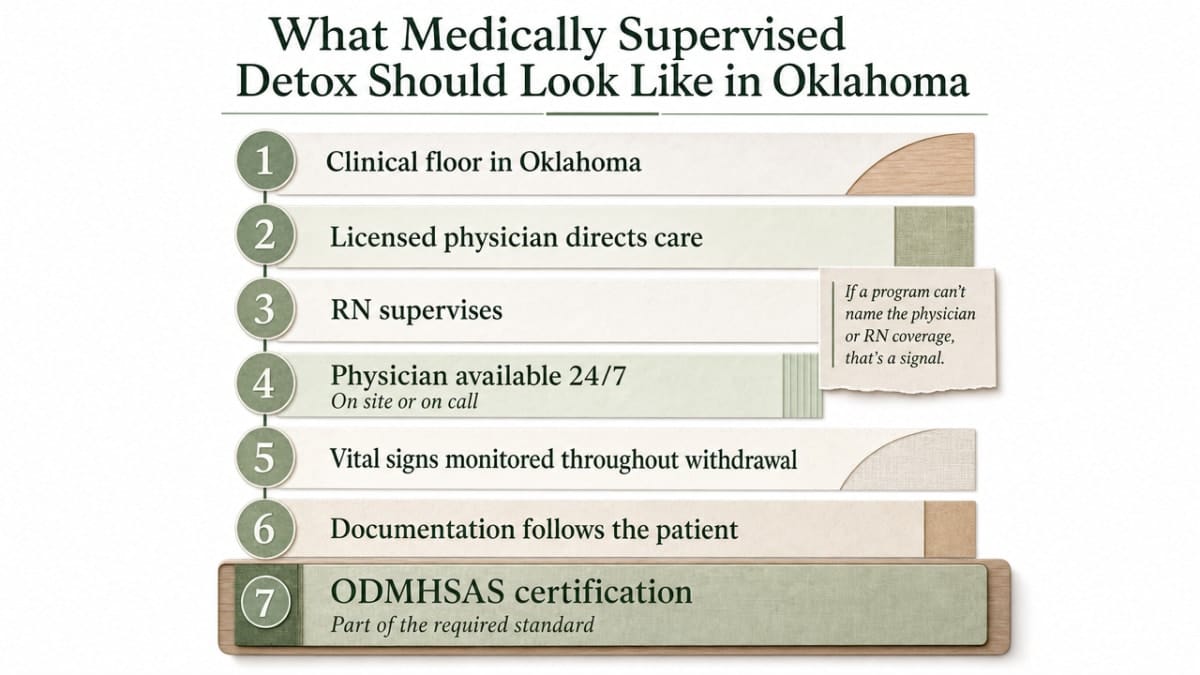
The state’s clinical standard for withdrawal management calls for a licensed physician directing care and a licensed registered nurse supervising, with a physician available on site or on call twenty-four hours a day, seven days a week.5 Vital signs get tracked throughout withdrawal. Documentation follows the patient. This isn’t a suggestion buried in a manual — it’s the floor Oklahoma expects any facility calling itself a medical detox to stand on. If a program can’t tell you who the physician is and when the nurse is on the unit, that’s a real signal.
Certification is the other piece. The Oklahoma Department of Mental Health and Substance Abuse Services (ODMHSAS) sets the rules for how substance use treatment programs get and keep their license, and facilities offering medically supervised withdrawal management fall under a distinct set of standards inside that framework.11 Ambetter, like other commercial insurers in the state, uses that certification as part of how it decides which providers can be in-network. A facility without the right ODMHSAS certification usually isn’t going to show up on your plan’s covered list, no matter what its website says.
What should you feel when you walk in the door? A calm intake, a clinical assessment by someone qualified to do one, a plan for the medications you may need, and monitoring that doesn’t stop when the shift changes. Renewal Springs is built to those standards, which is part of what makes it eligible as an in-network Ambetter provider in Oklahoma City. You don’t have to grade every facility yourself. You just have to know what the state already promised on your behalf — 24/7 physician and RN oversight, real monitoring, a licensed program — and confirm the place you’re calling meets it.5, 11
The Anatomy of an Ambetter-Covered Detox Episode
Once you know detox is a covered benefit, the next question is the one that actually keeps you up: what will your plan pay for, and what will land on your card at the end? It helps to break a detox stay into its parts, because your Ambetter plan doesn’t pay for “detox” as a single line item. It pays for a bundle of clinical services, and it excludes a smaller set of non-clinical ones.
On the covered side, the things your plan is built to pay for are the medical parts of the stay. That means the initial assessment by a licensed clinician, the physician oversight the state requires around the clock, and the registered nurse monitoring that tracks your vital signs as your body clears the substance. It also means medication-assisted treatment when it’s clinically indicated — buprenorphine, methadone, or naltrexone protocols used for maintenance, detoxification, overdose reversal, and relapse prevention are named as covered MAT services in Oklahoma’s benefit design, which is the same clinical framework Ambetter must follow under parity.2 Behavioral health supports delivered alongside the medication — the counseling contact, the discharge planning conversation, the referral for what comes next — are considered part of the treatment episode, not add-ons.9
On the excluded side, the pattern is consistent across payers. Oklahoma’s residential SUD reimbursement rules carve out things like room and board and housekeeping-type services from covered treatment.1 The opioid treatment program rules do the same, drawing a bright line between medical services and non-treatment activities.9 Commercial plans generally mirror these carve-outs. So if a facility bundles a private-room upgrade, transportation, or amenity fees into your bill, those pieces may sit outside what any insurance pays and show up as your responsibility.
Here’s how that shakes out in practice for you as an Ambetter member. The clinical spine of a detox admission — physician-directed withdrawal management, 24/7 nursing, MAT when appropriate, monitoring, and the behavioral health work that gets you to a next level of care — is the covered core.2, 9 Your out-of-pocket exposure on that core is a function of your deductible, your coinsurance, and your annual out-of-pocket maximum, not a question of whether the service itself is a benefit. Anything labeled as a comfort, convenience, or non-treatment item is where surprises tend to hide. That’s the single most useful question to ask any facility before you admit: “Which line items on my expected bill are considered clinical treatment, and which are outside the covered benefit?”
Renewal Springs handles this conversation directly during benefits verification, so you’re not guessing what your plan will accept. You get a picture of what Ambetter is expected to pay against the clinical services, and a clear read on anything that would fall to you. That’s not a promise the number will be small. It’s a promise the number won’t be a surprise.
Prior Authorization Without the Panic
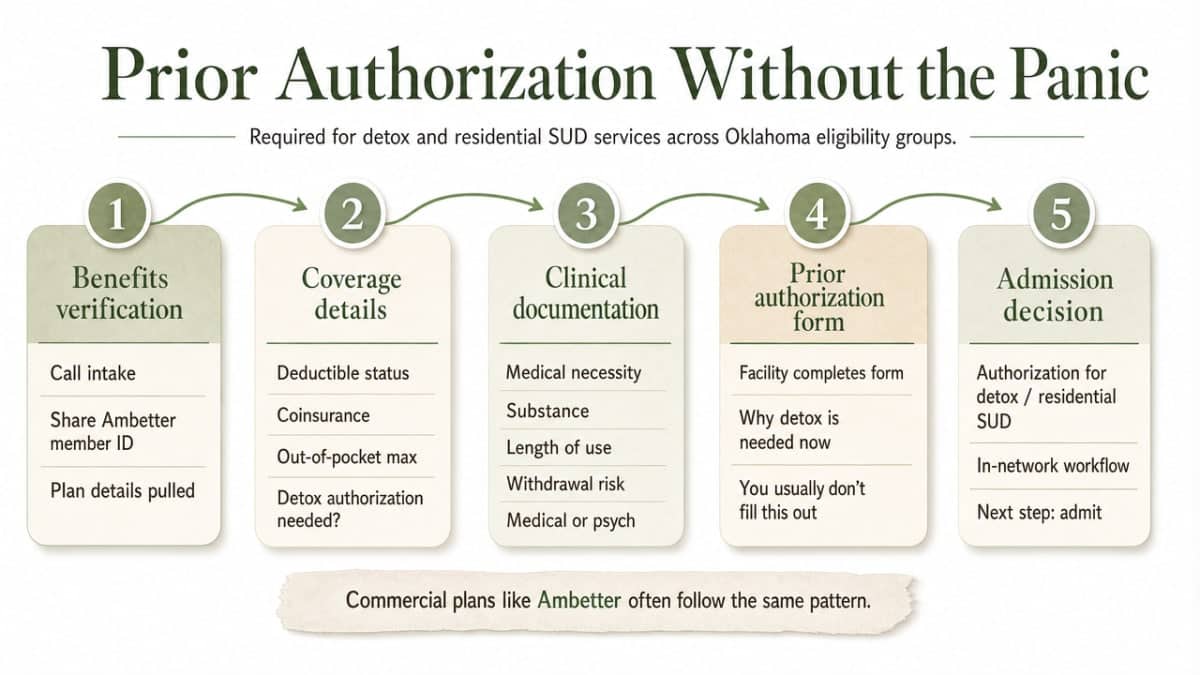
The phrase “prior authorization” sounds like a locked door. It isn’t. It’s a form — a clinical form your facility fills out to tell your insurance company why detox is medically necessary right now. Oklahoma requires it for detox and residential SUD services across every eligibility group, and commercial plans like Ambetter follow the same pattern.4 The good news is that at an in-network facility, you are almost never the person filling it out.
Here’s how the sequence actually runs. First, benefits verification. You call, share your Ambetter member ID, and the intake team pulls your plan details — deductible status, coinsurance, out-of-pocket maximum, and whether detox needs authorization on your specific plan. Second, the clinical team documents medical necessity: the substance, how long you’ve been using, your withdrawal risk, any medical or psychiatric complications, and the level of care that fits. This is where Oklahoma’s 24/7 physician and RN supervision standard comes in — that’s the clinical picture your facility is submitting for.5 Third, Ambetter reviews and issues the authorization, usually the same day for urgent detox requests. Fourth, you’re admitted, and medication-assisted treatment starts if it’s the right protocol for your withdrawal — the same FDA-approved medications for maintenance, detoxification, overdose reversal, and relapse prevention that Oklahoma names in its benefit design.2 Fifth, before discharge, the clinical team plans your bridge to what comes next, often a handoff to an office-based opioid treatment provider or outpatient program.9
What this means for you tonight: you do not have to call Ambetter yourself, argue medical necessity, or know the right codes. Renewal Springs handles the authorization on your behalf as part of the intake call. If you’ve been carrying the weight of thinking you have to sort insurance out before you can ask for help, you can set that down. The step in front of you is one phone call, not a stack of paperwork.
Deductibles, Bronze Plans, and the Self-Employed Cash Flow Problem
If you’re on an Ambetter marketplace plan, you probably didn’t get it through an employer’s HR portal. You picked it yourself, maybe during open enrollment between contracts, maybe after a job change, maybe because self-employment meant you were the only one shopping. So when detox enters the picture, the money question hits differently. It isn’t just “what does insurance pay?” It’s “what does insurance pay, what do I owe, and what happens to my income while I’m not working?”
Let’s take the plan mechanics first, because they’re more predictable than they feel. Every Ambetter plan has three cost-sharing numbers that decide your out-of-pocket exposure for a covered detox stay: your deductible (what you pay before the plan starts sharing costs), your coinsurance (the percentage you pay after the deductible), and your out-of-pocket maximum (the ceiling — once you hit it, the plan pays 100% of covered services for the rest of the plan year). A bronze plan usually means a higher deductible and lower monthly premium. A gold plan usually means the opposite. Neither one changes whether detox is covered. Both change what your share of the bill look like.
Here’s a way to picture your specific episode without invented numbers:
| Piece of the bill | What your plan pays | What you pay |
|---|---|---|
| Covered clinical services (physician oversight, 24/7 RN monitoring, MAT, assessments)2, 5 | Plan share after deductible, up to your out-of-pocket max | Deductible + coinsurance % until you hit the max |
| Excluded items (room and board carve-outs, non-treatment/convenience services)1 | Typically $0 | Full cost, unless the facility bundles it differently |
| Post-detox MAT and behavioral health follow-up9 | Plan share under outpatient benefit | Copay or coinsurance per your plan |
Two timing details matter for marketplace members specifically. Deductibles reset January 1. If you’re reading this in November, admitting before year-end and continuing care into January can mean crossing two deductibles — sometimes that’s still the right call clinically, sometimes it argues for waiting a few weeks. And if you have an HSA-eligible bronze plan, your HSA dollars can go toward the deductible. Renewal Springs’ benefits verification walks through both timing and cost-share on your exact plan, so you’re deciding with real numbers, not fear. The cash flow problem doesn’t disappear. But it stops being the reason you don’t pick up the phone.
MAT and the Bridge from Detox to Staying Well
Detox is the door, not the room. Getting through withdrawal safely is a real accomplishment — if you’re reading this while you or someone you love is still deciding, know that even a five-day medically supervised stay changes the physical picture. But the risk of relapse is highest in the weeks right after, which is why the medication you may start in detox is often the same medication you’ll continue in outpatient care.
Oklahoma treats medication-assisted treatment as one continuous benefit, not two separate ones. The state’s benefit design names buprenorphine, methadone, and naltrexone as covered MAT medications for maintenance, detoxification, overdose reversal, and relapse prevention — the same list your Ambetter plan follows under parity.2 When you become the first Medicaid state in the country to get federal approval for all FDA-approved MAT prescriptions through both opioid treatment programs and office-based settings, the effect trickles down to commercial coverage: more in-network prescribers, more places to continue care after discharge.8
Practically, that means your discharge plan from detox usually points to one of two settings. An opioid treatment program (OTP) is a licensed clinic that can dispense methadone. Office-based opioid treatment (OBOT) is a physician, nurse practitioner, or PA who prescribes buprenorphine or naltrexone in a regular office, paired with the behavioral health contact Oklahoma requires alongside the medication.9 Renewal Springs builds this handoff into your discharge — a scheduled appointment, the prescription bridge, and the release-of-information paperwork already done. You leave with somewhere to go on Monday, not a phone number to call.
Is Renewal Springs In-Network With Your Ambetter Plan?
Short answer: yes. Renewal Springs Detox in Oklahoma City is in-network with Ambetter marketplace plans in Oklahoma. That matters more than it sounds. Network status is often the single biggest lever on what you actually pay for a covered service — in-network care applies your regular deductible and coinsurance, while out-of-network care can mean higher cost-sharing or, on some marketplace plans, no coverage at all outside emergencies.
Being in-network also signals that a facility has cleared the licensure and certification checks Ambetter uses to build its provider list. That includes the ODMHSAS certification Oklahoma requires for programs offering medically supervised withdrawal management, and the clinical staffing standard the state writes down — a licensed physician directing care and a registered nurse supervising, with 24/7 physician availability on site or on call.11, 5 You are not being asked to take a facility’s word for it. The state and the insurer have already done that layer of vetting.
What this removes from your list tonight is real. You don’t have to comb through Ambetter’s provider directory, cross-check NPI numbers, or worry that the place answering the phone will turn out to be out-of-network after admission. What you still need is a benefits check on your specific plan — your deductible balance, your coinsurance, whether authorization is pending — and Renewal Springs runs that verification for free before you commit to anything. One call handles both questions at once: is this place covered, and what will my share look like.
Three Questions to Ask Before You Hang Up the Phone
When you make the call — tonight, tomorrow morning, whenever the moment comes — you don’t need a script. You need three questions that turn a vague conversation into a real plan. Write these down.
- “Can you verify my Ambetter benefits and tell me my deductible balance, coinsurance, and out-of-pocket maximum today?” This is the number question. A good intake team runs this while you’re still on the phone. You should leave the call knowing what your covered detox stay is likely to cost you personally, not a range that could mean anything.
- “Will you handle the prior authorization for me, and how fast does that usually move for an urgent detox admission?” Oklahoma requires prior authorization for detox and residential SUD services, and in-network facilities submit it on your behalf.4 You want to hear a specific answer — often same-day for urgent cases — not “we’ll get to it.”
- “What’s the discharge plan, and can you schedule my first MAT or outpatient appointment before I leave?” A warm handoff to an OBOT or OTP prescriber is part of the standard of care, not an extra.9 If a facility can’t answer this, keep calling.
Renewal Springs’ number is the one to try. You’ve already done the hardest part by reading this far.
Check Your Ambetter Detox Coverage Now
Get answers on Ambetter insurance and next steps for safe, medically supervised detox in Oklahoma.
Frequently Asked Questions
Does my Ambetter marketplace plan in Oklahoma cover medical detox?
Yes. Every Ambetter marketplace plan sold in Oklahoma has to include mental health and substance use disorder services as essential health benefits under the ACA, and federal parity law prevents the plan from putting tighter limits on that care than on medical care. Oklahoma also names medical detoxification as a recognized covered behavioral health service, which sets the state benchmark commercial plans follow.3, 4
Do I need prior authorization before I can be admitted to detox?
Usually yes, and Oklahoma requires prior authorization for detox and residential SUD services across every eligibility group.4 The important part: you are not the one filing it. An in-network facility like Renewal Springs submits the clinical documentation to Ambetter on your behalf during intake. For urgent detox admissions, the review often comes back the same day, so authorization doesn’t mean waiting weeks to start care.
What will I actually pay out of pocket if I have a bronze or high-deductible Ambetter plan?
Your out-of-pocket cost depends on three numbers on your specific plan: your remaining deductible, your coinsurance percentage, and your annual out-of-pocket maximum. A bronze plan doesn’t change whether detox is covered — it changes your share. Renewal Springs runs free benefits verification against your Ambetter member ID before you admit, so you see real numbers on your plan instead of estimates. HSA dollars can also apply toward the deductible.
Is Renewal Springs in-network with Ambetter in Oklahoma?
Yes. Renewal Springs Detox in Oklahoma City is an in-network provider with Ambetter marketplace plans in Oklahoma. That means your standard in-network deductible and coinsurance apply instead of higher out-of-network cost-sharing. Network status also signals the facility has met the ODMHSAS certification and the 24/7 licensed physician and RN supervision standards Oklahoma requires of any program offering medically supervised withdrawal management.11, 5 One benefits call confirms both coverage and your share.
Does Ambetter cover medication-assisted treatment (MAT) during and after detox?
Yes. Oklahoma’s benefit design names MAT as a mandatory service for adults and children who meet medical necessity, and the covered medications explicitly include those used for maintenance, detoxification, overdose reversal, and relapse prevention.2 Under parity, Ambetter follows the same clinical framework. That coverage carries into outpatient care — the office-based opioid treatment or opioid treatment program you transition to after discharge is covered under your outpatient benefit as part of the same MAT continuum.9
What services during detox are typically not covered by my plan?
The pattern is consistent across payers in Oklahoma: clinical services get covered, non-treatment items don’t. Oklahoma’s residential SUD reimbursement rules specifically carve out things like room and board and housekeeping-type services, and the opioid treatment program rules draw the same line between medical services and non-treatment activities.1, 9 Private-room upgrades, transportation, or amenity fees can sit outside your benefit. Ask the facility to flag any non-clinical line items before you admit.
References
- SECTION 95.50. Residential substance use disorder (SUD). https://oklahoma.gov/ohca/policies-and-rules/xpolicy/medical-providers-fee-for-service/individual-providers-and-specialties/inpatient-psychiatric-services/residential-substance-use-disorder-reimbursement1.html
- Oklahoma State Plan Amendment (SPA) 20-0036 – Medicaid. https://www.medicaid.gov/Medicaid/spa/downloads/OK-20-0036.pdf
- Behavioral Health and Substance Abuse Services. https://oklahoma.gov/ohca/individuals/mysoonercare/soonercare-benefits/behavioral-health-and-substance-abuse-services.html
- Mental Health and Substance Abuse Services – Oklahoma.gov. https://oklahoma.gov/ohca/individuals/programs/mental-health-and-substance-abuse-services.html
- Okla. Admin. Code § 317:30-5-95.46 – Residential substance …. https://www.law.cornell.edu/regulations/oklahoma/OAC-317-30-5-95.46
- Oklahoma Section 1115 IMD Waiver for SMI and SUD. https://www.medicaid.gov/medicaid/section-1115-demonstrations/downloads/ok-imd-waiver-smi-sud-pa.pdf
- State Plan Amendment (SPA) 20-0030 – Medication Assisted Treatment Coverage. https://www.medicaid.gov/CHIP/Downloads/OK-20-0030.pdf
- Oklahoma Health Care Authority to Increase Coverage for Opioid Treatment Programs. https://oklahoma.gov/ohca/about/newsroom/2021/march/ohca-to-increase-coverage-for-opioid-treatment-programs.html
- Okla. Admin. Code § 317:30-5-241.7 – Opioid Treatment Programs and Office-Based Opioid Treatment. https://www.law.cornell.edu/regulations/oklahoma/OAC-317-30-5-241.7
- Oklahoma State Plan Amendment (SPA) 25-0014. https://www.medicaid.gov/medicaid/spa/downloads/OK-25-0014.pdf
- Chapter 18. Standards and Criteria for Substance Abuse Treatment Programs. https://oklahoma.gov/content/dam/ok/en/odmhsas/documents/policy/provider-certification/administrative-rules/2021/Chapter%2018%20Final%20effective%209-15-21.pdf