
Key Takeaways
- Oklahoma requires medical detox providers to hold ODMHSAS state certification and national accreditation for SoonerCare eligibility, and neither credential depends on whether a facility is co-ed 12.
- Co-ed facilities pool one bed count instead of splitting men’s and women’s beds, which often shortens the wait between deciding to go and getting admitted.
- Research shows mixed-gender detox delivers comparable outcomes to women-only care for most patients, though trauma survivors benefit from women-only groups and gender-separated sleeping wings within the same building 2, 4.
- When calling an Oklahoma detox, ask what beds are open today, which groups run gender-separated, and how staff handle withdrawal complications and family admissions.
What happens on a co-ed detox floor, hour by hour
If you’re picturing a co-ed detox floor and imagining something chaotic or awkward, take a breath. The reality is quieter than that. Most of the day, you’re in your own room, resting, or you’re in a common area with a nurse checking in on you. Men and women share the same building and the same clinical team, but the day is structured around your body, not around social mixing.
A typical morning starts early with vitals. A nurse comes to your room to check your blood pressure, heart rate, and how withdrawal is hitting you. If you’re detoxing from opioids, alcohol, or benzos, that check is where medication decisions get made. Buprenorphine, comfort meds, sleep support, hydration — whatever’s needed. Sleeping quarters are separated by gender. You don’t share a room with someone of a different gender, and bathrooms attached to sleeping wings are gender-specific.
Breakfast is in a shared dining area. Some people show up. Some stay in bed on day two because they feel awful, and that’s fine. No one is forced to socialize when their body is in acute withdrawal.
Mid-morning is when group therapy or a psychoeducation session runs. These are usually mixed-gender, though a well-designed program keeps some groups women-only or men-only for topics where privacy matters more — trauma processing, relationship history, parenting 5. You’ll be told which is which. You can opt out if a topic feels too raw on day one.
Afternoons are lighter. One-on-one time with a counselor, a nap, a call to family if you’re ready. Another vitals check. Dinner. Evening meds. A wind-down group or a quiet hour before bed.
The rhythm is medical first, therapeutic second, social last. That’s true whether the facility is co-ed or gender-segregated. What co-ed changes is who you might sit next to at lunch — not the care you get when withdrawal spikes at 2 a.m.
Does mixed-gender detox work as well as women-only or men-only care?
This is the question that probably brought you here. If you’ve read anything about addiction treatment, you’ve seen the pitch for gender-specific care — the idea that women heal better with women, men with men, and that mixing the two is a shortcut. So it’s fair to ask, before you pick up the phone: am I choosing something clinically weaker if I go co-ed?
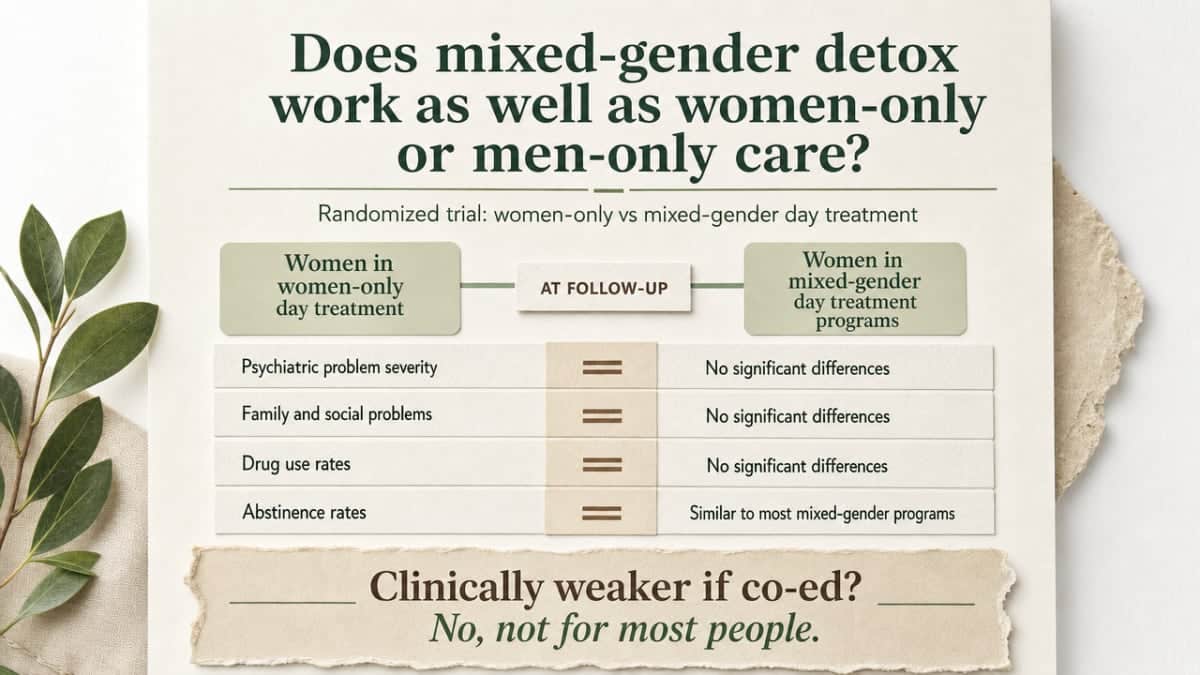
The short answer, based on the research: no, not for most people.
A randomized trial that compared women in a women-only day treatment program to women in several mixed-gender day treatment programs found no significant differences in psychiatric problem severity, family and social problems, or rates of drug use at follow-up. Abstinence rates were similar between the women-only program and most of the mixed-gender programs 2. That’s a controlled comparison, not a marketing claim. The women in co-ed care didn’t do worse.
A broader review of the literature reached the same conclusion in plainer language: gender-specific treatment is generally no more effective than mixed-gender treatment for most women, though some women prefer women-only settings and may only enter treatment there 1. That preference matters, and it’s real — but preference and clinical effectiveness are two different things. If a woman-only bed is what will get you or your loved one through the door, take it. If a co-ed bed is what’s open today, the evidence says you’re not settling for less.
The nuance worth naming: some studies do find advantages for women-only care in specific subgroups. Women with higher problem severity across alcohol, drug, family, medical, and psychiatric domains — including women with recent physical abuse — have shown better drug and legal outcomes in women-only programs, partly because those programs tend to deliver more intensive services to a more severe population 4. That’s not an argument against co-ed. It’s an argument for co-ed programs to build in the trauma-informed and gender-responsive pieces that make a difference — which the next section gets into.
What the research does not support is the idea that mixed-gender detox is a lower tier of care. It’s the same medical monitoring, the same medications, the same nursing hours. What changes is who else is on the floor, not what happens when your withdrawal symptoms peak.
The wait-time math: why co-ed admissions often move faster in Oklahoma
Here’s the part nobody explains when you’re on the phone at 11 p.m. trying to get someone into detox: bed availability is not one number. It’s two.
A gender-segregated facility tracks men’s beds and women’s beds separately. If the men’s wing is full and the women’s wing has three openings, a man in withdrawal still hears “we don’t have anything today.” The women’s beds might sit half-empty for two days while men wait, or the opposite happens next week. That’s not bad management — it’s what happens when you split a small bed count into two smaller counts.
A co-ed facility pools the count. Every open bed is available to whoever calls next, subject to clinical intake and safety review. When you’re calling about opioid or alcohol withdrawal, and the window between deciding to go and changing your mind is measured in hours, that pooling matters. It’s the difference between “come in this afternoon” and “call back Thursday.”
The access gap in Oklahoma is not abstract. In 2023, an estimated 15.4% of Oklahomans aged 12 and older met criteria for a past-year substance use disorder, and only a small fraction of adults with SUD received any substance use treatment in the past year 17. That’s a lot of people who need a bed and a much smaller pipeline that can hold them.
When the pipeline is that narrow, how facilities allocate beds shapes who actually gets in. Splitting capacity by gender protects a specific clinical experience for some patients. Pooling capacity — with women-only groups, gender-separated sleeping wings, and trauma-informed protocols layered inside — protects access for more of them.
Renewal Springs operates as a co-ed medical detox in Oklahoma City for that reason. When you call, you’re asking about one bed count, not two. If you want to know what’s open today, that’s the fastest question to ask, and the admissions team can answer it before you hang up.
The clinical standard: what ASAM Level 3.7 requires, gender mix aside
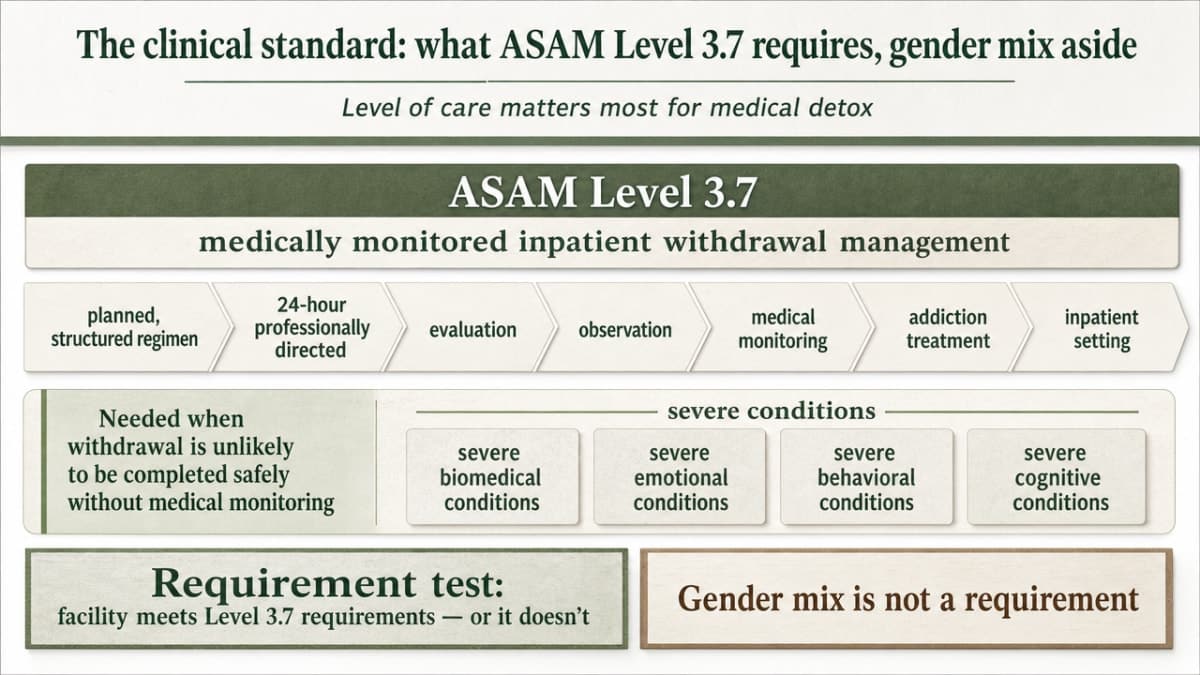
When you or someone you love is going into medical detox, the label that matters most is not “co-ed” or “gender-specific.” It’s the level of care. In addiction medicine, medically monitored inpatient withdrawal management sits at ASAM Level 3.7 — and that designation carries a specific set of requirements that a facility either meets or doesn’t. Gender mix is not one of them.
Level 3.7 is defined as a planned, structured regimen of 24-hour professionally directed evaluation, observation, medical monitoring, and addiction treatment in an inpatient setting. It’s built for people with biomedical, emotional, behavioral, or cognitive conditions severe enough that they’re unlikely to complete withdrawal safely without medical monitoring 9. Practically, that translates into a short list of things you should expect from any credible medical detox in Oklahoma:
- 24-hour nursing observation, not scheduled check-ins
- Physician assessment on a defined cadence — including a timely initial evaluation on admission
- Medication-assisted withdrawal protocols, including buprenorphine or methadone for opioid use disorder where appropriate, and benzodiazepine tapers for alcohol or benzo withdrawal
- Structured evaluation for co-occurring medical and psychiatric conditions
- A treatment plan that addresses what happens after detox, not just the days you’re in the bed
None of that changes based on who’s in the room next door. The nurse taking your vitals at 3 a.m., the physician adjusting your buprenorphine dose, the protocol for a rising CIWA score during alcohol withdrawal — those exist because the clinical guidance requires them, and they operate the same way in a co-ed facility as they would in a men-only or women-only one.
What separates a strong Level 3.7 program from a weak one is staffing depth, physician availability, medication protocols, and how the team handles complications — a seizure risk from alcohol withdrawal, a fentanyl-related precipitated withdrawal, a psychiatric decompensation. Ask about those things when you call. They tell you far more about whether you’ll be safe than whether the person across the hall is a man or a woman.
Where co-ed needs adaptation: trauma, safety, and women-only spaces inside the same building
Here’s where you deserve an honest answer instead of a sales pitch. Co-ed detox works well for most people. It does not work identically for everyone, and pretending otherwise would fail the readers who most need this section — women with recent trauma, survivors of intimate partner violence, and anyone whose first instinct when they read “mixed-gender facility” is a tight chest and a maybe.
The research is clear about the subgroup nuance. Women with higher problem severity across alcohol, drug, family, medical, and psychiatric domains — and women reporting recent physical abuse — have shown stronger drug and legal outcomes in women-only programs, partly because those programs deliver more intensive, gender-responsive services to a more severe population 4. Group therapy dynamics tell a related story: mixed-gender groups can be restrictive for some women, who show a wider range of interpersonal engagement in single-gender groups 5. If you’ve been quiet in mixed rooms your whole life, that finding will not surprise you.
None of this argues against co-ed detox. It argues for co-ed programs that build the right pieces in.
What that looks like in practice is specific, not vague. Sleeping wings are gender-separated with bathrooms attached, so the private hours of the day are private. Certain groups — trauma processing, relationships, parenting, and any session where disclosure carries a cost — run women-only or men-only, with clear signage on which is which. Staff receive trauma-informed training that changes small things that matter: how a nurse announces themselves at the door, how a de-escalation is handled, how a request to switch counselors is received without friction. Evidence-based, gender-responsive curricula like Seeking Safety and Helping Women Recover can be embedded inside a co-ed facility without segregating the whole program, and a 2023 systematic review found these integrated approaches produced significant improvements in substance use and mental health outcomes for women with co-occurring conditions 6.
If you’re a woman with a trauma history and you’re weighing this decision, two questions will tell you almost everything about a co-ed facility. Ask what women-only groups run each week and what they cover. Ask how staff are trained to work with survivors. A program that can answer both without hedging is a program that has done the work. One that can’t — regardless of gender mix — is the one to keep calling past.
Family logistics: partners, siblings, and parent-child dyads
A lot of people search for a co-ed facility because addiction rarely arrives alone. Couples use together. A brother and sister realize on the same weekend that they can’t keep doing this. A mother and her adult son face the same fentanyl crisis from opposite sides of a hallway. When you’re one half of a pair — or one part of a small family unit — a gender-segregated facility means two phone calls, two intakes, two buildings, and a real chance that only one of you actually goes.
A co-ed detox lets partners of different genders be admitted to the same facility on the same day. You won’t share a room — sleeping wings stay separated — but you’ll eat in the same dining area, sit in some of the same mixed groups, and see each other during common hours. For couples where one person’s willingness to go is tied to the other’s, that matters. The alternative is often neither of you going.
The same logic applies to adult siblings and to parent-child dyads. If you’re a parent trying to get your adult child into detox and you also need to be there — because the trust between you is what got you both to the parking lot — one building is easier than two.
Family involvement is not a nice extra during detox. National clinical guidance treats it as part of the work. SAMHSA’s TIP 39 quick guide directs clinicians to motivate family to engage the client in detoxification and to contract with the family around abstinence and its own treatment 18. That’s harder to do when family members are scattered across gender-segregated facilities on opposite sides of the city. It’s more possible when the family therapy session, the discharge planning meeting, and the visiting hour all happen in one place.
None of this replaces individual clinical judgment. Some couples should not detox in the same building, and any credible admissions team will screen for that — active violence, coercion, or a dynamic where one person’s presence keeps the other from disclosing what they need to say. Ask the question directly when you call. A good program will give you a straight answer about whether entering together makes sense for your specific situation.
Oklahoma’s rules: certification, accreditation, and SoonerCare
If part of your hesitation about a co-ed detox facility in Oklahoma is a quiet worry that mixed-gender means less regulated, that concern doesn’t hold up under Oklahoma’s rules. The state doesn’t have a lighter certification track for co-ed facilities. There’s one bar, and every medical detox has to clear it.
Oklahoma requires medical detox providers to hold two credentials, not one. The Oklahoma Department of Mental Health and Substance Abuse Services (ODMHSAS) issues state certification, and residential providers — including medical detox — must also carry national accreditation to be eligible for SoonerCare reimbursement 12. That means an outside accrediting body has reviewed the clinical protocols, safety practices, staffing, and quality systems on top of the state’s own review. Two separate sets of eyes. Neither of them checks a box for gender composition, because that isn’t what determines whether a program can safely detox you.
What they do check is whether the program meets the clinical standard for the level of care it claims. Oklahoma Medicaid policy defines residential substance use disorder treatment in ASAM terms, with Level 3.7 designated as medically monitored intensive inpatient withdrawal management for adults 13. That’s the same standard covered earlier — the 24-hour nursing, the physician oversight, the medication-assisted withdrawal protocols. A co-ed facility operating at Level 3.7 in Oklahoma is meeting the same regulatory expectations as any gender-segregated program operating at that level.
Renewal Springs operates within this framework. When you call and ask whether a program is state-certified and nationally accredited, you’re asking the right question. The answer tells you the facility is running inside Oklahoma’s actual rules, not around them — and that co-ed is a design choice about access and family flexibility, not a shortcut around the standard.
Making the call today: insurance, open beds, and what to ask
If you’ve read this far, the hardest part is probably still ahead of you: picking up the phone. That’s the step that turns a tab in your browser into an actual bed with your name on it. It’s okay if your hands are shaking. Making the call while you’re scared is not weakness — it’s the moment the rest of this starts.
Two things move faster than most people expect once you dial. The first is insurance verification. Renewal Springs works with most major insurance providers and runs benefits verification for free, which means you don’t need to have your policy figured out before you call. Read the numbers off your card, or your loved one’s card, and the admissions team runs the check while you’re on the line. SoonerCare covers medically monitored detox at accredited Oklahoma facilities, and private plans commonly cover Level 3.7 withdrawal management when the clinical criteria are met.
The second is the bed question. Because Renewal Springs runs a co-ed floor, the admissions team is checking one pooled bed count against your intake needs — not a men’s list and a women’s list. Ask directly: what’s open today, and if nothing is open today, what does the next 24 to 48 hours look like? A straight answer is a good sign.
Have this short list ready when you call:
- What substance, how much, how often, and when the last use was
- Any seizure history, especially with alcohol or benzo withdrawal
- Other medications you take, including buprenorphine or methadone
- Insurance card, or a note that you don’t have coverage — ask anyway
- Whether a partner, sibling, or family member is coming with you
You don’t have to have your life in order to make this call. You just have to make it. Every step you’ve already taken — reading this, thinking it through, asking the questions — counts. Call and ask what today looks like.

Talk to someone now about co-ed detox options
Get real answers about availability and next steps for medically supervised, co-ed detox care.
Frequently Asked Questions
Is co-ed detox safe for women, especially those with a history of trauma or abuse?
Yes, when the facility builds in the right protections. Sleeping wings and bathrooms stay gender-separated, and sensitive groups — trauma, relationships, parenting — run women-only inside the co-ed building 5. Trauma-informed and gender-responsive curricula have shown significant improvements in substance use and mental health outcomes for women with co-occurring conditions 6. When you call, ask which groups are women-only and how staff are trained to work with survivors. A clear answer means the work has been done.
Can my partner and I enter detox together at a co-ed facility?
Often yes. A co-ed facility can admit partners of different genders on the same day. You won’t share a room — sleeping wings stay separated — but you’ll see each other in common areas and some mixed groups. National family therapy guidance directs clinicians to engage family during detox, which is easier when everyone is in one building 18. Admissions will screen for safety concerns like active violence or coercion before clearing you both. Ask directly when you call whether entering together makes sense for your situation.
Will I get a bed faster at a co-ed detox than at a men-only or women-only program?
Usually, yes. Gender-segregated facilities split their bed count in two — men’s beds and women’s beds — so one side can fill while the other sits open. A co-ed facility pools that count, so every open bed goes to whoever calls next, subject to clinical intake. When you’re in withdrawal and the decision window is short, that pooling often turns a “call back Thursday” into “come in this afternoon.” Call and ask directly what’s open today.
Is co-ed detox the same clinical level of care as gender-segregated detox?
Yes. Medical detox is defined by ASAM Level 3.7 — 24-hour nursing, physician oversight, medication-assisted withdrawal protocols, and structured evaluation for co-occurring conditions 9. Gender mix is not part of that definition. A randomized trial comparing women in women-only versus mixed-gender day treatment found no significant differences in psychiatric severity, family and social problems, or drug use at follow-up 2. The nurse checking your vitals at 3 a.m. and the buprenorphine protocol work the same way on a co-ed floor.
Does SoonerCare or private insurance cover co-ed medical detox in Oklahoma?
Yes, when the facility is properly credentialed. Oklahoma requires medical detox providers to hold both ODMHSAS state certification and national accreditation to be eligible for SoonerCare reimbursement 12. Neither credential turns on whether the program is co-ed. Private plans commonly cover Level 3.7 withdrawal management when clinical criteria are met. Renewal Springs runs free benefits verification while you’re on the phone — read the numbers off your card and the admissions team checks coverage before you hang up.
What should I ask when I call a detox facility today?
Keep it short and direct. Ask what beds are open today and, if none, what the next 24 to 48 hours look like. Ask whether the program is ODMHSAS-certified and nationally accredited. Ask how they handle alcohol or benzo withdrawal complications and how buprenorphine or methadone are managed for opioid withdrawal. If you’re a woman with a trauma history, ask which groups run women-only. If a partner or sibling is coming with you, say so upfront so admissions can screen you together.
References
- Gender and Use of Substance Abuse Treatment Services. https://pmc.ncbi.nlm.nih.gov/articles/PMC6470905/
- Women’s programs versus mixed-gender day treatment. https://pubmed.ncbi.nlm.nih.gov/15598193/
- The Relative Effectiveness of Women-Only and Mixed-Gender Treatment for Substance-Abusing Women. https://pmc.ncbi.nlm.nih.gov/articles/PMC3081899/
- Women-only and mixed-gender drug abuse treatment programs: service needs, utilization and outcomes. https://pubmed.ncbi.nlm.nih.gov/16996232/
- Treatment of substance abusers: single or mixed gender groups?. https://pubmed.ncbi.nlm.nih.gov/9293039/
- A systematic review of gender-responsive and trauma-informed treatments for women with substance use and mental health concerns. https://pubmed.ncbi.nlm.nih.gov/36283062/
- TIP 63: Medications for Opioid Use Disorder (Full PDF). https://library.samhsa.gov/sites/default/files/pep21-02-01-002.pdf
- TIP 63: Medications for Opioid Use Disorder – SAMHSA Resource Page. https://www.samhsa.gov/resource/ebp/tip-63-medications-opioid-use-disorder
- Overview of Substance Use Disorder (SUD) Care Clinical Concepts for States (ASAM Resource Guide). https://www.medicaid.gov/state-resource-center/innovation-accelerator-program/iap-downloads/reducing-substance-use-disorders/asam-resource-guide.pdf
- Level 3.7 by Service Characteristic. https://www.pa.gov/content/dam/copapwp-pagov/en/ddap/documents/documents/asam/level%203.7%20by%20service%20characteristics.pdf
- Guidance for Implementing ASAM Criteria, 3rd Edition: Withdrawal Management. https://mn.gov/dhs/assets/WDM%20Guidance_9.8.2025_tcm1053-706303.pdf
- Provider Certification – Oklahoma Department of Mental Health and Substance Abuse Services. https://oklahoma.gov/odmhsas/policy/provider-certification.html
- SECTION 95.43. Residential substance use disorder treatment (Oklahoma Health Care Authority). https://oklahoma.gov/ohca/policies-and-rules/xpolicy/medical-providers-fee-for-service/individual-providers-and-specialties/inpatient-psychiatric-services/residential-substance-use-disorder-treatment.html
- CHAPTER 18. Standards and Criteria for Substance Abuse Treatment Services (ODMHSAS Administrative Rules). https://oklahoma.gov/content/dam/ok/en/odmhsas/documents/policy/provider-certification/administrative-rules/2021/Chapter%2018%20Final%20effective%209-15-21.pdf
- Okla. Admin. Code tit. 450, ch. 18, subch. 3 – Substance Abuse Treatment Services. https://www.law.cornell.edu/regulations/oklahoma/title-450/chapter-18/subchapter-3
- Behavioral Health Barometer: Oklahoma, Volume 8 (NSDUH State Report). https://www.samhsa.gov/data/report/nsduh-behavioral-health-barometer-oklahoma-volume-8
- 2023 NSDUH State Tables – Oklahoma. https://www.samhsa.gov/data/sites/default/files/reports/rpt56188/2023-nsduh-sae-state-tables_0/2023-nsduh-sae-state-tabs-oklahoma.pdf
- Quick Guide for Clinicians Based on TIP 39: Substance Abuse Treatment and Family Therapy. https://www.govinfo.gov/content/pkg/GOVPUB-HE20-PURL-gpo64339/pdf/GOVPUB-HE20-PURL-gpo64339.pdf