
Key Takeaways
- In Oklahoma City, a comfortable detox means private rooms, dim lighting, continuous monitoring, and staff who treat withdrawal as both a medical and human experience.
- A calm environment is clinical care, not luxury — it lowers physiological stress so symptom-triggered medications and vital-sign monitoring work more accurately during the acute 72-hour window.
- SoonerCare covers medical detox, residential SUD services, and all FDA-approved MAT medications, though prior authorization is often required and a good facility handles that paperwork 5, 6, 7.
- Before choosing a detox center, compare private-room availability, overnight staffing, medication protocols for your specific substance, insurance verification support, and how discharge planning connects you to what comes next.
What “comfortable” actually means when you’re detoxing
You’re probably picturing a cold hallway, a plastic mattress, and someone in scrubs telling you to hold still. That’s not what this is. And it’s worth saying out loud, because the fear of what detox will feel like keeps a lot of people from ever making the call.
When you see the word “comfortable” attached to a detox center in Oklahoma City, it doesn’t mean spa robes or room service. It means something quieter and more important: you get a bed that feels like a bed. A door you can close. A private bathroom. A window. Lights you can dim at 2 a.m. when your body is doing something it doesn’t understand. A staff member you can call by name.
That’s the surface of it. Underneath, comfort is doing clinical work. Withdrawal is stressful in the literal, physiological sense — your heart rate climbs, your sleep breaks apart, your nervous system goes loud. A calm room with minimal outside disturbances is part of standard supportive care during withdrawal, not a bonus feature 14. The quieter your environment, the less your body has to fight on top of what it’s already fighting.
Comfort also means you are not alone with it. Medical detox, as SAMHSA defines it, is evaluation, stabilization, and helping you get ready for whatever comes next 2. Someone is watching your vitals. Someone is adjusting your medications based on what your body is actually doing that hour, not a generic schedule. Someone is bringing you water and checking in without making you feel like a case number.
So when you read “comfortable detox,” read it as: safe, private, monitored, and treated like a person. That’s the whole idea. The rest of this page walks through what that looks like day by day, what it costs, and how to take one small step without committing to anything.
Why a calm room is a clinical safety feature, not a spa perk
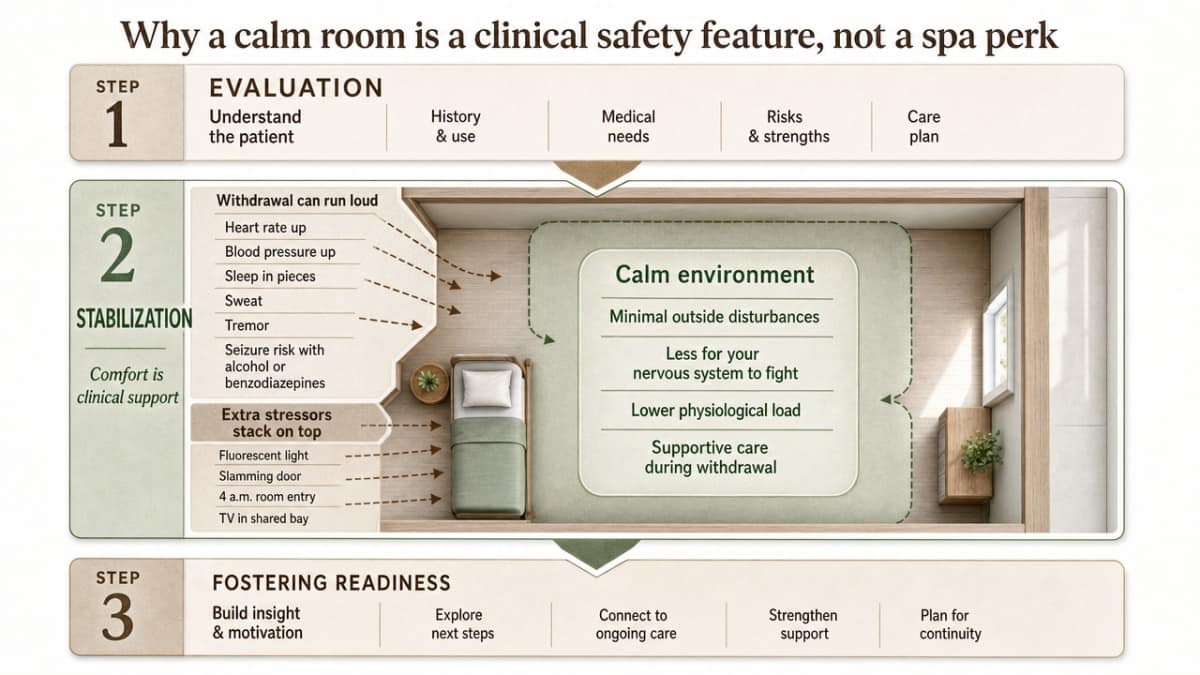
Here’s the part most people don’t hear until they’re already inside a good detox: the quiet is doing work. Your body in withdrawal is running loud. Heart rate up, blood pressure up, sleep in pieces, sweat, tremor, sometimes seizures if the substance was alcohol or a benzodiazepine. Every extra stressor stacks on top of that — a fluorescent light, a slamming door down the hall, a stranger walking through your room at 4 a.m., a TV blaring in a shared bay. The clinical guidance is direct on this point: supportive care during withdrawal includes a calm environment with minimal outside disturbances 14. Not because it’s nicer. Because your nervous system has less to fight.
It also fits inside a bigger picture of what detox actually is. SAMHSA’s clinician guide describes medical detoxification as three connected pieces:
- Evaluation is the intake — what you’ve been using, how much, how long, what other medical or mental health issues are in the mix, what medications you’re already on.
- Stabilization is the days that follow — managing withdrawal symptoms medically, keeping your vitals safe, letting your body reset.
- Fostering readiness is the part people skip past: helping you get pointed at what comes next, whether that’s residential treatment, outpatient care, or a step-down plan that actually fits your life 2.
The calm room lives inside stabilization. It’s not separate from the medicine. When your surroundings are steady, symptom-triggered medication protocols work more cleanly, because the staff can tell what your body is doing without a bunch of environmental noise on top of it. You sleep more. You eat more. You panic less. You are easier to keep safe.
The same guide is honest about the limit of all this: detoxification alone is not sufficient 2. A quiet room won’t fix a substance use disorder any more than setting a broken bone teaches you to walk again. What a home-like detox does is give you a safe, dignified place to get through the acute part — the days when your body is loudest — so you can actually make a decision about what comes next instead of just surviving the hour.
So if you’re weighing options and one of them mentions private rooms, soft lighting, or a home-like feel, don’t read that as marketing. Read it as: this place understands that a stressed body heals worse than a settled one, and they’ve built the setting to match the science.
The overdose picture in Oklahoma right now
If you’re weighing whether now is the right time to get help, it’s worth knowing what’s happening around you. Not to scare you. To give you honest context for a decision you’re already carrying.
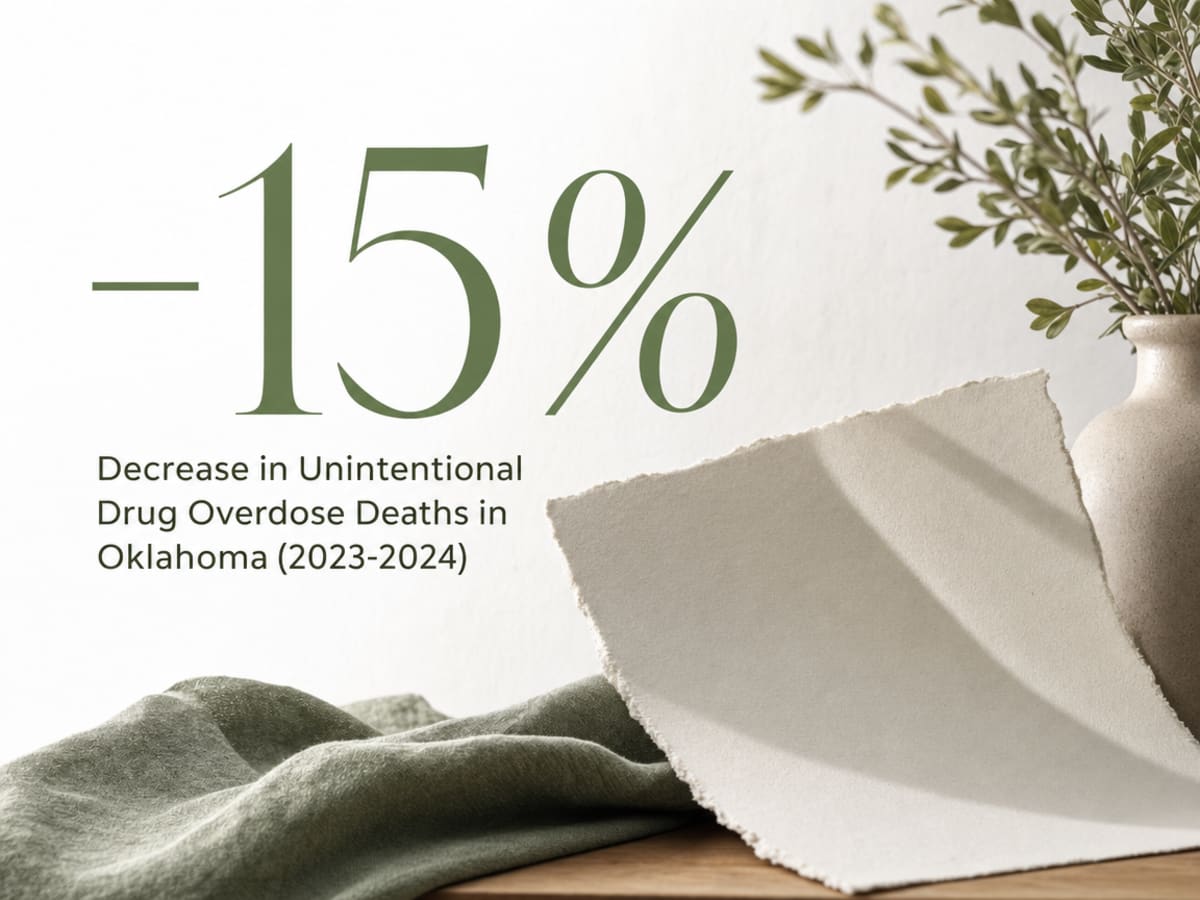
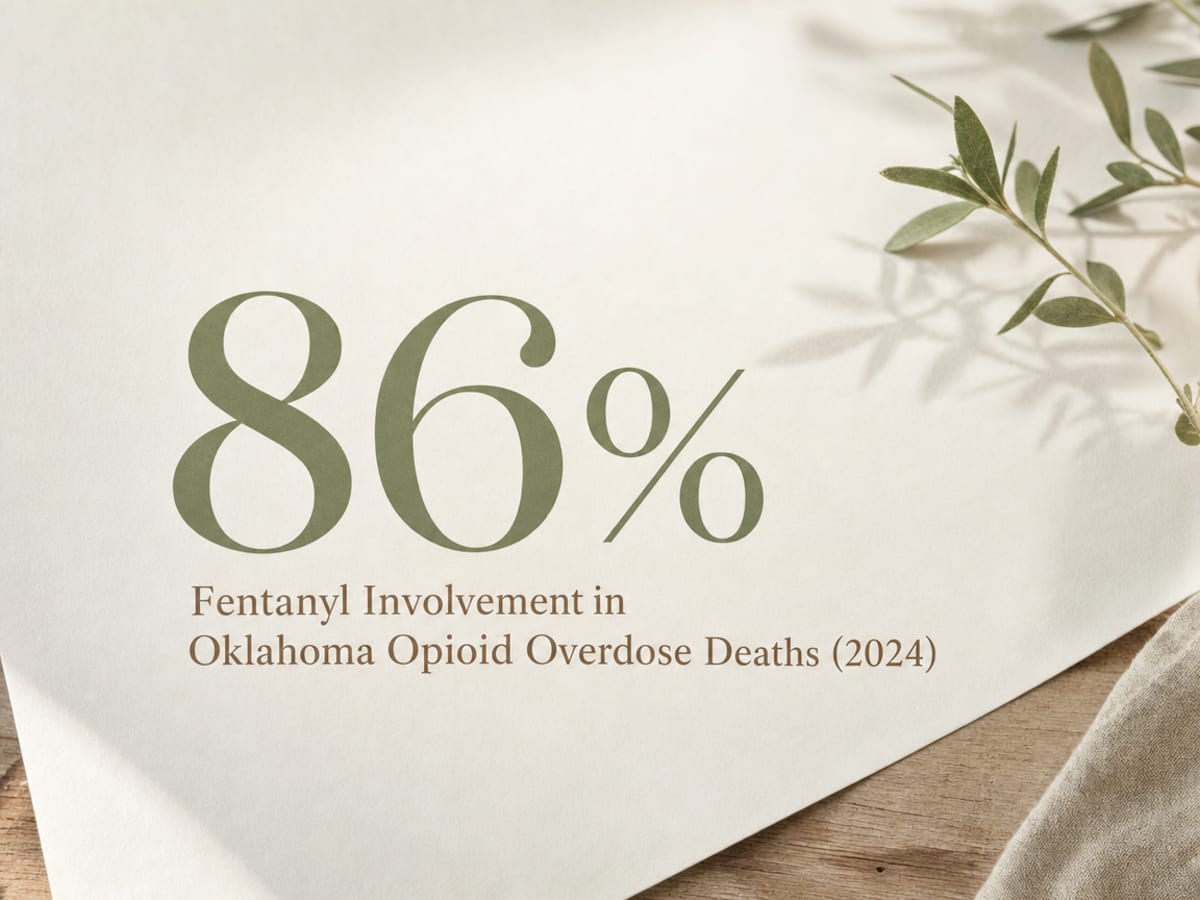
Oklahoma’s unintentional drug overdose death rate climbed 77% from 2020 to 2023, then dropped 15% from 2023 to 2024 9. That decline is real, and it’s the first meaningful downturn in years. It’s also fragile. Fentanyl is still moving through the state’s drug supply, and the people who survived the climb are the ones still trying to figure out how to stop.
Read the trend two ways at once. The rise tells you why the fear you’re feeling is warranted — the risk of using another day, especially with opioids, is not what it was five years ago. The decline tells you something quieter and more useful: people are getting into treatment, staying alive, and coming out the other side. That’s not a headline. That’s a slow, hard-won shift built by thousands of individual decisions that looked a lot like the one you’re weighing right now.
The other reason the local number matters: you are not an outlier here. Substance dependence in Oklahoma City is common, treatable, and increasingly met with real medical infrastructure. The nurses and physicians who staff detox units in this city have seen your exact situation before — the specific substance, the specific dose, the specific fear of what withdrawal will feel like. Whatever combination you’re bringing in, it’s not the first time they’ve worked with it.
None of this makes the call easier. But it changes what the call is. Reaching out to a detox center in Oklahoma City in this moment is not a leap into the unknown. It’s stepping into a system that has been quietly getting better at keeping people alive — and, more than that, at helping them build something on the other side of the acute days. The trend line is not just numbers. It’s people who did what you are considering doing.
A day inside a home-like detox: what the first 72 hours actually look like
The first question most people ask, once they’ve decided to consider detox, is the one they don’t say out loud: what is it going to feel like in there? So here’s a walk-through of the first three days, hour by hour where it matters, in a home-like medical detox — not a hospital ward.
Day one, the first few hours. You arrive. Someone meets you at the door — not a security desk. Intake happens sitting down, usually in a private room, with a nurse and a clinician asking you about what you’ve been using, how much, how recently, what other medications you’re on, and what your body has done during withdrawal in the past if you’ve been through it before. This is the evaluation piece SAMHSA describes as the front end of medical detox 2. It takes a while. It’s supposed to. The more they know, the safer the next 72 hours get.
You get shown your room. A real bed, made. A private bathroom. A window. A closet for the small bag you brought. A wearable goes on your wrist so vitals can be tracked continuously without someone waking you every two hours to take a blood pressure cuff off a rolling cart. Your first dose of medication — the specific medication depends on what you’re withdrawing from — is timed to when your symptoms are actually starting, not to a fixed schedule. That’s the symptom-triggered approach the ASAM guideline points clinicians toward for alcohol withdrawal, and the same logic shapes opioid and benzodiazepine protocols in a well-run detox 1.
Day one, overnight. This is often the hardest stretch. Sleep is broken. You sweat, or shake, or feel like your skin doesn’t fit. Someone is awake down the hall. If your symptoms climb, medication climbs with them. If you can sleep, they let you sleep. Nobody flips on an overhead fluorescent to check a chart.
Day two. The acute peak, for most substances, lands somewhere in the first 24 to 72 hours. You may feel worse before you feel better — that’s normal, and the staff will name it before you have to ask. Meals arrive. You eat what you can. You drink water. You might sit in a shared living area in a recliner and watch something forgettable on TV, or you might stay in your room. Both are fine. A calm environment with minimal outside disturbance is part of the clinical care plan, not a preference 14. Family calls, if you want them, happen on your schedule.
Day three. Symptoms usually start easing. You sleep in longer stretches. You eat a full meal. You start talking with a counselor about what comes next — residential, outpatient, sober living, MAT continuation. That’s the third piece of medical detox: fostering readiness for continued treatment 2.
Put this next to the other picture of substance-related care in Oklahoma. In 2024, the state recorded 1,137 overdose deaths, 4,228 inpatient hospitalizations, and 6,804 emergency department visits 11. The ED and the hospital ward are where a lot of Oklahomans meet the medical system during a crisis. A residential detox is a different setting entirely — planned, private, and paced to your body instead of a triage queue.
Medications, monitoring, and the people watching over you at 3 a.m.
The middle of the night is when a lot of people ask themselves if they made the right call coming in. Your body is loud, your head is loud, and the clock feels stuck. So it helps to know exactly who is on the other side of that door, what they’re doing, and what they can give you.
The medications themselves. For alcohol withdrawal, benzodiazepines are the first-line therapy in most medically supervised detox settings, dosed on a symptom-triggered basis rather than a fixed clock — meaning a nurse assesses you on a regular schedule and only gives the next dose when your symptoms actually call for it 14. That’s the approach the ASAM alcohol withdrawal guideline points clinicians toward, and it’s what keeps people from being over-sedated on one end or under-treated on the other 1. For opioids, the medications look different — buprenorphine, methadone, or comfort meds for the specific symptoms (nausea, muscle aches, insomnia) — but the same principle holds: your dose reflects what your body is doing right now, not a template. For benzodiazepines, the taper is slow and careful, because coming off them too fast is genuinely dangerous.
The monitoring. Vitals get tracked around the clock. In a home-like detox, a wearable on your wrist reads heart rate, sleep patterns, and stress signals continuously, which means the nurse can see a problem starting before you feel it starting. That’s the point. Withdrawal complications — a spike in blood pressure, an arrhythmia, a fever climbing — are safer when someone catches them at hour two instead of hour six.
The people. A nurse is on shift at 3 a.m. A physician or nurse practitioner is reachable. When you press the call button, someone actually comes — not a voice on an intercom telling you to wait. If your anxiety is climbing, they’ll sit with you. If your medication needs to be adjusted, they can adjust it. This is the kind of physical and social support the clinical literature names directly as part of withdrawal care, alongside the calm environment 14.
None of this makes detox easy. It makes it survivable, and it makes it dignified. You are not white-knuckling this alone in a chair. Someone is awake, watching, and their whole job at 3 a.m. is you.
Paying for detox in Oklahoma: SoonerCare, private insurance, and what to expect
Money is one of the loudest reasons people put off the call. So here’s the plain version, without the fine-print voice.
If you have SoonerCare. Oklahoma Medicaid covers medical detoxification. It’s not a favor or a pilot program — it’s a named benefit, listed alongside inpatient acute care and crisis stabilization in the state’s behavioral health coverage 5. Residential substance use disorder services are covered too, which matters because detox usually flows into something longer 6. The one honest wrinkle: prior authorization is often required for detox and residential SUD care, meaning the facility has to submit clinical documentation showing the service is medically necessary before Medicaid greenlights the stay 6. A good detox center handles that paperwork for you. You should not be the one on hold with a Medicaid line while you’re in withdrawal.
Medication-assisted treatment is also on the covered list. In 2020, Oklahoma became the first state Medicaid agency to receive federal approval to cover and reimburse all FDA-approved MAT prescriptions through both opioid treatment programs and office-based settings 8. That approval was reinforced through a state plan amendment that made MAT a mandatory benefit for adults and children who meet medical necessity criteria 7. So if you’re detoxing off opioids and the plan includes buprenorphine or methadone continuing after discharge, SoonerCare is set up to pay for it.
If you have private insurance. Most major commercial plans in Oklahoma cover medical detox as a behavioral health benefit, though the specifics — deductible, coinsurance, in-network status, length-of-stay authorization — vary widely by plan. You do not have to figure this out alone. Ask any detox center you’re considering to run a free benefits verification before you commit. They call your insurer, pull the coverage details, and tell you in plain English what your out-of-pocket looks like. That call takes about a day. It costs you nothing. It’s how you find out whether the number in your head is the real number.
If you don’t have either. Say that on the first call. Most facilities have a case manager who can walk you through emergency SoonerCare enrollment, sliding-scale options, or referral to a program that fits your situation. Not having coverage today does not mean the door is closed.
The point of all this: the financial part is a logistics problem with known steps, not a locked gate. You are allowed to ask the cost question first, before you decide anything else.
What happens after detox — and why nobody should hand you a bag of pills and a bus schedule
Here’s the honest thing about the days right after your body clears: you are physically stabilized, but you are not done. The clinical literature is direct about this — detoxification alone is not sufficient, and the last piece of medical detox is fostering your readiness for continued treatment 2. If a facility hands you a bag of pills and a bus schedule on day five, they’ve skipped the part that actually protects the work you just did.
A real discharge plan looks like a conversation, not a checkout. Before you leave, someone should sit with you and map out what’s next: residential treatment if the substance and your situation call for it, intensive outpatient if you have a home and a support system to return to, MAT continuation if you’re detoxing off opioids and buprenorphine or methadone is part of your plan going forward. Oklahoma Medicaid covers residential SUD services and ongoing MAT, so the medication doesn’t have to stop when the detox stay does 6, 7. Warm handoffs — where your detox team actually calls the next program and books the intake — are the difference between a plan on paper and a plan that happens.
You should also leave with the small things named: who to call if cravings spike on day nine, what your first outpatient appointment date is, what your medications do and when to take them, what to tell your family so they know how to help without hovering. That’s what fostering readiness actually looks like on the ground. Getting through withdrawal is the hard part your body did. Getting pointed at the right next step is the hard part your care team owes you.
How to take the next step without committing to anything
The hardest part is not detox. The hardest part is picking up the phone. So here are two ways to start that don’t require you to say yes to anything today.
Book a walk-through. You can tour a detox center before you ever check in. Ask to see a room. Ask where the nurses’ station is. Ask what dinner looks like on a Tuesday. Ask what happens overnight. Standing in the hallway and seeing that it’s just a hallway — carpeted, quiet, normal — does more for the fear than any brochure will. A tour is a conversation, not a commitment.
Call and ask questions. You are allowed to call and not admit that day. You can ask what your SoonerCare or private insurance covers, how long a typical stay runs, what medications are used for your specific situation, whether your family can visit. A free benefits check runs in the background while you think 5, 6. If you’d rather start with a neutral resource, SAMHSA’s National Helpline is free and confidential, and they can point you toward local options without a sales pitch 3.
You already did the thinking. That was the leap. Whatever you decide next — today, tomorrow, next week — the door isn’t going anywhere, and neither is the person on the other side of it.
Speak with a real person right now
Get your questions answered and next steps clarified in a private, supportive conversation.
Frequently Asked Questions
What should I bring with me to detox?
Keep it simple. A few days of comfortable clothes — soft, layered, easy to sleep in. Toiletries without alcohol in the ingredient list. Slip-on shoes. A phone charger. Your ID and insurance card. Any current prescription medications in their original bottles so the medical team can review them at intake. Skip anything valuable, anything sharp, and anything with alcohol in it. If you forget something, staff can usually help you get it. Pack like you’re going somewhere to rest, because you are.
Can my family visit or call me while I’m there?
Yes. Contact with family is part of the support that keeps people steady during withdrawal. Most home-like detox centers set specific call times and visiting windows so the schedule protects your rest and your medication timing — not to keep your people away. You can ask before you check in exactly how visits work, when calls happen, and whether video calls are an option. If a family member is going to be your main point of contact, tell the intake team on day one so they know who to update.
What happens if I change my mind and want to leave?
You are not locked in. Medical detox is a voluntary treatment for almost everyone who walks through the door. If you decide you want to leave, a clinician will sit down with you first and talk through the medical risks — leaving mid-withdrawal, especially from alcohol or benzodiazepines, can be genuinely dangerous, and they owe you that honest conversation. But the choice stays yours. Knowing the door opens from the inside is one of the things that makes it easier to stay.
Will I be restrained or locked in a room during withdrawal?
No. That’s a hospital-ward image, and it’s not what a home-like medical detox looks like. Your room has a door you open. You move around common areas. Restraints are not part of standard withdrawal care — supportive care means a calm environment, medication adjusted to what your body is doing, and staff nearby if things get hard 14. If you’re worried about a specific fear from a past experience somewhere else, say so at intake. Naming it lets the team plan around it instead of past it.
How long does medical detox usually take?
Most stays run three to seven days, depending on the substance, your history, and how your body responds. Alcohol and short-acting opioids often settle in three to five days. Benzodiazepines take longer because the taper has to be slow and careful. Your first day is heavy on evaluation, the middle days on stabilization, and the last on planning what comes next — the three-part structure clinical guidance describes for medical detox 2. Nobody rushes you out. The length matches your body, not a template.
What if I don’t have insurance or my SoonerCare hasn’t been approved yet?
Say that on the first call. It doesn’t close the door. A case manager can walk you through emergency SoonerCare enrollment, sliding-scale options, or a referral that fits your situation. SoonerCare covers medical detox and residential SUD services once you’re enrolled, though prior authorization is usually part of the process 5, 6. If you need a neutral starting point before you commit to any facility, SAMHSA’s National Helpline is free and confidential and can point you toward local options 3. Ask the cost question first — you’re allowed.
References
- The ASAM Clinical Practice Guideline on Alcohol Withdrawal Management Pocket Guide. https://www.samhsa.gov/resource/ebp/asam-clinical-practice-guideline-alcohol-withdrawal-management-pocket-guide
- Quick Guide For Clinicians Based on TIP 45—Detoxification and Substance Abuse Treatment. https://www.nida.nih.gov/sites/default/files/samhsa_detoxification_and_substance_abuse_treatment.pdf
- National Helpline for Mental Health, Drug, Alcohol Issues. https://www.samhsa.gov/find-help/helplines/national-helpline
- Help for mental health, drugs, alcohol: OK Medicaid, CHIP. https://www.samhsa.gov/find-support/health-care-or-support/professional-or-program/medicaid-or-chip/oklahoma
- Behavioral Health and Substance Abuse Services. https://oklahoma.gov/ohca/individuals/mysoonercare/soonercare-benefits/behavioral-health-and-substance-abuse-services.html
- Mental Health and Substance Abuse Services. https://oklahoma.gov/ohca/individuals/programs/mental-health-and-substance-abuse-services.html
- Oklahoma State Plan Amendment (SPA) 20-0036. https://www.medicaid.gov/Medicaid/spa/downloads/OK-20-0036.pdf
- Oklahoma Health Care Authority to Increase Coverage for Opioid Treatment Programs. https://oklahoma.gov/ohca/about/newsroom/2021/march/ohca-to-increase-coverage-for-opioid-treatment-programs.html
- Data – Oklahoma.gov. https://oklahoma.gov/health/health-education/injury-prevention-service/drug-overdose/data.html
- Drug Overdose Data Dashboard. https://oklahoma.gov/health/health-education/injury-prevention-service/drug-overdose/data/drug-overdose-data-dashboard.html
- PowerPoint Presentation. https://oklahoma.gov/content/dam/ok/en/health/health2/aem-documents/prevention-and-preparedness/injury-prevention/drug-overdose/Drug%20Overdose%20Data%20Graphs%20and%20Maps.pdf
- Guide to City Government. https://www.okc.gov/Government/About-OKC/Guide-to-City-Government
- University Hospitals Authority. https://oklahoma.gov/top/agency/825.html
- Alcohol Withdrawal in Hospitalized Patients. https://www.ncbi.nlm.nih.gov/books/NBK604324/