
Key Takeaways
- No Oklahoma City detox facility can quote a real price before verifying your coverage, since insurance type, in-network status, deductibles, prior authorization, and length of stay drive the final number.
- Parity laws, including Oklahoma’s SB1718, require commercial plans to cover detox comparably to medical hospitalizations, so insured patients often face bounded copays rather than open-ended cash prices 14, 2.
- SoonerCare covers medically necessary detox with prior authorization, though room and board in residential step-down settings sit outside Medicaid’s per diem reimbursement and should be asked about directly 15, 12.
- Before committing, compare in-network status, per-day versus per-admission cost-sharing, prior authorization turnaround, and self-pay or grant options—especially if uninsured or on a self-funded employer plan 13.
The Honest Answer About Detox Pricing in Oklahoma City
If you came here hoping for a single price tag, you deserve a straight answer: no honest detox facility in Oklahoma City can hand you one before they know who you are and what coverage you carry. The number you actually pay depends on your insurance card, your plan’s cost-sharing, whether you qualify for SoonerCare, and whether the stay needs prior authorization before it starts 15, 8. Two people can walk through the same door in the same week and owe very different amounts.
That can feel frustrating when you’re scared and trying to plan. It can also feel like a stall tactic. It isn’t. It’s the truth of how medical detox is paid for in this state.
Here’s the piece most cost articles skip: for many insured patients in Oklahoma, detox is treated more like a hospital stay with a copay than a cash purchase. Federal parity rules and Oklahoma’s SB1718 require plans to cover substance use care in the same manner as medical and surgical care 1, 14. That means your out-of-pocket exposure is often shaped by the same deductibles, copays, and out-of-pocket maximums you already understand from other medical bills.
The rest of this guide walks you through the three funding paths—commercial insurance, SoonerCare, and self-pay or grant support—so a phone call about your specific situation feels less like a leap and more like a next step you’re ready to take.
What Actually Moves Your Out-of-Pocket Number
You already know the frustrating part: no one can quote you a real number until they see your card. What you may not know is that there are only about seven variables actually doing the work behind the scenes. Once you can see them, the fear of a mystery bill gets a little smaller.
Here’s what shapes your cost:
- Coverage type. Commercial insurance, SoonerCare, a self-funded employer plan, or no coverage at all. Each one runs on different rules, and self-funded employer plans may not follow the same state parity requirements as fully insured ones 13.
- In-network status. A facility that’s in-network with your plan almost always costs you less than one that isn’t. Same care, different math.
- Where you are in your deductible and coinsurance. If you haven’t met your deductible yet, the first days of detox may feel expensive. If you’ve already met it, the same stay can cost a fraction of that.
- Prior authorization outcome. For SoonerCare and many commercial plans, inpatient and residential services need approval before you’re admitted 8. If it’s approved, coverage kicks in. If it’s denied or delayed, your exposure changes fast.
- Length of stay. Detox is usually a few days, not weeks, but medical necessity drives the exact number. A longer stay because withdrawal is more severe is not a failure on your part—it’s clinical.
- Level of care. A hospital-based detox, a freestanding medical detox like Renewal Springs, and a residential SUD program are billed differently. Same word, different codes.
- What’s bundled and what isn’t. This one surprises people. Oklahoma Medicaid pays residential SUD treatment through per diem rates for each level of care, but room and board sit outside that reimbursement 12. Commercial plans handle bundling their own way.
When someone asks “what does detox cost?” they’re really asking about the interaction of these seven levers in your specific situation. That’s why a five-minute benefits check tells you more than any price list on a website ever could. You’re not being brushed off—you’re being taken seriously enough to get a real answer instead of a made-up one.
Path One: Using Commercial Insurance for Detox
If you have insurance through work, through the marketplace, or through a spouse, this is probably your first question: will they actually pay for detox, or is this one of those benefits that looks good on paper and disappears in practice? The short answer is that parity law changed the math a lot in your favor. The longer answer is that a few specific mechanics still decide how the bill lands.
How Parity Law Sets the Ceiling on What You Pay
Here’s something worth holding onto before you make a single call: the law is on your side more than you probably realize. In 2020, Oklahoma passed SB1718, which requires carriers in the state to offer mental health and substance use disorder coverage on par with physical health coverage 14. On top of that, all commercial health insurance plans regulated in Oklahoma have to follow state and federal parity laws 13. Federal Medicaid rules extend that same logic to Medicaid and CHIP plans as well 1.
What does parity actually mean for your wallet? It means the copay, coinsurance, deductible, and out-of-pocket maximum that apply to your detox stay can’t be worse than what your plan uses for a comparable medical or surgical hospitalization 2. If your plan charges a $250 copay for an inpatient medical admission, it can’t quietly charge you $1,500 for an inpatient detox admission. If your plan has a $6,000 out-of-pocket max, detox costs count toward that same ceiling.
One caveat worth naming out loud: some self-funded employer plans operate under different federal rules and may not be bound by every Oklahoma requirement 13. If your card says “administered by” a big-name insurer but the plan is self-funded, ask specifically whether SB1718 applies. It’s a fair question and the plan has to answer it.
A Real Copay Example From an Oklahoma Plan
Numbers help. Let’s use one real, publicly documented example so you can see what parity looks like on the ground.
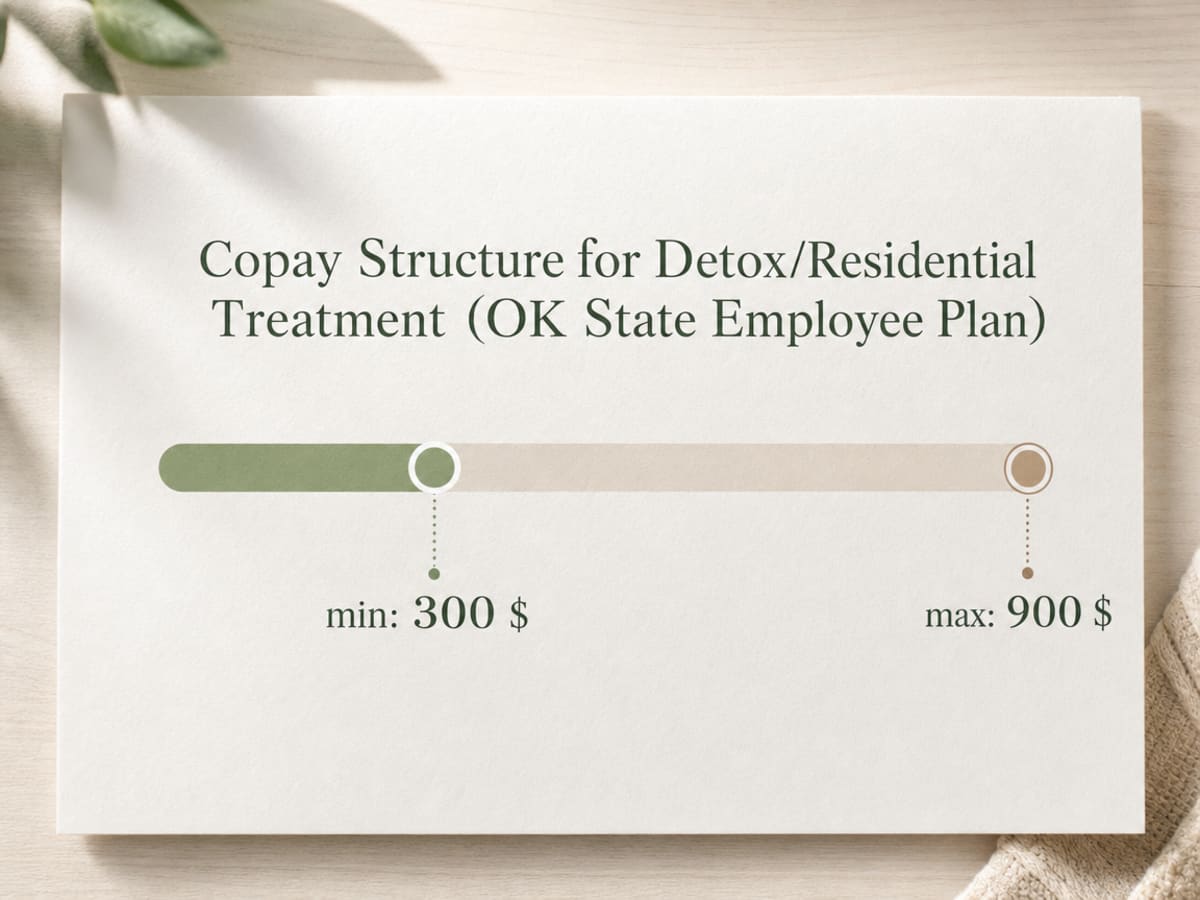
Oklahoma’s 2026 state employee health plan comparison lists residential treatment center or medical detox at a $300 copay per day, with a $900 maximum per admission 9. That’s it. Not a running charge that climbs into five figures. A per-day copay that caps out after three days of cost-sharing, no matter how long the medically necessary stay runs.
Read that again if you need to, because it undoes a lot of the fear people carry into this conversation. If your admission is medically necessary and covered, your exposure on that plan tops out at $900 for the whole detox stay. Whatever the facility bills, whatever the length of stay, whatever medications are used—the patient’s share of the copay column stops at $900.
That is one specific plan. Your plan almost certainly looks different. You might have coinsurance instead of a flat copay. You might have a deductible you haven’t hit yet, which changes the first few days. You might have a lower or higher out-of-pocket max. The point isn’t that everyone pays $300 a day. The point is that insured patients in Oklahoma often face bounded cost-sharing that behaves like a hospital bill, not a cash-price sticker shock.
When you call for a benefits check, this is exactly the kind of structure you want the person on the phone to walk you through: what’s the copay or coinsurance per day, what does your plan count as the admission, and where does the out-of-pocket maximum sit. Those three answers turn a scary unknown into a real range you can plan around.
If you don’t have this plan, don’t panic. Use it as a mental model for the questions to ask about your own.
In-Network, Prior Authorization, and Length of Stay
Three practical levers move your final number the most once parity has done its work.
In-network status. Going to a facility your plan already has a contract with keeps the negotiated rate in play and keeps your copay or coinsurance in the lower tier. Out-of-network detox is sometimes covered, sometimes not, and almost always more expensive on your side of the ledger. Ask the facility directly: “Are you in-network with my specific plan?” Not the insurance company in general—your specific plan.
Prior authorization. Many commercial plans, like SoonerCare, require approval before an inpatient or residential stay begins. Oklahoma’s recent HB 2049, effective November 1, 2025, tightens compliance analysis around how plans handle prior authorization for mental health and SUD services 5. That’s a good thing for you—it means plans are under more scrutiny to approve medically necessary detox promptly. A good detox facility handles the authorization paperwork on your behalf. You don’t have to become an expert overnight.
Length of stay. Detox usually runs a few days, driven by what withdrawal actually looks like for you. Longer isn’t worse—it’s clinical. If your plan uses per-day cost-sharing, longer stays cost more until you hit your out-of-pocket max. If your plan uses a per-admission copay, length matters less.
Get these three answers, and you’re already past the scariest part.
Path Two: SoonerCare and Medicaid-Funded Detox
If you’re on SoonerCare, or you think you might qualify, this path can carry more of the cost than most people realize. It’s not a discount program bolted onto private insurance. It’s a full coverage structure with its own rules for what’s paid, when it starts, and what still lands on you. The next three pieces walk through each part so you can call with the right questions instead of the wrong assumptions.
What SoonerCare Covers for Medical Detox
SoonerCare’s coverage of behavioral health is more generous than many people expect when they first pick up the phone. Oklahoma Medicaid’s benefits explicitly include inpatient acute care, crisis stabilization, and medical detoxification for members 7. In plain terms: medical detox is a covered service, not a favor.
On the Oklahoma Health Care Authority’s benefits table, detox and residential substance use disorder services are listed as covered, with prior authorization required 15. That means once your stay is authorized as medically necessary, SoonerCare picks up the covered portion of the bill rather than sending you a facility invoice at the end.
There’s a piece of federal history that quietly matters here. For decades, Medicaid couldn’t pay for adults staying in larger residential treatment facilities, a rule known as the IMD exclusion. Oklahoma received CMS approval to receive federal Medicaid payment for medically necessary residential SUD treatment in those settings under a demonstration waiver 3. Federal review of that waiver found members have access to evidence-based OUD and SUD treatment across a full continuum, from residential and inpatient care to community-based services 4.
What that means for you: SoonerCare-funded detox in a residential-style setting is a real option in Oklahoma City, not a technicality. If you qualify, you’re not stuck choosing between a hospital ER and paying cash.
Prior Authorization: The Step That Decides When You Start
Here’s the part nobody warns you about until you’re in it: prior authorization is the door between “covered on paper” and “admitted today.” Inpatient hospital and residential services for SoonerCare members must have prior authorization before the service is provided 8. That’s the rule for the whole state, not one facility being difficult.
Before you spiral, take a breath. You are not the one filing the paperwork. The detox facility’s clinical team submits the authorization request, documents the medical necessity, and works with the plan to get the green light. The OHCA behavioral health manual walks providers through those exact procedures and contact points 6. This is their job, not yours.
What does that mean for timing? For someone in active opioid withdrawal, authorization for medically necessary detox often moves quickly because the clinical picture is clear: withdrawal is dangerous, delaying care raises risk, and the plan has parity obligations. Oklahoma’s HB 2049, effective November 1, 2025, adds regular parity compliance analysis around prior authorization changes for mental health and SUD services 5. Regulators are watching whether plans use authorization as a stall tactic, which pushes decisions to move faster.
The practical takeaway: when you call a facility, ask who handles the authorization and how fast they typically get a decision. A facility that answers cleanly is a facility that does this every day. The step that decides when you start isn’t a mystery. It’s a phone call and a form, both of which the clinical team handles for you.
What SoonerCare Won’t Pay For
SoonerCare is generous with clinical care and specific about the rest. Knowing the difference keeps you from being blindsided.
Oklahoma’s residential SUD reimbursement policy pays covered treatment services through per diem rates for each level of care, but the policy states that room and board are not included in that reimbursement 12. Translation: the medical piece of a residential-style stay is covered, but the hotel piece of it—the bed, the meals, the physical roof—sits outside what Medicaid pays the facility.
That doesn’t automatically mean you owe money for room and board. Some facilities absorb it, some use grant funding or state contracts to cover it, and some ask about it upfront. What it means is you should ask. Specifically: “Is room and board covered here for SoonerCare members, or is there any patient responsibility for that piece?”
Medical detox itself, not residential, is generally structured differently and often lands more fully inside coverage. But if your care includes a residential step-down after detox, the room-and-board question is worth asking before you transition.
One question, asked early, prevents a surprise later.
Path Three: Self-Pay, Grants, and Scholarship Options
If you’re uninsured right now, you’re not alone in Oklahoma, and you’re not out of options. The Oklahoma Health Care Authority’s own data shows uninsured rates broken out by income and age, and they aren’t small numbers—especially among working-age adults 11. If that’s you, take a breath. The lack of an insurance card doesn’t mean the door is closed. It means the path to walking through it looks different.
Here’s what self-pay actually involves, and where to push for help.
- Check SoonerCare eligibility first, before you assume you don’t qualify. Income limits and eligibility categories have expanded in recent years. A quick eligibility screen at the facility or through OHCA can surprise you. If you qualify and enroll, you shift from Path Three back to Path Two, and detox becomes a covered service with prior authorization 15. That single step can change your out-of-pocket exposure from a large unknown to something much closer to zero.
- Ask about self-pay rates and payment plans in the same call. Cash rates at a freestanding medical detox are typically lower than hospital-based charges for the same clinical work, and many facilities offer structured payment plans rather than lump-sum demands. You are allowed to ask, “What is the self-pay rate, and can it be paid over time?” A facility that answers plainly is a facility worth trusting.
- Ask about grant funding, scholarships, and state-contracted beds. Some detox providers hold funding through state contracts, foundation grants, or private scholarship programs designed for exactly this situation—someone in opioid withdrawal, without coverage, who needs care today. These slots are limited and not always advertised on a website. You have to ask.
- Family contribution, if that’s on the table, is fine to name. A parent, sibling, or partner offering to help with a portion of the cost is common. Bring them into the benefits conversation so the numbers are honest from the start.
One last thing: being uninsured does not mean you have to detox at home. Home detox from opioids is genuinely dangerous, and the risk is not something to weigh against a bill. Call, ask about every funding path in one conversation, and let the intake team do the work of matching your situation to the option that fits.
Making the Phone Call: A Script You Can Actually Use
The phone call is the hardest part. Not the paperwork, not the drive, not the admission. The call. If your hands are shaking or you’re making it for someone you love, that’s normal. Here’s a script that keeps you from freezing when someone picks up.
Start with one sentence. “I’m calling about medical detox for opioids, and I need help understanding what it will cost.” That’s it. You don’t need a speech. The intake team hears this every day and knows exactly where to take the conversation next.
Have these things nearby if you can. Your insurance card, or the name of your plan if the card isn’t in front of you. Your date of birth. A rough sense of what you’ve been using and for how long. If you think you might qualify for SoonerCare but aren’t enrolled, say so—eligibility can be checked on the same call 15.
Ask these four questions. What’s covered under my specific plan? Are you in-network? Who handles the prior authorization, and how fast does it usually move 8? What’s my estimated out-of-pocket, in a range, based on what you see?
If you’re uninsured, ask this instead. “What are my options if I don’t have coverage right now?” Then let them walk you through self-pay rates, payment plans, SoonerCare eligibility screening, and any grant or scholarship beds available.
One call. Four questions. You don’t have to know the answers before you dial—that’s the whole point of the call. You’re already doing the hard part by picking up the phone.
How Renewal Springs Handles the Cost Conversation
Here’s how the cost conversation actually goes at Renewal Springs, so nothing about the call feels like a mystery.
When you call, the first thing you hear isn’t a price. It’s a set of questions about you—what you’re using, how long, whether you have a card in front of you, and whether you’re safe right now. Clinical picture first, coverage second. That order matters, because a benefits check without a clinical picture just produces a number in the air.
From there, the intake team runs a free benefits verification. If you have commercial insurance, that means calling your plan, confirming in-network status, and translating your deductible, copay or coinsurance, and out-of-pocket maximum into an actual estimated range. If you’re on SoonerCare or think you may qualify, the team walks through eligibility and the prior authorization step 15, 8. If you’re uninsured, the conversation covers self-pay rates, payment structure, and any grant or scholarship options open at the time you call.
What you get at the end of that call isn’t a brochure. It’s a personalized cost breakdown for your situation, in plain language, with the room-and-board question named directly rather than buried 12.
You don’t have to know your answer before you dial. That’s the whole point of picking up the phone.
Get Real Answers About Detox Costs Now
Speak with a professional about your unique detox cost and funding options, confidentially and without judgment.
Frequently Asked Questions
Can I start medical detox in Oklahoma City if I don’t have insurance?
Yes. Being uninsured doesn’t close the door—it changes the conversation. Ask about self-pay rates, payment plans, and any grant or scholarship beds available when you call. Also ask for a SoonerCare eligibility screen, because income limits have expanded and you may qualify without realizing it 15. Uninsured status is common in Oklahoma, especially among working-age adults 11. One phone call can sort through every option at once.
How long does it take to get prior authorization for detox through SoonerCare?
For active opioid withdrawal, authorization often moves quickly because the clinical picture is urgent and the plan has parity obligations. Inpatient and residential services do require authorization before admission 8, and the facility’s clinical team handles that paperwork on your behalf using OHCA procedures 6. Oklahoma’s HB 2049, effective November 1, 2025, adds compliance oversight around how plans handle these requests 5. Ask the intake team their typical turnaround time.
Will my commercial insurance cover medical detox the same way it covers a hospital stay?
For most Oklahoma plans, yes. Parity law requires substance use disorder benefits to be treated comparably to medical and surgical benefits, including copays, coinsurance, deductibles, and out-of-pocket maximums 2. Oklahoma’s SB1718 reinforces this for state-regulated carriers 14. One exception worth checking: some self-funded employer plans follow different federal rules and may not be bound by every Oklahoma requirement 13. Ask whether your specific plan is fully insured or self-funded.
What information should I have ready when I call for a benefits check?
Your insurance card or the name of your plan, your date of birth, and a general sense of what substances you’ve been using and for how long. If you think you might qualify for SoonerCare but aren’t enrolled, mention that too—eligibility can be checked on the same call 15. If a family member is helping with cost, bring them into the conversation. You don’t need answers in advance. That’s what the call is for.
If I’m approved for SoonerCare, will I owe anything out of pocket for detox?
For medically necessary detox authorized through SoonerCare, the covered clinical services are paid by Medicaid rather than billed to you 7. The one area to ask about directly is room and board in a residential step-down setting, which sits outside Medicaid’s per diem reimbursement 12. Some facilities absorb that cost or cover it through other funding; some don’t. Ask the intake team specifically whether room and board carries any patient responsibility.
What happens if my insurance denies coverage for detox?
A denial isn’t the end of the road. Plans must apply medical-necessity criteria in a manner comparable to medical and surgical benefits, and they have to disclose the reasons for a denial 1. The facility can appeal on your behalf, and if the denial looks like a parity violation, the Oklahoma Insurance Department accepts consumer complaints 10. In the meantime, ask about bridge options—self-pay, payment plans, or grant beds—so care isn’t delayed while an appeal moves.
References
- CMS finalizes mental health and substance use disorder parity rule for Medicaid and CHIP. https://www.cms.gov/newsroom/press-releases/cms-finalizes-mental-health-and-substance-use-disorder-parity-rule-medicaid-and-chip
- Parity for Mental Health and Substance Use Disorder Benefits. https://www.medicaid.gov/medicaid/managed-care/guidance/parity-for-mental-health-and-substance-use-disorder-benefits
- CMS Announces Approval of Oklahoma & Maine’s Substance Use Disorder Demonstrations. https://www.cms.gov/newsroom/press-releases/cms-announces-approval-oklahoma-maines-substance-use-disorder-demonstrations-30th-31st-expand-access
- Institutions for Mental Diseases Waiver for Serious Mental Illness and Substance Use Disorder Mid-Point Assessment. https://www.medicaid.gov/medicaid/section-1115-demonstrations/downloads/ok-qutrly-cms-accepted-mid-point-assessment-12132024.pdf
- HB 2049 – Oklahoma Legislature. https://www.oklegislature.gov/cf_pdf/2025-26%20ENR/hB/HB2049%20ENR.PDF
- Behavioral Health Prior Authorization Procedures. https://oklahoma.gov/content/dam/ok/en/okhca/docs/providers/types/behavioral-health/OHCA%20BH%20Manual.pdf
- Behavioral Health and Substance Abuse Services. https://oklahoma.gov/ohca/individuals/mysoonercare/soonercare-benefits/behavioral-health-and-substance-abuse-services.html
- Behavioral Health and Substance Abuse Services. https://oklahoma.gov/ohca/providers/types/behavioral-health-and-substance-abuse-services.html
- 2026 Health plan comparison. https://www.oklahoma.gov/content/dam/ok/en/egid/documents/health/2026-health-chart.pdf
- Mental Health Parity and Addiction Equity Act. https://www.oid.ok.gov/regulated-entities/financial/financial-regulation-forms/mentalhealthparity/
- Oklahoma Uninsured Fast Facts CY2023. https://oklahoma.gov/content/dam/ok/en/okhca/docs/research/data-and-reports/fast-facts/2024/december/Uninsured%20Fast%20Fact%20CY2023_oct2024.pdf
- SECTION 95.50. Residential substance use disorder (SUD). https://oklahoma.gov/ohca/policies-and-rules/xpolicy/medical-providers-fee-for-service/individual-providers-and-specialties/inpatient-psychiatric-services/residential-substance-use-disorder-reimbursement1.html
- Mental/Behavioral Health and Insurance. https://www.oid.ok.gov/mental-behavioral-health-and-insurance/
- Understanding Mental Health Parity and Your Insurance. https://www.oid.ok.gov/getready12_2023/
- Mental Health and Substance Abuse Services – Oklahoma.gov. https://oklahoma.gov/ohca/individuals/programs/mental-health-and-substance-abuse-services.html
- Inpatient Psychiatric Services (policy chapter related to behavioral health). https://oklahoma.gov/ohca/policies-and-rules/xpolicy/medical-providers-fee-for-service/individual-providers-and-specialties/inpatient-psychiatric-services.html