
Key Takeaways
- OKC first responders often avoid detox because of career-jeopardy fears, and 42 CFR Part 2 specifically protects your identity, diagnosis, and treatment records from disclosure without written consent 4.
- Alcohol and opioids frequently start as shift-management tools, with over half of surveyed Oklahoma urban firefighters reporting recent heavy or binge drinking 8, making unsupervised withdrawal genuinely risky.
- Before choosing a provider, compare confidentiality architecture, off-site private-room settings, medical supervision with MAT, and how the program coordinates with OKFRWD counseling and peer support 9.
- Stigma in this profession is largely a confidentiality concern in disguise, with fears about privacy and career impact ranking as the top-endorsed barriers to care 2.
The Paper Trail Is the Barrier
You already know what the job costs. What keeps you from picking up the phone is not a lack of information about withdrawal, or MAT, or PTSD. It is the file. The one that follows you to the next promotion board, the next fitness-for-duty review, the next contract negotiation. It is the quiet math you do about who might see the intake form, who might mention it at the union hall, who might remember it when a captain’s slot opens up.
That fear is not paranoia. It is the reason help-seeking looks so different in this profession than in almost any other. RAND’s review of substance use and mental health among first responders identified fear of career jeopardy as one of the primary reasons personnel avoid treatment, even when they know they need it 11.
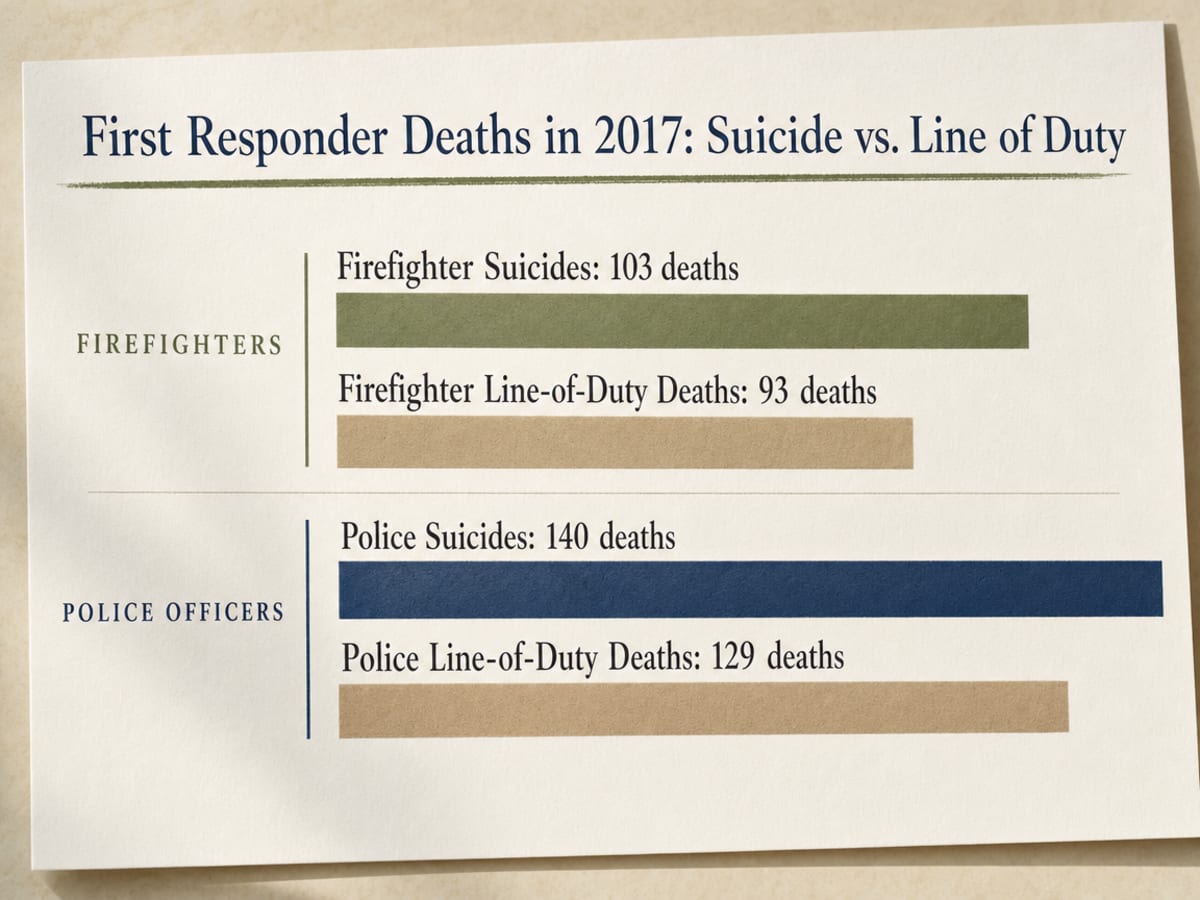
And the cost of that avoidance is not abstract. The Ruderman White Paper compiled data showing that in 2017, U.S. firefighters lost more colleagues to suicide than to line-of-duty deaths — 103 suicides versus 93 line-of-duty deaths — and the same pattern held for police officers, with 140 suicides against 129 line-of-duty deaths 3. The internal risk, in other words, is now larger than the external one. Substance misuse sits inside that risk, not next to it.
So this article is not going to tell you that detox is important. You know that. It is going to walk through exactly which records are protected, where the edges of that protection are, and what a medically supervised admission looks like when you are the one whose name is on the badge.
Why OKC First Responders Reach for Alcohol First
Alcohol is the first tool because it is the most available one. It is legal, it is at the station house cookout, it is at the bar two blocks from the precinct, and it does not require you to explain yourself to anyone. After a bad run — a pediatric code, a scene with a colleague down, a night of dispatching calls you cannot unhear — a drink is the shortest distance between the shift you just worked and the sleep you need before the next one.
The research on Oklahoma City first responders makes this pattern concrete rather than theoretical. A 2002 study of 181 OKC firefighters who worked bombing rescue and recovery found relatively low rates of PTSD but significant associations between post-disaster alcohol use disorders, drinking to cope, and poorer functional outcomes at work and at home 1. The authors framed alcohol not as a moral failing but as a coping mechanism that carried real downstream cost. That framing matters. It means the drinking that started as management can quietly become the primary problem while the original stress is still sitting there, unaddressed.
The pattern is not confined to a single event. An ODMHSAS wellness handout summarizing research on Oklahoma first responders reported that more than half of nearly 1,000 urban firefighters surveyed had at least one heavy or binge drinking episode in the past 30 days, and that during COVID-19, 31% of first responders met criteria for risky alcohol use alongside elevated depression and anxiety 8. That is not a fringe subset. That is the shift rotation.
Opioids often enter the picture later, sometimes through a legitimate prescription after a back injury, a knee, a shoulder that never fully healed. What starts as pain management becomes sleep management becomes shift management. By the time you notice, the two substances are working together, and stopping either one on your own is genuinely dangerous.
None of this makes you weak. It makes you someone whose coping toolkit was built for the job, and whose job broke the toolkit.
What Actually Stays Private in a Detox Admission
42 CFR Part 2: The Rule Written for Exactly This Fear
Most privacy rules were written to keep hospitals from leaking your test results to a marketing firm. 42 CFR Part 2 was written for something narrower and much more relevant to you: to protect the identity of anyone who walks into a federally assisted substance use disorder program.
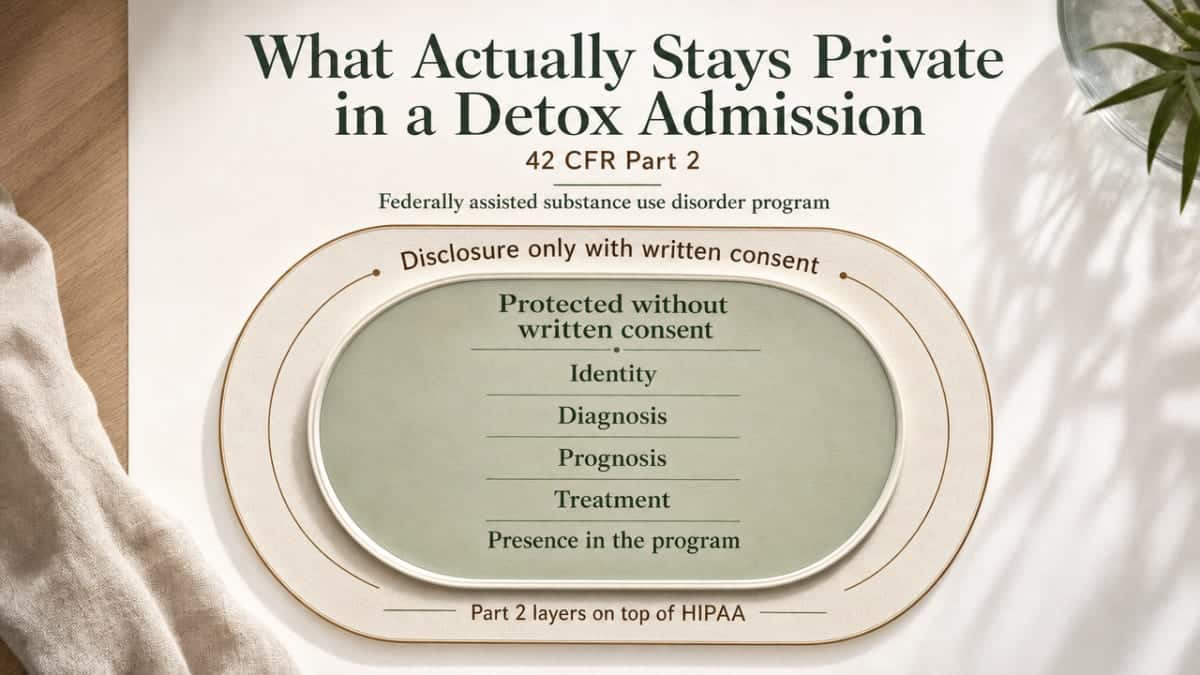
The HHS Office for Civil Rights fact sheet on the 2024 Part 2 Final Rule is direct about what the rule covers. It protects the records of the identity, diagnosis, prognosis, or treatment of any patient in a Part 2 program from disclosure without written consent 4. Not just the medical chart. Your name on the intake list. The fact that you were there at all.
That matters because HIPAA alone would not stop a curious records request from certain corners. Part 2 layers on top. If a Part 2 program received a subpoena from your department’s internal affairs office tomorrow, the program could not confirm you had ever been a patient without either your signed consent or a court order that meets Part 2’s higher standard, not a standard civil subpoena 4.
The 2024 rule also modernized how consent works. Under the update, you can sign a single consent that covers future uses and disclosures for treatment, payment, and health care operations, rather than resigning paperwork every time your care team needs to coordinate 4. You control the scope. You can also revoke it.
This is the rule that lets a detox admission sit outside the paper trail you are actually worried about.
HIPAA, the NPP Update, and the Narrow Exceptions
HIPAA still applies, and for SUD care it works alongside Part 2 rather than replacing it. HHS/OCR guidance on behavioral health information is explicit that protected health information for people receiving SUD treatment in federally assisted programs is subject to the additional confidentiality protections under 42 CFR Part 2 6. Two locks on the same door.
Starting February 16, 2026, HIPAA-covered entities are required to include specific information about SUD records protected under Part 2 in their Notice of Privacy Practices 7. When you sit down at intake and read the NPP, that document will spell out, in plain language, what can and cannot leave the building.
The exceptions to Part 2’s consent requirement are narrow and worth knowing precisely. A qualitative study of clinicians working under Part 2 catalogued them:
- medical emergencies
- internal communication within the program
- a valid court order meeting the Part 2 threshold
- research or audit purposes
- reports of child abuse or criminal activity that occurs on the program’s premises 5
That is the full list. Your captain calling to check on you is not on it. A background investigator running a routine records sweep is not on it. Your insurance company processing a claim you authorized is on it, but only because you authorized it.
The same study found that clinicians sometimes err on the side of over-restricting information because the rule is strict 5. For a first responder patient, that institutional caution works in your favor.
Where Confidentiality Ends: Fitness-for-Duty and What You Choose to Share
Here is the honest edge of the map. Part 2 protects what the treatment program can say. It does not, by itself, decide what your department can require you to disclose if a fitness-for-duty process is opened for a separate reason, or what you must report if your agency has an affirmative disclosure policy for prescribed controlled medications.
If you check in on your own time, off duty, with no incident triggering a departmental review, no one at the program can confirm to your employer that you were there without your written consent 4. That is the default state.
Where it gets more complicated: if your agency later initiates a fitness-for-duty evaluation, you may be asked to sign releases as a condition of returning to work. You still control what you sign. You can consent to limited disclosure — for example, confirming completion of a program and medical clearance to return — without releasing full clinical records. A good intake team will walk through those release options with you before you sign anything.
The RAND review of first responder help-seeking notes that fear of career jeopardy is one of the largest deterrents to voluntary treatment 11. Understanding the exact shape of what leaves the building, and what stays, is how you take that fear from vague to manageable.
Stigma Is a Confidentiality Problem in Disguise
When people in the wellness industry talk about first responder stigma, they usually treat it as a cultural attitude — the tough-it-out ethos, the locker room jokes, the fear of looking soft in front of the crew. That framing is not wrong, but it is incomplete. When you actually ask first responders what holds them back, the answers are more specific than culture.
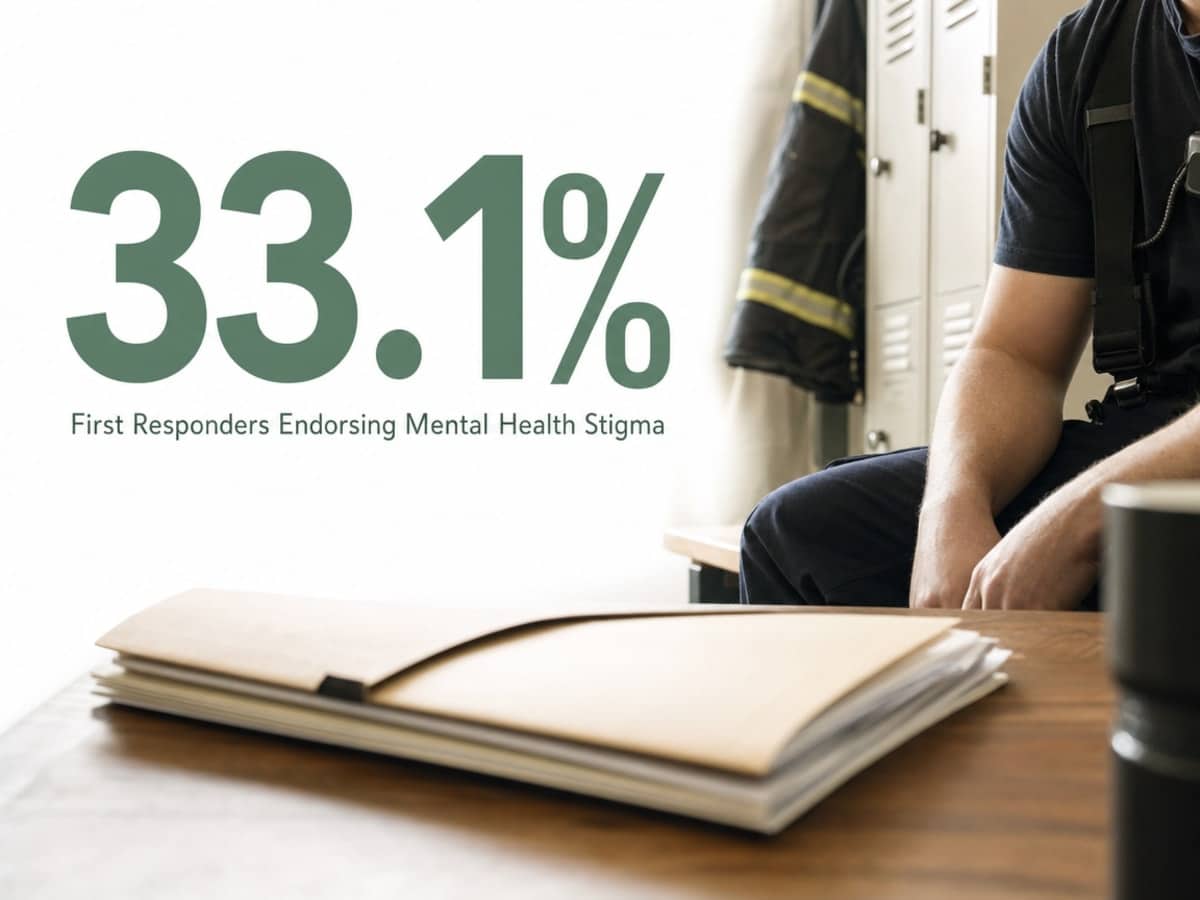
A systematic review of stigma and barriers to mental health care among police, firefighters, and paramedics found that 33.1% of first responders endorsed stigma-related items on standardized measures, and the two most frequently endorsed items were fears about confidentiality and concern over negative career impact 2. Read that again. The top two items are not shame about weakness or worry about what the crew will think. They are: will this stay private, and will this cost me my job.
It matters because the two problems have different solutions. If the barrier were purely cultural, the fix would be years of peer-led normalization campaigns, chief-level messaging, and slow generational turnover. Useful work, but slow. If the barrier is actually a rational assessment of what happens to your records and your career when you seek help, then the fix is technical and available now: pick a provider whose confidentiality architecture is built for someone in your position, and understand the exact protections you are getting before you sign the intake form.
The first is a decade of work. The second is a phone call and a set of questions you already know how to ask.
What you did in the last section — reading the actual shape of Part 2, HIPAA, and the narrow exceptions — is the substantive answer to the top two items in that stigma measure. You did not just learn a rule. You addressed, directly, the two concerns that keep most of your colleagues out of care.
What Medically Supervised Detox Looks Like When You Do the Job You Do
Alcohol Withdrawal, Opioid Withdrawal, and the Case Against White-Knuckling
You have watched people white-knuckle a lot of things. This is not one to add to the list.
Alcohol withdrawal is the one people underestimate because alcohol is legal, familiar, and everywhere. The physiology does not care. If you have been drinking heavily and daily for months or years — and if the shift pattern has quietly pushed your intake up without you tracking it — stopping cold at home can trigger tremors, elevated heart rate, hypertension, seizures, and in the more serious end of the range, delirium tremens. DTs carry real mortality risk. This is not a caution to talk you into a longer stay; it is the reason emergency departments hold alcohol withdrawal patients that they would send home for other reasons.
Opioid withdrawal is rarely fatal in a healthy adult, but calling it survivable is not the same as calling it manageable. Seventy-two hours of vomiting, diarrhea, muscle pain, insomnia, and the specific kind of psychological distress that opioid withdrawal produces is the reason relapse rates for unassisted detox are as high as they are. You do not fail because you are weak. You fail because your brain, at hour 40, becomes very good at negotiating.
CDC-associated analysis of occupational factors among first responders identifies substance misuse as a contributing factor in the elevated suicide risk observed in this population 10. The window during and immediately after an unsupervised attempt to quit is exactly when that risk sharpens. Medical supervision is not about comfort. It is about not being alone with your own physiology and your own thoughts at three in the morning on day two.
MAT, Biotech Monitoring, and Private Rooms
Medication-assisted treatment is the standard of care for opioid withdrawal, and it does what willpower cannot: it stabilizes the receptors that are screaming, so your brain can think about something other than the next dose. For alcohol, benzodiazepine protocols manage the seizure risk and the autonomic storm. These are not shortcuts. They are the tools that make the difference between a detox you complete and a detox you abandon at hour 30.
At Renewal Springs, wearable monitoring from Huml Health tracks heart rate, sleep, and stress markers continuously, so the medical team catches shifts in your vitals before you have to describe them. For someone whose training runs toward downplaying symptoms, that continuous data layer takes the burden of self-reporting off your shoulders. The numbers speak first.
Private rooms matter for reasons that are obvious in your line of work. You do not want to share a space with someone who might recognize the department polo in your bag, or whose cousin works dispatch. Off-site, private, and quiet is not a luxury upgrade. It is the clinical environment that lets you sleep, which is the single most restorative thing your nervous system can do this week.
The Off-Site Advantage: Why Distance from the Department Matters
There is a specific kind of geography that matters here, and it is not just miles. It is the distance between the place you get care and the place you might run into someone who knows your radio number.
If you go through an in-network hospital detox in the metro, there is a non-zero chance the tech drawing your blood is the cousin of someone you trained with, or the charge nurse remembers you from a scene last year. That is not a hypothetical. In a city where the fire and police families are tight and the EMS crews rotate through the same ERs every shift, the odds compound. Even with 42 CFR Part 2 fully in force 4, the anxiety of being recognized in the hallway is its own barrier.
Off-site, private-room care solves a problem the rule cannot solve on paper. Renewal Springs sits outside the hospital corridors where your department drops patients. The intake happens in a setting where no one is wearing a uniform, no one is running your name against a duty roster, and the person in the next room is not likely to be a colleague’s spouse.
ODMHSAS understood this when it built confidential telehealth access for Oklahoma law enforcement via dedicated iPads — the point was to put a layer of physical and procedural separation between the officer and the people who might otherwise see them seek help 8. A medical detox admission needs the same separation, at a higher clinical intensity.
Distance is not indulgence. It is what makes the rest of the confidentiality architecture usable.
How OKFRWD, Peer Support, and Medical Detox Fit Together
Think of it as three layers, not three competitors.
The Oklahoma First Responder Wellness Division provides confidential counseling, training, and resource navigation for first responders and their families across agencies and disciplines 9. That is the ongoing, outpatient behavioral health layer — the place you go for talk therapy, for critical incident debriefs, for the slow work of processing what the last decade of shifts did to your nervous system.
Peer support is the layer that meets you at the station. A trained peer who has worn the same uniform can normalize the phone call, sit with you while you make it, and drive you to intake if that is what today requires. Peer support does not do medical management. It does trust.
Medical detox is the acute layer neither of the other two can provide. When your body is physically dependent on alcohol or opioids, no amount of counseling or peer conversation will safely manage the withdrawal window. That is where Renewal Springs sits — as the 24/7 medically supervised bridge that gets you through the first several days, so OKFRWD counseling and peer support can do their work on the other side.
The layers reinforce each other. You do not have to pick one.
Making the Call: The First 48 Hours
The first call is the hardest one, and it is also the shortest. Ten minutes, maybe fifteen. You do not have to explain a decade of shifts. You have to answer a few questions about what you are using, how much, and how recently. That is it.
Pack light. A duffel with a few days of clothes, your ID, insurance card, a phone charger, and whatever helps you sleep. Leave the department polo at home.
Tell one person you trust. A spouse, a peer support officer, a chaplain. Not the whole crew. Not yet. One person who can drive you, or answer the door if you need something dropped off. The research on career-jeopardy fears is clear that keeping the circle small is a legitimate protective choice, not avoidance 11.
If you are the spouse or the peer support officer reading this on someone else’s behalf, you already know your role. You make the call, you sit in the parking lot, you handle the logistics that a person in acute withdrawal cannot handle. You do not have to have the perfect words. You have to have the phone number.
The first 48 hours are not about recovery. They are about getting somewhere safe, letting the medical team stabilize your body, and sleeping. Everything else — the return-to-duty conversation, the counseling, the longer arc — waits until you are through the window.
One call. One bag. One trusted person. That is the whole to-do list today.
Speak Privately With a Medical Detox Expert Now
Connect instantly for confidential answers and support tailored to first responders’ unique detox challenges.
Frequently Asked Questions
Will my department find out if I check into detox?
Not from the treatment program itself. Under 42 CFR Part 2, the facility cannot confirm you are a patient — or that you ever were — without your written consent 4. If you check in on your own time, off duty, with no departmental process already open, the default is silence. What can change that: a fitness-for-duty evaluation you are separately required to participate in, or releases you choose to sign. You control the signature.
Does 42 CFR Part 2 actually stop a subpoena or a fitness-for-duty request?
A standard civil subpoena, yes — Part 2 requires a court order that meets a higher standard than an ordinary subpoena before records can be released without your consent 4. A fitness-for-duty request is different. Your agency cannot force the program to disclose, but it can ask you to sign a release as a condition of returning to work. You can negotiate the scope: completion and clearance, not full clinical records.
Can I detox on my own time off without telling my chief or supervisor?
In most cases, yes. If you use accrued leave, PTO, or FMLA, you are not legally required to disclose the medical reason to your chief. FMLA specifically allows certification through a health care provider without naming a diagnosis to the employer. Some agencies have separate policies on controlled-substance prescriptions or safety-sensitive duty. Read your own department’s policy before you go, and if in doubt, talk to a private attorney or union rep.
What is the difference between OKFRWD counseling and medical detox?
The Oklahoma First Responder Wellness Division provides confidential counseling, training, and resource navigation across agencies 9. That is outpatient behavioral health — talk therapy, critical incident work, family support. Medical detox is the acute layer neither counseling nor peer support can safely provide. When your body is physically dependent on alcohol or opioids, you need 24/7 medical supervision through the withdrawal window. Then OKFRWD counseling picks back up on the other side.
Is alcohol withdrawal really dangerous enough to need medical supervision?
Yes, and this is the one people most often underestimate. Heavy, daily drinking that stops abruptly can trigger tremors, elevated heart rate, seizures, and delirium tremens, which carries real mortality risk. Emergency departments admit alcohol withdrawal patients they would send home for other complaints. Medical supervision means someone is watching your vitals, managing seizure risk with appropriate protocols, and keeping you out of the window where things go wrong at three in the morning.
What should a spouse or peer support officer do when making the first call?
Make the call yourself if the person cannot. You do not need a diagnosis, a full history, or the right words. You need to describe what they are using, roughly how much, and how recently. The intake team handles the rest. Pack a duffel with clothes, ID, insurance card, and a charger. Drive them there, or arrange the ride. Keeping the circle small is a legitimate protective choice, not avoidance 11.
References
- Coping, functioning, and adjustment of rescue workers after the Oklahoma City bombing. https://pubmed.ncbi.nlm.nih.gov/12092908/
- Mental health stigma and barriers to mental health care for first responders: A systematic review. https://pubmed.ncbi.nlm.nih.gov/28800529/
- The Ruderman White Paper on Mental Health and Suicide of First Responders. https://dir.nv.gov/uploadedFiles/dirnvgov/content/WCS/TrainingDocs/First%20Responder%20White%20Paper_Final%20(2).pdf
- Fact Sheet: 42 CFR Part 2 Final Rule. https://www.hhs.gov/hipaa/for-professionals/regulatory-initiatives/fact-sheet-42-cfr-part-2-final-rule/index.html
- 42 CFR part 2 and perceived impacts on coordination and integration of care: a qualitative study. https://pmc.ncbi.nlm.nih.gov/articles/PMC5441679/
- Information Related to Mental and Behavioral Health, Including Opioid Overdose. https://www.hhs.gov/hipaa/for-professionals/special-topics/mental-health/index.html
- Model Notices of Privacy Practices. https://www.hhs.gov/hipaa/for-professionals/privacy/guidance/model-notices-privacy-practices/index.html
- First Responder Wellness Handout – Healthy Minds (Oklahoma Senate/ODMHSAS). https://oksenate.gov/sites/default/files/2022-10/First-responder-wellness_handout%20Healthy%20Minds.pdf
- Oklahoma First Responder Wellness Division – Services. https://oklahoma.gov/okfrwd/services.html
- Suicide and Occupational Factors Among First Responders — CDC/NIOSH-supported analysis (document in NFFF archive). https://stacks.cdc.gov/view/cdc/218814/cdc_218814_DS1.pdf
- Helping Those Who Help Others: Substance Abuse and Mental Health Issues Among First Responders — RAND. https://www.rand.org/pubs/research_reports/RR1007.html