
Key Takeaways
- Clinicians in Oklahoma City face a narrower margin for error during opioid withdrawal, given state overdose rates near 30 to 33 per 100,000 and a supply where fentanyl was implicated in 86% of opioid deaths in 2024 1, 8.
- Confidentiality for clinician-patients rests on three layers: 42 CFR Part 2 protections for SUD records, Oklahoma parity rules on insurance coverage, and voluntary peer assistance pathways with confidentiality tied to compliance 3, 9.
- The first 72 hours follow a predictable arc—intake and COWS assessment, buprenorphine induction timed to physiology rather than schedule, then symptom management and planning for the level of care that follows detox.
- Before making a call, compare programs on private accommodations, benefits verification handled without HR involvement, experience with fentanyl and polysubstance inductions, and willingness to coordinate with monitoring pathways on your terms.
The Call You Have Rehearsed a Hundred Times
You know the number. You have probably pulled it up on your phone at 2 a.m., thumb hovering, then closed the screen and told yourself tomorrow. Maybe after this stretch of shifts. Maybe after the next Pyxis audit. Maybe when you can figure out how to explain a week away without anyone asking the wrong question.
This is not a piece written to convince you that opioid dependence is serious. You already know. You have discharged patients with the same diagnosis you now carry, and you have watched what happens when withdrawal is managed poorly, or not at all. What you need is not education. You need somewhere to be a patient without the room going quiet when your chart loads.
This article addresses clinicians in the Oklahoma City metro who are dependent on opioids and quietly seeking a private, medically supervised path through withdrawal. It covers confidentiality protections, the initial 72 hours of detox for a clinician-patient, and the local clinical landscape.
One conversation. Peer to peer. No chart, no committee, no decisions made before you are ready to make them.
Why White-Knuckling Opioid Withdrawal Is Not a Clinical Option
What Oklahoma Overdose Data Says to Clinicians
You understand the pharmacology of opioid withdrawal better than most patients entering detox. You also recognize the prevalence of overdose in your state.
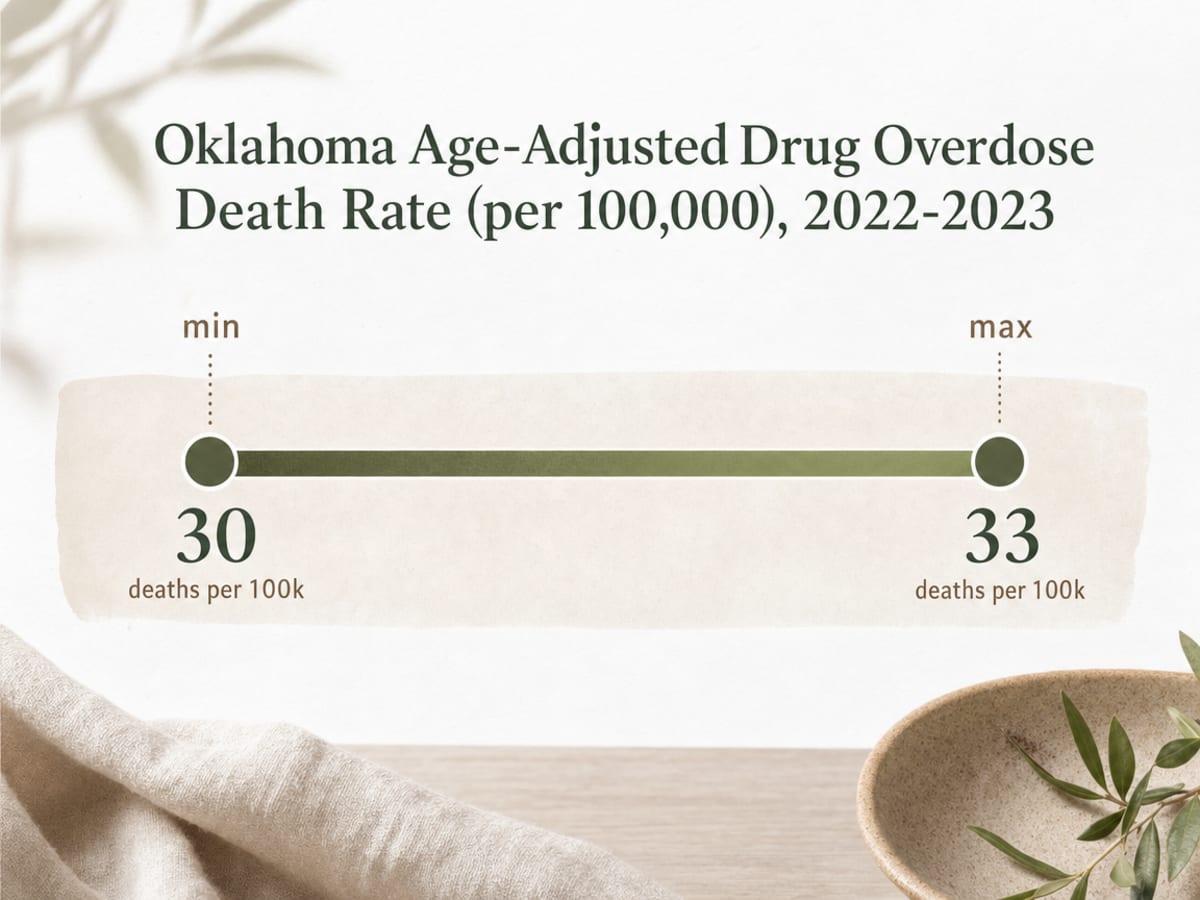
Provisional CDC NCHS data indicates Oklahoma’s age-adjusted drug overdose death rate was approximately 30 to 33 deaths per 100,000 in 2022 to 2023, exceeding the national average 1. This statistic highlights the environment in which you might be self-dosing—on shifts, between shifts, or before rounds. It underscores why a self-managed home taper differs significantly from a monitored taper.
You already treat withdrawal as a medical problem for your patients. The following are all clinical concerns:
- Autonomic instability
- Hypertension
- Tachycardia
- GI compromise
- Dehydration
- The risk of relapse after tolerance drops
- The risk of aspiration if benzodiazepines or alcohol are involved
These physiological realities do not change simply because the patient has a professional badge.
Polysubstance Exposure and Why Supervised Withdrawal Matters
You may be hesitant to admit it, but you might not know the exact composition of the substances you have been taking. This is not due to carelessness, but because the illicit drug supply has changed significantly.
The Oklahoma State Department of Health reported that methamphetamine was involved in about two-thirds of drug overdose deaths in the state in 2024, and fentanyl was implicated in 86% of opioid-related overdose deaths during the same year 8. As a clinician, you understand the implications of these statistics. If you have used diverted pills, pressed tablets, or anything sourced outside a pharmacy, the likelihood of exposure to fentanyl, a stimulant, or both is high, not theoretical.
This reality alters the withdrawal experience. A patient expecting to manage hydrocodone withdrawal might actually be tapering off fentanyl with an underlying stimulant component. Clinical Opiate Withdrawal Scale (COWS) scores can escalate rapidly, cravings intensify, and sleep architecture can be severely disrupted in ways not predicted by a short-acting opioid taper alone. If benzodiazepines or alcohol are also involved, you face overlapping withdrawal syndromes that demand real-time monitoring, not just a hopeful plan and a bottle of clonidine.
Medically supervised detox is not excessive in this environment. It provides a safe setting for initiating Medication-Assisted Treatment (MAT), continuous vital sign tracking, and ensures that someone else, not you working from memory at 3 a.m., is adjusting your buprenorphine induction.
You have witnessed precipitated withdrawal in the ED. You know how quickly a straightforward induction can go awry when the last use involved fentanyl and the timing is incorrect. Allowing someone else to manage the timing is not surrender; it is the standard of care you would insist upon for any other patient.
The Stigma You Carry Into the Intake Room
The stigma is not paranoia; it is a documented barrier that disproportionately affects healthcare professionals.
A systematic review on stigma and help-seeking found that health professionals, along with military personnel and men, are among the groups most significantly deterred by concerns about disclosure 6. Internalized stigma and treatment stigma, rather than public stigma, were the primary factors preventing access to care. This means that what stops clinicians is not what strangers might think, but rather their own beliefs about what it means to be a patient instead of the one giving orders.
You can likely articulate these fears without prompting:
- The charge nurse who oriented you also serves on a committee.
- The ED you might be transported to is staffed by former colleagues.
- Your access to the Pyxis, crash cart, med room, and sample closet is both a professional privilege and a private problem.
- Someone might notice discrepancies in medication counts.
There is also the quieter fear: knowing you meet the diagnostic criteria for opioid use disorder, having met them for some time, and feeling that admitting it aloud undermines the professional identity you have worked to build. None of this indicates a character flaw. It is the predictable burden of working within a system that often treats Substance Use Disorder (SUD) as a medical condition in patients but, too frequently, as a moral failing in staff. Research simply identifies this pattern, allowing you to recognize its influence.
What helps are small, concrete steps: a first conversation off your employer’s network, on your own phone, with someone not credentialed at your facility. A clinical intake that values your pharmacological knowledge as an asset, not a red flag. A private room where the person taking your vitals does not know your attending physician. You do not need to overcome the entire stigma to move forward; you just need to navigate around it long enough to achieve medical stability.
What Actually Stays Private: Confidentiality for Clinician-Patients
The Legal Layers Around Your Treatment Record
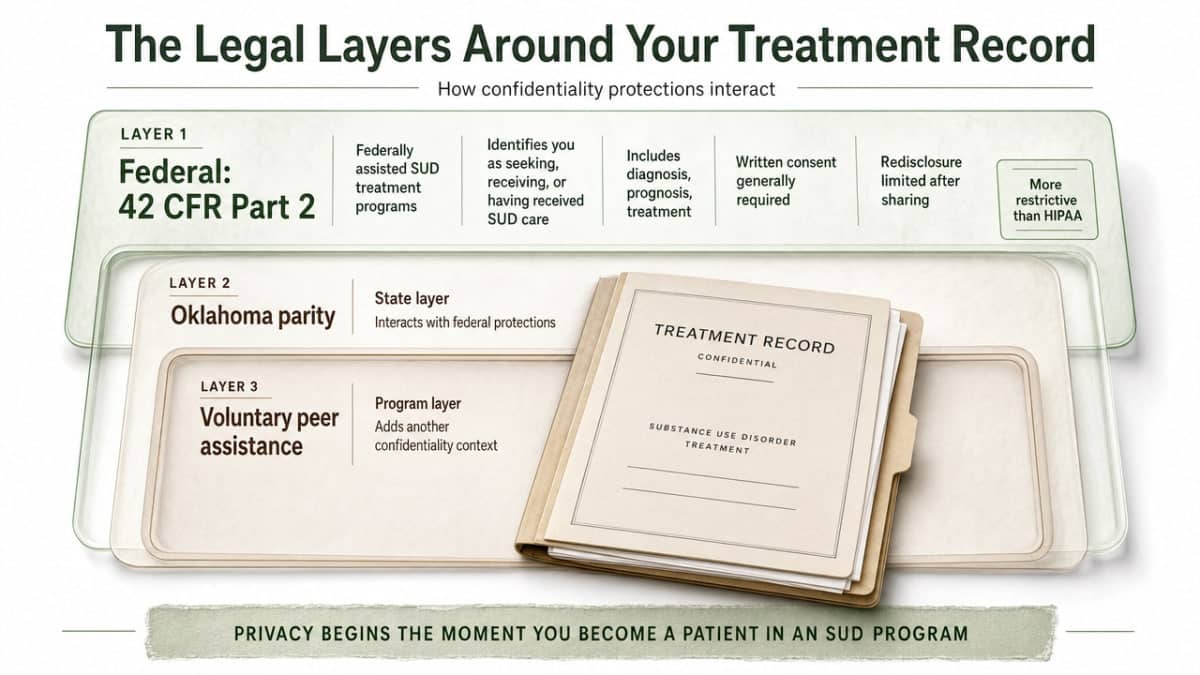
Privacy is not merely a promise; it is a framework of federal and state regulations that apply the moment you become a patient in a substance use disorder program. Understanding these layers is crucial before making a call.
The strongest protection is federal. 42 CFR Part 2 governs records held by federally assisted SUD treatment programs. It safeguards information that could identify you as someone who has sought, received, or is receiving SUD care, including your diagnosis, prognosis, and treatment 9. Part 2 is more restrictive than HIPAA in a way that is particularly relevant to clinicians: your written consent is generally required before these records can be released, and the redisclosure of Part 2 records is limited even after they have been shared. This standard differs from a routine medical chart at your own hospital.
The second layer is state parity. Oklahoma mandates that state-regulated health plans cover mental health and SUD services on terms no more restrictive than medical and surgical benefits. This means detox and rehabilitation are treated as covered medical care, not as an optional benefit outside your plan 4, 5. Parity dictates what your plan must cover, while Part 2 dictates what your treatment program can share.
The third layer is voluntary. Oklahoma offers alternative-to-discipline monitoring pathways for licensed professionals, which keep participant records confidential as long as the participant maintains program compliance 3. Whether this pathway is appropriate for you is a separate discussion with your own advisors, not a decision made during detox intake.
These three layers serve distinct purposes. Together, they ensure that the record of you seeking help is not the same as a chart entry at your workplace.
Insurance, Parity, and Paying for Detox Without a Paper Trail Through HR
A common practical concern is whether using your insurance will alert your employer.
Generally, your employer does not receive clinical details about claims filed against your health plan. The information your carrier sees is governed by parity rules. In Oklahoma, state-regulated health plans must cover mental health and SUD benefits, including detox, under terms no more restrictive than those applied to other medical and surgical benefits. Carriers report annually to ensure compliance 4, 5. In essence, detox claims are processed like other covered medical care, moving between the facility and your insurer, not through your department manager.
It is important to note limitations. Self-funded employer plans, common in large health systems, are federally regulated rather than state-regulated, meaning Oklahoma’s parity bulletin may not apply in the same way 4. However, this does not mean coverage disappears; it means the plan documents, not state rules, define coverage details.
A benefits verification call, conducted by the facility using your insurance card information, is the quickest way to determine your specific plan’s coverage for medically supervised detox before you commit. This call occurs between the intake team and your carrier, without requiring involvement from HR, your manager, or your workplace employee assistance program. You can also inquire about what appears on any Explanation of Benefits sent to the policyholder before any charges are filed.
Voluntary Peer Assistance Pathways in Oklahoma
This section is crucial, but we will not dictate your choices.
Oklahoma offers voluntary, alternative-to-discipline monitoring programs for licensed professionals. For example, the Oklahoma Board of Nursing describes its Peer Assistance Program as a voluntary pathway for nurses whose competency may be compromised by alcohol or drug use. Participant records are protected by confidentiality as long as the nurse maintains program compliance 3. Similar structures exist for other professions through their respective regulatory bodies. The common goal of these programs is to allow clinicians to receive treatment and continue or return to practice under structured monitoring, rather than automatically initiating disciplinary action.
For you today, this means pathways exist. Whether, when, and how you engage with one are decisions to discuss with an attorney specializing in professional licensing in Oklahoma, and with the treatment program assisting you in achieving medical stability. A detox facility’s role is to stabilize you clinically and coordinate with any monitoring program you choose to engage with on your own terms.
Achieving safe withdrawal is the priority. Other conversations can occur with appropriate advisors once you are no longer acutely ill.
The First 72 Hours When the Patient Is Also a Clinician
Hour 0 to 6: Intake, COWS, and Being Allowed to Be a Patient
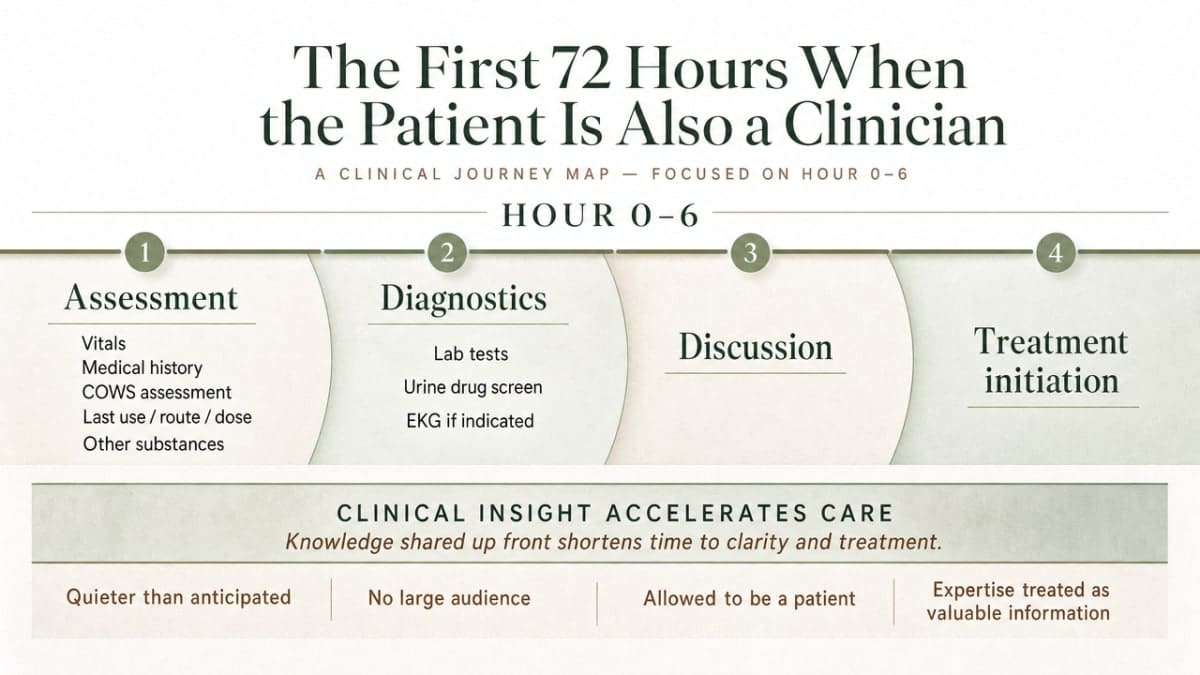
The initial six hours are often quieter than anticipated. There is no large audience or committee. A nurse will take your vitals, someone will review your medical history (which you likely know by heart), and a COWS assessment will be performed, just as you have done countless times for others.
The difference lies in the context. You are not expected to demonstrate insight or express contrition. The intake team understands your pharmacological knowledge. Your expertise is treated as valuable information, not scrutinized as evidence. Providing details about your last use, route, approximate dose, and any other substances involved can expedite the clinical assessment and treatment initiation.
Expect laboratory tests, a urine drug screen, an EKG if indicated, and a discussion about any previous self-treatment attempts. Questions about benzodiazepines, alcohol, and sleep aids are standard, as overlapping withdrawals necessitate a modified plan.
During the first hour, you are not required to make decisions about your license, job, or family. Those conversations will occur later. Your immediate task is to allow someone else to manage your vitals while you transition from clinician to patient.
Hour 6 to 24: Stabilization and MAT Initiation
This period is when the physiological effects of withdrawal become undeniable. COWS scores increase, GI symptoms emerge, and the autonomic picture becomes uncomfortable, mirroring what you have documented in other patients’ charts.
Medication-assisted treatment (MAT) is timed according to this physiological curve, not a rigid schedule. Buprenorphine induction waits until your COWS score is within the appropriate range, acknowledging your understanding of precipitated withdrawal and the desire to avoid it. If your last exposure was fentanyl, the induction timeline will be longer and slower than the textbook version for short-acting opioids, and the team will adjust accordingly. Adjunctive medications for nausea, cramping, autonomic symptoms, and sleep will be provided as needed.
Vitals are checked frequently. Wearable monitoring can track heart rate, sleep, and stress markers in the background, reducing the need for a nurse to wake you hourly to confirm stability.
You may not sleep soundly, or your sleep may be fragmented. This is expected, and no one will judge your tolerance. The clinical goal during this window is clear: to make you comfortable enough to manage withdrawal and stable enough to prevent an emergency at the 24-hour mark.
Hour 24 to 72: Symptom Management and What Comes After Detox
By day two, acute physiological symptoms typically subside. Peaks are lower, appetite may return intermittently, and while sleep remains fractured, the autonomic storm diminishes. This phase of detox is often described as boring, and that boredom is a sign of progress.
The clinical focus shifts. MAT dosing is refined. Cravings, mood fluctuations, and the psychological weight you have been carrying begin to surface as your body stabilizes. A counselor may meet with you, and questions about your next steps, distinct from what led you to detox, may arise.
This is the planning stage. Whether you transition to a residential program, an intensive outpatient level of care, or an outpatient plan coordinated with a local prescriber is a decision the team helps you shape, not one they impose. If you choose to engage with a voluntary monitoring pathway, discharge planning can coordinate with that separately 3. If you are not ready for that yet, that is also a valid response at the 72-hour mark.
Detox is not the end goal; it is the process of achieving physical stability to make subsequent choices with a clear mind.
Ambivalence Is Not Weakness
You may read all of this and still hesitate to make the call. This is not a failure of insight; it is a natural part of the change process.
SAMHSA’s TIP 35 identifies ambivalence as a normal, expected stage in substance use disorder treatment, not an indication of denial or resistance 7. This protocol was developed for clinicians to use with patients, and you have likely applied it to others’ care plans. Applying it to yourself is appropriate.
Ambivalence often manifests as: “I know I need to stop, but I am unsure if I can, and I am uncertain about what will happen to my life if I do.” All three sentiments can be true simultaneously. Holding these conflicting thoughts is not denial; it is the honest assessment of a clinician who understands both the physiology of dependence and the practical implications of a career built credential by credential.
You do not need to resolve your ambivalence before making a call. The call itself can be a step toward clarity. Speaking with someone off the clock, without committing to admission, is a legitimate clinical action. It is what you would advise your own patient. Extend the same consideration to yourself.
One Private Conversation, Peer to Peer
The request is simpler than the burden you have been carrying.
One conversation. On your personal phone, off your employer’s network, at a time of your choosing. Nothing will be entered into a chart at your facility. No committee will be convened. No decisions will be made on your behalf. You will speak with someone who understands the pharmacology, the concerns about your license, and the specific context of practicing medicine in Oklahoma City, and you will learn what medically supervised detox would entail for you.
You can inquire about benefits verification without providing your name. You can ask about the initial six hours of treatment. You can ask what happens if, at the end of the call, you decide today is not the day. All of these are valid reasons for the conversation.
You have made more difficult calls than this, usually for someone else. This one is for you, and it is allowed to be private, judgment-free, and yours to conclude whenever you wish.
Speak Privately With Someone Who Understands Healthcare Pressures
Get confidential answers and support from professionals who know the unique challenges healthcare workers face.
Frequently Asked Questions
Will my employer or licensing board automatically be notified if I enter private detox in Oklahoma City?
No. A private detox program does not report to your employer or licensing board on your behalf. SUD treatment records held by a federally assisted program are protected under 42 CFR Part 2, which generally requires your written consent before those records can be released. What you choose to disclose, when, and to whom is a separate conversation to have with your own advisors.
How long does medically supervised opioid detox typically take for a healthcare worker?
The acute withdrawal phase usually lasts five to seven days, though fentanyl exposure and polysubstance use can extend this period. The first 24 hours focus on intake and stabilization, hours 24 to 72 on symptom management and MAT titration, and days four through seven on continued stabilization and discharge planning. Your specific timeline depends on the substances involved, your history, and your response to induction.
Can I use my health insurance for detox without creating a paper trail through HR?
Yes, in most cases. Claims move between the facility and your carrier, not through your department manager. Oklahoma parity rules require state-regulated plans to cover detox on terms no more restrictive than medical and surgical benefits. A benefits verification call before admission can clarify your plan’s coverage and what appears on any explanation of benefits sent to the policyholder.
What happens if a colleague or former patient recognizes me during treatment?
Private detox programs utilize small census sizes, private rooms, and controlled common spaces specifically to minimize this risk. If a recognition occurs, staff manage it as a clinical privacy matter, and other patients are held to the same confidentiality expectations as you. You should ask the intake team directly about their private accommodations before admission; it is a common and valid question from clinician-patients.
I am not sure I am ready to commit to treatment. Is it worth calling anyway?
Yes. SAMHSA’s TIP 35 frames ambivalence as a normal stage of change, not a barrier to contact 7. One conversation does not commit you to a bed, a date, or a decision. You can inquire about benefits checks, the initial six hours of treatment, and your options if you decide today is not the right time. Such a call is a legitimate clinical step.
What does MAT initiation look like during detox, and will I be tapered off before discharge?
Buprenorphine induction is timed based on your COWS score, not a fixed schedule, and the timeline extends if your last exposure was fentanyl. Whether you are discharged on a maintenance dose, a taper schedule, or transition to a long-acting formulation depends on your clinical picture and your next level of care. The treatment team will collaborate with you to develop this plan rather than imposing a single discharge protocol.
References
- Changes in Drug Overdose Mortality and Selected Characteristics: United States and Oklahoma, 2022–2023. https://www.cdc.gov/nchs/data/hestat/drug-overdose/drug-overdose-2022-2023.htm
- SUDORS Dashboard: Fatal Drug Overdose Data. https://www.cdc.gov/overdose-prevention/data-research/facts-stats/sudors-dashboard-fatal-overdose-data.html
- Peer Assistance Program – Oklahoma Board of Nursing. https://oklahoma.gov/nursing/peer-assistance-program.html
- Understanding Mental Health Parity and Your Insurance Coverage. https://www.oid.ok.gov/getready12_2023/
- LH BULLETIN NO. 2020‑05 – Mental Health and Substance Use Disorder Parity Requirements. https://www.oid.ok.gov/lh-bulletin-no-2020-05/
- What is the impact of mental health‑related stigma on help‑seeking? A systematic review of quantitative and qualitative studies. https://pubmed.ncbi.nlm.nih.gov/24569086/
- TIP 35: Enhancing Motivation for Change in Substance Use Disorder Treatment. https://library.samhsa.gov/product/tip-35-enhancing-motivation-change-substance-use-disorder-treatment/pep19-02-01-003
- Data – Oklahoma.gov. https://oklahoma.gov/health/health-education/injury-prevention-service/drug-overdose/data.html
- Fact Sheet 42 CFR Part 2 Final Rule. https://www.hhs.gov/hipaa/for-professionals/regulatory-initiatives/fact-sheet-42-cfr-part-2-final-rule/index.html
- Drug Overdose Mortality | Stats of the States. https://www.cdc.gov/nchs/state-stats/deaths/drug-overdose.html