
Key Takeaways
- Detox for older adults in Oklahoma City is a valid, effective option at 65, 72, or 81, because federal guidance confirms this age group responds well to person-centered care 1, 2.
- Alcohol and benzodiazepine withdrawal grows more dangerous with age, not less, especially when combined with heart medications, statins, and the other prescriptions already in an older adult’s pillbox.
- Age-sensitive detox in OKC should include slower pacing, a real review of every prescription, mobility accommodations, family involvement, and coordination with a primary care or geriatric doctor 1, 7, 8.
- Before choosing a program, compare how it handles older patients, medication interactions, family participation, and hand-offs to primary care — and use person-first language when raising it at home 6.
“I Should Have Handled This Years Ago”
Maybe you are sitting at the kitchen table right now with a mug that has gone cold, the phone face-down beside you. Maybe it is your daughter who is sitting there, staring at the phone, wondering how to bring this up without setting off a fight. Either way, the sentence in your head sounds something like this: I should have handled this years ago.
You are 67. Or 74. Or 81. The bottle of wine after dinner became two, then a nightly ritual you don’t quite remember starting. Or the Ativan your doctor first prescribed after a rough stretch became something you cannot picture a night without. Or the hydrocodone left over from your knee replacement kept getting refilled, and then somehow it didn’t, and now the mornings feel wrong.
Here is what you need to hear before anything else. You did not miss your window. The idea that older adults are unwilling or unable to benefit from treatment is a misconception that the federal guidance itself flags and pushes back on 1, 2. People in their sixties, seventies, and eighties respond well to care when that care is built around them, not around a generic protocol written for a twenty-two-year-old.
This piece is written for you, whether you are the person weighing the decision or the family member trying to help without pushing too hard. It is not a sales page. It is a slow, honest look at what respectful, medically supervised detox for older adults in Oklahoma City actually involves, why this stage of life makes safe withdrawal more important rather than less, and what a first phone call to a place like Renewal Springs Detox might sound like.
You are still allowed to ask for help. Even now. Especially now.
Why It Is Not Too Late at 65, 72, or 81
Let’s sit with the fear underneath the whole question. If you are 65, or 72, or 81, some quiet voice keeps whispering that you missed your chance. That your liver is tired, your habits are set, your friends won’t understand, and whatever damage is done is done. So why bother.
Here is the honest answer. That voice is wrong, and it is wrong in a specific way that the people who study this for a living have been trying to correct for years. The federal guidance on treating substance use disorder in older adults opens by naming this myth directly. The idea that people your age won’t benefit from treatment is false. Older adults respond well to care when the care actually fits them, and person-centered treatment is the preferred approach for this age group 1, 2.
Read that again slowly if you need to. Not “can sometimes benefit.” Not “benefit less than younger people.” Respond well.
The same guidance recommends yearly screening for substance use in every adult 60 and older, which is another way of saying that this is common enough, and treatable enough, that primary care doctors are supposed to be asking about it every single year 1, 7. If no one has asked you, that is not because you are past the point of help. It is a gap in the system, not a verdict on you.
There is also a stubborn belief that decades of drinking or pill use have carved a groove too deep to change. What the research actually shows is that shame and moral framing are two of the biggest reasons older adults don’t get diagnosed in the first place 3. Not biology. Not brain age. Shame. And shame is something you can walk through with the right people beside you.
So if the number in your head is 65, or 72, or 81, hold it gently for a moment and then set it down. The number is not the barrier. The story you have been told about the number is the barrier. And that story is one you are allowed to stop believing today.
What the Substance Actually Is: Wine, Ativan, Hydrocodone
Before we go any further, it helps to name the thing out loud. Not with the heavy clinical words that make you feel like a chart in a file, but with the actual objects sitting in your actual house.
For a lot of older adults in Oklahoma City, it looks like one of three things.
It might be alcohol. Maybe a glass of red with dinner that quietly became three, and then a nightcap you stopped counting. Maybe beer while you watched the game, still going long after the game ended. Nobody talks about it because you were never the person stumbling. You were just the person who couldn’t picture the evening without it.
It might be a benzodiazepine. Ativan after your husband died, because the nights were unbearable and the doctor was kind. Klonopin after the panic attacks started. Valium your primary care doctor has been refilling since the Clinton administration. You didn’t go looking for something to lean on. It was handed to you, on a prescription pad, by someone with letters after their name.
Or it might be an opioid. Hydrocodone left over from your knee. Percocet after the back surgery. Tramadol that seemed harmless. Somewhere along the way the pain stopped being the only reason you took it, and now the mornings without it feel like a low-grade flu you cannot explain to anyone.
None of that makes you an abuser or an addict. Those are words the federal guidance itself asks people to stop using, because they load a medical situation with moral weight it was never meant to carry 6. You are a person with a body that has become dependent on a substance. That is a description, not a verdict.
Naming the substance clearly matters for one practical reason: the safest way off each of these looks different. Alcohol and benzodiazepines share a withdrawal profile that can be medically dangerous without supervision. Opioids feel like the worst flu of your life but rarely put you at the same acute risk. The people answering the phone at a detox line need to know which bottle is on your counter to tell you what a safe next step actually looks like. So when you make the call, or when your daughter makes it for you, the first honest sentence is enough: It’s the wine. It’s the Ativan. It’s the hydrocodone. That is where respectful care starts.
Why Withdrawal Is More Serious at This Age, Not Less
Here is the part that a lot of older adults get backwards. You may have told yourself that at your age, quitting on your own is the honorable thing to do. Tough it out at home. Skip the fuss. That thinking is understandable, and it is also the thing most likely to put you in an ambulance.
Then there is polypharmacy. You are probably already taking five, seven, maybe ten prescriptions. Blood pressure medication. A statin. Something for your thyroid. An SSRI a doctor added years ago. Each one has its own way of interacting with alcohol or a benzodiazepine coming out of your system, and each one may need to be adjusted during withdrawal. That is not a job for a spouse with a legal pad. That is a job for a medical team that can watch your vitals, hold or restart the right medications, and catch a problem before it becomes an emergency.
Age also changes how withdrawal feels. Symptoms can look like other things you already live with: unsteady gait, confusion, insomnia, a flare of anxiety, a heart that races. Providers who are not trained to look for withdrawal in an older patient sometimes miss it entirely, which is one of the reasons this age group is chronically underdiagnosed in the first place 3.
None of this is meant to scare you. It is meant to reframe the decision. Choosing medically supervised detox at 70 is not weakness. It is the responsible read of a body that has more history in it than it used to. The safest way through is not around a hospital-grade team. It is with one.
What Age-Sensitive Detox Actually Looks Like
You may be picturing a fluorescent-lit hallway, a clipboard, and a stranger asking you to rate your pain on a scale of one to ten while the person in the next room shouts at a television. That is not what respectful, age-sensitive detox is supposed to look like. And the federal guidance is unusually direct about the difference.
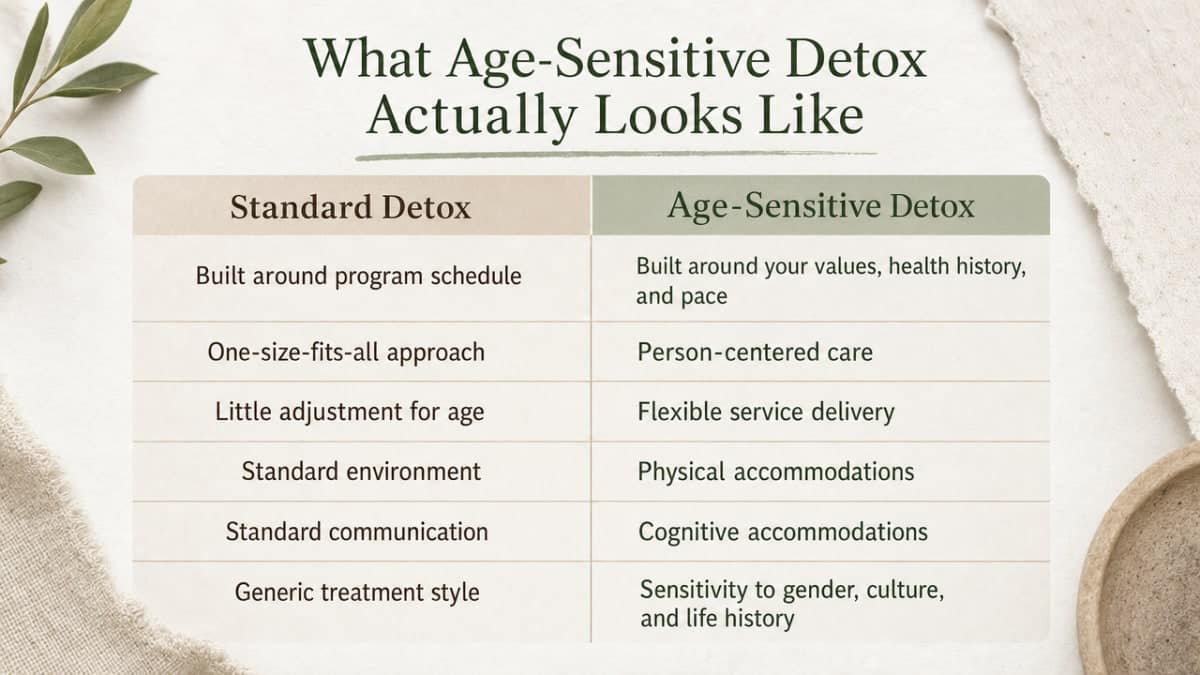
Person-centered care is the preferred approach for older adults with substance use disorders, meaning treatment is built around your values, your health history, and your pace, not a schedule designed for someone forty years younger 1, 2. The Wisconsin state report that translates that guidance into practice fills in what age-sensitive really means: flexible service delivery, physical and cognitive accommodations, and sensitivity to gender, culture, and life history 7.
In plain terms, here is what changes when a detox program is actually built for someone in their sixties, seventies, or eighties.
Standard detox tends to look like this: a single intake pace for everyone, a medication protocol built around younger bodies, group programming that assumes you can sit in a hard chair for two hours, minimal review of the prescriptions already in your pillbox, and family kept at arm’s length until discharge.
Age-sensitive detox looks different in specific, boring, important ways:
- Slower pacing. Shorter sessions. Time to process. Nobody rushing you through paperwork while you are still shaky 7.
- A real medication review. Someone actually reads the list of the seven or ten prescriptions you already take, checks for interactions with withdrawal medications, and decides what gets held, what continues, and what needs to be adjusted 1.
- Mobility and cognitive accommodations. Grab bars where they belong. Rooms you can get to without stairs. Written instructions in a font you can actually read. Staff who repeat things without making you feel small 7.
- Family and caregiver involvement. Your spouse, your daughter, or the neighbor who drives you to appointments is treated as part of the team, not an inconvenience 1.
- Coordination with your primary care or geriatric doctor. Your cardiologist knows what is happening. Your PCP gets the discharge summary. Your heart, your kidneys, and your thyroid do not get treated as someone else’s problem 1, 8.
None of this is exotic. It is the standard of care for your age group as national guidance defines it. If a program cannot describe how it does these things, that is useful information. If a program can, you are in the right kind of room.
The Three Things Detox Is Supposed to Do
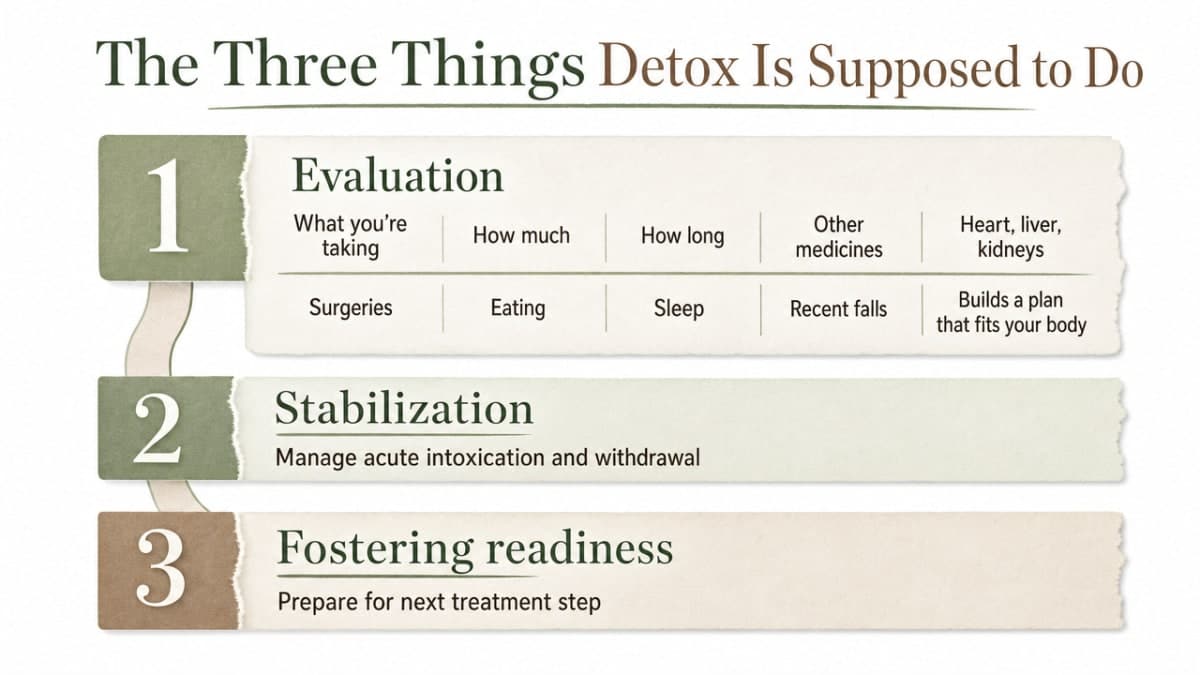
If you have never been through this before, the word detox can sound bigger and scarier than it is. It helps to know what it actually means as a medical process. The federal quick guide is specific: detox is a set of interventions aimed at managing acute intoxication and withdrawal, and it does three things, in this order 4.
First, evaluation. Before anyone gives you a single medication, a clinician sits down with you and asks questions. What are you taking, how much, how long. What else is in your medicine cabinet. What your heart, your liver, and your kidneys have been up to. What surgeries you have had. What you eat. How you sleep. Whether you have fallen recently. This is not a quiz you can fail. It is how the team builds a plan that fits your body, not a body from a textbook.
Second, stabilization. This is the part most people picture when they hear the word detox. Medication to keep withdrawal safe. Vitals watched around the clock. Fluids, food, sleep, quiet. For alcohol and benzodiazepines, that supervision is what keeps a seizure from becoming a hospital stay. For opioids, it is what keeps the worst days bearable enough that you don’t quit quitting.
Third, fostering readiness for what comes next. Detox by itself is not the whole treatment; it is the doorway 5. A good program uses these days to talk with you, gently, about what a next step might look like — outpatient counseling, a residential program, a support group, working with your primary care doctor. No hard sell. Just a warm hand-off so you don’t walk out the front door alone.
Three parts. Evaluation, stabilization, readiness. Done with respect and dignity, in partnership with you, not to you 4.
The OKC Context: Family, Church, and the Pills in the Cabinet
Oklahoma City has its own texture around this conversation, and pretending otherwise doesn’t help anyone. Your family lives close. Your church group knows what casserole to bring. Your kids grew up two exits down I-40 and still call on Sunday. That closeness is a gift, and it is also part of why the pills in your medicine cabinet have never been spoken about out loud.
There is a particular kind of Oklahoma silence around this. The bottle in the sideboard is not something you drink in front of the grandkids. The Ativan is filed under doctor’s orders, which feels different from a problem. The hydrocodone from your knee is leftover, not something you use. Naming any of it feels like betraying the person your community thinks you are.
The state’s own data give you a piece of the context, even though it is not broken out by age. Oklahoma saw prescription opioid overdose deaths fall from 355 to 156 across the state’s tracked period — a statewide, all-ages trend, not an older-adult number 11. What it tells you is that Oklahoma has been living with a prescription opioid problem for a long time, at a scale that touches households across generations. If a hydrocodone bottle is sitting in your bathroom cabinet from a surgery three years ago, you are not the strange one. You are inside a very Oklahoma story.
The other piece of context is who is prescribing what to whom. Older adults in this state, like older adults everywhere, are often on long-standing benzodiazepine prescriptions and old opioid scripts that got refilled without anyone reassessing whether they still made sense. Federal guidance says every adult 60 and older should be screened for substance use once a year 1, 7. If your primary care doctor has never opened that conversation, you are inside a common gap, not an unusual one.
Family is the other Oklahoma variable. Your daughter in Edmond, your son in Norman, the sister-in-law who still lives in the old neighborhood — they matter here. Age-sensitive detox care treats those relationships as part of the plan, not background noise 1. A local facility means your daughter can be in the parking lot within twenty minutes if she needs to be. That closeness is not a small thing when you are 74 and scared.
You do not have to leave Oklahoma to be treated with dignity. You do not have to explain yourself at church to make a phone call. The pills in the cabinet are a medical situation, not a character assessment. And the state you have lived in your whole life has quiet, respectful help inside it.

If You Are the Daughter, Son, or Spouse Making the Call
Now the audience shifts. If you are the adult child or the spouse reading this, and the older adult in your life doesn’t know you are here yet, this part is for you.
You have probably been carrying this quietly for a while. You noticed the wine bottles in the recycling. You counted the Ativan refills. You watched your father get unsteady at Thanksgiving and told yourself it was just his back. You are tired, and you are scared, and you are not sure whether making a phone call today would help or blow up the family.
Two things are true at the same time. Your worry is not overblown. And your parent or spouse is not a lost cause. The federal guidance is explicit that older adults are often assumed to be unwilling to accept help, and that assumption is wrong more often than families realize 2. What looks like refusal is frequently shame, or fear of being talked to like a child, or not knowing that a dignified option exists.
A few things worth knowing before you dial.
You can call a detox line first, without your parent on the phone. You do not need their permission to ask questions about what care would look like for someone in their situation. You can describe the substance, the health picture, the medications in the pillbox, and ask what an age-sensitive plan might involve. The person on the other end can walk you through it.
When you do bring it up with your father or your husband, the CDC’s guidance on language is worth borrowing. Person-first, whole-person, no labels 6. Not you have a problem. Try I’m worried about how the Ativan is interacting with everything else you take, and I’d like us to talk to someone about it together.
Bring your parent’s primary care doctor into the loop when you can. Detox for an older adult with co-occurring conditions works best when it is coordinated with the people who already know their heart, their kidneys, and their history — that interprofessional handoff is part of what makes person-centered care for frail older adults actually function 8.
And give yourself credit for the call itself. Making the phone call is the first step, not the last one. That counts.
A Phone Call Script You Can Actually Use
The hardest part of the whole thing is often the first sixty seconds. You have the phone in your hand, and your mind goes blank, and you cannot picture what to say without sounding like a stranger to yourself. So here is a script. Not a performance. A scaffold you can lean on.
If you are the older adult calling for yourself, try this:
“Hi. I’m 74. I’ve been drinking more than I should for a long time, and I take a few prescriptions I’m worried about mixing with it. I’m not sure what the right next step is. Can you tell me what care would look like for someone in my situation?”
That’s it. You do not have to list every drink. You do not have to have a diagnosis. You do not have to sound composed. The person on the other end has heard this call before, and their job is to listen and answer, not to judge you 4.
If you are the daughter or the son, try this:
“I’m calling about my mother. She’s 78, she’s been on Ativan for years, and I’m worried. She doesn’t know I’m calling yet. Can you walk me through what age-sensitive detox looks like so I can talk with her about it?”
A few questions worth having ready, whichever seat you are in:
- Do you work with older adults regularly?
- How do you handle someone who is already taking several prescriptions?
- Can you coordinate with a primary care doctor 1?
- What does a typical day there look like?
- Can family visit or be involved 7?
You do not have to decide anything on this call. You are gathering information. That is a whole, complete first step. When you are ready, Renewal Springs Detox in Oklahoma City takes that first call, and asking what care would look like for your situation is exactly the right question.
Talk With Someone Who Understands Your Journey
Get honest answers about what respectful, age-appropriate detox really looks like for you.
Frequently Asked Questions
Is medically supervised detox safe for someone in their 70s or 80s?
Yes, and for alcohol or benzodiazepines it is usually safer than trying to quit at home. Federal guidance treats safe withdrawal management as the first order of business for older adults with substance use disorders, precisely because age raises the medical stakes, not lowers them 1. A trained team watches vitals, adjusts medications, and catches trouble early.
My mother has been taking Ativan for years. Can she really stop at her age?
She can, but not on her own and not quickly. Long-term benzodiazepine use calls for a slow, medically supervised taper with vitals watched around the clock, since stopping suddenly can trigger seizures. Person-centered care built around her values, pace, and other prescriptions is the preferred approach for someone in her age group 1, 2. Her doctor and the detox team should coordinate.
What makes age-sensitive detox different from a standard detox program?
Slower pacing, shorter sessions, and a real review of every prescription in her pillbox. Physical accommodations like grab bars and step-free rooms. Written instructions in a font she can read. Family treated as part of the team, not an interruption. Sensitivity to gender, culture, and life history 7. The clinical work is the same category of care; the fit is entirely different 1.
Will the detox team coordinate with my parent’s primary care or geriatric doctor?
A good program will, and you should ask directly. Older adults with several conditions and multiple prescriptions do best when the detox team, primary care, and any specialists share information — that interprofessional coordination is part of what makes person-centered care actually work for frail older adults 1, 8. Bring the medication list, the specialist names, and phone numbers to the first call.
How do I bring this up with my father without making him feel ashamed?
Lead with worry, not diagnosis. Try something like, I’m worried about how the wine and your blood pressure medicine are mixing, and I want us to talk to someone together. CDC guidance recommends person-first, whole-person language and steering clear of labels like addict or abuser, which load a medical situation with moral weight 6. Name the substance and your love. Skip the verdict.
Isn’t it too late to make a real difference after decades of drinking or pill use?
No. This is the most persistent myth in the field, and federal guidance names it directly: the idea that older adults are unwilling or unable to benefit from treatment is false, and this age group responds well to care built around them 1, 2. Decades of use do not close the door. Shame and the stories you have been told about your age close the door. Neither one is medical fact.
References
- TIP 26: Treating Substance Use Disorder in Older Adults (Updated 2020). https://library.samhsa.gov/sites/default/files/SAMHSA_Digital_Download/PEP20-02-01-011%20PDF%20508c.pdf
- Treating Substance Use Disorder in Older Adults: Executive Summary. https://www.ncbi.nlm.nih.gov/books/NBK571027/
- Substance Abuse Among Older Adults. https://pubmed.ncbi.nlm.nih.gov/22514832/
- Quick Guide for Clinicians Based on TIP 45—Detoxification and Substance Abuse Treatment. https://nida.nih.gov/sites/default/files/samhsa_detoxification_and_substance_abuse_treatment.pdf
- Detoxification and Substance Abuse Treatment. https://www.ncbi.nlm.nih.gov/books/NBK64115/
- Stigma: Beyond the Numbers | Stop Overdose. https://www.cdc.gov/stop-overdose/stigma-reduction/stigma-beyond-the-numbers.html
- Addendum to Older Adults Report (Wisconsin State Council on Alcohol and Other Drug Abuse). https://www.dhs.wisconsin.gov/scaoda/scaoda-addendum-older-adults-report.pdf
- Person-Centered Care for Older Adults With Serious Mental Illness and Substance Misuse Within a Program of All-Inclusive Care for the Elderly. https://pubmed.ncbi.nlm.nih.gov/27110737/
- Opioid Overdoses (Oklahoma State Department of Health Fact Sheet). https://oklahoma.gov/content/dam/ok/en/health/health2/documents/opioid-overdose-fact-sheet.pdf
- Drug Overdose Data Dashboard (Oklahoma State Department of Health). https://oklahoma.gov/health/health-education/injury-prevention-service/drug-overdose/data/drug-overdose-data-dashboard.html
- Drug Overdose Data Graphs and Maps (Oklahoma State Department of Health). https://oklahoma.gov/content/dam/ok/en/health/health2/aem-documents/prevention-and-preparedness/injury-prevention/drug-overdose/Drug%20Overdose%20Data%20Graphs%20and%20Maps.pdf