
Key Takeaways
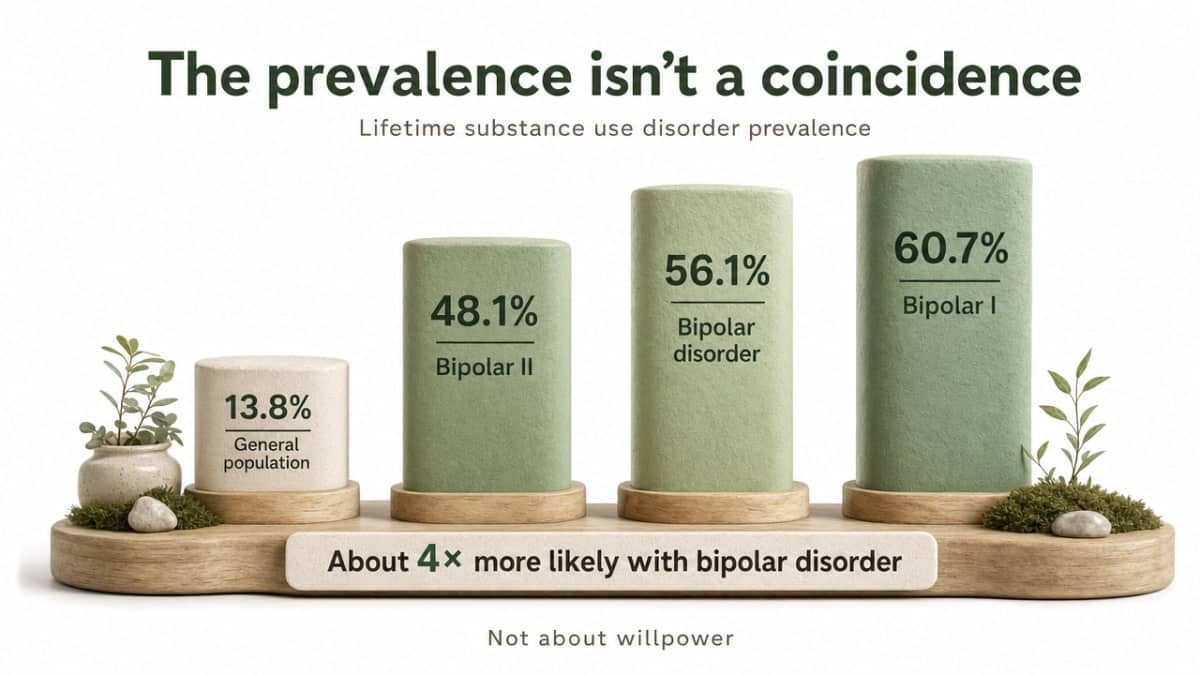
- Bipolar disorder and substance use disorders overlap heavily, with lifetime SUD prevalence around 56% in people with bipolar compared to 13.8% in the general population 12.
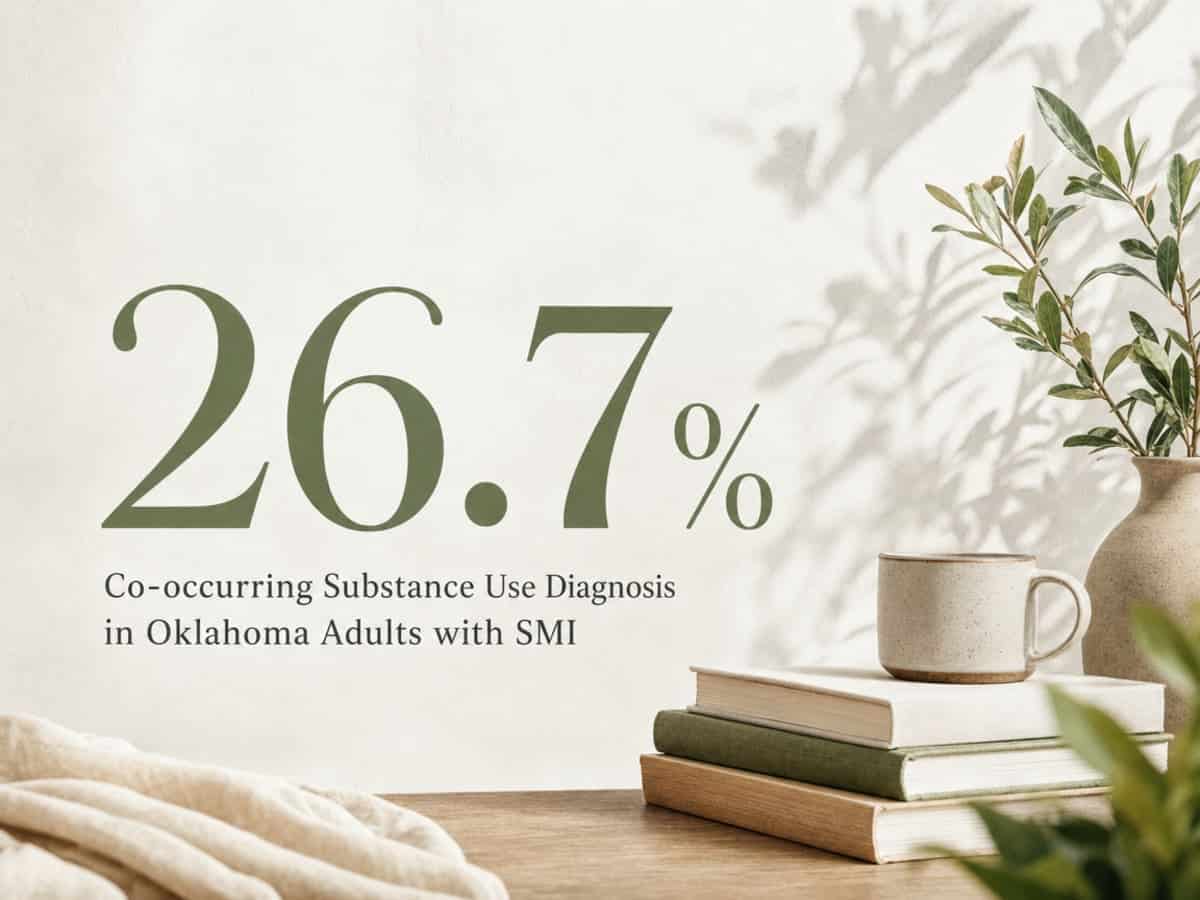
- Oklahoma’s own data shows 26.7% of adults with serious mental illness in the state system also carry a substance use diagnosis, so co-occurring care infrastructure already exists here 2.
- Medical detox for bipolar disorder requires clinicians who can distinguish withdrawal from mood episodes and typically continue prescribed psychiatric medications rather than stopping them 6.
- After detox, ask any Oklahoma City facility how they hand off to CCBHCs, outpatient therapy, and psychiatric care, since integrated long-term treatment is what changes outcomes 9, 3.
When quitting keeps ending in a mood crash
If you’ve tried to stop drinking or using before and watched your mood fall apart a few days in, that wasn’t a character flaw. That was untreated bipolar disorder meeting untreated withdrawal, and the two of them making each other worse.
Maybe the depression came back so hard you couldn’t get out of bed by day four. Maybe the mania showed up out of nowhere once the alcohol was gone. Maybe your psychiatrist knew about the drinking and your sponsor knew about the lithium, but they never actually talked to each other, so you were the one holding both sides together while sick.
You’re not imagining how hard this is. People with bipolar disorder are more likely than people without a mental illness to develop a substance use disorder, and substance misuse can worsen bipolar symptoms and make the illness harder to treat.10, 1That’s not a personal failing. It’s a known clinical pattern that needs a specific kind of care.
This guide walks through what safer detox looks like in Oklahoma when bipolar is in the room too, and what needs to come after.
Why bipolar and substance use travel together
The prevalence isn’t a coincidence
If you’ve been carrying a quiet suspicion that your drinking or using has something to do with your bipolar diagnosis, you’re not making that up. The two conditions run together in a way that clinicians see over and over.
A 2025 review of the research put numbers to it. The lifetime prevalence of any substance use disorder among people with bipolar disorder is 56.1% — roughly 60.7% for bipolar I and 48.1% for bipolar II. In the general population, that figure sits at 13.8%.12So if you have bipolar disorder, you are somewhere around four times more likely to develop a substance use disorder than a person without it.
That gap is not about willpower. It’s about a brain that’s already dealing with dramatic shifts in mood, sleep, and energy trying to find something — anything — that steadies the ride. Alcohol dulls the edge of a hypomanic night. Stimulants push back against a depression that won’t lift. Cannabis quiets a racing mind long enough to sleep. For a while, the substance seems to help. Then the pattern turns on you.
NIDA has spent years studying this bidirectional pull and found that people with mental disorders are more likely than those without to develop a substance use disorder, with mood disorders like bipolar being one of the strongest overlaps.18SAMHSA’s own advisory on bipolar disorder and co-occurring SUD estimates that 30% to more than 50% of people with bipolar disorder will develop a substance use disorder at some point in their lives.15
Read those numbers slowly. What they mean is that if you’re in the middle of this right now, you are inside a well-documented clinical pattern, not a personal moral failure.
The substances that show up most
When clinicians see bipolar disorder and substance use together, the substances aren’t random. There are patterns — the same handful showing up in study after study.
Alcohol leads the list. Across the research synthesized in that 2025 review, alcohol use disorder is present in an average of 30% of people with bipolar disorder. Cannabis use disorder shows up in roughly 24% across 53 studies, with some samples reporting rates as high as 67%.12Stimulants and cocaine follow, often tied to depressive phases where the pull of anything that lifts mood becomes hard to argue with.
If you drink to bring yourself down from a hypomanic stretch, you are doing something a lot of people with bipolar disorder do. If you use cannabis every night to sleep because the racing thoughts won’t stop, that is also a pattern clinicians recognize. Naming it isn’t about shame. It’s about giving your detox team the actual information they need.
Here’s the part worth sitting with: substance misuse can worsen bipolar symptoms and make the illness harder to treat.10What starts as a way to smooth out the mood swings ends up amplifying them. The alcohol that took the edge off last year is now the thing making the depressive weeks longer. The cannabis that quieted the noise is tangled up with sleep problems that trigger the next episode.
None of this makes you a special case. It makes you someone whose care needs to account for both conditions at the same time — which is exactly what a co-occurring-capable medical detox is built to do.
The Oklahoma picture
What the state’s own data shows
National numbers are one thing. What’s happening down the road from you is another.
Here’s the Oklahoma anchor: 26.7% of adults served through the state mental health authority who meet federal criteria for serious mental illness also carry a substance use diagnosis.2Read that again. More than one in four adults with a serious mental illness in Oklahoma’s public system is dealing with both at once. Bipolar disorder sits inside that SMI group alongside other serious mood and psychotic conditions.
What that number actually tells you: if you live in Oklahoma with bipolar disorder and you’re using, you are not a rare case that clinicians have never seen. You are part of a population the state is already tracking, already funding services for, and already building infrastructure around. The care exists because people who look like your situation keep needing it.
The number also tells you something less comfortable. A quarter of adults with serious mental illness in the state’s system means a lot of families are having the same 2 a.m. conversations yours has had. A lot of psychiatrists in Oklahoma are already thinking about how mood stabilizers interact with active drinking. A lot of detox nurses have watched someone come off benzos while managing an episode.
You are not the first person to walk in that door. That’s not a small thing when shame has been doing most of the talking.
When it starts young: families in Oklahoma City
If you’re a parent reading this because your 19-year-old was just diagnosed with bipolar disorder and you found the vape pens, or the empty bottles, or the pill count is off again — the Oklahoma data has something specific to say to you.
ODMHSAS looked at youths and young adults, ages 11 to 25, enrolled in the OKSOC system. Among clients with a bipolar diagnosis, 47.2% reported using some type of substance at least a few times in the 90 days before entering care.14Cannabis showed up in 31.3% of substance-use reports, with roughly one in five of those describing daily use. Alcohol accounted for another 28.8%.14
That is a young Oklahoma kid, already diagnosed, already using, probably already scared and pretending they aren’t.
The pattern shows up early because bipolar disorder often shows up early. Late teens, early twenties — right when independence, sleep disruption, and access to substances all collide. If your son or daughter is in that window, the goal isn’t to catch them in something. It’s to get them in front of clinicians who won’t treat the diagnosis and the use as two separate problems handed off to two separate specialists.
Detox for a young adult in this situation is not the whole answer. But it can be the pause that lets everyone — including the person struggling — see what’s actually going on underneath.
Why detox is different when bipolar is in the room
Withdrawal symptoms and mood symptoms wear the same clothes
Here’s the puzzle nobody warned you about: the shakes, the sleeplessness, the crushing low that shows up on day three — is that withdrawal, or is that your bipolar depression coming back?
You can’t always tell from the inside. Neither can your family. And honestly, a clinician who’s only trained in one side of this can miss it too.
Alcohol withdrawal can look like agitation, insomnia, racing thoughts, sweating, a heart that won’t slow down. Stimulant crash can look like depression so heavy you can’t lift your head off the pillow. Benzodiazepine withdrawal can bring anxiety and mood swings that feel identical to a mixed bipolar episode. The symptoms overlap so completely that SAMHSA’s national detox guidance flags this directly — a period of roughly one to two weeks of confirmed abstinence is sometimes needed before clinicians can properly sort out what’s drug-induced and what’s the underlying mood disorder.6
That’s not a delay tactic. That’s the actual clinical work of separating two conditions that have been braided together, sometimes for years.
What it means for you: a good detox team isn’t just watching your vitals. They’re watching your sleep patterns, tracking whether the depression lifts as the substance clears or digs in deeper, listening for hypomanic signs once the alcohol is gone. That observation window is part of the treatment, not something happening around it.
Psychiatric medications during withdrawal
One of the most common fears people bring to that first phone call: Are they going to make me stop my lithium? My lamotrigine? My antipsychotic?
That said — and this is where case-by-case actually means something — the situation gets more complicated when the substance and the medication interact in ways that need real attention. SAMHSA specifically cautions that combining certain SUD medications with benzodiazepines can cause serious adverse effects.1If you’ve been mixing prescribed benzos with alcohol, or taking a mood stabilizer while drinking heavily, the clinical team has to think through those interactions carefully rather than following a one-size protocol.
This is not a guide to what medications you’ll be on. That conversation belongs between you and the prescriber who’s actually looking at your chart, your history, and your labs. What this guide can tell you is that a co-occurring-capable team won’t ask you to abandon your psychiatric care to get sober. Those two things belong in the same room, held by people who talk to each other.
Why case-by-case actually matters here
“Individualized care” gets said so often in this industry that it stops meaning anything. So let’s be specific about what it has to mean when bipolar disorder is part of the picture.
Your detox plan has to account for:
- which substance you’re coming off of and whether you’ve had seizures or DTs before
- whether you’re in a depressive phase, a hypomanic one, or somewhere in between right now
- what psychiatric medications you’re already taking and how they interact with the substances leaving your system
- whether the substance use has been masking symptoms your treatment team hasn’t seen clearly in years
None of that fits on a checklist.
Renewal Springs, the medical detox facility in Oklahoma City, structures its co-occurring care around this reality — 24/7 medical supervision paired with the clinical judgment to hold both conditions at once, rather than treating your bipolar diagnosis as somebody else’s problem. That’s the practical difference between a detox that stabilizes you and one that hands you back to your regular life on day seven no better off than before.
The right question to ask any facility isn’t “do you treat co-occurring disorders” — everyone says yes. It’s “how do you actually do it, in my case.”
What medical detox in Oklahoma City looks like in practice
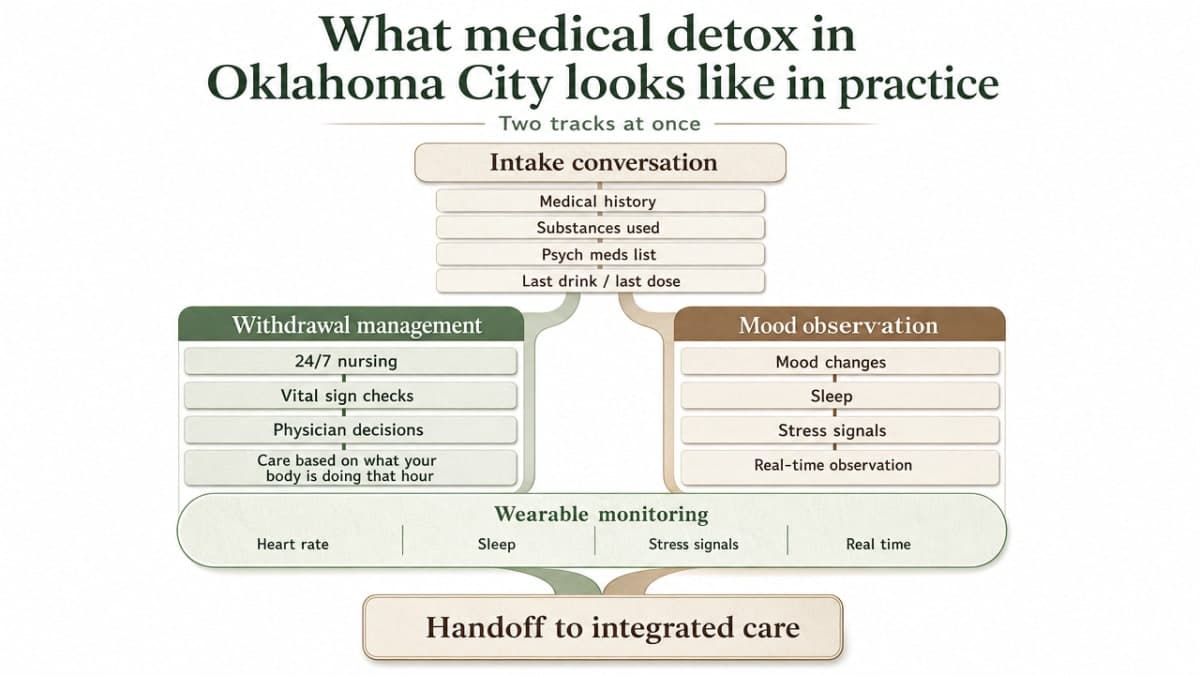
The first 24 hours are less dramatic than most people expect. There’s an intake conversation, a medical history, questions about every substance you’ve used and every psychiatric medication in your bag or on your list. Someone asks about your last drink or last dose, not to judge, but because the timing changes what needs to happen next.
From there, medically supervised detox means around-the-clock nursing, regular vital sign checks, and a physician making calls about your care based on what your body is doing that hour. At Renewal Springs in Oklahoma City, wearable monitoring from Huml Health tracks heart rate, sleep, and stress signals in real time, so a nurse doesn’t have to wait for a scheduled check to know something has shifted at 3 a.m.
When bipolar disorder is part of the picture, the clinical work runs on two tracks at once. Your body is clearing a substance. Your mood is being watched for the patterns underneath. Are you sleeping four hours and feeling energized, or four hours and dragging? Is the flat feeling on day five a stimulant crash or a depressive episode surfacing? A co-occurring-capable team is asking those questions on purpose.
Case-by-case care shows up in small decisions that add up. Which room placement makes sense for someone in a mixed episode versus straightforward alcohol withdrawal. How to structure family contact when a spouse has been the one holding everything together. When to loop in an outside psychiatrist you already trust versus when the on-site clinician makes the call.
That’s what the days look like. Quieter than the movies, more attentive than most people believe is possible.
Detox is stage one, not the finish line
The care that has to come next
Here’s something worth saying plainly, because too many facilities won’t: finishing detox is not the same as being treated.
NIDA puts it directly — detoxification is only the first stage of addiction treatment and by itself does little to change long-term drug use.9That’s not a downgrade of what happens in those first days. Getting through withdrawal safely, with a mood disorder in the mix, is real medical work. But if the story ends when you walk out the door on day seven, the odds turn against you fast.
What has to come next is integrated care — not two separate teams handing you back and forth, but clinicians treating your bipolar disorder and your substance use as the same problem with two faces. SAMHSA’s TIP 42 makes this the central principle for people with co-occurring conditions, and a systematic review of integrated versus non-integrated treatment found that comprehensive, long-term integrated programs delivered for 18 months or longer produced significant reductions in substance use and, for some, sustained remission.13, 17
On the therapy side, integrated group therapy — a model built specifically for people carrying both bipolar disorder and a substance use disorder — has the strongest evidence base of the psychosocial approaches studied.5It’s not the only path. But it exists, and it works better than trying to run mood treatment and recovery groups on separate tracks that never meet.
How Oklahoma’s outpatient and CCBHC network fits in
The good news for anyone starting this in Oklahoma City is that the state has actually built the infrastructure for what comes after detox. It’s not perfect, and it’s not evenly distributed, but it exists.
Certified Community Behavioral Health Clinics — CCBHCs — are required by Oklahoma Medicaid rules to provide a comprehensive array of services that stabilize people in crisis and deliver ongoing treatment for those with the most serious and complex mental health and substance use disorders.3That includes screening, assessment, and medically necessary treatment for exactly the population this article is written for.
Alongside CCBHCs, Oklahoma’s Part 21 outpatient behavioral health rules cover psychotherapy, crisis intervention, behavioral rehabilitation, targeted case management, and medication-assisted treatment for opioid use disorder under Medicaid.4Those are the pieces a real aftercare plan is built from — the therapist you see every week, the psychiatrist managing your mood stabilizer, the case manager helping you keep appointments when the depression makes phone calls feel impossible.
A detox that does its job doesn’t just discharge you. It hands you off — with your consent, your records, and a warm introduction — to the outpatient team or residential program that carries you through the next months. That handoff is where a lot of people fall through. Ask about it before you arrive.
Making the call: what to say and what to ask
The first call is the hardest part. Not because it’s complicated — because it means saying out loud what you’ve been carrying quietly.
You don’t need a script. But it helps to know that whoever picks up has heard this before. Say the substances you’re using and roughly how much. Say you have a bipolar diagnosis and name the medications you take, even if you haven’t been taking them lately. Say if you’ve withdrawn before and what happened. If a family member is calling for you, they can share what they’ve seen — the sleep patterns, the last known dose, the episodes.
Then ask real questions:
- How does your team handle bipolar disorder during withdrawal specifically?
- Will my psychiatric medications continue? Who decides that?
- What happens on day seven or ten — where do I go next, and do you make that handoff for me?
At Renewal Springs in Oklahoma City, that conversation happens directly with the clinical team, not a call center reading from a script. Case-by-case co-occurring care means the person on the phone is actually thinking about your situation, not just booking a bed.
Making the call isn’t the whole recovery. It’s one honest conversation. That counts.
Connect Now About Managing Bipolar and Detox
Get real answers on safe detox options when bipolar disorder and substance use overlap.
Frequently Asked Questions
Is it safe to detox at home if I have bipolar disorder?
For most people with bipolar disorder and active substance use, home detox isn’t the right call. Withdrawal from alcohol and benzodiazepines can be medically dangerous on its own, and when a mood disorder is in the mix, symptoms get harder to read and easier to miss. Medically supervised detox exists precisely because both conditions need eyes on them at the same time.6, 1
Will I have to stop my psychiatric medications during detox?
Usually no. SAMHSA’s national detox guidance is clear that therapeutic doses of psychiatric medications should generally be continued through withdrawal when they’ve been taken as prescribed.6The specific decisions belong to the prescriber looking at your chart, not a general article. Bring your current medication list and honest recent use history to the intake conversation so the clinical team can make those calls with real information.
How do clinicians tell the difference between withdrawal and a bipolar episode?
Time and observation. Withdrawal symptoms and mood episodes overlap heavily, so clinicians watch how symptoms change as the substance clears your system. SAMHSA notes that roughly a week or two of confirmed abstinence may be needed before the role of substances in driving manic or depressive symptoms can be properly assessed.6That observation window is part of the clinical work, not something extra layered on top.
What happens after the first week of detox?
Detox is stage one. NIDA is direct that detoxification alone does little to change long-term outcomes.9What comes next is ongoing integrated care — some combination of residential treatment, outpatient therapy, medication management, and community-based supports through Oklahoma’s CCBHC and Medicaid outpatient network.3, 4A good detox team plans that handoff with you before discharge, so day eight isn’t a cliff.
Does insurance cover detox for co-occurring bipolar and substance use in Oklahoma?
Most major insurance plans cover medically necessary detox, and Oklahoma Medicaid covers a range of outpatient behavioral health services that connect to detox care.4Coverage specifics depend on your plan, deductible, and clinical criteria. Renewal Springs offers free benefits verification, meaning someone on the clinical team checks what your plan actually covers before you commit to anything. Call and ask directly — that’s the fastest answer.
What should a family member say when they call on behalf of someone with bipolar disorder?
Say what you’ve seen, not what you think it means. Name the substances and rough amounts if you know them. Share the bipolar diagnosis and any current psychiatric medications. Describe recent sleep patterns, mood shifts, and whether there’s been a prior withdrawal or hospitalization. A co-occurring-capable team will take that information seriously and walk you through what a safe next step looks like for your person.
References
- Co-Occurring Disorders and Other Health Conditions. https://www.samhsa.gov/substance-use/treatment/co-occurring-disorders
- Oklahoma 2025 Uniform Reporting System Mental Health Data Results. https://www.samhsa.gov/data/sites/default/files/reports/rpt57227/Oklahoma.pdf
- Okla. Admin. Code § 317:30-5-266 – Covered services (CCBHCs). https://www.law.cornell.edu/regulations/oklahoma/OAC-317-30-5-266
- PART 21. OUTPATIENT BEHAVIORAL HEALTH SERVICES. https://oklahoma.gov/ohca/policies-and-rules/xpolicy/medical-providers-fee-for-service/individual-providers-and-specialties/outpatient-behavioral-health-services.html
- Clinical practice guideline on pharmacological and psychological management of adult patients with bipolar disorder and comorbid substance use. https://pubmed.ncbi.nlm.nih.gov/34171104/
- TIP 45: Detoxification and Substance Abuse Treatment. https://www.govinfo.gov/content/pkg/GOVPUB-HE20_400-PURL-gpo124442/pdf/GOVPUB-HE20_400-PURL-gpo124442.pdf
- Behavioral Health Barometer: Oklahoma, Volume 4. https://catalog.data.gov/dataset/behavioral-health-barometer-oklahoma-volume-4
- Part 2: Co-Occurring Substance Use Disorder and Mental Illness. https://nida.nih.gov/publications/research-reports/common-comorbidities-substance-use-disorders/part-2-co-occurring-substance-use-disorder-and-mental-illness
- Treatment Approaches for Drug Addiction DrugFacts. https://nida.nih.gov/publications/drugfacts/treatment-approaches-drug-addiction
- Bipolar Disorder. https://www.nimh.nih.gov/health/topics/bipolar-disorder
- Drug Overdose Deaths in the United States, 1999–2017. https://www.cdc.gov/drugoverdose/pdf/pubs/2018-overdose-data.pdf
- Co-Occurring Bipolar and Substance Use Disorders: A Review of Impacts, Treatments, and Clinical Considerations. https://pmc.ncbi.nlm.nih.gov/articles/PMC11995909/
- Substance Use Disorder Treatment for People With Co-Occurring Disorders (Treatment Improvement Protocol TIP 42). https://library.samhsa.gov/sites/default/files/pep20-02-01-004.pdf
- Co-Occurring Substance Use among OKSOC Youths and Young Adults with Serious Emotional Disturbance or Mental Illness. https://oklahoma.gov/content/dam/ok/en/odmhsas/documents/research/reports/Substance-Use-Report.pdf
- An Introduction to Bipolar Disorder and Co‑Occurring Substance Use Disorders. https://library.samhsa.gov/sites/default/files/sma16-4960.pdf
- Substance use comorbidity in bipolar disorder. https://pubmed.ncbi.nlm.nih.gov/29596721/
- Review of integrated mental health and substance abuse treatment for patients with dual disorders. https://www.ncbi.nlm.nih.gov/books/NBK67188/
- Part 1: The Connection Between Substance Use Disorders and Mental Illness. https://nida.nih.gov/publications/research-reports/common-comorbidities-substance-use-disorders/part-1-connection-between-substance-use-disorders-mental-illness