
Key Takeaways
- Detox handles the physical side of withdrawal, while rehab addresses the behavioral patterns, triggers, and life rebuilding that follow — they are sequential steps, not interchangeable ones.
- Alcohol and benzodiazepine withdrawal can cause seizures and life-threatening complications, so stopping on your own is unsafe and medical evaluation should come first 8.
- For opioid dependence, detox without continuing treatment is linked to higher rates of relapse, illness, and overdose death because tolerance drops sharply after clearance 5.
- Rehab comes in levels — residential, PHP, IOP, and standard outpatient — and the right intensity depends on home stability, relapse history, and daily structure needs.
- The handoff between detox and what follows decides outcomes; a stabilized body without new skills tends to drift back, and detox alone generally leads people back to use 2.
The Question Behind the Question
If you’re reading this at 2 a.m., or reading it because someone you love is falling apart in the next room, the words detox and rehab probably feel like they’re being used interchangeably by every website, hotline, and TV commercial you’ve come across. That confusion is not your fault. The treatment world has done a poor job of explaining that these are two different things that happen in a specific order.
Here’s the short version: detox handles what’s happening inside your body right now — the shakes, the sweats, the nausea, the crawling need. Rehab handles what happens after your body settles down — the reasons, the triggers, the habits, the life you’re trying to rebuild. One is medical. The other is behavioral. Both matter. Neither replaces the other.
The real question isn’t which one should I pick. It’s which one do I need first, and how do the two connect. For anyone physically dependent on opioids, alcohol, or benzodiazepines, that answer is almost always the same: a medically supervised detox comes first, because trying to skip it can be genuinely dangerous 1, 2. What follows in the rest of this article is what each step does, why the handoff between them matters more than either piece alone, and how to figure out where to start today.
What Detox Actually Does (and What It Doesn’t)
The Three Jobs of a Medical Detox: Evaluate, Stabilize, Hand Off
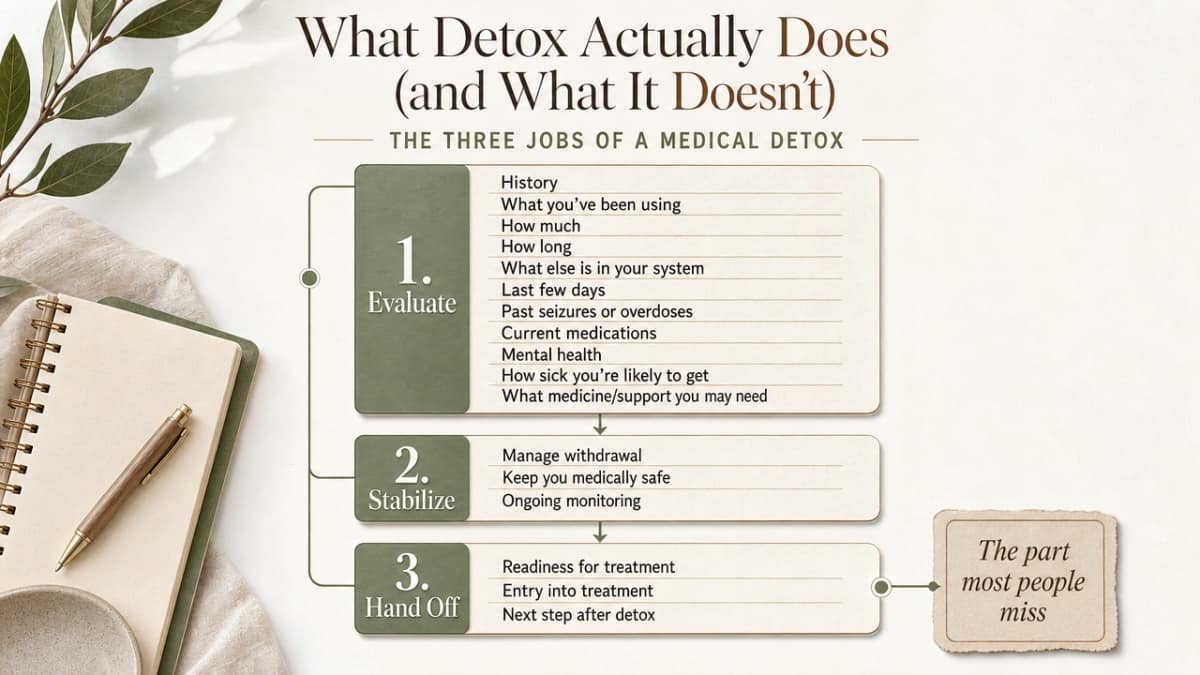
When you picture detox, you might picture a room, a bed, and a bad week. That’s part of it, but it’s not the whole job. The federal clinical guide that most reputable detox programs work from describes detox as three connected tasks: evaluation, stabilization, and fostering your readiness for and entry into treatment 4. That last piece is the one most people miss.
Evaluation happens the moment you walk in. A clinician takes your history — what you’ve been using, how much, how long, what else is in your system, what your last few days looked like, whether you’ve had seizures or overdoses before, what medications you take, what’s going on with your mental health. This isn’t paperwork for paperwork’s sake. It’s how the team decides how sick you’re likely to get and what medications and monitoring you’ll need.
Stabilization is the part you probably imagined. Nurses and physicians manage your withdrawal with medication and close observation so your body can come off the substance without spiraling. For opioids, that often means medication-assisted treatment protocols. For alcohol and benzodiazepines, it often means preventing seizures. Vital signs are watched around the clock, not because you’re being scrutinized, but because withdrawal can change fast.
Fostering readiness is the handoff. A good detox program spends your last day or two lining up what comes next — a rehab bed, an outpatient program, a counselor, a prescription that continues after you leave. If a facility hands you a discharge paper and a taxi voucher, they’ve done one of three jobs. Not all three.
Why Alcohol and Benzo Withdrawal Are Their Own Emergency
Opioid withdrawal feels like the worst flu of your life. It’s brutal, but it usually won’t kill you on its own. Alcohol and benzodiazepine withdrawal are different animals. Both can cause seizures. Both can cause a life-threatening syndrome that comes on days after the last drink or pill, sometimes right when you think the worst is behind you.
That’s why the American Society of Addiction Medicine has a dedicated clinical practice guideline for alcohol withdrawal management, and why hospitalists have their own summary of it — this isn’t a category of care you improvise at home with willpower and Gatorade 8, 11, 12. The guideline exists because the level of care matters: some people need inpatient medical detox, some can do a monitored outpatient taper, and the difference between those two calls is not something you can make on your own at 3 a.m.
The Line Detox Does Not Cross
Here is the sentence you’ll hear pushed back on by anyone who has sold you the idea that a week away fixes everything: detox is not treatment. That’s not our opinion. It’s how the National Institute on Drug Abuse says it in plain English — detoxification is not the same as treatment and is not sufficient to help a person recover 2. The federal detox guidance says the same thing another way: detox is one part of a continuum of care, not the whole thing 1.
What detox does beautifully is get you physically safe. It quiets the withdrawal. It clears your head enough that you can think again. What it does not do is teach you how to walk past the gas station where you used to buy, or how to sit with the feelings you were medicating, or how to rebuild the relationships you’ve been avoiding. Those are real skills. They take real time. That work belongs to the next phase, and it’s the phase that decides whether the hard week you just spent in detox turns into a hard year that finally sticks.
What Rehab Actually Does
Inside a Real Week of Rehab: Counseling, Triggers, Relapse Prevention
If detox is the medical week, rehab is the months of practical, unglamorous work that follow. It’s what happens after your hands stop shaking and you have to figure out what you’re going to do at 4 p.m. on a Tuesday when you used to use.
To make this less abstract, look at what a real evidence-based outpatient program actually asks of you. The Matrix model, one of the most widely used treatment manuals in the country, structures a typical week around a handful of moving parts:
- Individual counseling with a therapist
- Early-recovery skills groups
- Relapse-prevention groups
- Family education sessions
- Encouragement to attend outside recovery groups weekly on top of the formal program 14
That’s not filler. Each piece does a different job.
Individual counseling is where you unpack the stuff you couldn’t say out loud in group — the trauma, the shame, the specific reason last March broke you. Relapse-prevention groups are more tactical. You learn to spot triggers before they hit, map out the people-places-things that put you at risk, and rehearse what you’ll actually do when the craving shows up on a Saturday night 14. Family education sessions bring the people who love you into the room so they stop reacting and start understanding.
You’ll also start building the outside scaffolding: a home group, a sponsor if you’re doing 12-step, a sober friend, a routine. This is where the phrase recovery is a job stops sounding dramatic. In residential rehab, this schedule fills most of your day. In outpatient, it fits around work and family. Either way, the point is repetition — practicing the new muscle until it holds under pressure.
Residential, Outpatient, IOP: The Menu Nobody Explained to You
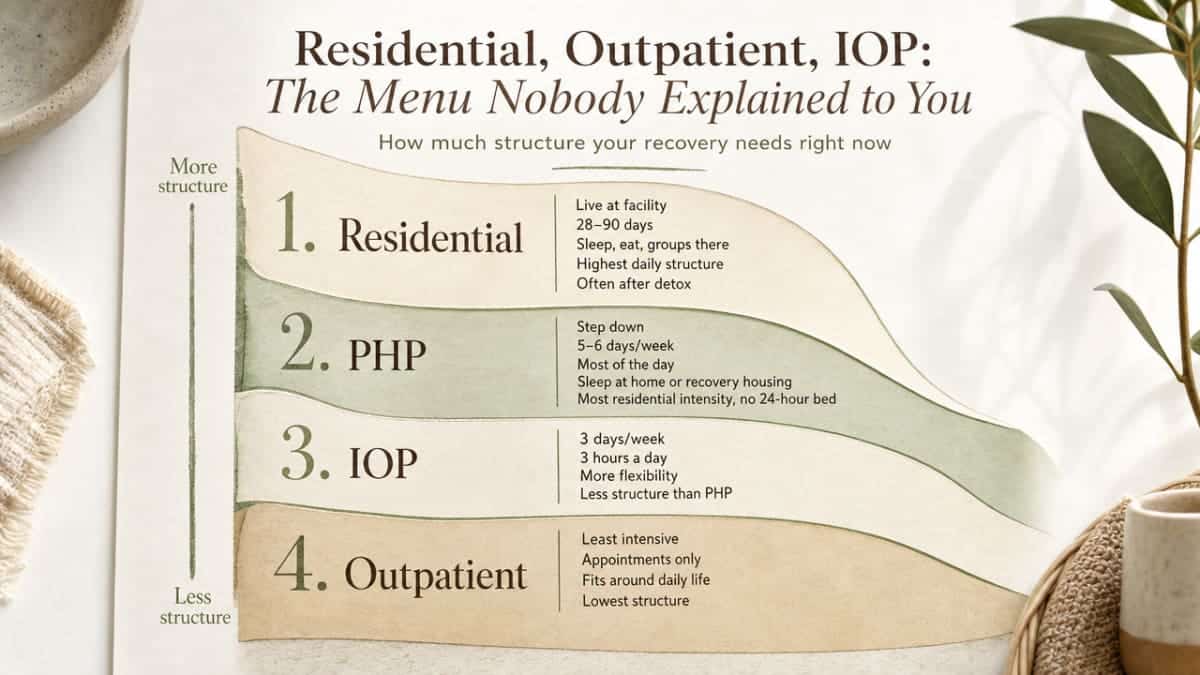
“Rehab” is not one thing. It’s a set of intensity levels, and the right one depends on how much structure your recovery needs right now, not on which brochure looked nicest.
- Residential rehab
- Means you live at the facility, usually for 28 to 90 days. You sleep there, eat there, do groups there. It’s the highest level of daily structure short of a hospital, and it’s often the right next step after detox if home isn’t safe, if you’ve relapsed from lower levels of care before, or if the people and places around you are actively pulling you back.
- Partial hospitalization (PHP)
- Is a step down. You show up five or six days a week for most of the day, then sleep at home or in recovery housing. You get most of the intensity of residential without the 24-hour bed.
- Intensive outpatient (IOP)
- Usually runs three days a week, three hours a session, for eight to twelve weeks. It fits around a job. It’s what most people picture when they hear “outpatient rehab.”
- Standard outpatient
- Is once-a-week counseling, often the long tail after IOP ends.
You don’t have to figure out which level you need on your own. A good detox program does an assessment before you leave and recommends a specific next step — and, ideally, has already made the phone call and reserved the bed. This is the handoff the federal detox guidance describes as fostering entry into treatment, and it’s the difference between a discharge plan and a wish 1, 15.
Detox to Rehab: Why the Handoff Is the Whole Game
The 72-Hour View vs. the 90-Day View
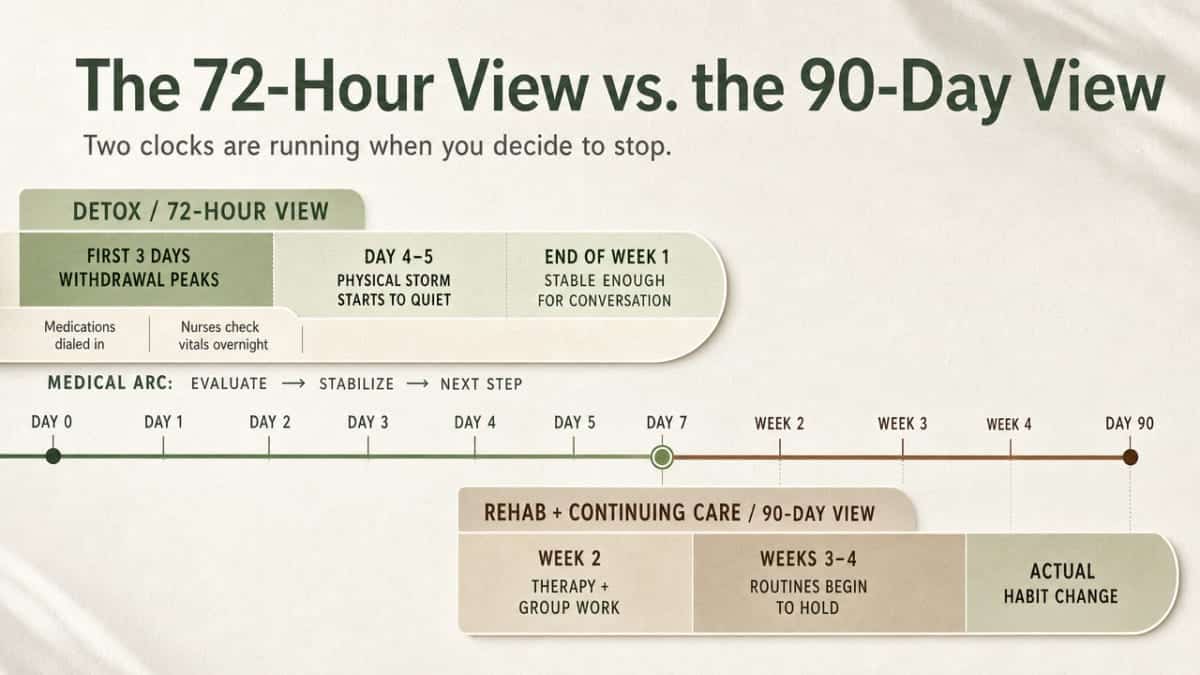
Two clocks are running when you decide to stop. One is measured in hours, the other in months, and confusing them is where a lot of good intentions come apart.
The 72-hour view belongs to detox. In roughly the first three days, your body is doing the loudest part of the work. Withdrawal peaks. Medications get dialed in. Nurses check vitals through the night. Somewhere around day four or five, the physical storm starts to quiet, and by the end of the first week most people are stable enough to sit through a conversation without their skin crawling. That’s the whole medical arc: evaluate, stabilize, and get you pointed toward what comes next 1.
The 90-day view belongs to rehab and the continuing care that follows. This is where the actual habit change lives. Week two is when you start therapy and group work in earnest. Weeks three and four are when you begin naming your triggers instead of getting ambushed by them. By day 30 you have a rough routine. By day 60 you have a sponsor or a home group or a therapist you don’t want to lie to. By day 90, if things are going well, you have practiced sobriety enough times in enough situations that it stops feeling like a stunt.
Neither timeline works without the other. A stabilized body without new skills tends to drift back. New skills without a stabilized body never get a fair chance to take hold.
The Warning You Need to Hear Once, Clearly
Read that again, because it’s counterintuitive. Getting the opioids out of your system, and then walking away, is riskier than you’d think. The reason is biological. After a few days without opioids, your tolerance drops fast. If you relapse — and without ongoing treatment, relapse is common — the dose that used to get you through a Tuesday can stop your breathing. This is how people who’ve technically “gotten clean” end up in the worst overdoses of their lives, sometimes within days of leaving a facility.
The guideline isn’t telling you not to detox. It’s telling you not to stop there. The safer path is detox linked directly to medication for opioid use disorder, counseling, and a real plan for the weeks after. That’s not a nice-to-have. For opioids specifically, it’s the difference between a first step and a last one.
This is the one warning worth carrying with you out of this article. Everything else can be figured out on the phone.
What Happens When People Stop at Detox
The pattern is well documented, and it’s not a moral failing when it happens — it’s what the research shows across settings. A cohort study of people leaving inpatient detox found that detox alone was insufficient to sustain abstinence afterward, with post-detox outcomes tied to what happened next, not to how well the withdrawal week went 6. A longitudinal study comparing patients who entered formal aftercare with those who didn’t found that going without aftercare was associated with much faster lapse and relapse 7. NIDA puts it plainly: detoxification alone, without follow-up treatment, generally leads people back to use 2.
What that looks like in a real life is quieter than you’d expect. Someone finishes a five-day detox, feels sharper than they’ve felt in a year, tells themselves the hard part is over, and goes home. The first week is fine. The second week, an old friend calls. The third week, a fight at work. There’s no counselor, no group, no plan for that Saturday night. The habit is still wired in; the body just isn’t sick anymore. The relapse isn’t a surprise. It’s what the wiring was going to do without new work on top of it.
This is why the handoff is the whole game. Detox opens the door. What you walk into next is what decides whether the door stays open.
Which Door Do You Walk Through First?
If You’re Using Opioids Daily
If you’re using heroin, fentanyl, or prescription painkillers every day — and especially if you’re using to keep withdrawal away rather than to get high — the door you walk through first is medical detox. Not outpatient counseling. Not a meeting. Not a taper you design in your kitchen.
The reason is specific to opioids. Your tolerance has shifted, your body is dependent, and stopping cold means a week of misery that most people can’t ride out alone. More importantly, detox is where you can be started on medication for opioid use disorder and connected directly to what comes next, which is the piece the national guideline says protects you from the relapse-and-overdose pattern that follows detox-only care 5. Call a medical detox first. Let them do the assessment. The rehab decision gets made from there.
If You’re Drinking Heavily Every Day, or Using Benzos
Same door, different reason. Alcohol and benzodiazepine withdrawal can cause seizures and, in some cases, kill you. This isn’t a scare tactic — it’s why there’s a dedicated clinical guideline for managing alcohol withdrawal at all 8.
If you’re drinking to the point of shaking in the morning, or you’ve been on Xanax, Klonopin, Ativan, or Valium daily for months, the safest first call is a medical detox that can evaluate you and decide whether you need inpatient monitoring or a supervised outpatient taper. Do not stop on your own to “prove you’re serious” before calling. The evaluation is the first step. That’s what detox is set up to do.
If Stimulants and Mental Health Symptoms Are the Bigger Issue
Stimulants — meth, cocaine, misused Adderall — work differently. There’s no seizure risk from stopping, and the physical piece of withdrawal is more crash than crisis. What tends to be dangerous is what’s underneath: paranoia, depression that arrives when the drug leaves, suicidal thinking, or a psychiatric picture that was there before the stimulant use started.
The current ASAM/AAAP stimulant guideline treats this as a chronic-care problem, meaning the assessment and treatment plan matter more than a single detox stay 10. You may still benefit from a supervised setting for the first days, especially if mental health symptoms are severe or other substances are in the mix. Call and describe what’s actually happening. The right level of care gets sorted from that conversation.
After Rehab: Recovery Housing, Case Management, and the Long Middle
The part nobody warns you about is the middle. Detox is loud. Rehab is structured. What comes after — the six months, the year, the second year — is quieter, and it’s where a lot of the real work of staying stopped actually gets done.
Two supports tend to matter here more than people expect. The first is recovery housing: a sober living environment that gives you a stable place to sleep, drug-free peers around you, and enough structure to keep the wheels on while you go to work, therapy, and meetings. SAMHSA’s 2023 best-practices guidance treats recovery housing as a key strategy for sustaining recovery and reducing overdose risk, particularly in the vulnerable months after formal treatment ends 9. If home is chaotic, unsafe, or full of the same triggers you just spent 30 days learning to name, recovery housing is often the piece that keeps the plan intact.
The second is case management — someone whose job is to keep the different parts of your life talking to each other. A case manager coordinates your counselor, your prescriber, your primary care, your probation officer if there is one, your insurance, your housing, your family. SAMHSA’s case management guidance frames this as the connective tissue of long-term recovery, because outcomes tend to depend on coordinated services rather than any single episode of care 13.
Recovery is a chronic-care problem, and it deserves a chronic-care approach — ongoing check-ins, medication adjustments, and support that doesn’t disappear the day your program ends 10. The long middle is where you find out that the work continues, and that continuing it is not a sign that something went wrong. It’s the point.
How Renewal Springs Fits Into the Picture in Oklahoma City
Now that you know detox and rehab are two different jobs, here’s where Renewal Springs sits on that map. We do the first one. Specifically, we’re a medical detox facility in Oklahoma City with licensed clinicians on-site around the clock, personalized withdrawal management for opioids, alcohol, benzodiazepines, stimulants, kratom, and other substances, and specialized tracks for veterans, men, women, and people who need private or luxury care while they get through the hardest week.
What we don’t do is pretend to be a full continuum under one roof. Residential and outpatient rehab happen elsewhere, including through a sister facility we can coordinate with directly. That means the handoff SAMHSA calls fostering entry into treatment isn’t an afterthought at discharge — it’s part of the plan from the assessment forward 1, 15.
If you’re in Oklahoma and you’re not sure whether you need detox, rehab, or both, calling us first is a reasonable move. We’ll verify your insurance, do the medical assessment, and help you figure out what comes next — even if what comes next is a bed at another facility.
Speak with a Medical Detox Specialist Now
Get guidance on starting detox safely and what happens after, right when you need it most.
Frequently Asked Questions
Can I just do detox and skip rehab if I feel better afterward?
Feeling better after detox is real, but it’s misleading. Your body is stable; the habits, triggers, and wiring that led to use haven’t changed. Detox alone, without follow-up treatment, generally leads people back to use 2. Rehab is where the staying-stopped work happens. Skipping it is the most common way a good week turns into a hard month.
How long does medical detox usually take?
For most substances, the acute withdrawal window runs three to seven days, though benzodiazepine tapers can take longer. Length depends on what you’ve been using, how much, and how your body responds. The evaluation on day one shapes the plan 4. Nobody can quote you an exact number until a clinician has looked at your history.
Is it safe to detox from alcohol or benzodiazepines at home?
Usually no. Both can cause seizures and, in some cases, a life-threatening withdrawal syndrome that peaks days after your last drink or dose. That’s why there’s a dedicated clinical guideline for alcohol withdrawal management at all 8. Call a medical detox first and let a clinician decide whether you need inpatient monitoring or a supervised outpatient taper.
Does Renewal Springs offer rehab, or only detox?
Renewal Springs specializes in the detox step — medically supervised withdrawal management in Oklahoma City with 24/7 clinical staffing. Residential and outpatient rehab happen through partners, including a sister facility we coordinate with directly. That handoff is part of your plan from the assessment forward, so you’re not left figuring out the next step alone at discharge.
What if my loved one refuses to go to rehab after detox?
It happens more than you’d think, and it’s not the end of the story. Detox itself is a real step, and staff often use those days to build motivation and connect your person to what’s next 15. If they still decline rehab, ask about medication for opioid use disorder, an outpatient counselor, or a recovery group as a smaller next move. Something is better than nothing.
Do I need a referral or assessment before calling, or can I call directly?
Call directly. You don’t need a doctor’s referral, a prior assessment, or paperwork in hand. The intake conversation is the assessment — a nurse or admissions clinician asks what you’ve been using, verifies your insurance, and figures out whether detox is the right level of care today. One phone call is the whole first step.
References
- TIP 45 Detoxification and Substance Abuse Treatment. https://www.govinfo.gov/content/pkg/GOVPUB-HE20_400-PURL-gpo124442/pdf/GOVPUB-HE20_400-PURL-gpo124442.pdf
- Treatment and Recovery. https://nida.nih.gov/publications/drugs-brains-behavior-science-addiction/treatment-recovery
- Principles of Drug Addiction Treatment: A Research-Based Guide (Third Edition). https://nida.nih.gov/sites/default/files/podat-3rdEd-508.pdf
- Appendix C—Excerpts From Quick Guide for Clinicians Based on TIP 45. https://www.ncbi.nlm.nih.gov/books/NBK64044/
- Management of opioid use disorders: a national clinical practice guideline. https://pmc.ncbi.nlm.nih.gov/articles/PMC5837873/
- Overdose History Is Associated with Post-Detoxification Outcomes in an Opioid Agonist Treatment Cohort. https://pmc.ncbi.nlm.nih.gov/articles/PMC6077990/
- A naturalistic longitudinal analysis of post-detoxification outcomes in inpatient and outpatient settings. https://pubmed.ncbi.nlm.nih.gov/28940788/
- The ASAM Clinical Practice Guideline on Alcohol Withdrawal Management Pocket Guide. https://www.samhsa.gov/resource/ebp/asam-clinical-practice-guideline-alcohol-withdrawal-management-pocket-guide
- Best Practices for Recovery Housing. https://library.samhsa.gov/product/best-practices-recovery-housing/pep23-10-00-002
- The ASAM/AAAP Clinical Practice Guideline on the Management of Stimulant Use Disorder. https://stacks.cdc.gov/view/cdc/156927/cdc_156927_DS1.pdf
- The ASAM Clinical Practice Guideline on Alcohol Withdrawal Management. https://pubmed.ncbi.nlm.nih.gov/32511109/
- Clinical guideline highlights for the hospitalist: 2020 American Society of Addiction Medicine clinical practice guideline on alcohol withdrawal management. https://pubmed.ncbi.nlm.nih.gov/34910619/
- Comprehensive Case Management for Substance Use Disorders. https://library.samhsa.gov/sites/default/files/PEP20-02-02-013.pdf
- Client’s Handbook: Matrix Intensive Outpatient Treatment for People with Stimulant Use Disorders. https://library.samhsa.gov/sites/default/files/sma15-4154.pdf
- The Next Step Toward a Better Life. https://library.samhsa.gov/product/next-step-toward-better-life/sma14-4474