
Key Takeaways
- UnitedHealthcare generally covers medically necessary detox for opioid dependence, but actual cost and length of stay depend on plan type, network status, level of care, medical necessity, and prior authorization.
- The insurance card itself determines the rulebook: commercial, Marketplace, Medicare Advantage, and UHC Community Plan (SoonerCare) each follow different authorization workflows, cost-sharing structures, and appeal pathways 1.
- If coverage is denied, internal appeal deadlines run 72 hours to 30 days depending on urgency, and Oklahoma external review offers an independent second decision within roughly 45 days 8, 9.
The Direct Answer, Before Anything Else
Yes. UnitedHealthcare typically covers medically necessary detox for opioid dependence, including fentanyl, heroin, and prescription painkillers. If you have a UHC card in your wallet right now — commercial, employer-sponsored, Marketplace, or Community Plan — there is a real path to getting a bed, and Renewal Springs has a strong reimbursement relationship with UnitedHealthcare that makes that path shorter.
Here is the honest part. “Covered” is not a single yes or no. What you actually pay, how long UHC will approve, and whether admission happens today or tomorrow depends on five things: your specific plan, whether the facility is in-network, the level of care you need, how medical necessity is documented, and whether prior authorization is required before you walk in 7. A trained admissions team can check all five in under an hour.
You do not have to make that call yourself. If you are reading this while shaking, sweating, or watching someone you love go through it — skip ahead, call us, and let someone else work the phones. The rest of this article explains what that call uncovers, so you know what is happening on your behalf.
Why ‘Covered’ Has Conditions: The Five-Variable Coverage Check
When someone tells you “UnitedHealthcare covers detox,” they are telling you a half-truth that is still mostly true. The yes is real. What that yes actually looks like for you — how many days, which setting, what you owe at discharge — hinges on five specific variables. Think of them less as hurdles and more as the questions a trained admissions specialist works through, usually in a single phone call, so you do not have to.
Here is the framework worth memorizing:
- Plan Type. Is your UHC card a commercial plan through an employer, a Marketplace plan you bought yourself, a UHC Community Plan (Medicaid), or a Medicare Advantage product? Each one has different benefit rules, different appeal pathways, and sometimes a different regulator. The card in your hand usually tells us which one you have within thirty seconds.
- Network Status. Is the facility in-network with your specific UHC plan? In-network almost always means lower cost-sharing for you. Renewal Springs maintains a strong reimbursement relationship with UnitedHealthcare, which is why this variable usually lands in your favor.
- Level of Care. UHC does not pay for “detox” as one generic service. It pays for a specific level — inpatient medical detox, residential withdrawal management, or ambulatory outpatient detox — based on what a clinician documents you need. Opioid withdrawal from fentanyl or heroin typically meets inpatient criteria. The level has to match the medical picture.
- Medical Necessity. This is the clinical gatekeeper. UHC uses written criteria to decide whether your symptoms, substance history, and risk factors justify the requested level of care. Under federal parity rules, those criteria cannot be more stringent than what UHC uses for comparable medical conditions 7. Documenting withdrawal severity, co-occurring conditions, and prior treatment attempts is how admissions wins this one.
- Prior Authorization. Most UHC plans require approval before an inpatient detox admission. The clinical team submits the request with supporting documentation, and UHC responds within federal timelines. Prior auth is a step, not a wall — and it is also a formal process, which means it has deadlines UHC must meet and an appeals path if the answer is no.
Notice what is not on this list: your motivation, your worthiness, or whether you “deserve” help. Those are not variables UHC gets to weigh. The five above are the whole picture, and every one of them is something an admissions team can check on your behalf while you focus on getting to the door.
What UnitedHealthcare Plan Do You Actually Have?
Pull out your insurance card. That piece of plastic tells us almost everything we need to know in the first thirty seconds of a verification call. The reason it matters: “UnitedHealthcare” is not one product. It’s a family of plans, each with its own rulebook, its own regulator, and its own path to a covered detox bed. Mixing them up is how people end up with the wrong information and the wrong bill.
You don’t need to decode the card yourself. But knowing what we’re looking at — and why the distinctions matter — takes some of the mystery out of what happens after you hand over your member ID.
Commercial, Employer, Marketplace, and Community Plan Differences
Most adults with UHC carry one of four product types. A commercial employer plan comes through a job and may be either fully insured (the employer buys coverage from UHC) or self-funded (the employer pays claims directly and uses UHC to administer them). That distinction is invisible on the card but matters for appeals, because self-funded plans are regulated primarily under federal law rather than Oklahoma’s insurance code. A Marketplace plan is one you bought yourself through HealthCare.gov — fully insured and state-regulated. A Medicare Advantage plan has its own federal appeal rules. A UHC Community Plan is Medicaid, administered in Oklahoma through SoonerCare. Each carries different cost-sharing, different prior-auth workflows, and different complaint pathways 1.
If You Have a UHC Community Plan (SoonerCare)
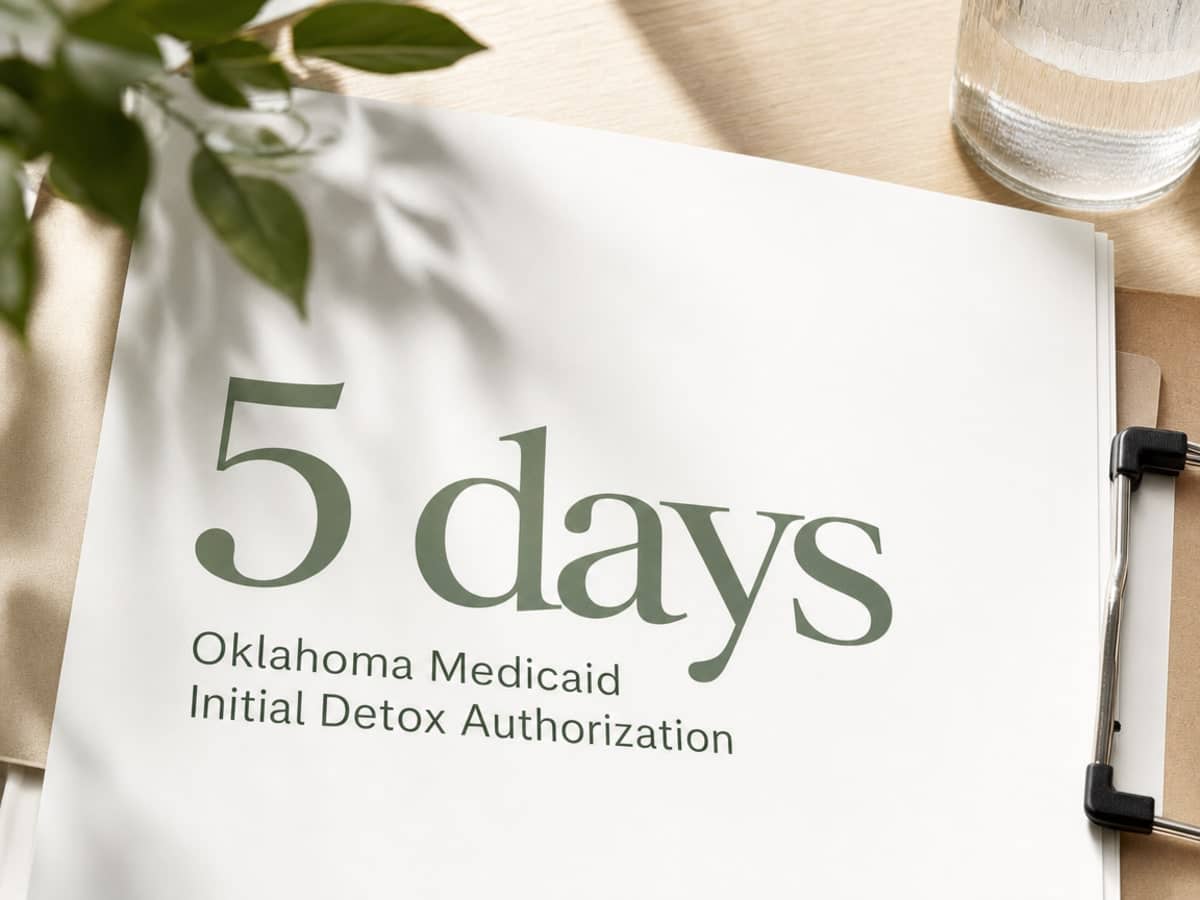
A UHC Community Plan card means your coverage runs through Oklahoma Medicaid. Detox and residential substance-use services are covered benefits, but prior authorization is required before admission in most cases 12, 13. One number worth knowing: OHCA’s manual allows an initial maximum of five days for chemical-dependency detoxification based on medical necessity, with continued-stay review after that 14. That five-day figure is a Medicaid rule — not something that applies to your sister’s commercial UHC plan or your neighbor’s Marketplace plan. The verification workflow looks different too, which is why we confirm plan type before anything else.
What Medical Detox Looks Like on a UHC Benefits Summary
If you have ever stared at a UHC benefits summary and felt your eyes glaze over, you are not alone. The document rarely has a line that says “detox: yes.” Instead, the coverage sits inside a few benefit categories that an admissions specialist knows how to read.
Most often, medical detox falls under behavioral health inpatient services or substance use disorder treatment. Sometimes it is grouped with mental health benefits as a single category. The summary will usually show whether you have a deductible to meet, what your coinsurance percentage looks like after that deductible, and whether in-network and out-of-network benefits are listed separately. If there are two columns, the in-network column is almost always the one that keeps your share of the bill lower.
A few phrases to look for, even if they feel like fine print: prior authorization required, medical necessity review, concurrent review, and out-of-pocket maximum. The last one matters more than people realize. Once you hit it, UHC pays 100% of covered services for the rest of the plan year.
What the summary will not tell you: how many days UHC will actually approve, whether your specific symptoms meet their written criteria, or how long prior authorization will take. Those answers come from a live call to the number on the back of your card — the one we make for you, so you can focus on getting through the next hour. The benefits summary is the starting point. It is not the final word.
Prior Authorization, Medical Necessity, and the Parity Protections Behind Them
Two phrases do most of the heavy lifting in a UHC detox approval: prior authorization and medical necessity. They sound bureaucratic, and they are. They are also the places where coverage usually gets won or lost — and where federal law gives you more protection than most people realize.
Prior authorization is UHC’s requirement that a clinical team ask for approval before you are admitted. The clinician submits your history, current symptoms, substance use pattern, and risk factors. UHC’s reviewer compares that picture to written criteria and says yes, no, or “we need more information.” For opioid withdrawal from fentanyl, heroin, or prescription painkillers, the clinical picture is usually strong — autonomic symptoms, risk of relapse and overdose, often co-occurring conditions — and inpatient medical detox is the typical result.
Medical necessity is the standard those reviewers apply. It is not a judgment about your character or your effort. It is a comparison between your documented symptoms and a written rulebook. A skilled admissions team knows what documentation moves the needle: withdrawal scores, vital-sign patterns, failed outpatient attempts, concurrent benzodiazepine or alcohol use, mental-health diagnoses.
Here is the part UHC rarely volunteers. Both of these processes are regulated. Under the federal Mental Health Parity and Addiction Equity Act, prior authorization and medical-necessity criteria are what the Department of Labor calls nonquantitative treatment limitations — and plans cannot apply them to substance-use care in ways that are more restrictive, in writing or in practice, than how they apply the same limits to comparable medical and surgical care 4, 5. Translation: UHC cannot make detox harder to get approved than, say, cardiac rehabilitation after a heart attack.
Oklahoma reinforces this. State regulators require carriers operating here to demonstrate parity compliance, meaning treatment limitations for substance-use benefits may not be more restrictive than those applied to substantially all medical and surgical benefits 2, 3. The 2024 federal final rule went further, requiring plans to collect data and take action when their own processes are creating unequal access 5. And current enforcement guidance from the Department of Labor names prior authorization and concurrent review — the ongoing checks that decide whether UHC keeps paying day four, day five, day six — as active enforcement priorities 6.
What this means for you, in plain terms: if UHC’s criteria feel stricter for detox than they would for a comparable medical admission, that is a parity question, not just an insurance dispute. You do not have to argue it yourself. But knowing the floor exists changes the conversation. Prior authorization is a step with rules on both sides, and the rules are not all tilted against you.
Emergency Withdrawal vs. a Scheduled Admission
There are two very different doors into a detox bed, and knowing which one you are walking through changes what UHC is allowed to ask of you first.
A scheduled detox admission is a different animal. You are symptomatic and in real distress, but stable enough that a clinical team can plan the admission a few hours out. This is where prior authorization lives, where network status matters more, and where a verification call makes the biggest financial difference. Most opioid detox admissions at Renewal Springs are this second type — urgent, uncomfortable, and worth doing right, but not an ER crisis.
If you are not sure which door you are walking through, call us. We can help you tell the difference in a few minutes.
What to Have Ready So Someone Else Can Make the Call
Calling your insurance company while you are already in withdrawal is a lot to ask. So you do not have to. When you reach our admissions line, we make the UHC call for you — but we move faster when a few things are within arm’s reach.
Here is what helps:
– Your UHC insurance card (front and back). The member ID, group number, and the behavioral-health phone number on the back are what we need first.- Your date of birth and legal name as they appear on the policy — and the policyholder’s name if that is someone else, like a spouse or parent.- A rough substance history: what you are using, how much, how often, and when the last dose was. A guess is fine.- Any prescribing clinician’s name, if you have one, plus any current medications.- An emergency contact who can be reached if you cannot pick up the phone.
That is the whole list. No benefits research, no portal logins, no reading the fine print. You get the information together; we handle the rest of the conversation with UnitedHealthcare.
If UnitedHealthcare Denies or Cuts Your Stay Short
A denial feels like a door slamming. It is not. It is the start of a process with timelines on both sides, and most of those timelines favor you more than you would guess reading the letter.
First, understand what usually gets denied. It is rarely “detox, no.” It is more often “not at this level of care,” “not for this many days,” or “we need more documentation.” The second category — a stay getting cut short on day three or day four through what UHC calls concurrent review — is the one that catches people off guard. You are still symptomatic, the clinical team still thinks you need to be there, and a reviewer on the phone says the plan will not keep paying. Concurrent and retrospective review are on the Department of Labor’s active enforcement list under the 2024 parity rules, which means those mid-stay decisions are getting more scrutiny than they used to 6.
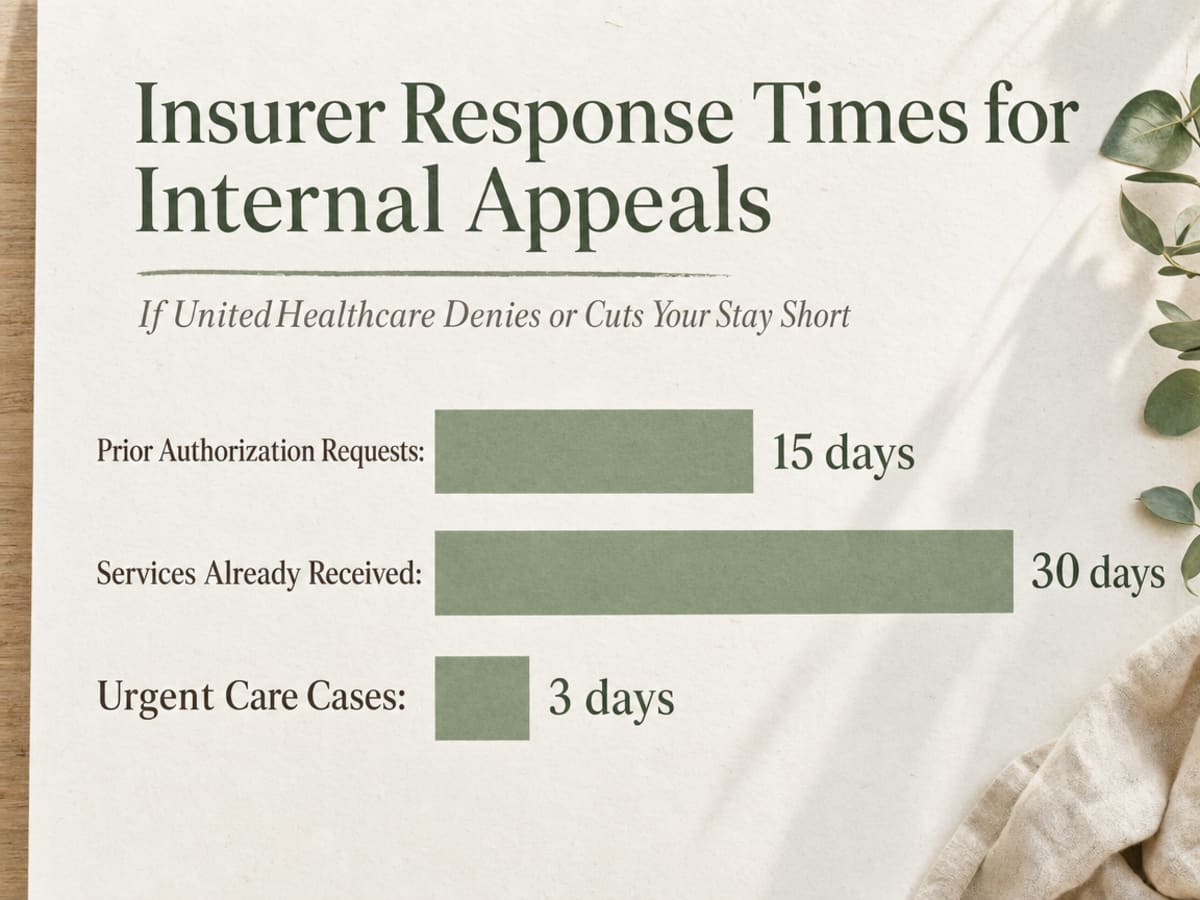
Here is the clock that matters. Once a denial is issued, federal rules give UHC specific windows to respond to an internal appeal, and you generally have 180 days from the denial notice to file one 9. Response time depends on the type of request: 72 hours for urgent care, 15 days for a prior-authorization decision, and 30 days for services you have already received 9. For a patient still inside a detox stay, the urgent-care clock is usually the one that applies.
You do not file this yourself from a hospital bed. The clinical team at Renewal Springs handles peer-to-peer reviews, submits the supporting documentation — withdrawal scores, vitals, substance history, co-occurring diagnoses — and pushes the appeal through on the fastest clock the situation allows. If the answer is still no after internal appeal, there is a second path through Oklahoma’s external review process, which the next section covers. A denial is a step in the conversation, not the end of it.
Your Oklahoma-Specific Rights When the Appeal Doesn’t Go Your Way
If an internal appeal with UnitedHealthcare still ends in a no, Oklahoma gives you a second swing. It is called external review, and it moves your case out of UHC’s hands and into the hands of an independent review organization that has no stake in the outcome. For disputes about medical necessity, appropriateness, setting, level of care, or effectiveness — exactly the kinds of fights that come up with detox denials — external review is often the right next step 8.
Two timelines frame the full runway you have. On the federal side, you generally have 180 days from a denial notice to file an internal appeal with UHC 9. On the state side, once UHC issues its final decision, Oklahoma’s standard external review can take up to 45 days for an independent reviewer to reach a decision, and you generally must request it within four months of that final decision 8. Those two windows, stacked together, mean a denial on day one does not have to be the end of the conversation on day thirty.
A few honest caveats. External review applies to eligible state-regulated plans; if your coverage is a self-funded employer plan, the appeal path runs through federal rules instead, and the Oklahoma Insurance Department can help you figure out which bucket you are in 1. You also do not have to run this process alone. The clinical and billing teams at Renewal Springs assemble the records, physician letters, and medical-necessity documentation that external reviewers actually read. Your job is to keep showing up for your recovery. The paperwork has a path, and the path has deadlines on UHC’s side too.

Medication-Assisted Treatment: A Separate Coverage Question
Here is something worth knowing before admission day: the medications that make opioid detox safer and more effective are usually a separate coverage question from the detox stay itself. Methadone, buprenorphine, and naltrexone are the three FDA-approved medications for opioid-use disorder, and people treated with methadone or buprenorphine are less likely to die or overdose than those who go without 15. These are not optional comfort measures. They are the standard of care.
But UHC may pay for them under a different benefit than the facility stay. The medication itself can sit under your pharmacy benefit. In-facility administration can fall under behavioral health. A buprenorphine induction can be billed as a medical service, while the follow-up prescription runs through your drug plan with its own copay and formulary rules. Each piece can have its own prior-authorization requirement.
The practical takeaway: when admissions verifies your UHC benefits, we check MAT coverage as its own line item — not as an assumption folded into the detox approval. You should not find out on day two that the medication keeping withdrawal manageable is being billed to a benefit you did not know existed.
How Renewal Springs Handles the UHC Verification Call
Here is what happens after you call our Oklahoma City line. An admissions specialist pulls your UHC member information, calls the behavioral-health number on the back of your card, and works through the Five-Variable Check in a single conversation — usually in under an hour. Plan type, network status, level of care, medical-necessity requirements, and whether prior authorization is needed before admission. We confirm cost-sharing in plain numbers you can actually hold onto: what your deductible status is, what your coinsurance looks like, and whether you’ve hit your out-of-pocket maximum.
From there, the clinical team submits the prior-authorization request with the documentation UHC’s reviewers look for — withdrawal severity, substance history, co-occurring conditions, risk factors. If MAT is part of your plan, we verify that benefit separately so there are no surprises on day two. If UHC pushes back, our team handles the peer-to-peer review on the fastest clock the situation allows.
You do not pay for this verification. You do not do the paperwork. Your job right now is to pick up the phone. Ours is everything after.
Get Answers About Your UnitedHealthcare Detox Coverage
Quickly confirm your UHC benefits and get guidance for starting safe, medically supervised detox today.
Frequently Asked Questions
Does UnitedHealthcare cover medical detox for opioid use?
Yes, in most cases. UHC commercial, Marketplace, Medicare Advantage, and Community Plan products typically cover medically necessary detox for opioid dependence, including fentanyl, heroin, and prescription painkiller withdrawal. What varies is the specific setting approved, the length of stay authorized, and your out-of-pocket cost. Renewal Springs holds a strong reimbursement relationship with UnitedHealthcare, and our admissions team confirms your exact benefits before you walk in the door.
How do I find out what my specific UHC plan will pay for detox?
You do not have to figure this out alone. Call our Oklahoma City admissions line with your UHC card nearby, and a specialist verifies your plan type, network status, level of care, medical-necessity requirements, and prior-authorization rules in a single conversation — usually under an hour. Verification is free, and you get cost-sharing numbers in plain terms, not fine print. No portal logins or benefit-summary decoding required on your end.
What happens if UnitedHealthcare denies my detox stay or cuts it short?
A denial starts a process, not the ending. Our clinical team handles peer-to-peer reviews, resubmits with stronger documentation, and files an internal appeal on the fastest clock the situation allows. If internal appeal still ends in no, Oklahoma’s external review moves the case to an independent reviewer with no stake in the outcome 8. You keep focusing on recovery while the paperwork runs through regulated channels with deadlines on UHC’s side.
Is medication-assisted treatment (MAT) covered along with detox?
Usually yes, but it is verified as its own line item. Methadone, buprenorphine, and naltrexone are FDA-approved for opioid-use disorder and reduce overdose risk compared with no medication treatment 15. UHC may pay for the medication under your pharmacy benefit, in-facility administration under behavioral health, and follow-up under medical — each with its own rules. Admissions confirms every piece before day one so nothing surprises you mid-stay.
What if I’m already in withdrawal and can’t wait for prior authorization?
If symptoms are severe — seizures, chest pain, persistent vomiting, hallucinations, or suicidal thinking — that qualifies as an emergency medical condition under federal law, and emergency services generally must be covered without prior authorization 10, 11. Go to an ER or call 911. For urgent-but-stable withdrawal, call our line directly. We can often start the authorization while you are on your way in, so care begins without a wait.
Does a UHC Community Plan (SoonerCare) work the same as a commercial UHC plan?
No. A UHC Community Plan runs through Oklahoma Medicaid, with its own authorization workflow, covered-service list, and continued-stay review rules 12, 13. Prior authorization is required for detox and residential services, and cost-sharing looks different from a commercial plan. That is why plan type is the first thing we confirm from your card. The verification call takes the same amount of time; it just follows a different rulebook.
References
- Mental/Behavioral Health and Insurance. https://www.oid.ok.gov/mental-behavioral-health-and-insurance/
- LH BULLETIN NO. 2020-05. https://www.oid.ok.gov/lh-bulletin-no-2020-05/
- Mental Health Parity and Addiction Equity Act – Oklahoma Insurance Department. https://www.oid.ok.gov/regulated-entities/financial/financial-regulation-forms/mentalhealthparity/
- Fact Sheet: Final Rules under the Mental Health Parity and Addiction Equity Act (MHPAEA). https://www.dol.gov/agencies/ebsa/about-ebsa/our-activities/resource-center/fact-sheets/final-rules-under-the-mental-health-parity-and-addiction-equity-act-mhpaea
- Departments of Labor, Health and Human Services, and Treasury Issue Final Rules under the Mental Health Parity and Addiction Equity Act. https://www.dol.gov/newsroom/releases/ebsa/ebsa20240909
- Field Assistance Bulletin No. 2026-03. https://beta.dol.gov/policy-regulations/reference-materials/guidance-searches/ebsa-field-assistance-bulletin-no-2026-03
- Understanding Your Mental Health and Substance Use Disorder Benefits. https://www.dol.gov/agencies/ebsa/about-ebsa/our-activities/resource-center/publications/understanding-your-mental-health-and-substance-use-disorder-benefits
- External Review Process – Oklahoma Insurance Department. https://www.oid.ok.gov/consumers/external-review-process/
- Internal appeals. https://www.healthcare.gov/appeal-insurance-company-decision/internal-appeals/
- No Surprises: Understand your rights against surprise medical bills. https://www.cms.gov/newsroom/fact-sheets/no-surprises-understand-your-rights-against-surprise-medical-bills
- High level overview of No Surprises Act provider requirements. https://www.cms.gov/files/document/high-level-overview-provider-requirements.pdf
- Mental Health and Substance Abuse Services – Oklahoma.gov. https://oklahoma.gov/ohca/individuals/programs/mental-health-and-substance-abuse-services.html
- Behavioral Health and Substance Abuse Services – Oklahoma.gov. https://oklahoma.gov/ohca/providers/types/behavioral-health-and-substance-abuse-services.html
- Behavioral Health Prior Authorization Procedures – Oklahoma.gov. https://oklahoma.gov/content/dam/ok/en/okhca/docs/providers/types/behavioral-health/OHCA%20BH%20Manual.pdf
- Medications for Opioid Use Disorder. https://nida.nih.gov/research-topics/medications-opioid-use-disorder