Key Takeaways
- Oklahoma City sits inside a real overdose burden, with 1,137 deaths and over 11,000 hospital contacts statewide in 2024, and local detox is built around that mix of alcohol, benzodiazepines, opioids, and meth.5
- Alcohol and benzodiazepine withdrawal can trigger seizures and delirium, so clinical guidelines call for monitored, symptom-triggered medication rather than stopping cold at home.11
- Before choosing where to detox, compare continuous monitoring, physician-led medication protocols matched to your substance, and program tracks like veterans, men-only, women-only, or private care that fit your situation.
- Detox is a door, not a destination — ask what happens after the first week, including MAT continuation, naltrexone or acamprosate for alcohol, and the outpatient handoff planned before discharge.9
What actually happens to your body when you stop
If you’ve been using opioids, drinking heavily, or taking benzodiazepines every day for a while, your brain has quietly rewired itself around those substances. It has turned down its own calming chemistry because the drug was doing that job. Drug detox Oklahoma City can help manage this process safely. It has cranked up the systems that keep you awake, alert, and physically activated because the drug was pressing the brake. When the drug leaves, the brakes come off all at once.
That is what withdrawal actually is. It is not weakness. It is not a bad attitude. It is a nervous system that got used to a chemical passenger and now has to drive alone, at high speed, with no warning.
Depending on the substance, that shift can look like shaking hands and a pounding heart. It can look like sweating through your sheets at 3 a.m. It can look like nausea that will not stop, muscles that feel wrong in your own skin, or a level of anxiety that makes the walls feel too close. With alcohol and benzodiazepines, it can escalate into seizures and delirium, which is why those two are the substances doctors will tell you never to stop cold at home.
Reading this page is already the hard part. You’re doing something people in active dependence rarely do: you’re looking at the medical reality instead of looking away.
The rest of this article walks through what withdrawal actually does to your body, substance by substance, and how a medical detox team in Oklahoma City handles each one. Not to scare you. To give you the honest picture, so that when you make the call, you already know what you’re asking for.
Why Oklahoma City sits inside a specific overdose picture
If you’re looking for detox in Oklahoma City, the odds you’re facing are not abstract. They are counted, tracked, and published by the state health department every year.
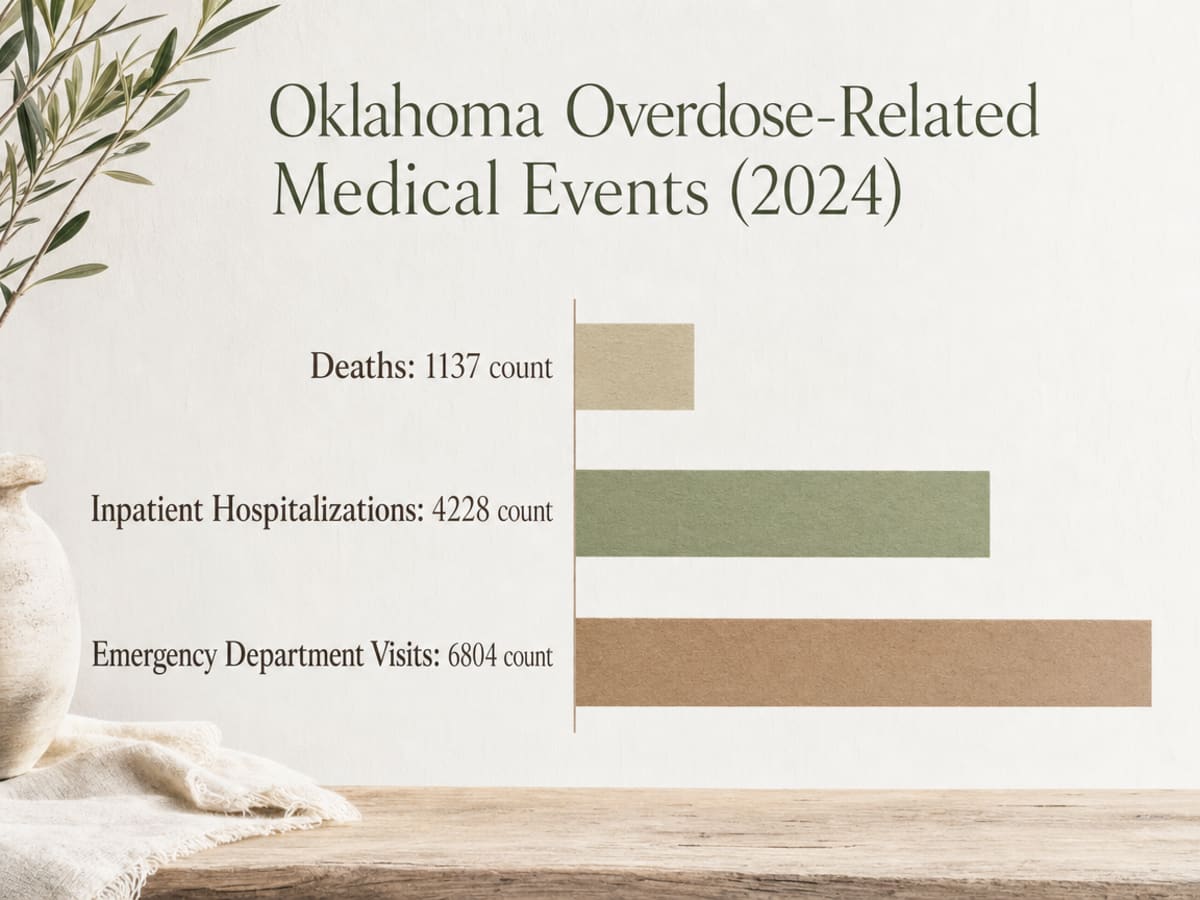
In 2024 alone, Oklahoma recorded 1,137 overdose deaths, 4,228 inpatient hospitalizations for overdose, and 6,804 emergency department visits for overdose. Read those three numbers together for a second. The deaths get the headlines, but the two larger numbers, more than 11,000 hospital contacts, are people who survived, often after a night of unmanaged withdrawal, a relapse, or a dose that landed differently than the last one. Those are the encounters medical detox is designed to prevent.5
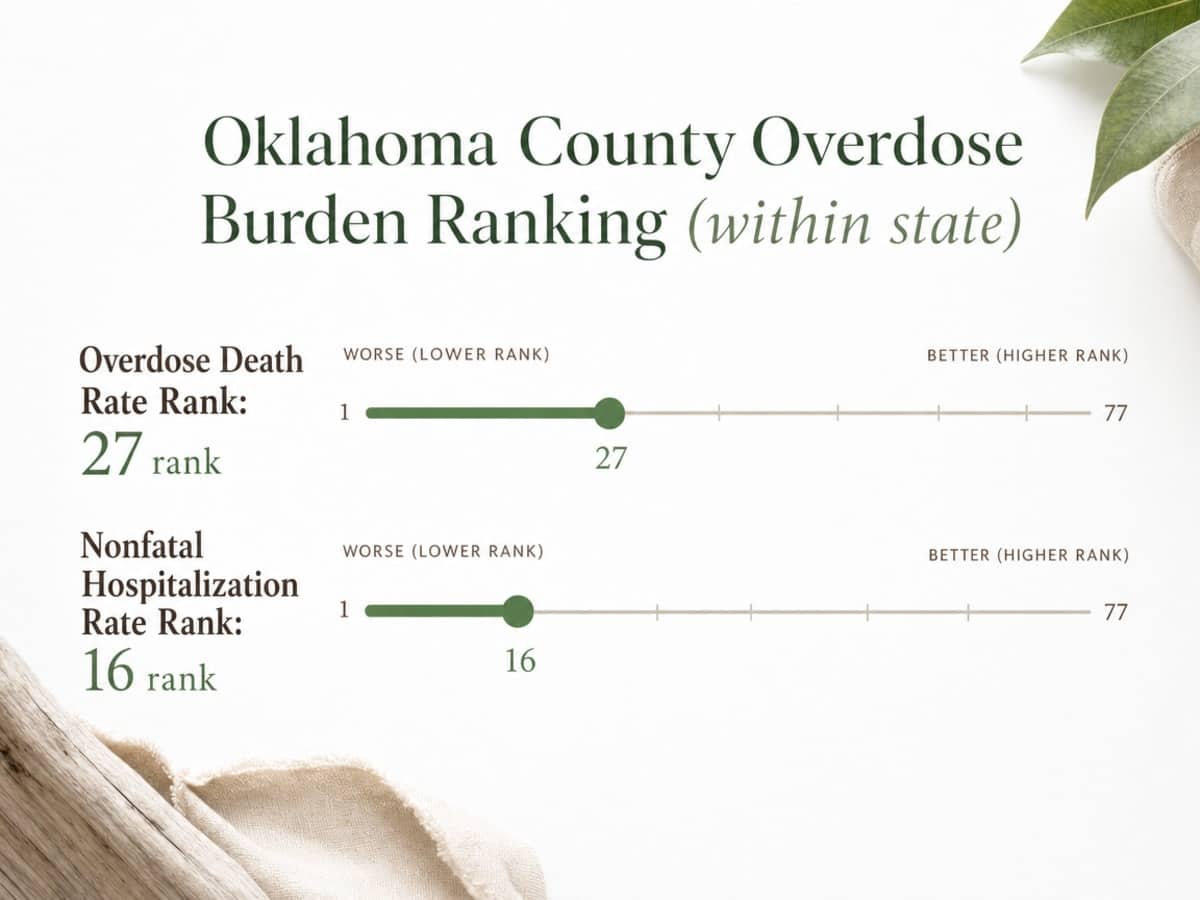
Oklahoma County, where Oklahoma City sits, is not the worst county in the state, and you don’t need it to be. The county fact sheet ranks it 27th in overdose death rate and 16th in nonfatal overdose hospitalization rate. What that mid-to-high burden actually means on the ground is that local emergency rooms, EMS crews, and detox admissions staff see this every shift. You are not an unusual case walking through the door.3
The substances driving those numbers in Oklahoma County are the same ones that make withdrawal medically serious: methamphetamine, fentanyl, heroin, alcohol, and benzodiazepines. That mix is the reason the rest of this page is broken up by substance instead of lumped into one generic detox conversation. What your body is doing right now depends on what it’s been getting, and how a medical team responds should match that.4
You are reading this from inside a real local picture, not a national statistic. That matters, because the help is also local, and it is closer than the numbers make it feel.
Alcohol withdrawal: the one you cannot ride out at home
If you drink heavily every day, or almost every day, and it has been more than about six hours since your last drink, your body is already in early withdrawal. That shaky feeling in your hands, the sweat on the back of your neck, the sudden anxiety that showed up before you were even fully awake — that is not you being weak. That is your central nervous system in a chemical panic.
What that looks like in practice inside a medical detox: a nurse or physician assesses how severe your withdrawal is right now, usually with a scoring tool that tracks tremor, pulse, sweating, agitation, and orientation. Based on that score, benzodiazepines are given at doses matched to your symptoms, not on a fixed schedule that either undertreats or oversedates you. Fluids, electrolytes, thiamine, and other supportive care go in alongside. Your vitals get watched around the clock so that if the picture changes at 3 a.m., someone is there to change the plan.
That is the difference between a bedroom in Oklahoma City and a medical detox bed in Oklahoma City. It is not comfort versus toughness. It is monitored pharmacotherapy versus an unmonitored seizure.
One more thing worth being direct about: acute withdrawal management and long-term treatment for alcohol use disorder are two different clinical conversations. Medications like naltrexone, acamprosate, and disulfiram are for the months after you are stable, not the first 72 hours. Detox handles the dangerous window. What comes next handles the life you are building on the other side of it.9
If you are already shaking, sweating, or counting the hours since your last drink, that is the signal to call today. Not tomorrow morning. Today. Renewal Springs’ Oklahoma City team does same-day intake specifically because alcohol withdrawal does not wait politely for business hours.
Benzodiazepine withdrawal: slow, medical, and never cold turkey
Xanax, Klonopin, Valium, Ativan. If you’ve been taking any of these daily for more than a few weeks — prescribed or not — your brain has adapted around them in a way that makes suddenly stopping medically dangerous. Benzodiazepines work on the same calming system alcohol touches, which is why the withdrawal risk profile looks similar: seizures, severe anxiety that tips into panic, insomnia that becomes its own emergency, and in the worst cases, a delirium picture that can last for days.
Here is what makes benzo withdrawal different from alcohol: the timeline is longer and slower. Short-acting benzos like Xanax and Ativan can push symptoms into the open within 24 hours. Longer-acting ones like Valium and Klonopin may not peak for a week or more. That extended window is why cold-turkey stopping is never the plan. The clinical approach is a structured taper — usually a switch to a longer-acting benzodiazepine dosed on a schedule that steps down gradually, so your nervous system is never left without a floor underneath it.
Inside a medical detox, that taper is not a guess. A physician sets the starting dose based on how much you’ve been taking and for how long, then adjusts it against your symptoms and vitals. Blood pressure, heart rate, tremor, and mental status get tracked around the clock. If something shifts, the taper shifts.
If you have been trying to stop benzodiazepines on your own and you’re already anxious, sleepless, or feeling waves of unreality, that is not you failing. That is a medical taper being asked to happen without a doctor. Call today. Renewal Springs’ Oklahoma City team can take that taper off your shoulders and put it in clinical hands where it belongs.
Opioid withdrawal: fentanyl, heroin, and prescription painkillers
Opioid withdrawal usually will not kill you. That sentence gets misread every day by people in Oklahoma City trying to white-knuckle it in a bedroom, and it is why so many of them are back to using within 48 hours. Not dangerous does not mean survivable on your own. It means a different kind of medical emergency: the kind where the pain of the withdrawal itself sends you back to the drug, and the drug you go back to is now fentanyl, and the dose your body used to handle is no longer the dose your body can handle.
Here is what your nervous system is actually doing. If you have been using heroin, prescription painkillers, or fentanyl daily, your brain has dialed down its own opioid production and turned up the systems that regulate pain, mood, and gut motility. Take the drug away and everything it was suppressing comes back at once, loud. With short-acting opioids like heroin and most pills, symptoms usually start 8 to 24 hours after the last dose. With fentanyl, the timeline is trickier — some people feel it inside 8 hours, others get hit harder on day two or three because fentanyl and its analogs store in body tissue and release unevenly.
What that feels like: bones that ache like the flu turned up ten times, sweating and chills at the same time, restless legs that will not stop moving, diarrhea and vomiting that leaves you dehydrated within a day, waves of anxiety, and a specific kind of insomnia where your body is exhausted and your nervous system will not let you sleep. None of it is dignified. All of it is treatable.
Inside a medical detox in Oklahoma City, opioid withdrawal is handled with medication-assisted treatment — usually buprenorphine, sometimes methadone, dosed to your symptoms rather than left to a clock. MAT is not swapping one drug for another. It is stabilizing the opioid receptors that are screaming, so your body stops crashing and you can actually think. Clonidine, anti-nausea medication, sleep support, and IV fluids fill in the gaps. Vitals get watched around the clock because the biggest opioid-specific risk during detox is dehydration and electrolyte loss from vomiting and diarrhea, especially in people who came in already run down.
Oklahoma County’s overdose picture has fentanyl and heroin sitting at the center of it. That matters for one reason above all: if you leave detox and relapse on today’s fentanyl supply, the tolerance you had a week ago will not protect you. Medical detox is the safer window to stop, and it is also the setup for what comes next — the medications and support that keep you from being that statistic on the way back out.4
Stimulant withdrawal: meth, cocaine, and the psychiatric crash
Stimulant withdrawal fools people. Because it usually will not put you in a seizure or a hospital bed, a lot of Oklahoma Citians who use methamphetamine or cocaine assume they can just sleep it off. Then day two arrives.
Here is what actually happens when you stop. Meth and cocaine flood your brain with dopamine while you’re using. Your brain, being a brain, adapts by dialing its own dopamine production way down. When the drug leaves, that dial does not spring back overnight. What you feel instead is called the crash: bone-deep exhaustion that sleep does not fix, an appetite that comes back in confusing waves, and a flat, colorless mood where nothing feels like it used to. With meth especially, that flatness can slide into serious depression, paranoia that lingers, and suicidal thinking that shows up somewhere between day two and day ten.
Methamphetamine is one of the substances driving Oklahoma County’s overdose picture, and the psychiatric window after stopping is where a lot of people relapse — not because they crave the high, but because they cannot tolerate feeling this empty.4
Medical detox for stimulants is less about tapering a drug and more about protecting you through the crash. That means around-the-clock monitoring for suicidal ideation and psychosis, sleep and nutrition support, medications for anxiety and depression when clinically appropriate, and a structured environment so the worst 72 hours happen somewhere safe.
What continuous monitoring changes about a 72-hour window
Here is the honest truth about the first 72 hours of withdrawal: symptoms move faster than a nurse checking in every four hours can catch. Blood pressure can climb between rounds. A pulse that was 92 at midnight can be 128 at 2:15 a.m. Sleep quality — or the total lack of it — is one of the earliest warning signs that alcohol or benzodiazepine withdrawal is heading somewhere serious, and it is invisible to anyone who is not actually sitting in the room with you.
That gap is what continuous monitoring closes. At Renewal Springs, wearable biotech from Huml Health tracks heart rate, respiratory rate, sleep patterns, and stress signals in real time, feeding that data to the medical team around the clock. What changes clinically is not the medication list. It is the timing. Symptom-triggered dosing, the approach recommended in the ASAM alcohol withdrawal guideline, only works if someone actually catches the symptom. A wearable that flags a rising heart rate at 2 a.m. lets the nurse walk in with the right dose before the shakes turn into something worse. Without it, the same nurse finds out at the next scheduled check, and by then the window for a smaller intervention has closed.11
The reason this matters right now is written into the state data. Oklahoma’s unintentional drug overdose death rate rose 77% from 2020 to 2023, then dropped 15% from 2023 to 2024. That downturn is not a signal to relax. It is a signal that the treatment infrastructure being built around this crisis — medical detox, MAT access, monitoring — is beginning to work, and that the people who reach it are the ones who benefit from it. Riding withdrawal out at home does not put you on that curve. Getting into a monitored bed does.2

Who each Renewal Springs track is actually built for
A detox facility that runs one track for everyone is really running a track for no one. The reason Renewal Springs splits its programs into veterans, men-only, women-only, and private care is not a marketing shelf — it is a clinical fit question. What makes you feel safe enough to actually stay through the worst 72 hours is not the same for every person walking in.
The veterans track exists because service-connected trauma, chronic pain from old injuries, and prescribed opioid or benzodiazepine histories often layer on top of each other. Detox for a veteran is rarely just about the substance. It is about a nervous system that has been running hot for years, and clinicians who know to expect that in the room.
The men-only and women-only tracks exist because withdrawal strips you down. For women, that often means confronting histories of trauma that make a mixed-gender unit feel unsafe at exactly the moment safety matters most. For men, it often means being able to sit with fear and exhaustion without the reflex to perform being fine. Same clinical protocols. Different rooms, different group dynamics.
The private and luxury option exists for people whose jobs, families, or public lives make discretion part of whether they will actually check in at all. A quieter setting is not a lesser medical setting — the monitoring, the medications, and the physician oversight are the same.
Oklahoma County ranks 27th in the state for drug overdose death rate and 16th for nonfatal overdose hospitalizations. That mid-to-high burden means the people arriving at detox here are not a narrow demographic. They are veterans, they are working parents, they are professionals, they are young adults, they are grandparents. One track cannot hold that range well. Four can.3
What detox connects to after the first week
Detox is a door, not a destination. Once your vitals are stable, sleep is starting to come back, and the acute withdrawal has passed, the clinical work shifts. The nervous system that just got through the storm is still raw, and the cravings that show up in week two are different from the ones you felt in hour twelve. They are quieter, more patient, and much better at waiting for a bad day.
What comes next depends on the substance and the person. For opioid use, that often means continuing medication-assisted treatment — buprenorphine or naltrexone — in an outpatient setting so your receptors keep getting the support they need. For alcohol use disorder, the conversation moves from benzodiazepines used for withdrawal to medications like naltrexone, acamprosate, or disulfiram, which are built for the months after you are stable rather than the first 72 hours. For stimulants, the follow-through is heavier on therapy, structured routine, and psychiatric care.9
Renewal Springs plans that handoff before you leave, whether it is residential treatment, an intensive outpatient program, or a lower-intensity outpatient track with medication management. Getting through detox is worth doing on its own. Getting through detox with somewhere to go next is what turns a hard week into a foothold.
When to call today, and what happens when you do
Here is the short version of when the phone call cannot wait. If you drink heavily every day and it has been more than six hours since your last drink, and your hands are shaking, you are sweating, or the anxiety is climbing — call today. If you have been taking Xanax, Klonopin, Ativan, or Valium daily and you have already stopped or cut back on your own, and you feel waves of panic, unreality, or your sleep is gone — call today. Alcohol and benzodiazepine withdrawal do not wait politely for Monday morning, and the window where a smaller intervention works is the window you are in right now.
What happens when you pick up the phone is not a sales pitch. A person on the other end asks what you have been using, how much, and how long. They ask when your last dose or last drink was. They verify your insurance while you are still on the line, so you are not left wondering what this costs. If your symptoms sound like they are already moving, they get you in the same day.
Once you are on-site in Oklahoma City, a nurse and a physician assess where your withdrawal actually is, not where it was an hour ago. Medications get started. Vitals and continuous monitoring go on. Someone stays with you through the first night.
You do not have to be ready. You have to make the call.
Talk to a Medical Detox Specialist Now
Connect directly for fast answers about safe, professional drug detox in Oklahoma City.
Frequently Asked Questions
Is it dangerous to stop drinking or using drugs on my own at home?
For alcohol and benzodiazepines, yes — genuinely dangerous. Both can trigger seizures and, less commonly, delirium tremens, which is why clinical guidelines call for risk assessment, monitoring, and symptom-triggered medication rather than a wait-and-see approach. Opioid and stimulant withdrawal usually will not kill you directly, but dehydration, psychiatric crisis, and relapse onto today’s fentanyl supply carry their own serious risks. Medical detox exists to close all four of those gaps.11
How long does drug detox in Oklahoma City usually take?
Acute withdrawal is typically a 3 to 7 day window, but the honest answer depends on what you were using. Short-acting opioids and alcohol tend to move through the worst 72 to 96 hours quickly. Long-acting benzodiazepines like Valium or Klonopin often require a slower taper that runs longer. Stimulant crashes ease physically in a few days but the psychiatric piece stretches further. Your medical team sets length based on your vitals and symptoms, not a calendar.
Can I get into detox the same day I call?
Yes. Renewal Springs’ Oklahoma City team runs same-day intake specifically because alcohol and benzodiazepine withdrawal cannot wait for a Monday appointment. When you call, someone asks what you’ve been using, how much, and when your last dose or drink was. Insurance gets verified while you’re still on the line. If your symptoms are already moving — shaking, sweating, anxiety climbing — they get you in that day. You do not need paperwork ready to make the call.
What medications are used during medical detox?
It depends on the substance. Alcohol withdrawal is managed with benzodiazepines dosed to your symptoms, plus fluids, thiamine, and electrolytes. Opioid withdrawal is managed with medication-assisted treatment — usually buprenorphine, sometimes methadone — along with clonidine and anti-nausea support. Benzodiazepine withdrawal uses a structured taper, often switching to a longer-acting benzo. Stimulant detox focuses on sleep, nutrition, and psychiatric medication when needed. Post-detox medications like naltrexone or acamprosate for alcohol use disorder come later.9
Does insurance cover drug and alcohol detox in Oklahoma?
Most major insurance plans cover medically supervised detox as a medical necessity, and Renewal Springs accepts most major providers. Coverage specifics — deductibles, length of stay, in-network status — vary by plan, which is why benefits verification happens on the first phone call rather than after you arrive. You will know what your plan covers before you commit to admission. Cost should not be the reason someone in active alcohol or benzodiazepine withdrawal delays making the call today.
What happens after I finish detox?
Detox stabilizes you. The next layer keeps you stable. Depending on the substance and your situation, that handoff might be residential treatment, an intensive outpatient program, or lower-intensity outpatient care with medication management. Opioid recovery often continues with buprenorphine or naltrexone. Alcohol use disorder often shifts to medications built for the months after withdrawal. Renewal Springs plans that transition before you discharge, so the door detox opens has somewhere real on the other side of it.9
References
- Drug Overdose Data Dashboard – Oklahoma.gov. https://oklahoma.gov/health/health-education/injury-prevention-service/drug-overdose/data/drug-overdose-data-dashboard.html
- Data – Oklahoma.gov. https://oklahoma.gov/health/health-education/injury-prevention-service/drug-overdose/data.html
- OKLAHOMA COUNTY. https://oklahoma.gov/content/dam/ok/en/health/health2/aem-documents/prevention-and-preparedness/injury-prevention/drug-overdose/county-fact-sheets/Drug%20Overdose%20County%20Fact%20Sheet%20-%20Oklahoma.pdf
- OKLAHOMA COUNTY. https://digitalprairie.ok.gov/digital/api/collection/stgovpub/id/641307/download
- PowerPoint Presentation. https://oklahoma.gov/content/dam/ok/en/health/health2/aem-documents/prevention-and-preparedness/injury-prevention/drug-overdose/Drug%20Overdose%20Data%20Graphs%20and%20Maps.pdf
- Provisional County Drug Overdose Deaths. https://www.cdc.gov/nchs/nvss/vsrr/prov-county-drug-overdose.htm
- DOSE-DIS Dashboard: Nonfatal Overdose Emergency Department and Inpatient Hospitalization Discharge Data. https://www.cdc.gov/overdose-prevention/data-research/facts-stats/dose-dashboard-nonfatal-discharge-data.html
- SUDORS Dashboard: Fatal Drug Overdose Data. https://www.cdc.gov/overdose-prevention/data-research/facts-stats/sudors-dashboard-fatal-overdose-data.html
- Medication for the Treatment of Alcohol Use Disorder. https://library.samhsa.gov/product/medication-treatment-alcohol-use-disorder-brief-guide/sma15-4907
- Drug Overdose Deaths in the United States, 2001–2024. https://www.cdc.gov/mmwr/volumes/74/wr/mm7419a1.htm
- The ASAM Clinical Practice Guideline on Alcohol Withdrawal Management. https://www.ncbi.nlm.nih.gov/pmc/articles/PMC6037502/