
Drug Treatment Centers in Oklahoma City: 24/7 Admissions
Key Takeaways
- Medical detox in Oklahoma City can begin the same day you call, since 2024 federal rule changes to 42 CFR Part 8 removed the one-year opioid history requirement and allow clinician judgment on admission 2.
- Detox and rehab are separate steps: three to seven days of monitored withdrawal management comes first, with residential or outpatient therapy following once your spouse is medically stable.
- Alcohol and benzodiazepine withdrawal can be fatal without supervision, while opioid withdrawal responds to buprenorphine induction — the substance involved determines which local facility and protocol fits your situation.
- Ask about the post-detox handoff before admission, not after; in 2022 only 25.1% of adults needing OUD treatment received medication for it, and day six is where recovery most often breaks down 9.
You’ve Already Done the Hardest Part
If you’re reading this, you’ve probably been carrying something heavy for longer than anyone around you realizes. Maybe you searched at 2 a.m. Maybe your partner is asleep in the next room, or on the couch, or hasn’t come home yet. Either way, you opened a browser and typed the words. That counts. It’s the hardest step, and you already took it.
Here’s what you need to hear before anything else: your spouse can start medically supervised detox in Oklahoma City today. Not next week. Not after a waiting list. Under the federal rules that took effect in 2024, admission no longer requires a documented one-year history of opioid use or two failed withdrawal attempts — a clinician can admit based on judgment and current need 2.
This article is written for you, not for your husband or wife. You’re the one making calls, checking insurance cards, and trying to figure out if it’s safe to let them go one more night without help. The next few sections will walk you through what medical detox actually is (and isn’t), what happens in the first hour after you call, how insurance verification works in real time, and how to make sure day six doesn’t undo day one. Take a breath. You’re in the right place.
Medical Detox Is Not Rehab — And Why That Distinction Matters Tonight
Most people use “detox” and “rehab” as if they mean the same thing. They don’t, and mixing them up is one of the reasons families lose weeks they didn’t have to lose.
Medical detox is the short, medically supervised window when your spouse’s body clears a substance and gets through acute withdrawal safely. It usually runs three to seven days depending on what they’ve been using and how long. Nurses check vital signs around the clock. A physician orders medications to manage seizures, dangerous blood pressure spikes, nausea, agitation, and cravings. For opioid dependence, that often means starting buprenorphine or another FDA-approved medication under supervision 3. For alcohol or benzodiazepines, it means benzodiazepine tapers and monitoring for seizures and delirium tremens under ASAM’s clinical framework 11. The goal isn’t insight or behavior change. The goal is that your partner survives withdrawal and comes out the other side stable enough to think clearly.
Rehab — residential treatment, intensive outpatient, therapy, group work, aftercare — is what happens next. It’s where the psychological, behavioral, and life-rebuilding work lives. Rehab can last thirty, sixty, or ninety days, sometimes longer. It assumes someone is medically stable enough to sit in a room and do the work. Someone actively withdrawing from alcohol or fentanyl usually is not.
You don’t have to have the whole plan solved tonight. You just need the right door. If withdrawal has started or is close, medical detox is where you’re aiming — and you can call that door directly, without a referral from a rehab or a primary care doctor first.
What Actually Happens When You Call at 2 A.M.
The First Phone Call: What They’ll Ask and What You Should Have Ready
The person who picks up the phone at a medical detox center at 2 a.m. is not a receptionist reading a script. It’s usually an intake clinician or nurse who has done this call hundreds of times. They know you’re scared. They know your voice might shake. They will not ask you to explain how it got this bad.
They’ll ask a short list of practical questions:
- What substance is your partner using, and how much on a typical day?
- When was the last drink, last pill, last dose?
- Are they still breathing normally right now, or are you worried about an immediate medical emergency? (If it’s the second one, they’ll tell you to hang up and call 911 — detox admits people who are stable enough to walk in, not actively overdosing.)
- Any history of seizures, past withdrawals, other medical conditions like diabetes or heart problems, and current prescriptions.
Here’s what helps if you can grab it before you dial: your insurance card, your partner’s date of birth, a rough list of what they’ve been taking and for how long, and the name of any doctor they see. If you don’t have all of that, call anyway. Missing information is not a barrier to admission. Getting them onto the phone with a clinician is what matters at this hour.
Insurance Verification in Real Time
The insurance question is usually the one that keeps a spouse frozen in the driveway. You don’t know your deductible. You don’t know if detox is covered. You’re not sure if calling your employer’s HR line will out your partner at work. Take a breath — most of this gets handled on the same call, and you don’t have to have the answers before you dial.
Here’s how it actually works. Once you give the intake team your insurance card number and your partner’s date of birth, they run a benefits verification directly with the insurer, often in under an hour. They’re checking whether the plan is in-network with the facility, what level of care is covered (medical detox is typically classified as inpatient or residential), whether prior authorization is required, and where your deductible and out-of-pocket maximum currently sit for the year. Most commercial plans, Medicaid managed care in Oklahoma, and many veteran benefits cover medically necessary detox.
You should hear back with plain-English numbers: what your responsibility looks like, what the plan covers, and whether the facility is willing to work with any gap. Ask directly. If prior authorization is needed, the facility handles that call with the insurer, not you. If a plan is out-of-network, ask whether single-case agreements or self-pay options are on the table before you assume the door is closed. Verification is a step, not a verdict — and it happens while your partner is still on the couch, not after they’ve packed a bag.
Clinical Assessment and the First 24 Hours
Once benefits check out and a bed is confirmed, admission moves quickly. Under the 2024 federal rule governing opioid treatment programs (42 CFR Part 8, effective April 2, 2024, with a compliance date of October 2, 2024), the old barriers to fast admission are gone. Adult patients no longer need a documented one-year history of opioid addiction, and clinicians can admit based on their own judgment of current need 1, 2, 16. Telehealth intake was also expanded, which means the initial evaluation can start before your partner is physically through the door in some cases 1.
What that looks like in practice for you: arrival, a brief intake with photo ID and paperwork, and then a private clinical assessment. A physician or nurse practitioner reviews vital signs, medical history, substance use pattern, mental health history, and any medications your partner is currently taking. They calculate withdrawal severity using standardized tools (CIWA for alcohol, COWS for opioids) and write orders for the medications and monitoring your spouse will need over the next several days. For opioid dependence, that often means starting buprenorphine or another FDA-approved medication once withdrawal symptoms are far enough along 3. For alcohol or benzodiazepines, it means a benzodiazepine taper and close monitoring for seizures.
Within the first 24 hours, your partner is in a monitored bed, symptoms are being actively managed, and someone is checking on them every few hours. You can breathe. The phone call worked. The rest of the plan can be built from here.
How the 2024 Federal Rule and Oklahoma’s Chapter 70 Changed Admission Speed
For years, the frustrating part of trying to get a spouse into medical detox wasn’t just finding a bed — it was clearing paperwork built for a slower era. That changed in 2024, and it’s worth understanding why, because those changes are the reason your phone call tonight can turn into an admission tomorrow morning.
At the federal level, the revised 42 CFR Part 8 rule went into effect on April 2, 2024, with a compliance date of October 2, 2024 16. The old admission criteria for opioid treatment programs required documenting a one-year history of opioid addiction for adults, and two unsuccessful withdrawal-management attempts for minors. Both of those requirements are gone 2. A clinician can now admit based on current clinical need and their own professional judgment, and telehealth is a formally accepted part of the intake process 1. In practical terms, that means the intake nurse taking your call is not required to build a year-long paper trail before your husband can walk into a bed. She can assess, decide, and admit.
Oklahoma’s rules moved in the same direction. ODMHSAS Chapter 70 — the state’s Standards and Criteria for Opioid Treatment Programs — took effect on October 30, 2024, aligning Oklahoma’s certification, staffing, and service definitions with the new federal framework 17. Proposed 2025 revisions to Chapter 70 continue to refine how OTPs coordinate with other services, including stand-alone medication units that require joint SAMHSA and ODMHSAS approval 18. This matters for your family because detox centers in Oklahoma City don’t operate in isolation — they hand off to OTPs and outpatient providers for the medication-assisted treatment that comes after acute withdrawal, and those handoff channels are now clearer than they were even eighteen months ago.
You don’t need to memorize any of this. You just need to know that if someone at a detox center tells you your partner has to prove a year of use, or wait for a Monday morning committee, that’s not the current standard of care. The rule changed. The door is faster than it used to be.
What Withdrawal Actually Looks Like by Substance
Alcohol and Benzodiazepines: Why Medical Supervision Is Non-Negotiable
Here’s what happens in the body. Both alcohol and benzos calm the brain’s electrical activity. When they’re taken away suddenly after long, heavy use, the brain rebounds — hard.
- First 6 to 24 hours: tremors, sweating, racing heart, anxiety that feels bottomless.
- Between 12 and 48 hours: some people have withdrawal seizures.
- Between 48 and 96 hours: a smaller group develops delirium tremens: severe confusion, hallucinations, dangerously high blood pressure, and heart strain.
ASAM’s clinical practice guideline identifies hospitalized adults with alcohol withdrawal as the population where structured medical management makes the difference between a rough few days and a medical emergency 11. SAMHSA hosts a companion pocket guide that operationalizes the same protocols in day-to-day care 10.
In a medical detox setting, a physician orders a benzodiazepine taper — usually longer-acting medications given on a schedule that quiets the rebound without stopping it cold. Nurses monitor vital signs, hydration, and mental status. That’s what your partner needs. Not willpower. Not a garage.
Opioids, Including Fentanyl: What Buprenorphine Induction Looks Like
Opioid withdrawal is rarely fatal on its own, but it is one of the most brutal things a human body can go through — and with fentanyl in the picture, the timing has gotten stranger and harder to predict. Your spouse may describe it as the worst flu of their life multiplied by ten: bone-deep aching, cramping, sweating and chills at the same time, uncontrollable diarrhea and vomiting, restless legs that won’t let them sleep, and cravings that feel like a scream inside the chest.
Here’s what changes that experience: buprenorphine. It’s an FDA-approved medication that eases withdrawal safely and, when continued after detox, keeps the risk of return-to-use much lower. CDC states plainly that medications for opioid use disorder are especially effective and that adding medication increases the chance of success 3.
Induction — the clinical word for starting buprenorphine — is not immediate. Your partner has to be far enough into withdrawal that the first dose helps instead of pushing them deeper (a problem called precipitated withdrawal, which is worse with fentanyl because it lingers in body fat). In practice, that often means waiting 12 to 24 hours after the last opioid use before the first dose. In a monitored bed, nurses use the COWS scale to know when the moment is right. Then relief comes, usually within an hour.
Stimulants, Kratom, and Polysubstance Cases
Stimulant withdrawal — methamphetamine, cocaine, high-dose Adderall — doesn’t look like the shaking-and-sweating picture most people expect. It looks like a crash. Your husband may sleep for eighteen hours, wake up unable to feel pleasure, and sink into a heavy depression with cravings that come in waves. There’s no FDA-approved medication that treats stimulant withdrawal the way buprenorphine treats opioids, but medical supervision still matters. Suicidal thinking during the crash is real, and a monitored setting keeps your partner safe while the brain’s dopamine system resets.
Kratom withdrawal behaves more like a milder opioid withdrawal — restlessness, muscle aches, insomnia, GI symptoms — because kratom’s active compounds hit some of the same brain receptors. It responds to similar clinical approaches, sometimes including short-course buprenorphine.
Polysubstance cases — alcohol plus opioids, benzos plus fentanyl, stimulants plus everything else — are the norm, not the exception. That’s exactly why a medical detox admission with a physician making the call, rather than a one-size protocol, is what your spouse actually needs.
Urgency Hasn’t Left Oklahoma, Even as National Numbers Fall
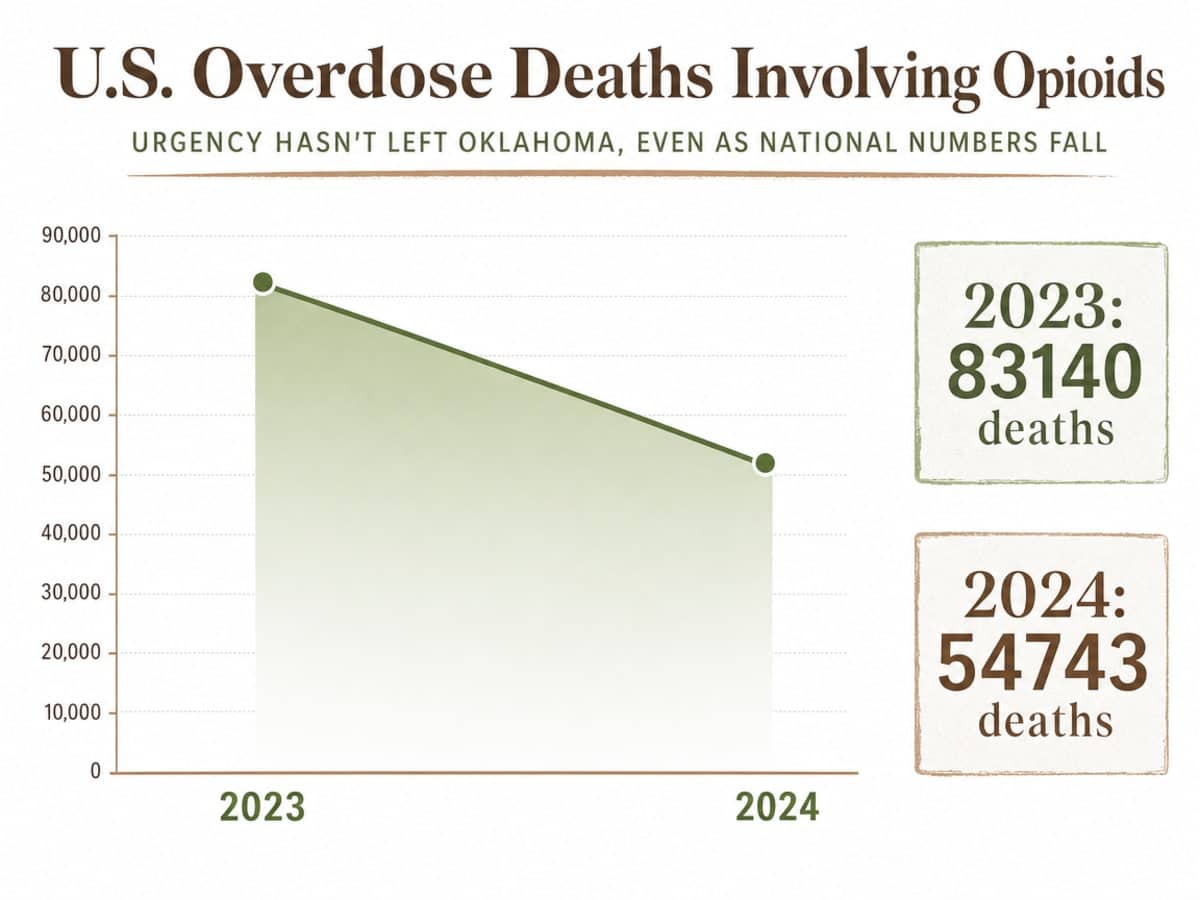
There’s a piece of good news worth naming, because you probably haven’t heard it in the middle of everything you’re carrying. Nationally, overdose deaths involving opioids dropped from an estimated 83,140 in 2023 to 54,743 in 2024 — a decline of nearly a third in a single year 5. That is not a rounding error. It’s the largest one-year drop the country has ever recorded, and it represents tens of thousands of families who did not get the phone call you’ve been afraid of.
Hold that number lightly, though. A national average is not your kitchen. Oklahoma’s overdose burden is tracked in real time by the Oklahoma State Department of Health’s Drug Overdose Data Dashboard, which shows county-level counts and rates for both fatal overdoses and hospital discharges — including Oklahoma County 19. When you look at the dashboard’s county map, the picture is more textured than the headline. Fentanyl is still on the street. Methamphetamine is still in circulation. Nonfatal overdose ED visits, tracked separately by CDC at the county level, remain a meaningful signal of acute demand for detox and stabilization services 20.
What this means for your Tuesday night is simple. The national trend is moving the right way, and that is worth breathing into. It also doesn’t change what’s true about your spouse right now. Progress at the country level doesn’t shorten the half-life of the drug in your husband’s system, or make your wife’s morning shakes any less dangerous. The window to act is still today. The direction of the numbers is a reason for hope, not a reason to wait.
Day Six Is the Cliff: Planning the Post-Detox Handoff Before Admission
Here’s the thing nobody warns a spouse about at intake: the most dangerous moment in this whole process isn’t day one. It’s day six. Your partner will have made it through the worst of withdrawal. They’ll feel physically better. Their eyes will be clearer than they’ve been in months. And unless a next step is already scheduled — not “talked about,” scheduled — that clarity can evaporate within 72 hours of discharge.
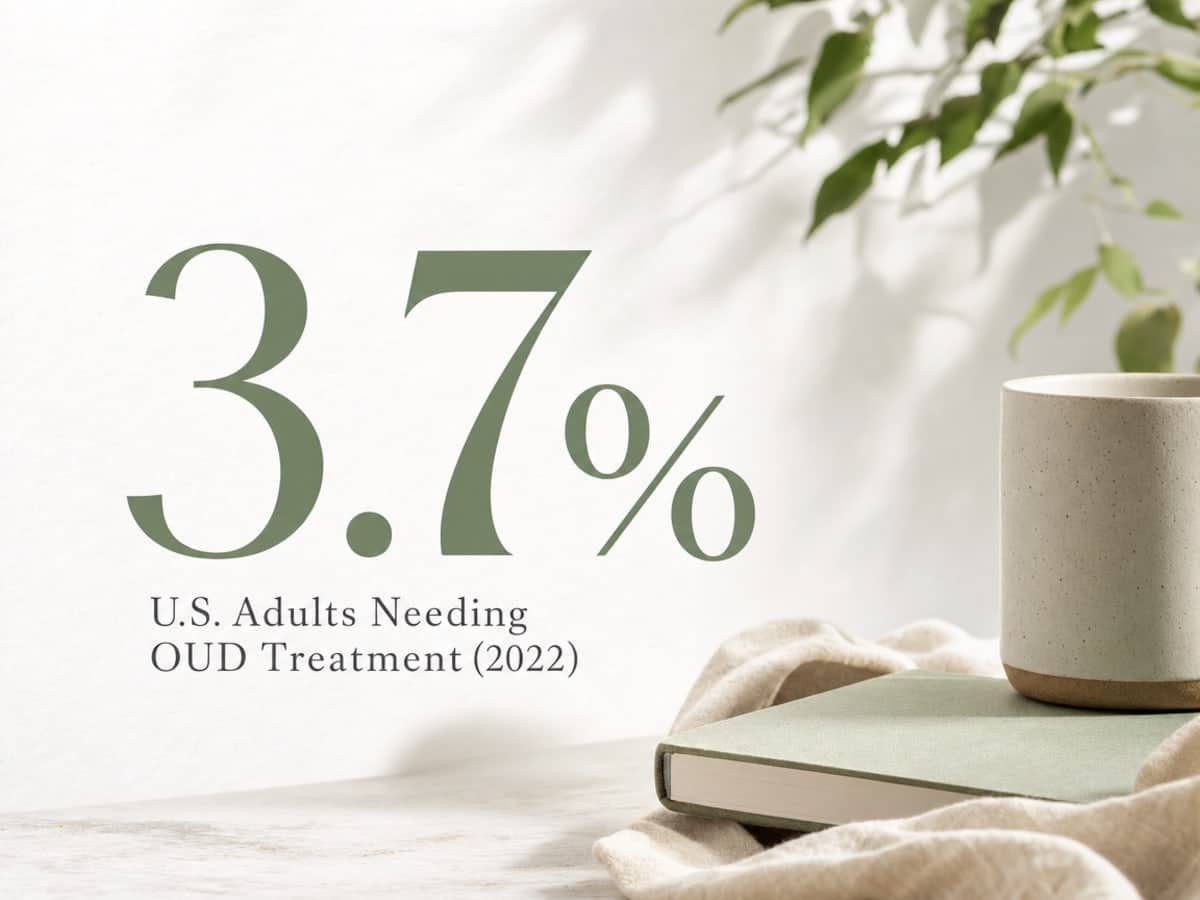
The national data on this gap is stark. In 2022, 3.7% of U.S. adults needed treatment for opioid use disorder, but only 25.1% of them actually received medications for opioid use disorder 9. Three-quarters of people who needed the medication that most reliably prevents return-to-use didn’t get it. That gap doesn’t happen because families don’t care. It happens because the post-detox handoff usually gets built in the last twenty-four hours of a five-day stay, when everyone is exhausted and the paperwork feels like a small problem compared to the crisis that just ended.
Flip that sequence. Ask about the handoff before your spouse is admitted, not after. Concrete questions to raise on the intake call:
- Does the detox facility coordinate directly with an opioid treatment program or outpatient MAT provider for the medication bridge?
- If your partner starts buprenorphine during detox, who is prescribing it on day eight, day fifteen, day thirty?
- Is there a residential rehab bed reserved for the day of discharge, or is that a call you’ll be making from the parking lot?
Oklahoma’s Chapter 70 standards, effective October 30, 2024, define how OTPs are certified and how they coordinate with other providers — which means those handoff channels exist and can be arranged during your partner’s stay 17.
Day six should feel like a scheduled appointment, not a cliff. Ask before admission. Get the name of the receiving clinician written down. That single conversation is often the difference between a first week and a first year.
What to Do in the Next Hour
You don’t need a plan for the next thirty days. You need a plan for the next sixty minutes. Here’s what that looks like.
- Find your insurance card and your partner’s date of birth. Put them next to your phone.
- Grab a piece of paper and write down, as best you can, what your spouse has been using, how much on a typical day, and roughly when the last dose or drink was. If you don’t know exact amounts, estimate. Missing details won’t stop the call.
- Dial a medical detox center in Oklahoma City. Ask three things: Can you admit tonight or tomorrow morning? Will you run our insurance benefits on this call? What does the handoff to ongoing care look like after detox — specifically the medication piece? 9
If your partner is sitting near you, you don’t have to convince them of a thirty-day commitment. Ask them to agree to one phone call with a nurse. That’s it. One call. The clinician on the other end will take it from there.
You’ve been carrying this for a long time. The next hour is the one that changes.
Speak With a Local Admissions Specialist Now
Connect fast for answers, support, and immediate admission guidance—right when you need it most.
Frequently Asked Questions
Can my partner get into a medical detox bed in Oklahoma City the same day I call?
Often yes. Under the 2024 federal rule (42 CFR Part 8), clinicians can admit based on current need and professional judgment — the old one-year opioid history requirement is gone 2. Most centers verify insurance and complete clinical assessment within a few hours of your first call. If a bed is available and your spouse is medically stable enough to walk in, same-day admission is the norm, not the exception.
What’s the difference between medical detox and rehab?
Medical detox is the short, monitored window — usually three to seven days — when your partner’s body clears the substance and gets through acute withdrawal with medication and nursing care. Rehab is what comes after: residential or outpatient treatment focused on therapy, group work, and long-term recovery. Detox keeps them safe. Rehab helps them rebuild. Most rehab programs require medical stability first, which is why detox is the entry door.
Will our insurance cover detox, and how is that verified?
Most commercial plans, Oklahoma Medicaid managed care, and many veteran benefits cover medically necessary detox. You don’t have to figure this out alone. Give the intake team your insurance card number and your partner’s date of birth, and they’ll verify benefits directly with your insurer — often within an hour. They’ll come back with plain-English numbers on coverage, deductible, and any prior authorization the facility will handle on your behalf.
Is it safe for my spouse to stop drinking or stop taking benzodiazepines at home?
No. Alcohol and benzodiazepine withdrawal are the two categories that can be life-threatening without medical supervision. Seizures typically appear between 12 and 48 hours after the last dose, and delirium tremens can follow — ASAM’s clinical guideline treats structured medical management as the standard of care 11. A monitored bed with a physician-ordered taper is what your partner needs. Please don’t let them try to power through in a bedroom.
What happens after detox ends — usually around day five or six?
This is the moment that most often derails recovery, and it’s why the handoff should be scheduled before admission — not after. In 2022, only 25.1% of U.S. adults who needed OUD treatment actually received medications for it 9. Ask the detox center who prescribes buprenorphine on day eight, whether a residential bed is reserved for discharge day, and how outpatient counseling connects. Day six should feel like an appointment, not a cliff.
What information should I have ready when I make the first phone call?
Grab your insurance card, your partner’s full name and date of birth, and a rough list of what they’ve been using — substance, amount on a typical day, and roughly when the last dose or drink was. Note any past withdrawals, seizures, medications, and medical conditions. If you don’t have all of this, call anyway. Missing details won’t stop the admission. The intake nurse will fill the gaps with you on the phone.
References
- 42 CFR Part 8 Final Rule. https://www.samhsa.gov/substance-use/treatment/opioid-treatment-program/42-cfr-part-8
- 42 CFR Part 8 Final Rule: Expanding Access and Flexibility for Patients. https://www.samhsa.gov/substance-use/treatment/opioid-treatment-program/42-cfr-part-8/for-patients
- Treatment of Opioid Use Disorder | Overdose Prevention – CDC. https://www.cdc.gov/overdose-prevention/treatment/opioid-use-disorder.html
- Understanding the Opioid Overdose Epidemic. https://www.cdc.gov/overdose-prevention/about/understanding-the-opioid-overdose-epidemic.html
- U.S. Overdose Deaths Decrease Almost 27% in 2024. https://www.cdc.gov/nchs/pressroom/releases/20250514.html
- Opioid Dispensing Rate Maps | Overdose Prevention. https://www.cdc.gov/overdose-prevention/data-research/facts-stats/opioid-dispensing-rate-maps.html
- United States Dispensing Rate Maps | Overdose Prevention – CDC. https://www.cdc.gov/overdose-prevention/data-research/facts-stats/us-dispensing-rate-maps.html
- Medications for Opioid Use Disorder (MOUD) Study. https://www.cdc.gov/overdose-prevention/data-research/facts-stats/moud-study.html
- MMWR, Volume 73, Issue 25 — June 27, 2024. https://www.cdc.gov/mmwr/volumes/73/wr/pdfs/mm7325-H.pdf
- Pocket Guide. https://www.samhsa.gov/resource/ebp/asam-clinical-practice-guideline-alcohol-withdrawal-management-pocket-guide
- Clinical guideline highlights for the hospitalist: 2020 American Society of Addiction Medicine clinical practice guideline on alcohol withdrawal management. https://pubmed.ncbi.nlm.nih.gov/34910619/
- Ward Map – City of OKC. https://www.okc.gov/Government/Administration/Ward-Map
- planOKC Map | City of OKC. https://www.okc.gov/Infrastructure-Development/Development-Planning/Comprehensive-Plan/planOKC-Map
- Zoning Map | City of OKC. https://www.okc.gov/Infrastructure-Development/Development-Planning/Zoning-Map
- Subdivision & Zoning – Oklahoma City. https://www.okc.gov/Infrastructure-Development/Development-Planning/Subdivision-Zoning
- Federal Register/Vol. 89, No. 23/Friday, February 2, 2024/ …. https://www.govinfo.gov/content/pkg/FR-2024-02-02/pdf/2024-01693.pdf
- Chapter 70. Standards and Criteria for Opioid Treatment Programs (Effective October 30, 2024). https://oklahoma.gov/content/dam/ok/en/odmhsas/documents/policy/provider-certification/administrative-rules/2024/PC–Chapter-70_10-30-24.pdf
- Proposed Rules 2025: Chapter 70. Standards and Criteria for Opioid Treatment Programs. https://oklahoma.gov/content/dam/ok/en/odmhsas/documents/policy/provider-certification/proposed-rules/2025/PC–Chapter-70_PERM_2025.pdf
- Drug Overdose Data Dashboard – Oklahoma State Department of Health. https://oklahoma.gov/health/health-education/injury-prevention-service/drug-overdose/data/drug-overdose-data-dashboard.html
- DOSE-DIS Dashboard: Nonfatal Overdose Emergency Department Visits (Accessible Table). https://www.cdc.gov/overdose-prevention/data-research/facts-stats/dose-dis-accessible.html