
Key Takeaways
- Cigna is the insurer and Evernorth is its behavioral health arm, so the number on the back of the card routes detox questions to the right reviewers in Oklahoma City.
- Medical detox is a higher level of care, not outpatient therapy, which means prior authorization and medical-necessity review happen on an expedited timeline once the facility submits clinical details.
- The 2024 MHPAEA final rules limit how strictly plans can review detox versus comparable medical admissions 5, and Oklahoma parity depends on whether the plan is fully insured or self-funded 7.
- Before admission, confirm deductible, coinsurance, out-of-pocket maximum, and in-network status for the specific plan — either by calling Cigna directly or letting the facility verify benefits.
What to do in the next hour if your loved one needs detox
If you’re reading this while someone you love is sick, scared, or telling you they want to stop using opioids, take a breath. You don’t have to solve everything in the next hour. You just have to move one step at a time.
Here’s what that hour can look like. Find their Cigna insurance card. Flip it over. There’s a member services number on the back, and often a separate behavioral health number too. Both matter, and we’ll walk through why in a moment. If you can’t find the card, log in to myCigna on their phone or yours — the digital ID card is right there.
Next, keep your loved one with you. Opioid withdrawal is painful and, depending on what they’ve been using and how long, medically risky. If they’re showing severe symptoms right now — trouble breathing, chest pain, seizures, thoughts of harming themselves — call 911. Detox admission can happen after they’re stable.
If they’re withdrawing but stable, your job is smaller than it feels. Call a medically supervised detox facility that works with Cigna and Evernorth, or call the number on the card yourself. Renewal Springs in Oklahoma City verifies Cigna benefits for free, usually in about 15 minutes, and can tell you whether a bed is available today.
That’s the hour. One card, one call, one conversation. You’re already doing the hard part by looking for help.
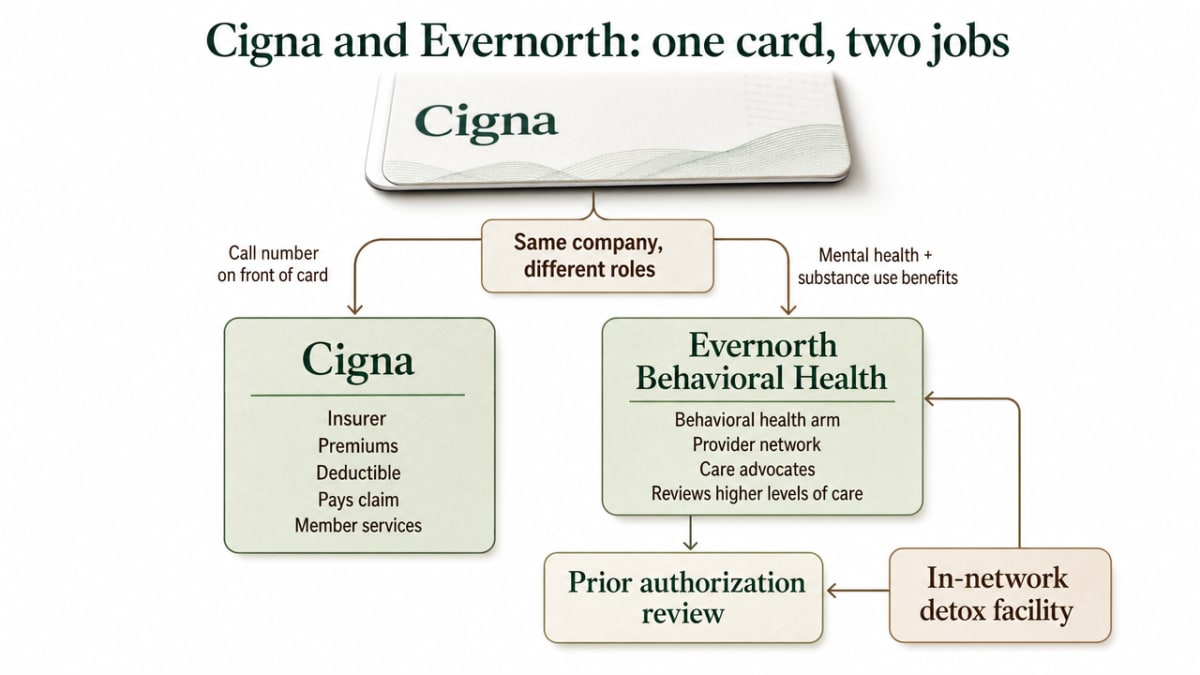
Cigna and Evernorth: one card, two jobs
Here’s the part that trips almost everyone up. Cigna and Evernorth are not two separate insurance companies. They’re the same company doing two different jobs, and once you see how the pieces fit, the phone call in front of you gets a lot less scary.
Think of it like this. Cigna is the insurer. That’s the name on the ID card in your hand, the company that collects the premium, sets the deductible, and pays the claim. When you call the main member services number on the front of the card, you’re reaching Cigna’s general line for questions about coverage, claims, and your medical benefits.
Evernorth Behavioral Health is the arm of Cigna that manages the mental health and substance use side of your plan. Behavioral health has its own provider network, its own care advocates, and its own team that reviews requests for higher levels of care like inpatient detox. That’s why most Cigna cards list a separate behavioral health number, often on the back or under a heading like “mental health” or “substance use.” When you’re asking about detox, that’s usually the line you want.
So the split looks like this: Cigna (the plan on your card) → Evernorth Behavioral Health (the network and authorization team for detox and mental health) → an in-network detox facility → a prior authorization and medical-necessity review that decides how the admission gets covered. Renewal Springs sits in that in-network detox spot for many Cigna commercial plans in Oklahoma City, though your specific plan should always be verified before admission.
If you dial the general Cigna number first, don’t worry — you haven’t wasted the call. The rep can transfer you to Evernorth, or read your behavioral health benefits directly. Making the call is the win. The routing sorts itself out.
Detox is its own level of care, not routine outpatient
Here’s something that will save you an hour of frustration on the phone: when you call about detox, don’t let anyone route you to “outpatient behavioral health benefits.” Medical detox is not a therapy session. It’s not a weekly counseling visit. In the language insurers actually use, it’s a higher level of care — the same category as inpatient psychiatric admission or a hospital stay. That distinction changes almost everything about how the call goes.
Why does this matter for you? Because higher levels of care come with their own set of rules. There’s usually a prior authorization requirement, meaning Evernorth’s clinical team has to review and approve the admission before or right at the time your loved one arrives at the facility. There’s a medical-necessity review, where a licensed clinician on Evernorth’s side looks at withdrawal symptoms, substance history, vital signs, and safety risk to confirm that 24-hour medical supervision is the right setting. And there’s a network question — is the facility contracted with Cigna and Evernorth for this specific level of care, not just for outpatient counseling?
Renewal Springs handles this lane every day. The admissions team knows exactly what Evernorth’s care advocates need to see: current substance use, last use, withdrawal scoring, medical history, any co-occurring conditions. That clinical package is what turns a phone inquiry into an approved admission.
Here’s the encouraging part. Because detox is treated as a medical event, the delays and paperwork that come with routine outpatient prior auth — waiting weeks for a therapist referral, for example — don’t apply the same way. Detox authorizations are often reviewed on an urgent or expedited basis, sometimes within hours, because withdrawal from opioids or alcohol has real medical risk. Peer-reviewed research on substance use treatment access confirms that insurance design and prior authorization can slow entry to care 11, which is exactly why working with a facility that submits the clinical review for you matters so much.
So when you call the number on the Cigna card, or when Renewal Springs calls on your behalf, the ask sounds like this: “I need to verify benefits for a medically supervised inpatient detox admission — a higher level of care under behavioral health.” That single sentence puts you in the right lane and skips a lot of confusion. You’re not asking for therapy. You’re asking for a safe, monitored place to get through withdrawal.
What parity law actually gives you when you call
The 2024 final rules, in plain English
Here’s a piece of law worth knowing before you dial. Federal parity rules got a serious update in 2024, and they matter for exactly the call you’re about to make.
The short version: your Cigna plan can’t make it harder to get approved for medical detox than it would be to get approved for a comparable medical or surgical admission. That’s the heart of the Mental Health Parity and Addiction Equity Act, and the 2024 final rules made the guardrails tighter. Specifically, the rules restrict how insurers can apply what they call nonquantitative treatment limitations — things like prior authorization requirements, medical-necessity criteria, and how a facility gets counted as in-network 5. Translation: the review Evernorth does on your loved one’s detox admission has to be comparable to the review Cigna would do if the same person needed, say, a cardiac admission.
The federal agencies released these rules together in September 2024 3, and the Department of Labor’s own summary confirms the same standard 2. Timing matters here. Most of the new protections apply to group health plans (the kind you get through an employer) for plan years starting on or after January 1, 2025, and individual coverage generally follows on January 1, 2026 1.
That’s a sentence worth saving in your notes app.
Oklahoma’s parity picture and the fully-insured vs. self-funded split
Federal law is the floor. Oklahoma adds its own layer, and there’s one distinction that changes how your specific Cigna plan behaves: is your plan fully insured or self-funded? You probably don’t know off the top of your head, and that’s okay — most people don’t. But it’s worth understanding before the benefits call, because it shapes what protections apply.
The Oklahoma Insurance Department confirms that fully insured plans sold to individuals, small employer groups, and large employer groups have to include mental health and substance use disorder benefits at parity with medical benefits 7. That covers a lot of Cigna commercial plans in Oklahoma City. The same state guidance notes that most health insurance plans have to follow state and federal parity laws, though a few (like Medicare fee-for-service) are exempt 6.
Self-funded plans are different. These are usually offered by larger employers who pay claims out of their own pocket and just hire Cigna to administer the plan. Self-funded plans aren’t required to offer MH/SUD benefits at all — but if they do (and most do), they have to provide them at parity 7. The practical takeaway: two coworkers with the same Cigna ID card design can have slightly different detox coverage depending on how their employer structured the plan.
You can find out which type you have by asking the benefits rep directly: “Is this a fully insured plan or a self-funded plan?” It’s a one-line answer, and it tells you which rulebook governs your loved one’s admission.
The Oklahoma City context around your call
You’re not alone in making this call. That’s not a platitude — it’s a fact of the neighborhood you’re in. Oklahoma County had the 16th highest nonfatal drug overdose hospitalization rate in the state, and while the rate actually decreased 13% from 2017-2019 to 2020-2022 9, the demand for medically supervised detox in and around Oklahoma City remains steady. Progress is real. So is the need.
What that means for your call today: emergency departments, primary care offices, and detox facilities across the metro area are used to fielding exactly the questions you’re about to ask. You are not an unusual case. You’re not bothering anyone. The state health department keeps a public overdose dashboard that tracks these trends county by county 8, and behind those numbers are thousands of families who picked up the phone the same way you’re picking it up now.
Renewal Springs is one of the local options built for this moment — a medically supervised detox facility in Oklahoma City that works inside the Cigna and Evernorth behavioral health lane and verifies benefits before admission. There are other in-network options too, and any of them starts the same way: with a phone call. The 13% dip is a small, hard-won reason to hope. Your call is another one.
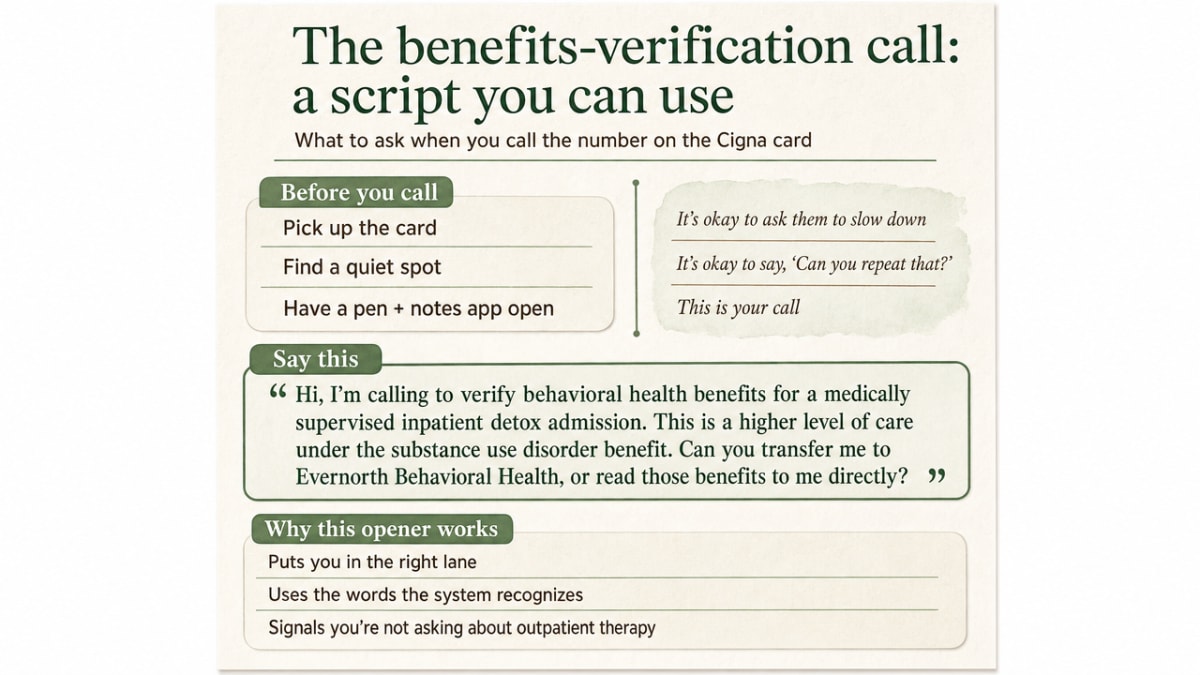
The benefits-verification call: a script you can use
What to ask when you call the number on the Cigna card
Pick up the card. Find a quiet spot if you can. Have a pen and a notes app open, because the rep is going to say things fast and you’ll want to write them down. It’s okay to ask them to slow down. It’s okay to say, “Can you repeat that?” three times in a row. This is your call.
When someone picks up, here’s a script you can lean on word for word:
“Hi, I’m calling to verify behavioral health benefits for a medically supervised inpatient detox admission. This is a higher level of care under the substance use disorder benefit. Can you transfer me to Evernorth Behavioral Health, or read those benefits to me directly?”
That opener does a lot of work. It puts you in the right lane, it uses the words the system recognizes, and it signals you’re not asking about outpatient therapy.
Once you’re connected to the right team, here’s what to ask, one question at a time:
- Is this plan fully insured or self-funded?
- Is inpatient medical detox a covered benefit under this plan?
- Does the admission require prior authorization? If so, who submits it, and how quickly is it reviewed?
- Is Renewal Springs Detox in Oklahoma City in-network for inpatient detox on this specific plan?
- What is the deductible, and how much of it has been met this year?
- What is the coinsurance or per-day cost-share for an inpatient detox stay?
- What is the out-of-pocket maximum, and how much of it has been met?
- Are there any exclusions or step-therapy requirements I should know about — meaning, does my loved one have to try outpatient treatment first?
Write down the rep’s name, the date, the time, and a reference number for the call. If they quote you a benefit, ask them to note the call in the file. This is not paranoid — it’s exactly what you’d do for any hospital admission.
If a question stumps them, that’s a signal to ask for a supervisor or a behavioral health care advocate. You’re not being difficult. You’re being thorough for someone whose safety depends on the details.
Or: let Renewal Springs verify for you
If the thought of that call makes your chest tighten, you have another option. Renewal Springs verifies Cigna and Evernorth benefits for free, and the admissions team handles the same questions you just read — plus a few clinical ones you shouldn’t have to know.
Here’s what that looks like on your side. You share the member ID, date of birth, and a callback number. The team calls Evernorth, walks through the benefits, confirms in-network status for your specific plan, and starts the prior authorization conversation if a bed is needed today. Most verifications take about 15 minutes. You get a callback with plain-language answers: what’s covered, what the day-of-admission cost-share looks like, and what happens next.
This isn’t a shortcut around the work. It’s the same work, done by people who make this call every day and know which Evernorth queue to sit in. If you’d rather hold the phone yourself, the script in the section above is yours. If you’d rather someone hold it with you, that’s a valid choice too. Either path counts as progress.
Prior authorization, medical necessity, and how to push back on a denial
Prior authorization is the piece that scares people most, and it’s the piece Renewal Springs handles for you most often. Here’s what’s actually happening behind the curtain.
When your loved one is being admitted, the facility submits a clinical package to Evernorth’s care advocates: current substance use, last use, withdrawal severity scoring, vitals, medical history, mental health history, and any risk factors that make outpatient withdrawal unsafe. A licensed reviewer on Evernorth’s side compares that package against medical-necessity criteria and issues a decision, often within hours for an urgent detox request. That’s the authorization.
Denials do happen. They’re not the end of the road. If Evernorth pushes back — say, suggesting outpatient withdrawal management instead of inpatient detox — the facility’s clinical team can request a peer-to-peer review, where the admitting physician talks directly with Evernorth’s reviewing clinician. That call resolves a lot of denials on the spot, because the person on your side can speak to symptoms and safety risk in real time.
If the denial holds, you have appeal rights. And this is where the 2024 parity rules give you real leverage. Under the final MHPAEA rule, plans can’t apply prior authorization or medical-necessity standards to SUD care that are more restrictive than what they use for a comparable medical admission 5. Federal regulators reinforced this posture in the 2025 enforcement report, signaling they’re actively watching for uneven treatment 4.
Ask for the denial reason in writing. Ask for the specific medical-necessity criteria used. Request a comparability analysis under MHPAEA. Renewal Springs’ admissions team can walk you through the appeal — you don’t have to draft it alone.
What admission day actually looks like
Admission day usually starts with a phone call and ends with your loved one in a bed, safe, being watched by people who know what withdrawal looks like at 3 a.m. The middle part is where the nerves live, so here’s the shape of it.
You’ll arrive at Renewal Springs with an ID, the Cigna card, and any current medications. Intake paperwork is short and mostly clinical — substance use history, last use, medical conditions, allergies, mental health history. A nurse takes vitals and runs a withdrawal severity assessment. If prior authorization wasn’t fully wrapped up on the verification call, the admissions team is already on the line with Evernorth while your loved one is being assessed. That parallel work is normal and it’s why the wait feels shorter than you’d expect.
Belongings get inventoried. Phones and personal items are handled according to facility policy — ask what the visitation and contact rules look like so you’re not guessing later. The medical team starts a personalized detox plan, which for opioid dependence usually involves medication-assisted treatment to blunt the worst of withdrawal.
Then you say goodbye for now. That part hurts. It’s also the moment the medical piece takes over, which is exactly what you came here for. You did the hard thing. Let the clinical team do theirs.
Costs you will confirm on your benefits call
Nobody can hand you an accurate dollar figure for detox without seeing your specific plan. Anyone who tries is guessing. What you can do — and what the benefits call is for — is confirm the four numbers that decide what admission actually costs you.
- Deductible
- The first is your deductible: what your plan wants you to pay before coverage kicks in, and how much of it has already been met this year. If it’s late in the plan year and most of the deductible is behind you, that’s real money in your pocket.
- Coinsurance
- The second is coinsurance — the percentage share of the inpatient detox stay you’re responsible for after the deductible.
- Out-of-pocket maximum
- The third is your out-of-pocket maximum, the ceiling on what you can be charged in a plan year. Once you hit it, the plan covers the rest.
- In-network vs. out-of-network differential
- The fourth, and the one that swings the total the most, is the in-network vs. out-of-network differential. In-network detox at a facility contracted with Cigna and Evernorth almost always costs less than the same care out-of-network — sometimes dramatically less.
Write those four numbers down during the call. That’s your real cost picture, not a stock estimate from a website.
Talk With a Local Detox Expert Now
Connect instantly for benefit details or to discuss safe Evernorth-covered detox options in Oklahoma City.

Frequently Asked Questions
Is Renewal Springs in-network with Cigna and Evernorth for detox in Oklahoma City?
Renewal Springs works inside the Cigna and Evernorth behavioral health lane for inpatient medical detox and treats many Cigna commercial plans as in-network. Because employer plans differ, in-network status has to be confirmed for your specific plan before admission. The Renewal Springs admissions team can run that check for free in about 15 minutes, or you can call the behavioral health number on the back of your Cigna card yourself.
Do I call Cigna or Evernorth to check my detox benefits?
Either call works, because Evernorth is the behavioral health arm of Cigna. Start with the behavioral health number on the back of the card if there is one — that routes you straight to the team that reviews detox admissions. If you dial the main Cigna line first, the rep can transfer you or read your behavioral health benefits directly. The important thing is making the call. The routing sorts itself out.
Does my Cigna plan require prior authorization before a detox admission?
Almost always, yes. Inpatient medical detox is a higher level of care, and Evernorth’s clinical team reviews the admission against medical-necessity criteria before or at the time your loved one arrives. The good news: these reviews are usually handled on an urgent basis, sometimes within hours, and the facility submits the clinical package for you. You do not have to draft anything or argue the case yourself.
What if my employer plan is self-funded through Cigna?
Self-funded plans are set up by the employer, with Cigna administering claims. They are not required to offer mental health or substance use benefits, but if they do, those benefits have to be provided at parity with medical/surgical care 7. Most self-funded Cigna plans do cover detox. Ask the benefits rep directly: “Is this plan fully insured or self-funded?” That one question tells you which rulebook governs your admission.
What can I do if Evernorth denies my detox authorization?
A denial is not the end of the road. The admitting physician can request a peer-to-peer review, where they talk directly with Evernorth’s reviewing clinician about symptoms and safety risk. If the denial holds, you have written appeal rights. Under the 2024 MHPAEA final rules, prior authorization for detox cannot be more restrictive than for a comparable medical admission 5. Ask for the denial reason and medical-necessity criteria in writing.
How fast can someone get admitted to detox once benefits are verified?
Often the same day, sometimes within a few hours. Benefits verification and prior authorization can happen in parallel while your loved one is being clinically assessed. Bed availability is the other variable — Renewal Springs will tell you honestly whether a spot is open today or whether you’re looking at tomorrow. If withdrawal is severe or dangerous right now, go to the nearest emergency department first. Admission can follow once they’re stable.
References
- New Mental Health and Substance Use Disorder Parity Rules. https://www.dol.gov/agencies/ebsa/laws-and-regulations/laws/mental-health-parity/new-mhpaea-rules-what-they-mean-for-providers
- Departments of Labor, Health and Human Services, and the Treasury Finalize Parity Rules. https://www.dol.gov/newsroom/releases/ebsa/ebsa20240909
- Fact Sheet: Final Rules under the Mental Health Parity and Addiction Equity Act (MHPAEA). https://www.dol.gov/agencies/ebsa/about-ebsa/our-activities/resource-center/fact-sheets/final-rules-under-the-mental-health-parity-and-addiction-equity-act-mhpaea
- US Departments of Labor, Health and Human Services, and the Treasury release 2025 MHPAEA enforcement report. https://www.dol.gov/newsroom/releases/ebsa/ebsa20250117
- 89 FR 77586 – Requirements Related to the Mental Health Parity and Addiction Equity Act. https://www.govinfo.gov/app/details/FR-2024-09-23/2024-20612
- Mental/Behavioral Health and Insurance. https://www.oid.ok.gov/mental-behavioral-health-and-insurance/
- Mental Health Parity and Addiction Equity Act – Oklahoma Insurance Department. https://www.oid.ok.gov/regulated-entities/financial/financial-regulation-forms/mentalhealthparity/
- Drug Overdose Data Dashboard – Oklahoma.gov. https://oklahoma.gov/health/health-education/injury-prevention-service/drug-overdose/data/drug-overdose-data-dashboard.html
- Oklahoma County drug overdose deaths 2018-2022 – page 2. https://digitalprairie.ok.gov/digital/collection/stgovpub/id/681217/
- HHS, DOL, Treasury propose new rule to strengthen parity for mental health and substance use disorder benefits. https://www.hhs.gov/about/news/2024/10/15/hhs-department-labor-treasury-propose-new-rule-strengthen-parity-mental-health-substance-use-disorder-benefits.html
- Barriers to treatment access for substance use disorders: a scoping review. https://www.ncbi.nlm.nih.gov/pmc/articles/PMC10247714/
- HB 2049 (Enrolled) – Oklahoma Legislature. https://www.oklegislature.gov/cf_pdf/2025-26%20ENR/hB/HB2049%20ENR.PDF