
Key Takeaways
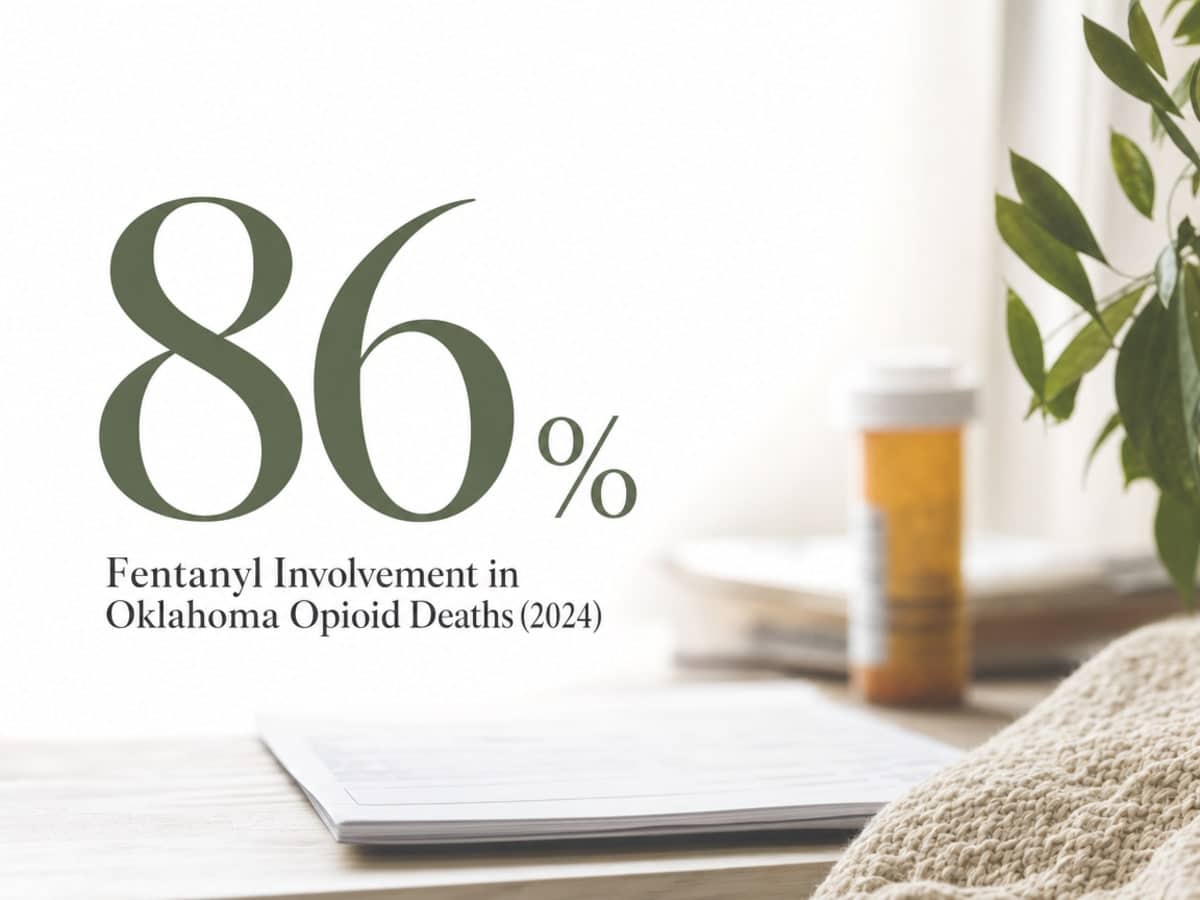
- Oklahoma fentanyl overdose deaths dropped about one-third from 2023 to 2024, yet fentanyl still drove 86% of the state’s opioid overdose deaths 1.
- Fentanyl hides in fatty tissue and keeps releasing for days, which is why home detox and mistimed buprenorphine often trigger precipitated withdrawal and push people back to using 15.
- Calling a licensed Oklahoma City medical detox like Renewal Springs starts with a short phone conversation and free insurance verification, and a family member can make that first call.
If You’re Reading This at 2 A.M.
You’re awake because something has to change. Maybe you’re the one who can’t stop using. Maybe you’re the parent, the wife, the brother scrolling on the couch while someone you love sleeps in the next room, and you don’t know if they’ll still be breathing at 6 a.m.
Both of those places are real. Both of them are exhausting. Neither one makes you a bad person.
Here’s what you need to hear first: fentanyl dependence is a medical condition, not a character flaw. Your body has adapted to a substance that is genuinely harder to come off of than the opioids of ten years ago. That’s not you being weak. That’s pharmacology.
This guide is written for Oklahoma. It covers what fentanyl withdrawal actually looks like, why medical supervision matters, what the first week feels like, and what comes after. No fear tactics. No pretending it’s easy. Just what’s true, and what your next step can look like tonight if you want it to.
Where Oklahoma Stands Right Now
You’ve probably heard that fentanyl is bad in Oklahoma. What you might not have heard is that the picture, for the first time in years, is starting to shift.
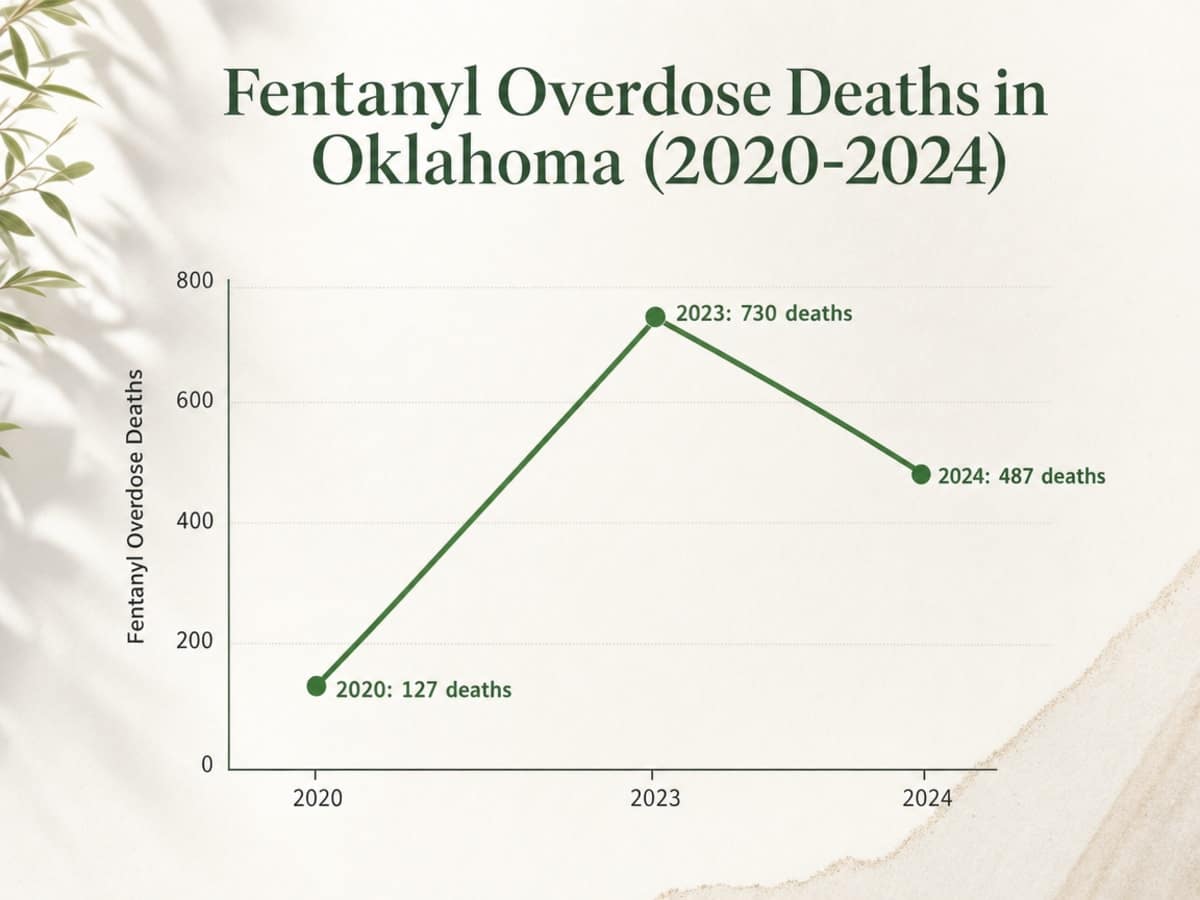
Here’s the honest curve. Oklahoma recorded 127 fentanyl-related overdose deaths in 2020. By 2023, that number had climbed to 730 — nearly six times higher in three years. Then in 2024, the count dropped to 487, roughly a one-third decrease from the year before 1. That drop is real. It’s also not a finish line. Fentanyl was still involved in 86% of Oklahoma’s opioid overdose deaths in 2024 1. In other words, the number of deaths went down, but fentanyl’s grip on the illicit drug supply did not loosen.
To understand how fast this happened, it helps to look further back. Oklahoma saw a 12-fold jump in fentanyl deaths between 2019 and 2022, from 50 to 606 3. That’s the kind of curve public-health people usually reserve for talking about outbreaks. It hit Oklahoma the way a wildfire hits dry grass — quickly, and in places that weren’t ready for it.
Zoom out to the whole overdose picture and the numbers get heavier. In 2024, Oklahoma recorded 1,137 overdose deaths, 4,228 inpatient hospitalizations, and 6,804 emergency department visits tied to overdose 4. Behind each of those numbers is somebody’s kid, somebody’s coworker, somebody who called someone at 2 a.m. and got voicemail.
The national context matters too. Between 2023 and 2024, the U.S. death rate from synthetic opioids other than methadone dropped by 35.6% 12. That’s the biggest single-year decline the country has seen since fentanyl arrived. So if you’re feeling like it’s too late, or like nothing works — the data quietly disagrees. More people are surviving this year than last. More people are getting into treatment. If you’re reading this and considering that step, you’re not late. You’re part of the reason the curve is finally bending.
Why Fentanyl Withdrawal Is Different From Other Opioid Withdrawal
If you’ve been through withdrawal before — from pills, from heroin, from methadone — you already know it’s bad. But if the drug you’re coming off of is fentanyl, or something sold to you as something else that turned out to be fentanyl, what you’re facing is not the same thing your cousin went through in 2015. The drug changed. The withdrawal changed with it.
Look at Oklahoma’s own numbers and it’s clear how fast that shift happened. In 2021, fentanyl was involved in roughly one in five opioid overdose deaths in the state. By 2024, it was involved in 86% of them 1. That is not the same drug supply. That is not the same withdrawal. And it’s why the playbook your family remembers from a decade ago — sweat it out on the couch, drink Gatorade, ride the flu for a week — is not the playbook that works now.
Two things make fentanyl withdrawal harder than what most people picture when they hear the word “detox.” The first is how fentanyl sits in your body. The second is what happens when the medications designed to help you stop are introduced too early or in the wrong way. Both are physical. Neither is about how badly you want to quit.
The scary part is that these two features — the way fentanyl lingers in your tissue, and the way standard treatment medications can backfire if the timing is off — are exactly what push people out of treatment before they get stabilized. Someone tries to detox at home, feels worse than they expected on day two, uses again just to stop feeling like they’re dying, and walks away convinced they failed. They didn’t. The setup did.
This is the piece your loved one probably doesn’t know, and the piece that most rehab websites gloss right past. So the next two subsections are the technical explanation, translated into normal English. Not to scare you. To arm you with what fentanyl is actually doing so that when you or your person walks into a medical detox, you already understand why 24/7 supervision, careful medication timing, and validated symptom tracking are not overkill — they’re the minimum.
The Pharmacology in Plain Language
Older opioids like heroin or oxycodone are water-friendly. They move into your bloodstream, do their work at the opioid receptors, and clear out relatively fast. Fentanyl doesn’t behave that way. It’s fat-loving, which means it slips out of your blood and into fatty tissue — muscle, brain, organs — and hides there. When you stop using, your blood level drops quickly and withdrawal kicks in hard, but the fentanyl stored in your tissue keeps leaking back out for days.
That’s why people describe fentanyl withdrawal as feeling like two waves crashing at once: the acute crash from the drop, and a long tail that won’t quit. It’s also why timelines you might have read for heroin withdrawal don’t apply cleanly here. Your body is essentially detoxing from a moving target.
None of this is speculation. A 2024 review in JAMA Internal Medicine put it plainly: fentanyl’s pharmacology has made older withdrawal-initiation techniques inadequate for a lot of people 15. Translation — the way this drug lives in your body is exactly why doing it alone rarely works.
Precipitated Withdrawal and Why It Scares People Off Treatment
Here’s the part almost nobody explains before it happens. Buprenorphine — one of the main medications used to help you stop — can knock fentanyl off your opioid receptors so fast that it triggers withdrawal instead of relieving it. That’s called precipitated withdrawal. If it hits you, you go from bad to unbearable in about 20 minutes.
People who go through that once often refuse to try again. They tell friends the medication “made it worse.” It didn’t, exactly. The timing did. Because fentanyl keeps leaking out of your tissue, the standard rule of thumb — wait until you feel sick enough, then take the first dose — doesn’t always work the way it did with heroin.
This is why validated withdrawal scoring and careful timing matter. Eleven major clinical guidelines recommend tools like the Clinical Opiate Withdrawal Scale before starting buprenorphine 17. In a supervised setting, someone is watching, adjusting, and catching this before it spirals. At home, you’re on your own.
What ‘Medical Detox’ Actually Means
“Medical detox” gets thrown around like everyone knows what it means. Most people don’t. And when you’re scared, vague language makes everything scarier. So here’s the plain version.
The federal definition, from SAMHSA’s TIP 63, is that medically supervised withdrawal is the process of tapering opioids or related medications to help someone stop using — under the eye of licensed medical staff, in a setting equipped to manage what your body throws at you 14. It is not a rehab. It is not a therapy program. It’s the short, medical piece at the front — the part that gets you through the physical crisis so your brain has a chance to catch up.
In practice, good medical detox for fentanyl looks like five things happening in order.
- 1. Intake and assessment. When you walk in, someone sits down with you and takes a full picture: what you’ve been using, how much, how long, your medical history, mental health history, any other substances involved. Trained staff also use a validated withdrawal scale — most commonly the Clinical Opiate Withdrawal Scale, or COWS — to score how far into withdrawal you already are. Eleven major clinical guidelines recommend tools like COWS before starting buprenorphine 17. That’s not paperwork for its own sake. It’s how the team decides what happens next without guessing.
- 2. Round-the-clock monitoring. Fentanyl withdrawal doesn’t respect business hours. Vital signs, symptoms, hydration, sleep, mood — all of it can shift fast, especially in the first 72 hours. Good detox facilities have nurses and medical staff on-site 24/7, not on-call from home. At Renewal Springs in Oklahoma City, that continuous monitoring is supported by wearable biometric technology from Huml Health that tracks heart rate, sleep, and stress patterns in real time, so the medical team catches changes early instead of at the next check-in.
- 3. Medication-assisted symptom management. This is the part that makes the difference between suffering and being taken care of. Medications can ease nausea, muscle pain, anxiety, insomnia, and the deeper withdrawal symptoms that make people quit quitting. Because of the precipitated-withdrawal risk we covered earlier, the timing of any opioid-agonist medication has to be handled carefully by clinicians who understand fentanyl specifically — not the drug supply of a decade ago.
- 4. Stabilization. Somewhere in the middle of the stay, your body starts to settle. You sleep a little. You keep food down. Your COWS score drops. This is when honest conversations about what comes next start happening — because the physical piece is only one leg of the stool.
- 5. A warm handoff to ongoing care. This is the part cheap detox programs skip, and it’s the part that matters most. The 2024 national guideline update is direct: patients with opioid use disorder should not be offered withdrawal management alone, because doing detox in isolation increases relapse, illness, and death 16. A responsible detox doesn’t discharge you to a parking lot. It hands you off — to residential treatment, outpatient care, medication-assisted maintenance, whatever fits your life — with the appointment already scheduled.
That’s it. Five stages. No mystery. If a program can’t explain those five pieces to your family in a phone call, that’s information too.
The First 5 to 10 Days: What Your Body Is Doing
Here is what nobody tells you honestly: the first 72 hours are the hardest part of your life, and then it gets better. Not easy. Better.
- In the first 24 to 36 hours, your body registers that the fentanyl it had adapted to is gone. Anxiety climbs. You yawn constantly. Your nose runs. Muscles start aching in a deep, restless way that no position fixes. In a medical setting, staff are already scoring you on the Clinical Opiate Withdrawal Scale 17and giving medications to blunt the worst of it before it peaks — instead of watching you white-knuckle it on a bathroom floor.
- Days 2 through 4 are usually the hardest. Sweating and chills alternate. Stomach cramping, vomiting, and diarrhea can leave you dangerously dehydrated — which is one of the actual medical reasons people don’t survive home detox. Sleep disappears. Your legs won’t stop moving. Because fentanyl keeps releasing from fatty tissue 15, this stretch can hit harder and last longer than what your family remembers from older opioids. That is not you being dramatic. It is the drug.
- By days 5 to 7, the acute physical storm starts easing. You might eat a real meal. You might sleep four hours in a row and cry about how good that feels. The COWS score drops. Vital signs settle. You start remembering you have a personality.
- Days 8 to 10 are quieter, but not empty. Cravings sharpen as the fog lifts. Mood swings are normal. This is the window where the plan for what comes next gets built — because leaving here without one is what the guidelines warn against directly 16. Your body did the hard part. Now your life gets to catch up.
Detox Alone Is a Beginning, Not a Cure
Here is the sentence most detox websites will not put in writing: getting through withdrawal does not, by itself, treat opioid use disorder. It gets the drug out of your system. That’s it. Your brain chemistry, your triggers, your habits, the reasons you started using in the first place — none of that is fixed by ten days of medical care.
So what does work? Detox connected to something. Medication-assisted treatment. Residential care. Intensive outpatient. Counseling. A recovery community. Some combination, chosen with you, that fits your job, your family, your insurance, your life. The federal guidance from SAMHSA has been clear for years that medically supervised withdrawal is the front door, not the whole house 14.
This is why the question to ask any Oklahoma detox program is not just “can you get me through the week.” It’s “what happens on day 11?” If they don’t have an answer, keep looking. If they do, that’s the program worth calling.
Oklahoma’s Harm-Reduction Safety Net
While you’re deciding what to do next, it helps to know what’s already around you. Oklahoma has quietly built out a harm-reduction layer that didn’t exist five years ago, and it exists for one reason: to keep you or the person you love alive long enough to get to real help.
Since 2021, the state has distributed 213,528 fentanyl test kits and 427,056 doses of naloxone 8. Naloxone is the medication that reverses an opioid overdose. It’s the reason a lot of people are still here to read articles like this one. Fentanyl test strips let someone check pills or powder for fentanyl before using — imperfectly, because no test is 100% accurate 7, but well enough to change a decision on a hard night.
In 2024, Oklahoma shifted its distribution model away from vending machines toward posters with QR codes that let people order supplies discreetly 6. If you’re not ready to walk into a detox yet, that access still matters. Naloxone in a nightstand drawer buys time. Time is what gets people to the phone call they eventually make.
What Local Care Looks Like in Oklahoma City
You don’t have to leave the state to find real medical detox. Renewal Springs Detox operates out of Oklahoma City as a licensed medical detoxification facility with 24/7 medical supervision — not a call-center dispatching you to somewhere in Arizona, and not a residential rehab pretending it can also handle acute fentanyl withdrawal. The distinction matters, because fentanyl withdrawal needs actual clinicians on-site, not a house manager with a first-aid kit.
What that looks like day to day: licensed medical staff overseeing personalized detox plans with medication-assisted treatment protocols, and wearable biometric monitoring from Huml Health tracking heart rate, sleep, and stress patterns between formal check-ins. That continuous data matters most in the first 72 hours, when fentanyl’s release from tissue 15makes symptoms unpredictable.
There are also tracks that recognize not everyone walks in the same door with the same story. Veterans have a program built around military experience. Men and women can be placed in gender-specific detox settings when that feels safer or more focused. Private rooms are available for people who need quiet to get through this.
Most major insurance plans are accepted, and benefits verification is free — so you can find out what’s covered before you commit to anything.
How to Take the Next Step Today
You don’t have to wait until Monday. You don’t have to wait until your insurance card comes in the mail. You don’t have to have the perfect words ready.
Renewal Springs Detox answers the phone in Oklahoma City around the clock. When you call, someone real picks up, asks a few questions, and runs your insurance benefits for free before you commit to anything. If you’re the family member making the call, you can make it. Your person does not have to be the one holding the phone the first time.
Here is what happens if you decide today is the day. A brief phone conversation. Benefits check. A plan for how to get through the door safely. Then a licensed medical team on-site, 24/7, walking with you through the first hard days 14— and a real handoff to what comes next, because detox alone is not the treatment 16.
The last three years in Oklahoma have been the worst on record for fentanyl. They have also, quietly, started to bend the other way. Pick up the phone. That’s the step.
Talk to Someone About Safe Fentanyl Detox Now
Connect with a caring medical professional right away for urgent, judgment-free guidance on fentanyl withdrawal.

Frequently Asked Questions
Is it safe to detox from fentanyl at home?
Honestly? For most people using fentanyl, no. The dehydration from vomiting and diarrhea alone can be dangerous, and the psychological pressure to use again just to stop feeling like you’re dying is enormous. The 2024 national clinical guideline states directly that withdrawal management alone increases the risk of relapse, illness, and death 16. You deserve medical support. Not because you’re weak. Because this drug is that hard.
How long does fentanyl withdrawal last?
The acute physical piece usually runs 5 to 10 days, with the worst stretch typically falling between days 2 and 4. Fentanyl lingers in fatty tissue and leaks back into your bloodstream for days, which is why it can feel longer and heavier than withdrawal from older opioids 15. Cravings and mood swings can continue for weeks after the physical symptoms fade. That’s normal, and it’s why what comes after detox matters.
Why is fentanyl withdrawal harder than withdrawal from heroin or prescription pills?
Two reasons. First, fentanyl is fat-loving, so it hides in tissue and keeps releasing for days after your last use, stretching out the misery. Second, the medications used to help you stop — especially buprenorphine — can trigger precipitated withdrawal if timed wrong, which is more common with fentanyl than with older opioids. A 2024 JAMA Internal Medicine review confirms traditional withdrawal-initiation approaches are inadequate for many fentanyl users 15.
Does insurance cover fentanyl detox in Oklahoma?
Most major insurance plans cover medically supervised detox, but coverage details vary by plan, deductible, and level of care. Renewal Springs Detox in Oklahoma City accepts most major insurance providers and offers free benefits verification over the phone before you commit to anything. That means you can find out exactly what’s covered — inpatient days, medications, room type — without paperwork or pressure. One phone call. No obligation.
What happens after the 5 to 10 days of medical detox?
Detox is the front door, not the whole house. After stabilization, most people transition to residential treatment, intensive outpatient care, medication-assisted maintenance, counseling, or some combination — chosen with you based on your life and coverage. SAMHSA’s core guidance treats medically supervised withdrawal as a bridge to ongoing care 14. A responsible detox program schedules that next step before you leave, not as a suggestion on your way out.
Can I bring my loved one in, or do they have to call themselves?
You can absolutely make the call. Family members reach out first all the time — spouses, parents, adult children, siblings. Someone at Renewal Springs will answer questions, run insurance benefits, and walk you through what admission looks like. The person struggling doesn’t have to be the one holding the phone the first time. Sometimes just knowing the door is open, and someone else did the hard part of finding it, is what gets them through it.
References
- Data – Oklahoma.gov. https://oklahoma.gov/health/health-education/injury-prevention-service/drug-overdose/data.html
- Drug Overdose Data Dashboard – Oklahoma.gov. https://oklahoma.gov/health/health-education/injury-prevention-service/drug-overdose/data/drug-overdose-data-dashboard.html
- OKLAHOMA, 2018-2022. https://oklahoma.gov/content/dam/ok/en/health/health2/aem-documents/prevention-and-preparedness/injury-prevention/drug-overdose/2024_State_DO_Sheet.pdf
- PowerPoint Presentation. https://oklahoma.gov/content/dam/ok/en/health/health2/aem-documents/prevention-and-preparedness/injury-prevention/drug-overdose/Drug%20Overdose%20Data%20Graphs%20and%20Maps.pdf
- Drug Overdose Deaths, 2019-2023 – Oklahoma. https://oklahoma.gov/content/dam/ok/en/health/health2/aem-documents/prevention-and-preparedness/injury-prevention/drug-overdose/2025%20State%20Drug%20OD%20-%20IPS%20-%20Fact%20Sheet.pdf
- Revamped Overdose Prevention Strategy Enhances Harm Reduction Efforts Across Oklahoma. https://oklahoma.gov/odmhsas/about/public-information/press-releases-and-other-news/2024/revamped-overdose-prevention-strategy-enhances-harm-reduction-ef.html
- Fentanyl – Oklahoma.gov. https://oklahoma.gov/health/health-education/injury-prevention-service/drug-overdose/opioid-overdose/fentanyl.html
- ODMHSAS’ Opioid Response Continues Saving Lives Across the State. https://oklahoma.gov/odmhsas/about/public-information/press-releases-and-other-news/2023/odmhsas–opioid-response-continues-saving-lives-across-the-state.html
- OJA and ODMHSAS Collaborate to Prevent Deaths from Fentanyl. https://oklahoma.gov/oja/press-releases/oja-and-odmhsas-collaborate-to-prevent-deaths-from-fentanyl.html
- Data Resources | Overdose Prevention. https://www.cdc.gov/overdose-prevention/data-research/facts-stats/index.html
- U.S. Overdose Deaths Decrease for Third Consecutive Year in 2025. https://www.cdc.gov/nchs/pressroom/releases/20260513.html
- Drug Overdose Deaths in the United States, 2023–2024 – CDC. https://www.cdc.gov/nchs/products/databriefs/db549.htm
- ASAM National Practice Guideline for the Treatment of Opioid Use Disorder. https://www.samhsa.gov/resource/ebp/asam-national-practice-guideline-treatment-opioid-use-disorder
- TIP 63: Medications for Opioid Use Disorder. https://library.samhsa.gov/sites/default/files/pep21-02-01-002.pdf
- Caring for Hospitalized Adults With Opioid Use Disorder in the Era of Fentanyl: A Review. https://pubmed.ncbi.nlm.nih.gov/38683591/
- Management of opioid use disorder: 2024 update to the national clinical practice guideline. https://www.ncbi.nlm.nih.gov/pmc/articles/PMC11573384/
- Management of Opioid Use Disorder, Opioid Withdrawal, and Opioid Overdose Prevention In Hospitalized Adults: A Systematic Review of Existing Guidelines. https://www.ncbi.nlm.nih.gov/pmc/articles/PMC9474657/
- SUDORS Dashboard: Fatal Drug Overdose Data. https://www.cdc.gov/overdose-prevention/data-research/facts-stats/sudors-dashboard-fatal-overdose-data.html